Tag: Equity-Centered Practice

What it looks like to run a business through an equity-centered lens, prioritizing marginalized voices and anti-oppressive practices at every level.

  • Your Business Is Not Stuck – Your Systems Are, with LaToya “Patrice” Seawood of Level Up Management

    Your Business Is Not Stuck – Your Systems Are, with LaToya “Patrice” Seawood of Level Up Management

    LaToya “Patrice” Seawood, founder and principal consultant of Level Up Management, MBA professor, and Mighty Impacts instructor, joins Kim Allchurch Flick to discuss the theme “your business is not stuck; your systems are.” 

    Seawood shares how she started Level Up during COVID after leaving her job to care for her children and evolved it into a social-enterprise-minded consultancy focused on turning vision into clarity, structure, action, and impact, with emphasis on operations, workforce development, and customer experience. 

    She describes common challenges for entrepreneurs and nonprofits – lack of administrative knowledge, undervaluing operations until breakdowns occur, and the emotional side of change and trust – especially during growth. 

    She highlights tailored leadership development for marginalized communities, building workforce pipelines, aligning operations with purpose and values, and helping founders let go so the owner is not the system.

    Listen Now

    Time Stamps

    00:00 Welcome and Guest Intro

    01:20 Origin Story and Mission

    04:21 Community Needs and Systems

    07:22 Challenges and Trust Building

    09:48 Founder Passion and Burnout

    12:55 Client Wins and Optimism

    14:30 Connect and Systems Speak

    16:15 Serving Marginalized Communities

    19:07 Future Vision and Work Culture

    22:22 Values Driven Operations

    25:18 Growth Exposes Weak Systems

    26:43 Founder as the System

    30:25 Dinner Guests and Closing

    Kim Allchurch Flick: Hello everyone. Welcome to the Mighty Measure Podcast. Today I am very excited to be with LaToya “Patrice” Seawood. LaToya is the founder and principal consultant of Level Up Management, where she helps business owners turn vision into clarity, structure, and sustainable action with a background in human resources, operations, organizational strategy, and workforce development.

    She specializes in helping leaders build the systems and infrastructure their businesses need to grow. Well, LaToya is also an MBA business professor, speaker, and facilitator, who brings a practical people-centered approach to organizational challenges through Level Up management. Her work is grounded in a simple purpose, build people, strengthen businesses.

    Empower communities. Today we’re going to be discussing your business is not stuck. Your systems are, what a great topic. 

    LaToya “Patrice” Seawood: Wonderful. Yeah. Thank you so much, Kim. 

    Kim Allchurch Flick: Yeah, it’s so nice to have you here. And also I will add that you are also one of the instructors in the Mighty Impacts continuum that my company hosts as an educational cohort and asynchronous platform for learning about these types of issues.

    So thank you. Thank you so much. What has been your journey to this point and the inspirations that have brought you to now? 

    LaToya “Patrice” Seawood: Local UP started during COVID, as with so many other companies, I’m sure. COVID was the time, we are all able to benefit in a way from the lack of noise. And I actually had to.

    Leave my job in order to care for our young children at home. And I decided to initially build this framework so that actually my husband and I could eventually use it together later. As the world started coming back together and waking up, I knew that I wanted our business to actually help fund nonprofits.

    I had started opening up a nonprofit. And really did not want to only depend on grants, but really saw a great opportunity to where business can really help funnel and support and grow and help keep nonprofits sustainable. So that led me to actually learn more about this concept of what a social enterprise is and how business can be a tool for both economic and community impact.

    Along the way, I met some great people, some wonderful mentors and coaches who really opened up my horizon, my i, my ideas, my brain. To really gain more clarity for what I actually wanted to build and what I really wanted to serve the community with. So the business continued to evolve as I paid attention to where people consistently needed help, and also to what brings me joy.

    So today a lot of my work centers around operations and I like to use the word functionality but particularly with workforce development and customer experience. I guess I would say that at the heart of it, we help people take vision that matters to them, and we move it towards clarity structure.

    Action, but ultimately impact, which is, I really think how you and I connect so much is this idea of impact and how do we make that impact? How do we communicate it? How is it known? And that progression is just directly aligned with the Level up signature framework. 

    Kim Allchurch Flick: And Yes. I remember when we met as well, you were a guest speaker at the Benefit Corporations for Good, happy hour a couple years ago in Portland.

    Yes. And the presentation you gave was so open, warm. And informational that I was really taken with that and introduced myself afterward. And yes, thank you. I’m the rest. Glad is glad you did the, a journey. Indeed. I can’t believe it’s been that long, Kim. I was counting and it’s like, could it really be two years?

    But it, I think it’s been pretty close to it, so thank you. What are you seeing in the community you serve and how do you serve and what are you seeing that people are bringing to the table? 

    LaToya “Patrice” Seawood: Being involved in the community as back in Portland as much as I am, and still now also adding to it the community here in the Raleigh Durham area.

    I see so many good people with really good ideas. It’s really. Inspiring and heartwarming to see it all. They have dreams for businesses, for nonprofits, for ministries, and community programs. What I’ve noticed and seen is that a lot of times though those dreams struggle not because the people aren’t working hard or because they don’t have enough passion, but because they don’t have the administrative knowledge or the systems or the operational structure that can truly make them sustainable.

    And so you hear all these stories about businesses closing, or nonprofits closing, or even scandals that are happening. It all goes back to the structure and the operations of the organization. And that’s where I like to come alongside people sometimes, we don’t need more ideas, we just need clarity around what isn’t working around.

    The structure for what they’re trying to accomplish and the practical support that’s needed to move it forward. On the workforce development side, I also see people who want to work and they wanna work, they wanna contribute, but for whatever reason, they haven’t had the opportunity to develop the skills or even the confidence or the professional exposure that’s needed.

    And that’s partly why I developed my Thrive in Program and why workforce development continues to be such an important part of Level Up. I want to build stronger workforce pipelines, not just help people get a job. And these stronger pipelines, support those same businesses, nonprofits, ministries, and community programs that I mentioned earlier.

    So essentially level Up is the bridge that brings those two together and helps functionality take place at work, and skill people in the community to work at those places. And that essentially should bring economic wellness to the community. 

    Kim Allchurch Flick: Oh, and that’s, I think, is so important because it sounds like what you’re doing is taking some groups that may not know each other.

    But are missing the same elements or maybe not being strong. The same elements that structures they need, and in a way bring it together. 

    To make an entire community stronger. 

    LaToya “Patrice” Seawood: Yes. That’s the goal. That’s the vision. 

    Kim Allchurch Flick: Wow. What are some of the obstacles and challenges? 

    LaToya “Patrice” Seawood: The most.

    Immediate obstacle is my own season of life. A challenge for me personally is simply the fact that, I’m a mom first. I have three children, ages eight to 15, and so I’ve had to build this business. But in respect to that priority. So when time I look at growth opportunities, I, it has to be sustainable given my current limits of life.

    And so it’s not for me, it’s not growth at any cost. It’s all extremely measured. So that’s my number one challenge, I would say, and just in understanding and respecting and loving the season I’m in while I, my children are at home. The other challenge I see when I am speaking with people, bus business owners in the community.

    Is the fact that we know oftentimes people don’t recognize the value of operations and investing in operations until something isn’t working. It’s much easier to invest in what’s visible than it is to invest in the systems underneath it. And so helping to educate and just bringing awareness to that has been a challenge.

    I’d also say that this work that I do requires a great deal of trust. When I’m working with leaders and founders and entrepreneurs, this is their baby, right? This is their passion. And in order to bring someone alongside that and look into and potentially make some changes, it requires a lot of trust and, that just takes time to build. And it’s understandable why it would take time to build and you can’t rush that relationship. And so I have found that my pipeline, if you will it’s, it lasts. It’s a longer pipeline. And learning just to be patient with that has been, part of the challenge.

    I would say that I’ve learned that sustainable change isn’t just operational, it’s emotional too. And that’s a part of what that trust people are attached to what they’ve built. So part of my job is helping them navigate change, not simply just handing them a solution.

    Kim Allchurch Flick: I love how you said it’s also emotional ’cause people are throwing their hearts into this. 

    LaToya “Patrice” Seawood: Absolutely. 

    Kim Allchurch Flick: And what are some of the challenges and obstacles for them? 

    LaToya “Patrice” Seawood: What I have learned is. They often are very much caught and engrossed in their passion, right? Whether it’s a somebody who loves to bake and now owns a bakery, or somebody who loves to coach and now owns a coaching business.

    The, the service is the passion. The operational administrative structure that supports that passion often isn’t the strength of the individual and. Passion only goes so far and is only so sustainable if you don’t eventually have the right structure to support it. And so that’s the main challenge I see that they’re dealing with this understanding when is the right time to invest in that structure and to have that internal reflection and knowledge that.

    Passion isn’t gonna take them all the way, 

    Kim Allchurch Flick: It’s so true. And it made me think of a, an example of a, a friend of mine who was ill and yoga helped save her, helped her heal through a 

    A chronic illness to the point where she created a yoga business that she then grew to hate. Yeah.

    And partly it was because. Because it started to feel like a ball and chain. And as you were talking about that, that’s exactly what I thought of is sometimes without that knowledge to keep something upright, to know when to hire, help, to know when to delegate it, it can become the thing you don’t want to do anymore.

    The thing that drags, drags people down. 

    LaToya “Patrice” Seawood: And when that person decides to leave. Their business lead the passion because of that burnout. That is something I feel deeply and that also I go back to COVID, but that’s so many businesses closed and.

    I don’t I don’t know. I, all I can say is I felt that that, it broke my heart to hear that continually, these businesses didn’t make it, these businesses didn’t make it. And knowing how hard those people worked to get to where they were, to not be able to be sustainable through that type of crisis, it just, it was.

    It’s kind of a motivation for me. I want my clients to be strong and sustainable so that they can ride through the market up and down. Now, obviously that was more than just a market down, but just in general to create resilient businesses, that is something I care deeply about. 

    Kim Allchurch Flick: And that helps an entire community and it helps people be happy.

    Exactly. Yeah. Do you have any examples and what makes you optimistic about what you do in your work and what you see out there? 

    LaToya “Patrice” Seawood: Yes. When I first read this question, the first thing I thought of were my clients. I get to work with really good people who generally want to do good things and not just want to do good things.

    They are willing to put the effort in to make it happen, to take the risk, to make it happen, to just move forward with action. I’ve been able to help support management development. For people who are once outh, who are once unhoused I’ve been able to work on systems designed to support economic mobility for people experiencing generational poverty.

    Another client helping build an organization that will that helps to support like the whole human, so that people leaders can grow, perform, and build sys and build sustainable businesses and their careers. And then there’s the individual coaching ones. When I’m working with people one-on-one.

    Sometimes impact isn’t this huge organization transformation. Sometimes it’s just getting to watch somebody have their aha moment, as I gain clarity and confidence and then they’re, being able to take that next step. So all of that keeps reminding me that this work is important and continually makes me just so thankful that I get to do that.

    Kim Allchurch Flick: I love that. What are some of the best ways people can reach you and how can we help you? 

    LaToya “Patrice” Seawood: In terms of helping, I think it’s just, keeping eyes and ears open. One area I’m talking about more is called when systems speak. Systems are always communicating something and you learn a lot about an organization by looking at its operations and particularly the experience those operations create for employees and customers.

    So paying attention to that and keep me in mind if leaders wanna talk more. I’m also continuing to expand our workforce development work, and that includes workforce pipeline development, professional training, leadership development, and helping organizations think beyond filling positions to actually developing people.

    And definitely if there’s organizations within the network that are interested in that, I’d love to have a talk with them. But ultimately Level Up is about building people, strengthening businesses, and empowering communities. And so since those three things are connected, any, anything in those areas are really interesting to me.

    In terms of reaching out to me, I am on LinkedIn and that’s probably the best way to connect with me. It’s where I share a lot. About what I’m seeing and learning through the work, especially around leadership operations, workforce development, and how systems affect people. And then I’ll also give you a link that you can use, that people can use to connect with me and just talk through what you’re dealing with and see if there’s, a way I can help.

    Kim Allchurch Flick: Thank you. And you mentioned something that popped into my brain, and if it’s okay, I’d love to ask you a little bit more about how you’ve served unhoused people and others in perhaps those marginalized areas that haven’t been their fault. Because we’ve seen mass layoffs, we’ve seen a lot of situations that have been out of some people’s control.

    LaToya “Patrice” Seawood: Absolutely. 

    Kim Allchurch Flick: What are you seeing there and how does Level Up. Respond and the other things that you’re doing. 

    LaToya “Patrice” Seawood: So I have been able to partner with community serving organizations who have been entrenched in the work for years, and because of that, they have a large amount of credibility in the community and they have graciously brought me in to partner with them as they do their work.

    And so for the clients that work with those who are unhoused, they’re already doing workforce development through internship programs and through training and now looking at that next step for their participants and for their staff, and, one of the challenges in that particular project is a lot of leadership development or manager development programs.

    They’re template. And our partnership really has worked out so well because I customize the program to meet the participants where they are. And with that one in particular, there was a recent example where we were doing a debrief on where we are so far in the program and realized that it wasn’t working for all of the people and needed to make some adjustments again to meet them where they are and.

    Equip and provide the support and the pathway needed to get them to where they want to be. And so that is one of the things I’m learning a lot through my clients who are these community serving organizations, is the ability to meet somebody where they are is how you have the great impact, coming to people who have been marginalized, who have had any type of barriers you wanna mention with a template program, it doesn’t work. And so while I know that other business models do that and they do it well, and that’s great, I just want it to be different. And so I work with leadership very closely to design a program that will work for their participants.

    Kim Allchurch Flick: That tailored approach must be so important. 

    LaToya “Patrice” Seawood: It is. It is. And there’s a need for it. Definitely. 

    Kim Allchurch Flick: Yeah. Absolutely. Where do you see the future of leveled up and thrive? 

    LaToya “Patrice” Seawood: Just for it to continue to grow as I have, as I continue to work with different organizations and touch more lives with workforce development.

    I mentioned earlier about being the bridge between the two. I really want to continue to build this pi to build the pipeline. So on one side where. Equipping people and helping people get back to work in a lot of situations. And then I’m working with businesses to be great places to work, and so the more that we can do that, the greater economic wellness we can bring to the community.

    And I see that, that isn’t limited to the Portland area or the Raleigh Durham area. Any organization. That wants to have that kind of impact in their community is a great fit for us. And just looking to be able to sit, to do more good work and to continue to meet more good people.

    Kim Allchurch Flick: And as a former employee along the way in my career, it really makes a difference. I’ve been with companies that did not treat us well. Did. Did not recognize potential that were very rote and had cultures that were focused on money more than people. And then I’ve been in the opposite, and the, the feeling is completely different, even though the work might be the same and the productivity needed is as much the same.

    So what you bring to that I, I think, is so important and how people feel at work. Can make everybody feel better. And it goes up to the consumer level too. It’s, we notice things even if they’re unspoken. 

    LaToya “Patrice” Seawood: Absolutely. If I go to the grocery store and the checkout person is complaining to me about what their supervisor did, that’s a problem.

    That’s a problem. I, for every customer that comes through there, that’s affecting their experience and yet. You want that genuine dialogue, but what’s going on that your employee feels like that’s what they wanna share with your customers, right? It just goes, to me, it just continues to, there’s just always this opportunity to dig further beneath the surface.

    And so in my former corporate HR days, that example would’ve just been met with, okay we’re going to give that person a warning. Tell them not to do that. You can do that, or we can systematically look at what’s causing that behavior. And a lot of. What our employees experience and our customers experience know.

    There’s a lot of scientific research that goes into that and the companies that have invested in that have also done really well because they’ve created their operations to support the research in order to get the goal that they want, the experience that they want their employees or their customers to have.

    So that’s also what I look to continue to look into and grow and learn more is also the, that industrial psychology part of it. 

    Kim Allchurch Flick: Indeed and as you know, I’m in the B Corps and benefit corporations world quite a bit, and it becomes a discussion point is like, what does it mean to earn these certifications?

    It means a lot. And on the employee side, it means it can attract people. And if it’s true and real and the values are being lived, it helps people stay. It helps people express things in their community. When you love where you work and you go, your parent going to the games, talking with other parents or when it’s.

    It seeps out in a good way. It 

    LaToya “Patrice” Seawood: does. 

    Kim Allchurch Flick: Where? Where if it’s miserable, it seeps out as well. 

    LaToya “Patrice” Seawood: And that’s what I was just going to say. The values seep out one way or the other. And that’s part of the challenge when I’m working with leadership is we really need to have a real conversation about your own purpose and your own values, because that is what is being communicated whether.

    You know it or not. And so identifying what they are and then building your structure so that every layer of your structure represents that value. It, you don’t just create a customer processing or a customer onboarding process based on what the industry does. You look at that to inform what you do, but you also have to keep that end goal in mind.

    How? What do you want the customer to walk away feeling? What do you want your. Your onboarding process with your employees, to create, in how your employee walk walks away feeling. It’s all very in. It has to all be very intentional. And again, that goes back to, it takes the investment not only, not only a financial investment, but takes the investment of time.

    And a really deeper a deeper self-reflection. And I appreciate that. Not all leaders have that capacity. 

    Kim Allchurch Flick: Indeed. What happens when they don’t have the capacity? 

    LaToya “Patrice” Seawood: If I’m working with them, then. The focus becomes capacity building for the leader. If I’m, there, it’s just a, an a organization that you hear about on the news.

    What happened? Something blew up, there was a mess, and now it’s all over the place. And so then that’s where we, again you find out, there’s, you see the reach out for the crisis management and often. It requires, again, going back to initial purpose and how that gets baked into every layer of the organization so that the big messes don’t occur.

    Kim Allchurch Flick: Oh indeed. And I like what you’ve said when I’ve heard you speak, it’s what looks like a people problem may actually be a systems problem and absolutely those things can change. But also growth exposes your current systems. What your current systems can no longer carry. Absolutely. Yeah. People are so head down, they can’t see the forest for the trees, so how would they even know until it breaks?

    LaToya “Patrice” Seawood: Absolutely true, and that’s where I have seen most systems break is in the growth. And I’m all for growth and I’m all for meeting business goals. And I fact that’s what I help people do. I want them to meet their business goals and grow, but in order to do that well and to stay there, the system has to be built to support it.

    Because otherwise you end up with burnt out employees who complain to your customers or you have this horrible churn of people quitting coming on and quitting within 90 days or six months. And that it wreaks havoc on the bottom line because it costs so much, to hire people.

    And growing is a true test of whether or not your system is strong enough to support it and it’s also valuable. It gives you valuable insight to where you need to do some additional scaffolding. 

    Kim Allchurch Flick: Indeed. And the last thing was that the owner should not be the system. And sometimes people start things and they make it up as they go along and they create a system and then.

    Sometimes it isn’t as good as it could be. Sometimes they can be great. It the how did, ’cause you work with a lot of entrepreneurs and 

    And startups as well as established companies. But what do you do in those instances where the own, the owner has been the, the creator of all things? 

    LaToya “Patrice” Seawood: That one’s 

    Kim Allchurch Flick: don’t quite know how to articulate the question, but it, it has to do with, when they get into a growth phase.

    LaToya “Patrice” Seawood: Yeah. So the,

    the temptation that a lot of leaders face is to make everything in the organization about them, and they become decision maker for everything they become. The one who makes all the, who takes all the moves and bears the responsibility for their organization alone. And that only goes so far.

    If you want to stay, if you want to increase your impact, you have to expand past yourself and not. Just duplicating yourself, but looking at different perspectives and different skill sets. Understanding what you’re good at and what you’re not good at, and bringing in people who fill in the gaps that you’re missing.

    I find that leaders who do that have a greater field of vision in a way and can create their organization, build their organization in a way that covers more ground in a way that doesn’t have, these great pitfalls. And so it’s interesting, it’s like the way to hang onto your organization and the impact you’re making is actually to let go of some of the reigns.

    And that’s hard and I appreciate how hard that is for people. And so again, it goes back to the trust and the willingness to take risks. 

    Kim Allchurch Flick: Sounds almost like a metaphor for parenting as well, but 

    LaToya “Patrice” Seawood: Absolutely. 

    Kim Allchurch Flick: But at the same time, 

    LaToya “Patrice” Seawood: absolutely. My son is about to be 16 and of course the conversation of driving is coming up and I’m thinking no.

    Kim Allchurch Flick: Yeah. And yet at the same time, isn’t it wonderful when there’s a sense of delegating independence and decision making? So it’s yes. If the building blocks to that have been strong, then. Everybody’s happier and sometimes I don’t think some founders and people who are really just working and stressing about it, everything realize how you can do a good job with less stress too.

    So part of this may be the key to unlocking some of that and recognizing that in the end you’re actually gonna be happier for letting go of some of it. Yeah. In training systems, 

    LaToya “Patrice” Seawood: you are absolutely. 

    Kim Allchurch Flick: That’s a hard part though. It’s very psychological 

    LaToya “Patrice” Seawood: again. Yep. I hope to, I, I plan to continue to dive into that and learn more about that so that it can better inform my work.

    Kim Allchurch Flick: Oh, and you are well informed and informative to people like me and I so appreciate it. So is there anything more you’d like to add before the final question? 

    LaToya “Patrice” Seawood: I don’t think so. I think we’ve covered it really well, Kim, thank you so much. 

    Kim Allchurch Flick: Well, you’re amazing. That’s part of the reason why. So the final question is, if you could have dinner with up to three other people living or deceased, who would they be and why?

    LaToya “Patrice” Seawood: So it actually wouldn’t be anybody famous. I really would like to be able to have dinner with my grandparents. They passed early on. I say early on, meaning like before I started this company and my grandfather was an entrepreneur himself. And so looking back, there’s just so much I would like to ask and to learn more about not only who he was as a businessman, but who both my grandparents were as people.

    My grandmother passed when I was in my young twenties, and I’m sure like many people in my young twenties already thought I had it all figured out. And so now 25 years later, I, there’s some things I would love to know, and so my grandparents would be two. And then the third person would be my father who passed away as well, when I was just a very young toddler.

    I didn’t even, really know, I didn’t know him. But I, here he was amazing and I would love to talk to him. At this stage in my life, I would just really appreciate those conversations in a completely different way. 

    Kim Allchurch Flick: Oh, what a beautiful and very personal table. Thank you for sharing that.

    And thank you for being here, LaToya. 

    LaToya “Patrice” Seawood: Thank you. Thank you for having me and such great questions that you’re asking and really it was a really a deep dive to really think those things through and I appreciate the opportunity and the platform to speak about the great work that my clients are doing.

    Kim Allchurch Flick: Thank you. And I think what is revealing too, without even intending it in the beginning, but I have the best seat in the house, so I get to hear so many wonderful stories. Yeah. Stories are important. How people have built on their passion. How very few of us had a straight line weren’t 

    LaToya “Patrice” Seawood: Oh yeah.

    Kim Allchurch Flick: Weren’t born to say, I’m gonna do this hardly anybody. And the other thing is the question about optimism gets answered with every single person, and it’s. It’s showing me, and it’s like you said before with your clients, there are a lot of people that are doing really good things. Some are below the radar, some a little bit above the radar, but that knowledge that people are forging ahead regardless 

    Is so encouraging. 

    LaToya “Patrice” Seawood: It is. And especially we know in the world when we hear a lot of negative, crazy things. It is knowing, the, the good work being done, I guess in the trenches or on the ground, that is the motivator and it’s what inspires that goodness in you to go ahead and join in and to continue to do and to look at whatever you’ve been given.

    Or worked hard for, however you wanna look at it, but to use that to generate and multiply more goodness I ha I’m truly inspired by the work of others and the stories of others as well as yourself. And it yeah, I, if I don’t even listen to the negative news anymore, I can’t I listen mainly.

    To the motivational positive real stories that are happening with real people. 

    Kim Allchurch Flick: Indeed. And I think we don’t always see it, but we’re not doing this in isolation. There’s somewhere, there’s someone else doing something that forms a concentric circle, like a Venn diagram. And so we are touching each other, even though we may not be aware of it.

    LaToya “Patrice” Seawood: We absolutely are. And that’s the whole idea of the E of ecosystems, right? And then building ecosystems. I love looking at nature for inspiration and looking at how different parts of the system feed and support each other, and that when that is done authentically. I think that’s when you see the great even greater impact.

    There’s no way I can have the impact that I do by myself. I’m just one person. And so it’s been, the people who have poured to me who have encouraged me, helped me see things that I didn’t even see in myself. It’s been the business partners who I’ve connected with and I’ve learned so much from.

    It’s been a whole bunch of people, right? Like nobody can say that they did it on their own. 

    Kim Allchurch Flick: Absolutely. And you bring it forward so beautifully. So thank you. I appreciate your time. Thank you and have a great day.

    This Episode’s Guest: LaToya “Patrice” Seawood

    Headshot of LaToya "Patrice" Seawood wearing a tan suit coat and white top. She is smiling and looking at the camera with arms crossed.

    LaToya Patrice Seawood is the Founder and Principal Consultant of Level Up Management, where she helps business owners turn vision into clarity, structure, and sustainable action. With a background in human resources, operations, organizational strategy, and workforce development, she specializes in helping leaders build the systems and infrastructure their businesses need to grow well.

    LaToya is also an MBA, business professor, speaker, and facilitator who brings a practical, people-centered approach to organizational challenges. Through Level Up Management, her work is grounded in a simple purpose: build people, strengthen businesses, and empower communities.

  • Language Access, Impact Measurement, and B Corp V2 with Jeffrey D. Stewart of Enharmonic Encounters

    Language Access, Impact Measurement, and B Corp V2 with Jeffrey D. Stewart of Enharmonic Encounters

    Jeffrey D. Stewart, founder and executive director of Enharmonic Encounters, joins Kim Allchurch Flick. Enharmonic Encounters helps companies measure impact and amplifies non-English speaking stakeholders through language access.

    Stewart describes becoming the first company in the United States to certify under B Lab’s new standards (V2) and explains the need for real case studies to show compliance is possible across company sizes.

    He traces his path from a Fulbright experience in Brazil to working at B Lab as a Portuguese-speaking analyst certifying over 100 companies, then launching a translation practice combined with B certification consulting.

    They discuss global versus local impacts, the growing need for language access amid B Lab’s global consolidation, and key V2 updates including required climate action planning, continuous improvement mechanisms, equity integrated across standards, and higher-level governance buy-in, as well as early challenges setting qualitative climate SMART goals.

    Listen Now

    Time Stamps

    00:00 Welcome and Intro

    01:15 First on New Standards

    02:50 Fulbright to B Lab

    06:35 Founding Enharmonic

    11:20 Community at Crossroads

    19:38 Local Meets Global

    28:42 Climate and Improvement

    35:55 Purpose and Governance

    41:05 Obstacles and Optimism

    48:09 Stories and Next Wave

    50:13 How to Connect

    53:14 Dinner Question Finale

    56:21 Closing Thanks

    Kim Allchurch Flick: Hello everyone. Welcome to the Mighty Measure podcast. This is Kim Allchurch Flick and I am so delighted today to have someone who I met at the Champions Retreat in 2026. Jeffrey Stewart, who is the founder and executive director of Enharmonic Encounters, one of the coolest names I’ve ever heard, dedicated to helping companies measure their impact and amplifying the voices of non-English speaking stakeholders through language access.

    As an expert consultant on the B certification process, placing Enharmonic encounters at the helm of the world’s largest. Third party verified socially responsible business movement as the first company in the United States to certify on B Lab’s new standards, otherwise known as V two. Jeffrey is uniquely positioned to guide companies on their B certification journey, ensuring that companies values shine to the fullest extent.

    Today we’re gonna talk about trailblazing on B Lab’s new standards, and there’ll be a lot of takeaways and good discussions here. Welcome, Jeffrey. It’s so good to see you again. 

    Jeffery D. Stewart: Thank you, Kim. I really appreciate the invitation. 

    Kim Allchurch Flick: Yes. First of all, congratulations being the first. You are truly a trailblazer and I believe that you and I as other be certified or be meg, be trained consultants.

    I’ve been learning about the new standards and giving feedback on the new standards for a while, but to actually embed in them and complete, that’s a first, so congratulations. 

    Jeffery D. Stewart: Thank you very much. This achievement means everything to us, and you’re exactly right that for quite some time now, we’ve been speaking about the new standards we’ve.

    Been doing our best to study and prepare ourselves for compliance. What we ultimately needed was to begin seeing examples, real examples of companies implementing the requirements, verifying what works and what maybe doesn’t work. And we really needed to see how companies were approaching the requi, the requirements.

    I’m glad that at N Harmonic Encounters, we were able to set an example for our ecosystem and show that compliance is indeed possible for any size company and for any, well, almost any industry. 

    Kim Allchurch Flick: I concur. Let’s go back to your story a bit and what led you to this, and a lot of listeners may not even know what B Corps is at this point, but what has been your journey and inspirations that brought you to this point?

    Jeffery D. Stewart: Really, everything began for me with the Fulbright grant that I originally applied for back at the end of college. I applied for that grant in Jordan. At that point in time, and still today, I was very serious about studying Arabic and I wanted to put those skills on the ground in a real environment. I then applied for a Fulbright grant coming toward the end of college, and ultimately Brazil gave me a chance instead of Jordan, since the program is very prestigious.

    I decided to go to Brazil and learn Portuguese, which at the beginning was not part of my plan at all. I was so focused on taking Arabic to the next level. I had never considered Brazil Brazilian culture or the Portuguese language before. Then as it happened, that Fulbright experience changed my entire trajectory.

    That when I came home, I knew that I wanted to have my own practice in translation. One of the biggest things that the Fulbright did for me in Brazil was that they gave me experiences and real opportunities to leverage my language skills in the work I was doing in Brazil, in federal universities. I then saw that.

    The, the language profession was something very serious for me and I wanted to take it forward. When I got home, I then understood that eventually I would have my own practice, but I needed to get started in my professional career some other way. I wasn’t going to be able to have my own company and start making all this money right away.

    I decided that I would need to pursue a normal employment kind of experience first, that pursuit led me to B Lab as it happened. At that point in time. B Lab was searching specifically for Portuguese speaking individuals to serve as analysts for companies pursuing B certification. I knew nothing about.

    B certification. Nothing about sustainability really. My college studies were in music performance, but I did have the language skills that B Lab was seeking. So that’s how I found myself entering into this ecosystem of certified B Corporations through the year and a half that I worked as an analyst at B Lab, I personally certified over.

    100 companies, of course in Brazil, throughout South America, really all over the world. That showed me how it looks for businesses to run their operations in a different way, in a way that prioritizes people and planet over profit as it happened that could, that was the best thing that could have happened, because I originally had.

    An idea of what I would wanna do. And now through the experience working as an analyst, I had a much clearer image of how I would run my own company. Those two things were pivotal in those early days. And then when I departed from the analyst position at B Lab, a third element came into play that was.

    The experience gained as an analyst would be very beneficial for companies because as we know, the certification journey is sometimes long and complex. Companies often benefit greatly from working with someone who understands the in and outs of the process, knows what to expect from analysts, from the audit, and can guide companies accordingly.

    I then understood. Not only would I have a company based around translation, but we could also add this very niche consulting service to guide companies on their B certification journey. That’s what led me to found N Harmonic Encounters, which the name by the way is giving or paying homage to. My studies in college in music performance and harmonic is a music theory term to signal that when you have in sheet music two notes that look different on paper, yet they sound the same to the ear.

    That’s kind of where I was going in terms of aligning different voices or different viewpoints to be on one accord and I’ve. Been threading the needle in that where whatever industry or whatever company that comes to the B certification journey or whatever stakeholder that needs to engage in crucial conversations on people and planet, whether they be a Portuguese speaking individual, Arabic speaking individual, or English speaking individual, or even any other language that.

    Through our partnership, we are able to align all of those different linguistic backgrounds or all of those different business perspectives to be on one accord that is very powerful today and relevant to the new standards for B certification in that we’re making a larger push than ever toward collective action.

    That is to put all of our voices and all of our efforts together and to leverage them to be a much stronger force than any of us could have been individually. 

    Kim Allchurch Flick: That is so fascinating and what a beautiful gift you’re bringing to people and that is that of language and translation. And while you were talking, I was thinking back on all the opportunities I’ve had to perhaps learn a language to fluency and I have studied some and yet have fallen way short of the mark of really being able to communicate.

    Any other language I stumble upon and I really admire that you did that. And also this story of serendipity where going from Jordan to Brazil, totally different continents, perhaps even different hemispheres, and yet it was, ended up being a gift because it led you into the B Lab community where Jordan May not have who knows what that we can’t know what the other path might have been, but what an incredible story 

    Jeffery D. Stewart: Indeed.

    I often look back on it today, and you’re absolutely right that it’s impossible to predict how things could have been otherwise. Although what we often say is that hindsight is 2020. That, that particular decision the decision for Fulbright to give me a chance in Brazil instead of Jordan, that changed everything both in my life and for my family.

    Brazil has become very personal in my life, and now it’s a permanent part of my life. I was blessed to meet my wife in Brazil. Today, my in-laws, a whole new part of my family is in Brazil, and we go regularly and it of course informs the, the never ending journey of learning of the language and culture that plays a direct role in the type of language access that we provide at end Harmonic encounters.

    Kim Allchurch Flick: Absolutely. And it leads me to my next question. What do you see in your community and how is the community that you see solving it, solving problems that are of life experience, but also what is, what are you seeing as solutions? But I also wanna add that there’s. More than one community for you, there’s the Brazil community and the US community and your local community and more global.

    How does that feel for you and how do you think about issues in Brazil? Issues in the us Not necessarily as competition or contrast, but in their own worth. What is true for the people in Brazil and what you see there and what is true for the people in your local community in the US and how does in, Enharmonic encounters be a part of finding solutions and working with those communities?

    Jeffery D. Stewart: I’ve often seen myself and have identified in many ways in our. Global ecosystem of certified B corporations. I mentioned earlier that my start was as an analyst at B Lab. Since then, I’ve really grown and expanded how I’ve served this ecosystem, both in the United States and both in Brazil and on a larger global context as we know.

    B Lab as an entity is moving toward a global consolidation, whereas in the past it has been or focused on different regions. For example, United States and Canada has been one. There are various Sistema Bay presences, for example, Sistema Bay in Brazil, or Sistema Bay. Mexico and others. I’ve seen that our community, particularly now, is at a crossroads where the update in the standards has been implemented as a way to meet the current challenges that people and planet are facing.

    One of the biggest concerns with this update is. How companies will remain compliant and how they will rise to the occasion. And so what we’ve done in pursuing the certification on the new standards and being the first company to do so in the United States is begin to give our ecosystem a clear image of how it looks to meet the new standards, ultimately seeing others.

    Complete something that we are ourselves are pursuing, I believe, gives us a higher sense of confidence. It gives us more encouragement and really sets a path that we ourselves may consider adopting in some way. Of course, that’s going to look different in the case of every company, and the magic of this transformation is that gradually we will see different.

    Ways that companies spotlight their form of meeting the new requirements. Ultimately we need to see some real case studies and that was part of the biggest motivation for us, that End Harmonic encounters when we took that step. We want to do everything possible to, of course, build our credibility among stakeholders in our ecosystem, but also serve.

    As a resource to communicate to companies that in making this transition, companies are not alone in embarking on this journey, and from our part at an Harmonic Encounters, we’re here to serve in any way we can. That was one of the major points for us in how we identify and what we’re seeing in our community.

    There’s also another element. That element is really how we’ve been working to embed our language access arm at end, harmonic encounters with the global consolidation of B Lab. Ultimately, that’s going to mean a higher need for language access. That’s really what we’ve been seeing more and more in our community in September last year.

    Right before COP 30, which was held in Brazil, I had the privilege of attending the equivalent of Champions Retreat in South America is what is called, that is the, the premier platform in South America for, for everything B Lab related. Last year in Quent MAs Bay was held in Brazil, and it was my first time attending this conference.

    It switches countries every year and it’s on a biannual basis. The, the previous one they had was in Mexico. This current one, or this most recent one was in Brazil. That really did something for me in showing me and showing our team at end Harmonic encounters how we’re able to. Step up even more for our ecosystem.

    We’re not just about being one dimensional in how we show up and serve our community. We see that everything that we’re doing and every part of the expertise we have is applicable to our community, and we are fully dedicated to pouring everything we have into it in Entro MAs Bay in Brazil. Was a coming together of the entire continent of South America.

    Not only were there Brazilian companies, there were also Mexican companies, Colombian companies, Argentinian companies and stakeholders present. You can imagine the kind of linguistic celebration and cultural celebration that that was. That’s not something that we see to the same degree. In the United States or at Champions Retreat.

    And so what we’re looking to do moving forward is to leverage our linguistic expertise, our language access services, to once again be at the helm of driving this ecosystem forward. And we believe that we are uniquely positioned to do so on the basis of yes, our. Consulting work. Were deeply embedded in the standards and the jargon of this ecosystem.

    But then when you combine it with the lifelong journey, that is language learning and a never ending pursuit, I often compare it with the work of professional athletes that even when. An athlete arrived to the NBA to the NFL to is even on the World Cup platform. Those athletes do not stop training and refining their craft.

    That’s language learning, that is the provision of live interpreting services. We’re saying that we are uniquely positioned in a multitude of fashions to see our ecosystem. To make our for people and plan it and pushing it forward. 

    Kim Allchurch Flick: Wow. I’m gonna share an observation as well because BB Lab and a lot of social enterprise talks about how it’s important to think local and you have grown up and done many things overseas.

    I myself grew up overseas, mostly in, in Europe, was exposed to different languages, and then later in life I got an international master’s and have been part of the Global Trade Center in, in. The Oregon area and the way I see local is important, and yet there are chemicals internationally all the time everywhere, and it can be through a supply chain.

    For instance, one thing I learned one of my first B Corps journeys with another company was helping a winery very, very local. The grapes are on site, making the wine on site, and yet the corks and the barrels. Come from overseas. And so an international component. I see even in some service companies or growing companies sometimes.

    Sometimes the international connection is through who they employ. How the diversity comes in is someone an immigrant who is part of the employment as well. So local can mean something. But listening to you speak, it seems if we keep ourselves in a bubble that is defined by whatever individual might think what local means, we’re losing the beauty of that.

    That emphasis that the world is connected. And I also really appreciate what Rebecca Dre has done as being part of creating the purchasing with purpose movement, which is how to think about connecting. Across all sorts of networks to think about how do we purchase together, work with each other, network, work with each other for purpose.

    And it goes across a lot of local lines and you’re bringing up so much with the language piece, which makes you as, a B certified consultant or B train consultant, as am I, an and a growing number of people, that there’s this uniqueness to you that I’m really so happy to talk about today because it’s fascinating, it’s important, and I was wondering if you could address that a little bit before we dive into what.

    What V 2.1 looked like when you were deep in it? I, myself am in V 2.1, not even close to being finished with it yet. And and we’ve both been, trained in it and working with it and giving feedback on it. But before that I was just wondering if you could speak to that international and local.

    Local piece that I brought up because listening to you really inspired me to think that it is important to see the global impacts that we all have or the global influences. Even though focusing on local is remains important. 

    Jeffery D. Stewart: That’s correct. I believe that with the new version of the standards, we are of course encouraged to consider local in various ways.

    We’re also encouraged to look at the supply chain in general, and in fact, encouraged to be more deliberate about our relationships with suppliers and how those suppliers even treat their own team members. When we look at the, our global ecosystem in general, the majority. Of certified B corporations are located outside of the United States.

    According to my most recent numbers, there are about 1,800 companies, certified companies in the United States. I believe there were upwards of 3000 or so when you consider the United States and Canada. Then our global ecosystem is over 10,000 Now, I believe there’s something to be said about the, the collective power that we have when we look beyond the United States.

    There are plenty of case studies and plenty of examples of how companies are prioritizing people and planet that. We would benefit greatly from considering. Oftentimes, I feel that those stories don’t reach us either because of distance, oftentimes because of language barriers. One of the main pieces that we’re emphasizing, which we found in ourselves over our journey toward.

    Version two of the standards is that many of the voices, narratives, and solutions that are crucial in facing the challenges in front of people in planet today are with stakeholders, non-English speaking stakeholders. Those voices, narratives, and solutions need to be brought to the fore, and they need to be made accessible to the rest of the world.

    We believe that. That’s going to play a very crucial role in taking us to where we want to go in this ecosystem to creating a world that is more just more inclusive and an economy that is more regenerative that has to go well beyond the borders of the United States. And so through the new standards.

    Through the collective, the, the direction more toward a collective voice that we’re now emphasizing through these new standards. We believe that both local and global need to be part of the conversation. 

    Kim Allchurch Flick: Yes. And it reminds me of a friend of mine who is a professor at a variety of places, including in Paris and Berkeley and Portland State wrote a book called.

    Brand global, adapt local, and it isn’t necessarily B Corp focus, but the gentleness and the concern about how different cultures may not interpret something a company is trying to say. If it’s too broad and if the same message is going everywhere, it will mean different things. So to think about.

    Adapting local means taking a look at it. And when I, sometimes I teach a little bit at Portland State and small business development center, and one thing I teach is marketing and branding and we look at branding failures and there are some, and most of them are cultural, that the companies didn’t do enough research to find out how a culture will interpret what they’re trying to say.

    So it’s really a fascinating topic and I think that you also bring that expertise as well about what it means to reach out and communicate with someone somewhere else and be able to adapt language that suits their needs instead of assuming that our message will mean something. Because sometimes it can really, there’s some funny ones, but there are some, some crisis ones as well, and to.

    To know that is meaningful.

    Jeffery D. Stewart: Indeed, it is very meaningful and I’m so glad that it’s a topic that we can move toward having more and more and to make more commonplace. I maybe because it’s in my nature now, or from what I’ve been studying, I’ve always had a desire to. Engage with the world more widely through, through different languages.

    That, that seems to have been my channel or what I discovered in myself. But of course there are plenty of other ways, but I’m glad that we’re able to leverage not only our, what of course is now our vocation, but to for it to also be aligned with. Something that we generally, genuinely like doing, that’s a blessing for us and we’re proud to continue to move in that direction.

    Kim Allchurch Flick: I love that you said genuinely like doing. I think that’s something about this whole community, even though sometimes it can be tough, it is really a joy to work with companies that are trying to be a force for good. So as we go into your experience in B 2.1, could you also tell us a little bit about, just in general, what obstacles and issues are you seeing and in, in your work in the community and.

    If anything, how can V 2.1 shine a light on some of those issues, positive or negative? 

    Jeffery D. Stewart: One of the biggest additions about version two of the standards is all companies are now required to take some kind of action on climate change from the very smallest companies to the very largest companies. Taking action on climate change has, in a way been viewed with concern because of course, when you look at smaller companies, the resources might not always be available to measure greenhouse gas emissions or, step reduction goals, offsetting and so on.

    What the new standards require, even from the smallest company for us, from US at end, harmonic Encounters, for example, is to create a climate action plan that contains, among other things smart goals. The smart goals will list actions that we take to ultimately address and combat the climate crisis in some way.

    It doesn’t mean that we measure scopes one, two, and three of our emissions, in fact, that’s not part of the requirement for the smallest of companies. Of course, that is always the best and encouraged practice, but really the spirit of climate action for smaller companies is to not get bogged down with.

    Measuring greenhouse gas emissions, but rather to take some action because at the end of the day, taking some action is better than remaining stagnant. There’s nothing wrong with better Mo moving forward in some way. That’s ultimately what it’s about, and in fact is aligned with probably what I would say is, has become the slogan of.

    B Lab, or particularly around the new standards, which is a continuous journey of improvement. I believe that phrase has come to the fore in a way that was much stronger than before. On the previous version of the standards, companies weren’t really held accountable to making improvements over time as long as they.

    Maintained the minimum score of 80 points, then they were deemed eligible for certification and remained in the ecosystem. There was no mechanism to measure what has been done over the years for certification ultimately, that allow companies to remain stagnant in their journey on continuous improvement.

    The biggest update now with version two is that there are mechanisms in place that mandate progress be taken, that progress be made over the years of certification, and that shows up in new requirements that will only come into play in years after the initial certification on version two. I think that is.

    Going to be very significant in getting all companies aligned on the collective action piece that no longer are we identifying high performers or individual companies in the sense that they are different things that they’re doing, or they scored very high, they scored. Over 150 points on the previous version.

    It’s not about highlighting high performers anymore. It’s about leveraging the collective voice of an entire movement that is implementing a blanket set of standards. Climate action is one of those standards.

    Kim Allchurch Flick: I concur, and I love that you said it’s a continuous journey of improvement and you don’t reach a goal. You can celebrate it, but the goal’s not the end. The goal is the journey and part of it. The other thing I really appreciate about the new standards and part of it’s my training, I was also, I’m certified with the Institute of Equity Centered Coaching and just as a white person trying to learn as much as possible and be an advocate, be an ally, but I love that equity is not a category.

    It’s more of an imperative that overarches everything in the standards because climate considerations have to also consider equity. Employee considerations also have to consider equity. Community considerations should also consider equity. What does that mean? And I look at it as, as one of the benchmarks that are part of the values that I’ve learned is to look and examine.

    If there’s a question and a decision to be made, the question is who benefits, who’s burdened, who’s left out? And sometimes those left out, it’s okay because it, it’s not harming them to be left out, but to measure things against that. So when we’re making climate decisions, purchasing decisions employment decisions, that those three things, who, who benefits, who’s burdened, who’s left out can.

    Kimberly help us. And the V 2.1 standards seem to help us incorporate that equity decision making across the board. And I was wondering, since you’ve been deeply fully through and submitted the new standards, how did that appear to you? And was what is, was it as good as I think it is supposed to be or what challenges and obstacles do you see?

    Jeffery D. Stewart: I believe so that it is becoming as good as we would hope it would be. Certainly moving the needle from where we were before. One of the, to be honest, if we talk long enough, we could say that all of these pieces from the new requirements are so significant for this particular moment. Another of the biggest elements of version two is that there needs to be approval from the highest governing body for various requirements.

    That means that at the very top of any company there not, there needs to be not only awareness, but also buy-in and. A willingness to remain committed to those requirements that are held for a company, not just in the beginning, but over time. For us at N Harmonic Encounters, that was key. And really identifying our purpose.

    I, I, when we’re. When we continue to think about these standards and then serve our partners on their B certification journey, what we’ve found is that the new standards really move us in a direction of intentionality. In defining our purpose, I’ve discovered that the purpose is really connected.

    To every subsequent requirement that appears for companies that starts off from the purpose and stakeholder governance impact topic, where companies are required to define a purpose statement that is articulating why they exist and how the work that they do generates a positive social or environmental impact.

    That’s a bit different from a mission statement. We find ourselves distinguishing between the two, that a purpose statement can be a part of a mission statement, but a mission statement isn’t always automatically a purpose statement. When we got down to it, we defined our raison death, why we exist and connecting it.

    To a positive social and environmental impact. In addition to making explicit the integration into our strategy and demonstrating business relevance, when we did that, we found that every subsequent requirement goes back to that purpose statement. I believe that’s a huge discovery for our ecosystem and a nugget that we should take with us moving forward.

    Because the definition of that purpose ultimately leads us to make decisions for every other aspect of our company. For us, at End, harmonic Encounters, we defined our purpose as incubating a world. Really we were thinking about our ecosystem of certified B corporations empowering it. To be more inclusive, accessible, and representative of our diversity, particularly that last part, representative of our diversity, that then leads us to make certain decisions on the partners we serve.

    It leads us to make certain decisions on the, on our supply chain where we direct our spending. It leads us to make certain decisions on the community investments that we make and so on. It leads us to make decisions on our Jedi actions, our collective action examples and so on. It really shows up in every single aspect.

    And so I believe that we need to really focus on the purpose of a company, get that locked in, and then we can really. Take the next steps. It really guides us in how we approach the next steps on, on the B certification journey. 

    Kim Allchurch Flick: And what I’m hearing too is there’s kind of this joy of discovery that sometimes the purpose statement comes first and a company might build around it.

    But it also sounds like on your journey that the journey itself helped create, inform, and evolve a purpose statement. That can be a really dynamic process, and it doesn’t mean that a statement has to be static through time. It can last a long time, but as times change, and we’re recording this in 2026, there’s what I’m hearing from you is it’s also giving you some freedom to develop and question and hone a, a purpose statement as the company itself.

    Hones and grows and adapts and evolves and improves and all the things that companies do. Very few of us are standing still. I love what you said. I was also wondering if you could speak a little bit to what obstacles your and issues are out there for you and clients, what you might be seeing, and then we’ll go into what makes you optimistic too.

    Jeffery D. Stewart: Sure that’s a very relevant point to raise, particularly in the early days of version two, allow me to bring up the climate action plan again, as in this area as well. I’ve been seeing a little bit of un uncertain uncertainty, a few obstacles around setting the smart goals. I had mentioned before that small companies are not required to measure greenhouse gas emissions.

    In fact, that only comes into play for large companies and above. That means that for the majority of the ecosystem, a considerable number at minimum, companies aren’t gonna have to do that. I found early on that. Not measuring greenhouse gas emissions isn’t necessarily bad in and of itself, but it seems to make setting smart goals a little difficult in that, my sense initially is that we wanna have some kind of reduction goal very specific with a percentage.

    For example, we want to. We want to emit, 25% less emissions than a baseline year. You can’t really do that if you don’t first have a clear image of the inventory by measuring the different scopes and setting goals that way. However, the standards do allow for the setting of smart goals that are qualitative.

    The smart goals can be both quantitative, they could be quantitative or qualitative, but it seems, at initial glance in these early days, I repeat that we have a natural tendency to want to set quantitative smart goals on climate action. How does it look for companies to set qualitative goals? Are still compliant, that that’s an area where I still would like to see more definition, more examples of how that looks.

    We’ll get it in due time while we’re at this early stage. That’s still an area that we’re wrestling with a bit. 

    Kim Allchurch Flick: That’s. I concur. I hear you speaking, saying yes, this is a dynamic process and those are very good things to consider. What makes you optimistic?

    Jeffery D. Stewart: What makes me optimistic is the gravity and the weight of this moment for our ecosystem. The update for version two of the standards took four years, if I’m not mistaken. A lot of stakeholder feedback, a lot of things that were taken into consideration. Some four years it took for us to reach this moment.

    The moment has arrived at the end of September this year. The new European Union regulation will go into effect, and that in fact is what? In fact has driven in large part this, this significant transition for our ecosystem this year. Not too many companies, at least in the United States, will be certifying on the new standards, but for those who are subject to the new European Union regulation, they will seek to do that next year.

    A slew of companies, a myriad will be due for submission, and so at that point in time, we will really begin to see un mass, how our ecosystem is entering into compliance and making their case for all of these requirements. What makes me optimistic is that any initial kinks. Uncertainty in the new standards will begin to be addressed with that large number of companies that will be submitting, going through the audit, corroborating the requirements with their evidence, substantiating their arguments, and so on.

    That makes me very optimistic because it’s really through real live case studies. I think that we will most efficiently move forward. At present we work with the guidance and the information that the standards and that B Lab provides. Although real examples from companies give us it seems to me that gives us a, a.

    A clear image. And so my optimistic is really based on seeing this large wave of companies now come to submission and get to the other side 

    Kim Allchurch Flick: and stories matter and it’s fun. And I also see, and I’m one of them, my, my company re certified in the old. Version in November. This is a handful of months ago, and yet I’m in the V 2.1 and the way I’m looking at it, because I like to know how things work and if I’m going to share something with others and encourage others not to wait, because even though there’s a if companies are already certified, that’s a beautiful history of documentation and learning.

    And yet look at the new standards as a fresh start. It is a year zero, and it is a way to take everything, whether certified or not, and start to establish a new baseline that takes us into something. And learning how it works is, for me, is part of the joy. Yes, it’s part of the work and it can be part of the frustration, but yet it’s also.

    Part of the joy and everything you’ve said about this is a lot about the reasons why and the dynamic and the positivity that can come from it. So I truly appreciate your words about this and how the ecosystem can be stronger because of it as well. 

    Jeffery D. Stewart: In fact I wanna highlight what you noted on the storytelling.

    I believe that that’s really what it is, that stories. I’m not making this line up myself. I actually heard it somewhere, so I’ll give wherever I heard. The credit stories are what move us, I believe more than anything. When companies reach the end of the audit with the po, with the positive decision, it then enables them to.

    Tell a story of that journey, of that experience, that’s what’s gonna move companies, and that’s where B Lab is heading. I see. In amplifying more stories to highlight the innovation of such a wide array of companies in this ecosystem, yet somehow all aligning on. What is now a, a blanket set of standards applicable to everyone, that’s gonna look different for companies.

    We need to hear those stories in every case. That’s really what will move us forward and encourage companies to join us and continue to grow this ecosystem at Enharmonic Encounters, we are fully committed to contributing to that growth. Whether through retention or through welcoming new companies into our ecosystem, our pursuit and success early on in this b certification process hopefully will give us a, a jumpstart to, to that storytelling, to inspire other companies to follow along.

    Kim Allchurch Flick: Yes. And I do think that B Lab and we can all do a better job of sharing the stories and getting them out there so that people can find them. But that’s part of the journey. What else would you like to say and how can people reach you? 

    Jeffery D. Stewart: I would like to say that for all companies out there that are considering or concerned in some way.

    About compliance on version two of the standards. Please know that this journey is more than feasible and more than worth the effort, the requirements. I believe once companies begin to dig into them, companies will find that the requirements are doable. They may not be as intense. Some may not be as intense as the former version, whereas others may be more intense.

    Certainly there will be some new things that companies encounter, whether from Jedi or from a more deliberate focus on the supply chain to the consideration of certain impacts in procurement decisions. No matter where we are in the standards, there is a path forward and I want all companies to know that from our part at end, harmonic Encounters.

    The whole reason that we embarked on this journey so early was for this moment so that we could be as equipped as possible with as many resources to serve you. We are available. On our website at www.nharmonicenc.com. I’m also very active on LinkedIn at Jeffrey D. Stewart, and we’re also available on Instagram at n Harmonic e nnc too.

    I should say. And Harmonic ENC as well. We want all of you to engage with us. To learn more about our story and understand that we’re here to help you in any way we can. We’re so glad to have accomplished what we’ve accomplished early on. We know that it’s for a higher purpose, and we stand ready to play our part.

    Kim Allchurch Flick: Oh, beautifully said. And I see you as a community builder, a connector, catalyst, and, we can create more together. It’s also really interesting that B Corps is now not the only verifier of benefit corporations, and I think that’s a good thing, that there are other ways to go that create more of a common ground community and to consider purchasing with purpose.

    And I think the new standards are more key to embrace that possibility instead of trying to be. Exclusive. It’s more inclusive. Now. For the final question, it’s a fun one. If you could have dinner with anyone, up to three individuals living or deceased to have a table of four, who would they be and why?

    Jeffery D. Stewart: That is a very tough question, and I’ll tell you, I spent some time thinking about this one. Allow me to go back to my days in college. What exactly sparked in me? A desire to pursue languages in my career or to center things around being a language professional. In my very first Arabic class in college, Arabic 1 0 1 a, a basic course for beginners.

    There was a point where I was on YouTube. I looked up, I don’t exactly remember how, but I found myself watching this video in the aftermath of a very tragic event in Ra, in, in tortilla.

    The then Prime Minister of Tortilla was addressing the nation on that tragic event, and there was live interpreting into Arabic. Of course those early days, I understood very little of the live interpretation. It was on El Ja Zura. Yet somehow the words of that interpreter touched me and moved me a great deal.

    Still today. I remember it fondly that was, can you believe 11 years ago? I heard that YouTube video I listened to it time and time again over the years, gradually understanding more and more of the live interpretation into Arabic. But when I really get down to it, that video is what inspired me to pursue everything that I have as a language professional, not just related to Arabic, but really related to everything.

    Unfortunately, I don’t know the name of that Arabic interpreter on El Jazeera’s network, but if I was able to somehow obtain that information and contact that individual, I would want to have dinner with them and learn all about their life trajectory and how they achieved everything that they’ve achieved as a language professional.

    What they did on that video. On that occasion, which was tragic, really set the tone and gave me a clear image of what I would wanna do someday. For me, that is the equivalent of appearing on the World Cup stage or appearing in the Super Bowl or any other equivalent in sports.

    Kim Allchurch Flick: I hope you find that person.

    Jeffrey, thank you so much. I love. Time with you listening to you, your brilliance, and I appreciate every listener who’s here and the future ones. Thank you so much. This is Kim Allchurch Flick with the Mighty Measure Podcast and coming soon, Mighty Impacts Continuum cohort learning.

    We appreciate you. Have a wonderful day. 

    This Episode’s Guest: Jeffrey D. Stewart

    Jeffrey Stewart headshot - smiling at the camera and wearing glasses, a light blue shirt and gray suit jacket.

    Jeffrey D. Stewart is the Founder and Executive Director of Enharmonic Encounters LLC, dedicated to helping companies measure their impact and amplifying the voices of non-English-speaking stakeholders through language access. As an expert consultant on the B Certification process, placing Enharmonic Encounters at the helm of the world’s largest third-party-verified, socially responsible business movement as the first company in the United States to certify on B Lab’s New Standards (V2), Jeffrey is uniquely positioned to guide companies on their B Certification journey, ensuring that companies’ values shine to the fullest extent.

  • Good Groceries, Farm-to-School, and Supporting Small Farmers with Kristy Athens

    Good Groceries, Farm-to-School, and Supporting Small Farmers with Kristy Athens

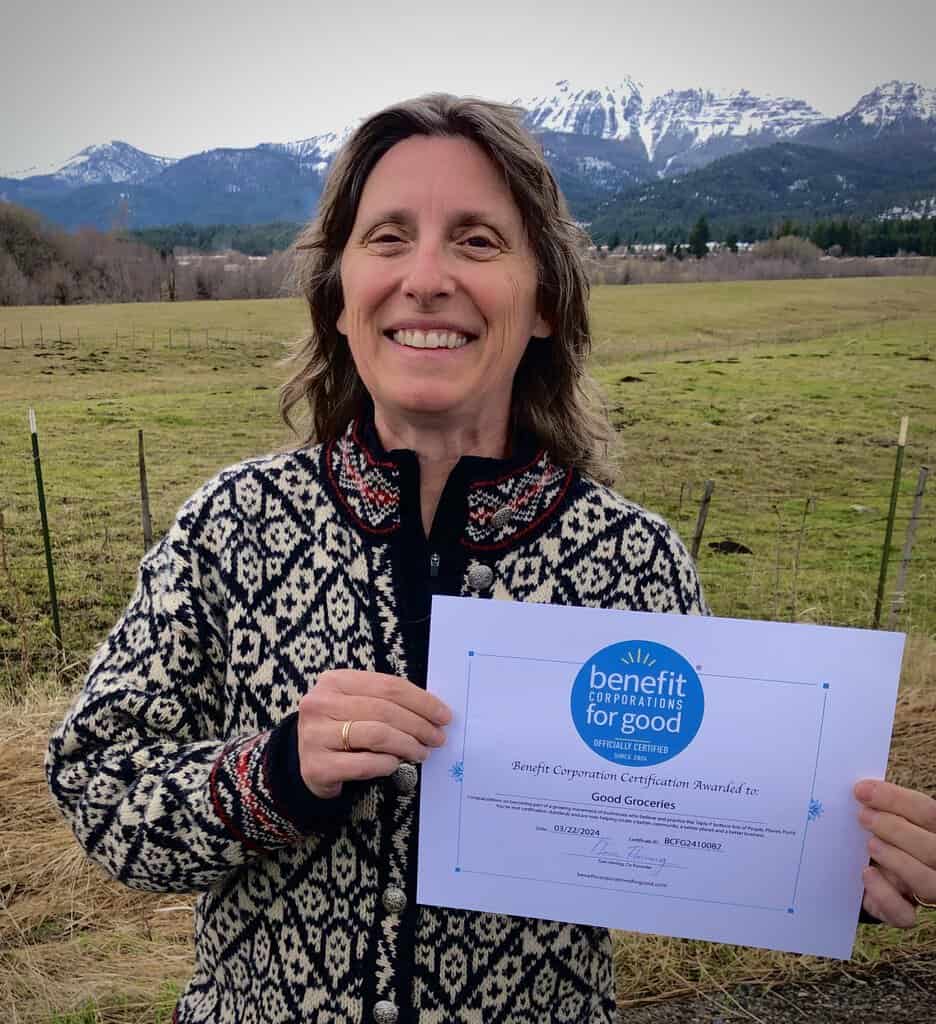
    Kristy Athens of Good Groceries in Wallowa County, Eastern Oregon, joins Kim Allchurch Flick.

    Athens recounts her path from generalist writer to food-systems specialist, including moving to rural White Salmon, writing “Get Your Pitchfork On,” earning an MS in Food Systems and Society, and launching a local gift-box business that evolved into Good Groceries, rebranded in 2024.

    She describes Eastern Oregon’s short growing season and dominance of large-scale commodity agriculture, and how most residents rely on low-priced corporate groceries.

    Good Groceries has grown yearly since 2020, prioritizing paying small farmers while acknowledging higher prices by donating $1 per sale to food pantries and accepting SNAP with Double Up Food Bucks.

    Athens also supports local procurement as a liaison for the Oregon Farm to School Network, discusses pragmatic views on organic and soil care, notes logistical challenges of rural delivery, and urges listeners to buy from local food hubs, CSAs, farm stands, and farmers markets first—“Buy local is not a drill.”

    Listen Now

    Time Stamps

    00:00 Welcome and Guest Intro

    01:15 Kristy’s Rural Journey

    03:18 Food Systems Wake Up Call

    04:07 Launching Good Groceries

    05:55 Eastern Oregon Growing Reality

    08:01 Cheap Food Culture

    09:10 Food Hub Model and Mission

    13:10 SNAP and Access Efforts

    14:10 Farm to School Connections

    15:41 Organic vs Local Nuance

    18:22 Land Stewardship and Awareness

    20:14 Logistics and Scaling Challenges

    23:08 What Keeps Her Hopeful

    24:01 Buy Local Is Not a Drill

    27:49 Dinner Guests and Wrap Up

    Kim Allchurch Flick: Hello everyone. Welcome to the podcast. This is Kim Allchurch Flick. And I’m so happy to be here with Kristy Athens of good groceries. Kristy has an MS in Food Systems and Society from Marylhurst University and is the author of Get Your Pitchfork on The Real Dirt On Country Living.

    She has worked in rural minority economic development for decades, currently connecting Eastern Oregon farmers and school districts as the procurement liaison for the Oregon Farm to School Network and serving for a number of years on the Wallowa County Farmers. Market board. Kristy moved to Wallowa County in 2013 and before that lived in western Oregon, Washington, and the upper Midwest in her spare time, ha ha ha.

    She manages Pitchfork Garden with her spouse, makes collage art, and plays songs on fiddle and electric base. Today we’re gonna talk about how Bilocal is not a drill. Kristy, I’m so excited to have you here. thank you Kim, so much for having me. Thank you. And the Wallowas are beautiful. You live in an amazing place in eastern Oregon.

    And curious, what has been your life journey and inspirations that brought you to the current moment? I. 

    Kristy Athens: I would love to say that it is a linear path, but I don’t think that’s the case. I started out as a writer and as a generalist. I wrote about lots of different industries and, after doing that for oh gosh, probably 15 years. I wanted, I decided I wanted to specialize and around that time my spouse, Mike and I moved from City Life. We had grown up in the Midwest, in Minneapolis, and then we moved to Portland in 1995 and we were looking for something a little more rural. We would go out and hike in the gorge and, fell in love with that area and thought, geez.

    Seeing all these houses on the sides of the road, it’s like, how do these people live here? What are they doing? And so we moved out to white Salmon Washington in 2003 and, that’s how the book Get Your Pitchfork on came about. I learned a lot of lessons not having lived in a rural community.

    There are lots of cultural lessons I learned as well as, how to work the land and that kind of thing. And so I thought other urban people might like a guide to moving to a real place. And when I started doing the research, it was a lot based on my experience, but when I was doing research for that, I was learning more about agriculture and learning nuances like scale and farming methods and different markets and different philosophies about agriculture.

    And that sort of piqued my interest in. In agriculture writ large, but also specifically about small farms because I talked to a few small farmers and one of my friends had also started a farm, moved to the area around the same time as I, and just learning how. Not profitable. That was really surprised me.

    And so I started to get interested in that. And around that time I learned of a brand new master’s program that was at Meryl Hurst University. It was called Food Systems in Society. And I had not yet done a master’s program. And. Finally, I was interested in doing one, and so I joined the first cohort of that in 2013.

    And so it’s a social science degree, so I learned about what are called in quotes, externalities, which means all of the sort of very serious side effects of industrial scale agriculture. Including land grabs and environmental degradation and human rights abuses. And by then I had moved to an even more rural area.

    So in Wallowa County, Oregon where we are now. And I was, so now not only am I learning about in how agriculture works, but I’m learning about rural economies and I originally started a gift box business using the different things that people out here make carb wooden and spoons and different value added food products and things like that.

    And I also, as you mentioned, join the farmer’s market board. And after a couple years of doing the gift boxes, some of the farmers came to me and asked if I would do something like what I was doing for the artist, for the. For the farmers. And I said yeah, that’s what I should be doing anyway so I launched I had a couple of them help me, be on an advisory board and start what is now called good groceries.

    Originally the original gift box business was called Genuine Wallowa County, and then the food delivery was called Genuine Wallowa County Provisions. And then I sold off the gift box piece to another local person and then so I could focus on the food. And so I rebranded the food delivery to good groceries in 2024.

    So that’s my direct line to this position. 

    Kim Allchurch Flick: Wow. You’ve learned so much along the way, and I’m really intrigued in what have been your impressions through time about learning about agriculture and the factory farming side. And also what you’re deeply in now is more the rural local soil carrying side and what are you seeing around you and how are people responding to those differences? 

    Kristy Athens: This area. So first of all Eastern Oregon is a very different growing climate from Western Oregon. I felt like when I lived in St. John’s in Portland, I could throw a candy wrap around the ground and something would grow out of it.

    But out here we have real winter, although we aren’t really having it this year, but that’s another story. We have a very limited growing season for things like tomatoes and basil, and we can have a frost any night of the year. In the middle of summer it can happen. Growing what are called specialty crops, which means everything that’s interesting, all the fruits and vegetables.

    Things that as opposed to commodity crops, which are your wheat and liquid milk and things are sold on a grand scale. So specialty crops are hard to grow out here. The soil is actually good. Unlike a lot of Eastern Oregon we have. Because of the way the mountains are shaped.

    We have more bunch grass than sagebrush and so we have a little bit more moisture. So we have really good soil, but it’s just we’re enterprise is at about 4,200 feet and elevation. And it’s just, it’s harder to grow things here. And just the, climate in agriculture the work that was done over the 20th century to have everything consolidated and and industrialized yeah. Everything out here has been industrial level. So people grow, hundreds of acres of wheat, hundreds of acres of grass hay and raise a lot of cattle out here. Because the land even though the soil could support.

    Different crops, the climate and the season can’t really support them very well. Yeah, so it’s, it’s just like everywhere in the United States, most of the agriculture up here is a large scale

    Kim Allchurch Flick: and what has been the need in the community and some of the solutions with with that climate. 

    Kristy Athens: Most people get their food from a large corporate source. We have one corporate grocery store in our county. And then people travel to others in different areas. I know people will try, will travel two hours to go to Costco in Lewiston.

    They’ll drive to La Grande to go to one of the big box stores there. People in Northeast Oregon, or I different from people anywhere else, most of them are by necessity looking for the lowest price of their food. And, you’ve seen it in news headlines. And I remember even in junior high school there being week or so that we spent in social studies class talking about food system. But every, the whole focus of it was, calculating the cost per ounce of something. And, getting the best deal was definitely the focus. And I think it’s been, we’ve been hardwired for a long time that the cheapest food is the goal.

    And so I’ve got my work cut out for me 

    Kim Allchurch Flick: Indeed. So how is Good groceries doing and how does it fit into these systems? 

    Kristy Athens: It’s going well. As far as growth, it’s the year over year growth. So again, it started in 20. 20. And so I’m closing in on my sixth year. And the year over year growth has been there every year.

    It’s grown every year. But it’s a tiny drop in the bucket of actually feeding people. As I did with the gift boxes, the goal was to create another revenue stream for local people. Here, it’s hard to live out here. People think that things are cheaper in rural places, and that’s not true.

    I think if anything it’s more expensive because of scarcity and, and the, and especially the traveling, that one must due in order to get things or, ordering things that are shipped to you. There’s just a lot of extra and having to drive everywhere. I live four miles from town.

    That’s a long walk. So there’s there are more expenses I think for rural living, but I I have a lot of, colleagues who are doing similar work around the state and around the country. And they, it’s really interesting. Food hubs are approached in from many different directions and they serve many different purposes with different organizations.

    And so what I mean by that is a lot of organizations are. For-profits, a lot of them are nonprofits. And so the food hub in a lot of cases, is a one component of many programs within a nonprofit. Some of them are farmer co-ops. Most of those developed during COVID when they were trying to figure out another way to sell their food when farmer’s markets and other things were closed.

    And so a lot. And then there’s that piece of it, and then. People also come at it from different mission bases. And what I mean by that is a lot of people are looking at food justice on the part of the eater. And which is incredibly important and feeds into that larger conversation of of income inequities that have developed over the last 50 years as well as the industrial agriculture trends that we were talking about earlier.

    But my my focus has been on the farmers because there are so few. Farmers generally. It’s a few, it’s a handful of farmers that run a lot of land out here, and then there are just a very small number of small farms, on 10 or five acres or less. A lot of them are just backyard garden kind of farms.

    We don’t have the big market farms that you have in the Willamette Valley. But I don’t wanna lose those. And my focus has been pay the farmers what they need to make this worthwhile. And in our current capitalists model, it’s really hard to make those two things. Work at the same time.

    Food justice for eaters and income equity for farmers without there being some grant support in the middle. And because I don’t function as a nonprofit, even though I do function as a benefit company which we can talk about as well, but that, that basically is a commitment to focus on the environment and and social justice as well as profit.

    So even though my business is a for-profit, profit is not the main focus. So yeah, so I’ve been focused on paying my farmers and I, in order to. I’m very aware of the fact that in some cases, not all cases, but in some cases, that results in my prices being higher than in a grocery store.

    And to try to compensate for that, I donate a dollar of every sale to the local food pantries. As well as other community giving things, but that in particular. Is it an intention to acknowledge the fact that the pricing, because I’m supporting the farmers, the pricing might be out of reach for some people.

    I also went to the trouble to be able to take snap payments, which if you’ve ever worked with USDA is a huge hassle, but it was also important to me to be able to do that as well. And on now I just just starting in January farmer’s Market Fund in Oregon is supporting my snap payments with double up food bucks.

    So the people who do use Oregon EBT card to buy their groceries at groceries can get half off of their Oregon grown produce. 

    Kim Allchurch Flick: That’s so incredible. I’m curious also about your connection to the schools where a lot of food flows through public schools.

    And what can you tell us about that?

    Kristy Athens: So I do some work on a contract basis with Oregon Farm to School Network. And so I am working with the schools to, to make sure that they take advantage of state funds that are allocated through the Department of Education to school districts to purchase local food for their for their cafeterias.

    And good groceries does not do any wholesale sales. For that same reason that because I’m paying most of the money up to 80% of the retail price goes to the farmer. So there’s no room for me to do any wholesale. With the current model that I have I might, you know, try and work out a different situation in the future, but at this present time, I just sell directly to consumers.

    But I do work as a liaison and so the school districts and the farmers are still making their own contracts with each other, but I’m there to help them find each other. If they have questions about how the program works, I can answer those things like that. But it’s a great opportunity for local schools to support their neighbors, and, in a lot of cases, the kids of the farmers are in the school makes a lot of sense.

    Kim Allchurch Flick: And for the kids’ health and variety of things. And can you share with us your thoughts about the environmental piece of local farming and what you’ve learned about the differences between large factory. Farming and more local. 

    Kristy Athens: It’s an interesting topic. It’s pro, it probably could be its own topic.

    I know we have we don’t have all day to talk, but it is a rich topic and I do think that I do think that it. Is, yeah, it’s something that, it’s something that people should look into from various angles, I guess I would say. And the reason I say that is there are a lot of farmers out here who use organic practices who are not interested in certifying.

    And so for good groceries, I do not require organic certification. And I, I’m, I guess I’m a pragmatist. I think that I understand why chemicals are used sometimes and I also also understand that the word organic has become a bit of a it has. There are realities to organic that a lot of people are not aware of or don’t want to know about.

    ‘Cause there are lots of chemicals that are used in organic farming, especially in industrial organic farming. Personally I would rather eat food from a small non-certified farm then. Industrial organic that you get at a corporate grocery store. That’s my personal my personal preference.

    I, I think that all organic is good. But I do think it’s become a bit of a panacea for some folks. And and I’ll leave it there ’cause it is its own topic for sure. 

    Kim Allchurch Flick: I think there’s another podcast coming up at some point, but we can definitely, I have to get more than 

    Kristy Athens: me on it.

    Kim Allchurch Flick: Indeed. And it’s important. And thank you for that. And I also know that in your area there’s a a ranch that is Regener certified and concerned about soil health. So it seems like in the region there are some people who are really looking at the environmental piece. Yeah, from soil upward and it doesn’t always have to be small.

    Kristy Athens: I would say that all farmers care about soil. It’s just some farmers have a different view of the impact of of traditional agricultural practices. I don’t think that there are farmers that don’t care about soil. I just think that they yeah, they just have a different approach. But yeah.

    I don’t think it was because of a lack of care. I think it’s just a different approach. 

    Kim Allchurch Flick: Yeah. And that makes a lot of sense. And I sense. While it still feels small scale because of things like films like Kiss the Ground, biggest Little Farm, common Ground, those types of films that are talking about agriculture, reaching people that.

    Many of whom never considered where food comes from. And that learning can help move needles of awareness. And I’m wondering what you’re seeing in terms of that awareness of the consumers and awarenesses of the farmers as time goes by. 

    Kristy Athens: As far, if I look at my customer base it’s definitely a lot of people who have moved here from somewhere else who maybe brought their value system with them and also brought a job with them that enables them to be a good groceries customer.

    Yeah. Definitely people everyone who lives in Wallowa County is very, very proud of living here and want to protect it. For example, we’ve had a lot, we have a, Wallowa Land Trust has done a lot of work to preserve. Some lands near the wall Lake. There’s also been some land that’s been returned to the Nez Perce tribe, or oo as the original inhabitants of this area.

    There’s been a great, also the Land Trust has done some great work to work with local ranchers to invite the Nimiipuu. Back here to dig canvas route and do other gatherings that they used to, that they’ve traditionally done in this area. Yeah, again, I don’t think, I don’t think that the love of the land has changed.

    I think maybe some of the processes, people are re reexamining some of the processes. 

    Kim Allchurch Flick: And that’s good. What are some of the obstacles and challenges for you? 

    Kristy Athens: Oh gosh. Where should I start? I mean on the really pinpoint on the ground I have a. Two wheel drive cargo van that has a refrigeration unit in the back and which is great for summertime, but it is impossible.

    Not impossible, but very, very difficult and somewhat dangerous to take. If I because as I mentioned, it’s hard to grow food in Wallowa County, so a lot of the food that I sell is not grown in Wallowa County. That was one of the reasons that I changed the name. So I get a lot of food from the neighboring county, which is Union County.

    That’s where La Grande is located. And then I also get a lot of produce and other food and some really great value added products from two food hubs in Washington. One is in Walla Walla, which is two hours away and one is Puget Sound Food Hub. And they deliver. Orders to Walla if food hub and then I go to Walla Walla and pick up the whole thing and bring it back.

    So I have access to some amazing cheese some kelp snack chips and just all kinds of cool things that I would not be able to carry if I were just relying on our region. And also to get to Walla Walla, I have to go through the Blue Mountains. And in the wintertime, taking a two-wheel drive van over a mountain pass is terrifying, even with studded tires.

    So I have practical limitations like that. I just got a grant slash loan to purchase a four wheel drive van, and I’m very excited about that. And so there’s, yeah, so there’s lots of logistical challenges in that regard. There’s also the challenge of this being a very sparsely populated county.

    There’s 3,500 square miles and 7,500 people. That necessitate has necessitated me moving into, and I am just going to do this next week launch into a weekly delivery to Union County. And so that’s terrific. But that requires an hour plus drive also. So there’s just, there’s a lot of driving.

    The the people who run benefit corporations for good, which is my B company. Certifier, are always pressing me to get an electric van, which I would love to do, but it either needs to be refrigerated or have four wheel drive. So there are those kind of realities at this moment.

    Hopefully that technology will catch up with the need. But yeah, so there’s just lots of challenges, logistical challenges I would say. And then obviously the situation with it just being a short season and hard to grow a variety of crops here. 

    Kim Allchurch Flick: Oh indeed. And what makes you optimistic?

    Kristy Athens: Lots of things. A lot of my existing customers are people who are new to the area. They tend to be in their thirties and they are unwilling to throw their ethics under the bus just for convenience or other considerate air price or anything else.

    They make me optimistic. They are great supporters. They’re super excited about this. And they, they’re telling their friends. They’re making a point of it. So that’s been really great. 

    Kim Allchurch Flick: I really like that thought. Unwilling to throw their ethics under the bus and hopefully all of us how can people reach you?

    That’s easy. Just go to good groceries.shop.

    And is there anything else you’d like to share? Also, thinking about the people that aren’t in the county, but in terms of overall thoughts about how to select food and some of the considerations going to a store. What are some key differences of making a selection that can help us all not throw our ethics under the bus?

    Kristy Athens: For a lot of people, we need in income equality for people to be able to to use that old phrase, vote with your fork. Not a lot of people don’t have as many votes as others, and I definitely don’t want to suggest that if people are buying from large grocery stores that they don’t have ethics.

    It’s, there, there’s a lot to fix. I used to do just as an aside, I used to do a community con, lead a community conversation with Oregon humanities called good food, bad food. And I don’t know if you’re familiar with the conversation project, but it’s it’s not a lecture.

    It’s a conversation. And so we would all be talking, I would, seed the conversation with various aspects of the food system and then we would talk about them. But one of them was that, during the Reagan administration the Emergency Food Assistance Program was developed TFA and it’s still called TFAP or no, it was originally, I just gave away the punchline.

    Originally it was temporary Emergency Food Assistance program, and eventually they just changed the name to the. Emergency Food assistance program because wage inequality has been going on for decades. And eventually it became clear that people are never not in an emergency situation anymore, a lot of people.

    I don’t wanna judge anybody who doesn’t shop at good groceries or any other local farm stand. And there are, I wanna point. Farm stand or food hubs all over the state. So wherever you live in Oregon you can probably find a food hub where you live. But yeah, I think the thing I want to people to take away, despite what I just said, is that, and this is the title of our little program here.

    Buy Local Is Not a Drill. If you can. Find a food hub. Find a CSA, find a farmer’s market. Find a farm stand and go there first. You can always fill in the rest of your list somewhere else, but first buy from your neighbors. Because once if we lose all of our farms. They’re not, if we put buildings and data centers on all of our farmland it’s not gonna come back for a really, really, really long time.

    I don’t think, I think looking at the, our current global situation, I don’t, I think everyone can agree that importing food is not such a great idea or needing, more importantly needing to import it. It’s one thing to import. French wine because you want to, but needing to import our basic staples, I think is everyone can agree is a bad idea.

    And the only way that’s not gonna happen is if people actively seek out local sources of food first. 

    Kim Allchurch Flick: Actively seek out local sources. Yes. And that can vary across regions, counties, and states. But as you said, they are there and they will, they want to sell. They want to continue doing what they’re doing and share food with people.

    And it’s one of my greatest joys is going to a farmer’s market. It’s, they’re fun, they’re. It’s interesting to see what people bring in. It’s fun to talk with people, get to know who the farmer is. 

    Kristy Athens: Yep. 

    Kim Allchurch Flick: Exactly. Indeed. Thank you so much. Thank you for those tips and giving us all food for thought.

    And speaking of food if you could, this is the final question. If you could have dinner with anyone, up to three people living or deceased, who would they be and why? 

    Kristy Athens: Can I have two answers? 

    Kim Allchurch Flick: Absolutely. 

    Kristy Athens: Okay. So my first answer would be my Life group. And that would be my two grandmas and my mother-in-law ’cause I missed them.

    And then my career group would be, also family, my father-in-law because he had a food broker business. When I started dating my spouse in 1990 when we were tiny babies and he had this food broker business. And at the time, like I said, I was a writer and I did not care one bit about his business.

    He died in 2005 and I started doing this food stuff in 2013 with grad school, and boy do I wish I could ask him some questions now. But Jim Menlow and then and then my other two choices were Dolores Huerta. ‘Cause she was so inspirational. So good at motivating people and so food justice oriented a lot of people.

    Might not know who she is, but she was right up there with Cesar Chavez doing the same work. And Cesar gets most of the credit and the streets named after him. But Dolores Huerta is somebody to look up. And then James Beard, another civic, Northwest Hero. The first television chef before Julia Child.

    Although there’s no, no tape of it left anymore. But he is a he is wrote an a million cookbooks and he was probably the first besides native,

    their whole, for millennia. James Beard I think was born. Like early, very early, 19th or 20th century. And he lived in Portland and he and his nanny house person helper would go down to the markets down on the waterfront in Portland. And so he learned to eat oysters as a young boy and learned the importance of.

    Seasonal, eating seasonally and eating from the place you’re in. And so he’s a bastion of regional and seasonal cooking. So I would love to also, he was also if he, especially if he was making dinner, ’cause he was a great chef and and a good he had a good taste in wine from what I understand. Those would be my dinner tables.

    Kim Allchurch Flick: Oh, that’s lovely. And a nod to James Beard is the, Portland is building a new James Beard market in exactly. Downtown, so

    anyone visiting Portland probably into 20 27, 28. I might wanna look that up. Kristy, thank you so much. I love the work you’re doing. The heart and soul you put into the hard work of driving in all four seasons with so much variability and continuing that congratulations on being benefit corporations for good.

    And we’ll put everything in the show notes. Everyone. Thanks for listening. This is Kim Allchurch flick, signing off. 

    This Episode’s Guest: Kristy Athens

    Kristy Athens smiling and holding the Benefit Corporation for Good certificate.

    Kristy has an M.S. in Food Systems and Society from Marylhurst University and is the author of Get Your Pitchfork On!: The Real Dirt on Country Living. She has worked in rural/”minority” economic development for decades, currently connecting Eastern Oregon farmers and school districts as the procurement liaison for the Oregon Farm to School Network, and serving for a number of years on the Wallowa County Farmers Market board. Kristy moved to Wallowa County in 2013, and before that lived in western Oregon/Washington and the upper Midwest. In her spare time (ha ha!) she manages Pitchfork Garden with her spouse, makes collage art, and plays songs on fiddle and electric bass.

  • Sustainable Marketing, AI Disruption, and Trust with Jen McFarland

    Sustainable Marketing, AI Disruption, and Trust with Jen McFarland

    Jen McFarland, founder of Women Conquer Business, joins Kim Allchurch Flick.

    Women Conquer Business is a mission-driven consultancy helping women solopreneurs build sustainable, scalable marketing using digital strategy, SEO, and AI with a values-based focus on accessibility and clarity.

    McFarland shares her path from early marketing work to Peace Corps service in Kazakhstan, which shaped her perspective on equity and being “in the know,” then to earning an MPA and leading policy and digital transformation projects for the City of Portland, including IRS data tax matching.

    Burned out and disconnected from community impact, she started helping women with technology and later rebranded from Foster Growth to Women Conquer Business.

    She discusses challenges of entrepreneurship, community-based marketing amid economic stress, capacity-aware marketing, mixed feelings about AI’s environmental and privacy costs, the need to reduce doomscrolling, and optimism centered on younger generations and a marketing future focused on trust. 

    Listen Now

    Time Stamps

    00:00 Welcome and Guest Intro

    01:39 Jen’s Origin Story

    02:20 Peace Corps Perspective Shift

    06:57 City Government Lessons

    10:18 Leap to Entrepreneurship

    14:07 Serving Community in Hard Times

    21:21 Capacity Aware Marketing

    22:45 AI Disrupts Marketing

    25:43 Staying Optimistic and Joyful

    28:36 Values and Trust in Marketing

    32:27 Where to Find Jen

    34:06 Dream Dinner Guests

    38:11 Closing Thanks

    Kim Allchurch Flick: Hello everyone. This is Kim Allchurch Flick and today I am delighted to have a dear friend, Jen McFarland. Jen McFarland runs Women Conquer Business and is the founder. Jen is a marketing strategist, former City of Portland digital transformation leader and founder of Women Conquer Business, a mission-driven consultancy helping women solopreneurs build sustainable, scalable marketing.

    After a decade of shaping policy and public facing digital services inside government, she saw firsthand how small businesses are underserved and often preyed upon. She built her business to change that. Jen blends deep expertise in digital strategy SEO, and AI driven marketing with a values-based approach centered on accessibility, clarity, and real world results.

    She now helps women-owned businesses cut through overwhelm, build marketing they can sustain and grow with confidence. Today we’re gonna talk about how small businesses grow lessons from city government to helping women survive the marketing mess. That has to be about the coolest topic ever because I feel it every day.

    Welcome. It’s so good to see you. 

    Jen McFarland: You too. Thank you so much for having me. This is great. 

    Kim Allchurch Flick: Yes. 

    So 

    Jen McFarland: good 

    Kim Allchurch Flick: to see you. It’s, it is, and we have known each other for a while and both of us have been involved instructing at the small business development Center. So you’re a teacher, a coach supporting Accelerate women as well, and I’m so happy to learn more about your journey.

    So what has been your journey and the inspirations that brought you through a city to this point in time? 

    Jen McFarland: I know it’s so funny, like the question because when I, sometimes when I talk to people, they’re like, you did that too. What haven’t you done? Like I, because I am really into having really good experiences.

    So I’ve worked at a paper, I was a DJ for a while. I’ve done, I’ve done a lot of things. I got my first marketing job in at a company on Swan Island here in Portland, Oregon in the nineties, because I knew. What a scanner was like. The person interviewing me amazing. I know pointed at and said, you know what this is, I’m like a scanner.

    And so it’s just been it’s been a journey. I think the most transformational experience I had that probably set me on this trajectory was when I was in college and like right after I got out of college, one of my closest friends was in the Peace Corps. In Guatemala. And then and then I was like I wanna do that, and so then it started this whole thing of but then I got married and, but my husband wanted to go to, and so we had to figure out our finances. So it was this whole big thing about how to go serve. And then when you do have an experience like that, it just like. Sets you on a different mindset, a different place.

    You look at the world differently because you realize contextually what goes on here is so different than somebody else’s context, and it makes you look at things through a different lens. Just because I think it’s because of the length. After the first year, you’re still holding on to all of your.

    Ideas about we do it better America, whatever, but by the end of the second year, you have enough experience that you’re like, we really don’t, we don’t really know what we’re talking about anymore than anybody else does. We just do it differently. And I think for me, the biggest thing for me in terms of like equity and inclusion happened when, it’s really cold in Kazakhstan. That’s where we served. And so getting dressed to go to the school. Is like a big deal, like you’re, ’cause the whole, the apartment is cold. Like we’re not talking about central heating and stuff here, and so you put on all of your clothes and it’s 20 below and and you get to the school and there’s a padlock on the door.

    And nobody told you that there’s no school today. And I remember that. I remember standing outside the school and it was the second year and nobody told me there wasn’t school. And like I started to lose it, and I remember saying to myself that just doesn’t happen at home, and I was like, wait, no, it does. I’m just part of the group that’s in the know. And so those are the kinds of things that happen when you live in a culture long enough. Like you start to see that oh, I’m the other, oh, at my, where I live, I’m not the other. And like you start to have these aha moments, and so after that, when I got back from the Peace Corps, that was when I ran an AmeriCorps program for a year, and then I got my master’s in public administration. And worked at the city and did do a lot of policy work and things like that. And tech projects.

    Like my last project was bringing IRS data to the city of Portland for tax matching. You’re welcome. So for higher tax compliance at the city. And that was a big lesson like working with the federal government. That’s like a whole other thing versus working in local government. And then I just got burned out.

    I really felt like I wasn’t, I was affecting, there’s more, but at the time, 50,000 business owners at any one time. And then when it came to like bigger projects, it was like every portlander, we were affecting with like apps we would stand up or, redoing the website was one of my projects.

    All kinds of things. And then I was like, but I don’t really see. How it’s impacting people, and I got, I felt very disconnected from the community in that work, doing it at that level. And and a bunch of other things happened. Like it wasn’t a good environment for me as a individual.

    It didn’t really work for me. I like to move a little faster and so I started helping people on the side, like just with websites and things like that, because I could see. That there was a lot that needed to happen and a lot of people who particularly with like technology would just pat women on the head and be like, oh, you’re okay.

    And like they wouldn’t really help them or didn’t really have a real sense of. How the, as a provider, their actions were affecting these women business owners. And I was like I can help with this stuff. Like I can do this. And so that’s where at the time, foster growth, that’s, that was my, still my LLC was born, was out of that because I help and the name foster growth was because I help people foster growth and change.

    And that was what was on my resume, like all kinds of stuff. And then I got out in the world and people didn’t understand what foster growth meant. So a couple years later I changed it to Women Conquer Business, which is a pretty cool name. And it does a good job of attracting the right people and repelling the wrong people, which is always a good marketing exercise,

    Kim Allchurch Flick: wow, that’s my 

    Jen McFarland: story of sticking to it. 

    Kim Allchurch Flick: Indeed. You said something that I think is profound because essentially a city and employees of a city or government, county state. All that are supposed to be there for the people. And it really struck me that you said you felt so disconnected from the people in that role and yet we’re learning so many things and what a viewpoint that must be, but also seeing what’s missing that led you to women conquer business.

    Jen McFarland: Yeah. I think that. We tend to see and we talked about it a lot in grad school, we tend to see the street level bureaucrats. So those are like firemen, police officers customer service people, if you go to a public park or things like that. Like they’re there and they’re like the people that you see, that you interact with.

    And then there’s a lot of people like me who are making decisions. Without public meetings, without any sort of discourse. And then you learn later oh my gosh, we like, we didn’t translate something. Or the form is confusing and people don’t do it. Or, people didn’t even know they were supposed to pay this tax.

    There’s all kinds of things that happen and there’s a lot of fallout and it’s because there is a big disconnect. The, a lot of policies, the city happened because somebody got elected and they decided this thing was gonna happen, and whether or not people want it or not.

    And that’s the thing that, that has always been frustrated. Frustrated. My dad, who worked at the Idaho Tax Commission for 42 years was like, politicians make decisions, but it’s the frontline, like workers of a state or county or whatever that get all of the blowback, and it’s.

    It’s politicians who raise your taxes. It’s politicians who make decisions that you don’t like. But then everybody says that they hate government. And there’s things within the system that are not great, not good. I find most government was formed, like how we do things was formed in the 1950s.

    And the world has changed vastly since then, but we don’t fund government to be agile at all. And if you look at some of the things that have happened since Trump 2.0 where they’ve just been slash and burning things like they’re, they have devastating consequences because everything is so interconnected that you can’t just be like.

    Doge and like just cut through everything. It just, it’s too intricate and making those shifts take so long, and it’s good and it’s bad. If you’re like me and you want change to happen quicker, like it’s not the right place for you to work, but. Government taking a time to like shift is actually a good thing because then you have more time to make sure that everybody comes along, and the danger with a lot of the things that are happening is it just skips over all of the like, inconveniences that people think make government slow, but it’s also what makes it work better. For all of its flaws. There are some things that were good about government being slower. Especially at the federal level.

    Kim Allchurch Flick: Yeah, that, that makes sense. And thank you for that insider view. And I think we’ll probably come back to that every once in a while through the conversation. And what been some challenges and obstacles, particularly also going from employment or an organization, which is the government to being an entrepreneur?

    Jen McFarland: I. Every, I always think about it like, I’m so grateful to the infrastructure of like corporate life and like working at the city because I, and that’s why like I’m so grateful for my business operations manager, because there were just a lot of things that I didn’t realize I was getting help with.

    You learn pretty fast as soon as you’re out and you’re doing everything like holy cannoli, there’s like a lot to do. And so that was like the biggest gap was like, here I was somebody who did a lot of work but I wasn’t the face of the city. That was other people. I wasn’t doing all the finance.

    I wasn’t doing all the admin. I didn’t have an admin employee, but there was still a lot of admin that happened without. Me having to do anything. It was like magic, and all the magic’s gone. When you have your own, when you have your own business, all of a sudden you’re like, you’re the magic maker for everything.

    And that was like, that was a big shift. Like it was a, oh, be careful what you ask for, Jen. You just got it,

    Kim Allchurch Flick: yeah, be careful what you wish for it. It is true, isn’t it? I also came from more corporate life, not in a city, but through necessity after being laid off. It’s what’s next?

    Have to build something and having business acumen, but not having been a, not having run a business had been a part of a bigger machine, and steady paychecks are. Very nice. Pretty nice, 

    Jen McFarland: aren’t they? Yeah. Yeah. 

    Kim Allchurch Flick: And work. Working hard for sometimes to build revenue that is not yet arriving is a good boy Cup call is, that is really 

    Jen McFarland: something, isn’t it?

    Or I remember the, and it hasn’t, I’ve been very blessed. It hasn’t happened very many times, but somebody didn’t pay, so I did all this work and then they never paid. And that happened to me like. Within two months of leaving the city. And I was like, are you kidding me? And then having like conversations with this business owner who just it was so vitriolic and adversarial, and I’m sending like proof of work, which she knew, she knew that I’d done the work, and I had to walk away from a few thousand dollars like.

    And I was like, oh man, I didn’t even consider this, as like a possibility. And that was a, that was also a big thing that happened, like pretty, pretty new to business that I was like, oh yeah, I guess that’s why they have small claims court, or whatever. And so yeah, you have those moments, but then.

    Then you learn how to analyze people when they come in to see if they’re really a good fit. And of course you can’t really know if people are not gonna pay. That’s still a thing that could happen I guess. You get better with time at assessing. If somebody’s full of it, 

    Kim Allchurch Flick: absolutely. And knowing you through the years, I also see as being. A very mission-driven, values aligned business owner and caring about people in the community. And sadly, it’s too, sometimes along the way, there are those who don’t always see the same value set. They just want something to be done.

    And unfortunately, I have heard more than once about people who don’t get paid. With that it strikes me that you stuck to your values so much throughout and actually building stronger ones, and I think that’s one of the things I admire about you and women conquer business so much. And what do you see in the community you serve and how do you share your values with your community?

    Jen McFarland: I would say that, there’s a couple of different ways. There’s. There’s the community of say, like Accelerate Women or the work that David Mim and I put together for Prosper, Portland’s Inclusive Business Resource Network, where we built a digital marketing program from the ground up and served.

    I think it ended up being several hundred businesses. In the beginning it was just the two of us. And then at the end we had, I think, six or seven consultants, who were all serving. BIPOC business owners. Through IBRN and Mercatus, which is how I also got hooked into SBDC and some of those other things because David and I were also training the trainers so that we could help people understand how to help businesses.

    And that was really the foundation of getting into the community and really hearing about the problems and the questions that people had. It’s been a struggle lately. I’ve been talking to more businesses who are thinking of closing because of tariffs or the economy just hasn’t been what it once was in this immediate area, and then at the same time it all it’s all tied together. The nonprofit funding has dried up, which means the state funding has dried up. And then the city funding, is tied to how much business income we have. And if I talk to a lot of businesses that are thinking of closing, that means there’s not as much money then to go into places like Prosper Portland to support business development, and so the wheels go round and round. And so a lot of it right now in the immediate is how do we. Keep going. How do we do this in a way that is helpful? And so for a lot of people right now, I’m reminding them that everything isn’t online. You have to build relationships in the community.

    You have to talk to other people. You have to share and collaborate with others. And that’s always been a part of it. But when you’re a digital marketer, that’s maybe not always like the front and center. Piece of it, necessarily. I’ve been really fortunate too that I built my own community and the conversations we have in the online Women Conquer business community have been really great because there are some people who’ve been there for three years now. And so everybody’s really comfortable. It’s a really safe space and very supportive. And the question comes up a lot, like, how are we supposed to do marketing in this environment? Where it seems like the world is on fire like every day, and. And then at the same time, I’m navigating like crazy pants changes to marketing at the same time, and so I just keep reminding people in all of these meetings and stuff like, okay, we do the work because we care about our communities and marketing is energy. And if we can keep showing up for our communities, it benefits yes, our business, but it also benefits the people that we serve.

    And if we stop. Marketing and if we stop talking to people because we’re scared and we have so many things going on in the world that are making us fearful for the future, if we stop talking to other people, then we’re not helping. The people that we have vowed to surf. So it’s a real conundrum because if you feel scared and you feel uncertain, it makes marketing hard.

    ’cause like I said, it’s energy. So people can like, feel that you’re tentative about something. And it may not be like the business, it may just be like you read a headline, you doom scrolled and then you walked into a client meeting or whatever so it’s a really. Hard time to be a business owner.

    If you are mission driven and , if you have feelings about what’s going on right now it’s a hard time. And so really it I was putting together next week’s newsletter yesterday, and there’s actually like a link. In there that talks about like less doom scrolling more books.

    And it’s about just read and don’t read the book online. Read an actual physical book, so that you’re not putting yourself in a place where you could suddenly start scrolling something else, and and I bought myself, they sell like iPod lookalikes for $60 now, and I bought myself one so I can.

    Put my music on an iPod and go for walks without having my phone with me. And we just have to separate ourselves from a lot of the noise. It’s good to be aware, but like, when it comes to running a business in an environment like this, sometimes we have to protect our peace or it’s gonna be too much for us.

    Kim Allchurch Flick: We have to protect our peace and. That resonates so much because we do ’cause it’s constant fire hose out there, so if we don’t pull away from the fire hose, we will get watched downstream. 

    Jen McFarland: Yeah. 

    Kim Allchurch Flick: Thank you for saying that. And this is from you working in like in depth so much about digital strategy and even though I am a marketing major and I’ve.

    Earned a digital strategy certificate. I discovered what I like about marketing, which is more the idea of it and reaching people in authenticity and creativity. And what I don’t like about it is things like ad words and all the machinations that can go into marketing. And what I have noticed about you is you understand all of these things and bring.

    Marketing to light in such a holistic fashion that it’s still important and yet it doesn’t need to be. It is still a game in a way. It’s always a game. It’s a game to get views. It’s a game to be noticed. I understand that part, but you make it really authentic and. That’s one of the things I appreciate and yet deeply digital and your understanding of ai, which to some people sounds new, but I know AI’s been around for 20 years.

    It’s just the incarnations are so rapidly growing and the use of it is, I don’t even know how to express it. The use of it seems to be like. Not just one train it. It’s almost like an airport and every plane flying out is like the AI doing something without us gathering information. Also, creating some things that are good, creating some things that are potentially nefarious and trying to understand it all at once.

    It’s like trying to understand how an airport works. It seems big, there’s a lot going on and in airport working where there’s no people. It’s just imagine that going on every day. Yeah. That’s how AI feels to me. It’s almost, I know it’s out there. I know it can be useful and it’s very large.

    Jen McFarland: Yeah. There’s a few things that you said that I wanted to touch on, if that’s okay. Like 

    Kim Allchurch Flick: Sure. 

    Jen McFarland: Absolutely. Sometimes people say that that what I, that I only help people with marketing basics, and I’m like, no, you don’t understand. I make marketing so approachable that it sounds basic and it’s not that I do basic things, it’s that I give people.

    Like a modular approach so that they can figure it out for themselves. And sometimes it’s really technical and sometimes it’s not. And the big thing that I’m excited about right now is that I’m helping people with something that it doesn’t have a sexy name. I’m sorry but it’s capacity aware marketing.

    So it’s like you only have so much capacity in any given day. To do things, and you have to market your business. So like, how can you fit this in, and so it like changes the conversations with people where, they’re like, I wanna do this, this, this, this, and this. And I’m like, okay, but you have a whole business to run.

    Is this really reasonable? And so I’m trying to really encourage people to ask those types of questions to really think about what they can, what their marketing strategy actually is, so that they can build it for success. Instead of saying that you’re gonna do 150 things and feeling like a failure because you did 20, like you should feel like a success because you did 20.

    And it’s just what you had capacity to do. So if we can build the capacity from the beginning that gives people more opportunities to succeed when it comes to things like ai. And it’s so tricky, because I and AI has become so. It has disrupted marketing more than Elon Musk buying Twitter, which is now X or more than TikTok hitting the scene and now.

    The US splintering off TikTok into its own formation with horrible, even more horrible privacy policies than we’ve ever seen. Like I know, I feel I sound like Trump. It’s the worst that we’ve ever seen, but it literally is the worst we’ve ever seen in terms of a privacy policy. AI has disrupted everything.

    And when it came, I remember it was right after I had hired Alti and I said there’s this thing chat, GPT. I don’t know if it’s gonna be a big deal or not, because I’ve been using AI for five or six years, and then I was actually surprised when that was the thing that like everybody latched onto is a big deal, but it’s terrible for the environment.

    We know this, it’s just as bad as crypto is for the environment. And at the same time I find that I have to use it so that I can compete with everybody else. And so it’s like a real, it like. It can be so cool. And then it also gives me some heartburn to use it and and I think that there’s a real struggle with that right now.

    You’re seeing it right now where a lot of people are saying like they don’t wanna see the junk. They wanna see the potential for what it can do, but then it’s also like a huge privacy risk or, it’s not even a risk, it’s just a threat really, to the privacy. And then, so there’s so many ways that we can look at the AI conversation, like in a silo from a marketing perspective.

    As a professional, I have to use it at least in some ways because I’m gonna get left behind, and also doesn’t mean I have to like it all the time, that I don’t like what it does. And I certainly don’t like the people in charge of it because I don’t think they’re using the right governance.

    I used to say that Claude and Anthropic had the right governance, but right before coming on this call, I read that they have lifted their guardrails, which was what made them so special for military purposes at least. And that is terrifying, because it still makes a lot of mistakes and the guardrails are what protects us from some of this stuff.

    I don’t. So I am very conflicted about ai. I help people navigate it. I do use it and and I’m concerned. 

    Kim Allchurch Flick: Yeah. Thank you for that. And for listeners, this is February, 2026 in a conversation that will span 

    Jen McFarland: a long 

    Kim Allchurch Flick: time, a lot of, a long time. But sometimes it’s good to make a record and make a mark in time.

    And I agree with you. You said it very, very, very well. And with that, what makes you optimistic? 

    Jen McFarland: Oh, like so many things, I’m like, I’m really optimistic about the generations that are coming after. Like I’m definitely not one of those people that’s like, oh, but we used to do it. Right. Except for drinking out of hoses.

    I still think that was okay. But I think that, like aside from that, the new generation they really excite me and it makes me really hopeful. I think that also with, everything I just said about ai and I said all that stuff before, aside from the anthropic comment, like all of this stuff is pretty timeless.

    Like all of those issues existed like three years ago. They’ll exist in three years too. So I’m optimistic because younger people as digital natives, as people who like. Understand the technology and how it works in ways that, like people older than me don’t, you know, because they grew up with it, like in their hand.

    They have a different way that they relate to work. They have a different way that they relate to the world and what they want. I’m seeing some really exciting conversations around the environment that have never happened before. And that makes me really optimistic. And, I’m optimistic about business.

    We survived this before, and and we’ll make it this time too. And it’s just, we just it just means that if you were in business, say during the pandemic, it’s almost like that again, where you have to really like, be agile and think about it. And I do feel like, we came through the pandemic and we were better.

    I think if we come through this we’ll be better. It’s just a matter of what it looks like and I don’t know, but that’s exciting too. I don’t know. I don’t know what’s gonna happen. But I’m always optimistic, my, my tagline that I don’t use nearly enough is fine joy marketing your business.

    And that’s why I like protecting your piece is so important because. If you don’t, you stop being joyful and optimistic and that’s really important for all of us. 

    Kim Allchurch Flick: I love that. Find joy marketing your business and it can be fun. 

    Jen McFarland: Oh, absolutely. 

    Kim Allchurch Flick: To make an expression that people resonate with can be really joyous.

    Jen McFarland: Yeah, and like marketing can be fun as long as you don’t listen to somebody who tells you you have to do. X, y, z like when you don’t want to do the things that you enjoy when it comes to marketing your own business. Yeah. There are people everywhere that, that need what you offer. So it’s about saying I like to do these things, and then doing it.

    Kim Allchurch Flick: Yeah, 

    Jen McFarland: It sounds simple. It’s not you have to do, put some thought into it. But but yeah, everybody can do it and you need to do it your own way. That’s how you stay optimistic and hopeful, I think. 

    Kim Allchurch Flick: Yes. And it gives some agency, may I share some data with you? 

    Yeah.

    Data. So I, I geek out on Nielsen every once in a while and they’ve done several studies on social enterprise and consumers, and I think it was 2014 and then another round 2017 where they said that. Two thirds of consumers globally are willing to pay more for products and services when they know a company has good values.

    And then the later one was about 73% were millennials. And I’ve always thought, and where I come in my work is, okay, great. There’s somebody out there who’s got great values as a business and somebody’s looking, how do they find each other? And that’s where marketing comes in. And that’s where the big gaps have been.

    And as a consumer, sometimes I am delighted when a company is very expressive about their values. And I have a friend that says, market your values like a product. Yeah. And yet I get so frustrated sometimes with the. The companies that I know have great values and I can’t find it anywhere unless I’ve had coffee with the person and they bring it up as an aside and say, oh yeah, by the way, we, we helped a village, or we help a village in some country, and they’ve done amazing things, but it’s nowhere.

    So that’s part of it. And then there’s a couple of other things that I’ve heard along the way that just helped me get through these times. And it’s like running a business, enjoying it, and being part of a community is an act of resistance. Also the other one that is just as important as working hard is rest as an act of resistance.

    Jen McFarland: Yeah. 

    Kim Allchurch Flick: And that’s what I’m working 

    Jen McFarland: on right now. I am not good at rest at all. 

    Kim Allchurch Flick: And in a way it’s interesting though. I find being in conversation with you here restful. It’s like it’s, it brings me. Fun. Yeah, its fun. It brings me joy and we all find our own things. Sometimes it’s not always sleeping, but you’re also talking about handling a book instead of digital.

    It gives the brain a break, and it may be different forms of rest, but business itself and how your values have always resonated to me, that’s, I think, one of the things I enjoyed from the first meeting and how dedicated you are to helping others. 

    Jen McFarland: The one thing that I will say that I, that also makes me optimistic or could be like one other tidbit to share, is that with all of this AI stuff it has made people less trustful of brands that are not forthright about their values, that aren’t talking about what they do.

    And so the underlying thing is that. Moving forward. So starting with this year, it really is about trust. So think about how you can get people, how you can share what you do so that people trust you. And a lot of times that comes back to things like values, impact, being integris in what you are doing, conscientious, like all of those types of things lead to.

    Customer trust, and so it’s do good work, have honest conversations. If you can’t do the work, tell people and help them find somebody else. There’s a lot of things. And so that actually makes me very hopeful too, that people aren’t just believing what the AI overlords are saying.

    They’re wanting to find and be in community with people that they trust. And so marketing is really about trust and I like that better than marketing being about AI and what it can make because it can’t make things that you and I can do. 

    Kim Allchurch Flick: Yeah, I agree. And even metrics. It’s nice to get the analytics, it’s nice to see how to tweak and adjust and, but I love that.

    Moving forward, it’s about trust. What more would you like to add and how can people reach you and how can people get on that newsletter?

    Jen McFarland: Yeah. I don’t know what else to add except, yeah I do think it’s important to get off. I also think that’s how we build better community among people that we don’t agree with, is to get them off of their devices and have real conversations. ’cause people say stuff online that they would, I hope it would never say to an actual person.

    So the more conversations that we can have the better I think we are as a community. I am excited about the fact that trust is just so critical right now. And I think that that’s gonna stick with us for a long time. You can find me all over the internet at Women Conquer Biz and then that’s my website.

    WomenConquerBiz.com. The newsletter is at WomenConquerBiz.com/newsletter and that’d be the easiest way to subscribe. I’ve also been very good about putting it on the bottom of blog posts and on every page to try and make it as easy as possible. The newsletter is super fun and it’s informative and really focused on.

    Small businesses, local businesses and then people who work in professional services to an extent as well. So coaches, consultants, experts which is probably why you like it, Kim, as an expert. And yeah. So yeah, find me. Let’s hang out. Let’s have coffee. Let’s chat. 

    Kim Allchurch Flick: Absolutely. I love getting your newsletters and they’re the kind of newsletters I like to share, so I hope everyone will tap into that.

    And the last question is, if you could have dinner with anyone living or deceased up to three people, one, two, or three people, who would they be and why? 

    Jen McFarland: Okay, so this is hard because there are so many people. But I decided to go with the three that came. Right away, like top of mind. And my guess is it’s possible that one of these people you’ve never heard of, so that could be interesting.

    So first, the first two people that you’ve heard of. One is Amy Poehler because she’s funny and fun and feminist. The next one is Ichiro Suzuki, ’cause he’s my favorite baseball player of all time. And the third person is Effa Manley. Who is the only woman in the Major League Baseball Hall of Fame. She was a civil rights activist and she owned a Negro League team with her husband and helped first of all, helped get African Americans into Major League baseball.

    And then also was really helpful to players so that they had income after. ’cause like back in the early days, baseball players did not make enough money to live and so she helped them with finance. Then, like I said, she was integral into the civil rights era and I just think she would be interesting to talk to.

    When I learned about her, I was like, wow, that’s so cool. Ichiro Suzuki has given the most money of any former player to the Negro League Museum to help keep the history of baseball alive. And and I just think he’s an interesting guy. He played for 20 years in Japan and then played another 20 years here.

    When we lived in Arizona, we would go to spring training games and he just had the most interesting routine before a game, like to get ready. And I just thought, that’s just so cool. 

    Kim Allchurch Flick: That blows me away. First of all, names I’ve never heard Amy, of course, no, but don’t know personally, but it’s what also strikes me about those two people is in their worldview.

    They did something small that was really mighty and not small. Globally, small, but not small to the people that they were serving, that those things were huge and how we don’t all have to spread broad and do big things Sometimes. It’s the deep niche and serving people. 

    Jen McFarland: Yeah. 

    Kim Allchurch Flick: In a narrow sense and locally that can make some of the biggest differences.

    And when you were talking about those two that really struck home that I know nothing about baseball, I don’t know anything, but the fact that they helped people knew how to do it and made a difference that’s lasting. 

    Jen McFarland: Yeah. 

    Kim Allchurch Flick: Is something we can all think about in whatever niche we might wanna operate in.

    That’s amazing. 

    Jen McFarland: I guess that’s something else about me. I am. I love baseball. We have season tickets to the Pickles, which is our little Portland Pickles, wooden bat league. And and so yeah, the more I’ve learned about baseball, like there are these people who have like really helped with the community and then as they’re like butterfly wings, that have an impact beyond the immediate circle and, amy Poller would just be a kick, like Parks and Rec. I could relate to that on so many levels as a former like city employee. And and so yeah. And I just think that she would be fun and interesting to talk to. But yeah, I mean there are a lot of people who’ve done really big things and certainly I had some people in mind like JFK, who started the Peace Corps. But I’ve read some things about him that I find very troubling, so I’m like, I don’t know if I’d really wanna talk to him, as a person. These are people that I’ve read enough about that I think I would actually like, they would probably talk to me and be interesting.

    So yeah that’s why. 

    Kim Allchurch Flick: I appreciate that so much. What a delight. I appreciate you and I can see what people Amy Pohler, ’cause you make me laugh and have her you two in a room together, I think really something 

    Jen McFarland: you should come to be. Yeah. 

    Kim Allchurch Flick: Fly on the wall. I’ll bus the table and.

    Bring you dessert. Thank you so much. This is a delight. Everyone, I appreciate you listening. This is Kim Allchurch Flick signing off and wishing you a good day. 

    This Episode’s Guest: Jen McFarland

    Headshot of Jen McFarland smiling.

    Jen McFarland is a marketing strategist, former City of Portland digital transformation leader, and founder of Women Conquer Business, a mission‑driven consultancy helping women solopreneurs build sustainable, scalable marketing. After a decade of shaping policy and public‑facing digital services inside government, she saw firsthand how small businesses are underserved and often preyed upon. She built her business to change that. Jen blends deep expertise in digital strategy, SEO, and AI‑driven marketing with a values‑based approach centered on accessibility, clarity, and real‑world results. She now helps women‑owned businesses cut through overwhelm, build marketing they can sustain, and grow with confidence.

  • Strategy and Solidarity: Theresa Logan on Racial Justice, Conflict Resolution, and Organizing in a Rising Fascist Landscape

    Strategy and Solidarity: Theresa Logan on Racial Justice, Conflict Resolution, and Organizing in a Rising Fascist Landscape

    Theresa Logan – Portland-based facilitator, trainer, and consultant – joins Kim Allchurch Flick for a discussion about “strategy and solidarity.”

    Logan describes her 20-year background in community organizing, public policy engagement, organizational equity, conflict resolution, and restorative justice, emphasizing analysis of race, gender, and power dynamics and using conflict as an opportunity for collaboration, racial harm repair, and trauma healing.

    She shares formative experiences: growing up in Portland after her teen mother moved the family there for college; early exposure to sociology concepts like gentrification and racial inequality; attending a predominantly Black middle school and being raised in a multiracial family; studying abroad (Guatemala, Spain, Cuba); a high school pilgrimage to El Salvador for the 20th anniversary of Oscar Romero’s assassination; and retracing the Cuban Revolution with a professor who fought in it.

    Logan recounts work with the Inter-American Foundation, immigrant families in early childhood development in Washington, DC, earning a master’s in conflict analysis and resolution at George Mason University, returning to Portland during the recession, and roles including bilingual field interviewing for the National Survey on Drug Use and Health, helping launch Oregon’s Foreclosure Avoidance Program, and working at Resolutions Northwest after its merger with Uniting to Understand Racism.

    She explains how racial equity consulting grew from repeated organizational calls about racialized harm and conflict, and notes that DEI became a buzzword, with her and Carlos focusing instead on human rights and racial justice and on shifting organizational outcomes.

    The conversation covers federal funding cuts and program shutdowns, hostility and legal challenges targeting DEI-related work (including a “Dear Colleague” letter that was appealed twice and rescinded), and the need to learn from history rather than treat current conditions as unprecedented.

    Logan previews a community learning lab, “Conflict Resolution for Anti-Fascists” (February 10–26), focused on lessons from revolutionary and anti-fascist movements and on choosing conflict strategies based on who is being moved, when collaboration is useful, and when it is unsafe with bad-faith actors.

    They discuss themes including stereotypes and immigration, the role of public data in journalism and public awareness, the Haitian Revolution and global anti-Blackness, the strain of chronic crisis during “the fall of an empire,” neighborhood-level mutual aid and organizing, and the importance of knowing one’s neighbors for resilience.

    Logan shares sources of hope: the miracle of life, long time scales and survival through past mass extinctions, her children, and younger generations’ self-advocacy and emotional intelligence; they also discuss human innovation, climate solutions, and comparisons of infrastructure investment.

    Logan provides ways to connect with Strategy and Solidarity (strategyandsolidarity.com; online community at strategyandsolidarity.org with free membership and sliding-scale offerings).

    Listen Now

    Time Stamps

    00:00 Welcome and Guest Intro

    01:39 Theresa Origins and Values

    05:26 Travel and Revolution Lessons

    08:21 Career Turns and Recession

    11:17 Building Racial Justice Practice

    14:50 DEI Backlash and Funding Cuts

    16:35 Haiti History and Stereotypes

    21:29 Conflict Resolution for Anti Fascists

    26:37 Empire Collapse and Mutual Aid

    31:03 Know Your Neighbors Strategy

    33:46 Finding Hope and Optimism

    41:28 Where to Find Theresa

    42:41 Dinner Guests and Closing

    Kim Allchurch Flick: Hello everyone. I’m Kim Allchurch Flick on the podcast today, with Theresa Logan. Theresa is a facilitator, trainer, and consultant based in Portland, Oregon, with 20 years experience in community organizing, community development, public policy engagement, organizational equity. Conflict resolution and restorative justice.

    She approaches all of her work with a critical analysis of the race, gender, and power dynamics that are present in every interpersonal conflict, every group and organization, and every social structure. Theresa’s deep holistic skill set offers clients and workshop participants, tools and frameworks for transforming conflict into opportunities for collaboration or in collaborative problem solving, creating strategies for mitigating and repairing racial harm and healing, personal and collective trauma in service of universal human wellbeing.

    Today we’re gonna talk about strategy and solidarity. And if a topic like this wasn’t needed anytime more than now, I mean there probably have been some many historically, but true to fact now is one of those times when you were an important person to have in the world.

    We met not because we were, I import, we’re both in Portland, Oregon. It was more accidental that I found. Strategy and solidarity, and we’ve never met in person online and I’ve taken the courses and I am dedicated to learning in the framework that you and Carlos provide.

    What has been your journey and the values that have shaped and guided you up to this point?

    Theresa Logan: I think Carlos, who’s my business partner and I were just driving back from a trip to San Francisco over the weekend and we were sharing even more of our life stories than neither one of us had known for an hour drive. So I’ve been giving this some thought about my journey and some of the things that got me where I am today.

    I do say in doing racial justice work as a white woman, that I’d certainly never do it alone, right? That I’m always working in partnership and collaboration with my colleagues of color, because that’s what’s required to, to combat these systems of white supremacy and patriarchy and capitalism is to be willing to be part of a collective when we’re so trained by society through movies and pop culture and all these things to be like the one, the hero, the answer, spend a lot of time arguing about whose opinion is right or wrong, to remember that we are all part of a collective. And so I think that is one of those values that’s driven me through my journey through, interesting experiences. Probably not unique in the history of humanity, but maybe not so common for someone of my background.

    I’d say I always go back to starting with being the child of a teen mother who moved us from Bend, Oregon to Portland, Oregon in 1989 so that she could pursue a four year degree at Portland State University because there was no four year university in Bend, Oregon at that time. And so I got to get a sociology degree along with my mother as a.

    A child from 

    Kim Allchurch Flick: Oh wow. 

    Theresa Logan: Elementary school through middle school. And so she often came home and told us what she was learning about at school that day, which was a lot about gentrification and racial inequality and how to critically analyze the world around us. My sister and I mostly sound really annoying.

    So I tell parents like, it may not land, but you are planting seeds and they may or may not develop in the way you expect, but when you’re a parent, you are planting seeds with your kids. And so having that critical analysis of the world around me was something, an amazing gift that she gave me at a fairly young age.

    And again, as a. White girl growing up in one of the whitest cities in America, in Portland, Oregon, in the nineties. I went to Harriet Tubman Middle School, which is a predominantly black school at that time. And so I had a cultural immersion without leaving my city. And I’d say from, pretty much from middle school, through college, lived in the whitest city in America, but did not have very many, if any, white friends.

    And I was also in a, raised in a multiracial family. So I myself am not genetically multiracial. And so I had that experience of being adjacent and within Portland’s black community for most of my life. And understanding those places where I found cultural affinity and belonging, but also the ways where my whiteness, just how to navigate that, right? Trying to understand what it was to be white in a black community and what it means to be part of that community while recognizing the ways that I will never share those experiences of living the experience of blackness and getting taught and learning how to stay in my lane and recognize, my privilege and my place and where I was overstepping and what’s just not for me, right?

    Because I don’t actually share that experience. 

    So I’d say those were pretty foundational experiences of my young life that set me up to follow my mother’s footsteps into a sociology degree. Among other things, I came out of PSU with about five or six degrees of learning. Yeah. So I did end up was very fortunate to get a scholarship from the Ford Family Foundation.

    Is here in Oregon outta Roseburg, not Ford cars, but the Roseburg Roseberg wood products Ford family who gives about a hundred scholarships a year to low income. And I underprivileged students in Oregon. And they pay for my entire undergraduate and a good chunk of my graduate degree.

    Part of that included being able to study abroad. I was able to take my loans and go spend a summer in Guatemala at a language immersion program to learn Spanish, and I spent a semester abroad in Spain, another semester abroad in Cuba. And so many things there. It’s gonna go back, I guess even before then.

    Probably one of the things that may have helped me get that scholarship is that I traveled with my, I was, I’m not very. Practicing Catholic anymore, but at the time, through our Catholic church, went on a pilgrimage to El Salvador when I was a senior in high school to, it was for the 20th anniversary of Oscar Romero’s assassination.

    And so we spent a week in El Salvador really traveling through all these places that had been involved in the Civil War and learning about what the. FMLN and the radical Jesuit priests and other folks who were really fighting for social justice and really brutally oppressed, had endured and hearing first person accounts from folks who fought in war.

    And as an American, civil War, revolutionary War feels so far away, like things that happened in the past, but really being in a place where folks had just, lived through that kind of brutal violence really gave me more of an understanding of, you know what we mean when we talk about revolution when Americans talk about revolution, it often is an abstract story that might be in a movie sometime, but when we’re talking about revolution in El Salvador and Nicaragua, and Cuba in Venezuela, like there’s a whole, excuse me, whole different lived experience of what that really means, what it takes to engage in that, and then what it takes to rebuild something on the other side that isn’t just replicating the harms of the past. So that was a pretty foundational experience. And then I when I was in Cuba, we were an amazing group led led by a Chilean expat who we landed in Havana and the next day we hopped on an old Russian plane and flew to the other end of the island in Santiago, and spent the next two weeks retracing the steps of the Cuban Revolution across the island with a professor who himself had fought in the Cuban Revolution.

    Again, just a really amazing, like visceral voyage through history. That helped me understand a lot about strategy and solidarity and what it takes to create not just reform of an existing social system, but to truly enact a revolution that tries to set up something completely different.

    And how often are our dreams and aspirations, many things Cuba has achieved and also many, many challenges. Along the way especially right now. I met my ex-husband in Cuba and so I married into a Cuban family and still have family on the island.

    And again, seeing what our family over there is enduring. Though I got divorced, we have three kids together and I still consider all his family. My family, again, a different level of understanding. When we talk about struggle and hardship here in the States, I’m like, well, we got running water and electricity all day long, so we’re doing pretty good.

    So I’d say those have all been fairly foundational experiences in my life that really put me on a path of thinking about strategy and solidarity. Lots more. I could say I was a community organizer in college. I went and worked at the Inter-American Foundation after college supporting grassroots community development projects in Latin American and the Caribbean I worked with, immigrant families doing early childhood development in Washington, DC when I was in grad school getting a master’s in conflict analysis and resolution at George Mason University. And then somehow I found myself back in Portland, Oregon. Unemployed as a mother welfare said, how did this just happen? I’ve been traveling the world and doing all these things.

    I was a professional in DC living my best life, and then all of a sudden I was in my mother’s basement, unemployed with a baby in my marriage on the rock. And it was 2008, so we’re in the middle of that. Or no? Oh yes, 2010. It wasn’t 2008, it was 2010, 2011 and we’re in the middle of the recession.

    So I had a fresh master’s degree. I was ready to go out and get a master’s level job and no one would hire me in Portland for anything. So it was a really humbling moment after having had all these experiences and a lot of professional su success in my career up to that point. I ended up working part-time for the national Survey on drug use and health as a bilingual field interviewer, and as I’m naming all these places, almost none of them exist anymore as of 2025 because they’re all programs have been shut down by the Trump administration, the Inner American Foundation. Oh my. There was a suit in place to try to get it restored, but they’re a very small agency compared to U-S-A-I-D, but they were shut down the same way U-S-A-I-D was.

    Last year, the national survey on drug use in health, I think has had most of their funding stripped away. And that’s really where we get most of our information and data about how many glasses of wine per day people have, or how many kids have tried this drug or that drug. It gives us really important information that helps us plan public health and policy.

    So I think most of that’s been shut down. I was just like, yeah, in one year I think they shut down pretty much all the funding in every job I ever had. I am sure they’ve shut down the funding for early childhood development and those sorts of things. And let alone, instead of trying to support our immigrant families, people are hunting them down in the street regardless of the circumstances of their arrival or what could be waiting for them back home.

    Kim Allchurch Flick: Wow. 

    Theresa Logan: Yeah. And then I moved on to work at the Oregon Foreclosure Avoidance Program and help set that up as we’re coming out of that recession to help homeowners, find strategies for moving forward. ’cause the banks are so terrible that they’re just like, lose your paperwork and not process things and you couldn’t talk to anyone on the phone.

    And so Oregon in instituted this program that required the banks to meet in mediation. And while they weren’t gonna come up with some magical solution to save people’s homes, if they could not afford to continue paying for them, it did require them to show up and be accountable. And make sure that they were processing paperwork correctly, that they were following the law and hold them accountable without putting all that burden on homeowners alone.

    We’re in the middle of crisis. I’m not sure how to navigate it. And then I got hired after several years of volunteering as a mediator and facilitator at Resolutions Northwest, which was I think maybe still has one small mediation program going, but has also lost a lot of its funding local organization doing mediation Center.

    And they had just merged when I got hired with Uniting to understand Racism, which was running kind of a nineties style. Racial awareness dialogue program. And the merger really infused everything r and w was doing with a focus on racial equity. And so we were doing public engagement facilitation for the city.

    A lot of conflict mediation. But more and more we started getting calls from people who were. Either having racialized incidents or incidents of racialized harm at the organization and needed someone to come help them figure out how to move through that in a restorative way.

    Or people were trying to move forward racial equity work and encountering a lot of conflict in doing that. So we started getting a lot of calls for conflict resolution, specifically around racial justice and racial equity issues. Our consulting work really grew out of that. We didn’t start off.

    And Carlos and I who now have our own independent practices did not start off ever thinking racial equity consultant was a job. I don’t know that it still is in 2026, but it really grew out of working at a conflict resolution center with a racial equity, racial justice focus, and then getting a lot of calls from folks and a lot of conflict.

    Because working for racial justice does not minimize conflict. It tends to exacerbate conflict in organizations. Like getting the puss out of a wound. Like you gotta clean out the gunk that’s in there if you’re gonna let it start healing. Otherwise it’s gonna keep 

    Kim Allchurch Flick: right, 

    Theresa Logan: Getting more infected and growing.

    And so after getting a number of those calls and working on a number of those cases, we started to just recognize the systemic patterns. And so we were able to work with organizations more intentionally around. What are the systematic approaches to mitigating and minimizing harm and inequity in organizations?

    And also increasing not just increasing diversity for diversity’s sake, but increasing the skillset and lived experience and appreciation of what folks who have historically been excluded from the places and positions of power bring to an organization and how to. Bring people in and make the most of their experiences and not tokenize people or, sideline them or traumatize them because they’re not agreeing with your limited perspective.

    And so we left resolutions northwest around 2019. Weren’t necessarily expecting to work together for, but had one client contract that we picked up together on the way out the door. And I have continued to find a lot of success together, working with mostly public agencies and nonprofits to transform their cultures, to support leaders.

    And again, not just being more inclusive, but being very strategic in in, in shifting their outcomes. There’s a, we, diversity, equity, inclusion were never our favorite words because they became very buzzwords. There’s a lot of performative things happening around DEI that weren’t actually shifting outcomes for staff of color or customers, clients the communities of color that, that right agencies work with.

    So our focus was always more on human rights and racial justice. And so we’re able to work to transform systems and cultures to shift their outcomes fairly successfully over the past six and a half years to ago. Six and a half years. It’s a little rough right now in 2026. There’s not a, certainly not the boom of DEI contracts and commitment that there was in 

    Kim Allchurch Flick: indeed 

    Theresa Logan: 20 21, 20 22.

    There are people who are still deeply committed and because of federal government has shut down so much funding for so many social programs across the board. It’s just created such a budgetary crisis for everyone, everywhere. I’m not sure about other states. I’d say in the Pacific Northwest and probably most of the West Coast, there’s still a deep commitment, probably 80.

    When we go into organizations, 80, 90% of people would tell us that understanding racial equity is essential to their job. Not important, not interesting, but like essential. Essential, what they’re trying to do, absolutely essential. And that commitment and that understanding is still there, but the funds to bring in folks who have the expertise to help shift those systems to do that just aren’t there.

    So we, we do see people still making an effort, still moving where they can and there’s just so much hostility trying to shut things down with legal challenges. Some of those have been one, there was an important one recently where the Department of Justice and Department of Education dropped this dear Colleague strong arm tactic they were trying to use to intimidate school districts away from any kind of anything that could be related to what they call DEI, which is don’t ever talk about people of color or women.

    But that they lost an appeal twice on that letter, and so they’ve dropped it and rescinded it. They’ve done a lot of harm in the process. But the legal challenges aren’t always catching the headlines, but are successful. So that’s a very long but also short version of my path and where we’re at today.

    Kim Allchurch Flick: And so impressive, so relevant. So. Interesting and intriguing, and there’s a couple of things I’d dislike to summarize that pop up for me as also it’s, I grew up overseas, but not in not in Latin America at all Holland, Belgium and England, but still outside the US and different, and being exposed.

    To different cultures. I think, has really helped shape my world views particularly, even though I didn’t realize it was when I was a kid. But looking back, it really frames things. And you said a couple things that are super important about the importance of history and what does revolution mean and tracing someone’s steps.

    And when you were saying that, it popped up a story I heard on NPR yesterday about. Haitians in Springfield and someone was talking about the Haitian community that is afraid that they will be deported back to a country that has no infrastructure or very little gangs. It’s very dangerous. And the stereotypical assumptions of who the Haitian people are and the local people who live around them are saying, no, you’ve gotta understand these people had their leader assassinated.

    Have had earthquakes, have had so many things happen, and the people that left the country, not because they wanted to leave their home but for survival are the doctors, the lawyers. And they said the brilliance and the capabilities that have brought been brought into that community are being welcomed by a lot of the local people.

    And we’ve gotta get past. That’s why I’m so anti stereotype. It’s so wrong. And you also talked about data, and I was thinking when data is shut down, journalism doesn’t have as much to work with and flow of data shuts down, then a population is somewhat blinded. And when that happens, that’s where historically and understanding history, this.

    These chapters have been written before and absolutely many times over. And to recognize that if we recognize it and with the kind of work you do should help us put the guardrails up early instead of saying, oh, that happened before it’s happened again. Stop the cycle before it gets worse. 

    Theresa Logan: Even with Haiti, we can go all the way back to Haiti was the first country to successfully stage a revolution in the Western hemisphere, post colonization.

    They were the first independent nation in the Western hemisphere, the Haitian Revolution. Yeah. And the anti-blackness and the fear of black liberation drove so much of colonial policy in the rest of the Americas and the US in particular. Fear of but they’re gonna come here and do the same thing.

    That’s why we have to keep these people enslaved and keep them in line. Like the way that Haiti was used as a cautionary tale for the rest of the Americas. Yes. And the way that the, you know, difficulty Haiti finds itself in today is an entirely a function of the way Haiti was. They didn’t call it an embargo at the time, but held responsible for paying reparations to France for its own freedom.

    Cutoff from global trade by the rest of the colonized world. It’s not an accident that, oh yes. Assassinations. Who was involved? How has the US and other countries, influenced what’s happened in their politics, but also just the global anti-blackness that really made Haiti a pariah in the middle of colonization when the global powers, European powers were trying to hold onto their colonies and the rest of the hemisphere.

    The US and other countries that were engaging in the slave trade, were trying to protect their property, their ability to traffic human beings, and it just, the, it feels so appalling to see the Epstein files and all these things coming out, but the threads go directly back. It’s not hard to see where they go back to.

    How much exploitation happened in, in the Caribbean islands when Yes. Where, that’s the place where Columbus first landed, right? Was Haiti. And we call the whole island Espanola because of Haiti and Dr two different countries on one small island, but Id was the name, the indigenous people called it and the havoc and just atrocities that were wreaked on the indigenous folks there by the first colonizers.

    We are still paying for that today. Haiti’s still paying that for that today. We’re still paying for that today. 

    Kim Allchurch Flick: Yeah, in human lives in many other ways. And your perspective also about how it’s important to recognize what we have compared with people who are living without running water and electricity.

    There’s a lot to work with here. I was wondering how this wonderful arc of your very young life so far and and that knowledge of history is shaping what you’re doing now. 

    Theresa Logan: How is it shaping what we’re doing now? Right now and I’m not sure when this will broadcast, but next week, starting February 10th through 26th, we are running a community learning lab called conflict Resolution for anti-fascists.

    And a lot of what we’re trying to do there is draw on these lessons from the past, from history of other revolutionary and anti-fascist movements and look at what lessons we can learn and how can, how we can apply that today. There is among a certain mainstream population of the United States, a lot of this is unprecedented and it’s all fallen apart and we’ve never seen anything like this before.

    And I understand where that’s coming from, but it’s absolutely not true. And re trace these patterns all the way back through the entire history of this country through the entire history of European colonization, of the Americas. And so to not fall apart because our level of expected comfort and ease is falling apart.

    But to find ourselves to find strength and lessons and all of the many freedom fighters who have come before, Harriet Tubman, who with a very severe disability, freed like 800 people from enslavement, 750 of them in one raid that she led during the Civil War. Yeah. So many, right? So many lessons.

    Hatuey was a Eno indigenous leader. When Columbus and them landed and he fled Haiti to go to Cuba to warn the Taino folks in Cuba that those Spanish were coming. And then he led a gorilla warfare for several months. So tried to fend off the Spanish and do everything he could to get them out of Cuba.

    He was eventually caught and burned at the stake, and while he was on the state, the Franciscan friar is like, do you wanna like claim Jesus Christ as your Lord and Savior so you don’t go to hell? And he was like, are the rest of these Christians gonna be there? He was like, yeah. He’s like, absolutely not.

    Send me to hell. I don’t wanna be anywhere y’all are ever again. So it’s like there’s no 

    Kim Allchurch Flick: recognizing recognition of what’s real. 

    Theresa Logan: Yeah, absolutely. And we can carry that thread of those horrific acts of violence and acted on indigenous people in the Caribbean when the first Europeans arrived.

    Absolutely follow through to people who will sit in Christian churches today and not do a, not do anything to support people who are being harmed in the street. Like these threads carry through, they’re not brand new. In this conflict resolution for anti-fascists, we’re looking at history to learn those lessons and to remember, we don’t have to start from scratch.

    We don’t need to rebuild the wheel. We’ve been doing this and black and indigenous folks in particular have been doing this since the, arrival of the colonizer age. And if we’re willing to sit back out of our own narrow perspective and recognize, where we are, how we got here, and who has been fighting this fight already.

    Then we can’t pick up the torch that they’ve left us and carry it forward instead of feeling like we have to start some brand new thing now. So that’s one part of is history. The other part of is really thinking about how we engage with conflict. We have terrible conflict resolution skills in our society overall.

    It’s a lot of based on domination and control and how can I force others to get my way.

    Kim Allchurch Flick: Indeed. 

    Theresa Logan: And so we’ll be talking about how we engage with conflict specifically in the. The current, rising fascist landscape, it requires different tactics. But if we only go to the old standbys of

    Try to yell until I get my way or go to violence, it just escalates into more violence. But to really think about who am I trying to move and what’s the best way to move them? If I spend all day yelling at people who have an entirely different worldview and understanding and do not care about the things I care about online, I’m probably not gonna move them anywhere, but deeper entrenched into their point of view.

    If I also just spend my time arguing with the people who I’m trying to build with until I get my way, because I think I know the right way and they’re wrong, we’re probably not gonna build a very effective movement. So thinking about where collaboration is helpful, where collaboration can lead to abuse and harm.

    There’s a kind of basic conflict resolution methodology. Assumes that everyone’s moving with, good as good enough intentions to meet a basic need and working in good faith When you have people who are actively trying to cause harm to others, just kidnapping people off the streets want to imprison people for profit and want to strip people of their rights, like that’s not the time to collaborate.

    We will end up getting harmed and abused because they will weaponize and take advantage of our good faith and willingness to be thoughtful and empathetic and creative. So thinking about what strategies work, where and how and to what end. 

    Kim Allchurch Flick: And I am delighted that I signed up for it. I think there’s always something to learn, even though I try to continuously learn and apply, there’s always something to learn and to put good use of the lessons that you teach.

    So I’m very impressed by that. And we’ll put that in the show notes as well. And what. What problems are you seeing in your work and in the community and solutions that you’re able to use for you and your work and also the solutions you’re providing for others? 

    Theresa Logan: Oh, the problems. The problems. We’re living through the fall of an empire and we’re living through the fall of an empire.

    In a culture in which we’ve been taught to be like prioritize individual success and failure, right? And so living through the collapse of an empire and then feeling like it’s my fault that I’m struggling to keep my bills paid while the economy is crumbling around me. So I think that’s one of the biggest issues I see is just like everything is changing.

    For the better in the immediate term. I hope that in the long term there is the potential to take the transformation that’s happening in this time and push it towards that just and thriving future for all that we’re working towards. But it’s gonna be very challenging in the short term. And so just getting to a place where things we’ve taken for granted are not going to be reliable anymore is a really hard place to be for folks.

    Human beings tend to be really good in a crisis. Like in an acute crisis, natural disaster, something like that, we can come together and do the most amazing things for each other. We have a lot harder time working through like chronic sustained stress and trauma because it just becomes too much. And so I think as we’ve seen a Minneapolis, the, I’m not even gonna call it silver lining, I’m just gonna say the like honest human response.

    To the occupation of a city has been all of this really incredible organizing. And it’s not to romanticize or pretend like it’s not taking a very high toll on folks there because it is, but we can also see what we’re capable of, right? Which is of this like self organizing and just small neighborhood level units who are taking whatever action they can to protect their neighbors and themselves.

    Not that they’re a hundred percent successful all the time, but they really are. Making a difference and building the kind of cohesive web of relationship that we need to move through the compounding and continuous crisis we’re probably like to see for, at least the next decade, maybe more.

    How things go. So that’s part of the problem and it’s just, when everyone is struggling, it’s harder to feel like we know how to support one another. If mostly everyone’s, got a job and one person loses their job, we can do a GoFundMe and help that person get their rent paid.

    But if nine of the 10 of us are out of jobs, we can’t pay our rent, then, it becomes a lot more challenging. So I think that 

    Kim Allchurch Flick: absolutely 

    Theresa Logan: scarcity of money, resources is gonna be a big challenge for folks right now. I think that will force us whether we want to or not to turn to the abundance of other resources available to us and human connection and connecting with the earth and figuring out how we make do with less than we’re accustomed to.

    But it’s not gonna be easy. It’s not gonna be fun. And I think that interconnectivity and return to recognizing our relationship as part of the earth. Not just ants walking on it, but as like the ants, one of the fabulous creations that the earth has made, pretty much a sent mud walking around out here.

    Those are things that will allow us to create something different on the other side. I don’t know that I will get to see it, ’cause I think it’ll take several generations to get there. But I. I am finding hope in recognizing myself as one chapter in this great long story going back to Hati and Harriet Tubman and John Brown and 

    All the folks who’ve come before they played out their chapter and I’m playing out mine and hopefully leaving something for my kids to continue to work with. 

    Kim Allchurch Flick: Indeed. And you’re making me think about what it’s like to be in arcs of history and. How history speaks. And now I’m hearing stories of there’s an example of someone who’s lived in an apartment for seven years and doesn’t know any of their neighbors and decided to knock on doors and say, how are you?

    And put a QR code, print it up in elevators and say, do you wanna connect? This is the, how can we do this? And sometimes that grassroots power, small, mighty. Very local can be transformative. And I’m also hearing how much that our words do matter and in ways that are expressed, where it brings in the masses and the collective of those voices really does something.

    Theresa Logan: Yeah. 

    Kim Allchurch Flick: And we. Go ahead. 

    Theresa Logan: We’re so socialized into this like instant gratification, hero culture of some, no, someone needs to go out and make a stand and do the thing, and that will change everything tomorrow. And I think maybe ’cause of the way we’ve made story made movies about like the civil rights movement and things like that.

    Without understanding the years and amount of organizing, relational organizing, strategic planning that went into those movements, that it was not just a spontaneous protest. Rosa Parks didn’t just not feel like moving that day. That was a planned effort. She was chosen very specifically because she was light skinned and pretty and would be a more what do you call it?

    A victim we would have more empathy for than if she was a older, darker skinned woman or something like that. There’s, there was strategy there, there was planning, there was many years of thought going into this or other people who had refused to move before and it didn’t lead to the whole Montgomery bus boycott.

    There’s a great deal of planning and strategy that go into these things. And so trying to help folks realize that it’s not just, well, I want it to change so it should change. ’cause that’s not how we get change. Right. But there is a lot of entitlement we hold as Americans about des deserving and demanding to get our way.

    And so breaking out of that and realizing it’s not about being a hero or starting the, the general strike that will change everything tomorrow. It really is what you were talking about of do you know your neighbors? If the lights go off, who can you go get a candle from? Or how are you gonna stay warm if there’s no heat in your entire building?

    Those ways where it’s like, how are we gonna get through challenging crisis together? And once we, when we know our neighbors and we have conversations and we can start to build that capacity for strategy and solidarity and organizing, and I say these things not to discourage folks from going out to protest or do whatever you can do today.

    Absolutely do that and make sure you know your neighbors also. There’s been so much. Especially since COVID and even before, so much movement towards virtual communities of affinity around, political ideology or special interests or whatever that we found ourselves with in, in these small groups of like-minded people or large groups of like-minded people through virtual connectivity, which is beautiful.

    And there’s also a way where it’s started to, detach us from connectivity with the folks we’re actually in physical proximity to which if things get real bad and the lights go off and there’s no more internet are the ones you’re gonna depend on for survival. So for me, I always tell people, you wanna see the revolution happen?

    Go make sure you know your neighbors. Start there. Start by talking to your neighbors and finding out what they need, what’s most impacting them right now. And don’t just, throw them out because their concerns don’t immediately align with yours. But start looking for that, that shared common ground.

    That, that does connect you in physical reality.

    Kim Allchurch Flick: You wanna start the revolution, get to know your neighbors. That’s so quotable. I love that. With all of this, what makes you optimistic? 

    Theresa Logan: Oh

    I struggle with that one. I can go back and forth. There’s some days where, like today and we’ll set aside. Should not be this warm and sunny in Portland, Oregon in February. But the sunshine, I saw a hummingbird in the yard the other day and there’s like chaia trees, which I had learned are actually supposed to bloom in the winter.

    And it’s not just climate change causing them to bloom right now. Going outside and filling the sunshine on my face and the wind blowing through my hair and just remembering that I’m alive in the world is such a miracle that any of us are here, that anything exists at all. Given what we know of, the rest of what we can see of the universe, like the fact that this much life exists here on this planet is just miraculous.

    So that gives me hope, right? There’s been, not everyone finds this comforting, this works for my brain, but to look at the vast scape of scale of time, of life on this planet. It has been five mass extinction events before we even got here. Life still succeeded, right? Five times we’re like 90, 99% of life got wiped out on the surface of the Earth.

    And that 1% that survived is what gave birth to all of this that we see here now, including us, right? And so that place of I don’t know if humanity’s running out the clock. We may be done. Maybe we deserve to be, I don’t know. On good days, I don’t think we do on bad days. I’m like, maybe. But to know that maybe plastic eating microbes will become the next, dominant species on the earth.

    Clean up the mess we made. I don’t know. And I don’t need to know for me in my own spiritual understanding of the nature of life. I find that comforting in a way that’s not just about me, it’s about I have this incredible opportunity to be here today. How do I make the most of it?

    I don’t know what’s coming next. I have no control over the evolution of humanity and whether we do or don’t save ourselves from climate catastrophe. 

    I will do my part where I can to try to push things the way I would like them to go. As I did in the last presidential election, it did not go my way.

    And yet we are still here and I have three amazing children and. My job is help them hopefully still get to live out whatever life is calling for them to be and do in the world. So those things give me hope. They’re pretty incredible, even just in one generation. I look at the difference between how I understood the world and many of the dumb mistakes I made as a teenager, largely based on my socialization as a woman in the society and be.

    The awareness my children have about grooming and pedophilia and what’s right and what’s wrong, and they understand a lot of dynamics. I was still, I’m 43, I’m like on the cusp between Gen X and millennials. I don’t consider myself a millennial, but I’m definitely not real Gen X either. I was, I graduated in the year 2000, so I consider myself generation class of 2000.

    I really am on the cusp. I have a lot of things in common with Gen X, a lot with millennials, but I really don’t identify with either. Anyway, in my era, we were still very much socialized into this, like older men, younger women. That was like desirable or romantic for younger women to have relationships with older men.

    And my kids are disgusted. I don’t know if you remember or ever watched Buffy the Vampire Slayer, but it’s like a 300 year old vampire with a 16-year-old girl. And my kids were aghast. I was like, none of us had that response in my era. I don’t think. It was just like, oh yeah, of course. My kids have no patience for that.

    They’re such good self-advocates. They’re so self-possessed that they give me a lot of hope and optimism for the future and see a lot of, it’s not perfect. That’s not every young person, but I see a lot of hope in our young people who have so much more and emotional intelligence, ability to self-advocate and are not interested in going along with systems that don’t make sense and are not just.

    Kim Allchurch Flick: Oh, I love that. And it also makes me think that, these brains are gonna continue to do incredible things, be inquisitive and also be innovators of solutions. And that’s one of the things that keeps me optimistic is even when things feel like they’re falling apart, I learned that somebody’s creating something new and it’s gonna be amazing.

    And in Portland we have a lot of. Innovators, there’s clean tech and there’s other incubators of people that are starting things and it’s encouraging. They’re not all gonna make it. Starting a business is hard, but they’re creating solutions to longtime problems and it’s pretty, pretty fascinating.

    Theresa Logan: Absolutely. I think I have that and I, I do have a Pisces Sun, so it gives me a positivity bias, but. I do just see there’s we’re so incredible humans. Like the things we can create, are just there’s, we can absolutely solve climate catastrophe. We probably create more problems in the process because that’s how it goes.

    But if we just invested our resources there instead of lining the pockets of billionaires and creating plagiarism machines that make people dumb. ’cause they stop thinking for themselves. You know, we could do so many things. And those are the days I feel less optimistic is like, why?

    Why are we not all choosing that? The answer seems so simple and I struggle with that one a lot on the hard days, but 

    Kim Allchurch Flick: sure. 

    Theresa Logan: On the good days, I think, life is pretty incredible and Sprout will always grow. 

    Kim Allchurch Flick: Oh, I agree with that. And also it depends on where we look. I was just listening to NPR today, the man who knows China very well and he was, he lives in San Francisco.

    He was talking about how current, since COVID onwards, such a short window, the infrastructure that has been invested. Into China for transportation. They’ve been leapfrogging wind to go to solar. The forecast in a book called, here Comes the Sun, is that they’ll have much cleaner air in 10 years than any other city, even though they’re still really bad now.

    But they’re knowing and that the difference he sees between the US and China is both countries are very wealthy. How that money is directed into infrastructure for populations and how they’re doing it. So well. I said, wow, we should take a chapter outta this book. Take a look. How could it be any compared it to San Francisco and the Bay Area, just in terms of transportation.

    And it says it’s night and day difference, even though the money’s there and part of it is how it’s allocated, but also how it’s used and. He said that the US is good at litigating and China is good at creating and building infrastructure. And maybe that’s another place where our voices, locally can matter.

    And I also have heard that if we call our Congress people and senators as business people, and the first sentence is, I’m a business owner. There’s some real weight to that and I got that from Oh, interesting. Camilla Taylor of the American Sustainable Business Network, which is a nonprofit that advocates and supports for businesses and also builds in a lot of equity into that.

    So I think we’re also in, in networks that we can connect to and create a web of these thing, same thought processes and be grassroots about it, but do some big things. And I think you’re part of that the strategy and solidarity and the anti-fascist upcoming program that, that you and Carlos are holding is part of that, pushing needles, helping other people along.

    It’s transformative. 

    Theresa Logan: No, thank you. 

    Kim Allchurch Flick: Thank you. Is there anything else you’d like to add?

    Theresa Logan: Oh no. I’ve said a lot. We talk very fast. This might be one of the times where you have to slow down the podcast instead of speeding it up. 

    Kim Allchurch Flick: No, I think we’re doing great. And how can people reach you? What are the websites and the socials where people can reach you? 

    Theresa Logan: You can learn more about the strategy and solidarity collective@strategyandsolidarity.com.

    You can join us in our online community, it’s strategy and solidarity.org. We have a free basic membership to join our community. We have a sliding scale for the conflict resolution for anti-fascists coming up next week. And we have other offerings over the course of the year where we are trying to build community and strengthen our ability to find strategies and build solidarity and create that world.

    Not in one, centralized economy way necessarily. But in that beautiful way of if we let everyone do their own thing, we all have a lane, we all have a gift, we all have something to offer to this world right now. And if we can do that while also coordinating our actions together. We can create a lot more than if we’re each just trying to start our own thing.

    Kim Allchurch Flick: I love that. Thank you so much. And the closing question is, if you could have dinner with up to three people living or deceased, who would they be and why?

    Could be one, could be two, could be so hard to 

    Theresa Logan: pick. I’m thinking about all these people on our flyer for the thing from history and oh, there’s so many people. And I’m like they wanna have dinner with me though. I don’t know. I think I would like Tui Harriet Tubman and John Brown. I could invite a lot more people to this dinner party, but I’d start there and just see what lessons I could learn from there.

    Really radically different, understandings of time and place, but also still entirely human right. And what, we have a way that we exoticize the past as much as we exoticize other people’s and cultures. It’d be really fascinating to be able to see what, how they framed their understanding of their experience and what parts of that would be radically different and what parts of that would be really useful to shifting our perspective.

    Kim Allchurch Flick: Now that would be amazing. Thank you so much. It’s been a pleasure to spend time with you. This is Theresa Logan and Kim Allchurch Flick signing off. Be safe out there. Thank you. 

    This Episode’s Guest: Theresa Logan

    Theresa Logan - Subduction Consulting - headshot

    Theresa Logan is a facilitator, trainer and consultant based in Portland, Oregon. With 20 years’ experience in community organizing, community development, public policy engagement, organizational equity, conflict resolution, and restorative justice, she approaches all of her work with a critical analysis of the race, gender and power dynamics that are present in every interpersonal conflict, every group and organization, and every social structure. Theresa’s deep, holistic skill set offers clients and workshops participants tools and frameworks for transforming conflict into opportunities for collaborative problem solving, creating strategies for mitigating and repairing racial harm, and healing personal and collective trauma in service of universal human wellbeing.

  • Moving From Overwhelm to Sustainable Impact with Tessa Bridge

    Moving From Overwhelm to Sustainable Impact with Tessa Bridge

    Tessa Bridge, founder of Tessa Bridge Coaching, joins Kim Allchurch Flick to discuss helping social impact leaders manage pressure, avoid burnout, and lead sustainably.

    Tessa shares her path from developmental psychology and public education into community organizing, racial equity work, running for city council, and DEI consulting, and explains how her own burnout led her to focus on boundaries, values-based leadership, and community care.

    She identifies her core values as community, authenticity, and integrity, and discusses current challenges for nonprofit and social impact leaders in January 2026, including reduced resources, Trump-era budget cuts, moral injury, community violence, and rising authoritarianism.

    Tessa describes practical approaches she teaches – setting clear goals, making intentional choices about time and attention, building pauses for decision-making, and celebrating progress to increase agency – while emphasizing that sustainable leadership is part of resisting harmful conditions.

    She draws on Adrienne Maree Brown’s Emergent Strategy and the concept of fractals to connect personal practices (like releasing perfectionism and loosening tight control) to organizational and societal change, and explains facilitation as creating enough structure and safety for groups to take risks and collaborate.

    Tessa reflects on lessons from her city council campaign, including canvassing less-engaged renters, developing thick skin, and tying policy decisions back to transparent community values while holding leaders accountable without dehumanizing them.

    She notes she is writing a book on sustainability, justice, and entrenched leadership beliefs, encourages leaders not to struggle alone, and shares how to reach her via LinkedIn and TessaBridgeCoaching.com.

    Listen Now

    Time Stamps

    00:00 Welcome + Meet Tessa Bridge (Sustainable Leadership & Burnout Prevention)

    01:32 Tessa’s Origin Story: Education, Organizing, and Equity Work

    03:56 From Burnout to Boundaries: Founding Tessa Bridge Coaching

    04:50 Core Values: Community, Authenticity & Integrity in Practice

    05:44 Host’s Burnout Wall Story + Why Connection Matters

    07:32 Why This Moment Is So Hard: Nonprofit Cuts, Moral Injury & Uncertainty

    11:25 Obstacles on the Ground: Funding, Violence, and Activated Nervous Systems

    13:13 Practical Tools for Overwhelm: Goals, Priorities, and the Power of the Pause

    17:54 Hope & the Ripple Effect: Fractals, Letting Go, and Gentle Justice

    21:19 Emergent Strategy & Fractals: Linking Self-Care to the Mission

    23:22 Everyday Facilitation: Welcoming Neighbors and Creating Connection

    24:43 How Tessa Facilitates: Team Coaching, Workshops, and Holding Space

    25:39 Local Organizing & Bridging Differences to Build Belonging

    28:04 Running for City Council: Lessons From the Campaign Trail

    32:18 Making Policy Human: Values, Accountability, and Trusting Community Wisdom

    34:42 What’s Next: New Book + Leaders Don’t Have to Do It Alone

    37:18 Closing Questions: Where to Find Tessa + The Dream Dinner Table

    39:55 Final Sign-Off and Farewell

    Kim Allchurch Flick: Welcome everyone. This is Kim Allchurch Flick, willing welcoming you to today’s podcast. I’m with Tessa Bridge, who is a coach, facilitator, and founder of Tessa Bridge Coaching, where she helps social impact leaders manage the pressure to get it right so they can keep making an impact without burning out.

    She brings 15 years of experience as a public education administrator, community organizer, organizational leader, political candidate, and consultant. After facing her own burnout in high stakes leadership roles, Tessa is now dedicated to ensuring other values driven leaders have the tools and support they need to create lasting change without sacrificing themselves.

    Her work is grounded in the belief that sustainable impact starts with sustainable leadership. That’s just beautiful. I’m so glad you’re here. The title is Moving From Overwhelm to Sustainable Impact. So welcome Tess. It’s a delight to have you here and we met because of a mutual friend Pallavi Pande, who’s also on the podcast series.

    So glad to have you here. 

    Tessa Bridge: I’m really happy to be here. 

    Kim Allchurch Flick: So we’ve spoken before and I am just so intrigued and for these times and others, what you’re doing. Seems profoundly important. And what has been your journey and your values from, in, from early childhood or wherever you wanna start to now? Yeah. What’s been your guiding force in Muse?

    Tessa Bridge: Yeah. I think from a very young age, I’ve always been motivated to make the world a better place and I was very focused on fairness, even as a young kid. And so I always knew that I. Wanted to go into social justice, equity focused work. From the beginning of my career, that’s where I put my energy and I’ve always loved children and so I initially entered into this work from the education space and my undergraduate was in developmental psychology and I wanted to be in a practical, real world environment.

    And so that’s how I ended up working in, in public education. And, as time unfolded and opportunities came and I learned more and more, I moved into a number of different roles. First in, in school districts, but also I did a lot of community organizing, electoral organizing in my community.

    And, really came to see the power and the importance of community coming together to create change where you live. And from that I actually ended up running for a city council in the community where I lived at the time. And I also ended up getting much more involved in racial equity work.

    In the public school space. And from there went on to found a company doing diversity, equity and inclusion consulting and coaching with two other women who I had worked with in a previous role. And for the last, I would say five plus years I have been in more of this coach consultant role helping organizations, helping, social impact leaders, both in for-profit and nonprofit spaces, figure out how to lead with their values and bring equity and inclusion into what they’re doing every day, both inside their work and in the way they work with their community. So for me, it’s really been a both a professional journey, but also a personal journey.

    And Id say that in that process I’ve lived myself and also supported other leaders who have. Really sort of struggled with caring so much about what they do and seeing the importance of what they do and wanting to use the power they have to really make a profound difference in the world. And also feeling really like they have to get it right.

    They can’t make a mistake. Like things are very high stakes and how exhausting that can be and how overwhelming that can be. And I’ve had my own journey with burnout. And really having to figure out how to really lean into my values in ways that feel aligned for me and do that publicly and also learn how to.

    Set boundaries, protect myself and my peace and figure out what to say yes to and what to say no to. And I’ve worked with a lot of other folks who have sort of struggled to find that balance as well. About two years ago I founded Tessa Bridge Coaching and now I work with social impact leaders.

    Who are in that dance of trying to figure out how do I live bravely, lead with my values really embody what I wanna see in the world and also create spaces for, ease, self care, community care and release some of that pressure because we can be very, very hard on ourselves. So that’s like a, just a little bit about my story and I’ll just say in terms of values, my core values are community, authenticity, and integrity. And community to me really means that we’re all tied up together, right? My wellbeing is tied with your wellbeing, and we show up for each other with our whole hearts.

    It also means that. I ask for what I need and I honor what other people need. So it’s that clear communication piece and the authenticity and integrity is really like I do what I’ll say I do. I’ll, yeah, I do what I’ll say I’ll do. And I’m honoring what I believe and my true self in how I show up.

    And so it’s like holding both of those pieces, like the community and the authenticity and integrity is I think, really central to how I see the world. And also how. I do my work in the world supporting other people. Yeah. 

    Kim Allchurch Flick: I really appreciate that. And it’s so beautifully put and it reminds me of conversation I had with someone who else, who just was talking about our brains and she said there’s some people who believe that, our brains are creative and we do things, we’re very much in our brains, but our brains are also receivers.

    Yeah. Like receivers of, call it energy, call it intuition, call it whatever it might. Be, but the connectiveness in some cultures is much more understood and revered than in others. But that connectiveness is, it is really there and it’s really strong. And often we don’t utilize it as much as we should.

    And when you were talking I was thinking about that. I also wish I’d known you a few years ago when I hit a corporate life, hit a huge wall. I went on a vacation, which I hadn’t had in a long time. ’cause usually there was so much work I felt I couldn’t even take a vacation. I took a vacation and I was so burnt out that I sat in a hotel balcony in I lot Israel, looking at ABA Jordan over the Red Sea.

    I had books, I had postcards, I had everything. And I sat there and just looked. I didn’t even have the, it wasn’t lack of energy, it was. Bandwidth to the point where the hotel called me to ask if I was okay. ’cause all they did Oh wow. For two days was order, room, service and sit on the balcony. Yeah. But it kind of, I was like that and I realized that was a wall, but it was also a reset.

    Yeah. I was like, I, my brain couldn’t, didn’t want more stuff. More inputs. Yeah. And then I started to relax and 

    Tessa Bridge: yeah. 

    Kim Allchurch Flick: I wish I’d known you then. So for anybody who feels like that, there’s somebody to call. And so this is January 20, 26. 

    Tessa Bridge: Yeah. 

    Kim Allchurch Flick: And in the work you do and what we see and people doing beautiful work what is current for you?

    Tessa Bridge: Yeah, it’s a really good question. I think. In some ways this is like a really particular and specific time to be doing this work. A lot of the folks I support are nonprofit leaders, the nonprofits. 

    Kim Allchurch Flick: Yes. 

    Tessa Bridge: Industry has been really impacted by Trump’s budget cuts, organizations that we’re working with, very few resources to begin with are now having to make really impossible decisions at a time when the need is.

    So high. And one of the things that we know leads to burnout is that sense of moral injury, right? Like I, I am unable to do what I think is moral and right, because of the system that I am within and so many. Nonprofit and social impact leaders, and really all of us are grappling with that.

    So I would say that’s really specific to this moment and that a lot of what we are experiencing now is sort of a ratcheted up of things that have been true for a very long time. And part of what I see as possibility perhaps in this moment is. Perhaps this is our moment where we actually get to say like, okay, these strategies that have allowed us to get by, many of which are like, we’re gonna push through no matter what.

    We’re gonna do more with less. We’re gonna be scrappy. These things that are come from a place of like deep care motivation and are good strategies, aren’t going to be the long term things that are gonna move us through this moment and into what comes next, which hopefully is, it’s brighter than where we are now.

    So I think one of the things that I’m really working with folks on is like, how do you make really challenging choices and get really clear in your values and your options as you navigate that. How do you stay really grounded in. The midst of huge uncertainty, right? What are we doing to ground ourselves and our nervous systems every single day, particularly as leaders, because we are the barometer of our organization, right?

    So when we are grounded, when we are clear, we can actually help those around us to be clear. And I think that modeling component is critical right now. And how can we actually, think differently as opposed to keep going back to the same things that maybe have gotten us through difficult things in the past, but just barely.

    As you were describing, it’s so often we have to hit that wall, be in a complete state of burnout to say okay, I’m willing to try something different. Particularly for those of us, many leaders are really high achievers who’ve been really successful and have been able to just sort of power or muscle through.

    Challenges in the past, and maybe now is the first time or one of the first times that they’re hitting that wall like you described. And it’s okay, so you know, you’ve got this great toolbox and there might be some things that aren’t in that toolbox that you can add, or some tools that you’ve used in the past that may not be serving you in this moment.

    So I think those are a lot of the conversations that I’m having with my folks. And in some ways I feel like. I feel very grateful that I had my own burnout experience prior to this moment. It’s like everything happens for a reason. I do believe that. And so I feel like I have learned for myself and my own lived experience how to manage some of these challenges in a way that I’m really grateful to have that wisdom so that I can then share that with other people who are going through that right now.

    And I’ll just say, I had a coach at that time. Which was transformational for me, so it, this idea of paying it forward of how do we show up with and for the people who are around us? Yeah, 

    Kim Allchurch Flick: That is so beautiful. And what are you seeing besides some of the seemingly obvious ones for these times, but what are some obstacles you, your clients, and your community are dealing with?

    Tessa Bridge: Yeah. Funding is a really big one, as I said. And just generally like the violence that we are experiencing in our communities, particularly for folks who are doing frontline work, is really materially impacting people. And all of our nervous systems are activated by witnessing.

    Or experiencing the violence that’s happening in our communities and rising authoritarianism in our communities. And so again, I just come back to that it’s hard. It’s hard in some ways to talk about burnout, to talk about slowing down, to talk about being creative in our leadership in a time of so much uncertainty.

    But I really do believe that it’s actually an essential time to talk about it because we, when the way we treat ourselves and the way we treat each other is part of how we resist what’s happening in our country. And it’s like building in how do we do this amidst so much uncertainty. It’s like we’re just jumping right into the masterclass in a lot of ways.

    But I’m experiencing like actually a lot of openness to that because I think people are in a place where they’re like, it’s very clear that we have to do something. D differently or in a different way. And I’d say that’s something that makes me feel really hopeful is the number of conversations I have with folks where they say this is so critical, I really need that.

    And I think that openness, creates like a huge amount of opportunity. Yeah. 

    Kim Allchurch Flick: I love that quote. We’re just jumping into the masterclass and we’re open to it. Yeah, just dive right in. 

    Tessa Bridge: That’s right. 

    Kim Allchurch Flick: Necessity is a form of invention, right? 

    Tessa Bridge: That’s 

    Kim Allchurch Flick: right. 

    Tessa Bridge: Exactly. 

    Kim Allchurch Flick: And what are you sharing with people that they can do, and what are you seeing that people are doing and that listeners could take away is, especially when we’re feeling.

    Overwhelm is kind of an overused word, but it’s more than that now. There’s, 

    Tessa Bridge: yeah, 

    Kim Allchurch Flick: definitely life issues. And then there’s current issues when they’re feeling like they don’t know where they can capture an action or a point of resistance or resolve that they feel good about what? What do you think are some things people can actually do for themselves or with you?

    Yeah. 

    Tessa Bridge: Yeah. So one of the things I work a lot with clients on is defining goals and then really making choices about time, attention, and resources. Because although we would all love to have infinite resources, we do not. And for big hearted social impact folks, I’m one of them too, right?

    We can want to solve every problem and we can feel really responsible for solving every problem and. In fact, if we each do our part and get really clear on what that is and really move the balls that are ours forward, trusting that other people are gonna do their parts too, we can have much more impact than if we are bouncing around between so many things.

    That’s when you lose a lot of energy. So one of the things I really work with folks on is like getting very clear about your goals, like really specific, and then each thing that comes across your desk. Measuring, does this move me closer towards my goal? Is this something I wanna say yes to? And even building in that pause to say, this might be important, like this is likely a good thing, but is it aligned with what I have set as my priorities or my organization’s priorities?

    Creating that breathing space to set, to make that as an act of conscious choice. Helps you to stay more focused and creates a feeling of agency versus these things are happening to me. So really seeing where there is choice is something that I really work on. And then really celebrating when you are moving those things forward, right?

    It, when there’s always so much more to do, we kind of just jump to the next thing. But if we set these goals and we took the actions we said we would take towards the goals, right? Actually, like closing that loop is incredibly important and being like, here’s what I did, right? I did what I said I would do, I followed through and here’s the impact of that.

    Now I’m gonna move on to the next thing. Really taking that time, just like slowing down our process to have that celebration. And I would encourage leaders to do that with their teams also, because that sense of franticness I can’t really sustain in that for a long time. So that’s one big piece.

    Yeah. That I think is really, really critical and helps organizations as a whole to feel like, okay, we are wrapping our arms around something and we are moving forward this constant pivoting. Sometimes it’s necessary to pivot, but the constantly pivoting and leaving, things have done all the time.

    It may it doesn’t contribute to a feeling of having agency and having power. And that can be very demoralizing. 

    Kim Allchurch Flick: That’s why I really enjoy talking with you too, because, I, myself and some of it is cultures and paradigms where you feel like you’re working in a pinball machine or something.

    Yes. It’s just all about speed and, but also hearing quotes, things like a good, healthy business is a form of resistance. 

    Tessa Bridge: Yeah. 

    Kim Allchurch Flick: And rest is a form of resistance. 

    Tessa Bridge: Yeah. 

    Kim Allchurch Flick: And I, myself, looking back at myself, thought I can never slow down. 

    Tessa Bridge: Right. 

    Kim Allchurch Flick: And then, hence hit a wall. But that was what was expected a lot of times.

    And 

    Tessa Bridge: yes, 

    Kim Allchurch Flick: so breaking some of the moles of expectation and all these things that you said about taking a pause. I also think through time people are learning more and more that values are more than a list of words. 

    Tessa Bridge: Yes, definitely. 

    Kim Allchurch Flick: And sometimes, particularly if money is needed, there’s a sense of, well, we could compromise on this to get this client, but it’s not perfect, but we need the money to stopping that thought process and sitting as a team and saying, okay, these are our values, does everything about what we are about to do.

    Reflect well on these and use the values as the primary decision matrix. 

    Tessa Bridge: Yeah. 

    Kim Allchurch Flick: To actually talk through them. 

    Tessa Bridge: Yeah. 

    Kim Allchurch Flick: And I, I love how you phrase doing that and taking that pause, but a pause also gives us strength. 

    Tessa Bridge: Yes. 

    Kim Allchurch Flick: We breathe, breathe in and breathe out every day. And the breathe out part can’t live without it.

    So we can, yeah. We can think of that in the other forms of work as well. Yeah, 

    Tessa Bridge: definitely. 

    Kim Allchurch Flick: What, what in this makes you optimistic? 

    Tessa Bridge: I get, I partially, I just really believe that another world is possible. Like I believe that in an embodied way, right? So I think each step that we’re taking is moving us closer to a more just world. The line is not straight. It isn’t gonna happen without our effort for sure. And I see the ways that we are shifting to, to bring that world into being right.

    I, and that I choose to put a lot of my energy and attention in that place. And that does make me hopeful. I think also I love Adrian Marie Brown’s work on fractals, and I think a lot about. What happens at the small is reflected at the large. And my background is in movement work, right?

    So I do think on systems level changes and I think when we do this work internally with ourselves. It creates ripples that are critical to create the bigger ripples. So like when I, or a client of mine works on my sense of perfectionism that everything has to be done just right, that taking a risk is too scary because I might mess it up and what would that say about me?

    And I, actually do some work around releasing on that and not holding so tightly. And then I’m able to, think more creatively, try new things. Allow someone on my team to take a risk because I am trusting, like maybe it’ll work, maybe it won’t, but we can handle and figure out what comes next.

    That then ripples out into how does my organization function? What are we willing to try, which then ripples out into our community, which then ripples out into our broader community, into our movements into the world. I think so often we are unintentionally holding so tightly. To the way we’ve always done things because it’s scary to try something different and that inadvertently is keeping us stuck in a lot of these patterns.

    So the coaching work 

    Kim Allchurch Flick: Indeed yes. 

    Tessa Bridge: Where I’m, doing that work and creating that space for people to, in many ways, like crack open and take risks in that way. I think that is part of how we get to the. The better world because if we’re holding tightly, then we’re gonna stand still. And that’s not working.

    So I feel very hopeful the more I do this work about the possibility that comes from that and the gentleness that comes from that. That there is a gentle way to seek justice. I mean rigorous and active. And also gentle, right? Like that we can combine these pieces. Yeah. I see a lot of hope.

    I see a lot of hope there. 

    Kim Allchurch Flick: That is so beautiful. I’m listening to you. I wrote down a couple of quotes Yeah. With the one about holding tightly that, that really resonates because we do tend to. Hold each other tightly and sometimes that can be too much. Letting go and having more loose connection is more emotion, but also holding tightly to belief.

    Yeah, holding tightly to paradigms. Holding tightly to perhaps rituals and how we think, I’m not talking religiously, but things about how we form our own patterns sometimes and don’t recognize them. And patterns can be wonderful and they can also sometimes need to be broken. 

    Tessa Bridge: Yeah. 

    Kim Allchurch Flick: And you mentioned one of my favorite words, fractals.

    How did that book in inspire you and what is 

    Tessa Bridge: Yeah, 

    Kim Allchurch Flick: what does that mean? 

    Tessa Bridge: I’ll say, when I read that book emergent Strategy, it was the first time I had actually heard the word facilitator as a job or as a role. And I was like, oh my God, that’s me. Like, I like, so that one’s just like pretty transformational for me just to be like, this is a real.

    Community role to play, to be facilitator. So I think that in and of itself, for me was really powerful. And I think the connection of the big and the small is so critical because I think I’ll just speak for myself. Like I sometimes feel like, okay, I’m gonna, yes, I know I should do this and I know I should do that, but the mission me is worth it.

    So I’m going to, move fast and power through and do all these things and overwork myself and whatever the thing is take because the mission is worth it. And I think the logic of fractals, where it’s like the way we move is what we are creating doesn’t mean we never, ever move fast, right?

    But just to bring the mindfulness and the in intentional intentionality to like, these are mirrors of each other. I really think about that, I would say on an almost daily basis because it can feel indulgent. To pay attention to yourself and to focus on these small pieces when there are so many big things happening.

    But they are intricately connected and so the way we treat ourselves, the way we treat our neighbors, the way we are in community with other people. The way we support our team is not separate from like our bigger vision of what we’re trying to build or create. It’s actually a part of it.

    And so I try to make that explicit as much as possible. Yeah. And her writing around that has been really like, key for me. 

    Kim Allchurch Flick: Thank you that inspires and that word is so beautiful and it also reminds me in conversations with others that. There are people that I’ve spoken with, the one who lives in an apartment building and it dawned on that person that they don’t know their neighbors.

    Tessa Bridge: Yeah. 

    Kim Allchurch Flick: And there’s something about these times that it inspired to say, bake some cookies and knock on a door and say, Hey, are you okay? 

    Tessa Bridge: Yeah. 

    Kim Allchurch Flick: And hand ’em over a few seconds of connection. And I also love what you said about facilitation. And I think in these times what we also see is some spontaneous facilitation.

    Tessa Bridge: Yeah. 

    Kim Allchurch Flick: And somebody’s out there doing something individual, indivisible in a big way is doing a lot of fa facilitating. But even locally on a street, people facilitating something. Or sometimes we’ve seen when there’s an accident, somebody will set up something, somebody else will make a call, somebody else will direct traffic.

    It’s within us. 

    Tessa Bridge: Yeah. 

    Kim Allchurch Flick: That facilitation. And what is it that inspires you about that word and how do you actually facilitate, because your work is a lot of coaching, which is a form of facilitation. Yeah. What other types of facilitation do you see 

    Tessa Bridge: Yeah. In 

    Kim Allchurch Flick: your world? 

    Tessa Bridge: So I do, team coaching, and I also do trainings and workshops, so that is like directly facilitating groups which I really love to do. It facilitation is a little bit of a dance of like creating the space and bringing in whatever the content is, but then allowing the group to fill that space. And you’re creating like just enough structure and safety for folks to be able to take risks and be vulnerable in there.

    But allowing the flexibility for the group to go where it needs to go. And I really love that. And that’s a skill I’ve like very intentionally worked on myself to be able to hold that space in that way. And I think, as you’re saying, sometimes it’s not like I’m like capital F facilitating. I think it’s just when somebody is new to your community, how do you welcome them in? When somebody has something or needs something and you know somebody else has it, how do you connect them? Just how do you bring people together? And I think so many of us lead such siloed and individualistic lives, and I just really believe that coming together.

    Fills us up and makes us stronger and builds connections right where we are. It’s part of why I got into local organizing, right? It’s just like I wanna be a part of and have impact in the community where I live, right? It’s the federal government so far feel so far away and so challenging to influence or impact no matter what the administration sometimes, and.

    But here in our local communities, we can make a really big difference with our voices, with our energy, with our votes, with our organizing. 

    And that is really powerful to make the community into something where everyone belongs and has what they need. I think that’s like the driving force for me of a lot of what I do.

    And yeah, like bringing people together. Not being afraid of disagreement or differences of opinion, right? Creating space where we can have co, have things in common and maybe have some things not in common, right? We don’t have to agree on everything, but where we are collectively working.

    Towards building towards like a community and a future for everyone. And I think that is a thing that makes me really optimistic. Like these smaller examples of community and community care and neighborliness and knowing each other. I think that’s part of what gets us where we need to go.

    Yeah. 

    Kim Allchurch Flick: That makes me optimistic as well. And to that point, there’s a couple things. I know there’s other studies, but there have been a couple of interesting thought experiments through Great Britain where they did that on purpose. And one was just putting two people together that they know were politically on different.

    Different pathways and they said, whatever you do, don’t talk about politics. But they put people together and say, have lunch. And what came out of it was they discovered what they had in common. How many kids they have, how many if they do or don’t, what what movies they like. Oh, these things that melt some of the tension and bring it back to, we all wanna keep.

    Our family’s safe. We want a community where we feel safe, we wanna go to movies, we wanna buy food, we all these things that are so common. And yeah, I was thinking about that when you were talking about that. And I’m also wondering how and congratulations on your, I look at it as a brave thing ’cause I’m such an introvert and I’m a backstage player, but how was your experience running for city council and what do you learn about community?

    And policy, which some people, yeah, and I’m one of them sometimes that feel like policy makers and legislations are a different world than community. Yeah. But they shouldn’t be. Yeah. They should be. So intersected. What are some things that you can share about that experience and what can we, as people do to help get our voices across to legislators and policy makers?

    Tessa Bridge: Yeah, that’s a great question. There were many things that were really amazing about running, running. I didn’t win. So there’s that. That’s okay. There were many things, but you ran 

    Kim Allchurch Flick: and 

    Tessa Bridge: that’s, but I did, I ran and I ran because I was asked to run by my community. And I think for me that was critically important, like that I felt I had been doing organizing work and, people who I trusted, who knew me, encouraged me to do it. And so like that service orientation I think for me was really important. So I was rooted in the community when I did it, so that matters. And that really was my orientation. And I was living in a progressive community that had a fair amount of resources.

    And so I really ran a campaign that was sort of like. Let’s do the things that we need to do, right? Let’s say like we are going to build more housing. We are going to come up with 

    Creative solutions to supporting folks’ mental health. Like we are going to run a campaign based on like, how do you actually create dignity or treat people with dignity?

    And we can do that. We can do that here and we can then be a model for how to do that. And that was my approach. And I mean it’s a massive learning curve. Like it’s one thing to have worked on political campaigns, but to be the candidate is a massive learning curve. I had to learn how to get very clear on what I was articulating, both in a one-on-one conversation like this, like when I’m knocking the door, but also in a debate and also in an op-ed, and, just like, how am I gonna really clearly say what I wanna say again and again, I had to really learn.

    How to take criticism and figure out like what is criticism that’s like constructive and I wanna take this on board, which of course there was. And what is criticism that’s like, fair enough, but that isn’t going to penetrate to me. Like I’m, this is just not something that actually is helpful or that I want to let in.

    You have to learn how to have a thick skin. Interesting. And. Mostly, I just talked to so many people. Like I, I talked to so many people and that was like a real joy and a real honor to be, people open their doors and you’d stand there. And you talk and you ask what’s going on in your life?

    What do you need? Here are some things that I think, what do you think about that? Some of those conversations are very feel good. Some of those conversations are challenging, but I think just. Being willing to have those conversations. I made a commitment that in my race I was gonna really put energy and time into canvassing folks who are less politically engaged.

    So we had a lot of renters in our community who don’t tend to vote as much in local elections. So I put a lot of energy towards that. Bringing people into the political process. Like this is what a local election is like, are you registered? Like how, inviting folks into that. And that was really important to me.

    So I really try to live out my values in that campaign. And I think you asked me something else about policy. What was the other part of your question about policy? 

    Kim Allchurch Flick: Oh, it’s about. That policy and legislation can seem distant. 

    Tessa Bridge: Yes. 

    Kim Allchurch Flick: And how to make it tangible and also to be able to share a voice that can help support or at least question or move those heavy hitters that are 

    Tessa Bridge: Yeah.

    Kim Allchurch Flick: Making those decisions. 

    Tessa Bridge: I think it goes back to what the example you gave about when you have to make hard decisions. And there are a lot of variables out there, right? Like you gave the example of we need the money. Do we take this contract? Centering the values in that if you are clear on your values and you have been transparent with your constituents about your values and you are making a vote or bringing forth legislation, I would say you should be able to articulate the ties between those things.

    It sometimes gets opaque and wordy and that is true, like writing legislation is a specific skill. And it’s not gonna necessarily make everyone happy all the time. And I think that’s another thing I really learned in this is the tendency we have to put our leaders on a pedestal and create that distance and almost like a lack of humanity with folks who are sometimes in leadership.

    Because leaders are gonna make mistakes, they’re gonna learn. And if we think it’s supportive of where we wanna go. Supporting them in that journey and staying with them through that journey. I think rather than, treating folks as expendable is important and we need, do, need to hold our leaders accountable, right?

    So it’s like a both and but I think just like tying to the values and being able to tell the story in a way that makes sense to. Everyday people who put you where you are. I think that is something that sometimes gets lost in our political system, or you can tell which you can tell which politicians are doing that and which aren’t.

    So I, I think that like really trying to this is what we believe as a community, and either what you’re doing is supporting that or it isn’t it doesn’t have to be that much more complicated than that. And I think that’s part of what we’re seeing. It’s like when the value. When there’s that values disconnect, we know what that feels like.

    And so in some ways, it’s like really trusting ourselves and our intuition around what is okay and what isn’t. And that we as the community have the right and the wisdom to hold our leaders accountable to do that 

    Kim Allchurch Flick: we have the right and the wisdom. I love that. Thank you. And thank you for running it.

    It matters. It counts it all, it really does matter. Action matters. What is, what more would you like to share before we start to get into our closing questions? 

    Tessa Bridge: Yeah, I I’d like to share that I’m writing a book. It’s, it, I hoped that it’ll be ready by now, but it’s not quite. But it will be coming out at some point this year.

    And that is about a lot of the things that we’ve talked about here. Like how do we, 

    Kim Allchurch Flick: excellent. 

    Tessa Bridge: Creates just sustainability in the way we lead while being relentlessly focused on values and on justice. How do we hold both those things and some of the beliefs that are so deeply entrenched for so many of us but maybe keeping us stuck in doing things in the same way so.

    Keep an eye out for that. And the other thing I guess I’d like to say is just that people don’t have to figure this out alone. I feel like particularly when we are in leadership roles, it can feel really scary to admit like, I don’t know what I’m doing, or I feel really bad all the time, or I have lost the spark that I once had for this.

    Or, I thought I was prepared, but. Now I’m feeling woefully unprepared. Can I even do this? All these thoughts that kind of keep us awake at three in the morning. And there’s really no reason to do it alone because, I have the privilege of seeing across people and across organizations and so many folks are struggling with the same thing.

    So just whether that’s finding a coach who you can have a judgment free space with to like actually unpack where you might be stuck and begin to make those changes. Whether that’s really opening up with other leaders and creating community around the challenges that we are facing in this moment, I just think.

    The more we are able to be open and honest about that, the more we’re gonna be able to build a different way to move forward. And I think leaders deserve that gentleness and that care. And people deserve leaders who have that, who have done that work, right? Because it will make us. Better what we do.

    So just you don’t have to do it by yourself. 

    Kim Allchurch Flick: Oh, that is so profound. People deserve leaders who have done that work and I think many of us who’ve had managers know the difference. Yes. And that team work is also when it’s team care and team involvement and team engagement. 

    Tessa Bridge: Yeah. 

    Kim Allchurch Flick: That it builds such a.

    It’s so much stronger than isolation and just doing work because for the paycheck, but doing work for the joy and collaboration is a whole different feeling. Thank, yeah. People want their 

    Tessa Bridge: humanity. Humanity to be part of their work where we spend most of our days, you know? 

    Kim Allchurch Flick: In indeed. And this will be in the show notes along with connections for purchasing the book.

    How can people reach you? 

    Tessa Bridge: You can find me on LinkedIn if you just look for Tessa Bridge and you can also go to my website, which is tessa bridge coaching.com. 

    Kim Allchurch Flick: Perfect. And the final question is, if you could have dinner with anyone living or dead up to a table of four that includes you, who would that person or person be and why?

    Tessa Bridge: Yeah, I had fun thinking about this question. So the first one is my best friend, her name is Rose. She lives in Boston, which is where I used to live. I miss her very much, and we talk on the phone all the time, but if I could have dinner with someone, I would love to have dinner with her.

    And the Y is just, there are those people, we all have them in our lives who just lift our spirit and are like the touch people, touchstone people who we can be fully ourselves with. Who we leave those connection points like more energized than when we came together. And I just think. We need to spend as much time with those people as we can.

    And Rose is one of those people for me. And then on a different level. I would love to invite a OC to dinner. I really admire her. We both entered politics around the same time, although obviously our trajectories were different, we’re similar ages. And I would just love to learn from her how she is able to.

    Stay focused, how she takes care of herself. And how she’s navigated the spotlight she’s been under while doing so many powerful and important things that really make a material difference in people’s lives. So 

    Kim Allchurch Flick: indeed, 

    Tessa Bridge: yeah, she’s somebody who really inspires me. And then the third person I thought of was my grandmother who passed away.

    When I was a teenager, but she’s the one who taught me when I was a kid that slower is faster. That was one of her sayings and I think of her all the time, and that’s one of those seeds of wisdom that I heard one way as a child, but that has come back around for me in so many different ways.

    Throughout my own journey, and I would love to sit down and have dinner with her as an adult and be able to really hear her wisdom at this stage of my life. Because even that gem, has traveled with me and so shaped the way that I see the world. And I think the three of them would be one hell of a dinner party.

    So

    Yeah. 

    Kim Allchurch Flick: I wish we lived in the same city because I would love to have dinner with you. I think that would 

    Tessa Bridge: yeah, 

    Kim Allchurch Flick: be the beginning of one of my tables. Wonderful. I appreciate you so much. Thank you. Tessa Bridge of Tessa Bridge Coaching for this conversation in January, 2026. And this is Kim lik signing off, which you all have.

    Very good day. Take care. 

    Tessa Bridge: Bye. 

    This Episode’s Guest: Tessa Bridge

    Headshot of Tessa Bridge, smiling at the camera.

    Tessa Bridge is a coach, facilitator, and founder of Tessa Bridge Coaching, where she helps social impact leaders manage the pressure to “get it right” so they can keep making an impact without burning out. She brings 15 years of experience as a public education administrator, community organizer, organizational leader, political candidate, and consultant. After facing her own burnout in high-stakes leadership roles, Tessa is now dedicated to ensuring other values-driven leaders have the tools and support they need to create lasting change without sacrificing themselves. Her work is grounded in the belief that sustainable impact starts with sustainable leadership.

  • Building a Business for Good: Community Business Law, Benefit Corporations, and Strengthening Small Businesses and Nonprofits with Michael Jonas

    Building a Business for Good: Community Business Law, Benefit Corporations, and Strengthening Small Businesses and Nonprofits with Michael Jonas

    Michael Jonas, a JD/MBA licensed attorney and community advocate, joins Kim Allchurch Flick to discuss building values-aligned businesses for good. Michael shares his path to law, including financial hardship, losing housing twice, struggling to find employment after graduating law school in 2009, and taking nine bar exams before becoming an attorney in 2017. He explains why he created a values-based practice and the meaning behind his former firm Rational Unicorn Legal Services and his current firm Narwhal Law and Business Strategy, emphasizing accessible, practical legal help, flat-fee transparency, and business formation as economic justice and community building.

    Michael discusses challenges facing small businesses and nonprofits in Oregon, including confusion about navigating the business ecosystem, limited resource coordination, staffing issues, tariffs, low profit margins compounded by pandemic-era SBA loans and commercial lease debt, and high small business taxes. For nonprofits, he highlights risks from shrinking government funding for contracted social services, the need for hard decisions about narrowing focus, consolidating, or closing, and the lack of a nonprofit equivalent to the Small Business Administration, leaving nonprofits without sufficient technical assistance. He describes common nonprofit needs such as managing restricted vs. unrestricted funds, creating partnership agreements, scaling responsibly, clarifying board vs. staff authority, resolving governance conflict, and updating outdated, non-operational bylaws.

    They explore how Oregon’s economy depends on small businesses and a large nonprofit sector, and Michael argues for shifting emphasis from “startup and exit” toward sustainability, incubation, and helping local businesses grow into long-term anchors. He suggests encouraging shared use of commercial spaces to reduce lease burdens and address empty downtown buildings, improving triage support for organizations at immediate risk of closing, and modernizing public systems to reflect contractor, remote-work, and e-commerce realities learned during the pandemic (including unemployment coverage gaps, digital access, and childcare).

    Michael explains why he pursues Benefit Company certification, focusing on the triple bottom line of profit, people, and planet, and how Narwhal supports community through pro bono/low bono work and extensive education and presentations. He notes Narwhal operates in Oregon and Washington for business and nonprofit services, and can serve clients nationwide for federal matters like intellectual property and certain nonprofit work. They discuss how policy shifts affect clients, including DEI-related funding pressures, guidance for farmers markets on responding to ICE presence, the instability of changing or unenforced rules, and concern about Medicaid cuts affecting health organizations.

    Asked what makes him optimistic, Michael points to everyday community support and mutual aid, and he encourages people to ask “why,” check on neighbors—especially those who feel unsafe, including trans people, immigrants, and others—and lean into empathy as resistance. He shares ways to reach him via NarwhalStrategy.com, Instagram (Narwhal Law and Biz Strategy), LinkedIn, and mentions a new podcast, “All American Why,” plus an upcoming values-based directory project, Narwhal Pods (narwhalpod.com), supported by a Portland State University MBA capstone team. Kim closes by inviting listeners to explore Narwhal’s educational offerings and resources.

    Listen Now

    Time Stamps

    00:00 Welcome + Meet Community Business Lawyer Michael Jonas

    01:41 Michael’s Journey: Financial Struggles, 9 Bar Exams, and Finding His Path

    04:32 Starting a Values-Aligned Law Firm (Rational Unicorn → Narwhal Law)

    04:46 Why “Rational Unicorn”: Making Law Accessible, Human, and Creative

    08:21 Business Ecosystem Pain Points: Overwhelm, Resource Gaps, and “The Math Doesn’t Math”

    11:11 Nonprofit Reality Check: Funding Pipelines, Consolidation vs. Closure, and Missing Support

    13:22 What Nonprofits Need Most: Scalability, Restricted Funds, and Board/Staff Clarity

    17:34 Strengthening Oregon’s Small-Biz Economy: Sustainability, Shared Spaces, and Urgent Triage

    23:34 Post-COVID Business Shifts: Remote Work & New Economic Realities

    25:00 Pandemic Lessons We’re Forgetting: Unemployment, Tech Deserts & Childcare

    26:03 Values-Driven Entrepreneurship: Social Enterprise & Doing Work That Matters

    26:52 Why Become a Benefit Corporation: Triple Bottom Line in a Law Firm

    28:33 How Narwhal Puts Values Into Practice: Pro Bono, Education & Community Impact

    30:29 Where Narwhal Operates: Oregon/Washington + Federal IP & Nonprofit Work

    31:02 Policy Whiplash for Businesses: DEI Orders, ICE Guidance, Tariffs & Medicaid Cuts

    35:09 What Keeps Me Optimistic: Community Care, Protest, and Rebuilding the Social Contract

    37:29 Small Acts of Activism: Empathy, Checking on Neighbors, and Supporting Local Business

    42:51 How to Reach Narwhal + Narwhal Pods: Building a Values-Based Provider Network

    44:12 Dinner Table of Four: RBG, Harvey Milk, MLK + Closing Thoughts

    Kim Allchurch Flick: Hello everyone. This is Kim Allchurch Flick, and I am so excited to be here today with Michael Jonas. Michael Jonas is a JD MBA licensed attorney community advocate. Champion for equitable economic and social systems. Throughout his career, he has focused on strengthening small businesses, nonprofits, and mission-driven organizations through accessible legal services, legal education, strategic guidance and values aligned support.

    Michael continues this work by empowering community organizations through direct legal representation, consulting, training, and legal adjacent education, rooted in clarity, practicality, and community care. Today we’re gonna talk about building a business for good. So Michael, welcome. It’s so good to see you.

    Michael Jonas: Yeah, it’s always good to see you. Thank you so much for having me. 

    Kim Allchurch Flick: You are so welcome. We have known each other for. Quite a while, and I believe it was through the beginnings of Benefit Corporations for good. You’re a new attorney starting in very young practice. A lot has happened since we met before COVID, which has happened through that.

    So thank you for being here and also a super good friend. So tell us about the journey. That brought you here and to this place and how your values played a role. 

    Michael Jonas: Again, thank you for having me and I have loved getting to know you and Greg and I think I’ve known you for. Nine years, 10 years, something like that.

    Kim Allchurch Flick: That’s very close. 

    Michael Jonas: Yeah, so I do what I call community business law. I I’ll tell you a little bit about how I got here, but I know we don’t have all day. The most interesting thing was, growing up my dad and mom always said, you should own a business or you should do something where you have freedom.

    My parents had a lot of issues with jobs that either were draining, somewhat abusive, or didn’t really give ’em true ownership. We struggled really financially. And then as a child, we lost our house when I was 12. And then, I went to law school and lost my apartment and my car and had a, another cycle of that after getting educated.

    And then I had a hard time getting employed and had to take nine bar exams to become an attorney. That’s the shortened version. And I graduated law school in 2009. I didn’t become an attorney until 2017. In the interim of that, in addition to bar exams, I did all kinds of jobs. I did real estate marketing, mediation.

    I did restaurant work. And so after failing five California bars, I decided to move to Portland sight unseen, which is nuts, but I had. I decided I wanted to move to either Denver, Austin, Portland, or Seattle. And I went with Portland. And then, yeah, I moved here thinking, okay, I’m gonna take one Oregon Bar exam and pass.

    I ended up taking four here. And so passed my ninth bar exam. And when I passed my ninth bar exam, I was working at BPA Bonneville Power Administration doing. Some contract work there working in the real estate department, real estate record department. And soon after starting that, I checked and got the results.

    I thought that maybe this is a list of people who didn’t pass or there’s some sort of mistake. And I remember going outside on the patio and kind of crying hysterically and calling my husband. We weren’t married at the time or yet, but 

    He had been with me for four of my nine bar exams in Oregon and basically saying, I passed and how would that affect me and what would I be doing?

    And so the first thing I did was let it sink in. I think that because. There were so many years in between. And because I wasn’t sure if I was ever gonna be a lawyer, even though I wanted to and kept taking the bar I had to let that all sink in. A part of me wanted to say, screw you all.

    I’m done. I passed the bar. I’m a lawyer now. But I knew that in past circumstances I had to stay at that job. And yeah I thought about all my choices and I decided that the best choice for me was to create my own law firm that matched my values. 

    Kim Allchurch Flick: Absolutely. And how did you come about the name of that law firm?

    Michael Jonas: Yeah, so currently my law firm is Narwhal Law and Business Strategy. The law firm that I started in 2017 is Rational Unicorn Legal Services. I don’t really like how sometimes the legal profession is either inaccessible or arrogant or contentious or immediately adversarial. And I knew that I wanted something to be fine.

    And the idea of a rational unicorn is that you are a dreamer and a realist at the same time. And essentially, essentially that’s what I am. And working with small business owners and nonprofits, the idea was for everyone to be a rational unicorn as well. To be someone who dreams big dreams, but also does your your homework and getting the paperwork done, being realistic about resources, but also continuing to dream.

    So a rational unicorn was or is a. Person who dreams while doing a reflective analysis of who they’re and where they’re trying to go. 

    Kim Allchurch Flick: I love that. And you have some of the creative, most creative logos I’ve ever seen. I think people really need to take a look at that, the websites in the show notes, but such a creative way to look at loss.

    Something refreshing and full disclosure, I am have been a client of yours. And I think what attracted me part of it was that as a small business owner, somebody who’s trying to do the right thing, but do it with creativity and, but I can joy and to do things a little bit differently, but still have some guardrails so we don’t get into trouble.

    And you’ve done a great job of that. 

    Michael Jonas: Yeah. Thank you. I’ve definitely enjoyed it. I think the legal profession and a lot of other service professionals in general they’re taught to take on a sort of persona or character. And I really wanted to be myself as a lawyer. I didn’t want to have two personas.

    I didn’t want to, put on a suit every day and wear a tie every day. There’s times where I do wear a suit and put on a tie. If it’s appropriate, but this sort of idea of creating someone outside of yourself because the profession is asking you to do that, I didn’t really wanna do that.

    I also, I see business law and business formation as a form of economic justice, and

    When I help people with forming or creating businesses or nonprofits, we’re doing community building. And so it’s essentially it’s business law, but it’s public interest law. I think having fun logos or slogans and having a business model that works, that the community can trust. For example, in the legal field, most people, what they know is, give me a $5,000 retainer and I’m gonna bill you every 15 minute call or email or your time is up. You owe more money. And I tried and still try to cut through that to treat clients as humans and to be aware of what they’re going through, and also to not have surprises with billing.

    So it’s very much pay as you go, here’s your flat fee project and how can I help you? And that extends to not just business formation or contract reviewing, but what are your goals as a business owner? And do you want me to help you create a social enterprise? Let’s actually talk about that.

    So that, 

    Kim Allchurch Flick: yes, we’re 

    Michael Jonas: talking about how the structure relates to their values as well. 

    Kim Allchurch Flick: Absolutely. And what do you see as the problems to be solved as you work with for-profit businesses, nonprofits, organizations. What have you seen? What’s been changing? Positive and negative in your Yeah.

    Michael Jonas: Yeah. So that’s a good question. So generally, one of the things I see is that the business landscape the ecosystem, whether it’s we have a lot of really great ecosystem partners, but how, business Oregon links to prosper links to, small business office and. Innovation hub and we we have a lot of things going on now, and I think it’s really difficult for people to figure out where to go for help or what that organization does. It’s also a lot to figure out what the Secretary of State does or BOLI (Bureau of Labor and Industries) or the Department of Employment.

    The biggest thing I see and saw then, but also still see is this it’s like a, an overwhelm of not knowing how all the pieces fit together.

    And I would like to see for one, for that to be more systematized and make it so that people can, whether they’re already here or whether they’re moving to Oregon, it’s very clear how all the pieces fit together. So I would love to see that. I’d also love to see more resource sharing. I. We have the most amazing people here doing the most amazing work.

    But we’re all trying to do too much or don’t know what the other party’s doing. And that’s abundance mentality of really we need to collectively figure out what we have and what we need and how we can help. In terms of specifics, like during this time for small businesses one of the issues I see right now is.

    Staffing and an issue of tariffs, but one of them is that, the profit margin for small businesses has always been really tough. And then when you add in SBA loans from the pandemic or other loans that they’re paying, and then some of ’em also have. Commercial leases that even though we had the commercial lease moratorium, that’s still money owed to the landlord.

    So they either have a balloon payment at the end of the lease, or they’re paying more per month. So when you take the really low profit margin of a business and then you add on top of that an SBA loan and or payments to the landlord, in addition to what the monthly rent. Or was as planned. It makes it really hard. The math doesn’t math. For small business ownership. We also have some of the highest small business taxes in the nation. So anyways, so that this sort of putting it together resource wise and then also putting it together financially, those are really difficult.

    From the nonprofit world. A couple things. One of ’em is that cities and counties who no longer do those social services that are, that have contracted with nonprofits for 15, 20, 30 years. Those are services that are primarily federally funded. Or federal money then comes to state money, then goes to city or county.

    We have a really hard, a really difficult problem or reality we’re facing where if these nonprofits doing social services that are crucial, can’t survive the city and county no longer have the funds or the infrastructure to do those services. And so we really have three choices and we need to have these serious conversations with nonprofits of.

    Are you narrowing your focus? Or what is your focus or purpose? Are you consolidating or are you closing? And making a decision on which of those you’re doing and doing that in a respective manner. And then one more thing, I know I talk a lot. One more thing is 

    Kim Allchurch Flick: it’s good 

    Michael Jonas: the business ecosystem is set up for, for-profit organizations, right?

    So we have. The Small Business Administration Act that created the small business administration and then we get score and SBDC and things like that. There is no federal nonprofit administration or organization. And so a lot of the ecosystem partners that we have, they don’t help nonprofit organizations.

    And it actually should be the other way around because we’re expecting people who are doing services. Through a nonprofit to somehow have experience with business and then all, and then not have access to those resources. But then also to know nonprofit DOJ or IRS compliance rules. And so we’re not being good stewards of public funds because we’re not giving nonprofits what they need to succeed.

    And I’m terribly worried about that because it was bad before. And then now as we get into sort of a lack of funding we really need to figure out how to fund technical assistance for nonprofits. 

    Kim Allchurch Flick: That makes sense. And we’re speaking in January of 2026 and nonprofits themselves can be an all volunteer, no one paid organization to.

    Large, like the Gates Foundation or something is also a nonprofit. And how do you work with those clients and what are some of the greatest needs that they have out outside of the funding, but also what do you see as the greatest needs that they didn’t understand and that you as an attorney are helping them?

    Michael Jonas: Yeah. And sometimes lately I’m doing law and strategy. In the sense of somebody will call me and say, we lost our funding. How do we continue to do this program? And then advising them on restricted versus unrestricted funds or 

    How to do this program with a community, another community organization.

    And so having a community partnership agreement. In terms of, what I see or what I’ve been helping with, I think besides these funding issues, one of them is scalability. And so we often see an organization that has done a really great thing and it should be plotted. It’s you did a shelter or you did a really great program to, to feed elderly or whatnot.

    When we give them more money because they’ve met their value proposition, we don’t necessarily know if they have the ability to hire or scale in the way that a business would and a nonprofit is a corporation, just like any other corporation. Granted it’s not about shareholders and dividends, but we’re assuming that the scalability is there.

    And one of the things that I can help with is. How do you upsize or downsize and how do you do so legally? And that could be advising on hiring employees versus contractors. That could be on having the right contracts or looking at what the funds that they have are and what the rules are about funding.

    Can we hire someone for this amount of hours? Is that. These restricted funds. And so we have to go back and review and see if that’s the case. The other thing is staff and board dynamics. A lot of nonprofits, they don’t realize that the power always starts with the board. Like you were saying.

    Some nonprofits have volunteers only. The board is the steward of the funds for that particular public purpose. And so the board has to then vote to hire a program manager or executive director, and then in doing so, they have to tell the executive director what authority they have, whether that’s hiring or firing or authority to sign contracts.

    There’s a lot of confusion in organizations. Who is in charge and how do the board and staff work together? And what happens is all of that infighting sometimes is needed or it just is. But if it’s getting in the way of actually doing the purpose or doing the good, then we have a problem. So I see a lot of infighting and I think if we just clarify roles and responsibilities and power structures.

    Then the processes will play out a lot better. So that’s one. Another one is organizations have bylaws from 10, 15 years ago, and the bylaws, at the time were approved by the DOJ or whomever, but they’re not operational. They don’t give people an idea of. What kinds of committees do we have and or they don’t incorporate other documents, which they can incorporate, community guidelines or how do we do board recruitment? So basically a lot of nonprofits, they have documents that, like my attorney wrote, or I got this from someone 15 years ago, and it doesn’t actually, have applications to their everyday life. And I think that that’s a big mistake because we now more than ever need to capture what our collective rules are for how we’re doing that particular service or public purpose item. 

    Kim Allchurch Flick: Indeed. And I think also a lot of us don’t know what we don’t know and bring it back to Oregon and I believe a lot of states with big cities and big corporations.

    Also have this as well, where it’s the collective number of small companies that are actually the economic engine of the state, and it’s that collectivity that matters. The total dollar amount that comes from small is, is a lot. And keeping those businesses healthy individually feeds into part of that.

    It also makes communities strong. I find it interesting though that. Each of us has our own perception of what a small business is, or a small nonprofit. But the SBA says 5,000,050 employees, no more than that is small. And yet there’s so many that have maybe five people or less solopreneurs, and there’s so many of them.

    So that term small is defined differently according. To who with whom you’re speaking and what the SBA says, but that also guides funding in some ways or at least it used to. And I was just wondering if you could speak to that a little bit and how you see the world being small with nonprofits and for-profits and what makes a community strong and when it’s weak, how can we help what can these community members do?

    Michael Jonas: Yeah you raise a good point and those are good questions. And both Portland and Oregon as a whole we’re small business economies. We also have a very big nonprofit sector. I think it’s like 12 to 15% of. The economy is somehow nonprofit related. And I don’t know the specific statistic on that, but 

    One of the things that we can do is we focus a lot on startups and I love startups and I’m involved in startups, but. It’s not always about startups and exiting, it’s about starting up and then working on sustainability and scalability. So we’re often chasing, what’s this tech company? What’s this expensive tech company that can come here and then pay taxes?

    Or we need another Nike, we need another whale, and that’s great. Or we need other Dutch brothers or Tillamook or salt and straw. But what if instead the focus was. As we’re giving you this ecosystem help, we’re gonna identify who wants to franchise or who wants to grow in that nature. And then we’re incubating businesses.

    And this sort of incubation or focus on that would help us create businesses here that wanna stay because they receive the incubation, but also the support that they’ve received in growing would be value proposition oriented or proof in the pudding of this is where I grew and this is where I had the support to grow.

    So I think that businesses leave or they don’t start, or this sort of idea of churn and burn startup. I think we need to reevaluate that. I think that we often try to piece together. Small mom and pop store or mother and daughter store with venture capital and exiting, and there’s more to it.

    There’s the story and there’s their survival, and there is. How to get them and maybe they wanna just have one location and that’s fine, but we want them to be able to stay in their commercial lease which in itself is a difficult thing. Or maybe we find out that they want have locations all over America, instead of us focusing so much on startup and exit and on that big whale, I would love it if the city started thinking, who are the people that we want to help become the big whale. And that’s one thing we can start doing. Another thing nonprofit related is technical assistance for nonprofits.

    Another thing is encouraging shared use of commercial spaces. We often talk about downtown and downtown’s empty. And the reality is that some of these commercial spaces are.

    Someone cannot have money to run their business, pay their staff pay for inventory. Even if they’re doing really well, that idea that they’re gonna make it work. I know full-time business owners who also have another job because they don’t have enough money made from their business to pay all their bills.

    So the idea or the concept would be encouraging commercial landlords. To have two or three tenants in a building and they would end up reaching the amount of money that’s owed for that lease. And then Portland would love it. So we would go into a place and it would be, a coffee shop and a plant shop and a record store, and they would have less of a burden.

    For having the commercial speed lease. They’d have a commercial space. If they do really well, they can leave that space and go onto another space instead of having empty buildings everywhere. I think that the city should do a better job at encouraging shared use of spaces. So that’s something I think another one is we have a lot of education and a lot of resources, but as I said.

    If they don’t all piece together, I would love to know what people do and what they don’t do. I’d love to have more clarity on the ecosystem and have someone systematize it. Some of that also means we need urgency there’s not a lot of triage available for, for-profits or nonprofits.

    For example, if I tell someone who’s about to close, you should look into this leadership program, that’s great. And maybe the leadership program’s good, but they don’t have, they don’t have six, six weeks. Six months. They literally, right now they’re about to close the restaurant, or literally right now they’re a lot, they’re about to close their nonprofits.

    So we need to have real adult conversations about businesses. Nonprofits where we create an environment of vulnerability and we create an environment of community partnerships and resourcing. And I don’t think that we’ve done that. We are here to help and we do have a wishful thinking attitude, but that does not match the time that we’re in at all.

    Kim Allchurch Flick: Oh, indeed. He’s spoken about some real things and the shifts from COVID as well. There were often those commercial places were full of people doing service type of work, and discovered that remote work is also very viable and except perhaps consumer goods and places where you have to be on site, manufacturing, restaurants, retail sales, that remote work.

    It can actually be healthy for a company. It keeps people, they can expand their reach about where the talent is. So there’s a lot of shifts that have happened that aren’t only political, but came just from having a pandemic as well. Yeah. And we’ve learned from that good and bad, but we’ve learned from that a little bit and what the possibilities are.

    Michael Jonas: Some of what we learned, we unfortunately forgot right away. Yes. And that’s the sad nature of America sometimes. But one of the things we learned, for example, is that a lot of business owners they’re not their own employee. They’re taking owner distributions or 

    Kim Allchurch Flick: Yes. 

    Michael Jonas: Their work is contractor based, and so none of them were paying into an unemployment fund.

    And so during the pandemic, the state of Oregon had to create a pandemic unemployment fund. The government has not caught up with e-commerce or a freelance economy or contractor economy. They’ve not caught up with remote work. And so we have to modernize all those systems to actually match what the economy looks like.

    So I think that that’s really important. We also learned, about digital tech deserts. Do people have computers or internet if they’re gonna be working from home. We learned about daycare I also think we collectively are not remembering people in the pandemic and we’re not also.

    It things are a little bit too quick to go back to normal. I think that we should take a moment and be reflective on what we learned. I did see a lot of people learn about themselves and who they are and, I don’t wanna do this shitty job anymore. I wanna do my own business and I wanna lean into my own values.

    And that’s really exciting to have both then and now clients who are like. I want to take my business and make it into a social enterprise, or I’ve been doing this thing that I really don’t care about. I really, my heart is in this I’ve had a lot of clients who have expressed that and that’s really exciting that they learned that their way of life is important and that their values are important.

    Kim Allchurch Flick: That can be really healthy. It’s not always easy to make a living, but they can get started that way. And that’s what you did as well. You created something that was important because of your values. And I was wondering also, what does it mean to you to be a benefit corporation for good certified company as a benefit corporation in Oregon?

    Michael Jonas: Yeah my previous law firm that I sold was a benefit company and then my current law firm law and business strategy is also certified benefit company. I take it really seriously, and I don’t mean seriously, as in stern, I mean as in if I’m gonna do it, I’m gonna do it. And with the triple bottom line, profit planet and people.

    I think a lot of times with law firms or with professional services, profit is always assumed or is the most important and I don’t really work well that way. And so being a benefit company helps with my values. I am very much into, if I’m not a lawyer. Helping people or solving problems and what am I doing?

    And yeah, I have bills to pay. I have student loan debt, I have a mortgage, I have a mom assisted living. I have a lot of, expenses. But I really feel that anybody can anybody can and should care about people and the planet. And I think someone might be like, well, oh, your law firm, how do you do that?

    Because they’re thinking of. If you’re a food company, you could recycle or, you could do things related to that. But I do this for me so that we are accountable. But also I do this so that my clients have an example so that they themselves can think about how they wanna be a benefit company or uphold these standards.

    And so I always ask people whether they’re benefit company certified or gonna do that or not. What’s your community piece? What’s your social enterprise piece? Is there a bigger why? And so some of the stuff we do is not just in our pricing model and me being on probably too many nonprofit boards.

    But in how we deliver services, we’re asking questions about. Who are we helping and why, and how does it affect community? We’re doing a lot of pro bono and low bono work. And we also are really focused on education. In addition to our seminar series, I give presentations all the time for last week I had three.

    I gave a presentation for the organ, coastal Community College, SBDC in Lincoln City. And then I gave Fantastic at that same night, I gave a presentation to queer health service providers. And then the following day for NAMC for National Association of Minority Contractors.

    I talked about, I love 

    Kim Allchurch Flick: that, 

    Michael Jonas: how to go from residential contracting to commercial and what the risks were, and we’re constantly thinking about the work we do. And how does the education piece play into community? And so when we’re helping clients not only are we reflective upon our values, but and if people don’t have those values and they don’t wanna work with us, that’s fine.

    There’s. There’s a law firm for them. There’s a law firm for people who want this sort of legal work. But I think that it’s easier to build community when you’re collectively all agreeing to do your best in terms of how to affect community. So when we work or partner with other organizations, when we all have shared goals, which are at a further community it’s easier to work with ’em and build something special.

    Kim Allchurch Flick: I love that. And what states does Narwhal operate in? 

    Michael Jonas: Yeah, so we currently operate in Washington and Oregon for business services, for nonprofit services, for existing nonprofits or for intellectual property trademarking or copywriting. Those are federal. So we have clients for IP and nonprofit work across the country.

    Kim Allchurch Flick: That’s fantastic. So I want everyone listening to know that because we have listeners who might be from out of state as well. I think Michael, you are more in tune to what it takes to understand legislation policy making things than the average person by a long shot. And I was wondering if you could speak to that a little bit, because you’ve spoken about federal funding and how funding rolls down to the state, but also.

    People in states and federal are making decisions that affect businesses. So there’s policy and legislation. Yeah. I was wondering if you could speak to that a bit and if you want to about your propinquity to politics. 

    Michael Jonas: Yeah. So one of the things is that folks know is these executive orders about DEI related.

    Communications. This administration is saying that sometimes First Amendment rights are considered domestic terrorism, which is completely upside down and wild. But I have clients that either do DEI work or had to completely scrub their website or change all of their services in order to not get in trouble or to continue getting funding.

    So there’s that piece where, the work that both I do. And so that relates to this I am not an immigration attorney, but I prepared a kind of a guide for the Oregon Farmer’s Market Association for, oh their member markets, so that if ICE shows up to your market. Here’s what you should know about public and private areas.

    Here’s what you should know about administrative versus judicial warrants. Here, here’s some advice from a team perspective of how to organize your team. That’s definitely new. I mentioned tariffs earlier. I tried learning tariffs. I tried learning about tariffs for several weeks and then I just gave up because they kept changing.

    One of the main things I’ve been telling clients lately is kind of sad but true. I say I’m gonna give you the rules, but they could change tomorrow. And then I also say I’m gonna give you the rules, but they may not be followed. So in no time in my career have I had to give those two disclaimers of these rules could change or not be followed.

    In terms of the economy, so the one big beautiful bill or HR one or one big ugly bill, whatever people wanna call it there’s a lot of cuts to things, but the Medicaid cuts are somewhat scary because there are whole health organizations or hospitals that rely on Medicaid funding.

    And what that does is it causes unnecessary strain on already resources that were few and far between. And so helping clients have that real conversation of, okay, we know that you’re not gonna get this money. Do you have a development plan? Or you, I know you need to lay people off. How can we do that in the most efficient way?

    And. I think a lot of what I’m doing is resource building making organizational organizations stronger making sure that if they’re audited or if they’re questioned that they have their ducks in a row so that there’s not a pretext being used to close ’em. 

    Kim Allchurch Flick: Yeah, indeed. And I also find that you are so good at explaining and through my life I’ve had attorneys for a variety of things.

    Sometimes properties, sometimes. Drawing up wills, things of that nature. And sometimes the legalese is just something I can’t grasp and I start to need pictures and visuals and every time I’ve spoken with you or gone to one of your classes or a webinar or heard you speak, it is down to earth. This is why it’s important.

    This is what you need to know, and it you do it in such a way that it’s not speaking down to people at all. Speaking in a way that is comprehensive and understandable, and that’s something in the legal field that I think is somewhat rare, and I really, really appreciate that. I’m gonna switch gears on you a little bit and ask you what makes you optimistic.

    Michael Jonas: Yeah. One of the things that makes me optimistic is seeing the community come together. Whether it’s a march, whether it’s a community fundraiser. Fee. I like the stuff when they’re cutting SNAP benefits. I saw all kinds of people in the community coming together. I’ve seen I’ve, I am seeing and see neighbors who are asking their neighbors, what can I do for you?

    Do you eat food? Do you need a ride? So I think the optimism I get is not necessarily always from large governmental things. Everyday people standing up and doing things for others. I get optimism when I see not the shootings happening in Minnesota and how ice is ice asking, acting, excuse me.

    But when I see Minnesotans, coming out and below freezing temperatures to. Not only alert if ICE is there, but to see how their neighbors are doing and then to protest in the streets. So I’m optimistic for that. I’m also optimistic in the sense of we’ve been through times in America that have been horrible and catastrophic.

    And I’m not saying that we’re not. A time of fascism because we are. And we, it’s arrived. It’s no longer uncertain times this is the time. But I am optimistic when I read about what could be, or I think about what if we rebuilt America in 2028 and we, we untethered corporate greed for moral imperatives and we had legislation or an amendment.

    Get rid of what happened with Citizens United and calling corporations people. So I still believe in not only the American dream in terms of equity and the social contract that as America. I also believe that there could be a time in a couple years where we come to our senses and just decide everyone needs universal healthcare and everyone needs a clean environment. And these, yes, these are political and there’s ways to do them, but really these are human decency related things. 

    Kim Allchurch Flick: Indeed. And what can people do, even if it’s something small to be activists like that, but also to support themselves if they’re a business owner and to support local.

    Michael Jonas: Yeah. I’ll do a shameless plug of my new podcast called All American. Why? And you can listen to that and the goal with that is I’m asking questions that America is either afraid to ask or has gone in circles with for years. So I think the reason why I bring that up is people can continue to ask why and demand more.

    I think that is, i’m not saying it’s our fault because it’s not, but I think we need to flip the script. I think we’ve enabled power structures to act as they want. In terms of how can you get involved ask your neighbor how they’re doing. It is literally these small acts I think are most important now.

    And also identify people in your community that may feel as if they can’t leave their house. They like my trans friends, they’re worried about people not thinking that they should exist. I think, we’re taught right now or they’re trying to teach us that empathy is bad, which is bullshit.

    And they’re sort of hating people and then telling us that they’re good Christians and that they’re patriotic. What I’m gonna tell you is that the opposite is true. Having leaning into love and leaning into empathy is what we need to do is we need to look at people in our community and ask them what they need and how we can help.

    And we need to remind them that we love them and that we are here for them and we see them as they are and that and whether that’s someone who is queer or an immigrant, or. Someone who just feels all alone and is having a mental health crisis. We need to remind people that, that on the opposite of hate is love.

    And that if we all prescribe to this social contract of America, you don’t have to be the same as someone else, but 

    You should. You should see them and love them and make them feel like they have the safety that they need. And so I struggle with this because we’re being told right now that hate is just a difference of opinion or that it’s negotiable.

    And I know that sometimes it’s hard to talk to someone who doesn’t believe in truth or fact or creates their own truth. My thing is, yes, we have those people, but I also want you to focus on people who might feel like they are alone or in danger every day. And all it takes is for you to check in on them and see if they’re okay and ask them what they need.

    To me, that is the most tangible thing that people can do right now. 

    Kim Allchurch Flick: Thank you. Thank you so much. And another podcaster once said that. Running a business and supporting a business is a form of resistance. And I think listening to you that empathy is also a form of resistance, and empathy builds capacity.

    And I know from living a lot in the outdoors and being in open spaces that the most important strength to keep a forest healthy or an environment healthy is biodiversity. And diversity in our communities is the same. It’s a form of resistance, a form of strength, a form of, and empathy. Empathy is a, it binds, it really helps people.

    Michael Jonas: And whether you believe in, in, God or Mother Earth or creation, story, science, whatever you believe in, right? Big Bang Theory. We are all in it together. We are all related, we are, we’re all on earth. We’re all using the same resources. I’m not an expert on religion, but really to me, environmentalism is one of the most godly things.

    The other thing that is extremely godly is being yourself. And we’re now having people who are fighting against. People who were created and there’s a beauty in diversity that the people who are spewing such hate are missing out on and are not realizing that the beauty or sanctity of diversity is actually like what you said makes us stronger and makes us better.

    And so that’s really unfortunate, and I think that the thing you said about business and business being a form of economic justice and resistance, a lot of times people who start businesses, they can’t be themselves at a job place or they feel like they don’t have a voice or they can’t create what they want, or they’re in an abusive job relationship.

    And the act of business formation allows you to be you doing the thing that you care about, and there is great power in that. And also the public now, as you probably know, not only do they support sustainable businesses, we really like businesses that come from people who have authentic stories.

    And we see the person in the business that they’re forming and growing. Yeah, for anyone listening if people are telling you not to be yourself and they’re giving you hate, I’m gonna tell you be exactly who you are and that there are people who love you and see you.

    Kim Allchurch Flick: Indeed. Thank you so much. And before the last question, how can people reach you? 

    Michael Jonas: Yeah. I am on Instagram in a variety of ways, but Narwhal Law and Biz BIZ strategy, you can find us on Instagram. You can go to NarwhalStrategy.com. So Instagram, website. I’m on LinkedIn, and all the things. Feel free to reach out.

    Kim Allchurch Flick: And everyone, also remember that the law services are available if your issue is federal, no matter where you are in the US.

    Michael Jonas: We’re also in the process of building out something called Narwhal Pod. Narwhal Pods. And the idea with that is to present holistic service providers as they are, and then like an integrative health approach.

    You can find your people. Based on their values. So check out narwhal pod.com. We were very blessed to receive a Portland State University MBA team of four that are doing their capstone project to help us with the narwhal pods. I’m excited about that. And yeah, just trying to grow community in all the ways possible, and that’s what’s needed right now.

    Kim Allchurch Flick: I love that. And for the record, Mighty Epiphyte Counsulting – soon to be renamed – is a member of the Narwhal Pod, as are some other amazing people that we know. The final question is, if you could have dinner up to a table of four, so you could have three guests, one, two, or three guests, your choice, living or dead, who would they be and why?

    Michael Jonas: That’s really hard. It’s 

    Kim Allchurch Flick: hard. I know. 

    Michael Jonas: I think right now in the moment that we’re in, I think I wrote down three people because I knew you were gonna ask this question. I think one of them would be Ruth Bader Ginsburg. Another one would be Harvey Milk, and then another one would be Mar Martin Luther King, Jr.

    But yeah, that’s 

    Kim Allchurch Flick: probably put a table, 

    Michael Jonas: that’s a difficult question. But I think in the time that we’re in, those are the three people that I would love to have dinner with and would love to see them communicate with each other.

    Kim Allchurch Flick: I’m trying to imagine how profound that would be. And they crossed over, not generationally, but they were all alive at the same time for a little bit.

    In different areas doing different things, and yet strong values driven to peacefully make change. 

    That’s a beautiful thing. 

    Michael Jonas: Yeah. Thank you. It’s, I could think of a long list, so it’s hard to narrow down, but, I would love to see like Greta Thunberg interact with MLK, like interesting conversations of that nature. 

    Kim Allchurch Flick: Wouldn’t it be amazing? I know this is a hard question and it’s why I like it. We could answer it different ways in a different day as well. There’s all sorts of reasons to wanna reach back in history, but also connect with now. Yeah. So Michael, thank you so much everyone.

    The the links verbalized are also in the show notes. We really would love for you to interact with Narwhal and one of those educational offerings, which are often online so you can access them anywhere, the podcast. And look at the Narwhal pod. I’m Kim Allchurch Flick. I love helping businesses do more for good, whether it’s certifying or just really think about your impacts and being able to measure them, express them, and share them with the world.

    Thank you all signing off, and I hope you have a great week. 

    This Episode’s Guest: Michael Jonas

    Michael Jonas sits on a park bench, smiling at the camera.

    Michael Jonas, JD, MBA is a licensed attorney, community advocate, and champion for equitable economic and social systems. Throughout his career, he has focused on strengthening small businesses, nonprofits, and mission-driven organizations through accessible legal services, legal education, strategic guidance, and values-aligned support. Michael continues this work by empowering community organizations through direct legal representation, consulting, training, and legal-adjacent education rooted in clarity, practicality, and community care.

  • Operational Excellence, Change, and Community: Turning Big Ideas into Action with Ozzy González

    Operational Excellence, Change, and Community: Turning Big Ideas into Action with Ozzy González

    Ozzy González – an architect, educator, facilitator, and performing artist – about “operational excellence,” joins Kim Allchurch Flick to discuss his career path, and community leadership.

    Ozzy describes his Mexican upbringing as shaping his resourcefulness, agility, and commitment to constant improvement.

    He discusses founding P3 in 2019, a private consulting practice that helps clients turn big ideas into structured strategies, policies, and operational roadmaps; P3 has supported initiatives such as supplier diversity programs, zero-carbon and zero-waste goals, and respectful workplace programs on construction sites.

    Ozzy explains how his board service and policy involvement (including chairing the Oregon Governor’s Commission on Hispanic Affairs) both serve the community and sharpen his focus on mission, measurement, and knowing what to say no to.

    He connects architecture to systems thinking, project delivery, and facilitation, and credits theater with empathy, storytelling, and helping groups bring their “whole selves” into strategic planning, including using playfulness and early failure to support learning and change.

    The conversation addresses heightened divisiveness in January 2026, Ozzy’s layered concept of community, and his frustration that state-level work cannot fully address federal immigration enforcement impacts that are increasing fear and anxiety in the Hispanic community.

    He also notes Oregon’s economic and political challenges and their effects on opportunities and small businesses.

    Ozzy shares optimism based on human adaptability and describes change as often occurring only when staying the same becomes more painful than changing.

    He advises people to study how systems work – follow decision-making, incentives, jurisdiction, and history – so actions are precise and effective.

    Listen Now

    Time Stamps

    00:00 Meet Ozzy González

    01:59 Journey and Values

    04:56 What Consultants Do

    07:34 Operational Excellence Defined

    08:46 Board Service Benefits

    11:21 Whole Self at Work

    13:23 Architecture Meets Theater

    18:57 Fail Fast for Change

    21:08 Community in Heated Times

    23:22 Defining Community Layers

    24:20 State vs Federal Tensions

    26:35 Oregon Obstacles Today

    29:45 Early Adopters Drive Change

    32:04 Why Humanity Adapts

    35:42 Learn the System Levers

    40:41 History as a Playbook

    41:24 Where to Find Ozzy

    42:32 Dream Dinner Guests

    43:32 Closing Thanks

    Kim Allchurch Flick: Welcome everyone. This is Kim Allchurch Flick. I’m so excited to be here today with Ozzy Gonzalez and. This is a fascinating individual who has done many, many things. Ozzy Gonzalez is an architect, educator, facilitator, and performing artist who brings creativity and empathy to every aspect of his work.

    Over his 25 year career, Ozzy has served on over a dozen boards, including most recently as TriMet board president, and currently as chair of the Governor’s Commission on Hispanic Affairs in 2019. Founded P three, a private consulting practice dedicated to helping clients realize their grandest ideas by guiding them through the story they wish to create into tactical strategies, organizational policies and operational roadmaps to success since its founding in 2019 P three has helped clients create supplier diversity programs, implement zero carbon and zero waste goals.

    Roll out respectful workplace programs to construction job sites. The topic today is operational excellence, whatever that means. Ozzy, welcome. It’s so great to have you here. 

    Osvaldo “Ozzie” González: Thank you so much, Kim. It’s such a treat to be here. 

    Kim Allchurch Flick: And as we were talking before, we met years ago through I believe LinkedIn Local.

    You were a presenter and at the time you were also doing a play. And then we also had a dinner where you talked to me about your time in Arcadia, Northern California, and your knowledge and love of the redwoods from a scientific perspective, but also just a love of nature perspective. So I would call you a polymath, meaning.

    Good at very many things and a multipotentialite. It’s very good at so many things. So let’s get started. What has been your journey and the values leading you to this point? Ending in the creation of P three and then growing P three. 

    Osvaldo “Ozzie” González: Cool. Thank you. That was a nice intro. Like, wow that person sounds pretty neat.

    I want to hear their show. That sounds fun. Thank you. I appreciate that. It’s, and I appreciate you recalling our conversation during our first meeting that draws from periods of time in my life that I feel are so far away right now. My mind’s been elsewhere, so it’s really nice to recall those things.

    I, first and foremost, I consider myself. I think the easiest way for me to understand me is to first and foremost recall my upbringing as a Mexican. It is so deep in my culture and it speaks to some of this. These fancy words that you attributed me to that I just think of as well. We gotta be able to be resourceful.

    We gotta be able to be agile and learn how to solve problems from many different vantage points and try to understand systems the way things work so that you know how to not get caught behind the ball of something that you don’t understand. So getting good at mechanical, technical, artistic living a life of right brain, left brain and learning how to solve problems that.

    Nobody’s asking you to solve. And just seeing 

    With clear eyes that we’re in a constant state of improvement and innovation and there’s always something that can be done. A little cleaner, a little better, a little bit more efficient, or a little bit more holistic. There’s so much area for improvement that it feels like an endless journey of invention and reinvention.

    So that creates in me a spirit of can-do. Let’s figure it out. Things can always be done better. So constant improvement, constant growth, and that’s just resulted in. An adult that can do all sorts of different things and knows how to have fun creatively has, isn’t afraid of the technical side of things.

    And I have to apply myself in life and not wait for people to guide me into the problem I need to be solving. I’ve always had to learn how to be resourceful, even in where I put my own attention. 

    Kim Allchurch Flick: That’s so fabulous and good words for all of us, and to be resourceful and be agile and nimble.

    And as you’ve done so many things, what do you see as the importance of things like board service, policy advocacy and your current work, but also your previ previous work? What is some of the importance of that in the community and your own learning? 

    Osvaldo “Ozzie” González: Thank you. On the surface, it might look like my career over, over the years is a bit schizophrenic because I’ve done a lot of different things that too many are seemingly disconnected and it could look like my career has shifted from one problem set to another.

    And it makes it a challenge. Also in this version of myself where I’m a consultant and I have my own business people consistently ask a fair question to ask any consultant, what do you do? And I find that that’s a hard question to answer for no matter what you do as a consultant. In those types of businesses are typically ones that are solving problems that people have not thought to ask for.

    Necessarily, yes. No one wakes up wanting to hire a consultant for something. You have to understand your problem before you know there’s even help in it. For me, it feels even more complicated to answer the question of what I do as a consultant because I solve problems, and those problems can be.

    A variety of sorts and what ties a thread through my entire career and what allows me to jump from equity work to sustainability work to policy work from very technical exercises to very creative ones are that by and large, what I’m helping do is. Take a loose idea that doesn’t really have form and help create some structure around it so that you can bring that idea to life, and that is a magic process that in from my experience.

    At its best, it’s done at an organizational level because the most complicated, the most wonderful things we as a species can accomplish are things that we accomplish through collective action and the luxury to be able to walk into a space with someone that says, I have a lot of influence and I have this big idea I want to bring to life.

    And I wanna bring my team along with me. Taking that and turning that into a process where you get buy-in, you get people Yes. Getting out of their own silos, exposing their vulnerabilities sharing ideas and challenging each other’s ideas, maybe even growing and learning along the way. That’s the luxury I get to experience when I bring a team through a process of strategic planning and facilitation.

    So what ties it all together for me is. I am highly motivated for this idea. You meant, you, you questioned this notion of op operational excellence. What it means to me is we get better at doing the things that we want to be good at, and we have to know what we wanna be good at, and then we have to know how to measure.

    If we’re doing better or not. And once we get there, we can self-reflect, we can self-evaluate and correct. To always strive to be, get closer to that better. And so for me, I don’t necessarily choose which version of better. So it allows me to go into equity work. It allows me to go into sustainability work.

    I’m working on it with a client right now that simply wants to help increase retention. And through that conversation we’re talking about mental health, psychological safety. We’re talking about support programs, mentorship, career development and there’s a lot inside of that. And it’s all pointed right to helping with retention.

    But that retention word became. The box that we were able to enter this conversation through. And it was, it’s really exciting. Yeah, a little bit of how my life has gone from one place to another. And I’d say board service is an important element to that. For me, it’s one of the ways I give back to community.

    But it also feels very selfish because I get so much out of it. The people you get to meet, the problems you get to work on, the fact that they are by and large volunteer positions eliminates so much confusion about why you’re there. And it’s really nice to be able to rally around the mission of an organization.

    And being able to do that work has really helped sharpen my skillset on how to quote unquote, keep my eye on the prize. When you’re doing some good work with so much work to do in this world knowing how to focus an organization and their effort around a mission is an important piece of the puzzle.

    Knowing, part of operational excellence, part of doing better is knowing what to say no to. And so having a clean mission and an idea of what you wanna get really good at makes it easier to know what you can say no to, what you can outsource, and not have to own as you’re part of your problem set.

    And that, that’s exciting stuff to me. 

    Kim Allchurch Flick: And you, you mentioned also getting a lot out of it, and it almost sounds as an, as a metaphor. Feeding people, nourishing them and being nourished at the same time. And those two things can be true at once while you’re serving on a board. It’s, and it’s not food nourish, but emotional nourishment collective nourishment, forward motion, nourishment.

    Osvaldo “Ozzie” González: Yeah, 

    Kim Allchurch Flick: just the nourishment of understanding and clarity, things of that nature. 

    Osvaldo “Ozzie” González: Absolutely. I like the way you frame it. I do think of it as nourishment. It’s, it goes back to a little of your first question on who I am. I think growth is vital to our wellbeing. I feel like there is no homeostasis in this lifetime.

    You’re growing or you’re decaying just based on where you’re putting your energy. And so for me, consistent and constant growth shows up in the form of curiosity. Wanting to learn more, wanting to really understand a person and not being afraid to, continue to challenge myself.

    That I don’t know how else to do it, Kim. I feel like that gets me outta bed in the morning. It keeps me nimble and flexible and hopefully strong and healthy longer. But that’s how I operate. 

    Kim Allchurch Flick: And I think that’s why I was so excited that you could accept this podcast is I knew that A, it would be a joy, and B, I’m always learning something from you.

    That’s amazing. And how in your life do you see the architecture. And being an actor as informing these other things. And it seems that you don’t leave things behind. They may evolve and be in the background, but there’s something there still being informational to you. 

    Osvaldo “Ozzie” González: Good catch. In early days in my career, I used to think that those different skill sets that I brought to something.

    Had a place and architecture wasn’t the place where I needed to bring my acting and theater skills, for example, and vice versa. Over the years, boy have I learned differently and I have learned to bring my whole self into all the spaces that I occupy. So I love this question because it. I feel like now more than ever, I celebrate the fact that I bring architecture into my work.

    I bring acting and theater and performance art into my work. I bring my whole self because part of what I try to do when I lead groups through a process is that I try to. Call up their whole self as well. I invite them to bring their whole self, not just the business card, not just the title, not just their degree or their discipline in the stakeholder meeting, but to their whole self.

    And so I feel like I. I have to own that within me. 

    Before I can expect anyone else to do that. And this is where theater becomes very useful. I’ll say I, I do some mentorship once in a while, and one of my favorite things to tell young students is that architecture, my degree, environmental science and architecture, those are my degrees.

    They got me in the door of some really important rooms with some really big conversations. But theater pays my bills. Theater is what lets me be effective in that space. And what I mean to say by that is that, I received the technical discipline of architecture. I learned through architecture about project delivery processes, about government contracting, about risk management, about how to make.

    A lot of complicated and interdependent decisions in a clean way and how to give people enough creative license to be able to do their work and bring their best talent without having to gain approval for every decision they made. I learned how to, how. That doesn’t always happen as a designer. You sometimes get hired and told exactly what to do, and it does not let you bring all of your skills to the solution.

    For example, and it’s made me very sensitive to not doing that. Whether I’m talking to a designer, an engineer, or I’m just talking to, a stakeholder from a meeting a community member whom I don’t know what they studied or if they studied, I like to give people that space to, to teach and to learn.

    So in architecture I learned a lot about how to facilitate a large group of. Very busy, very expensive, smart, ego driven people and get us to have a collective e experience. Doing that over and over gave me a lot of skills. And, I use a lot of techniques from that. Just basic things like, how.

    How to lay out an 18 month plan on the wall with sticky notes and a pen and paper. With a lot of moving pieces. Doing those kinds of things is, are really useful. When I’m facilitating groups, our theater has allowed me to tap into a level of empathy that I don’t know how else I would’ve gotten, frankly.

    Not only does it give me the space to. Be creative to take the power of storytelling and use what I’ve learned in theater through storytelling and bring that to technical experiences. It’s why, in, in my intro I talk about and how I, it’s how I present my business. I help you write the story.

    That you want to tell and then I help you bring it to life. And that comes first straight at a theater for me. But it really feels that way. Really it’s tantamount to, I. What, what is our five year strategic plan? What kind of organization do you want to be five years from now? There’s there’s a very dry, black and white way to walk into that conversation and there’s a very open-ended let’s dance around and explore this idea a little bit and then let’s see what feels good. So that I get to draw from different type of processes. Really left brain, really right brain and.

    To me it’s it’s a luxury. I get to give people the creative license to get outside of their bubble and think about bad ideas or silly ideas and be playful. And it’s the artist in me that allows me to do that and be silly. And then that gives my room of engineers a little bit of wiggle room to be silly.

    And so that’s, that, that playfulness is, I think, part of the process of bringing the whole human to a problem and ultimately remembering, yes, this is all serious adult stuff we’re doing by trying to make the world better. Or dealing with things like sustainability and policy. Equity.

    These are heavy, burdensome, terms. And they’re real and there’s a lot of emotions attached to them. But at the same time, we’re talking about life and making this world a better place, and we must know how to rejoice in our triumphs and laugh at our tribulations, so enough that we can actually grow from them.

    And we don’t let ourselves get beaten down. Change is an exhausting line of work, and if you can’t fill your battery and know how to give I’d say give appreciation and celebration to the fact that you got up again and you’re still in the fight. No matter how hard it may be, that is fuel that I 

    That I draw from and I try to transmit. So I think theater has given me a lot of that, a lot of historical context as well in the human story. Architecture taught me. How we as a civilization can shift and reprioritize elements of society. Theater has taught me what behind all of that is still universal about humans.

    And what makes us tick. So I feel like that those two have given me such a gr breadth of of experience to be able to draw from. 

    Kim Allchurch Flick: I love that. I don’t, I was thinking as you were speaking, because I’m also a consultant that observing how. Through either Concern, worry, or Hyperfocus that people can actually get in their own way from making the progress they actually want to make.

    And they might see the goal, but they don’t know how to get there. And I love the way you talk about being plateful and bringing joy and possibility and silliness into that process because it may help some people break down those barriers. Take a breath, relax, and look at. Possibility and then the process becomes so much easier.

    ’cause sometimes we fight our own way through a process. 

    Osvaldo “Ozzie” González: Oh boy, you’ve heard, don’t let perfect be in the way of progress. 

    Kim Allchurch Flick: Indeed. 

    Osvaldo “Ozzie” González: Or phrases of that nature. 

    Kim Allchurch Flick: Yes. 

    Osvaldo “Ozzie” González: Yeah. Yeah. It’s amazing because we do, we tend to take ourselves, our lives, our jobs ourselves, so seriously that, we’re afraid to get it wrong and we could become hesitant to try a new thing because we are not sure if it’s gonna work.

    It’s so liberating to know that you’re supposed to try a new thing so that you can fail as early as possible so that you can start to find out how to work it. And no matter what you try in the beginning, the I most important quality you can incorporate into this change is the ability to adjust. Trying something early, seeing where it failed. Learning how to adjust is the most, is such an important part of the musculature of change. A lot of people tend to, wanna get it right the first time or be afraid to try something that might be wrong and have to be corrected. And one of my challenges is to get people over that, frankly to say, no, no, let’s try to fail as often and early as possible in the first three months so that we can correct as many things as possible.

    And sometimes it’s same with the strategic planning exercise, if you’ve got an all day retreat and you’ve gotta get people to some clear idea, in eight hours with a lunch break in between. Trying to get them to give you all of the, I find a lot of pro of joy and benefit from just getting people to give me all the bad ideas first.

    If we were to try to get this as wrong as possible Yeah. If we really wanted to break it, what are the things we would do to break it? And it leads to silly conversations, but there’s a lot of ahas in the process of what I really want out of this. And why? Why is that breaking a bad thing?

    Kim Allchurch Flick: Indeed, and helping people anticipate. I think that’s some of it too, looking forward and saying, okay, what are the roads that this will take? Take you to anticipate the good, the bad, the possible. And sometimes it makes a shift. 

    Osvaldo “Ozzie” González: It’s so much easier sometimes for us to begin with what we don’t want than to just come out and say, this is exactly what I want. 

    Kim Allchurch Flick: I love that. And how do you see around your community is large and multifaceted. From the political to friends, to the theater, to businesses. You’re very active in your community. And how are you seeing the community’s needs?

    And this question is coming up. In January of 2026. So particularly currently,

    Osvaldo “Ozzie” González: we seem to be in such heightened times. The stakes seem to be really, really high right now across all communities. And I hear this question as. As a way it brings me to reflect on what I consider to be my community or the community. And we’re in such interesting times where there is so much divisiveness that I see people from within the same community, the same family structure, the same city, the same state really at odds with each other, having a hard time reconciling differences.

    And a lot of disagreement. So I, I’m aware of that. However, that’s there, there’s, even though we’re in heightened times now, there’s always been some version of that. It’s not like we were frictionless before. However, throughout all of this time and including this heightened time.

    I’ve navigated the world with the sort of Russian nesting doll concept of community because there’s always like the nucleus, like my house, my kitchen table, my, my household and the people that are on my street the, I grew up in, in a very small. Like enclave of Southern California where the people on my street only spoke Spanish.

    No one spoke English on my street. But you go outside of that street, you cross the street. And you’re in now a place where no one speaks Spanish and they only speak English. And so for me it cultivated this idea that I have there’s the first sort of doll inside the Russian nesting doll.

    That’s my family. Yes. And my household, my kitchen table. There’s my community as in my neighborhood, my physical geographic proximity. So here, it’s the neighborhood I live in. It’s the city of Portland. And I extend that to the state of Oregon. I extend that to the country. I live in the United.

    States. And then I extend that to the, I say the continent because I’m lucky enough that, my, my dual citizenship, my dual identity is Mexico and US and they’re geographic neighbors. So it’s just continues to extend geographically that way. So I’d say North America is a community for me and then of course it’s the world.

    And all of those are versions of. My community. And I would say when I think of the world, I’m thinking of humanity at large and what is in the best interest of human beings. And it’s interesting because, I could have a conversation at my kitchen table with somebody across from me that I consider in my nucleus of my community, and I could have a very different answer about what is best for us to do right now than if I’m thinking about humanity at large.

    And 

    Kim Allchurch Flick: that makes sense. 

    Osvaldo “Ozzie” González: And it’s, and same like with Oregon State versus federal, I’m on the Hispanic Commission, I’m on the Oregon Commission on Hispanic Affairs. It is a state organization. We are serving the Hispanic community, which is in an. In a peak moment in my lifetime, this feels like a feverish moment of fear and anxiety about their wellbeing and their stability.

    My community is more afraid than I’ve ever seen them. And yet I’m sitting in this policy advisory body and it’s at the state level. And the problems that we’re having have my community’s having are not state level problems. In fact, the animosity between the state of Oregon and the federal government.

    Is not necessarily a of service to protecting the safety of my community in Oregon. Those kind of things are really difficult to navigate. Frustrating because I see a big problem and I have a fancy title connected to people in government, yet there’s not much those people in that layer of government can do for the community that.

    I have that I’m connected to, and that’s deeply frustrating because these, these issues have so much to do with how the federal government’s doing whatever they want. And the states are trying everything under the sun to cooperate, not cooperate challenge litigate. And none of it is making my neighbor feel safe to go outside today.

    It’s all they’re talking around it. They’re talking about legal support, but that legal support only begins after someone’s been picked up and they’re trying to find them. It’s very frustrating. Okay. 

    Kim Allchurch Flick: I’m listening and thank you for that. That’s the layers are deep and broad at the same time, it seems, and I think awareness.

    Osvaldo “Ozzie” González: So yeah, 

    I 

    Osvaldo “Ozzie” González: feel like I have 

    Kim Allchurch Flick: layers of 

    communities 

    Osvaldo “Ozzie” González: and they all have different needs. Sorry. 

    Kim Allchurch Flick: Yes, indeed. So it, the question about what are the obstacles? You’ve in a way already. Answered in, in that area, in other areas of your life, what do you see as some obstacles to doing what you want 

    Osvaldo “Ozzie” González: to know?

    Oh gosh. As I started, there’s so many, so much room for improvement. So many areas to, to innovate and improve. We’re having a hard time right now. The state of Oregon is having a hard time. Economically politically we’re in a weird sort of, it feels like a limbo stage. The urban rural divide is palpable.

    And. Portland as a city, the urban side, the I five corridor is struggling right now as if you compare it to other, our states neighboring to the north, south and east. Yes, we are a tough we’re not the horse to beat right now. We’re not sure if we’re even in the race.

    It feels, that’s a challenge. And that doesn’t bode well for opportunities for people in Oregon. As a small business in Oregon, I definitely feel that reality, I’m trying to, I’m trying to cultivate clients in the area, and if I were to grow as a business, what growth potential does this area provide me?

    And I know I’m not alone. And I’m just a small guy with my own shop. There’s businesses all up and down the state having to make the calculation that I, in a similar way that I’m making. And it’s a tough, it’s a tough one. And I don’t know that our, I feel like our relationship in the state of Oregon between job market I’d say employment centers, education centers, and.

    And quality of life are not strong right now. And I wish our leadership was a little bit less focused on us and them tit for tat who took the credit. And really more on just trying to think about the wellbeing of the whole state. And so my community needs that needs something different here.

    My Hispanic community across the country needs something. We are watching right now. How federal immigration enforcement is crossing beyond the original premise of, oh, we’re just gonna take criminals, convicted criminals that are not, that don’t have documents, and we’re gonna get the bad ones outta here.

    To where now people are seeing through that and are seeing the inconsistency to be diplomatic between those words and what we’re seeing outside in the world on camera, in the streets it’s only feeling farther and farther from that premise. Which was not a good answer to begin with, but it was the palatable one. And yeah, I don’t know where I was going with that. I lost my train of thought. I just think it’s a messed up situation. 

    Kim Allchurch Flick: It’s easy to do these days and yet you and I are in a community Portland, Oregon area where, and you’re one of ’em. See people that I gravitate to and I find so much strength and commitment to doing things.

    And we were at the pregame brunch just a couple of weeks ago. There are organizations that are just forging forward that are. Very diverse and inclusive and small actions collectively can be become pretty big. So what do you think about that in individual actions and actions of small organizations and what makes you optimistic?

    Osvaldo “Ozzie” González: I’ve been in the, thank you for that. I’ll take that in pieces. So I’ve been on the, I’ve been in the change making space for a while. I’ve been on the edge of industry change, many times. And I’ve learned, I’ve seen the patterns over time of how change, takes place and becomes normalized. When it’s on the fringes at the beginning.

    You need those early adopters, the ones that are mission-driven and unafraid of the uncertainty factor to be able to take something on and do it. They become the proof in the pudding that motivates everyone else to make that change. And those people are technically, generally speaking our.

    Willing to take a risk that may not, that many perceive as a risk that they see as an opportunity to get to increase value. And that’s what demonstrates it to everyone else. I. Find myself really excited to find those people as early as possible and work with those people as much as possible to get that case study proven and to go do the thing without needing anyone else to show us the way that.

    Allows me to get farther faster.

    I don’t have to be doing the convincing when I’m trying to get someone to be motivated to make change. And it’s. So long as I could keep finding those people, I feel like I won’t, I will not get bored and I will be able to continue to do good work and stay on the edge of innovation.

    It’s not that I’m a, an adrenaline junkie per se. I just I’m comfortable in that space and it’s, and I understand that many people are not. And I’ve guided people through the unknown of, into uncharted areas of an organization. That it’s, yeah, I’ve seen the pathway enough times that I can guide people through it.

    I’ve tried to do some of that. Now. One thing, now, having said that I, I do consider, my experience has shown me that it’s a minority of people that are those early adopters. Sure. It’s, it’s not the majority of people that are, that in the beginning. You gotta find the oddballs, and having done that, I feel like it, it’s a good reflection of what makes me optimist about society. We are, even though my client base is predominantly the more proactive of the bunch, I will say I am most optimistic about. Humanity about all the layers of the community in the rushing nesting doll.

    Kim Allchurch Flick: I love that 

    Osvaldo “Ozzie” González: and I’m optimist about all of ’em from the kitchen table to the humanity at large. I’m optimist that. We are, we have demonstrated to be an incredibly agile, adaptive resilient species that can live in any climate zone, that can create shelter out of anything that has tools and abilities to allow us to find ways to sustain ourselves.

    And in. Every condition this planet has thrown our way. We are incredible at that. We are incredibly agile at adapting ourselves. I don’t think we’re very good at being proactive about it. So I’m not surprised when we go through these cycles of struggle. When the push to change feels so messy and has ups and downs and two steps back and before a step forward kind of thing.

    I feel like that is a part of the process of change. And from that frustrating moment, a couple of outliers will pop out of it and go try something new. That cycle can happen overnight. We watched, we felt that when we got the pandemic, the, couple years back, how profoundly we can shift our patterns and so quickly.

    Because of changing conditions and something that might have felt so not normal before could feel so normal. For a while there we weren’t sure we’d ever come back to commuting to work because it just did not feel, it felt so foreign. I forgot how to tie a tie for a while there. We are nimble and I’m optimistic in that.

    When push comes to shove and even though sometimes our back has to be up against a wall, human beings are so powerful at being able to adapt and find survival. It doesn’t come easy and it doesn’t come in the beginning and it usually takes a lot of pain and suffering to make the change.

    And we’ve heard, perhaps you’ve heard the Adam from the Axiom from. Change makers, change occurs when the pain of staying the same becomes greater than the pain to change. And that’s, oh 

    Kim Allchurch Flick: wow. 

    Osvaldo “Ozzie” González: And that’s another way of for me, understanding this idea that, we are really good at change.

    We are just really bad at doing it before we have to. And that is what gives me such faith in us. 

    Kim Allchurch Flick: Oh, that’s a quote. Good at change. We’re really bad at doing it before we have to. 

    Osvaldo “Ozzie” González: Yeah. And so all of this like push to climate change and climate action. I understand. We don’t know what’s gonna happen and I come from science and so I can argue the studies and the projections.

    But at the end of the day I feel confident that, when push comes to shove we will adapt. I just don’t know what that means yet. 

    Kim Allchurch Flick: Indeed. Oh, this is so profound and so good. It, what are just one or two things? You see some of those people that are, see change needed but are slow. What are just one or two things that they could do?

    Now in that thought process, oh, what’s an action people can take? 

    Osvaldo “Ozzie” González: Oh, this is the way I operate learn how the machine is functions so that you know which lever to push. So take time. You know the, you know how I think it’s a Einstein quote, and it was like something like if I was given. I don’t know.

    It was, if I was given 10 hours to solve a problem, I’d spend nine hours and 55 minutes understanding the problem and five minutes solving it. And I think that, that’s what I’m saying here is, before you go beautiful screaming and raising your arms and writing letters or whatever, getting all up in a bunch.

    Look at the machine, look at the system. Follow the money, follow the decision making process. Look at how it is it actually operates, and who stands to gain by the thing doing what it’s doing. Who stands to lose by the thing changing? Look at all of that because those are gonna become the winds,

    of your crosswinds, those are gonna become the resistance that you are going to face. Even if the idea is good and a benefit to humanity. Change does not take place without impacting somebody. And even those that want the change might. Might gri when it actually requires them to get up and do something different.

    Change is hard even for the people that are asking for it. Keep that in mind and look at the way the machine is built, understand all the little pieces and you’ll find that it might just be a little pin that you need to pull in one little cog and the whole thing unravels. And if you just spend time getting to that little pin.

    Save yourself the trouble from all the other sort of just walking up with a sledgehammer and just trying to beat it up. There’s tactic and precision to these things. And don’t think for a second that whatever you consider the counter forces against humanity that they’re not thinking the same way.

    There’s a lot of what we’re seeing right now. There’s a bit of a tangent. A lot of what we’re seeing right now. Playing out at the federal government level, in the government level in the US right now, I would say the reason why a bunch of us are having to brush up on constitutional law and the checks and balances of our system are because they’re all getting tested.

    Somebody out, there’s pushing levers, pulling buttons, and messing with the machine. But believe you, me. They studied this machine for a while before they, they started all this stuff. This, this is years in the making of understanding how, how voting systems work, how electoral systems work, how the maps work how the checks and balances work.

    How are court systems work. Though all of these things are part of a strategy that is very precise in its interventions. And if we, and to all of my friends out there that are very concerned about what’s happening and what can I do? My first answer is go study and learn a little bit about how, what, how this has been done in the past and what is actually being done now before you go and take action.

    Go see what is being done and why, and who stands to gain. These are really important things to really know how to make the change. Otherwise I would. I would go bonkers right now. Serving at the, OR advocacy commission at the state level Advocacy Commission for Hispanic Affairs. In this time I would go nuts and I have some colleagues that are going bonkers right now because we are not doing enough in the advocacy commission for our community.

    And I walk into that work knowing that. The work that needs to be done for our community is not gonna be done or supposed to be done or can be done within this particular bubble of influence. The machine that needs to be tinkered with is in another department, and we need to learn how to get to that department and find.

    Those allies. Meanwhile there’s needs that our community has right now. So it’s deeply frustrating if you don’t know how a machine works to be somewhere where you think there’s influence and be hitting, an empty wall or just getting, it’s getting nowhere. And I think that we do that too much.

    We waste a lot of energy barking up the wrong tree because we don’t know, we’re not in the right. Jurisdiction. We’re not in the right layer of government to do the thing we’re trying to do. Learn the machine and learn the layers so you know precisely which office, which phone number to get to, to get the thing done.

    Otherwise, yeah, we get frustrated. It’s already hard enough 

    Kim Allchurch Flick: and thank you for that. And it’s a good reminder. And I would add to that I’m a history buff. I find knowing history is such a good tool for anticipating and seeing something that’s happening again and then saying, okay, this has happened before, so we need to be earlier, nipping it in the bud because this is not a new idea.

    And thank you. Look what happened and I think it’s the same thing, knowing how the machine works, is history teaches us that as well. 

    Osvaldo “Ozzie” González: You see the pattern? And you’re seeing what we’re, what’s happening now. You’re seeing how it’s not, this playbook has been seen before. 

    Kim Allchurch Flick: Yes, exactly. 

    Osvaldo “Ozzie” González: Yeah.

    Kim Allchurch Flick: So you are so fascinating. Is there anything else you’d like to share? And how can people reach you to work with you at P three to oh, thank you. 

    Go to a play that you’re in. What, how can they reach you? 

    Osvaldo “Ozzie” González: You wanna see me in the real world? You can come see a play.

    I’m actually gonna be performing in Milagro Theatre this February and March. There’s a Spanish language production that I’ll be involved with called Los. And that’s at milagro.org. Let’s see, that’s the artistic side. I do open mics once in a while and perform music here and there, but there’s no rhyme or reason.

    So I don’t know how to point you other than follow me on Instagram. I am, on Instagram, digital nomad, PDX, I’m on LinkedIn and you could also try to chase me down on YouTube. I’ve got a small channel that I’m starting to grow. To answer the question, what does Ozzy do for work? And so that’s where I’m sharing small snippets of the a day in the life of the kind of activity I do, what gets me excited about it, what sort of challenges I come into so people can see what is happening behind the curtain of change.

    Kim Allchurch Flick: Fantastic. I love that. And the last question is, if you could have dinner with anyone up to a table of four living or deceased, who would they be? Need.

    Osvaldo “Ozzie” González: Gosh, the people that come to mind right now are deceased by and large, and they’re folks, and I think about that because I feel like they’re gonna be able to give me like the most candid. Answers to things like they could tell me all the things they couldn’t tell me in life about themselves, about how they see us, the situation we’re in.

    I I wanna ask some historical people and I think of my grandfather, as one of them. I grew up on a farm in my very early years and I would spend time in Mexico with my grandfather. He loved baseball, so I would want to talk about baseball with him and about where we are in the world.

    He was a really wise man, so I would love to hear his perspective on things. My mother and my sister, because I didn’t get to have enough conversations with them. 

    Kim Allchurch Flick: That’s so beautiful. Thank you so much. 

    Osvaldo “Ozzie” González: Yeah. 

    Kim Allchurch Flick: You are a treasure. And listeners, thank you for being here. 

    This Episode’s Guest: Ozzy González

    Ozzy Gonzalez is smiling at the camera wearing a blue jacket and blue plaid shirt.

    Ozzie González is an architect, educator, facilitator, and performing artist who brings creativity and empathy to every aspect of his work. Over his 25-year career, Ozzie has served on over a dozen boards including most recently as TriMet Board President and currently as Chair of the Governor’s Commission on Hispanic Affairs. In 2019, Ozzie founded P3 – a private consulting practice dedicated to helping clients realize their grandest ideas by guiding them through the story they wish to create into tactical strategies, organizational policies, and operational roadmaps to success. Since its founding in 2019, P3 has helped clients create supplier diversity programs, implement zero carbon and zero waste goals, and roll-out respectful workplace programs to construction jobsites.

  • Championing Sustainability and Empowerment with Pallavi Pande

    Championing Sustainability and Empowerment with Pallavi Pande

    Pallavi Pande, the CEO and Chief Dishwashing Officer of DTOCS, a company known for its classy, compostable tableware, joins Kim Allchurch Flick. They discuss Pallavi’s journey from noticing waste at social events to creating a successful business that promotes environmental sustainability and social empowerment. Pallavi shares her insights on overcoming business challenges, the importance of people in driving success, and her company’s commitment to ethical manufacturing and social impact in India. The conversation highlights how DTOCS tackles issues like FDA compliance and tariffs while championing eco-conscious products and supporting women workers and children’s education. 

    Listen Now

    Time Stamps

    00:00 Introduction and Guest Welcome

    01:44 Pallavi’s Journey to DTOCS

    05:13 Creating Sustainable Tableware

    07:45 Challenges and Successes

    08:46 Manufacturing and Social Impact

    17:25 Navigating Business Obstacles

    23:18 Transition to Bamboo Products

    24:21 FDA Compliance Challenges

    26:01 Partnerships and In-Kind Donations

    27:33 Consumer Education and Advocacy

    29:46 Bamboo Product Innovations

    32:25 Compostability and Manufacturing Processes

    35:08 Entrepreneurial Insights and Optimism

    37:12 DTOCS Brand Story and Social Media

    40:34 Dream Dinner Guests

    42:55 Conclusion and Gratitude

    Kim Allchurch Flick: Welcome everyone. I’m Kim Allchurch Flick, and today I am very excited to welcome a dear friend of many years, Pallavi Pande, who is the Chief Dishwashing officer and CEO of DTOCS, a company that I discovered through a marketplace that built Oregon a few years ago and just absolutely fell in love with.

    Pallavi is a Bipoc, mompreneur and founder of DTOCS, a brand creating classy, compostable tableware for events and DTOCS consulting, helping brands grow on Amazon. Recognized as one of America’s top 100 businesses. A Tori Birch Foundation fellow. Honoree. She also leads 2000 plus members South Asian Moms Group in Oregon and serves on the board of naturally Seattle.

    When not building businesses or mentoring founders, she’s likely dancing Zumba or sipping wine, always championing people, planet, and parties, and also her family. It’s so nice to have you here. Welcome. 

    Pallavi Pande: Thank you for having me. It’s a pleasure. 

    Kim Allchurch Flick: It is a pleasure to see you. I was enthralled with your product, the leaf plates, when I first saw you at that marketplace and have been using, sharing, encouraging others ever since, because I, right off the bat, I saw you as someone with a good heart for people.

    And the planet in true form. So tell us a little bit about your journey. I love 

    Pallavi Pande: that. Thank you for first giving me this warm welcome, this invitation, and then I’m so happy and want to thank Built Oregon again for initiating this opportunity where you and met when you, where you and I met in person and from there our rendezvous started and from a.

    A buyer, our relationship went into a mentor, to a supporter, to an advocate. So I want to thank you in this journey and beyond our journeys. I wanna go back to my journey to motivate me to where I am today. So let’s go back Six years ago when I started my Brandy talk, and it came into picture because I am a person, like you said, who loves to party, who loves to entertain, and when I was. Entertaining in my own home. There’s something I realized near Trash truck when I was having a trash talk near my trash can with my guests at homes, which was how much of single use do we use at our home parties? And if we do use them, what are those reasons? Is it we tired or washing our dishes?

    Is it because we are looking for convenience? Is it because we just want to make the cleanup easy breezy when we are hosting and not worry about it? What are those reasons and why do we use single use and. At that time, I noticed that everybody who was my guest wished for one thing, which was they wished that they had better single use disposables than the cheap paper, the toxic plastics and the expensive chinaware that we eventually have to handle properly, wash it, dry them, and then.

    Stack them. So that was a light bulb moment for me because I had 10 years of experience in supply chain. I was doing bare housing inventory for a private company for their products, and I knew how things would ship between across countries, across continents. What does supply chain mean? What is logistics?

    What is warehousing? How to get inventory, how to manufacture product. What does retail look like? What does wholesale look like? So I had all this hands-on knowledge. I just had to figure out how would I use this in my personal life and after my own parties. The fact that was that I had a nostalgia of the moments from when I was a child.

    And I grew up eating on banana leaves and I was like, why don’t I do this today in my home here in the us Though I am a first gen woman of color immigrant in this country, I don’t go back to India that often, that I would like to, and I don’t get to experience that. Eating off food on leaves.

    So how can I do that in my own home with being intentional and still create a meaning behind it? And that was the day when I realized I’m gonna use my hands-on experience and create a brand that empowers me to represent my Indian culture of eating on leaves, and at the same time create this into a business model with a purpose, of course, with an income plus an.

    Impact because now I have this power of going back to India, figuring out the raw materials, going back to my farmers, and start manufacturing this meaningful product that will add value to our lives and make it convenient for us to host without being guilty. 

    Kim Allchurch Flick: Oh, that’s such a beautiful story. And how did that progress?

    What? What were the beginnings like going into India and looking at the leaves and saying, how do we make this so whatever we learned, learn, do we turn a leaf into something that you can actually put in a shipping container? 

    Pallavi Pande: Right? So 

    Kim Allchurch Flick: sell to people. 

    Pallavi Pande: So I think when I launched DTOCS, I was more sound and I had that clarity on what I was doing.

    And the reason being before that, I had two prior e-commerce businesses and they were an enter failure. And they were an experience, and those are the experiences that taught me on why is it that I wanna start a business? Why is that I wanna create a brand and how I wanna create it? How do I want to go to India, launch my go to market strategy, figure out my raw material, get it on shipping containers, get it to us, store it in warehouse, and then create marketing with those products and get a customer to pay for it.

    So this. Was my third business DTOCS, which is my successful business. And it is because of those learnings that I had from my prior failure failed experiences because I had not done my market research, I didn’t know what supply chain would look like, which is finding the raw material, finding supply chain and.

    Working on the operations behind the logistics of how to get a product from country A to country B, and even after getting it, how do I market it to sell it? What are those values that I’m marketing? Or even just having that clarity on, instead of going behind 10 values, let’s focus on two. Or maybe three, because those are my challenges.

    And how many people are there like myself? Maybe a hundred, maybe thousands, maybe millions. So how do I amplify my storytelling to make it resonating with the people who are having the same struggles as me, which is, I want the convenience, I hate the dish washing, I hate the clean part. And I don’t wanna be guilty of using and throwing.

    So all of that learning really got me that clarity into going back to India, finding my raw material, working with ethical farmers getting the products manufactured in a ethical way, getting those products into containers, getting them shipped to the United States, storing them, hiring people, giving people jobs at their warehouse.

    And from there. Having a marketing strategy to give it to consumers who are eco-conscious and who give a damn about what they’re using in their kitchens and events. 

    Kim Allchurch Flick: Oh that’s such a wonderful story and I know you have a heart for environmental good impact and also social. And I also wanna tell listeners that in the show notes is the website so you can actually see the product.

    But what I love about. The way these leaves are is because they’re heat pressed. They have a gold and sheen to them, and they’re very sturdy st sturdier than any kind of disposable I’ve ever used. They’re beautiful. Yes, and they are a hundred percent made with palm leaves, people, palm leaves and heat, and that Some of the other alternatives that are green go through more processing.

    That can be environmentally mentally detrimental. The only thing that’s in this is heat, and I was wondering if you could tell us more about the harvest, that process and the giving back to the land, but also the impacts. Sure on the social side in India. 

    Pallavi Pande: Yeah. So I think to say a DTOCS I led with purpose, my heart was full of purpose and that really came into action with ethics because. What that meant was like you rightly said, figuring out a raw material that is not greenwashing, that is not just saying we are compostable, but still ends in landfill. We wanted to make sure this is a hundred percent compostable and palm leaves, and I’ll give you the variety of palm leaves.

    This is an areca of palm leaf, A-R-E-C-A areca. The purpose of the areca tree is to produce ar nuts. Areca nuts are something we consume in the South Asian countries, the Middle Eastern countries and the Areca nuts are generally coated with mint and it is used as a mouth freshener. That people just like to chew on.

    So that is the purpose of these areca trees and the farming. So the tree, it takes three years all the way from a seed to get into a full grown tree. Where it starts shedding its leaves, once it starts shedding its sleeves, it’s a renewable material which is on the ground. And that goes to waste if nobody takes care of them, which is fine because Mother Nature created it.

    The mother nature takes it back and it’s a fertilizer. But here is something where we did was with our cottage farming of the areca trees. We go and we collect these leaves that are actually on the ground, and it is a harvesting season because if you don’t collect these leaves within the certain time period the leaves will start decomposing at its own natural rate in the environment because of the oxygen and the air and the water. So it goes back to nature anyway, because nobody’s picking up those leaves. But here is something golden. This becomes our golden raw material, and we start gathering it, collecting it, and storing it.

    And after that it goes through an elaborate process of cleansing sanitization, because every leaf has dirt, it has bugs, it has different kinds of things attached to it. So we have to go through a quality. Protocol, which is figuring out which leaf to use and which leaf to discard. And this is done in three steps by humans.

    And also we use some of the machineries to figure out which leaves are something we can use and some leaves, which we have to discard because of X, Y, Z reasons. So after they are picked up, they’re, like you said, they’re heat compress, just like you iron your clothes with an iron. We take a huge ironing machine.

    We put the leaf under it, and the leaves could be as tall as four feet. So we take the whole leaf and we just heat compress it and give it the shape that we’d like. So we have an aluminum fo mold that gives the shape to the leaf, whether it’s a circular plate or a rectangle bowl, or an oval tray, or a spoon.

    And after it’s heat compressed again, it follows the protocols for quality and check. Of the thickness of the leaf or how the designs on the leaves are, because some of the leaves are very, very dark. It’ll have its own textures, and it’s like how every human being is beautiful. We are all different with our own skins and textures and colors and gradients, and it’s the same thing with the leaves.

    So again, it goes through quality analysis, it goes through sanitation, and then it’s wrapped and packed. And some of our SKUs are packed in a hundred percent compostable wraps. So again, we had to be intentional in packaging as well. So again, here is under, the challenge that I go through is we have to still sometimes wrap our products into recyclable packaging wraps because sometimes the compostable wraps do not.

    Work. They do not perform. They break, they melt. Yes. They tear. So at the end it is very challenging to not just come up with a zero waste product, but also the packaging around. And so we’ve been intentional and we have made the slow transition in the last six years to move into a hundred percent compostable wraps on just few of our products because of the shape, the way they are packed.

    Because with the half has and big trays and shapes. The compostable wrap packaging just isn’t, is not worth a try. It just tears and breaks. So we haven’t yet found the a hundred percent correct solution for the packaging. But in a g then we the products come in, the shipping containers go to our customers, and at the end, our customers have options if they would don’t have composting.

    Compost the pick up at home, curbside or, yeah, or curbside. They can literally put this in the trash. And the point is, because these are leaves, they will naturally decompose at their rate. They will not add any extra carbon emissions in the environment, so it’s completely safe to put it in trash.

    But if you have composting bins at home, you compost them in your bins or. We do it in the backyard. So because these are leaves, I have a big garden box and we use the plates as the brown component and we put it in a garden and within 90 days they compost as fertilizers. And what my kids would use is use our plates and bolts.

    Either for dog sitting. So when we have dogs around, we just give them water in those bowls. Or my kids put plants like seed starters in those bowls, and we take the whole bowl and put it in the ground. And within 90 days it disappears. And love that. And the third idea is because we love to camp, we just burn them in our camping fire pits, so there’s no trash bags.

    Kim Allchurch Flick: What great idea, and my understanding also is that the scraps of those cutouts from the leaves go back to nature. So they’re doing what the leaves do in the first place, which is part of nature’s cycle is decomposition because it enriches the soil and that’s where the nutrients come from to make new life.

    Yes. That’s such a genius cycle. And what about the social part? 

    Pallavi Pande: Yeah, so we take extra we go extra lens in making sure we hire women workers in the manufacturing unit. And when we do hire them, we make sure to measure how are we impacting their livelihoods. Because in India, even today, it is a male dominant, it’s society and most of the men.

    Would take the wages from the women and just spend it on alcohol or domestic abuse. So we wanna make sure that we are empowering these women to go back to home and see the other bread earners they are taking back a paycheck. And beyond that paycheck, we make sure we give them rations, whether. It’s basic food like rice and lentils so that it’s not taken away so that we know there’s hot food in their plates while they come to our facility to work hard.

    And in supplement to this, we make sure their kids go to school. So we do a lot of education scholarships for these children so that they’re enrolled annually in the schooling system and in India, it’s not free schooling system. All the way from kindergarten to college. You have to pay an annual tuition.

    So we make sure that we pay for this scholarship for the kids to stay enrolled in schools while we can with our profits. 

    Kim Allchurch Flick: Oh my. Thank you for that. Also, what region of India is your manufacturing primarily? So 

    Pallavi Pande: our manufacturing happens only in the southern part of India because the AR farming is in the tropical areas, which is the South India.

    So it’s only, the manufacturing is in South India, but our social impact is actually done for children who are in North India, in the state where I am from, which is near the foothills of the Himalayas and the beauties, some of those kids don’t even have the money for purchasing their school dress, like school uniform or their backpack, or paying for this dance class that they’re really passionate about after school.

    So we make sure it goes beyond just the annual tuition. This fund also goes towards buying them a backpack or paying for their bus that takes them to school, the bus ride or their dance school clothing. So we make sure that we are effective in the livelihoods of these women, these children, and we go beyond borders.

    We also do a lot of sponsorship to children here in Oregon. In a nonprofit called Greater Than Portland, where this fund or our annual donations goes to us making sure that these underrepresented children from Hispanic communities are going to school, whether they need money for iPad in school, whether they need money for a therapist or they need family counseling, or they need a mentor to guide them into college applications.

    We make sure that they are supported in every way here in Oregon. 

    Kim Allchurch Flick: That too is amazing. And your heart is one of inclusion. Diversity, the social, the people part, the environmental part, the planet part, and also profit and supporting a DTOCS has been growing and I’ve been so happy to see that. And along the way for any entrepreneur, there are obstacles and we know the reality that one of those obstacles for anybody importing.

    Or exporting is tariffs and other things. So what has it been like for you at DTOCS and what are some of the obstacles that you’ve had to weather? 

    Pallavi Pande: So last six years, 2019, since we’ve launched, we sold out within three months of launching. In 2019, we won our first retail award and we thought life is gonna be fun.

    Establishing business is gonna get viral and it’s gonna be easy. But none of that happened. Fast forward six years, every year we’ve had to hit a hurdle, a milestone. But the difference was instead of focusing, instead of believing in, oh, we can’t. Figure this out. We, when I say we, I mean my me, my team members and my mentor, we are always in a solution oriented mindset, which is how do we keep moving forward despite these challenges?

    What is that one little thing we can tweak? What is that one pivot we can do? What is this one thing we can figure out to get to next point? And that is has been our motivation and our strategy to keep conquering these challenges and to. Lay out the challenges. Let me start with 2020. COVID happened.

    Yes. 20. 20. I was doing zero sales. Until June because my inventory was stuck in containers in Jamaica and other ports, and I had to con cancel all my confirmed pos up to $300,000 just in my first year. And that I, that felt like a big loss to the business, and it was, but guess what? We quickly pivoted into Amazon.

    And that was our strategy during COVID because Amazon was still trying to figure out how to deliver boxes, two doors with minimal cross-contamination with safety. So they were doing the job for us. We just had to figure out how do we get on it fast? How do we quickly, how. Leveraged this resource. So we got onto Amazon, we started our listings.

    We put in whatever pictures we had from our dang phone at that time, ’cause I don’t even remember if I had an iPhone at that time. So whatever phone I had, I quickly took pictures, uploaded it. And guess what? It worked. We closed at a 10 x sales in 2020. Okay, so one challenge completed, which is, okay, let’s focus on Amazon because that is giving us the most revenue because we tried to get on walmart.com, we tried to get on our website, we tried all the social medias because that was the year because we had zero social media presence.

    We. Didn’t have a website, so 2020 was a year two launching all of these strategies. We deployed everything. After 2020, we saw our result at the end, which was like, which performed the best and why? Let’s dive into that data. So then 2021, we focused purely on Amazon, and that year we launched into vendor central.

    In Amazon, which is an invite only platform by Amazon, because Amazon saw we grew from zero to 10 X sales in one year. So that means, okay, there’s demand for products. People want to shop on Amazon. People do not want to step out of their homes, go to a grocery store, rather have the package delivered to their door.

    So now the data confirmed our, and validated our presence and our strategy. So 2021, we expanded through Amazon Vendor Center where Amazon became my vendor and they started buying from us, which was a confirmed purchase order every week and every week getting a check was. Very, very boost morale boosting it gave us the confidence.

    It gave us the stability. Then 2022 happened, of course, and there were supply chain issues, and I remember, at that time, the container prices were 10 x. So for example, the container that I bring from India, because they manufacture in India and it. If it generally cost me $5,000 per container in 2022, I remember paying $50,000 for that container.

    So that was another challenge because I was not ready to pay $50,000 for a container that costs five 5,000. So what that meant was, was it full? I sorry to interrupt, but was it a full container or a partial? It was a full container. It was a full container. Okay. Yes. And then what, again, quickly, I had to pivot and shift, and that was a mindset change was that instead of getting tin containers, I will survive this, I will thrive this into containers to had to, I had to cut back, I had to slow down.

    But again, guess what? We were sold out of those two containers. But I didn’t have the cash flow to order more containers. So again, I fell into that challenge of how do I navigate this cash flow? Because even if you get purchase orders, the net payment terms are net 90 days, net 15 days.

    So that gave me another perspective to work on how do I work on better net paying terms with our new vendors, our wholesale customers? So, every hurdle taught me something on how to crisp. How to clear my offering and how do I get to better terms, whether it’s paying my vendors my suppliers, whether it’s getting payment net terms with my vendors.

    So all of those were. Actionable items that I had to learn through my p and l and balance statements going through these challenges while I was navigating it, did I make them stop me? Absolutely not. But yes, I, those challenges made me slow, but at the same time, I was learning and I was iterating my processes and systems and I was getting better at it.

    And in 2023 happened, I fell into a very, very unfortunate lawsuit, which had a reminiscence of the repercu repercussions for two long tailgating years. And I was in a loss and a lot of debt until 2024. 2025. Started with a good start, but then we ran into, again, two big challenges. The first one was tariffs because there was a 50% tariffs for products made in India.

    So we quickly had to transition into bamboo products. That was the whole. Point of diversifying our product offerings from palm leaves to bamboo products because we did the SWOT analysis, which is an internal analysis of your brand, of your products, and how do you di diversify it. So then we started manufacturing bamboo fiber products from China at a lower terror, which was 35%, which was still better.

    So it’s still high, but that’s a lower comparatively, right? That’s why that context is important. So that felt like a good pivot at that time. And again, that was a good decision because we are seeing 30% growth compared to our Palm Leaf products on our bamboo products just in six months. So that validates again, there is a demand from customers and they want this product for X, Y, z purposes.

    So the use cases have, again. Empowered us to increase our offerings like now beyond homes, beyond events. We can talk about food service, we can talk about to go carry out clamshells airplanes. So we’ve been able to diversify in that. And then the second challenge was FDA compliance, which we are still struggling with.

    We are still trying to work with FDA because FDA now wants us to have an FD compliance on our Palm Leaf product. So we are under that process in 2026. So, like I said, every year. Something fun, something Challeng has happened. 

    Kim Allchurch Flick: Yeah, there’s that saying. There’s always something. There’s always and for the listeners, if you’re in food production or food accessories, production, this is a reality to many of you and to us as consumers.

    It’s also a reminder that when we’re purchasing something, the energy, the effort, the obstacles, the analysis, the striving that is behind that. Is real and often across the board. And food in particular has, FDA has USDA often, osha, there are so many hoops to jump through and they’re ne necessary. There are, there’s a reason for it.

    And hearing the story, just know that, we’re talking with Pallavi Pande, who I know is heart of gold, always concerned about people in the planet. Striving as an uphill battle and getting some rewards from it. And sometimes in the uphill battle there’s a storm, and sometimes in the uphill battle there’s a beautiful sunset or a sunrise at the top of the cliff.

    And this seems to be part of the journey of entrepreneurship and building and growing. So thank you for outlining some of that and. But there’s also bright spots and your certifications. And one of the things that we like to do, because I’m also in a social enterprise company as B Corps certified and more is I’m a service provider.

    How can I help someone in consumer goods? And one of the things that we’ve done a few times. Is partner for in kind donations where the DTOCS products are getting some use and some wonderful visibility. A nonprofit that we’re donating to gets product. We’ve done this for B Lab taste for Equity.

    Some other organizations I think there was some others and. You get the benefit of exposure, I get the benefit of giving because I, I purchased the products. And we both get to, to share that we wanna do something special. And it’s an education for those events, especially where there’s food being served is trying to make it as waste free as possible.

    So everybody gets that learning curve as well as, oh wow, we get to eat off this. Beautiful, sturdy thing, and it isn’t gonna hurt the planet and it isn’t overly processed and it, there’s so much good about that. So I’m delighted to be able to do that. And this is also what’s the reciprocal nature of.

    A partnership. I don’t make things, but I can support those who do. And you 

    Pallavi Pande: bring a great point here, Kim, because I was just listening to this yesterday, that people just don’t buy anything. There are more chances of consumers buying when they are made aware. So that education piece that you totally mentioned in this cross pollination, cross collaboration partnership, that is what really converts.

    That people care more than ever now, especially for the food like you were mentioning, and that was a gist that we took into our brand, which was not just what is important is on your plate, but what is in your plate is equally important because you’re using that to put your amazing food on and you go and spend all those money on those org.

    Organic groceries from Whole Foods or wherever you buying it from your produce. So not just the food is important, but where you put it on is also important. And if we supplement that with educating our customers about the product, about the challenges when it comes to when they’re using other sustainable alternatives that are so-called alternatives or so-called sustainable that still in landfill.

    That’s how we know we are doing the right thing. And that becomes an easy path for people to believe, test it out, and then become an ad advocate for it. And that is exactly what you did for me. As a supporter or mentor. You’ve been an advocate because you’ve tried it and you believe in it and you’ve seen how it works.

    Kim Allchurch Flick: Yes. Oh, and we did try it in 2022, didn’t we? Yes, because we, my husband and I had a celebration at our home, and it was outdoors in the summer. And it was with food, and we decided to make it zero waste, that everything would be either recyclable or compostable and there would be no trash. And I, we’re about 90 plus percent.

    And the plates made the difference. And like you do in your backyard we have a very large backyard that those plates are from 2022 to now have become soil a long time ago. Beautiful. And that’s what’s made me so dedicated. I am curious to learn about your, the newer Bamboo products. Can you tell people about that and how they might be similar or different in.

    Processing and what to expect. But there’s also different products that can be made from bamboo that can’t be made from leaves. Like clamshells didn’t work as well. With the leaves.

    Pallavi Pande: Yeah. Thank you for bringing that up. Because the whole purpose of introducing the Bamboo products was not just the pivot piece or the challenge piece that made us deploy.

    The products, but it was also a pressing challenge that we were having with our wholesale food service and hospitality vendors, which was like people were looking for clamshell boxes. They were looking for to go boxes that did not have a plastic lid, like those black and plastic containers or those plastic clear lids.

    They were looking for something that’s a hundred percent compostable, not just in terms of the box, but also the lid. That is why we were motivated to do this with bamboo, because we tried lids with palm leaves was not quite successful because the leaves, when you put a little bit of pressure on it, they break, they crack, and they are not as sturdy as the lids should be On a bowl that is full of hot.

    Soup. So we had to find an alternative where we could design a product like that, which had the perfect lid and bamboo made the most sense because bamboo is, again, a renewable material just like palm leaves. Bamboo’s also something that grows in nature within 12 months, and it goes back to nature. Not as fast as palm leaves, but secondary to that later.

    So that was our intentionality behind picking up another raw material and coming up with products that would now suffice a larger use case scenario. And coming back to the point of compostability again, they are compostable in home as well as commercial compostable surroundings and. It’s one thing to say and then another thing to claim it with third party certification, and that is why we’ve been intentional about using Compostability certifications through CMA.

    That stands for Composting Manufacturing Alliance. That verifies that products are compostable and on top of that. People plus Planet First verified certification that full, that tells consumers about our claims of community plus environmental impact. 

    Kim Allchurch Flick: Indeed. And can you tell us a little bit more about Bamboo?

    Because my understanding is there are different ways to process it and some are not so gentle. Yours, yours is, and how to make people aware when they’re looking at a bamboo product. What the variations might be and why yours is safe. Yeah. And compostable. 

    Pallavi Pande: Yeah. So I’ll say if you think about corn-based products or sugar cane based, or some bamboo products, they what is important to ask is from the companies that are offering it when they say compostable, the question as a consumer I think is what is important is asking compostable.

    Is it a hundred percent compostable or 75% compostable, or what’s the percentage of compostability? Because that is where the basic difference of greenwashing, the main compostability versus biodegradable comes into play, which is. N palm leaves is the only material which is 99.9% compostable in the nature within X amount of time.

    After that comes bamboo, and then after that, everything else is called compostable, but it’s not a hundred percent compostable. So that was a study done by Google in 2024 where they did. This Compostability challenge for 10 materials, and I think there should be a review or report on it on Google, somewhere where they clearly showed where Palm leaves was the only.

    Material that compost a hundred percent. And then the second best option is bamboo, which still doesn’t compost a hundred percent, but maybe up to 90% or 95. And then our so other products which are up to 75% compostable. So that is the basic difference why our intentionality was not quant star sugar cane, but gas, but it was bamboo.

    Kim Allchurch Flick: And that makes sense. And I do know in, and this is previous, a few years ago, that. In bamboo clothing and bamboo textiles, sometimes it’s the, is either resins or chemicals that help with the breakdown of the fibers, right? Which makes them, which has a toxic byproduct. So it’s just a cautionary tale to all of us that knowing the manufacturing process can be very informative to make a choice.

    To know is this like a leaf? Is this a hundred percent? Natural. The only manufacturing change is heat. And then the other is what is the breakdown process? And I’ve been surprised over time to learn about things like paper products that are recycled. Sometimes in that process there’s so much toxin added, right?

    That kind of scratch our head sometimes and think what is the balance? What is the. The payment to the planet. What is the negativity that harms us or the planet. And knowledge is power. So I appreciate you bringing up more of that. And what makes you optimistic? 

    Pallavi Pande: I will say it’s people.

    It’s always been people. I could be wanting to offer the world X, Y, Z, but do the people want it? That’s the real question. And that’s what entrepreneurship has really taught me. It’s not about what I want to offer the customers, the people. It’s what people want. And when I changed that messaging, or when I started listening more of what does this customer want?

    What does this person want? Does he wanna play? Does he want a bowl? Does he want a fork? Does he want a bowl with. Bento box kind of a thing. Does he want a lid? That really helped me move forward as an entrepreneur to scale, to grow. It’s always been people. And that came very late to me because it was first me, I wanna be a brand or I wanna offer this, I want, it was me, me, me.

    But then that shift to what can I do to make it better for this person? Tell me your challenges. And I think that’s. The day I went back to the trash talk that was happening right next to my trash can. When people were throwing away dishes and going back to that memory of they was, what were they saying?

    That, oh, I wish I could find a sustainable alternative and I’ll pay more for it. Or I wish there were plates that. Did this or did that, or it could go mic in the microwave or it could hold my drink for more than 10 hours. So going back to that memory really helped me change that mindset and become more optimistic that it’s people.

    People drive the business, people drive products. Consumerism is high. But one thing that I can do to enhance fire amplify is that. Add an impact with that consumerism. Because just with consumerism, you’re a commodity. But now how do I change that narrative and make noise and say, I’m not a commodity, just a product, but I’m more than that.

    I wanna do so much more. So I will drive my passion to create an impact, not just with the product, but in the c. 

    Kim Allchurch Flick: Indeed, and this is also why you are such a good business consultant as well. So everyone stay tuned for a second podcast with Pallavi about her business consulting because this is a very wise individual.

    Is there anything else you’d like to add and how can people reach you? 

    Pallavi Pande: People are always welcome to find me on LinkedIn. I love two-way communications. I love open-ended questions, and even after this podcast, if people have any questions, I highly encourage them to reach out to me. So find me on LinkedIn with the first name, Pallavi, last name Pande.

    And a fun fact here is the meaning of my name, pal V. It actually means leaf. This is something I learned four years ago that my Indian cultural language, Hindi means leaf. And I was like, okay. I was just time to do that. I’m very content and at peace doing what I’m doing. I’m happy I’m successful. So just a fun fact that my name means leave, and other ways to keep in touch would be our Instagram or TikTok under the handle DTOCS plates.

    And a funny story goes behind the handle name. Why I called it DTOCS plates and not just DTOCS. It’s because in 2020 when I was starting our social media, we actually launched our brand with four products, and all those four products were plates, and I didn’t have that vision of going beyond plates. I was like, I give this a try and see how, if I can sell these plates. So since then, our handle became DTOCS plates, but since then we’ve evolved into plates and bowls and SCU trays and cutlery and Togo boxes and CoLab shells and whatnot. But the handle stays the same. DTOCS plates. 

    Kim Allchurch Flick: I love that. And it’s DTOCS, TOCS? Yes. Com. The one 

    Pallavi Pande: factor here is if I ask you what do you think DTOCS would mean, Kim, what is your answer?

    Kim Allchurch Flick: I always think DTOCSify, but spelled differently, but I think it’s an acronym as well. 

    Pallavi Pande: I didn’t put it out as an acronym. You might always get that asked because I wanted to keep it short and sweet. So DTOCS came from that thought of we always think about cleansing or the cleansing process inside our bodies. Like we’re always conscious about what are we putting inside our bodies? And I was like, why not the outside as well. So inside and outside cleansing. Where DTOCS and the, it is a nonstandard right? Spelling, it’s a play on the word. So it became d-T-O-C-S because I was like, think more, think beyond.

    And I wanted people to have this as an icebreaker. What is this? D-T-O-C-S is a DTOCS. Am I saying it right? I’m like, yes, absolutely. It is a cleansing journey of the nasty single use disposables, because that is what I have notoriously become famous for, and I’m good at it, 

    Kim Allchurch Flick: and I love that. Also, I wanna add for the listening audience that.

    Personally and privately because these are single use products. But PAVE has taught me that if you use the plates and hand wash them, they can last for a long time, which isn’t great for resales, but it’s very, very good for knowing that they’re super sturdy and they work and that I have received some of your prototypes and the.

    The clamshell with the lid was one of them, and everything was super sturdy, but it’s leaves just don’t fit very well. And so you’ve, you have your pivot there where you have gone into a natural, another natural product that has better flexibility and fit so. Everything else is great. Do go to DTOCS.com and look at the pictures and the vast array of offerings from small to large.

    So it’s so much fun. The last question is, if you could have dinner with anyone living or deceased up to a table of four, including you, who would that person or people be and why? 

    Pallavi Pande: Very, very interesting question, and I love everything that’s around the table, like from the tableware to the conversations.

    So if I have to fill those three seats apart from myself, I think I would pick the first one would be Oprah Winfrey. And the reason being, she’s a movement and she’s one of the greatest storytellers, community builders that I have been following for years. And she has in this unmatched ability to amplify stories and those stories I’ve seen creating cultures, changing cultures.

    So I would love to talk to her and just learn maybe 1% from her of how she does it. I know why she does it. I’ve seen a passion. It’s just how she does it. And I would want to learn some of that. So that would be my first candidate. The second one I think I would choose is Melinda Gates because of her journey of how she empowers women and how she’s such a thought leader when it comes to supporting other women and doing so much in her foundation.

    So I’m like, that’s another, a reason in my heart to support other women because we have to lift each other up. And culturally we are not taught that. I haven’t seen much support from my own community in the past. Now. I have but I’m just saying that there’s more room to amplify that support for women within our community, outside of community, just women to women kind of thing.

    So that’s something I would learn from Melinda Gates. And then the third one, I think I would choose the. To keep it fun. Jackie Chan, I like his self defense defense and I’m like, I wanna learn that. I’m fascinated by the humor he brings in the movies. So that would be my third choice. 

    Kim Allchurch Flick: And I know from.

    Socializing with you at times as well, that you have a great sense of humor as well and your wonderful husband and your kids are always smiling, the girls. So it’s a joy to know you. I appreciate it. I appreciate your journey. You are so knowledgeable in so many things, business, including that supply chain aspect, the logistics.

    There’s so much to that and I. I really appreciate consumer goods and what you bring to the table. Literally more because of that knowledge of everything that goes into it. There’s so many moving parts, so thank you. Look forward to hosting you a again on another topic. And everyone thank you for listening.

    This is Kim Allchurch Flick and we wish you well and appreciate you being here. 

    Pallavi Pande: Thank you for having me. This was a pleasure. 

    This Episode’s Guest: Pallavi Pande

    Pallavi Pande is smiling while holding two Dtocs plates in the aisle of a grocery store.

    Pallavi Pande is a BIPOC mompreneur and founder of DTOCS, a brand creating classy, compostable tableware for events, and DTOCS Consulting, helping brands grow on Amazon. Recognized as one of America’s Top 100 Businesses, a Tory Burch Foundation Fellow, and Inc. honoree, she also leads a 2,000+ member South Asian moms group in Oregon and serves on the board of Naturally Seattle. When not building businesses or mentoring founders, she’s likely dancing Zumba or sipping wine—always championing People, Planet, and Parties.