Tag: Food Systems

Insights on food systems, farm-to-school programs, and businesses working to support small farmers and local food economies.

  • Sustainability in Practice and the Evolution of Triple Bottom Line Businesses with Lisa Geason-Bauer of Evolution Marketing

    Sustainability in Practice and the Evolution of Triple Bottom Line Businesses with Lisa Geason-Bauer of Evolution Marketing

    Lisa Geason-Bauer, founder and president of Evolution Marketing, joins Kim Allchurch Flick to discuss sustainability/ESG consulting, impact storytelling, ethical marketing, and environmentally responsive design. 

    Lisa describes founding the firm on Sept. 15, 2007 to prove a professional services company can succeed using a triple bottom line lens – people, planet, and profit – while navigating Wisconsin’s long recessionary period after 2008. 

    She recounts building the state’s B Corp ecosystem through Be Local Wisconsin and helping companies certify, noting growth from a handful of B Corps to 26+ statewide and preparing members for B Lab’s new standards. 

    The conversation covers challenges like politicization of environmental and social sustainability, the need to find common ground, and Lisa’s optimism tied to launching Evolution Marketing’s 2025 Carbon Footprint and Operational Impact Report, climate education, and practical actions such as home efficiency, reduced plastics, local food systems, and Malarkey roofing innovations.

    NOTE: Lisa made an error, saying B Local Wisconsin started in 2007 when it was actually 2017.

    Listen Now

    Time Stamps

    00:00 Welcome and Guest Intro

    02:30 Evolution Marketing Origins

    02:40 Triple Bottom Line Explained

    04:43 Recession Era Lessons

    06:51 Wisconsin B Corp Growth

    11:26 New Standards and Recert

    12:53 Polarization and Language

    18:59 Finding Common Ground

    23:55 Climate Report and Hope

    27:52 Beyond Tech Fixes

    28:42 Clean Tech Optimism

    29:14 Off Grid Reality

    30:24 Low Cost Home Swaps

    31:27 Question Behind Green

    34:08 Responsible Consumption

    35:14 Local Food Mindset

    38:14 Farmers Markets Shift

    39:56 Beeswax And Preserving

    42:53 Eco Roofing Case Study

    46:07 Research And Community

    47:31 Dinner With Ancestors

    48:52 Land Stewardship Lessons

    51:16 Closing Reflections

    Kim Allchurch Flick: Hello everyone. I am Kim Allchurch Flick with the Mighty Measure Podcast. Delighted to be here today with Lisa Geason-Bauer of Evolution Marketing. She’s the president and founder, and our topic today is the 19 year journey of impact, sustainability and practice, and the evolution of triple bottom line businesses.

    Lisa Geason-Bauer is the founder and president of Evolution Marketing, a Wisconsin based woman owned, certified B Corporation, specialing in specializing in the area of sustainability consulting, impact storytelling, environmentally responsive, creative design, and ethical market. Lisa is a sustainability ESG practitioner and has been helping companies tell their impact stories for almost two decades.

    As a consultant, she has worked on projects in supply chain sustainability. For example, product transparency, social sustainability, for example, workplace or workforce engagement, culture and DEI, renewable energy, energy efficiency. The green building space. Lisa is a co-founder of Be Local Wisconsin and current co-president.

    Be local Wisconsin’s nonprofit. Mission is to connect, support and educate Wisconsin businesses on how to drive positive community impact. Through adoption of sustainable and inclusive practices since 2016, Lisa has helped companies become certified B Corps, and she is Wisconsin’s only consultant to have completed multiple to 2023 and 2026 blab US and Canada.

    Trained consultants program. So Lisa, it’s so awesome to have you here and reading this. I’m delighted because we got to meet in person at the Champions Retreat in Milwaukee, Wisconsin earlier this year, and I took one of the side programs, which was the Green Home Tour at your house, and I was. Jazz, I was awestruck.

    I was so happy. So welcome and thank you so much. 

    Lisa Geason-Bauer: Oh, thank you, Kim. I’m so excited to be here and I’m so glad we got to meet in person at the Champions Retreat and at my home. It was. It was. It was very nice. It was nice to see B Corps people and get to show the things that we’ve done over the last almost 10 years at my homes.

    Kim Allchurch Flick: Absolutely. So 19 years in business too. What has been your journey and inspirations to this point? 

    Lisa Geason-Bauer: Okay, so literally September 15th, 20 2007. Evolution Marketing was founded in Wisconsin, and when I started the business, my entire mission was literally to demonstrate that a pul, professional service company could operate in a triple bottom line manner, meaning that we could run all of our decisions through the lens of impact on community.

    So that would be the social side. So that’s people. We could run our decisions through the lens of environmental stewardship. So making sure that all the decisions we make actually we’re best for the environment. And then lastly, that we could be economically viable. Over long term. And again, it’s worked because we’re not, here we are 19 years later still in business.

    And that we’ve been able to actually make a profit, but also besides making a profit, have an impact on our local community. So that’s why I started Evolution Marketing and on our services, as you’d read. Our sustainability consulting and then marketing communications for sustainability consulting. So we’re, we work in this really intersectional space of public policy, operations, sustainability, and communication.

    And so when I started, nobody was doing this in Wisconsin and there were very few firms, I think honestly in the United States that were doing this really. I’ve looked to companies in the EU that were doing things similar. Again, maybe not exactly like evolution marketing. So when I started, I’m like, let’s just prove that we can do this.

    ’cause again. This is 2007. This is before the great Recession. This is, I’m in Wisconsin, so a truly purple state in the Midwest. Maybe a little bit more fiscally conservative, maybe a little bit more socially conservative, but big time environmentalists. So I really entered the market space doing a lot of environmental communication environmental communication tied to compliance like sustainability, storytelling about environmental actions a business was doing.

    And we’ve evolved over time. Of course, there was always the environmental consulting piece. Sustainability consulting piece or ESG consulting piece, pick a phrase in my mind is holistically I think of systems, but that’s how I entered the world. And at our 10 year anniversary we realized, hey, we’ve been doing this.

    We spent the first 10 years of our business literally beta testing my mission, and we were able to do it, which is gives us where we are now. But I think people forget that in 2007 the world was so different. We had a horrible, and then when the great recession happened in 2008 businesses in Wisconsin, really from 2008, actually, the recession, Wisconsin was under recessionary terms from 2008 to 2018.

    We did not come outta the Great Recession until quarter two. Our end of quarter one, early quarter 2, 20 18. So for 10 years we were under recessionary economic terms in the state. And so think about trying to implement really innovative sustainability stuff where there was a price tag associated with it would, it was very challenging.

    So we’ve come a long way since then, but I think people forget a lot of this stuff was new and triple bottom line from a concept. It, it only came out in the late eighties, early nineties. So that concept has only been around about, mid, like 30, 30 plus years. So we’re still perfecting what does that look like in practice?

    And so that’s what I strive to do with Evolution Marketing is to actually beta test it and demonstrate that it is doable to operate in a triple bottom line manner and also be successful and create impact and help my community, 

    Kim Allchurch Flick: and you’re doing such a good job of it. And as you’re speaking, I’m thinking I’ve been in the social enterprise world through corporate life quite a bit, but then with my own company fewer years, but over 10 and just how many landmarks you’re mentioning the great recession of 2008, and then there was COVID and how, I think part of it is companies that create resilience do so because they still have belief.

    In the triple bottom line and managed to work their way through it, but also how many things are changing and we’re both B Corps consultants and know that this new standards has been a topic of the last three years that is coming to fruition and actually being activated now, and how it’s like a great leap forward.

    There are a lot of these things happening, but I love how you’re hearkening back to. To the past and using some words that still have meaning. So with that what is your worldview of your community and what are you seeing happen with, how are people in your community rising up? How are people waking up to this and how have you been changing along the way?

    Lisa Geason-Bauer: Okay. So I think when you say community, I have a lot of communities that I’m part of. So there’s the, our B Corp community, which, as I said, this is my 10th year of helping companies become B Corps. So I was doing that before I was even a B Corp myself. And way before there was ever the B Corp consultant training program.

    Again, because I’m a sustainability person, right? So it’s really exciting to see in 10 years. We’ve went from when we started Be Local Wisconsin. We started rumblings of it in 2007. We officially launched January 1st, 2008. But throughout 2007 we were building the foundation for Be Local Wisconsin.

    And at that point we had. Five, certified B, either there five or six certified B Corp of the state, and it might’ve been five. And then that note, like November, December of 2007, the sixth one came in. My company was the seventh. And so I was like, well, we started this thing called Be Local Wisconsin. I’m helping folks in the B Corp community.

    My company really needs to be a B Corp. And I honestly, I just didn’t have time to do my own application because I was busy helping my clients. In 2018, my, we did, one of my interns, my intern that year she was like, I wanna do that. I’m like, fantastic. So she did our B Corp application the first time.

    And so July, I don’t remember the date, but I wanna say it’s July 23rd. Sometime in mid July 2018, we became the seventh certified B Corp in Wisconsin. And then. That fall, we had done a half day workshop for, with the, the handful of us that were B Corps in Wisconsin, half day workshop, and we had 20 plus people in attendance.

    Almost every one of those co people represented a company. Those companies have all, now, I shouldn’t say all, the vast majority, I wanna say it’s like 90% of them have now become B Corps in Wisconsin. So we went from this, this small scatter, like a handful, right? Or a. Whatever, six or seven B Corps, six B Corps mine mc became a seventh handful, to now we have over 26 in Wisconsin and that’s, to me, I know we think 2018 is a long time ago, but it’s really not that long ago. And I think we, we saw a big in influx of B Corps second half of 20 18, 20 19, 20 20. So we’ve seen a bunch of growth in that space, which is amazing. And these are folks from all across the state.

    And so we’ve really built up our community. And what I love about our little be local Wisconsin, I say little because we’re a mighty small, mighty nonprofit. Half of my board are folks that used to be at B Corps in other states, and they lived in Wisconsin, but they work for B Corps remotely and now over, career changes, job changes.

    They’re no longer at B Corps, but they’re still involved with B local Wisconsin which is really nice because that shows their commitment and maybe some of them are working in government or in other really social impact or social justice aligned positions. So I think. When you think about it that way, because there’s only 26 of us, we’ve really helped to grow the movement in our state by having folks associated with the B Corp community move into other roles and other jobs, which has, I think, been super helpful because in a state like Wisconsin we truly are a purple state.

    I mean our ballots are split ticket. One person votes, they vote for a for president, and you vote B for secretary sorry, Senator. So two diff from two different parties. But that’s how a lot of wisconsinites think. So with that I think it was really important for us to grow our community.

    And then in Wisconsin, we happened to have, it was originally called the Wisconsin Sustainable Business Council. They’ve rebranded to be the Sustainable Business Council a couple years ago. But I was on their board for a really long time and actually. Be local, Wisconsin came out of that board and out of that organization because it was the people in Wisconsin doing sustainability and said, Hey, we’ve got enough folks now in the B Corps space to let’s form a B local.

    So for me, when I think of community, I’ve got my sustainable business community, that’s B Corp. It’s folks that used to be a B Corps, but now in government and other jobs that maybe they’re not at B Corp, but they’re like B Corp allies or B Corp supporters. And then we have our sustainable business community, which is huge and continue to grow.

    And so that’s. That community in my mind is not stopping. It’s moving forward. We have a conference every year for the Sustainable Business Council and we bring together every year we have folks from the B Corps community who speak. It’s just a really nice, like holistic space where anybody who is.

    In, in that bigger holistic sustainability bubble, they all come together, right? And we meet, we talk, we learn from one another. And it’s not that, it’s like we’re learning about things that aren’t related to B Corps. Everything is related to B Corps at the end of the day. And I think in all sincerity, everything B Corps is doing helps the sustainability community, right?

    So I just think sometimes we need a little translator. And so I end up being that translator a lot of the time. Hey, we’re doing this in the B Corps community. What can the regular sustainable business community use? So that community it’s like it’s my family, right? I’m surrounded by them, they’re wonderful.

    But I think everyone right now is having just a challenging time from a community perspective, right? And so I think we doing programming where we can really help and educate the folks within the B Corp space especially about all the changes under the new V two version tube, I think is really important.

    And so that’s actually the theme for Be Local Wisconsin for the next year and a half, is what can we do to help folks in our community? Educate them to help them be prepared so that they can have a successful experience going through the recertification. And I say this as I was the first company in the US and Canada to submit for recertification earlier this year, and I’m still working through Evolution Marketing’s application.

    So it’s a process. The new standards are a big pivot, but it’s not a bad pivot. It’s just different. And I’m really excited about the new pivot. It’s just, it takes time to be prepared. With everything you need, meaning the documentation. 

    Kim Allchurch Flick: Indeed and with anything change can for some be a struggle.

    It’s always different and yet it’s still moving forward. And because it’s somewhat unknown. Maybe that’s part of it. And I was wondering if you could speak to obstacles and challenges you’re seeing some of which you already brought up. And you also mentioned that some B Corps have perhaps chosen this change in the standard as a window to, not recertify, but what are you seeing as obstacles and challenges for some of the people you work with, including those allies and everyone else in the community?

    Lisa Geason-Bauer: I think, at least in Wisconsin. So this is probably maybe a more Wisconsin or maybe a more Purple State issue, but many companies right now are afraid to talk about the things that they’re doing that might be pro Jedi, which is justice, equity, diversity, inclusion. Pro de and I, or I like to say social sustainability because they’re worried about what an elected official might say.

    There’s been proposed legislation in Wisconsin that has not gotten traction, but that. Doesn’t help the things that I’m doing say to say it kindly, right? And so I think there is a sociopolitical shift happening in some places where things have become partisan that actually are not. So to me, environmental sustainability is not partisan.

    I believe everyone. Republican, Democrat, libertarian, green Party wants clean air, clean water, right? They want to make sure that we have natural habitats for fish. When you go fishing, you want to make sure the fish you’re eating are healthy, you want to have the ability to go hunting. All of these things are all connected together.

    You. And I think in some cases there’s this partisan divide that’s occurred that’s made environmental sustainability a partisan topic, which it should not be. To me, environmental stewardship is not partisan, and the work that I’m doing is at these intersectional spaces. So I work with folks from all different sociopolitical and ideological differences on a daily basis.

    And I think ’cause of that, I’m very consciously aware that words have meaning. And especially right now, certain words may have been co-opted or influencers or media organizations may have attached meetings or co-created a new meaning for words. And so what you say to somebody really matters. And I am in one of, one of the, the Reds counties in, in the United States in the, I’m in the, the three, three most conservative counties in the state of Wisconsin.

    And every day I interface with folks who are different than me. And so it’s really important for me at least, to meet people where they’re at. And I think this goes to the challenges, but yet also the opportunity because I have young people that come to me all the time who are getting degrees or finishing school or in their first job and they’re like, oh my gosh, I had this problem.

    I got into a fight with my uncle at Thanksgiving. You know, about carbon reporting or about some, some nuanced thing, and. I said what happened? The young people are like I yelled at them and I was like, okay, hold up. Yelling at your family members is probably not a good idea, instead, I’m like, you need to take a step back. You have to be more neutral. And so this ends up being a conversation I, I have. A lot, probably more so than I actually wanna admit, but I, this also ties into how do we as sustainability practitioners advance sustainability? How do we as B Corps consultants encourage businesses to become B Corp and to advance the programming and the strategies and actually implement and op the, operationalize the B Corp standard.

    So I think we all really need to. Maybe take a step back Sometimes from the emotional response we may have to words and specific words or phrases that people put out because at the end of the day, I truly believe there’s more that unites us. Then separates us. And I think it’s hard to think about that sometimes because of the, the partisan nature of everything.

    It’s like everything’s been coopted by partisanship, which is a real problem. So I think that’s a real challenge. But we also have an opportunity because many of the people I work with, come across from very different perspectives, and I’m not saying one is bad or one is good.

    I have no I work in the nonpartisan space, because of the work that I’m doing. Because at the end of the day, it’s really about how can I help your company to advance sustainability? Whether that’s addressing your workforce issue and challenges or helping you to address environmental stuff so that you’re ready for your next audit.

    It’s, to me, that’s holistic sustainability. So does that answer your question? I hope 

    Kim Allchurch Flick: it does, and it makes me reflect a lot as well. There’s I have a, a couple of clients that have also, they are also in more conservative states, and when they share their values upfront with a client, sometimes they’ll get pushback, like what one said.

    She was, she would say, well, you’re just trying to turn me into a Democrat by a potential climate client. And we talked about okay, what can you bring to the table that makes the connection? Maybe it isn’t sharing the value so hard or leading with it, but what’s the work you can do together? And find a way to build that bond.

    But it also makes me laugh in a way, because when I was in Wisconsin with you and you’re very well run Champions Retreat, there was someone from Georgia who was talking about being a B Corps and going into a space which was clearly, clearly very conservative. Red hats and shirts everywhere. But she said she was going through this massive store.

    And seeing B Corps products on the shelf as well. So at the same time, two things can be together at once, and it doesn’t have to be opposing and polarizing. But I love what you said about being the interpreter. And I think that’s where it matters is because polarization helps people make assumptions and stereotypes, and that is no good at all.

    But when it comes down to it, yes, we all want clean water. We want clean air, we want to f. Feed ourselves and others. We want to live a basically good life and support our families, and you’re so good at interpreting across those lines and hopefully making the lines dissipate a little bit over time. So I love what you said about that.

    And we see it as well. I do wanna give some grace to also the people that are afraid. To speak up or present what they feel because potential backlash, which could come out of nowhere. And I live in a small rural town where that has actually been happening and happen yet with it. I, I think, that still things can still move forward and do well that serves everyone in a nonpartisan fashion.

    So with that, what makes you optimistic and what new things are you working on? 

    Lisa Geason-Bauer: Okay. I will address that in a minute, but I wanna say what you’re experiencing in your rural town. I think that’s very real right now and I just wanna voice over that. That it’s real. And I do, I, I had, I strive to give myself and my clients grace each and every day because these are really challenging times that we’re living in.

    And one of the things I’m a sociologist by training, so one of the things that we do here or that I do, that my team at Evolution Marketing does, when those situations arise. And I literally, I advise people on this all the time. Find something, find a common ground about something. Like for example, I was on our regional workforce development board for 15 years.

    I stepped off of it last year, and usually in the room I was, for a long time I was the youngest person in the room. I was one of the few women in the room. So I represented a lot of different diversity buckets, for lack of a better way of saying it. And of course, with my business being a B Corp.

    Very different than this room filled full of manufacturers that were owned by men. And so we would go to the board meetings and it don’t get me wrong, like I was on the board for 15 years, so it evolved over time. But when I first joined the board, I would find things that I could talk to elected officials about that we all agreed on.

    So innovation was something that everyone agreed on, saving money. Taking your operations, so finding efficiencies in your business operations, especially in manufacturing. So it’s finding whatever the, whatever those little pieces are. The other thing, at least in Wisconsin, and I think this is probably pretty universal across the US and Canada, a living wage.

    I was on the workforce of all award for so many years, and living wage was not a conversation point. And I’d say the last four to five years, living wage has become very important across the board. Vast majority of people, everyone I know says we should have a living wage. I don’t know, many people who are disagreeing that folks should be paid a living wage.

    And so I think finding those little nuggets or those little items that there’s agreement on, and then working from there, because I, that’s the only way I, and that’s, to me, that’s sociology 101 find our commonality and then work from that commonality towards a solution. But you have to also be willing to give and take, and I think that’s the part that’s hard. We’re told right now it’s like my way or the highway. And it’s like in actuality everything’s a negotiation, right? And you know what? There may be things that somebody else knows that I don’t know. So being open to hearing these ideas, and I truly believe the more diverse people you have at a table, the better the solutions are going to be.

    I know that’s a little off, off topic, but I just think it’s important to talk about. 

    Kim Allchurch Flick: Absolutely off topic, but on and here we are in 2026, more than halfway through the year. It also reminds me of some of something the British did. They took people from very different walks of life, but they knew they were, would be polarized, and they put two people in the same room and they said, you can talk about anything you want, but politics.

    And they started talking about. They’re church, they’re grandkids, they’re do I love dogs? Do, what kind of flowers do you grow? What type of work do you like to do? What makes you laugh? What’s your favorite music? And it started really breaking down some barriers. And there’s a little bit of magic that happens when we give ourselves a chance to be able to do that.

    And one of the things I’ve been doing in our small little town is no matter where I go. I smile and say hi to everybody in the grocery store, in the gas station line, whatever it might be. I’m just gonna approach everything in that fashion. And who knows maybe I’ll get a smile back, maybe I won’t but at least just not try to enter into anything as it might be a conflict, but enter into everything as it might just be a moment of grace in passing.

    Lisa Geason-Bauer: That is lovely and I 110% agree. My response in any situation is to smile. And I know not everyone does that. Sometimes people will frown or you can read facial expressions, but I’ve been in enough meetings over the last 30 years of my career where. Things are being said, and like my face, if I did not smile, my face would portray how I really felt, right?

    And so that, and that’s not gonna be helpful if I’m trying to negotiate and or come up with a solution that works for everybody. And so I think responding in a positive manner, smiling is really important because at the end of the day, we’re all humans, right? We are all people, and I think sometimes we forget that because we get into the emotions of everything.

    It’s like we take your step back, we’re all human. We all, at the end of the day, wanna take care of our families. We wanna support those that we love. We all should have access. I believe we should all have access to, to clean air, clean water be the ability to support ourselves and be paid a living wage.

    So 

    Kim Allchurch Flick: Concurs. And so what does make you optimistic and what cool things are you working on? 

    Lisa Geason-Bauer: Yeah, so what I’m optimistic about is we are just, we’re launching today the Evolution Marketing 2025 Carbon Footprint and Operational Impact Report. And Kim will be sharing out a copy of it with with the podcast, which I’m very excited about.

    And this year, because again, we’re working through the new standards and we’re going through our, verification part of that. Right now with Two cert, we have a whole section dedicated to our climate action plan. Again, my business was started in 2007. My first climate action plan was done in 2008.

    So I took, and we’ve been working on it for years, and I think what gives me hope is that there’s always something to do. I think a lot of times folks are like, here’s a goal. Let’s meet the goal and then we’re done. And it’s like, no, that’s not the case. We’re 19 years in. I have new goals for this year.

    We’re taking actions every year. Now, are the goals different today than, than they were actually, I should say were the yearly goals different? Yes, but the overall, the arching goals in our climate action plan have been the same. Our climate action goals were high enough level that we could implement yearly, and part of that is understanding holistic sustainability, which I don’t know if everyone does.

    I was in grad school in the late nineties. I’ve been working in carbon space since the late nineties, so I’ve been doing this a really long time. So when I started Evolution Marketing, I really wanted to make sure that we, in b in everything we’re doing. Operating in a climate responsible, climate friendly, environmentally responsible, pick a word manner.

    And to me that was decarbonization. And so we’ve been taking decarbonization actions for years. However, we’re at the point where we’ve decarbonized to the point where we can’t do anything else. Let get a sip of my water.

    But instead, now we do education. So once you’ve done the actions, then you need to educate about those. And so what gives me hope is that I truly believe and we joined this program, it’s called the Department of Natural Resources, so Wisconsin’s, department of Natural Resources, green Tier Charter for Climate Action.

    We joined it last year. It was a new charter last new charter. I think they came out in 20 23, 20 20, 23 or 24. So they’re pretty new. We were the, I think, the sixth business to join Wisconsin, either fifth or sixth. So there, there aren’t that many of us, but. When we did that we go we agreed to go to quarterly meetings with folks that are part of this program throughout the state of Wisconsin.

    And at our last meeting, our state of Wisconsin climatologist released a new state of Wisconsin Climate Impact report saying basically, this is what, what’s going on with climate in Wisconsin. And I’m borrowing his phrase, that’s why I’m talking about this. He said, we’re at a point in time where it’s all hands on deck moment, everybody.

    Doesn’t matter the size of your business, doesn’t matter the size of your home, right? Like everybody needs to start taking actions. And so in one way, it’s horrible that we’re in a climate emergency, but in another way, we have so many more tools now that we could use to address it. We have businesses like mine who are doing climate education on a regular basis.

    There’s so many more resources now. So my hope for the future is that every single person listening to this podcast can take action. And if you like something that we’ve done in our Impact report, copy it. That’s why we put this out there. We really want to help elevate the conversation and let business people know that small businesses could take action too.

    ’cause I also think sometimes we expect big businesses to make, Microsoft, we’re gonna decarbonize back to 1975. That’s amazing that Microsoft is doing that. However, they’re a huge multinational company. We can’t expect Microsoft to solve all the problems. Or the fact that, I love Google and I’m using the Google office suites and that’s running on renewable energy.

    That’s awesome. But that’s just one choice. There’s so many other little things we can do each and every day. And I know you were at my home, so we went through, like we compost. It’s just an example. We removed the buckthorn, which is a invasive species in Wisconsin, you know, so we do a whole variety of.

    Things that all tie into decarbonization every year. And that’s how we operate. But then we also educate and share what we’re doing with others so that other people ’cause you don’t know what you don’t know. And the older I get the more I’m really convinced that there’s a lot of things that, that I don’t know either.

    So being open and being curious to hearing about what things we can do to help address this challenge, I think is important. And just knowing that we all can have an impact. We can’t, we don’t, it’s not. We don’t want to put all of our hopes and dreams on technology. We can’t tech our way out of the climate crisis, right?

    So what can we do? We can all be empowered to take action.

    Kim Allchurch Flick: We can’t tech our way out of the climate crisis. That what a beautiful quote. And it’s so important and there’s small things we can all do as individuals. The other thing, as you were speaking, I was reminding myself how I’ve been so excited about innovations some things that weren’t there 3, 5, 10 years ago 

    Lisa Geason-Bauer: Yeah.

    Kim Allchurch Flick: That we can now embrace and future innovations are coming. And there are incubators for tech innovators, like clean tech incubators like Virtue Lab, which is based in Seattle and Portland. So there’s things there that even if we don’t see them every day, just knowing they’re there can help us with a little bit of optimism.

    And you’ve done so much with your house almost completely taken it off the grid in many ways. 

    Lisa Geason-Bauer: I wish we 

    Kim Allchurch Flick: could 

    Lisa Geason-Bauer: it, it’s illegal to go off the grid. Yes. We, so even if we wanted to, we could not leave the grid because it is currently illegal in the state of Wisconsin. 

    Kim Allchurch Flick: Oh, okay. That pardon my misstep then, but it does make sense.

    But your energy usage is so low and giving somewhat back to the grid. And I live in a house with solar panels as well, where every power bill is in the negative because it’s also giving back somewhat.

    There’s things we can do. 

    Lisa Geason-Bauer: Yeah. I wish we, this is a point of contention that I have with the state of Wisconsin.

    I wish we could go off the grid. But yeah, the way we have invest, we have five investor owned utilities, and currently that is not, if you build a new home, you could potentially build it not, and not connected to the grid, but it has to be a new home. And it has to be, there’s a bunch of criterion that have to, it can’t be like in a subdivision.

    It has to be, in a rural farm field surrounded by nothing for miles, but there’s a system in place that’s, that controls me in Wisconsin. 

    Kim Allchurch Flick: Yeah, indeed. And the other thing is it means we, we can continue talking about this and make a step at a time.

    Sometimes we can’t do everything at once. Some adjustments, particularly in environment cost money, like buying solar panels is not inexpensive and yet there’s an upside to it. But there are other things. That we can do that leave us pretty even. Some examples in my house are I decided I’m anti plastic as much as I can possibly be, even though food is almost impossible to wholly do away with it.

    But cleaning supplies, I now am down to zero plastic packaging and zero plastic content in any cleaning supplies in the house, and I start spreading the word the cost of that has. It’s been pretty much parody. It hasn’t cost that much more. And another bonus I hadn’t thought of in the beginning was because some of these things are.

    Dry capsules that you mix with water. I got so much space back inside of my cabinets that it’s just remarkable. So there are things and I think the other thing that you’re really wise about, you and your husband and I think about more is. Sometimes we tend to stop at the first question, and I’m gonna give an example.

    I was at the Oregon Zoo one time, which has a lot of conservation and whatever people might think about zoos, and I’m one of them. But this particular one has a lot of conservation science and is doing things behind the public view that are very strong for the environment. But there were some volunteers out of probably high school age who were standing by an exhibit that said There’s renewable palm oil.

    And I said, oh, what do you mean by that? And I said Palm oil grows, so once it’s planted, it grows and you never have to plant it anymore. And I said, but I’m gonna tell you a story about someone I know who’s a friend who happened to, at one point in time, be the US Ambassador to Malaysia. And in Borneo, there has been so much deforestation for palm oil that is yes, now sustainable.

    It is still growing in producing fruit every year. But all those orangutans lost a tremendous amount of habitat and. When the helicopter took off outta the forest and flew over the palm oil, the heat inside the helicopter increased. So what’s the question behind the question? Is this palm oil sustainable?

    Yes. If a plant keeps growing, keeps producing, all it needs is maybe some water, sun. But what’s the downside? What was before that? What was taken away? And I think that’s one of the mindsets that it’s hard for us to grasp. We tend to stop, like recycling is really good because we’ve been trained that, 

    Lisa Geason-Bauer: yep.

    Kim Allchurch Flick: Recycling has some huge downsides per the New York Times article of February 14th, 2025 and others before that, the green fence that I studied at Portland State University. Gosh, that was 2013. We knew then that recycling was bad, that China was sending full containers back of our recycling back to us because they wouldn’t take it anymore.

    Yes, exactly. So how do we reshape our questions and try to unpeel the onion a little more and ask the question behind that, that first point? Because. A lot of people would stop and say, oh yeah, recyclable palm oil. I feel better about that. I know that are renewable. So I think we’re. Framing that a lot has been done.

    We’re excited about where we are. We’re excited about innovations, but we can still challenge ourselves to keep thinking more and asking questions and saying, okay, this is good where we are at this point. What more can we do and what can we press against a little bit to challenge and say, yeah, but is it as good as we’re being told?

    What do you think about issues like that? 

    Lisa Geason-Bauer: I think you’re right and I wanna take it a step further and say. Again, I’m a sustainability person through and through, right? I’m a sociologist who worked in I’m a rural and environmental sociologist, so like that’s my classical training.

    So for, so me, for me, I’ve always watched people and watched companies and watched how things happen. And to your point, okay, what does responsible palm oil mean? How is it different than sustainable palm oil? And what third party certifications exist now? And I think. We’ve come so far from the late nineties when I was in grad school till now about factoring out or digging into, I call it, doing a deep dive right into these topics.

    And people are learning so much more. And I think taking, bringing the regenerative mindset is also really important. But also I think at the end of the day, we have to move away from this take, make, and consume model to. Do we do? First of all, do we even really need this? And if we really do need this, how can we do that?

    And I’m gonna use the word responsible because people define things differently, but for me, responsible is gonna be both socially and environmentally responsible. Okay? So should we be buying in the middle of summer tomatoes grown in a different state? Not state, a different country. In the United States.

    If we can grow our own tomatoes here, should we not be buying our tomatoes locally? And I remember being at a, a food ag conference, literally, I think it was like 2000, it was either 1999 or 2000 and Michigan State University. And the keynote speaker talked about apples and he said, I went to the, this was in the fall time, and he is like, I went, I think it was 2000 this happened.

    He went to, I went to the, the local co-op and he’s like, I looked at all the apples. There was only one, one set of apples that were local to Michigan. So fall and Michigan, there’s lots of apples, but they weren’t at the co-op. The apples were from Oregon, they were from Washington, they were from the West coast.

    So those, the food miles for all those apples. And so like that. Got me thinking about, okay. And I grew, and now I grew up on a dairy farm. So a lot of our food was local. Like we raised our food, we ate our food, we ate our animals, we drank our cow’s milk, we had our butter. All of that was from our cows.

    But I think a lot of people just go to the grocery store and they just, they want something, they get it. I remember being a kid. Avocados, were not at the grocery store in the wintertime, avocados and, I don’t know, I actually don’t know when avocados started showing up at the grocery store. But I was, I, from what I can remember, it was the nineties, like probably late nineties.

    I remember seeing avocados at the grocery store, unless you were in Hawaii or, ’cause trust me, like I’ve gotten lots of avocados awesome. In Hawaii or California or places where avocados go. But I think we’ve moved away from this seasonal diet, just as an example. And I think now, as we look towards the future, if.

    If we are, ’cause all the prices are going up. And my mother-in-law was really concerned about prices this fall for food because so much of the food that she buys at the grocery store is trucked in.

    An organic farmland surrounds us. It’s lovely. So I said to my mother-in-law, , well, you could go shopping at the Farmer’s market stores.

    And she’s like, yeah, but they’re only open Lisa from whatever, nine to five. And she started kinda giving me, like, pushing back and they don’t always have what I want. And I’m like. Yes. They won’t always have what you want, and you’re going to have to make the effort to go when they’re open.

    I get that you could go to the grocery store at any time of the day or night. Grocery stores are open 24 hours now. But I’m like, at the end of the day you’re also like, you don’t always need to have tomatoes. Don’t get me wrong. I love tomatoes. I love avocados, but I also realize I don’t buy tomatoes in the middle of winter unless I’m getting them at a farmer’s market where I know they were grown hydroponically by a farmer.

    Now I understand there’s a level of I have that privilege, right? And I know that there are people that don’t have that privilege, but I just think the more local we can eat as an example, that helps all of us. So then I can manage my pricing because I know, but I also need to realize that maybe in fall I’m eating different things and I ate in spring.

    And I think sometimes we want what we want, what we want it, and we don’t realize that there’s a cost to that. Not just a physical cost, but like a, like an environmental cost. And so to your point I mean I’m trying to use this as a good example, but I think people have started to really rethink food and food systems.

    I’m not saying it’s perfect. I’m not saying we’re done, but like I’ve been part of the farmer’s market food scene for over. 30 years now. A really long time and I know that we, during the great recession, more and more people across the United States went to farmer’s markets. More and more farmer’s markets opened in Wisconsin.

    Like I literally started a winter farmer’s market and then all these winter farmer’s markets started showing up all winter long during the Great Recession because people wanted to support farmers, but also help. Buy produce into the middle of winter. So you could buy 20 onions for, I don’t know, five bucks.

    I’m making up a number right now. But you could buy a lot of things at the farmer’s market that were gonna be cheaper, but you just had to know how to process it. I remember buying like bags of carrots and we made carrot cake, carrot muffins, we did all these different carrot things you know what I’m saying?

    So it’s like you have to understand how to process it and have the ability to do that, but. When we have less things and we, when we, when the price of things goes up, that I think encourages people to start to think about it. To do your point, ask these questions. What things can we do? That can change that, and I think growing up on a farm like I was taught, never waste anything. You only buy something if you’re, if you actually need it. Not because you want it, though. I do enjoy jewelry. That’s one of those things that it’s just. It’s an individual thing. My husband’s like, you don’t need any of that.

    He’s like, you just want that. I was like we can debate that. The point at the end of the day is, I’m not saying don’t treat yourself, but I think if we all start to look at our daily habits and the things we’re doing, there’s probably many things that each of us could do to live more sustainably or responsibly.

    And then the last thing I’m gonna say is, have you heard of bees wax paper? Oh my God. I love. I’m obsessed. I all of the presents, I do a lot of baking, so I gave vegan baking to all of our friends and clients. Last year for Christmas or for the holiday season, they all got it. It’d be bees wax, wax paper, and they all got their own set of bees wax paper with it so that they could start taking plastic out of their homes.

    Kim Allchurch Flick: I love that. There’s so much we could talk about. I think there’s a webinar in our future, you and I, about all the, the things that can add up by what seemed like small but mighty changes that we can make getting rid of plastic is a big one. And you’re also making me think of historically what did people do?

    They took their fresh produce and they preserved it. 

    Lisa Geason-Bauer: Yep. 

    Kim Allchurch Flick: Canned, and that’s where canning and freezing and in all, in some countries they pack things in salt, like fish and Yep, yep. There, there are ways to do it and, but also supporting local because I do think that a lot of us forget about what transportation costs are, and they’re not just monetary costs, they’re climate costs as well, 

    Lisa Geason-Bauer: discussion.

    Kim Allchurch Flick: So I do appreciate all these points you brought up. 

    Lisa Geason-Bauer: One, just with the transportation right now, the costs are going up because the fuel is went up. Right? 

    Kim Allchurch Flick: Fuel. Yeah. 

    Lisa Geason-Bauer: So my mother-in-law, she was really upset and concerned. She’s like, I don’t know how people, and she’s on a fixed income, she lives in a retirement home.

    She’s like, I don’t know how people are gonna be able to afford their groceries. And I was very nice when I said, there are winter farmer’s markets. There are things you can do. It may be inconvenient, but I think sometimes that inconvenience is probably gonna also be better for your health in the long run too.

    But people just, they don’t know what they don’t know. And so my mother-in-law’s awesome. And she means, well, she just, it’s from a generation that ha was, it had so many things like I can’t imagine. Growing up in the sixties and, and then looking at what we have in the two thousands, right?

    The fact that you could get any type of food you want any time of the day, it just it’s amazing, right? We have food from around the world in our grocery stores. And my mother-in-law loves to cook, so she loves exotic things, and I’m just like maybe tone that back a little bit, 

    Kim Allchurch Flick: yeah, indeed. Or get some exotic seeds and grow some under a, a light in the basement or something. There’s fun things we can do. 

    Lisa Geason-Bauer: Yes, exactly. She does not grow. She I literally, I’m growing organic lettuce for her and she’s like, oh my God, I want lettuce, Lisa. Because she’s, she does not grow. But that’s, we all, we each have our own thing.

    But the point, I just think we have to have these conversations though.

    Kim Allchurch Flick: Yes. And I loved what you said is responsible, what, thinking about what are things we can do responsibly that is a, and around a couple of layers of it. But there, there’s a future discussion here and I think it’s super important and ongoing.

    And also for everyone, everything will be in the show notes as well. There’s a lot of links that Lisa’s providing. Is there anything else you’d like to add before the final question? 

    Lisa Geason-Bauer: I think you should talk about the Malarkey River real quick because I think people need to know that. We have an Eco Home page on the Evolution Marketing website that’s in English and Spanish, and we showcased that page when we had our tour, the Eco Home Tour.

    But tell everybody your story, Kim, about what you learned and then what you did with the Malarkey RevX. I think this is just amazing. 

    Kim Allchurch Flick: Here we go. Because I was at your home tour standing outside as you were discussing with that group of people, all the energy efficiencies you’d added to your beautiful home.

    And one of them was these roof tiles, and you talked in detail about the roof tiles and how they actually reflect instead of pull heat in. And I know in older homes, if you’ve ever been in an attic in the summer, it’s in uninhabitable. And how that. This particular roof tile actually helped reflect that back out, but also that you said that, and these roof tiles were made in Oregon and two of us were standing there in Wisconsin saying, that’s an Oregon company.

    This is fantastic. And while my primary work is being a consultant in the same space in Oregon and Washington. I’m also a licensed real estate agent and we were selling, getting our house ready to sell in Beaverton, Oregon. It needed a new roof, so guess where I went for the new roof. Went over very well with the buyers and also two houses that I’m representing now have malarkey roofs on them as well.

    And it’s a very good company that. It has a lot of values driven I things baked into their charter and also my, our solar panels are from Oregon and they’re also from a benefit corporations for good benefit company. So that there are ways to do things that are really super, so it’s sometimes it’s asking the question, I need a new roof.

    What are some options? That are really good for the environment as well, and the good part is the price point was really no different than standard options, so I thank you for that, Lisa, because I didn’t know about a company in my backyard until I went to Wisconsin and saw it on your house. 

    Lisa Geason-Bauer: But you know what, that’s okay because what I did my research, and I think I drove my husband a little crazy before we put our new roof on, and I did all of this research and this was back in 2021, and I came down to it and I was like, okay, I want the malarkey roof.

    And so our roofer company was like, oh, okay, Lisa, they’re out of Oregon, so you’re gonna have to pay. A fee to get it shipped here. And I was like what’s the fee? And he’s like it’s $5,000. And I looked at him and he said, but you know what? Let’s, we’ll do Hals these, if you pay 2,500 for shipping, we’ll pick up the other 2,500.

    And I said, done. So like at the end of the day, yes, I paid a little bit more, but again, this is 2021. So I think the prices have probably come down since then, but. Well worth it because not only does it reflect the sun, it also pulls water out of the air and pulls well, actually pulls smog outta the air and makes, turns it into water, and it’s made with recycled materials.

    So O-M-G-I-I should just go work for malarkey because I’m so obsessed with our roof. But the reality is. There really are some cool companies, to your point about innovation and sometimes we just don’t know because these are newer companies, they have newer product lines, right? So it’s incumbent upon us to do our due diligence.

    But I think it’s hard because there’s so much going on in the world right now that we don’t maybe have the time. So I, that’s the other thing is I would just encourage people, if you have a big decision to make, take some time. Do some research, look into it, talk to people. ’cause that’s how my dad did it, 30 years ago or whatever, a long time ago.

    That’s how my dad and my grandpa did things, is they would talk to people. They were always asking, oh, we have to do this on the farm. Well, what have you done on your farm? And I didn’t ever fully understand that at, but now we, at, on our fingertips, we can ask Google and we, there’s so much more that we can find today where back in the day we didn’t have to, but I think.

    Reaching out to folks in our community is so priceless because let’s learn from each other. I don’t need to reinvent the wheel. So I think that’s a, something that maybe like a, a drawback or throwback to the way things used to be. 

    Kim Allchurch Flick: Indeed, a little bit of research can go a long way and some good keywords, and we have for some that are certified.

    B Labs directory. Or other places, other ways to search too. But keywords like eco-friendly. There’s so many ways to run a search and try and hone it down just a, a little bit and also and. Certainly try and keep it local, but this is an example of where the options weren’t available. So maybe more and more will happen.

    But I think you and I are both so encouraged by innovations and taking advantage of them as well. So for the last question, this is, if you could have dinner with one to three additional people living or deceased, who would they be and why? 

    Lisa Geason-Bauer: So I was just talking about my dad. So my father, my grandmother, and my grandfather are all deceased.

    My grandpa and grandma died on my dad’s side of the family over 30 years ago. My dad passed away 11 years ago. So I would have dinner with all of them and I would actually talk about what we what my company does, and how the world has changed. Because I keep thinking back to, I grew up on a dairy farm.

    My grandfather was born on the family farm. He died on the family farm. My dad was born on the family farm. He died on a piece of land next to the family farm, which was his home. That’s not gonna be my future. I am. I the, where I was, the home I lived in my whole life as a kid, that’s not the home I’m gonna pass away in.

    And just these shifts that have happened in familial like agricultural families where you have a piece of land. ’cause our family farm is 110 years old, and so like I would love to talk with my grandparents and my father about just. My father, not as much as my grandparents, just ’cause my grandparents had been gone so much longer, but how the world has changed and.

    Most people today aren’t born in the same home that they’re gonna pass away in. And most people don’t have that relationship with the land. And so I think land stewardship is so important to me. So I would love to talk with them about that and just see their take on the things one that I’d also love to like.

    Okay. We’ve done these things in my house. We’ve done these things in my yard. What other things could we do? Because growing up on a dairy farm, we did a lot of things that one might say. How do I say it the right way? Were environmentally responsible farming practices, but they also were things that just made sense and it was the way farming used to be done.

    50, 70, 80 years ago, you planted cover crops. You wanted to make sure that in the middle of winter there was something growing so the soil didn’t road. Because we live in Wisconsin and we have snow, and snow comes down and then snow melts, right? So erosion’s always been an issue here, however. More mainstream farms or bigger production, ag farms change their farm management practices to do things that maybe weren’t as environmentally responsible, that then the short term produced results.

    But at the end of the day, there were long-term ecological repercussions, right? And how does what I learned as a kid and what our farm did, and all of us kids working on the farm, how does that then translate to what I’m doing today? I’m striving to use that same mindset, of like a addressing, not per se I don’t have cover crops because I don’t have that big of a spot of land to have cover crops.

    But I have trees and I’m taking care of my trees and I’m planting things with the trees and and just trying to. Make good decisions. And so I would love, I think, to talk to my grandparents about that because they lived through the recession and as a child, like we had a cellar, and then the, the cellar were jars of, everything was tanned, or it was pickled.

    And then we started freezing things. I remember we got the chest freezer, I don’t know, maybe I was seven, five or six. They got this chest freezer and it was this big deal because then the meat went to the chest freezer, and so just all of these things that. To me we’re like huge technological changes, but have actually revolutionized how we eat, how we feed ourselves, how we take care of ourselves, right?

    And to see, and then the sustainability space. ’cause my grandpa would always be like do you really need that? I said this earlier, do you actually need that? No, I want that. You don’t need it, Lisa. That’s fine. Don’t worry about that. You don’t, you only worry about what your needs are.

    And I think if all of us as a society, maybe we’re less consumer driven, consumer product driven, I, I think that would make the world a better place and maybe help to address some of the plastic problem and. Other overproduction problem that we have. 

    Kim Allchurch Flick: Oh, indeed. What a beautiful table. I am so appreciative.

    I think there’s future conversations and let’s talk about that. Everyone, thank you so much for being here, listening. This is really special. This conversation is going to continue and we hope that you’ve all picked up something. Show notes are there for you. And this is Kim Allchurch Flick signing off with the Mighty Measure Podcast.

    Wishing you a wonderful day. Thank you all very much. Bye-bye. 

    This Episode’s Guest: Lisa Geason-Bauer

    Lisa Geason-Bauer's headshot. She's smiling and looking at the camera with glasses on, standing outside with trees in the background

    Lisa is a sustainability, ESG practitioner and has been helping companies tell their impact stories for almost two decades.  As a consultant she has worked on projects in supply chain sustainability (i.e. product transparency), social sustainability (i.e. workforce engagement, culture and DEI), renewable energy, energy efficiency and the green building space.  Lisa is a co-founder of  B Local Wisconsin  and current co-President.  B Local Wisconsin’s nonprofit mission is to connect, support, and educate Wisconsin businesses on how to drive positive community impact through adoption of sustainable and inclusive practices.  Since 2016, Lisa has helped companies become Certified B Corps and she is Wisconsin’s only consultant to have completed multiple (2023 and 2026) B Lab US & Canada Trained B Consultants Programs.

  • Good Groceries, Farm-to-School, and Supporting Small Farmers with Kristy Athens

    Good Groceries, Farm-to-School, and Supporting Small Farmers with Kristy Athens

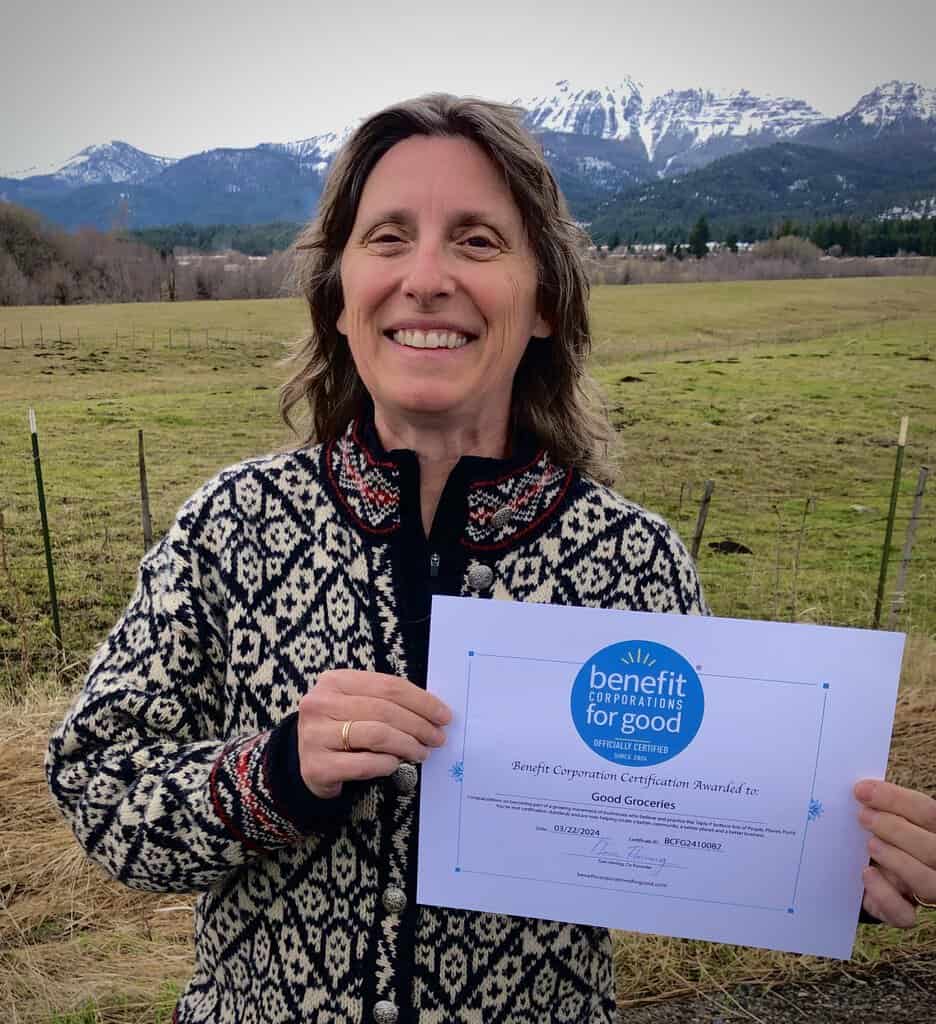
    Kristy Athens of Good Groceries in Wallowa County, Eastern Oregon, joins Kim Allchurch Flick.

    Athens recounts her path from generalist writer to food-systems specialist, including moving to rural White Salmon, writing “Get Your Pitchfork On,” earning an MS in Food Systems and Society, and launching a local gift-box business that evolved into Good Groceries, rebranded in 2024.

    She describes Eastern Oregon’s short growing season and dominance of large-scale commodity agriculture, and how most residents rely on low-priced corporate groceries.

    Good Groceries has grown yearly since 2020, prioritizing paying small farmers while acknowledging higher prices by donating $1 per sale to food pantries and accepting SNAP with Double Up Food Bucks.

    Athens also supports local procurement as a liaison for the Oregon Farm to School Network, discusses pragmatic views on organic and soil care, notes logistical challenges of rural delivery, and urges listeners to buy from local food hubs, CSAs, farm stands, and farmers markets first—“Buy local is not a drill.”

    Listen Now

    Time Stamps

    00:00 Welcome and Guest Intro

    01:15 Kristy’s Rural Journey

    03:18 Food Systems Wake Up Call

    04:07 Launching Good Groceries

    05:55 Eastern Oregon Growing Reality

    08:01 Cheap Food Culture

    09:10 Food Hub Model and Mission

    13:10 SNAP and Access Efforts

    14:10 Farm to School Connections

    15:41 Organic vs Local Nuance

    18:22 Land Stewardship and Awareness

    20:14 Logistics and Scaling Challenges

    23:08 What Keeps Her Hopeful

    24:01 Buy Local Is Not a Drill

    27:49 Dinner Guests and Wrap Up

    Kim Allchurch Flick: Hello everyone. Welcome to the podcast. This is Kim Allchurch Flick. And I’m so happy to be here with Kristy Athens of good groceries. Kristy has an MS in Food Systems and Society from Marylhurst University and is the author of Get Your Pitchfork on The Real Dirt On Country Living.

    She has worked in rural minority economic development for decades, currently connecting Eastern Oregon farmers and school districts as the procurement liaison for the Oregon Farm to School Network and serving for a number of years on the Wallowa County Farmers. Market board. Kristy moved to Wallowa County in 2013 and before that lived in western Oregon, Washington, and the upper Midwest in her spare time, ha ha ha.

    She manages Pitchfork Garden with her spouse, makes collage art, and plays songs on fiddle and electric base. Today we’re gonna talk about how Bilocal is not a drill. Kristy, I’m so excited to have you here. thank you Kim, so much for having me. Thank you. And the Wallowas are beautiful. You live in an amazing place in eastern Oregon.

    And curious, what has been your life journey and inspirations that brought you to the current moment? I. 

    Kristy Athens: I would love to say that it is a linear path, but I don’t think that’s the case. I started out as a writer and as a generalist. I wrote about lots of different industries and, after doing that for oh gosh, probably 15 years. I wanted, I decided I wanted to specialize and around that time my spouse, Mike and I moved from City Life. We had grown up in the Midwest, in Minneapolis, and then we moved to Portland in 1995 and we were looking for something a little more rural. We would go out and hike in the gorge and, fell in love with that area and thought, geez.

    Seeing all these houses on the sides of the road, it’s like, how do these people live here? What are they doing? And so we moved out to white Salmon Washington in 2003 and, that’s how the book Get Your Pitchfork on came about. I learned a lot of lessons not having lived in a rural community.

    There are lots of cultural lessons I learned as well as, how to work the land and that kind of thing. And so I thought other urban people might like a guide to moving to a real place. And when I started doing the research, it was a lot based on my experience, but when I was doing research for that, I was learning more about agriculture and learning nuances like scale and farming methods and different markets and different philosophies about agriculture.

    And that sort of piqued my interest in. In agriculture writ large, but also specifically about small farms because I talked to a few small farmers and one of my friends had also started a farm, moved to the area around the same time as I, and just learning how. Not profitable. That was really surprised me.

    And so I started to get interested in that. And around that time I learned of a brand new master’s program that was at Meryl Hurst University. It was called Food Systems in Society. And I had not yet done a master’s program. And. Finally, I was interested in doing one, and so I joined the first cohort of that in 2013.

    And so it’s a social science degree, so I learned about what are called in quotes, externalities, which means all of the sort of very serious side effects of industrial scale agriculture. Including land grabs and environmental degradation and human rights abuses. And by then I had moved to an even more rural area.

    So in Wallowa County, Oregon where we are now. And I was, so now not only am I learning about in how agriculture works, but I’m learning about rural economies and I originally started a gift box business using the different things that people out here make carb wooden and spoons and different value added food products and things like that.

    And I also, as you mentioned, join the farmer’s market board. And after a couple years of doing the gift boxes, some of the farmers came to me and asked if I would do something like what I was doing for the artist, for the. For the farmers. And I said yeah, that’s what I should be doing anyway so I launched I had a couple of them help me, be on an advisory board and start what is now called good groceries.

    Originally the original gift box business was called Genuine Wallowa County, and then the food delivery was called Genuine Wallowa County Provisions. And then I sold off the gift box piece to another local person and then so I could focus on the food. And so I rebranded the food delivery to good groceries in 2024.

    So that’s my direct line to this position. 

    Kim Allchurch Flick: Wow. You’ve learned so much along the way, and I’m really intrigued in what have been your impressions through time about learning about agriculture and the factory farming side. And also what you’re deeply in now is more the rural local soil carrying side and what are you seeing around you and how are people responding to those differences? 

    Kristy Athens: This area. So first of all Eastern Oregon is a very different growing climate from Western Oregon. I felt like when I lived in St. John’s in Portland, I could throw a candy wrap around the ground and something would grow out of it.

    But out here we have real winter, although we aren’t really having it this year, but that’s another story. We have a very limited growing season for things like tomatoes and basil, and we can have a frost any night of the year. In the middle of summer it can happen. Growing what are called specialty crops, which means everything that’s interesting, all the fruits and vegetables.

    Things that as opposed to commodity crops, which are your wheat and liquid milk and things are sold on a grand scale. So specialty crops are hard to grow out here. The soil is actually good. Unlike a lot of Eastern Oregon we have. Because of the way the mountains are shaped.

    We have more bunch grass than sagebrush and so we have a little bit more moisture. So we have really good soil, but it’s just we’re enterprise is at about 4,200 feet and elevation. And it’s just, it’s harder to grow things here. And just the, climate in agriculture the work that was done over the 20th century to have everything consolidated and and industrialized yeah. Everything out here has been industrial level. So people grow, hundreds of acres of wheat, hundreds of acres of grass hay and raise a lot of cattle out here. Because the land even though the soil could support.

    Different crops, the climate and the season can’t really support them very well. Yeah, so it’s, it’s just like everywhere in the United States, most of the agriculture up here is a large scale

    Kim Allchurch Flick: and what has been the need in the community and some of the solutions with with that climate. 

    Kristy Athens: Most people get their food from a large corporate source. We have one corporate grocery store in our county. And then people travel to others in different areas. I know people will try, will travel two hours to go to Costco in Lewiston.

    They’ll drive to La Grande to go to one of the big box stores there. People in Northeast Oregon, or I different from people anywhere else, most of them are by necessity looking for the lowest price of their food. And, you’ve seen it in news headlines. And I remember even in junior high school there being week or so that we spent in social studies class talking about food system. But every, the whole focus of it was, calculating the cost per ounce of something. And, getting the best deal was definitely the focus. And I think it’s been, we’ve been hardwired for a long time that the cheapest food is the goal.

    And so I’ve got my work cut out for me 

    Kim Allchurch Flick: Indeed. So how is Good groceries doing and how does it fit into these systems? 

    Kristy Athens: It’s going well. As far as growth, it’s the year over year growth. So again, it started in 20. 20. And so I’m closing in on my sixth year. And the year over year growth has been there every year.

    It’s grown every year. But it’s a tiny drop in the bucket of actually feeding people. As I did with the gift boxes, the goal was to create another revenue stream for local people. Here, it’s hard to live out here. People think that things are cheaper in rural places, and that’s not true.

    I think if anything it’s more expensive because of scarcity and, and the, and especially the traveling, that one must due in order to get things or, ordering things that are shipped to you. There’s just a lot of extra and having to drive everywhere. I live four miles from town.

    That’s a long walk. So there’s there are more expenses I think for rural living, but I I have a lot of, colleagues who are doing similar work around the state and around the country. And they, it’s really interesting. Food hubs are approached in from many different directions and they serve many different purposes with different organizations.

    And so what I mean by that is a lot of organizations are. For-profits, a lot of them are nonprofits. And so the food hub in a lot of cases, is a one component of many programs within a nonprofit. Some of them are farmer co-ops. Most of those developed during COVID when they were trying to figure out another way to sell their food when farmer’s markets and other things were closed.

    And so a lot. And then there’s that piece of it, and then. People also come at it from different mission bases. And what I mean by that is a lot of people are looking at food justice on the part of the eater. And which is incredibly important and feeds into that larger conversation of of income inequities that have developed over the last 50 years as well as the industrial agriculture trends that we were talking about earlier.

    But my my focus has been on the farmers because there are so few. Farmers generally. It’s a few, it’s a handful of farmers that run a lot of land out here, and then there are just a very small number of small farms, on 10 or five acres or less. A lot of them are just backyard garden kind of farms.

    We don’t have the big market farms that you have in the Willamette Valley. But I don’t wanna lose those. And my focus has been pay the farmers what they need to make this worthwhile. And in our current capitalists model, it’s really hard to make those two things. Work at the same time.

    Food justice for eaters and income equity for farmers without there being some grant support in the middle. And because I don’t function as a nonprofit, even though I do function as a benefit company which we can talk about as well, but that, that basically is a commitment to focus on the environment and and social justice as well as profit.

    So even though my business is a for-profit, profit is not the main focus. So yeah, so I’ve been focused on paying my farmers and I, in order to. I’m very aware of the fact that in some cases, not all cases, but in some cases, that results in my prices being higher than in a grocery store.

    And to try to compensate for that, I donate a dollar of every sale to the local food pantries. As well as other community giving things, but that in particular. Is it an intention to acknowledge the fact that the pricing, because I’m supporting the farmers, the pricing might be out of reach for some people.

    I also went to the trouble to be able to take snap payments, which if you’ve ever worked with USDA is a huge hassle, but it was also important to me to be able to do that as well. And on now I just just starting in January farmer’s Market Fund in Oregon is supporting my snap payments with double up food bucks.

    So the people who do use Oregon EBT card to buy their groceries at groceries can get half off of their Oregon grown produce. 

    Kim Allchurch Flick: That’s so incredible. I’m curious also about your connection to the schools where a lot of food flows through public schools.

    And what can you tell us about that?

    Kristy Athens: So I do some work on a contract basis with Oregon Farm to School Network. And so I am working with the schools to, to make sure that they take advantage of state funds that are allocated through the Department of Education to school districts to purchase local food for their for their cafeterias.

    And good groceries does not do any wholesale sales. For that same reason that because I’m paying most of the money up to 80% of the retail price goes to the farmer. So there’s no room for me to do any wholesale. With the current model that I have I might, you know, try and work out a different situation in the future, but at this present time, I just sell directly to consumers.

    But I do work as a liaison and so the school districts and the farmers are still making their own contracts with each other, but I’m there to help them find each other. If they have questions about how the program works, I can answer those things like that. But it’s a great opportunity for local schools to support their neighbors, and, in a lot of cases, the kids of the farmers are in the school makes a lot of sense.

    Kim Allchurch Flick: And for the kids’ health and variety of things. And can you share with us your thoughts about the environmental piece of local farming and what you’ve learned about the differences between large factory. Farming and more local. 

    Kristy Athens: It’s an interesting topic. It’s pro, it probably could be its own topic.

    I know we have we don’t have all day to talk, but it is a rich topic and I do think that I do think that it. Is, yeah, it’s something that, it’s something that people should look into from various angles, I guess I would say. And the reason I say that is there are a lot of farmers out here who use organic practices who are not interested in certifying.

    And so for good groceries, I do not require organic certification. And I, I’m, I guess I’m a pragmatist. I think that I understand why chemicals are used sometimes and I also also understand that the word organic has become a bit of a it has. There are realities to organic that a lot of people are not aware of or don’t want to know about.

    ‘Cause there are lots of chemicals that are used in organic farming, especially in industrial organic farming. Personally I would rather eat food from a small non-certified farm then. Industrial organic that you get at a corporate grocery store. That’s my personal my personal preference.

    I, I think that all organic is good. But I do think it’s become a bit of a panacea for some folks. And and I’ll leave it there ’cause it is its own topic for sure. 

    Kim Allchurch Flick: I think there’s another podcast coming up at some point, but we can definitely, I have to get more than 

    Kristy Athens: me on it.

    Kim Allchurch Flick: Indeed. And it’s important. And thank you for that. And I also know that in your area there’s a a ranch that is Regener certified and concerned about soil health. So it seems like in the region there are some people who are really looking at the environmental piece. Yeah, from soil upward and it doesn’t always have to be small.

    Kristy Athens: I would say that all farmers care about soil. It’s just some farmers have a different view of the impact of of traditional agricultural practices. I don’t think that there are farmers that don’t care about soil. I just think that they yeah, they just have a different approach. But yeah.

    I don’t think it was because of a lack of care. I think it’s just a different approach. 

    Kim Allchurch Flick: Yeah. And that makes a lot of sense. And I sense. While it still feels small scale because of things like films like Kiss the Ground, biggest Little Farm, common Ground, those types of films that are talking about agriculture, reaching people that.

    Many of whom never considered where food comes from. And that learning can help move needles of awareness. And I’m wondering what you’re seeing in terms of that awareness of the consumers and awarenesses of the farmers as time goes by. 

    Kristy Athens: As far, if I look at my customer base it’s definitely a lot of people who have moved here from somewhere else who maybe brought their value system with them and also brought a job with them that enables them to be a good groceries customer.

    Yeah. Definitely people everyone who lives in Wallowa County is very, very proud of living here and want to protect it. For example, we’ve had a lot, we have a, Wallowa Land Trust has done a lot of work to preserve. Some lands near the wall Lake. There’s also been some land that’s been returned to the Nez Perce tribe, or oo as the original inhabitants of this area.

    There’s been a great, also the Land Trust has done some great work to work with local ranchers to invite the Nimiipuu. Back here to dig canvas route and do other gatherings that they used to, that they’ve traditionally done in this area. Yeah, again, I don’t think, I don’t think that the love of the land has changed.

    I think maybe some of the processes, people are re reexamining some of the processes. 

    Kim Allchurch Flick: And that’s good. What are some of the obstacles and challenges for you? 

    Kristy Athens: Oh gosh. Where should I start? I mean on the really pinpoint on the ground I have a. Two wheel drive cargo van that has a refrigeration unit in the back and which is great for summertime, but it is impossible.

    Not impossible, but very, very difficult and somewhat dangerous to take. If I because as I mentioned, it’s hard to grow food in Wallowa County, so a lot of the food that I sell is not grown in Wallowa County. That was one of the reasons that I changed the name. So I get a lot of food from the neighboring county, which is Union County.

    That’s where La Grande is located. And then I also get a lot of produce and other food and some really great value added products from two food hubs in Washington. One is in Walla Walla, which is two hours away and one is Puget Sound Food Hub. And they deliver. Orders to Walla if food hub and then I go to Walla Walla and pick up the whole thing and bring it back.

    So I have access to some amazing cheese some kelp snack chips and just all kinds of cool things that I would not be able to carry if I were just relying on our region. And also to get to Walla Walla, I have to go through the Blue Mountains. And in the wintertime, taking a two-wheel drive van over a mountain pass is terrifying, even with studded tires.

    So I have practical limitations like that. I just got a grant slash loan to purchase a four wheel drive van, and I’m very excited about that. And so there’s, yeah, so there’s lots of logistical challenges in that regard. There’s also the challenge of this being a very sparsely populated county.

    There’s 3,500 square miles and 7,500 people. That necessitate has necessitated me moving into, and I am just going to do this next week launch into a weekly delivery to Union County. And so that’s terrific. But that requires an hour plus drive also. So there’s just, there’s a lot of driving.

    The the people who run benefit corporations for good, which is my B company. Certifier, are always pressing me to get an electric van, which I would love to do, but it either needs to be refrigerated or have four wheel drive. So there are those kind of realities at this moment.

    Hopefully that technology will catch up with the need. But yeah, so there’s just lots of challenges, logistical challenges I would say. And then obviously the situation with it just being a short season and hard to grow a variety of crops here. 

    Kim Allchurch Flick: Oh indeed. And what makes you optimistic?

    Kristy Athens: Lots of things. A lot of my existing customers are people who are new to the area. They tend to be in their thirties and they are unwilling to throw their ethics under the bus just for convenience or other considerate air price or anything else.

    They make me optimistic. They are great supporters. They’re super excited about this. And they, they’re telling their friends. They’re making a point of it. So that’s been really great. 

    Kim Allchurch Flick: I really like that thought. Unwilling to throw their ethics under the bus and hopefully all of us how can people reach you?

    That’s easy. Just go to good groceries.shop.

    And is there anything else you’d like to share? Also, thinking about the people that aren’t in the county, but in terms of overall thoughts about how to select food and some of the considerations going to a store. What are some key differences of making a selection that can help us all not throw our ethics under the bus?

    Kristy Athens: For a lot of people, we need in income equality for people to be able to to use that old phrase, vote with your fork. Not a lot of people don’t have as many votes as others, and I definitely don’t want to suggest that if people are buying from large grocery stores that they don’t have ethics.

    It’s, there, there’s a lot to fix. I used to do just as an aside, I used to do a community con, lead a community conversation with Oregon humanities called good food, bad food. And I don’t know if you’re familiar with the conversation project, but it’s it’s not a lecture.

    It’s a conversation. And so we would all be talking, I would, seed the conversation with various aspects of the food system and then we would talk about them. But one of them was that, during the Reagan administration the Emergency Food Assistance Program was developed TFA and it’s still called TFAP or no, it was originally, I just gave away the punchline.

    Originally it was temporary Emergency Food Assistance program, and eventually they just changed the name to the. Emergency Food assistance program because wage inequality has been going on for decades. And eventually it became clear that people are never not in an emergency situation anymore, a lot of people.

    I don’t wanna judge anybody who doesn’t shop at good groceries or any other local farm stand. And there are, I wanna point. Farm stand or food hubs all over the state. So wherever you live in Oregon you can probably find a food hub where you live. But yeah, I think the thing I want to people to take away, despite what I just said, is that, and this is the title of our little program here.

    Buy Local Is Not a Drill. If you can. Find a food hub. Find a CSA, find a farmer’s market. Find a farm stand and go there first. You can always fill in the rest of your list somewhere else, but first buy from your neighbors. Because once if we lose all of our farms. They’re not, if we put buildings and data centers on all of our farmland it’s not gonna come back for a really, really, really long time.

    I don’t think, I think looking at the, our current global situation, I don’t, I think everyone can agree that importing food is not such a great idea or needing, more importantly needing to import it. It’s one thing to import. French wine because you want to, but needing to import our basic staples, I think is everyone can agree is a bad idea.

    And the only way that’s not gonna happen is if people actively seek out local sources of food first. 

    Kim Allchurch Flick: Actively seek out local sources. Yes. And that can vary across regions, counties, and states. But as you said, they are there and they will, they want to sell. They want to continue doing what they’re doing and share food with people.

    And it’s one of my greatest joys is going to a farmer’s market. It’s, they’re fun, they’re. It’s interesting to see what people bring in. It’s fun to talk with people, get to know who the farmer is. 

    Kristy Athens: Yep. 

    Kim Allchurch Flick: Exactly. Indeed. Thank you so much. Thank you for those tips and giving us all food for thought.

    And speaking of food if you could, this is the final question. If you could have dinner with anyone, up to three people living or deceased, who would they be and why? 

    Kristy Athens: Can I have two answers? 

    Kim Allchurch Flick: Absolutely. 

    Kristy Athens: Okay. So my first answer would be my Life group. And that would be my two grandmas and my mother-in-law ’cause I missed them.

    And then my career group would be, also family, my father-in-law because he had a food broker business. When I started dating my spouse in 1990 when we were tiny babies and he had this food broker business. And at the time, like I said, I was a writer and I did not care one bit about his business.

    He died in 2005 and I started doing this food stuff in 2013 with grad school, and boy do I wish I could ask him some questions now. But Jim Menlow and then and then my other two choices were Dolores Huerta. ‘Cause she was so inspirational. So good at motivating people and so food justice oriented a lot of people.

    Might not know who she is, but she was right up there with Cesar Chavez doing the same work. And Cesar gets most of the credit and the streets named after him. But Dolores Huerta is somebody to look up. And then James Beard, another civic, Northwest Hero. The first television chef before Julia Child.

    Although there’s no, no tape of it left anymore. But he is a he is wrote an a million cookbooks and he was probably the first besides native,

    their whole, for millennia. James Beard I think was born. Like early, very early, 19th or 20th century. And he lived in Portland and he and his nanny house person helper would go down to the markets down on the waterfront in Portland. And so he learned to eat oysters as a young boy and learned the importance of.

    Seasonal, eating seasonally and eating from the place you’re in. And so he’s a bastion of regional and seasonal cooking. So I would love to also, he was also if he, especially if he was making dinner, ’cause he was a great chef and and a good he had a good taste in wine from what I understand. Those would be my dinner tables.

    Kim Allchurch Flick: Oh, that’s lovely. And a nod to James Beard is the, Portland is building a new James Beard market in exactly. Downtown, so

    anyone visiting Portland probably into 20 27, 28. I might wanna look that up. Kristy, thank you so much. I love the work you’re doing. The heart and soul you put into the hard work of driving in all four seasons with so much variability and continuing that congratulations on being benefit corporations for good.

    And we’ll put everything in the show notes. Everyone. Thanks for listening. This is Kim Allchurch flick, signing off. 

    This Episode’s Guest: Kristy Athens

    Kristy Athens smiling and holding the Benefit Corporation for Good certificate.

    Kristy has an M.S. in Food Systems and Society from Marylhurst University and is the author of Get Your Pitchfork On!: The Real Dirt on Country Living. She has worked in rural/”minority” economic development for decades, currently connecting Eastern Oregon farmers and school districts as the procurement liaison for the Oregon Farm to School Network, and serving for a number of years on the Wallowa County Farmers Market board. Kristy moved to Wallowa County in 2013, and before that lived in western Oregon/Washington and the upper Midwest. In her spare time (ha ha!) she manages Pitchfork Garden with her spouse, makes collage art, and plays songs on fiddle and electric bass.

  • Innovating for Sustainability with Michael Klepacz of Natural Materials Unlimited

    Innovating for Sustainability with Michael Klepacz of Natural Materials Unlimited

    Michael Klepacz of Natural Materials Unlimited joins Kim Allchurch Flick for a discussion into Michael’s journey from being an aircraft mechanic to becoming a sustainability advocate and business owner in Poland. Topics covered include the benefits of sustainable materials like hemp, the challenges and misconceptions around sustainability, and the importance of making conscious consumer choices. Michael also shares insights on his company’s innovative products and his future aspirations for shifting consumer mindsets toward more eco-friendly alternatives.

    Listen Now

    Time Stamps

    00:00 Introduction and Guest Introduction

    01:06 Michael’s Journey to Sustainability

    02:26 Defining Non-Climate Change Sustainability

    04:07 Challenges in Recycling and Sustainability

    05:54 Starting a Sustainable Business

    09:45 Innovations and Products

    12:59 The Battle Against Polyester

    17:03 Consumer Behavior and Market Challenges

    27:38 Exploring the Cost of Eco-Friendly Products

    28:54 Mindset Shifts Towards Sustainability

    29:43 The Hypocrisy in Cannabis Merchandise

    30:47 The Economics of Hemp Production

    33:52 Defining Sustainability

    41:55 Personal Choices for a Sustainable Lifestyle

    49:52 The Future of Sustainable Living

    56:30 Final Thoughts and Farewell

    Kim Allchurch Flick: Welcome everyone. I’m Kim Allchurch Flick. I am the founder of Mighty Measure, formerly Mighty Epiphyte Consulting, and my company is a B Corp, A People Plus Planet first verified and benefit corporations for good certified company. And I love to talk with founders and people who are interested in making the world a better place through their business and the way they live life.

    Today we have Michael Klepacz of Natural Materials Unlimited and he, on the website, he also has a book you can download called Hemp, the Future of Sustainable Industry. And it’s such a wonderful time to be here with Michael, who I’ve known for a couple of years, never met in person because Michael is speaking to us from Poland.

    So Michael, I would love to. Bring you in and say what interests do you have in, in speaking to people about what you do and your journey and your values to create your company? 

    Michael Klepacz: It started a really long time ago. I used to be an aircraft mechanic. And what actually got me shifted into sustainability was my own health, so I blew out my back when I was 20 in the Air Force working on airplanes.

    And I gained a bunch of weight because I wasn’t as active as I was when I was an aircraft mechanic. But I, but then I started eating really well. ’cause you get paid pretty decent in the Air Force and you don’t have to buy food when you’re young, the young one, you get food for free there.

    And so I just changed my food choices and I got back into good shape and I ended up moving back home. I gained a bunch of weight and. I moved to Poland for a while, which is where I am now. And I lost a bunch of weight. Wow. I’m eating pretty much the same. What’s the deal? I’d never really traveled abroad before, and when I moved back home, I gained a bunch of weight.

    Like this doesn’t make any sense. So I started looking into it and I have a background in project management from the Toyota Corporation. And so I started looking into why is my food making me fat? And then I fell down the rabbit hole of pesticides and herbicides and chemicals that are messing with our bodies and messing with the planet.

    And then it just became like a longevity mission. But in order to do that, then things needed to be sustainable, right? So I’m one of these like non climate change sustainability people, to get that Pandora’s box open right away. 

    Kim Allchurch Flick: Oh goodness. 

    Michael Klepacz: Yeah. Yeah, I know. Yeah. 

    Kim Allchurch Flick: Non climate change sustainability people.

    Michael Klepacz: Yeah.

    Kim Allchurch Flick: Can you define that for us a little bit more? 

    Michael Klepacz: I think in general, people like to latch onto things that they mildly understand, which I refuse to do. Like I’m not a climate scientist. I almost became a geophysicist at one point, but that more had more to do with whether than whether or not a certain molecule does or does not belong in mass in our atmosphere.

    And like I said earlier, I got into sustainability because of longevity. And climate change in general has become politicized and debatable. There are so many people saying it’s true. So many people saying it’s untrue. And I like to focus on things that I can measure and things that are very factual.

    And I could just rattle off a billion of them. Acidification of the oceans, dead zones and Gulfs of Rivers, microplastics, 90 million tons of polyester clothing being not recycled and just put in dumps every year. Cancer clusters, there are just, I could talk for hours about all of these things that are not climate change, that if fixed would fix climate change, including increasing our longevity. So that’s, those are the things that I like to to focus on the real concrete stuff, not the politicized boogeyman. 

    Kim Allchurch Flick: That’s interesting you bring that up too. And there was a, I think it was February 14th, ’cause Valentine’s Day referenced a New York Times article about how recycling is really broken.

    And one of the things they brought up in that is. Fast fashion ending up in landfills all around the world to the point where those countries are saying, no, we’re not your dumping ground anymore. Yeah. So it’s interesting you bring that up because recycling in this country is still a bit of a panacea in the minds of some.

    But this article, it’s really complicated. This before it, it’s been like 20 years of not working well. And this article really brought that up where the holes are in recycling, but also where the hope might be and where the optimism can be as an industry really recognizes itself and changes.

    But how we define things really matters. 

    Michael Klepacz: When I first moved to Poland, they didn’t, well, Warsaw in general the Warsaw metro area, they did, they weren’t even, they didn’t even have a composting program. So actually their laws were made in such a way that technically you could get.

    Food scraps from everybody in all of their condos. ’cause there’s no apartments here. Everyone has a condo, but there’s also hardly any houses here. Anyways. However, because of the way the law was written, if you were collecting the food scraps of a business person, they would have to issue a receipt for their food scraps.

    And so finally some common sense things have changed and we have just like Spain and just like other developed European countries, we have a metal bin, a paper bin, a glass bin, a food bin. So 

    Kim Allchurch Flick: it’s fascinating. I think another thing, a rabbit hole we could go down at some point in time is differences between countries and how countries respond to things.

    So how with this journey you had through the Air Force and that background of everything, how did you journey into creating your company? And what have been the steps along the way? 

    Michael Klepacz: That one is also like a bit of a strange story. So during this whole like eco-friendly rabbit hole that I went down, I ended up buying the website, StopMonsanto.org and like all this stuff.

    And I was too chicken shit. Too scared to publish the website, but at least I owned the domain for a while. And I had quit smoking cigarettes and I’m sure that you know many people who’ve quit smoking after about month 11, they become pretty evangelical about everyone not smoking. So I was freshly into the evangelical stage and I was trying to get my dad to quit smoking.

    And my buddy worked at a local head shop that family friend owned, and, I said, Joe, I said, my dad’s never gonna quit smoking if he’s not gonna. And because it is like before American cigarettes and like all this stuff how can we even make my dad like a healthier smoker, right? Because, like at the time it was all about longevity for me, quality of life.

    So he gives me like the best cigarette tubes, organic tobacco, this, that, and the other thing. And this wax string called hemp wick. And I’m like, what are we gonna do with this hemp wick? He’s you just, you’re supposed to light it and then you can light your cigarette or whatever with the hemp wick.

    And I’m like, that’s dumb. My dad’s never gonna go for that. Anyway, that night I ended up inventing like a hemp dispenser to make it more convenient for my dad to use and. That’s the stepping stone that took me from sustainable agriculture and project management into inventing stuff and kind of becoming actually a business owner.

    And so I had finished a program at UCLA for entrepreneurship. And that invention is what got me accepted to the program. A year later I got accepted to a business school in Poland and I started renting a farm here to do like organic agriculture while I was in business school here doing my bachelor’s and my master’s.

    And then it became clear to me that I needed more money to get the farm off the ground and we had so many extra buildings. So I thought why not start a side hustle basically in one of the buildings and then the side hustle be, became the primary business.

    Kim Allchurch Flick: Wow, that’s fascinating. And along the way what values were you creating this from and what did you learn and if anything changed, how have your values changed in this process?

    Michael Klepacz: I would say my values haven’t changed at all. I said to myself so there’s this design philosophy called permaculture. So permaculture, the design philosophy, permanent culture or permanent agriculture, nobody can agree to what’s what? And Bill Molson’s dead. So he can’t say what it is. But anyhow so I was like, what if like the principles of permaculture and the principles of Burning Man had a baby. And it became a business. And so it turns out that all other people have these ideas and they usually become a B Corp.

    And so that’s how, that’s honestly that was my thinking. Like Burning Man is very leave no trace, radical self inclusion and all this other stuff. And Permaculture is use everything, waste, nothing. I’m very much boiling down the two of them. So that’s how this country, that’s how this company was.

    That was, those were the seeds if Permaculture and Burning Man had a baby that started a business. 

    Kim Allchurch Flick: Oh, that’s fantastic. Yeah. And what is, 

    what have those seeds grown into? 

    Michael Klepacz: So much random stuff. Literally random things. We we started off making hemp wick because I knew companies in America who wanted wax string and at the time, we had no idea when the US would legalize hemp again. Like we knew that everyone felt like it was inevitable, but no one knew where the tipping point was gonna be. Sure, who would’ve thought it’d be 2018? But in the meantime, there were lot, there’s lots of hemp in Europe. And so we grew the hemp, hemp grows all over Europe.

    There’s spinning meals here still that survived that, that make great yarn and lots of beeswax. And so we started doing that. I landed a pretty good client and I just said to them I’ve been working in the hemp industry for a year, deeply within Europe. What else? What else would you want?

    And I’m like, well, can you do a vegan friendly guitar strap? And I’m like, why not? I played guitar. I know what I loved and hated about a guitar strap. And that was basically what we did. I just went to the store and looked at other guitar straps to see what guitar straps looks like now.

    Because I was 16 when I played guitar straps. I was, you know, 20, this was 10 years later maybe guitar straps had evolved. And then, so we did that project. And then it’s like, well, what else do you want? We ended up making, hemp silk robes for some ultimate fighter gig kind of thing.

    Wow. Like one of those, like boxer robes. We’ve done like a lot of dog stuff, like obviously like rope chew toys and things like that. Because the yarns that we use for making the wax yarn for the hemp wick is very specific. And if it falls out of like calibration, you could say so.

    The yarn is supposed to be 1.2 grams per meter, and if it’s 1.1 or 1.3, then we can’t really use it, especially if it’s less than that because then it’s like too thin or it’s too thick, it just doesn’t give the result that we want. So we just set it aside and then when we have enough of it, we spin it into rope and we use that rope to make rope leashes or chew toys.

    Kim Allchurch Flick: Oh, fantastic. So are those parameters for the hemp, is that for clothing or for ropes to hold weight? What are the parameters you spoke of? 

    Michael Klepacz: The per the parameters have to do with the thickness. So like most people say oh yeah, give me a one millimeter yarn, or a two millimeter yarn, or something like that.

    But this number that I mentioned is called Tex, TEX and it’s 1200 grams per kilometer. Yeah. So ours is 200 x sixt, which means. Six, 200 gram yarns, well threads spun together into a yarn. So little yarn lesson for kilometer. 

    Kim Allchurch Flick: I’m just imagining someone outside on a very straight road, which is rare in European countries and measuring a kilometer of rope.

    But it’s fascinating. And in your search for the guitar strap and other things, what have you been replacing? What materials?

    Michael Klepacz: Mostly polyester. Polyester. 

    Kim Allchurch Flick: That’s what I thought. 

    Michael Klepacz: Yeah. Polyester. Polyester is our that’s our thing. I’m just like with the climate change thing, I’m not completely anti polyester.

    I’m practical, my seatbelt’s made from polyester. And I hope that it continues to be for the foreseeable future until we can find something that’s better. Because I wouldn’t wanna wear a hemp seatbelt. I’ve had many vintage cars with original seat belts and they were made of polyester, and there’s a reason why.

    But that being said, something like, handles for bags or exercising straps or leashes for dogs or dog collars or just, you can you name it. It doesn’t need to be made out of polyester. Like polyester is 5 cents a meter, and hemp is a dollar a meter, $2, a dollar 50 a meter, depending on width, like plastic.

    It’s cheap, petroleum’s cheap, and the scale’s huge. If you looked at like the pie chart of global production of textiles, you would see polyester. That’s the big one. It’s like 75%. It’s probably less, but, and then you have cotton, so you have like polyester and other synthetics, and then you have cotton, and then you have a really, really super teeny tiny bit, which is ba fibers, which is hemp.

    Which linen nettle, Romy, Cecil jute, Canna. Those are the big ones. Yeah. And but that used to be the whole pie, like before the 1920s everything was ba fibers or cotton or wool or leather. 

    Kim Allchurch Flick: Yes. 

    Michael Klepacz: That’s it. 

    Kim Allchurch Flick: And that’s only a hundred years, so that, yeah. So that’s a big shift over a period of time.

    Huge. And so how do you see the role you play in future shift?

    Michael Klepacz: For a long time I really wanted to get, like into fashion, but I’m not a billionaire, right? And the, by fashion, I mean textile mail, like the Chinese in general, hemp started their millennia ago. They’ve never had it be illegal. They have billions of dollars invested in the textile space, and they’re not slowing down, for me it’s like all of these microplastics, like most of the microplastics are from clothing in our world, right? And like, all these microplastics are, because, it’s not being replaced by natural materials, and I want to be part of that movement.

    We’re a small team of people, I don’t have major investors. We’re all self-funded, I had to take out a bank loan after COVID, I’m fighting the good fight as fast as I can, but I, yeah, I’ve always wanted to become basically like the vision was always like, I wanna be the apple of eco, like I wanna make and develop mm-hmm. And sell eco-friendly products that just, that just don’t make the world worse. Like it’s impossible to make something like completely plastic free, nobody would buy a dog collar. You would have to get people to just stop using dog leashes and dog collars and actually train your animals before you’re gonna make it completely sustainable. Like it’s impossible to make it completely nonsynthetic. Like you can have it 95% natural, but you’re still gonna have a plastic buckle people oil.

    Why wouldn’t you wanna use a metal buckle then? Like instead of plastic, well pick your poison. They’re both in theory, not great, like metal’s, infinitely recyclable. But what about when you take your dog swimming in the ocean and the springs rust? You know what I mean? That doesn’t happen with plastic.

    What about the fact that it weighs five times more than plastic? What about the fact that the plastic that you use is highly recyclable? So you just have to pick your battles. That’s where I’m at. I’m always just like, which battle do I wanna fight? Right now the battle is microplastics.

    Kim Allchurch Flick: Thank you. And it sounds like there are a few caveats, but there are ways we as consumers can think. So what, for the audience listening, what are some tidbits or ideas or just a thought process where they could start to think about a future purchase and say, these are the considerations for me to switch to, like something that you’re creating or one of those materials you’re talking about.

    How do we even remember to prompt ourselves to say, I could buy this item. 

    How do I consider buying it made of something from your company or another company that’s doing the same thing? How do we start remembering to do that and then start to make it more of a new habit to consider replacing what we can with the materials?

    Michael Klepacz: If you seek out the alternatives, they’re there. The difficulty is getting people to wanna fork it out. One of my most favorite, least favorite stories is what I call like the dollar difference. And I’ll just quickly explain the story.

    ‘Cause this could be maybe a mind shift person, it could shift someone who knows. So I often have brands come to me ’cause I’m a factory. I make stuff like I don’t do brands. I supply brands. Brands are branding and marketing and sales and all the things that I’m just, they’re not my superpower, inventing and problem solving, that’s my superpower. And so one of my clients brought me a job that said, Hey, we want to redo this pillow. So it’s like a meditation pillow full of buckwheat shells.

    So it’s, 35 centimeters around about 15 centimeters tall. I apologize for the metrics everybody, but that’s how my brain works now.

    And he shows it to me. I get one in person ’cause I refuse to work on anything until I physically see what they’re working with right now. I look them up on Amazon, I see their ratings. It’s not great. It’s like three and a half stars and I don’t wanna make something that’s gonna be less than four stars.

    Like I want the goal’s of a five star product, if it’s not a five star, it’s not gonna sell. You know what I mean? And a four star is usually a four star. ’cause they’re mad about something that wasn’t my fault, and so it’s still a five star product, it’s just a four star experience, anyhow, so I said to him like, Hey, how much are you buying this for? And he said I’m buying it from China for $5 a piece. I said, okay, well here’s, it’s got a weak zipper. It’s got really thin outer liner and it, and the shells aren’t the best. What problems have you had? Well, I had one time we had returns because bugs were crawling out of the inside of the pillows.

    Like they weren’t sanitized properly. 

    Oh, okay. Sure. So you’re paying $5 a piece for like non-certified, non cleaned internal shells. And by the time, so your landing price the price that you actually paid by the time it’s in your warehouse is about $11. Am I right? And he’s like, yeah, 10 and a half.

    Okay, fine. Because by the time you pay for import and tax and shipping and this and that, that’s just how it is. It’s the landing price. So I said, look, I said I can make this for you with a heavier zipper. Heavier fabric, linen on the outside, organic cotton on the inside, certified shell and will definitely be paying, playing, paying people like 10, $12 an hour to make it, which is good money in Poland.

    And you know, what happened? He never called back? 

    Kim Allchurch Flick: Why? 

    Michael Klepacz: It was a dollar difference? I don’t know. 

    Never called back. But that kind of stuff happens all the time. So the consumer, the young ones, right? So the young consumers, right? I’m 40, you have someone who’s 20, I have t-shirts and jeans and boots that are 20.

    I’ll have this same leather jacket probably my entire life, you know what I mean? Like you just condition the leather every year. You take care of it, you have it forever, and so younger people, and I was in that boat too, like I’m the captain, planet generation.

    You know what I mean? And just to bash climate change one more time. Imagine if every episode of Cabinet Planet was about the same thing. It wasn’t. It was. Every episode was about a different problem, so I’m trying to captain Planet this problem and so a broad variety of solutions need to come in.

    But either way, so they’re mad about it, but it’s like they don’t wanna spend a dollar more for the organic cotton version or the linen version, or the whatever version. Everybody just wants to buy from Temu or Ali Express or whatever. It’s just for the people who have tight wallets, what you gotta do sometimes, like prices are going up, people are price sensitive.

    So that’s a rough one. 

    Kim Allchurch Flick: Indeed. And we’re speaking in the end of 2025, so that has become increasingly variable in, in some countries as well. 

    Michael Klepacz: Sure. 

    Kim Allchurch Flick: That, it’s fascinating to think about it because every, everybody has a pain point in terms of price and there is a statistic that I quote a lot when I’m speaking with people.

    It comes from Nielsen and they’ve done a lot of studies, but the main one was, I think it was 2014, it said that two thirds of consumers globally, and I’m paraphrasing, are willing to pay more for products and services when they know a company has good values or a company is sustainable. And that’s more the word they used.

    And then in a more recent study, they studied just millennials, and that percentage for the same characteristics is 73%. So that’s where my optimism lies. Yeah. That’s my, where my optimism lies, is that people are looking, they’re seeking and they’re willing to pay more. So something can be at the same price that might even increase the percentage of people, but that are willing to pay more.

    And the big difficulty is how do we make the connection for the consumer to the supplier that the values are there. And 

    Michael Klepacz: yeah. 

    Kim Allchurch Flick: And that’s one of the important things as well. And then you touch on something where it’s the dollar difference. So for some of those people, they might maybe be willing to pay more, but there’s always an upward limit to pay more.

    They may be willing to pay 25 cents more, but would they pay $2 more? And because every, everyone has their parameters for personal reasons and their life experience, right? So it’s super interesting to think about that. And yet, how do you let B2B, B2C, business to business, business to consumer people a, know that your company is out there, your products are out there.

    And find out what are they willing, what are they willing to pay? 

    Michael Klepacz: I mean for me, I do a lot of market in general. So let’s just say a company comes to me and they say, we want you to make this. What I’ll usually do first is I will go online ’cause I have to, I’m in Poland, and Poland is its own special little bubble.

    So you gotta go online and you gotta use VPNs and you gotta use private browsers and all this other stuff so that you get like fresh data, not biased location data. And. You say, okay, let’s see the high, mid and low tier products within this niche, right? Let’s see who the best manufacturers are.

    Let’s see who the worst manufacturers are. Maybe I’ll buy two or three of the worst stuff. Maybe I’ll buy one or two of the best stuff. We’ll bring it in. We will pick it apart. We’ll look at it and we’ll imagine to ourselves, okay, if, let’s just say our goal is we think the consumer based on what’s available would be willing to pay $50 for this due dad.

    And if we can produce this gizmo for $10 or less, it’s fine. So that’s usually like a it’s a times five. Like physical goods, usually like electronics and other things are different margins and I’m not familiar with those markets. But yeah, for the most part, if you are buying something for 50 bucks, it probably costs around $10 worth of materials and labor to produce for the most part.

    Kim Allchurch Flick: Okay. 

    Michael Klepacz: Unless of course it’s super inflated, like a Louis Vuitton bag or whatever,

    Kim Allchurch Flick: yeah. And before you mentioned that something made of polyester might be 25 cents or something you make of hemp is a yeah. So material costs come into play here too. And what are you finding with those other materials from the cotton and some of those other ones?

    Where can you find reasonable materials? 

    Michael Klepacz: Go to, you can go to, for example, you can go to Joanne Fabrics, not like I’m plugging Joanne Fabrics, but just to get an idea, right? And you can, if you ever buy a Hobby lobby or Joanne fabrics, like even if you don’t eat it, just go in one day just to poke around and you can see the price differences.

    So there, they’re talking about the price per yard, right? In general, when I’m buying, it’s linear meters, not square meters, right? Or square yards or whatever. So I’m gonna assume that that’s also true in America. I don’t actually know if they’re doing linear yards or not. So basically what that means is the loom, the weaving machine that made that fabric is only so wide, right?

    It’s not infinitely wide and it’s not super narrow. And so at a narrow point you have webbing and that, and then the wider you get it somewhere becomes, it turns from webbing into fabric. And so if you look and you say, okay, well per linear yard, this is a dollar, this is $2, this is $5, this is $10, this is $20.

    And it’s the same thing with natural materials, right? So you might have, and I’m just going to say a number, some polyester fabric is a as a dollar, but then you also have some crazy like high-end sports fabrics that are super technological or whatever, and they’re as expensive as linen or more.

    And then you have, your price for wool, right? So like, when you’re talking about wool for knitting, you’re talking about kilos. So you’re not really talking about yards. You’re talking about weight. So weight, yeah. Like a beanie might be 110 grams and you know that you’re gonna be spending, 30 euros for Marino wool, or 25 euros, or 20 euros for regular wool, or 15 euros for, 

    I don’t know, 

    22 euros for hemp, or cotton is 10, or some polyester is five.

    I’m just throwing out numbers. Some of them are real, some of them are not. I’m not sure what the synthetic numbers are ’cause I don’t pay attention. But yeah it’s, it’s all over the place, right? And you go to someone, I just. Shameless plugged hemp beanie naturally died.

    With acorns. It’s what makes black like something like this, like I said, 110 grams I did not mean, this is just you’re at my home desk, so I have prototypes everywhere. But like a polyester hat, like you can go on to you can go on to Alibaba and look up a polyester beanie.

    They might be 50 cents or a dollar, and of course by the time you get it, it’s $2, $3, whatever. And yeah, you might have to buy 3000 of ’em to get it at a dollar, sure. But something like this, which is 10 times the price, and it’s like, well, I really wanted to buy something for a dollar and sell it for 20, and then you make $19, or you could buy something for 10 and sell it for 40, and then you’re making $30.

    But then someone’s less apt or less whatever. There’s less people who are willing to buy like a $40 linen beanie or a wool beanie than they are to buy some unbreathable, super sweaty, gross polyester hat. Yeah.

    Kim Allchurch Flick: Oh I understand. What are you seeing in terms of shifts in people’s mindsets though? And I’m, I think I heard a couple of things about I think it was Billie Eilish in her tours and selling swag, and how she and her mother were very much considering what’s eco-friendly, what’s sustainable, and not going down the road of selling polyester based cheap swag t-shirts.

    And so that seems like a mindset shift that one person can shift a whole lot of other people’s thinking. Through fandom and through following. What does it take to have some of those mind shifts and have somebody else thinking, I really want that hemp beanie. I’m willing to pay $10 for it versus the,

    I think 

    the one for a dollar.

    Michael Klepacz: I think that’s a good example. Like we we, I often like the hemp beanies are a great thing for, let’s just say stoner bands, so if you’re like a stoner jam band or whatever, and you have a merch table, I often work in the cannabis space, and so you can go into any dispensary in any state, anywhere in the world and in general, they’re probably gonna have some swag.

    They’re gonna have a beanie, they’re gonna have a hat, they’re gonna have a t-shirt and a hundred percent chance. Not a hundred percent chance ’cause people like me exist, but a ve a small chance that there actually something there that’s made of hemp. Like they’re selling pro cannabis t-shirts made of cotton.

    They’re selling pro cannabis t-shirts made of polyester, and it’s really hypocritical. 

    Kim Allchurch Flick: Oh, that’s so interesting. Yeah. Yeah. That’s so interesting. It also sounds like the, your consumer base B2B or B2C, it could be really broad too, and if people really thought about it, they could have the products you’re talking about as an option.

    Michael Klepacz: Yeah, and the thing is too is that like this huge price difference is totally all about scale. You know what I mean? Sure. Like at one point in history, like there were something like 2 million acres of hemp being grown, and if there were still 2 million acres of hemp. The yarns and the fabrics made of hemp would not be $20 a yard, $25 a kilo because there’d be scale.

    So it’s just like you just have to vote with your wallet and once you can get it there, it’s like there, there are investors who are like, we want to invest into hemp. But, and like it’s an emerging market, I should say. It’s a re-emerging market, right? Yes. It’s a market that’s regrowing, the hemp industry here used was almost dead.

    Like at one point when I moved here, there was like 2000 acres of hemp left in Poland and now it’s bounced. It started to bounce back up. But like we are nowhere near our global maximum of hemp production again. And when you look at things like , the Horizon grants from the European Union, like any of these grant systems that are really about sustainability and stuff, or I have just tons of books.

    Like I, I bought this book about sustainable fashion and I saw it online. I just wanted it, I needed to have it. And I was so excited to see what this person was gonna talk about. And like hemp was mentioned once, like bass fibers in general I’m more of a bass fiber person these days than a hemp person.

    Like it really depends on where you are. Like the closer to the equator you are, the less you should be growing hemp. There’s a sweet spot for hemp. And there’s other bass fibers that are available for different climates. But either way, like this is cellulose, at the end of the day, as boring as it is, paper cellulose clothing is cellulose.

    All of our microplastics were synthetic replacements for cellulose. And so we need to be able to produce as much good cellulose, real cellulose as possible, and there’s a lot of interest in keeping things the way they are. Like that’s how cannabis became illegal in the first place was paper barons who owned forests and newspapers.

    Imagine being the guy who owned the forest and the newspapers and the paper mill. So you own the forest, the paper mill, and the company that needed the paper all at the same time. And then hemp is threatening you, therefore cannabis is bad. And that’s not even a conspiracy.

    That’s historical fact. 

    Kim Allchurch Flick: Yes. 

    Michael Klepacz: Read about it in my book that you can download for free. 

    I don’t really talk about it in there, 

    Kim Allchurch Flick: But it’s true. And we’ve seen that with other things like. When cars started emerging and being affordable for families.

    The tire industry and the vehicle industry fought the railroads because there could have been more mass transportation via rail and they said no and Right. That’s some historical fact as well. It’s really interesting to think about, but you also queued up a word which I want to quiz you about a little bit in terms of definition and that word is sustainable and sustainability.

    And we talked about one of my experiences where there were some volunteers at at a place where I went to, and they were talking about sustainable palm oil, and they b and Sweeten had been given the information to, to talk with people. And as I talked about it, I said, well, what does that mean? To you.

    And they said, well, Palm is something that grows. So you cut it, it’s like grass, it grows back so you don’t have to cut it down and replant it. And I said, yep. And where is it from? And usually from like Malaysian, Borneo, other areas like this. And he said, so what was cut down for the palm to be planted?

    And it turns out they, they didn’t know. But when we think about it, many, many, many hectares of forest habitat. So when that happens, what does the world word sustainability mean? And 

    Michael Klepacz: Right. 

    Kim Allchurch Flick: That’s something if we can hit on some kind of a common narrative and definition, because sustainability, especially in the B Corps world, is a word that has.

    Been bantered so much that the actual definition is somewhat dubious and sometimes we don’t know what other people are saying. So if palm oil is sustainable Yeah. But still has a negative impact on the planet how do we talk about what might have a positive impact on the planet, still be a product and Right.

    What does sustainability mean there? And so what are your thoughts on sustainability and sustainable? 

    Michael Klepacz: I’m pretty black and white about it. So I rattled some feathers. So last year I gave a speech for the Project Management Institute and I rattled a bunch of feathers talking about this exact topic.

    So sustainability has a lot of different definitions to a lot of different people. But for me I believe in this idea that we’re on a finite planet. And that this biosphere has this ability to regenerate. And that is because of the seasons and the water cycles and the nitrogen cycles and all this other stuff.

    But if we are extracting soil and trees and plants and oil and whatever faster, then it can regenerate, then we are unsustainable. And so if you look at I don’t remember the name of the project, but there’s basically, there’s a project that talks about it. It ranks every country in planets.

    And how many planets we would need if everybody lived like that country. And like the bottom on the rung is like Yemen. And the top of the rung is like the Saudi Arabia or UAE or something like that. And somewhere in the middle is the United States where if everybody in the whole world, ’cause because that’s the goal right now, right?

    Like the goal of quote unquote developing countries and all this and that is to not be developing or to not be a third world or whatever. And to have all the stuff and to consume all the things. And that’s the point. If everybody lived like Americans, we would need six planets. You know what I mean?

    And so like when I read Michael Pollan’s article talking about 10 calories of energy goes into producing one calorie of food that’s not sustainable. You know what I mean? And people think that we’re just gonna invent our way through some scientific miracle into using. Into being able to still use 600% of our planet’s resources, basically.

    And so I’m always just asking myself very plainly, does this lead to 0.99999 and it’s worth of resources, which is less than a hundred percent or not black and white. That’s it. That’s sustainability. 

    Kim Allchurch Flick: That’s fascinating. 

    Michael Klepacz: Super simple. 

    Kim Allchurch Flick: That’s fascinating. 

    Michael Klepacz: It’s that easy. It’s really freaking hard.

    It makes people very angry. But that’s it. It either uses more than one plant’s worth of resources a year and contributes to it, or it doesn’t, or, there are so many I’m gonna get on a high horse now. There are so much low hanging fruit that we can do as a society. So we are smart, we know how to do nature better than nature.

    You know what I mean? Compost teas and natural fertilizers and just all this other stuff. You know what I mean? I think one of the most radical things you can do is have a garden.

    Kim Allchurch Flick: I love that. 

    Michael Klepacz: There’s, it’s, it are things that we could be doing tomorrow just if I were king of the world, and I could just wave a magic wand and snap my fingers and a couple of things were changed, it would be a different place because it doesn’t have to be worse.

    Everyone’s oh, you just want us to go live in mud huts and loincloths or whatever. It’s by the way, cob houses, sand, clay and grass are awesome houses. There are people who pay a ton of money for artisans to come and build them a cob house.

    So, yeah, that’s a mud hut. It’s just a fancy mansion, and it’s like in Poland, we still have thatched roofs. I have a buddy with thatched roofs and it’s pretty crazy to look at,

    Kim Allchurch Flick: they’re very thick. It’s, it is incredible. Oh yeah. 

    Michael Klepacz: They’re wild. They’re wild. But it’s like the house, the houses that are made of natural stuff are so cozy when they’re made.

    Right, and so that’s, to get back to my point, is that we can do nature better than nature. And I don’t know if it’s a real phrase or not, but don’t they say that you can’t fight nature. Isn’t that a thing? You can’t fight nature. So then why the hell do we still try? Like why can’t we just finally start trying to enhance nature?

    If you think about it, like there’s no such thing as perpetual energy, but gravity and sunshine and nature is as damn close as we can get to it. 

    Kim Allchurch Flick: Indeed. And it reminds me of a book. Robin Wall Kimer, who is a, she’s our First Nations author, has written several things, but her premise comes down to don’t extract, be reciprocal.

    And we can live as one planet in parity because if what we take, we also give back. So we don’t need 1.2 to 2.5 to six planets. 

    Per person lifestyle

    and that wisdom, that goes back, it, it’s current in her books that goes back hundreds of years to how people lived. And so I thought it started thinking because it hadn’t occurred to me.

    What about the laws of. Don’t extract, just don’t do it. And and in a conversation about, we’re remodeling a kitchen and I was trying to find the most eco-friendly countertop, and this has taken like weeks worth of research to do. And somebody said why don’t you just go with the most equal friendly thing there is granite?

    And I said, no, because it’s extractive. Because I had learned from Robin ER’s book, what is the price you pay to extract something? And often when we extract, we don’t put things back. When somebody’s mining, sure. They don’t go back and fill the holes necessarily. So it’s interesting how it, it’s a thought process at a time.

    And sometimes it’s just a word like extraction that can, it sent me down a new thought process to think how do I consider, and if something’s extractive, would I do it or not? And it. It’s intriguing that we also have minds that can start to think along those ways as well. If we train ourselves.

    The other thing we’re trying to do in our household is reduce plastic. I would love to get it to zero with food, unless you grow yourself or go to a farmer’s markets, it’s almost impossible to get to zero. But there are ways to make decisions. So that is, packaging is a big part of a decision and instead of wanting a thing, I look at a category and say, I’m only gonna buy a thing if it’s not wrapped in plastic.

    Or if the packaging is not good. And it’s a process of elimination that now it’s more like a treasure hunt. It’s not that I want the thing so much, it’s that I want something that will suffice, that is also considerate in terms of. I have been able to reduce, and this is me also being optimistic because of people like you who are innovators, finding ways to do something differently that works.

    Laundry and cleaning that’s plant-based and the packaging is zero. Plastic has taken that category of life, laundry and cleaning to zero plastic so we can do it. And the parody of price was actually pretty interesting. It did. It has not cost a lot more to do that. So I think what that word sustainable is.

    The next question is how do you view the materials in general, but what is your, what gives you optimism for adoption To reach more people and have them go through the thought process to say, I’m gonna support Michael’s company. I’m gonna try and shift things one at a time. Whether it’s cleaning supplies, food, apparel, house housewares.

    What are some things that I don’t know, slowly encourage people to shift to what you’re doing. 

    Michael Klepacz: People usually, so there’s a lot of co cognitive dissonance, like people just wanna stay focused on what they know, what they love, people wanna be comfortable or whatever.

    This is a silly example and it doesn’t really answer your question, but it’s just like, do you know how crazy everyone’s going to think even with your crowd, that I make my own deodorant. I’ve been making my own deodorant for like 15 years, and everybody could make their own deodorant and it works better.

    I was on a vacation and I ran out of deodorant. I planned poorly and I ran out and I had to buy the commercial stuff. And my wife said to me, you smell terrible today. And I was like, yeah, it’s this store-bought deodorant , it’s garbage. And and so she was like I always thought you were weird ’cause you made your own deodorant.

    It just works better, you know what I mean? Smelling bad is just bacteria, and deodorant generally prevents the bacteria from growing. And it’s like, there’s little silly things like that. We, people don’t even make their own soap anymore. You know what I mean? And I don’t know, I just I just wanna see people do something small to do anything.

    Go to a farmer’s market, make some soap, do something, right? It’s I often think if there were some EMP or some massive solar flare or whatever, there’s no more YouTube, just everyone’s , everyone born after my, not everybody of course, but people born after the 1980s or just.

    Gonna be in a tough spot, like all the only digitals, the digital generation’s gonna be really screwed. You have to at some point take responsibility for your existence and want to somehow relieve the pressure that you’re putting on the planet. I know a ton of people who are super smart, who are like, well, I’m just not gonna have kids because I don’t want to add to the problem.

    And I’m like, but you’re the kind of person who needs to be having kids. Like people who think like you should be having kids, not people who think the opposite, having six, no offense to people who have six 

    Kim Allchurch Flick: And the future of good brains and innovators and people who are learning and thinking along those ways.

    I, I love that. And I think that is part of it, and I love. Seeing people that have kids and bringing them up to play in dirt and to have wonder about birds and to look at a tree. Yeah. And see how magnificent it is. Things of that nature. 

    Michael Klepacz: Yeah. I was teaching my daughter how to identify buckeye trees.

    So Buckeye trees and horse chestnuts are nearly identical except for the little bud the terminal leaf bud on the end of their branch during, once the leaves fall off, unless, you know, oh, I have to look for a smooth light gray bark. And these leaf buds you’re not gonna know that it’s a horse chestnut, but I talked, but she wanted to find the little Buckeyes, and she’s like, daddy, where can I find the Buckeyes? I’m like, just look for the trees that are this color. There are many trees that are that color, but that narrows it down. And then when you walk up to it, look at the branch and then look down and you’ll find them.

    And speaking of not being extractive. Like you try, I’m such a girl dad now, but you try telling a five-year-old girl not to pick every flower. I try. I’m like, you’re not allowed to pick the last flower. Those flowers have worked really hard to grow and they still need to, have food for the bees.

    So they still need to make seeds. So there’s flowers next year, like you can take one flower of each color. That’s it. And if there’s only two left, you’re not allowed to have it. 

    Kim Allchurch Flick: That’s so sweet. That’s so sweet. I know. And what kind of clothing is she wearing? What are the materials that her clothes are made of?

    Michael Klepacz: She wears a lot of, we’re like you for seasons. So she wears a lot of wool. A lot of wool.

    She also wears, cotton and linen, but she does not wear synthetics. 

    Kim Allchurch Flick: Yeah.

    Michael Klepacz: The only synthetics she has because I can’t say, do not, ’cause I would be lying, would be like pajamas that the grandparents in America bought her or whatever.

    Because wearing polyester pajamas to bed is normal in America, and then you like sweat in it. And there’s studies that talk about what happens when you wear synthetics and it just leeches chemicals back into your skin and all that stuff. And we wonder people are saying things like, well, our testosterone’s down and our sperm con’s down and this is down.

    And like the generation that was just born has a life’s expectancy less than ours. Why is that? How is it with all of these magical medicines and everything? Well, we’re just making our own more and more toxic. Because we want stuff. So our desire for stuff outweighs our desire to have a good, long life.

    Like the thing that should make people really angry that can makes me angry is like our meat suits hashtag Supernatural. That’s where I got the word supernaturals TV show. I love that show. They called it meat suits. Anyway so these meat suits could, in theory, live to be 120 and could you imagine like walking around like a 70-year-old or an 80-year-old does at 110?

    Do you know what I mean? Look at Dick Van Dyke. Dick Van Dyke is like 99, a hundred and i’m happy he’s still around, but I wouldn’t wanna be stuck at that meat suit, and but just imagine that, imagine being how Dick Van Dyke is now at 119, that’s 20 years later.

    You know what I mean? And we can’t because we’ve created this world that’s killing us slowly. It’s a soft kill. We have all of these chemicals, mostly, it’s mostly chemicals, and it’s all chemicals that, I mean, prior to the 1930s, we had mercury and other crazy things that we would do that would poison us, that we didn’t know about.

    But we’re still poisoning ourselves, thanks a lot indeed. Dow Chemicals and Bayer, indeed, Monsanto and everybody for the Forever Chemicals. 

    Kim Allchurch Flick: I love this conversation. I wanna end it up on optimism and a little story. 

    Michael Klepacz: And I’m so angry, Kim. 

    Kim Allchurch Flick: I know I went to Costa Rica for the first time in, gosh, about 30 years.

    And I didn’t realize the last time I was there that it had been deforested mostly for agriculture and industry. Down to about 25% of rainforest in a country that, except for the beach, it’s usually close to 99% of rainforest. If no humans were there and was just there staying in ecological only, and more than one person who didn’t know each other said that in the areas where we were staying, there’s such a move to regenerate agriculture and we stayed an ecolog that was growing their own food, with small exception for some organic, or emphasis on organic that they bought from a neighboring farm.

    The cows were there and both places where we stayed had been pasture.

    Now forest on several hectares growing their own food and to a person, they said that Costa Rica is now at 50%. So in that short period of time, like three decades before, they have regenerated from 20, less than 25% forest to 50.

    They also said there is still one of their biggest crops to export is pineapple. The people that fed us and grew their own pineapple and they also had small batch coffee and cocoa, but they grew everything else, they said they would never eat the commercial pineapple because of the pesticides. But they would eat the organic and how much differently it tastes. And the optimism part is a how quickly things rebound from less than 25% forest, which is 75 plus percent deforestation to. 50 in just a few short years. It’s like one early adult lifetime to make that difference, to have people be cognizant about it, to see what regenerative ag is one of the other things I’m really optimistic about.

    And that means biodiversity. It means understanding soil. There’s a ranch, Carmen Ranch in the Willows, Oregon, who a woman is trying to really restore tall grass prairie, and she understands what hoofed animals do and earn the first regenerative ranching certificate all on a hundred percent grass fed beef.

    And the thing is, we can choose to eat the beef or not. She sells beef, but yet knowing what she’s doing is really doing some climate change. So these are the things that make me optimistic are the innovators like you and the people who understand how things work. And that’s a pivotal point, I think is.

    We’ve gotta understand the how and why, and if we don’t know, at least learning along the way, and going back to the Robin Wal Kimer discussion about how to not extract and how to give back and how to be reciprocal so we can eat, but we can also feed the planet . So what are your thoughts about that?

    And then tell me if you could have anyone living or dead to dinner to have a continuing discussion, who would it be? 

    Michael Klepacz: Okay. Yeah, I would love to see, I would love to see us reciprocal more. I imagine one of these days I’m going to be involved in a real estate project where I get to do some consulting.

    I’d like to put my consulting hat and we’re going to design a whole condo. That doesn’t use drinking water to flush the toilet. ’cause that’s pretty insane. Like I on my LinkedIn, anyone can follow me on LinkedIn. I have crazy Wednesdays where I always rant about just a sentence or two of crazy things.

    And so yeah, using our drinking water to flush our own shit is pretty crazy, especially when we all have roofs and the surface area of those roofs is definitely big enough to handle the amount of toilet water volume that we need. It just makes sense. Or like what if every apartment had a chute for their food, instead of being ground up and putting back under the water or whatever.

    Like what if all of our cooking gas came from the biogas created from our building? You know what I mean? We generate so much weight, do you know the phrase, too poor to have a pot to piss in or piss pour? You would say, you know what they, you know where that comes from? Yes. Okay. Since most people don’t, back in the day before we invented the system to produce ammonia that we have now, which is nitrogen for agriculture. You used to sell your piss, so everyone had a pot to piss in, and you would sell it for agriculture. And so if you were too poor to have a pot to piss in, you didn’t even have enough money to buy the bucket to piss in it to sell your own urine.

    True story. Anyway. George Washington, 

    Kim Allchurch Flick: your dinner companion, what would the conversation be? 

    Michael Klepacz: Yeah I wanna talk to George Washington about hemp because there’s a lot of people who talk about the founding fathers and their love of hemp. I wanna know how true it is. There’s just, there’s so many like anecdotal things like, oh, it was they made it mandatory to grow hemp and all the founding fathers had there’s like a story there’s a book called The Emperor Wears No Clothes by Jack Hare.

    It’s all about hemp and cannabis. And he says in the book that apparently back in the day when Thomas Jefferson, was the ambassador to France, he hired mercenaries from Turkey to invade China to steal hemp seeds. And that, because it used to be punishable by death to export hemp seeds from China because that was their military industrial complex thing.

    Like you grew the hemp fiber for the sails and the rope and the clothing, and then the woody bits you burned for gunpowder, and so the hemp was really important for them. And so apparently there was some. Spy stuff, espionage stuff going on with America and China to steal their genetics to start the hemp industry here.

    And I just wanna know how true it’s, I wanna, I would love to have that conversation. 

    Kim Allchurch Flick: Yeah. That’s fascinating considering that companies like Monsanto have strict rules and patent processes on their seeds and they control 

    Michael Klepacz: it’s genetic pollution and it should be labeled as terrorism. 

    Kim Allchurch Flick: Yes.

    On that note , first of all, I love our conversations and I see how I would actually love to have you back to continue it because we’re talking about a large topic and details about it. Thank you in summary for some of the steps that you’ve helped provide to how we can rethink things, a purchase at a time or a thought process at a time and to make things better.

    And everyone listening, thank you so much. And what we’ll put in the show notes is the website, which is Natural Materials Unlimited is the company, NaturalMaterials.eu, is the website and you can download Hemp The Future of Sustainable Industry.

    And that is fascinating. I’ve read that and we appreciate it very much. This is Kim Allchurch Flick of Mighty Measure saying Goodbye, and we appreciate you. 

    Michael Klepacz: Thank you very much. Buy it nice or buy it twice. 

    This Episode’s Guest: Michael Klepacz

    Headshot of Michael Klepacz, smiling at the camera with trees in the background.

    Michael Klepacz is known for growing Natural Materials Unlimited into a lean, high-output producer of hemp wick and other natural-fiber goods while keeping the focus on honesty, usefulness, and craft.

  • Reforestation and Permaculture: Reconnecting People with Nature with Jason Yhost of Planet A-mor

    Reforestation and Permaculture: Reconnecting People with Nature with Jason Yhost of Planet A-mor

    Jason Yhost is a Miami-based permaculture designer working with Planet A-mor, a reforestation and improved forest-management project on 1,000 hectares of previously deforested land in Peru.

    Yhost shares his path from farming and professional volleyball to permaculture work in schools and communities, then joining Planet A-mor after reconnecting with its Danish CEO and learning the project’s origin story involving a Peruvian landowner.

    Jason and Kim discuss the need for transparency tools, monitoring, and funding to scale infrastructure, greenhouses, lodging, and technology, plus the challenge of engaging local communities through practical benefits like food and clean water.

    The conversation covers regenerative agriculture, native plants, trees’ role in urban resilience, examples of ecosystem recovery, and individual actions, partnerships, and investment opportunities to support Planet Amor.

    Listen Now

    Time Stamps

    00:00 Welcome and Guest Intro

    00:40 B Corp BeeHive Connection

    01:33 Jason’s Path to Permaculture

    03:26 Planet A-mor Origin Story

    05:46 Building Transparency Tech

    06:58 Reconnecting People and Forests

    09:06 Costa Rica Reforestation Lessons

    10:21 Miami Challenges and Tree Solutions

    15:05 Small Actions Create Big Change

    18:20 Scaling Planet Amor Obstacles

    19:57 Community Buy In and Food Culture

    27:09 Perception Shifts and Rewilding

    31:31 Optimism and the Soybean Example

    32:14 Let Farmers Farm

    33:31 Regenerative Proof Stories

    34:27 Seed Banks and Forest Recovery

    35:40 Common Sense Over Culture Wars

    37:07 Staying Positive by Solving

    38:07 Trash Pickup and Accountability

    39:28 Propaganda and Nature Perspective

    41:49 Local Wins and Dam Removals

    46:17 Rethinking Lawns and Beauty

    48:57 Kids Gardening and Real Food

    51:57 Meat Debate and Local Farms

    55:26 Convenience Culture and Waste

    57:24 Support Planet A-mor

    59:18 Banana Flour and Closing

    Kim Allchurch Flick: Hello everyone. This is Kim Allchurch Flick with a really, really interesting guest today. This is Jason Yost of who was a permaculture designer in Miami, Florida. Born in San Diego and working with Planet Amor for about four years. He’s passionate about prosperity, joy, neighborliness, and celebrating cultural differences as gifts that we give to each other.

    The topic of this is reforestation, improved forest management. Welcome. I’m so happy to have you here. 

    Jason Yhost: Thank you very much, Kim. It’s a pleasure to finally connect after a little back and forth.

    Kim Allchurch Flick: Absolutely. And we met because of B Lab. B Corps companies have what’s called the beehive, which is a place where people share information, and that’s where I found you and planet more.

    And I thought, oh. We have to have a conversation, so I’m so glad you’re here. 

    Jason Yhost: Absolutely. And it feels like, the beehive might be the first really functional application of social media. Kind of feels like a social media platform when I’m on there and it’s just people trying to do good work. So it’s a nice one.

    We’re B Corp certified actually, so that was just pending for a while and then now

    the last few months. So I just got on there. 

    Kim Allchurch Flick: Congratulations. Yeah. And as, as listeners know from my company, I help companies certify and my company just re-certified in November. I understand your pain and also the excitement of going, getting it done, so congratulations.

    So talk to us a little bit about your, the journey that brought you here to this place in time and what values led you to Planet a more. 

    Jason Yhost: So I’ve always been a nature lover and a bit of a green thumb. After college I did some farming, just for fun and while I had some other things going on.

    And then you fast forward I was involved in some things. I had played professional volleyball for a while in Europe. And then I came home and I wasn’t really sure what to do. I got involved in some tourism stuff and had started a business which the pandemic destroyed thoroughly. And I was talking to a friend of mine and he was a permaculture designer and he was doing installations and all that, and I just started volunteering for him and I loved it, it was nice to be back connecting, digging holes, planting trees, all that good stuff.

    And. Over a few years. I, he, right away he offered to start paying me just ’cause he liked working with me and things were going well ’cause I was doing it for free for a while, for fun. And so then I got into it for a few years, worked from for some different people and really getting to learn a lot.

    I got certified myself. Did some really interesting like school and apartment projects, really working a lot with kids and trying to replace the food in people’s grocery carts, with things that were growing at their school. And it was pretty cool. A lot of fun. Then I reconnected a few years ago with, at the same time I was doing this with our CEO, who was a friend of mine from beach volleyball.

    And we just started chatting. We hadn’t chatted for a while and then he said, Hey, what are you doing now? He’s from Denmark, he’s from Copenhagen. And I said, oh, I’m working in permaculture, this and that. And he said, no way. That’s crazy. I just started a permaculture company. We’re in Peru let’s meet, I’ll tell you all about it.

    We’ll talk and come to find out it was this planet of More, and it was one, it is 1000 hectares that was deforested a long time ago I believe by a European agriculture endeavor. And and then sold and left bear. Wow. So it was bought originally by our Peruvian owner. Then my friend Michael, I’ll try and it’s a really beautiful story.

    I’ll try and tell a very short version. He was on a motorcycle tour of South America. He’s like a sustainability guy, entrepreneur, et cetera.

    At this point, he was in his fifties and in the very remote part in the mountains of Peru. He got in a motorcycle wreck in the middle of the night and serendipitously.

    The Peruvian man who owns this land, rescued him, helped him, found them there. They were remote, no hospital, no hotel, no nothing. Helped him get back to Lima, get the bike there, took care of ’em, helped him get to a hospital. Thankfully he could speak a little English. My friend could speak a little Spanish.

    So they got all sorted out. Some months, maybe a year go by and he says, I’d like to thank you for helping me. How can I do that? My friend, the my friend the Peruvian guy said, well, I’ve got this land and I know I want to fix it. I bought it to do something with it and I don’t know what to do. And my Danish friend said, I’ll write you a plan.

    How we do that? Did it, studied permaculture, studied all these things, carbon markets, all this. Wrote ’em the business plan. And he loved it so much. He said, let’s do this together. Then there came in a third guy as well, a friend, another Danish guy who the two Danish guys had done business and worked together throughout their lives and other things.

    And he said, this is the third guy we need to make it happen. And then it was formed and they started planting trees very slowly. As anyone who has any experience in the snows, it goes very, very slow. So I got involved first. Helping to write some grants some uplink grants, and just getting to know the project, started studying carbon markets a little bit to help ’em out.

    Giving them some ideas. And then it just blossomed into this relationship where all of a sudden I was in, and we were working together and doing things, and it’s a startup and everyone’s been working for free for most of the entire project. And and here we are now and I’m responsible for a lot of our technology stuff.

    A lot of the things that we’re doing, we found there’s, a lack of the things we need to provide transparency. So we’re building a lot of things ourselves. Okay. In order to do things with, transparency, data verification, monitoring, all these kinds of things. We have to piece together a lot that will be, known to the world here pretty soon.

    And I do that, I do a lot of, 

    Trying to connect investors with our land. And 

    yeah, I do a lot of the white collar kind of stuff you could say. I’ve got my own business here doing permaculture designs, vegetable gardens, that stuff here in south Florida, my blue collar where I go and sweat and get my hands dirty.

    And then and then I’ve got this beautiful, beautiful thing. I’ve been to the land in Peru. I’ve seen it. It’s. The most inspiring thing I’ve ever done. When we first met, you said you didn’t want to do anything else, and that was the very same feeling that I got when I was there. I would like to finish this land that we have.

    I would like to expand and buy more land. I’d like to move into other countries ’cause it’s really all about, and I think we’re touching on some of the things you wanted to chat about today. It’s really about reconnecting people with nature. We get all these terms, these buzzwords, all these hot things, oh this is, climate finance and this and that.

    And really what it is a remembering of how people live with nature. There’s nothing new about what we’re doing. It’s actually, in my opinion, quite old. And we’ve labeled it new and we’ve tried to put science into it, which can help and that’s great. However. It’s just what we’ve always done before we had the capacity to do things at such large scale with technology the way it is, you, you just didn’t have the means to cut down a whole forest in a meaningful amount of time to sell the whole forest.

    You had to work with your part and you worked with nature and you found value in having the animals around. So for me, permaculture is just reconnecting people with what’s around them. Reimagining how we deal with forests, improve forest management is one of the real topics now.

    It’s like how do we get forest products and have more forest? People will never stop needing what comes from the forest. So how do we do that? And it’s easy. It’s not easy, if everyone gets on board, it’ll be easy. Yeah, 

    getting 

    easier more support.

    Kim Allchurch Flick: And I think, yeah, what we’re both chatting about as well is people don’t know what they don’t know.

    Sometimes we don’t look deep enough into where does our food come from and what are the alternatives if where it’s being sourced from is a burden on the planet, there are some alternative ways to get food that makes the planet healthier. And as you were speaking, I was thinking about the native wisdom.

    That there are people even alive now that were children when their land was taken, but they tell stories in the local tribes here about how being out in the forests and in the prairies was like being in a grocery store. Yeah. They knew where everything was. They know the reciprocity of everything.

    And then. It was taken away and now it’s a Superfund site. So there’s all this, but I’m also very optimistic. I was mentioning to you a short trip to Costa Rica for almost three weeks, only in eco lodges, but I’d been there before and thought it was beautiful. What I didn’t know when I was there before was it was deforested down to 25% remaining forest in the country.

    And when we went back last year, just a few months ago, every naturalist guide to a person said that the country has invested, and it is now re forested to slightly above 50%. And a lot of it is small plots, small farmers who are doing everything in a biodiverse way, which means native plants are growing with crop plants.

    The crop plants are native and they, every single one of them won’t buy a pineapple if it’s mass produced. They will if it’s off of their farm, but it’s changing a country. And so what we’re going to talk about during this time is also how can we think as individuals, even if we don’t have land, but if you have something or know somebody who does, how can it shape our perceptions about a, how we buy, what we think about, where our food comes from, and helping others who are the heavy hitters, like Planet Amor, who are doing some really big things.

    Jason Yhost: Yeah, I I’ve been able to have some really interesting conversations actually with people because in South Florida, I live down here in Miami and most of my time has actually been spent living in Fort Lauderdale. Just for those who are detail oriented and really care, it’s just normally easier to say Miami.

    And we have some really interesting issues, obstacles, heat flooding. Income inequality, all of these things, right? Like I, I personally am not on a crusade against wealthy people. I just think there’s a bare minimum that everyone can be afforded and we can probably find that, scraping the barrel a little bit.

    I think, such a place like the United States could really provide a quality of life for others. And, wealthy people, that’s cool. Most of them work very, very hard. I think, not to go on this crazy tangent, but I think wealthy people often don’t get enough credit for how hard they work and a lot of the, where their mind goes.

    And we have some really interesting dynamics here and I’m constantly preaching to everyone about how we need more trees. Trees will solve all of it. We have flooding problems, let’s. Plant trees, let’s we don’t see animals anymore. Let’s plant trees. We are hungry. Let’s plant trees.

    It’s too hot. Let’s plant some trees. We can do all of these things and solve so many of our problems. And, I’m constantly on this work to get people to replace their ornamentals with natives. 

    Kim Allchurch Flick: Natives, yes.

    Jason Yhost: We, it’s like I recently met a park ranger who gave me A-A-P-D-F that somebody in Florida had produced where it’s like, if you wanna produce or if you wanna plant this, consider planting this instead.

    And it’s all this beautiful, like substitutes with flowers and butterflies and birds and it’s really magical. And I think that those are some of the, when we say we don’t know what we don’t know, it’s sharing with people the value in that. I think that this is such an interesting place because it’s, it’s hard to talk about certain things because it automatically comes, with the climate of our culture at the moment. If you have an opinion, it comes in a basket of all the opinions. And so I tow the line here a lot with the conversations that I have. And it’s also unique because even the most diehard of people that you would think normally are not gonna care about the environment here, they love it.

    They’re water people. They love the Everglades, they love the ocean. 

    They love their stone crab and all of these things, and they see the value right away their houses on the intercoastal, on a waterway. And so we can bridge a lot of gaps. I always talk about let’s think about it simply, let’s talk about water.

    Do you feel comfortable drinking the water that comes from your faucet? Do you feel comfortable diving into the nearest waterway? Could we maybe reimagine how we’re treating that? There’s muscle repopulation programs in the intercoastal to start cleaning up the waterway, right? Like, I think so much common sense has been removed from our system, and I think that’s where we start.

    We start by sharing with people and connecting and meeting ’em where they’re at and finding what they care about and saying, Hey, this is how it’s deteriorating and this is a really simple way that we can bring it back. I don’t want to take things away from people. I want to have healthier systems so that we can all have more and have easier lives and enjoy our lives.

    And I think generally speaking, that if people feel like their baselines are taken care of, they have the capacity to care about others more. This watching out for themselves, and the selfish mentality comes from feeling not safe. And so if you could feel a little safer, if you could feel like the people around you were your allies instead of trying to come to get something from you, I think in your intro I had forgotten that I wrote that neighborliness is something that I really pray for a lot in my life.

    And it’s it’s like a fundamental thing that to me is what it is to be from the United States to be an American, you could say. And I think that comes with a level of caring about the people around you. And I think that’s missing from us a bit. And so that’s, being willing to talk about a group of people the way that you might talk about one person.

    We all, 

    you 

    could point to any group of people that has a stereotype, however, everyone knows someone who isn’t that. And it’s like, we’ll begin to talk about that group of people the same way that you would talk about that one person that you actually know. And I think there’s so many of these simple common sense things where we be kind to each other and we start to just pay a little more attention.

    And that’s where I think all the change comes from, whether you’re a big fish or a little fish, I shared with you earlier the universal arises from the specific, it’s something that, that really touched me in my life when I heard it, the idea that nothing was something that everyone did until someone did it, and

    until someone did it, and it catches on. And so these little changes that feel like it’s too much for one person to do that’s just not how it works. If you want something to be a trend, someone has to do it first. Someone has to be a thing. And let that be inspiring to others. Let them see you. We all probably have stories where we’ve been touched by something that someone did and they didn’t know we were watching, or they didn’t know that we knew that they did that.

    And we carry that with us in our lives. And so lives 

    Kim Allchurch Flick: Indeed. And sometimes just a little pearl of information. Like this happened to a friend of mine who started a restaurant based on the information that a hundred percent grass fed beef is much better for the planet and the individual than factory farmed and veganism is important too, but this is just to, to share some information.

    And his doctor told him that if he was going to eat beef at all, to eat a hundred percent grassfed, so he’s the kind of PhD scientist who did a deep dive on it, came out with Joel s you know, regenerative ag and. Books and data that showed why. And the why is stressed animals are like us. If we’re stressed, we’re not healthy.

    There’s high. Cortisols affects our lipid levels, blood pressure, everything that passes on down the food chain, grazing animals. It’s known that grazing is important for grass, for prairie, for a lot of things. And every animal contributes in terms of manure, which is healthy. Walking through it and cutting the grass makes everything healthier.

    And they’re healthier because of it. They’re eating things, their bodies were planting seeds, seed, stomping those seeds into the dirt, making the soil healthier. So the seed bank is so much better. And there’s a couple of films that talk about this. Kiss the Ground common Ground, which is the sequel biggest little farm.

    And there’s another one called the Serengeti Rules. And it’s more of a global film, but it’s a beautiful film about what is an apex predator and sometimes apex species are grazing animals. Why It makes the world so much better. And anytime I drive by a field that someone’s plowing and dust is rising up, I know the soil’s not healthy just because of watching one of those films saying, okay who’s planting their crops with cover crops?

    Who’s doing it? So the soil is getting healthy and everything you’re talking about are things that we can think about doing on a small scale too, even in a backyard. And so I was wondering what, you’ve talked about the problems that that were first noticed when the, your company was started.

    What are the problems are rising up that you see in the company sees as problems to be solved and what’s happening around you, where people are catching on?

    Jason Yhost: Wow. So I think there are, for anyone who’s involved already in the things that we’re doing who might be listening, they know all of the bureaucracy that it takes to do this. Yes, how expensive it is. That’s been actually one of the most mind blowing parts to me, is for all the good intentions, it is not easy.

    Our biggest problem is, yes, funding to scale, to pay more workers to be able to commit to a salary for people there. Like we’re creating a bunch of jobs and we can only create what we can guarantee. We need better greenhouses, more greenhouses. We can, we’re really interested in scaling up.

    Workers. So we need more places for them to stay. It costs money to to get the materials there, to build and to assemble all that, all of these things you would do to scale up. Eventually we’re gonna be planting with a thousand hectares, we’re gonna be planting far away, so that’s gonna take investment to be able to make that possible.

    Iot devices, all of these things that come with not just a forest, but also what you might need for carbon credits or for B Corp certifications. Sure. Like liquidity must be everyone’s number one issue when it comes to on the ground. I would say from my time there, speaking for myself, I think if you were talking to one of our owners, you would get different answers and they would also probably be very interesting.

    For me, the biggest hurdle. Is is helping the, because we do a lot of support for the local people we work with the, we work with, local communities as much as we can. We do a lot of support, some interesting things. And I’m 90%, maybe 99% sure that basically all of them, except for maybe our engineer and some of our workers, don’t grasp exactly what we’re doing.

    So Ashika is like a huge, there’s millions of people with different, I don’t know a ton about it. I just know that it’s, it’s a, people from the Amazon before these borders of countries were here. Okay. And so they’re extremely buried from A to Z. What type of practices remain?

    What new ones they have? It’s a huge community and so I, I certainly don’t speak for all of them in our area. I can only describe it as disconnected. They grow yuca and plantains and like sweet potatoes. We get all these interesting local things, Peruvian things. And the main staple for many people is rice with a small side of yuca and potato and plantain, right?

    Like they’re buying an imported starch that has basically the same digestive function as most of it. And having smaller portions of these foods that they grow around them. It’s almost like someone played a trick on them and convinced them something. The last time I was there we picked vegetables, peppers, and turmeric, different things 

    From the garden right outside the kitchen on the land there that they the lady that we pay when we go and visit, we hire a lady to cook meals. We bring like investors and different things down to see it. It’s the most touching special. I absolutely love it. It was my Thanksgiving last year.

    Thanksgiving’s my favorite holiday and I went down there instead and I had two pieces of white bread. ’cause we got there late and, it was like a little late night snack. I had two pieces of white bread with a fried egg as my Thanksgiving dinner and it was like, it was so touching.

    Normally I go crazy. But, they, it took us going out there to pick the things and in showing her how to incorporate them into the food, she didn’t realize that there was food and things out there. They were buying like broccoli and rice to feed us. And it’s like, I don’t want this rice, I want twice as much yuca, plantain and sweet potato.

    And it’s, and you don’t go demanding things. You don’t want to go and tell people how to live. It’s like showing them and reconnecting and inspiring. Like we, this is my favorite story. 

    Absolutely. 

    They under, they have chickens, right? They know chickens give you eggs, you can eat the chickens, whatever, the ducks.

    No. So we gave them ducks on the land to start breeding the ducks. Then they can get eggs and eventually we can be eating ducks. Just trying to provide food sources. Biodiversity, the whole thing, right? It’s a fantastic thing to have more animals. And it’s like a working farm and people live there.

    They go, you have to get there by boat. So they spend a few days there at a time, and then they go home and back and forth. So there has to be lodging, food, a kitchen, et cetera. Right away they just ate the ducks. No more ducks. And when you scale that out, when you extrapolate that to all the changes we would like to make and all the things we would like to do to improve the quality of water, right?

    I don’t want to tell anyone how to live. I wanna make sure they have clean water. I wanna make sure their food is good. I wanna make sure that they can meet the opportunities that they want for themselves. Live the life you want. Not really a too much concern to me. As long as it’s a good, healthy one your children have options.

    You feel safe, you feel well fed, right? And so there’s a minimum need, kind of what I touched on earlier, where we have to touch their lives and inspire their lives, the local people and let them see a benefit to their own lives personally, in a small way in their stomach, in their kids’ opportunities, in their wallet.

    Somehow that, oh, I’m interested in what they’re doing. Nobody’s listening. We can’t show up with a thousand ducks and say, now you have ducks. Your problems are solved. That’s like a month of good eaten, and the ducks are gone. What it is two ducks, four ducks per family, three families over and over again until they really are like ducks.

    I love this. Thank you. And they tell somebody else. And those people want ducks. And in a year, then there’s a thousand ducks because we started one at a time. And if somebody eats the ducks, we give ’em four more ducks. And we say, try it again. You see those guys, they got eggs, there is there is this level of disconnection where they’re buying food, buying medicine and buying water, we can clean the water instead, they can have clean water themselves.

    These kinds of improvements and. I before I went, I thought it would be easy to do that. And it’s not. People have to really it’s like the old saying, I used to do a lot of coaching. And especially with young kids, they say, and maybe teachers know this, they don’t care what you know until they know that you care.

    And so if you are less hungry and we sit down and we have some beers, then maybe you’re listening to me about the ducks. You’re not listening to me about the ducks when I show up and you speak a dialect that I don’t understand and you’re not listening to me and I get that.

    I wouldn’t wanna listen to you either. And so working like, can we produce things at a higher quality on our land in a really good regenerative agriculture way? That cost slightly less. Like organic people are not gonna pay extra for organic. They don’t care. Nobody cares. And so they just see that a kilo of limes is 5% cheaper, 10% cheaper, the quality is as good or better.

    And then they’re interested and they notice that maybe our presence is helping. And they’re curious. They see that we helped send a kid who wanted to study something to a university because she was really interested in music or art or agroforestry or engineering or whatever, and it wasn’t gonna happen.

    And we were able to help with that. Then they’re gonna listen. And so there’s the way, one of the biggest obstacles is, the World Economic Forum has nothing to do with the Han Inca. They don’t care at all about the un And these goals, they don’t care at all. Zero. Explain a carbon market to them.

    They don’t, they, it’s, they could understand if they had some idea of the reality that we are living over here and they don’t care about any of that. And so finding ways to connect with them to improve the life of the people around there, to make a ripple in a way that is inspiring, that we can have clean water, clean food, less import, right?

    I would love for them to import less rice from Asia or wherever that rice is coming from and stick to local products that are more delicious, healthier, cheaper, just all, it’s just all around better. Of course you can still have rice if you want it, but that’s not the biggest part of your plate.

    So that’s where I find, hopefully I answered your question. I, I find a lot of words very easily

    Kim Allchurch Flick: I think you’re touching on something too. And a lot of it has to do with perception and. And it makes me think about what people see now, what is their perception?

    A golf course can look beautiful to someone who doesn’t know what was there before or didn’t think about it. I grew up in England where when I was a kid I thought pastures and mall and hedgerows were absolutely beautiful and rolling hills and all of that. And then I grew up and start learning more and more about what was there first.

    And those are overgrazed and England is in trouble. And there are people like a man named Jake Fis, who wrote Land Healer just recently about, I was trying to turn that around, but I hadn’t seen a forest in England except maybe a couple small spots and what it would mean to reforest. There’s a farm in England called the nep, K and EPP that was dying.

    And Elizabeth Tree and her husband decided to do something differently. They were almost going bankrupt. And she wrote a book called Wilding about the 20 years of them bringing a variety of grazing animals in not to eat, but to actually wander to plant some more native plants to save an oak tree that was living by itself.

    And oak trees like to be closer together and to really learn about healing the soil. And now they have a place where you can go and stay in a tent and eat from the land and tour and learn. And it’s our perception. And I brought up golf courses because there are a couple places now that are actually reforesting golf courses and turning them into public spaces for everyone.

    And the amount of water it takes goes way down. The amount of heat generated way down, the amount of joy for the people that are visiting way up, more birds, more all sorts of things. And in Costa Rica, that had been down to 25% deforestation. We stayed in two eco lodges, one in the Caribbean side, one on the Pacific.

    And on the Pacific, a man from France came in and bought it cow pastures. And now it’s 10 years in. And he said, with planting, he said, the first ones to show up were the birds. Took five years for the monkeys to come back. And when they did, he said, now I know I’ve made it. Now I know that this is a habitat.

    This is a biodiverse habitat where everybody gets to play and be in like a, it’s a community and how important it is to support all the layers from soil to pollinators to bigger creatures. And I think that’s what you’re talking about. And, but you talked about the obstacles. Some people are against that.

    Some people see land is developable for a lot of money. How can we balance that as a species? And I was wondering what makes you optimistic and what can we tell people to look for, even if it’s small, to think about ways that we can support what people like you are doing or the biggest little farm or people that are truly doing regenerative ag.

    Where I live, Carmen Ranch is the first, I believe it’s the first regenerate certified ranch in the country. Because she’s actively restoring tall grass prairie with a hundred percent grass fed beef. And even if people don’t eat the beef, know that that land is becoming healthier. So it’s sometimes it’s not about what is the cow part of it, except they’re the ones making the land better.

    And how do we reframe things? So I was wondering if you could speak to that a little bit about what people can start to notice, how they can contribute, how they can contribute to planet and more so you, your work grows bigger and affects more land, more people. How can we make progress together as a community when we don’t always see that there’s a problem?

    Because what we’re looking at, like a golf course or a beautiful pasture look beautiful. And yet can, our framing is all what we know. 

    Jason Yhost: That’s true. My, my favorite example actually, i’ll touch on one and share maybe a little more in detail. My opinion on the other. One that most people will probably know is most recently we had this soybean debate, this big debacle about what are we gonna do with all of our soybeans?

    If I’m not mistaken, the government subsidizes the farmers to grow those soybeans. Someone is in the comments or knows better than me please help. I believe we make that viable for the farmers through subsidies and the fact that when there was not a buyer for our soybeans, right?

    We just had this big thing with China and they buy the majority of our soybeans, but they also don’t eat, they give it to animals. And that’s a separate thing. So we spend all of our resources to feed animals in other countries, which is absolutely insane to me. But never once in the entire conversation did I ever hear anyone, no matter what their opinion was.

    I’m shouting from the rooftops, but nobody’s listening is, how about we just let the farmers farm? How about we stop subsidizing the food that isn’t food, that’s, that we can use as like a leverage tactic and other countries are using as a manipulation tool. How about we just let farmers farm? I bet they don’t want to grow only soybeans.

    I bet they’d like to plant trees and have animals and have healthy biodiverse systems where they feel comfortable walking outside and eating their own food. I feel like we have enough land in the United States that we could start to localize a lot of people’s products. So much of it, imagine all these subsidies go to helping farmers convert to biodiverse stable systems to improving the logistics and supply chains of connecting local people to their farms of sharing all the data.

    Like, all you have to do is listen to the testimonials of farmers of ranchers who have switched to letting their animals graze. Like there, there isn’t a single, I’ve never heard of anything. Maybe they’re out there of somebody saying, you know what? This made things worse. I have to go back. I haven’t heard it.

    I haven’t heard it. 

    Kim Allchurch Flick: I agree with you. And that brings me to those two films. The first was Kiss the Ground Second, the sequel Common Ground. About that very thing. And there’s a farmer in both movies who was losing so much money because the industry had said, you need all these chemicals to support your soil, to give the plants more nutrients, all purchased.

    And his boundary is with another farmer. He decided, no, I’m going to do this differently. I’m not gonna plow anymore. I’m gonna have cover crop. I’m not, I’m gonna regenerate. I’m going to throw compost back into the soil. We’re gonna churn everything back into the soil. And there is a line where the neighbor is doing it.

    The well, the current more factory ways. Conventional way. Yeah. Would say conventional. And that land looks almost barren next door to the southern man that it bounced back. And I’ve noticed. Even in a small forest that I live on that is being regenerated with the help of a grant from Clark Conservation District the person who owned this before us used to mow down in the forest.

    We started letting everything own except for noxious weeds and just have pathways. And in six years, more and more comes up each year. And one of the experts that was down here was saying, it’s the beauty of a seed bank. And when you, when a tree falls, leave it there or wood chip it, put it back on, let things start to rot back into the ’cause.

    It’s not wrought in a bad way. It is, it’s a beautiful cycle of nature to have things be able to go back into the soil. And I started taking pictures year over year to see the change because you can’t always remember it. There’s a place where the first picture I ever took it was just trees and nothing but moss.

    Now it’s several species of ground cover and medium sized shrubs. That all came from a seed bank that was just waiting to be left alone. 

    Jason Yhost: Waiting to be left alone. Exactly. Yep. Exactly. Yeah. I think of all these kinds of things, and I think I tend to be kind of a one trick pony.

    I have a lot of opinions about a lot of things, and really it just comes down to like common sense and paying attention is like my number one thing. The other example that I, that we don’t have to dive into, ’cause it isn’t exactly nature related, it’s similar in thought process to me, to the soybean thing, which is when we maybe a couple years ago we had the big baby formula thing, and everyone was losing their mind, we don’t have enough baby formula.

    What are we gonna do? And. Never once. Never once did I hear a conversation about breastfeeding. I get it, that maybe there are not, maybe there are women who can’t breastfeed and they need formula. However, if we were having actual conversations about women’s health and about nutrition, then there wouldn’t be, there would be plenty of formula for the women who actually naturally couldn’t breastfeed.

    That must be such a small percentage compared to the norm, right? And not wanting to is not the same, right? That’s a stigma thing. That’s a cultural thing. Never once did we have a conversation about women’s health, about breastfeeding, about why do we actually need all of this baby formula.

    And we don’t have to dive into that. However, there’s all these things, right? When the conversation starts about formula, about soybeans, I’m like, why are we talking about this? It’s all dumb. Why are we arguing about the best way to preserve a system that doesn’t help anybody? It’s like, it just doesn’t compute to me.

    And so that’s naturally where I go. You asked me about staying positive. I’m just like that. It’s never had to be any work for me, to be honest with you. I just am happy to be alive. I think the world’s wonderful. And, for every problem there’s a solution, and it’s like, where does your mind go?

    If you were to tell me that you were thirsty, I don’t sit around thinking how sad. And imagine a dry mouth. I think of water, maybe a beer. If you’re old enough, maybe you’d like some juice or some lemonade. Like, where’s a water fountain? Do you have a bottle? Like, when you tell me you’re thirsty, that’s where my mind goes.

    I’m just like that. It’s easy for me. I love being alive. I love connecting with people. I love. All kinds of things. And for me it’s easy to make that connection to, I don’t dwell on things, I’m pretty sensitive to negativity. So when people start saying, a lot it’s you’re gonna get whatever you focus on.

    You’re part of shaping all of this, just like the rest of us. And so our attitudes mean a lot. The effort that we give, it’s, it’s kind of that universal to the specific thing is do you want to complain or do you just want to be able to live with yourself? Like I pick up trash everywhere I go.

    I have this big project that I’m working on for the city of Fort Lauderdale. There’s a venue, a big festival where they leave a lot of trash on the beach. And I’m kind of on this crusade to, to get some accountability so that when it’s over, they clean it up. And I pick up trash everywhere I go, boom, boom, boom.

    I just put it in my pocket, I throw it away, whatever. I don’t pick up gross stuff, but and it’s easy to be like, how can people don’t throw away their trash? And then, and it’s easy to feel overwhelmed and it’s also easy to look at that and say, if I don’t pick it up, it’s gonna sit there and at least that one won’t be there anymore.

    Kim Allchurch Flick: I call this karma pickups that it’s not my trash, it’s somebody else’s, but I still picked it up. So the world’s a better place in that little, 

    Jason Yhost: yeah. Yeah. That’s nice. I frame it a little different. I just say there has to be balance in the world, and there’s some people not picking up enough trash, so some of us have to pick up a little extra.

    And then soon everyone will just be responsible for their own. And so there will be balance and nobody has to pick up more trash than their own. That’s where my mind goes with that. But it’s the same as the karma thing. It’s just I don’t get defeated because things are a certain way, I always imagine that.

    Things are a pendulum and we’re swinging back the other way. For everything that’s happening, there’s a bunch of people who are sick of it, and no matter what you really believe in our society, I believe most people are very level-headed, very reasonable, ready to be neighborly.

    And really we live in, now get a little, bigger picture. We live in a giant propaganda machine, and what that machine feeds you is the really extreme ends of everything. And the majority of us live in the middle. However, many people are not stopping to think, wait, this person actually doesn’t represent no matter what they believe.

    This person doesn’t really represent what most of us think. And if I talk to anyone that I know, they’re far more reasonable and level headed and somewhere falling in this just want everyone to be happy kind of area. And so it’s easy to feel overwhelmed if you have that sort of personality where you think that the person screaming way over there and the person screaming way over there somehow represent most of us.

    They don’t, and it’s, there’s no money in, there’s no revenue, there’s no profit in letting a bunch of reasonable people be the voice for the majority, and so in knowing all of that, I just, I don’t get too down, I just like, I don’t think that we can really pollute water. I don’t think that we can ruin nature.

    I think we ruin water for ourselves. I think we ruin nature for ourselves and the other animals that are around. And if we make it bad enough, we are toast. And then nature will be fine. I don’t grieve for the earth, it’s not the earth. It’s not nature that suffers, right? Like it’s a very.

    Arrogant human thing to think that we can contaminate water and somehow the water is ruined. The water is the water, and the stuff in it is bad for us. The water will be fine and eventually the water will figure out how to clean itself. The landfills are cleaning themselves. All that will sort itself out.

    It’s just us. We’re cutting ourselves out of the equation. And that is something I would like for us to also keep enjoying life and live it in a balanced way, so I don’t think that I think it’s a human thing to think that humans are in control of everything and we’re not. And I find also a lot of peace in that, we’re gonna swing the pendulum and it’s gonna swing.

    And I think, hopefully it lands in the middle. I don’t know if that’s ever a thing. However I’m full of optimism. I’m full of belief in the power of nature and the power of inspiring people. And, that’s just where I’m at. It’s easy for me to be that way. 

    Kim Allchurch Flick: Can I share a couple of observations that were sparked in me while you were talking and it’s observations about where I live, but I think we can all ask questions wherever we live or wherever we go.

    But in the Portland, Oregon area of what I’ve noticed is there’s, over the last 20 years ago or so, and I didn’t even know this until recently because of the expert who does the planting, but there’s been an increase of what’s called bioswales where instead of putting water down a storm drain from the road, ’cause we get heavy rain here, it goes into a bioswale and they’ve been able to test it and they know how much pollutants and matter are captured that are not going all the way down the sewer system.

    So that’s one on small scale. There are so many nonprofits that are doing really niche and wonderful things. Like we have growing gardens, which deals with. Underprivileged and underserved communities to help them with gardens, even if it’s as small as containers on a patio or a deck. But they work in larger scales for community gardens as well, and they’re teaching people how to grow food, how to create nutrition out of it.

    And it’s such a bonding experience. There’s another one, a friend of mine has created a nonprofit to make medicinal gardens so physicians can actually write a prescription for these people to be able to go and cool and get the produce as a prescription. Friends of Trees is planted well over a million trees now, and we have a problem in Oregon where I’d say probably 30 years ago, plus no one built buildings with air conditioning, but heat in the summer that.

    Demands it. And most people who are underserved can’t afford it. So trees are a big part of that shade really, really helps. And underserved communities often don’t have the trees that richer communities. Do you know these organizations are doing that? And on scale from local, the things that you’re doing internationally as well?

    I think what we can all think about is what’s, what small things can we do on our own? If we don’t work in an organization that’s doing really, really big things, what can we do on our own? And then also, who can we support? Who are the heavy hitters, like Planet A more that we can support? So we’re all making a con contribution for regeneration.

    And it, and I know a lot of the references I had like Reading Healer, it’s quite scientific. It’s a wonderful book, but lighter reading is anything by Robin Wall, Kimmler about. Reciprocity and regeneration. She makes short books that speak to the heart of exactly what we’re talking about, and it brings in community as well.

    And another thing that just recently happened, and this involves the local tribes as well, is there are dams all over the place in Oregon and four were taken down, I think four four at the Oregon California border. It’s the Klamath area. And Senator Merkley was involved in that as well. Those dams came down after 60 years of no salmon.

    And wow. There were plantings like hun, tens of thousands of new plantings along the stream bed, making the stream better for young salmon. The native people reported that they saw salmon coming back within four to six weeks. 

    Jason Yhost: Wow.

    Kim Allchurch Flick: If you give nature a break. It’s amazing what can happen. And the same thing in Washugal Washington, a smaller dam that was built for Girl Scouts primarily 60 years ago so they could play and have camping and getting canoes.

    The water level got so hot, well too high and too hot. Salmon couldn’t live. And on the Wild Boy, boy Creek that comes out of that, they decided with the tribes to take the dam down. It’s a process. You don’t just knock it down, gotta prepare all the downstream. The stream had been denuded to bedrock and salmon can’t live on bedrock.

    They need organic matter. They planted, the dam came down within six weeks they had salmon, DNA. Wow. Amazing. So that makes me so optimistic. If we give things a chance to breathe the way they were supposed to. I’m a big com proponent, and I know I get pushed back on this ’cause people love lawns and they’re a place to play.

    Think of something else you can put there. Lawns take a lot. They release a lot of carbon. They take a lot of water. Yes, people like to play on lawns, but as I have literally killed a lot of my lawn through, shading it out and put in bark chips and pathways and ground covers that the dogs can run through by water.

    Less the number of birds and butterflies and all sorts of breeders that are, and it’s a small little backyard. 

    Jason Yhost: And your trees, 

    if there’s trees there, they’re probably doing better. 

    Kim Allchurch Flick: They’re every, everything’s healthier. And it’s such a remarkable thing to think about, but there was a time when I thought lawns were beautiful.

    I don’t anymore, but it’s, so we gotta give ourselves a little grace for having grown up with, ’cause most of us were born after a lot of deforestation. After a lot of sub developments with lawns. So we didn’t see what was before. So I want to really say that giving us all grace, that we only, we have a baseline and that baseline may be devoid of the knowledge of what the possibility of what had been.

    And to see something regenerate and come back can help us reset. And that’s where we can see beauty again. And to me, a forest with trees that are half down and all sorts of variety of plants coming up to somebody it looked, might look messy and chaotic. Nothing’s in rows, but to me it’s abs absolutely beautiful.

    And I think that’s what you’re talking about as well, is there’s a new beauty to be observed. And that’s in the movie, the Serengeti rules too. That’s about nature being regenerated. There’s, it’s amazing what we, what I didn’t know. Was possible when we leave nature alone. 

    Jason Yhost: Absolutely. It’s really amazing.

    Really, really amazing. We got it took almost no time at all, and we got leaf cutter ants back on our land. 

    there, there are, we have two kinds of monkeys. They don’t come into what’s been reforest yet. They stay, we have some places in our plot that were never cut down.

    And so those stay preserved. And so they, they tend to live in there. I think they know that they could be dinner, to be honest with you, if they come around the people there will, if it looks like it has meat on it, it could end up on a grill. So I think the monkeys are smarter than that, than to come around.

    Eventually they will, but yeah, I mean it’s really amazing how nature works. In terms of making an impact. I guess I would start with like an individual level. We talked a little bit in the beginning, I like to take my own to-go cup, whether that’s like my metal steel thing to get my coffee or my little ceramic espresso mug.

    If I don’t have the other one, I’ll take that and I’ll ask them to put my to-go coffee in there. Typically your small businesses are the ones that will do it and the big places are the ones that won’t anyway. So you’re doing yourself also a favor avoiding that moldy giant brand coffee.

    It’s got mycotoxins in it, so watch out. Those little things. For me, like every time you’ve mentioned the balcony gardening, I think of the value of connecting kids with food and with plants. Like adults are gonna be adults in some care and some don’t, and there’s not really much changing that in any significant way.

    However children are the action. I, I remember when I first started doing this, my first project I ever worked on, we built. A food forest, a farm, like row beds, this giant thing in a school. And there was this particular tree that was always fruiting. These little red berries, we call it like bubble gum tree or Jamaican chariot has all these cute names and the fruit are delicious.

    They’re highly perishable. You never see ’em in the store. It’s a beautiful tree. And I would eat a bunch while I was working. I’d be working, I’d eat some, and the kids would walk by and they would look at me like I was crazy. The idea that somebody would be eating something from a plant was entirely foreign to them.

    If it doesn’t come wrapped in a bag from Publix, from the grocery store, they do not recognize it as food. And over a few years, slowly, we had a garden club. We had kids taking things of produce home. The, when the kids were walking by the tree instead of looking crazy, they would 

    Show their friends how they were edible. And they’d all be picking ’em and eating ’em. And those are the ones who grow up to care about having their herbs on their patio. Those are the ones. If a parent is out there and really wants to affect the world in a meaningful way, grow some cilantro on your balcony.

    Like if nothing else, it’s cheaper, it’s more delicious. They’ll have fun planting the seeds. The, you can send them down ai, rabbit holes. You’re not gonna stop them from the technology, the computer stuff. So give them something interesting and meaningful to study. Tell them to tell you all about it.

    Find out about soil. There’s interesting videos and books. If you can connect kids with food and disconnect them from the idea that everything has to come from the grocery store. We’ve solved so many problems at once. We’ve solved people, getting outside, getting fresh air. We’ve solved a nutrition problem.

    We’ve solved a sustainability problem. We’ve solved like a circular finance kind of thing. We’ve taken at least a little bit of the revenue from these giant places that don’t give a crap about you and probably put it somehow in some, unless you’re getting, everything from Home Depot.

    Find a nursery around you. Be really mindful. You were talking about grass fed beef to tell a personal story, I tried for a while to stop eating meat. And it was terribly unhealthy. My, and I was with a woman at the time who was like vegan while she was a power lifter, and we were doing all the beans and doing all the, doing all the food, right?

    I’m not a processed food kind of guy. Like I was eating a ton. I was doing my best with all the, mushrooms and chickpeas and black beans and all these ways you can get all your protein and all that. And my hair was brittle, my nails. I looked unhealthy, I had no energy, and I couldn’t eat enough by the end.

    And I started eating meat again and I instantly felt better. Like right away. There are just those people who are not gonna be vegetarians. We’re never gonna force veganism or vegetarianism on the world. As an American, I highly resent the idea that people would produce these like fake patties and try to convince us that it’s somehow healthier than, this processed fake meat is somehow a healthier and more environmentally sustainable alternative to animals.

    This idea to me, and I’m probably ruffling a lot of feathers when I say this good thing I did it at the end is I don’t think that burping or farting cows are an issue at all. I think that people who want to change what we feed these animals so that they’re less gassy, I think that is stupid. Sorry to be offensive.

    However, if we put these cows in pastures where there’s biodiversity, nobody’s talking about the methane, are there more grazing animals and cows now in the world? Or are there less trees, bigger cities, more people, entirely different cultures, right? And so I don’t think that, I don’t think that old things are the problem to our new or to our new or the cause of our new problems.

    I think the way we treat animals, the way that we farm, the way that we do all that is an issue. And so I’m less about these high tech solutions, the stuff you can spray on grass. I had a long conversation with a guy who said, it’s made from seaweed, and it’s so good and it’s so interesting. Like maybe that just doesn’t seem, that doesn’t seem like there’s a lot of common sense, and so I’m all for natural common sense solutions that make people healthier. I think where we spend our money matters. It really matters that you support that farm that’s trying to produce beef in a different way. Unless you want Bill Gates who owns all of your farmland to tell you, you know what nutrition is, you have to support the small farms.

    You have to support local. You have to care about what you’re putting in your body. You have to reconnect children and your family with plants, with this idea, even if it’s something simple, growing a flower watching a butterfly turn or caterpillar turn into a butterfly. All these little things they really, really add up.

    And that, so if you wanna do things in your life, care about where your money’s spent, care about the trash that you’re making. And I think in just a way, I’ve probably by now saved thousands of to-go cups by just bringing my own assuming a little personal responsibility, making the commitment to remember it.

    To clean it, you’re gonna forget whatever, right? And you need your coffee. You forgot that day. Ha. Like you said, have the grace with yourself to just take the to-go cup. That’s fine, right? As long as it’s not millions of people every day after day, billions of cups every day. I think if you’re a, an entrepreneur, a small business, consider, especially if you have a lot of regulars, consider rethinking how you do business.

    If you’re a young person and you wanna start a business, consider that. You don’t have to subscribe to the same rules that were laid out to you. Some of it makes sense and other things don’t. My favorite example is I bartended for a long time and people always wanted to go cup for their water, and I always dreamed of just being able to say no.

    If you want a glass of water, I will give you a glass of water. You can sit here, I’ll give you 10 glasses of water. You can drink all the water you want. If you have a bottle, I’m happy to fill your bottle up with water. I’m not giving you trash that we paid for, that you expect for free, that I’m gonna pick up in the parking lot later, half full anyway.

    Because you think right now that you’re thirsty, wherever you’re going is between five 20 minutes away, there’s water there, you’re gonna survive. That’s my dream for businesses is to say, no, that’s dumb. You expect something that is unreasonable, and this is actually how we play it here. Thank you for your understanding.

    Thank you for caring. I think there’s an overhead in business that comes simply from cultural expectations that can make it easier. You don’t want your food to get more expensive. Stop demanding garbage just comes to you automatically, like you deserve it. I can I got a lot of strong opinions about things and I sometimes I could use a prettier bow on the language.

    However, I like to just be really straight and that’s really what I think, is we can readdress, we can address our relationship with convenience, with what we expect from people. With what we see as disposable. We can reconnect children these kinds of things. And that’s in the small day-to-day life, we can control where our money goes.

    And they trick us with packaging and it’s okay to make mistakes, right? And we all have a computer connected to the world in our pocket that we can check on a brand if it’s really important, those are the ways I think you gotta always check the back. The front they say is advertising and the back is information.

    So always look at the back, your, that’s good of your products. And then when it comes to the big picture stuff, there’s a lot of big projects out there. A lot of really great ones. I personally wouldn’t plug any of them. Now I would take this moment to plug us at Planet a more like every single project, we always, the number one thing you can do for us or any project is if you have it, is always investment. Some sort of liquidity. Invest in infrastructure, invest in some way, find out, if you want to talk to us, I’m sure we can get all my info, my contact info to people. There’s tons of ways that people need always financial support to scale to make, to invest in technologies that they need in order to do this work in a good, transparent way.

    All the bad actors have forced those of us doing the right thing to really have to go through hoops to prove that we aren’t monsters that we aren’t taking advantage of anyone. Your data is a huge asset that all of us have. Your infor your attention and your data, sharing our social medias, all the social medias of projects, searching things train your algorithm to send you things that are more enriching, that are like our stuff.

    Share our stuff. We always need help with. If you’re an influencer out there and you wanna help share our stuff if you’re involved in a university and you want to team up with us and send some students out there and start doing some really interesting, 

    there you 

    go. Research, like, we are very open to public partnerships, private partnerships.

    We work, we plant trees with tourism companies, with hotels, with private investors. We do all kinds of things. Your attention sharing, educational research opportunities. If you have experience in this work already and you want to go and check it out and work with us, somehow there’s no.

    Partnership collaboration that I’m not willing to explore. I can’t say yes until we talk, but there’s any way that you’ve ever dreamed of to get involved in this kind of work. Fantastic. We export banana flour if one of our forest commodities is green plantain flour. And we’re looking for somebody who is interested to start importing that from us.

    Organic regenerative agriculture, it’s a resistant starch, so it doesn’t spike your blood sugar. It’s gluten-free. Super, super good stuff, really high quality. So we’re looking for a bakery, a restaurant, a retail shop, anything who’s interested in our banana flour, so 

    Kim Allchurch Flick: I love that. Well, Jason, thank you so much and they can find you@planetamor.org.

    Jason Yhost: Correct. And I am jason@planet-a-mor.org. It’s, so, it’s planet hyphen a hyphen MO r.org. So planet hyphen a planet more.org. So it’s kind of a little play on words there, more planet and planet love. 

    Kim Allchurch Flick: I love that. Well, this is a very rich topic and I think this set the record for one of the longest podcasts.

    And the reason being, it’s a very rich topic. There’s so much to it, but we can all do something. We can definitely find ways to support your work. And is there anything else you’d like to say in closing before we say Adios? 

    Jason Yhost: Thank you very much, Kim. It’s been really a joy. And happy to work together, Chad, anytime.

    And thanks to your listeners, for checking us out and we’re here and happy to work together, thank you. 

    Kim Allchurch Flick: Thanks for all the tips and everyone, thank you for listening, the planet’s really worth taking a look at, and even on small scales, seeing where we can make change because it can all be good when the right changes are made and the planet gets a chance to breathe.

    So much, Jason. 

    Jason Yhost: Thank you, Kim.

    Kim Allchurch Flick: Take care everyone. 

    This Episode’s Guest: Jason Yhost

    Planet A-more logo. Reforestation for nature and people. Certified B-Corp logo. A smiling child.

    Permaculture Designer in Miami, FL.  Born in San Diego.  Working with Planet-A-mor about 4 years.  Passionate about prosperity, joy, neighborliness, and celebrating cultural differences as gifts we give each other.

  • Navigating Carbon Emission Standards and Science-Based Targets with David Jaber of Climate Positive Consulting

    Navigating Carbon Emission Standards and Science-Based Targets with David Jaber of Climate Positive Consulting

    David Jaber, a strategy consultant and author of “Climate Positive Business,” joins Kim Allchurch Flick for discussions about the evolving landscape of carbon emission standards and corporate decarbonization.

    Jaber describes his path from chemical to environmental engineering, moving from pollution cleanup to preventing pollution through sustainability and then founding Climate Positive Consulting.

    He outlines decarbonization strategy as measuring emissions, setting meaningful reduction targets, and creating plans to achieve them, emphasizing science-based targets rooted in the 2015 Paris Climate Agreement and typically aimed at 2030.

    Challenges include meeting ambitious targets while businesses pursue growth, and how target structures can lock in suboptimal behavior. They discuss drivers such as customer pressure and ESG investors, the new B Corp standards’ approach for smaller versus larger companies, optimism from shifting mindsets, examples like Microsoft’s carbon removal spending, and place-based reciprocity with nature.

    Listen Now

    Time Stamps

    00:00 Welcome and Guest Intro

    01:03 David’s Sustainability Journey

    05:15 Why Business Can Move Fast

    07:39 Decarbonization Strategy Basics

    08:48 Science Based Targets Explained

    10:06 Challenges and Better Incentives

    13:29 What Drives Company Action

    15:42 Consumer Optimism and Innovation

    19:59 B Corp Standards and Carbon

    24:45 Mindsets and Holistic Returns

    26:51 Costa Rica Regeneration Story

    30:42 Place Based Reciprocity

    34:04 Measuring What Matters

    35:42 How to Connect and Closing

    Kim Allchurch Flick: Hello everyone. This is Kim Allchurch Flick and I’m delighted to be here with. David Jaber, who is a results driven strategy consultant who has worked with over 200 organizations over 20 plus years on environmental excellence. He is the author of Climate Positive Business, how you and your company Hit Bold Climate Goals and Go Net Zero.

    He is also a uc Berkeley instructor, a change climate consulting network member. And served as the first sprint course developer for tara.do, which has the mission to get a hundred million people working in climate. The topic today is the dynamic landscape of carbon emission standards. Big topic, super important.

    I’m so glad to have you here. And we met because of TEDu. I was a student and hope to remain a student, and we’re in B Corps circles, so I’m so excited to have you on this podcast. 

    David Jaber: Real pleasure to be here with you, Kim. 

    Kim Allchurch Flick: Thank you. So tell us a little bit of your background and what has been the journey and what values have developed along the way to lead you to this point in your career.

    David Jaber: I appreciate that question. As I think about this and have been periodically asked about it in the past. As I suspect you’ve seen, many of us get inspired by our relationships with nature early in life. I think for those of us who work in sort of environments and sustainability related fields, and I’d say that’s almost certainly the root drive in my case.

    But just maybe to provide a little more context in that and. I’ll start in college. So in college, as I was pursuing a chemical engineering degree, what I discovered in part because of this, patterning younger in life, is that environment was my real passion and that was what I was really motivated to work on.

    And so for a master’s degree, I pivoted to environmental engineering. And for those who are unfamiliar with this in environmental engineering, what you get trained to do, essentially, or what we were trained to do at the time, ’cause I think it’s actually changed since, is to clean up pollution, whether that’s an air, water, or land.

    And in the face of seeing a lot of intractable problems. So you set up these systems that were labor laboring for years to clean groundwater or brown fields. And maybe not getting the results that we wanted. That in me inspired this genius idea that maybe we shouldn’t pollute in the first place. 

    Kim Allchurch Flick: Yes.

    David Jaber: And so I looked around at that time, this would’ve been like the late nineties, and I did see that there was this emerging concept. Some were calling it sustainability. Some were calling it green business. Some were calling it pollution prevention. But it all revolved around this idea that we can run businesses better and prosper while preserving and maintaining kind of the health and vitality of life on the planet.

    So when I saw this, I’m like, that sounds exactly right. I shifted what I was doing and I, it took a couple years, but I landed a position as a sustainability consulting firm. So a firm that had set itself to do explicitly this. And this was at a time where it was very nascent. There were not many players.

    It was hard to find a lot of activity in the space. So this company was not only focused on climate ’cause you had to be broader. So we were doing things like looking at zero waste and site energy efficiency and green building standards and a lot of other things that I would now, I think people would consider beyond pure carbon consulting and the way we do it.

    So I built skills at this firm for several years and that provided the basis to build my own firm. The purpose now that I think probably saw from the training of mine that you participated in, my firm, climate Positive Consulting, is to address climate challenges, and that’s working with a key sector.

    Businesses. Businesses both have this outsized impact on climates, I think on my read, but I think even objectively, a lot of, a lot of people look to businesses as people driving a lot of the resource use. Businesses have this outsize impact on climate, but also this capacity to move quickly. I think that’s one of the real superpowers of the private sector that a lot of us who work with the private sector really appreciate the fact that if you can get leadership to decide to do something, things can move quite quickly.

    Once there’s that, impetus and it’s, you’ve set a goal. So business is this key leverage point. And I, I know I’m not the only one, but that’s essentially kind, you think where we’re at now.

    Kim Allchurch Flick: That’s a great quote. In the private sector, things can move quickly. It’s a key point because some people do perhaps feel that things can move very slowly, but that’s very encouraging. Yeah, exactly. And could you elaborate or do you have examples perhaps of an idea like how that might work 

    David Jaber: in terms of businesses just moving quickly?

    Kim Allchurch Flick: Yeah. What have you seen? Have you created or seen one that moves quickly? 

    David Jaber: I think it’s. I think less of an example is just more the quick decision making. Like people get very frustrated with kind of government, for example, because you’re trying to change policy and you’re grinding away from years and it’s this collective decision making.

    It’s more about if for your homeowner, you’re an individual homeowner you can make decisions that sort of affect your home very quickly in a way that’s different, that if you’re part of a multi-family and not, I’m not really trying to dump on collective process and cooperatives and things that have become more process around it.

    It just, you have more agility. 

    Kim Allchurch Flick: That makes so much sense. 

    David Jaber: Yeah. And then I guess the problem is that you also have a lot of agility to go into the wrong direction too, which is why businesses are holding, so much of the resource use because they have been able to 

    Kim Allchurch Flick: Indeed, 

    David Jaber: I would like to say, I would like to say we’ve seen more progress on climate action that we have.

    But I guess one example that, that comes to mind that people probably hear a lot about is just Microsoft moving quickly in the carbon removal space. Like they’ve, there’s not really regulation requiring it but they’re like developing this area and later on way we can get into offsets versus reducing emissions.

    Versus carbon removals. But carbon removals are this sort of special type of carbon offset that sort of costs more. But it’s a field that needs to be developed more because you’re actually measuring how much carbon that you’re drawing out of the air and that is something that, that certainly needs to happen one way or the other.

    So Microsoft has just gone ahead and spent, many millions of dollars to help develop this space in a way that hasn’t happened from other parties. 

    Kim Allchurch Flick: Wow, that’s impressive. I had no idea. But that’s, it’s like they’re on the leading edge before they’re being pushed to do it. They’re actually being a leader on the 

    David Jaber: Exactly.

    Kim Allchurch Flick: Conflict of it. 

    David Jaber: And businesses can move before regulations where regulations are acquired. And that’s from a strategic standpoint or other reasons, we think that that should be happening. 

    Kim Allchurch Flick: That’s a very good point. What are some of the challenges for those companies and also you in the community where there are leaders, but some are not and some are still holding back and waiting for legislation.

    David Jaber: Let me maybe provide a little context and just, I’ll also focus it in the basics of what we do, just so this is really grounded and where, my most of my expertise is gonna be. So I think we discussed earlier that we do climate consulting, and it’s specifically how I usually describe that is decarbonization strategy.

    And since that’s a little abstract, I’ll just try to break that down a bit further. So what that typically entails is measurement of business emissions. So you’re looking at the operations and value chain of a business to come up with numbers, essentially on different aspects of their operations to come up with their footprint.

    So at step one, you kinda measure the footprint. There, you see hotspots in where the emissions are, and that leads you to the second step, which is setting meaningful emissions reduction targets. 

    Kim Allchurch Flick: Okay, 

    David Jaber: so this is you’ve measured your emissions and now you’re setting a goal to reduce those emissions.

    And then the third step is to create a plan to bridge, where you currently are, what your baseline emissions are to actually hitting the target. I know you’ve seen from the work we did together, the the standard for those emission targets are what are called science-based targets.

    Kim Allchurch Flick: Right. 

    David Jaber: And you can essentially think of those as ambitious emissions reduction targets. They are aligned with climate science. The genesis of science-based targets came from the Paris Climate Agreement, which was the. Agreements internationally among countries in 2015 at the cop, those conference of parties conferences that happen every year to, for international discussions on climate in 2015 that was in Paris, so that’s why it’s called the Paris Climate Agreement.

    And at Paris countries agreed to limit warming to well under two degrees and make efforts and strive to limit it to 1.5 degrees. So these science-based targets translate those 1.5 and two degrees to percentage of emissions reduction. And so these are ambitious reduction targets because we do need carbon emissions to come down quickly.

    The deadline for those targets is typically 2030, and they’re generally asking you to do a lot this decade in, within this decade to bring down emissions. So your question was about challenges. One clear challenge is that, is these targets are challenging to hit, you generally do not have a clear line of sights in 2025 as to how you’ll hit the target even in 2030, let alone 2035.

    So the science is telling us one thing you need to reduce your missions. Business as usual is telling us another, a lot of companies are under pressure to grow revenue or at least maintain it. 

    Climate targets are telling you that you need to cap emissions. So there is going to be this inherent tension, assuming that growth of revenue is tied to growth of emissions.

    Historically, it’s been the case that those two things are tied. But in that last, but that’s really where the answer is. Finding ways to decouple growth of revenue or whatever your growth targets are with the growth of emissions. So that’s one challenge. 

    Kim Allchurch Flick: Okay. 

    David Jaber: Another challenge is more in the structure of how these targets are set up because.

    Like government regulations or other, even non-government like rules of operations. It locks you into doing some specific things. And I am, I’m just cautious of like how technical to get it be in this conversation without losing folks. But, the typical way you’ll see target set up is you set a baseline year, as I described earlier.

    You’re measuring your mission say in 2020, and then you’re saying in 2030, we wanna reduce it by X. That is one approach. It’s so dominance that it can be hard for people to think differently about decarbonization, but there are different ways that you could think about it. However, science-Based Targets has, if, for those that sign up for science-based targets, it is voluntary, but some 11,000 companies, mostly multinational companies, have already signed up for science-based targets.

    So they who are driving a lot of activity and they’re supply chains that are, hundreds of thousands of, probably millions of other companies at this point are basically pulled into this structure. 

    Kim Allchurch Flick: Okay, 

    David Jaber: you’re locked into this, the this approach, but another approach, for example, is you could look at benchmarks within a specific industry and really investigate who’s already exhibiting excellent performance on carbon, who’s already emitting very little given how much product they’re creating or how much economic activity they’re creating to where maybe they shouldn’t have to do anything for targets because they’re already doing performance.

    And you should put it all on the laggards. We just want these great performers just to outcompete the poor performers essentially. And there’s other ways we could get into about how to tackle the climate crisis, but I’m just one thing I’m aware of is the structures that we put around goals and targets and create incentives can lock in behavior and activity that might not be the best.

    The best sort of actions to take if we’re thinking about the climate crisis broadly. 

    Kim Allchurch Flick: Indeed, it’s, and what do you see as the possibilities?

    David Jaber: I think there’s a lot of possibilities just given how many, how much awareness has taken off in the last, 10 years, but even less around this imperative to act on climates. 

    I guess one thing I would say, as someone who works with companies that are voluntarily pursuing this, we now have more regulations coming into place, but it’s really been voluntary drivers, like I mentioned with science-based targets.

    Historically, I would say the number one reason companies have gotten involved is because a major customer has asked them to take climate action. So this would be oriented toward B2B or business to business. Companies where you could have just one customer that might be 10 or 20% of your business asking them to take action.

    So that might not be a government regulation, but if you view 10% or 20% of your revenue at risk, if you don’t do X, you’re probably going to do X. The reason I think we’ve seen such an uptick in this over the last six to eight years, I would say, is the ri the rise of the ESG investor. And certainly you could objectively look and see that ESG has come under attack and there’s been a lot of withdrawal in the last, one to two years.

    But the fact that we had so many investors and essentially the people holding the purse strings, at least signaling that they wanted environmental and social responsibility out of their investees drove. Attention and decision making from boards and corporate leadership in a very different way than it is if it’s just World Resources Institute and World Wildlife Fund, asking companies to, to take action.

    Sure. So the, I think the hope is, I think what’s inspiring is to see, how many sectors this thought process and this understanding has. Has become to where you’re driving serious action and serious intention. It’s just that, it’s just running against that challenge of like kind of growth in business as usual.

    I think that we’re not seeing as much action as we would we’d like. 

    Kim Allchurch Flick: Sure. So I’m gonna put myself in the. Framework of a consumer, which I am. Okay, sure. I’m also a service provider, so my impact on environment is just microscopic compared to large industries and yet awareness and education can really help with decisions, and I find as a consultant to B Corps mission driven companies is.

    Really seeing innovation and possibility and challenges, and I’m encouraged that. I think it’s been more over the last five to 10 years that there have been more innovations for how I, as a consumer look at climate and there’s the fossil fuels part of it. There’s waste and recycling part of it. There’s.

    Toxins part of it, like I was listening to Frontline last night about the carpet industry and the amount of PFAS that go into water that goes downstream and kills cattle. All these things that make the term climate an extraordinarily large issue and to parcel it out, but where I’m seeing innovations is regenerate certificates for agriculture.

    A hundred percent breastfeed. Fed beef is way different for the climate and health than factory farming. Also genetically engineered meat that doesn’t have a whole animal that’s a sentient being and is much cleaner to produce and doesn’t have, it has a totally different type of factory plant-based, and also in things like just home cleaning and laundry products.

    We used to, everything used to be in plastic, and now I’m seeing several companies that are coming out with plant-based zero plastic cleaning and laundry products that are doing the same. Good job. It’s not a compromise, and the prices aren’t too much higher. So I’m in this place of optimism. Also wanting to learn more and learning how to support these companies that are doing what you’re doing with what, four years left?

    It’s 2026 and 2030 seems really close.

    David Jaber: Right, it does. 

    Kim Allchurch Flick: And I was wondering, as you’re working with companies primarily. It’s encouraging to know that the customer voices in, in B2B are asking them to take action. And how do you see that improving or increasing and is B Corps and a framework with the new V 2.1 that has so much emphasis on these climate issues?

    How do you think that will build a framework into the future? For companies and consumers. 

    David Jaber: I will answer that if I can just touch back on something you said. 

    Kim Allchurch Flick: Yeah. 

    David Jaber: So I was talking about decoupling business, I’ll call it business success maybe, but more than business growth from carbon emissions.

    But you can certainly lay on decoupling from toxic materials. Or Habitat destruction. Or non circularity and look at a lot of different things. For this greater sense of environmental and social responsibility that I was talking about or I was listening to I, Rebecca Solnit, who’s been very influential and I think an impressive writer was talking about, thinking about reciprocity rather than responsibility, which I appreciate ’cause that recognizes you something versus just are gi giving something back and more sacrificial.

    So I think whether this sort of these reciprocal relationships where things can be 100% renewable, non-toxic, clean, bio-based, circular that’s the holy grail here, right? And the challenge is working in a system that’s been built around, fossil fuel availability.

    And materials that aren’t passing all the sort of the toxicity tests. It’s like we have to redesign ourselves, our ourselves, our businesses, our processes, out of that. And it, that just takes kinda resources and investment. So it’s also part of the challenge. So I know you asked about V 2.1 in B Corps, but I’ll have to ask you to remind me the first part of that question.

    Kim Allchurch Flick: In the new standards, there is emphasis on carbon accounting, scope one, two, and three for companies that will be doing their recertifications or first certifications in the new standards, which starts actually today, February 2nd, 2026. This is the launch date. 

    David Jaber: Welcome B Corporations 

    Kim Allchurch Flick: Yes. 

    David Jaber: To the new standards.

    Kim Allchurch Flick: Yeah. So it’s all new to all of us. Yeah. And we know the, in the environmental segment of the standards, which have many pillars but environment being one of them, these things that you’re just talking about, carbon accounting, making changes over time and improving is built into. Into the goals to become a B Corps under the new standards.

    David Jaber: It is, and at the same time, they B Lab did recognize the burden that this could have put on small and medium sized companies. So they shifted the onus from measuring your missions to just taking climate actions for those that are under the medium threshold, which I was pretty generous as I recall, like 250 employees.

    And maybe 75 million in revenue. And I’d have to go back to see what the actual numbers were in the latest, but. And I think that’s exactly right. Another challenge that I didn’t get into earlier is how much efforts for sustainability professionals, it is put into measuring and reporting, but not actually driving improvements.

    And there’s reasons for that. Driving improvements means you have to like change systems and get buy-in and kind of work, cross departmentally. We’re measuring, you’re just looking at what was already done without really changing anything and then reporting that you’re just, telling people what you found.

    It’s a different level of intervention. But, so the fact that I think B Lab, I think it makes sense to say, okay. For those of you that are smaller and maybe have less resources to drive this forward we just want you to focus on. Taking climate action now buried in that, they say then you basically need to have some way of like measuring or gauging progress toward your actions.

    So it, it does suggest you do still need to do some level of measurement and that could still be measuring your carbon emissions and seeing what impact, if you decided where we’re gonna source. We recycled content packaging, or we’re gonna do LEDs in our warehouse, or we’re going to incorporate EVs into our fleets.

    Like you’re still gonna need some way. Measure that. And then for the larger companies that you mentioned, they have to go through essentially the process that I mentioned earlier in terms of setting science-based targets. Or the equivalent of science-based targets. They do have like a separate pathway, but essentially you’re setting a science-based target.

    You’re measuring your baseline emissions, and then you’re, pushing forward on your transition plan. You’ll see in, for those of you that are B Corps listening to this. There’s the Language Action plan versus transition plan. So action plan would be for smaller companies, transition plan is for larger companies, but essentially it’s the same thing.

    Transition plan. Just has a few other features like looking at the financing one. 

    Kim Allchurch Flick: Yeah. And that makes sense. And it’s good always to recognize sectors are different size. Is different service is way different than manufacturing or CPG consumer products or retail or.

    Transportation, things of that nature. So thank you for delineating that for us. I think also wrapping our heads around the fact that the SBA still labels small business as 5 million or 50 employees or less, and to service providers who might be solopreneurs. That feels way different. To be categorized as small as well, and there’s a huge difference in that.

    But I think what you’re doing in talking here is so important to, the more we learn about this, the more we can realize who to support, either as partners, suppliers, and who to support as consumers, because we understand that they’re taking transitional measures or they’re moving forward.

    And how, what makes you optimistic about that potential? That people trying to wrap our arms around this and understand it, because climate is such a big topic. A lot of times it’s not easy to understand what measuring that even means, but we’re moving forward. 

    David Jaber: You’ve mentioned different types of certifications a few times and, I think this maybe gets more to action. So I’ll go back to the optimism importance of question. You had mentioned awareness earlier. I think one thing, and we got into that a little earlier, but one thing that does make me optimistic is mindsets. And I will say as a caveat, so as a person of action, I see myself as someone trying to drive action.

    I do believe intentions need to manifest as action, mindset, and awareness isn’t enough. But it is honestly inspiring to see how many mindsets have been shifted in all these directions that we’ve been discussing. So there’s so many people that are seeking, genuine climate action, real reciprocity with communities and employees, seeking ways to ensure everyone benefits from company success.

    That could be employee ownership, but there’s other, models of stop auction programs and other ways to look at this. But then maybe even more fundamentally, and particularly with businesses, finding ways to think about more holistic returns and not just financial returns.

    So what other benefits are you creating in your pathway to generating revenue? Is that worker and community quality of life? Is that habitat revitalized? Is that cleaner? Air, water, and soil? There are a lot of ways to think about holistic returns. I know we see that sort of in the organic agriculture community.

    ’cause sometimes there’s pushback. It’s the yields aren’t quite the same as conventional. But you have to look at, yeah, but how are we supporting kind of local biodiversity and local ecology? And human health for those that are concerned about, pesticide residues. I think there’s a lot of different ways to think about return broadly.

    And then the trick again is to have financial systems that recognize that. So organic produce, usually you would get a premium on that. And there’s a reason because, people are recogniz ultimately people are recognizing these benefits. 

    Kim Allchurch Flick: Wow. That, and it’s so encouraging and I think.

    We’re seeing kts of that and also globally because the, it’s a global issue. I’m gonna share just a brief thing that gave me a lot of optimism for the first time in seven years, my husband and I actually got to take a vacation outta the country ’cause there was COVID and things. And we decided to go to Costa Rica and stay only in eco lodges.

    And regenerative Ag Farms where we ate what they produced on the land and in, in hikes with naturalists to a person, they said that Costa Rica had been down as far as down to 20 per 5% forest, which means about roughly 75% deforestation in a rainforest and mono cropp. Some things that were not done well and over the past 30 years or so, they’ve been really working to reclaim that.

    And the tours we went on, the looks we had at it, they are now up to 50% for in Costa Rica. And they, there’s still some things that are monocrop. There’s still some things that are industrial farming, but yet it seems to be working. On a pretty grand scale with a few hectares here, a few hectares there of farmers that are really being biodiverse farmers.

    These are active farms with biodiversity. So you have a cacao tree next to a palm tree next to the ground covers that are attracting the pollinators and they’re not in rows. Nature doesn’t plant in rows by herself and. It was fascinating to me, and my background is a biology major and I live in a forest that I’m actively rewilding and it just, it’s wow, there’s potential.

    It doesn’t take that many people and it takes, and the people who work on these farms seems so happy and they’re just. Devoted to it. And there was a lodge that we stayed in. We stayed on the two different coasts and one had been just pasture and 15 years later, this this place is not a farm. It’s a resort that’s very.

    Very low impact on the com, on the environment replanted and the owner said in the first year, the birds started coming back a few and then more birds than some pollinators took five years for the monkeys to come back. Now the biodiversity is everywhere and so it’s possible, and I think that’s one of the things I wanted to share here, because you started out seeing your.

    You love the environment, you wanna care for it for landscapes and possibility. There is possibility and we can all do things. And these are very reciprocal and it also impacts a country and is they’re using more organic and they’re exporting more organic than the basic large industry agriculture that they had just a few decades ago.

    David Jaber: So 

    Kim Allchurch Flick: What’s as an example? 

    David Jaber: Yeah, 

    Kim Allchurch Flick: I’m sorry. 

    David Jaber: What’s interesting about that is Costa Rica has had this reputation for like ecotourism and taking care of habitat, but the fact that it’s filtered into sort of farming practices. ’cause sometimes those worlds can be very separated, right?

    So farmers are just doing what they’ve, what they were doing, and then you have certain nature and sometimes there’s tension there. So if it’s more integrated, that is really promising. 

    Kim Allchurch Flick: It really is. It’s I just am so enjoying talking with you about this. It still seems like a very big topic, and yet you’ve helped us parcel down to some specifics which are important.

    Is there anything more you’d like to share and also your love of the environment on a personal level what do you see there that you’d like to share?

    David Jaber: I find it important to also be place-based. Climate can be seen as a global issue. And it, from a mission standpoint and the way it affects the atmosphere, there’s reasons for that. Although the impacts come down to hit local places, but. One. One aspect of that is just really viewing myself as part of, local ecology.

    Being even identifying with sort of the watershed and really just trying to understand you how water and nature and other natural systems kind of work on this kind of local landscape. Realize that I’m just an animal on this landscape, like the other animals I’m observing, whether that’s acorn woodpeckers, California, quail, ground, squirrels, whatever.

    There, there are some very functional differences around that because all those other beings I just mentioned they don’t have all ev all the resources they use are locally based. So they’re integrated in a way that those of us who have. Supply chains that are, all over the world are different.

    We’re bringing in external resources and so that for one just, boosts, boosts our population. So there’s that much more of us that there wouldn’t be if we were all just harvesting from local landscape. But I think I think there’s ways certainly to be very mindful of kind of your role in the landscape.

    See yourself as part of it, not separate. ’cause I think this. My indi indigenous oriented teachers that, that I’ve had and I know have influenced others, I think really have helped us challenge this artificial divide between, kind of people supposing to be in like urban developed ugly spaces and then nature separate over here that’s supposed to be preserved in pristine.

    And I think we, we need an integration of those worlds. We need an integration of kind of our, even mindset around that.

    Kim Allchurch Flick: Yeah, I can totally concur with that. It’s, there’s so much to learn. Robin Wall Kimer books talk about reciprocity, not extraction, and I started framing purchases or thought processes around if this is extracting, is there another way, do I have to settle? And often the answer is. No, not if I really think about it.

    And I, I just love the gentleness that she brings to that thought process. And I do believe there’s a lot of, no matter where we are in the United States, there is ancestral Native American wisdom about agriculture, land, and reciprocity everywhere. And every once in a while. If there’s a book about it or someone local is speaking, and I’ve been lucky enough to capture some of those.

    A couple of chiefs have talked about what it was like when they were grow growing up and how different it is and how they were told they weren’t managing their land well enough, even, a few decades ago, and how actually they were managing it quite well. And what that different perspective means.

    So it’s very encouraging that people like you are really starting to take a look at what does it mean to be reciprocal? What does it mean to do less harm? What does it mean to think before we act? And what does it mean to be supportive of the heavy hitters who are making decisions? And we can vote with our wallets as well.

    David Jaber: Yeah, exactly. Yeah. In making judgements on whether or not someone’s managing lands, it actually comes back to what you’re measuring. Are you just measuring yield of a specific thing or are you taking measures of ecological health? And sometimes I think, some, sometimes people aren’t even aware of what you decide to measure and how you measure it can actually, will drive behavior in specific directions that may not, still not be the right direction to go.

    Whether that’s GDP for a country or any number of things. 

    Kim Allchurch Flick: Yeah. That’s fascinating too. It is. And there’s a film called Serengeti Rules is one, it’s just more global about letting nature reclaim and kiss the ground, and the sequel is common ground. If you’ve seen those, the story of a farmer who decides to change the ways of doing all the tilling, that when you see the dust in the air and the soil is losing, its fundamental ability to be healthy.

    And without healthy soil there’s healthy nothing because things grow in soil. And how there’s two farms side by side where one is still doing the standard practices. The way it still looks, brown and dusty and the man who decided to stop and did more of a reclamation, regenerative no-till farming.

    And there’s a line that they’re totally different. One looks green and verdant and productive and the other is not. And we can do this, we can think about it that way from the soil upward.

    And it can be measured ’cause biodiversity can be measured. 

    David Jaber: Yeah. 

    Kim Allchurch Flick: It’s really fascinating. What else would you like to share about what you do, who you can help, and how can people reach you?

    David Jaber: We’ve mentioned I primarily work with businesses, but for those representing businesses or those interested in the space, you can certainly go to our website, www.climatepositiveconsulting.com. The best place to find me on socials would be LinkedIn, and if you just search for David Jaber, I should come up pretty quick.

    Kim Allchurch Flick: Great. Thank you so much. And final question, if you could have dinner with up to three people living or deceased, who would they be and why? So you could have a table of four or less I, 

    David Jaber: interesting question and so many possibilities.

    I think one person I would want to have there was Wangari Mata.

    And I’ll probably stick with this theme of people who have had to face like immense challenges and came up managed to drive things. I’ll also add Gandhi and for my third, let’s go with Abraham Lincoln. 

    Kim Allchurch Flick: Wow, that’s gonna be an amazing 

    David Jaber: conversation.

    It would be a pretty interesting conversation. Yes. Have no idea how it would go, but

    you definitely have three people there that had a diverse set of like big challenges to tackle. So that’s I think I can see some learning coming from that. 

    Kim Allchurch Flick: Oh, that would be incredible. David, thank you so much. Really appreciate this. This is Kim Allchurch Flick signing off.

    Be safe. We appreciate you and goodbye. 

    This Episode’s Guest: David Jaber

    Professional headshot of David Jaber of Climate Positive Consulting. He's smiling and wearing a suit.

    David is a results-driven strategy consultant who has worked with over 200 organizations over 20+ years on environmental excellence. He is the author of “Climate Positive Business: How You and Your Company Hit Bold Climate Goals and Go Net Zero”. He is also a UC Berkeley instructor, a Change Climate consulting network member and served as the first sprint course developer for http://Terra.do , which has the mission to get 100 million people working in climate.

  • Sustainability: A Mighty Word Problem

    Sustainability: A Mighty Word Problem

    I love a good impacts story, values base and cause driven. That passion I have for my work is embedded in the premise that (per Nielsen), two thirds of consumers world wide are willing to pay more for products and services from companies that have strong values, are cause driven. The growing problem: how do we find them? What do the words mean? “Sustainability,” “Impacts” etc? It matters and it’s up to you to define what these words mean in your work, in all or our communities, and for the environment.

    Sustainable brands are worth $44 billion to U.S. Customers. Piles of money.

    Sustainable Brands Are Worth $44 Billion to U.S. Consumers, New Study Finds

    About a quarter of U.S. consumers stopped doing business with a brand in 2023 because of its social or environmental behavior. And that’s only the tip of the iceberg when it comes to the value of sustainability for brands, new TriplePundit research shows.

    Triple Pundit – February 2024

    That word – Sustainability. It can be fraught with misinterpretation and definition. Overuse and assumption make words weak.

    We, as consumers, purchase based on many inputs on a daily basis. When there is a claim that sound good, but isn’t completely true, it has been “greenwashing.” Things have happened in our lives to make us feel good – recycling anyone? Except it’s been ridiculous for well over a decade. As Portland State University Masters student well over a decade ago, a team I was on researched recycling, the “Green fence” basically China sending our recycling back to us as trash. Then there’s agriculture, and “cage-free” hens being different than “free range”.

    Sustainability, Regenerative, Circularity, Impacts…Oh My!

    The Problematic Nature of the Word “Sustainability”

    The problematic nature of the word sustainability. Includes: vague, greenwashing, complex, and viability.

    “Sustainability” has become one of the most frequently used buzzwords in business, government, and society, yet its meaning often lacks clarity. The term is problematic for several reasons:

    1. Vagueness: The word “sustainability” can mean different things to different stakeholders. For some, it’s about reducing carbon emissions, while for others, it could mean sustaining profits, protecting biodiversity, or ensuring fair labor practices. This broadness can lead to diluted efforts and confusion about what is actually being sustained.
    2. Greenwashing: The ambiguity of sustainability allows some companies to engage in “greenwashing,” where they claim to be sustainable without substantial evidence or action. This can undermine trust and make it harder to identify businesses that are genuinely committed to sustainable practices.
    3. Complexity: True sustainability is complex and requires balancing environmental, economic, and social factors, which can conflict with one another. For instance, a company might reduce environmental harm by adopting renewable energy, but it could come at a higher financial cost, which may be unsustainable for small businesses in the short term.
    4. Long-term vs. Short-term: Sustainability implies long-term thinking, but businesses often face pressure to meet short-term financial goals. Aligning short-term actions with long-term sustainability goals can be challenging, especially when profits are prioritized over sustainability.

    Despite these challenges, sustainability is essential for future business success and long-term viability. To overcome these issues, businesses must take a holistic and measurable approach to sustainability.


    Substantiating Business Sustainability

    Substantiating Business Sustainability including business, community, environment, internal employee and culture, supply chain, and customer-centric sustainability.

    1. Business Sustainability

    Business sustainability refers to a company’s ability to operate in a manner that ensures its long-term financial health, while also considering environmental and social impacts. For businesses to achieve true sustainability, they should:

    • Adopt a triple bottom line approach: Focus on balancing financial profitability with social responsibility and environmental stewardship.
    • Set clear, measurable goals: Define sustainability objectives such as reducing energy consumption, cutting emissions, or improving employee welfare.
    • Innovate for sustainability: Invest in new technologies or processes that not only reduce environmental impact but also enhance operational efficiency and cost-effectiveness.
    • Engage stakeholders: Involve customers, employees, suppliers, and communities in sustainability initiatives to ensure buy-in and alignment.

    2. Community Sustainability

    Community sustainability focuses on how businesses can positively impact the communities where they operate. This can be achieved through:

    • Local economic support: Invest in local suppliers, create jobs, and offer training opportunities that contribute to the growth of the community.
    • Social impact programs: Develop and support initiatives that address local challenges like poverty, education, or healthcare.
    • Partnerships with local organizations: Collaborate with non-profits, schools, and other community organizations to drive meaningful change.
    • Cultural sensitivity: Ensure that operations respect and enhance the local culture, traditions, and societal norms, rather than exploiting or undermining them.

    3. Environmental Sustainability

    Environmental sustainability focuses on minimizing the ecological impact of business operations. Key strategies include:

    • Carbon footprint reduction: Commit to reducing greenhouse gas emissions by transitioning to renewable energy, improving energy efficiency, and reducing waste.
    • Resource efficiency: Adopt a circular economy model by reusing materials, recycling, and reducing raw material usage in production.
    • Water conservation: Implement water-saving practices in operations, such as low-flow equipment and wastewater recycling.
    • Biodiversity protection: Ensure that business activities do not harm local ecosystems and wildlife, and consider proactive measures to restore and preserve natural habitats.

    4. Internal Employee and Culture Sustainability

    Internal sustainability focuses on the well-being of employees and the overall corporate culture. This is crucial for long-term business health, as happy and engaged employees are more productive and innovative. Steps include:

    • Fair wages and benefits: Offer competitive salaries, healthcare, and other benefits that ensure employees can live comfortably.
    • Diversity and inclusion: Foster a workplace that is welcoming to all, regardless of gender, race, age, or background.
    • Work-life balance: Encourage policies that promote flexibility, such as remote work options, paid leave, and mental health support.
    • Professional development: Invest in employee growth through training, mentorship, and opportunities for advancement.

    5. Supply Chain Sustainability

    A sustainable business extends its practices beyond its own operations and into its supply chain. This means ensuring that suppliers and partners also follow ethical and sustainable practices, such as:

    • Ethical sourcing: Work with suppliers who adhere to fair labor practices, avoid child labor, and provide safe working conditions.
    • Environmental standards: Partner with suppliers who have strong environmental credentials, such as using renewable materials or minimizing waste.
    • Transparency: Maintain a transparent supply chain, where the origin of materials and products is known, and stakeholders can be assured that practices align with stated sustainability goals.

    6. Customer-Centric Sustainability

    Modern consumers increasingly demand sustainability from the companies they support. Businesses can ensure customer-centric sustainability by:

    • Providing eco-friendly products: Offer products that are ethically sourced, made from sustainable materials, and designed for durability and recyclability.
    • Transparent communication: Be open and honest about sustainability practices and goals, including any challenges or setbacks.
    • Customer education: Help customers make informed choices by providing information about the sustainability impact of the products and services they purchase.

    Conclusion

    Achieving sustainability in business is not without its challenges. The broad and often vague nature of the term can lead to misunderstandings or superficial efforts. However, by taking a systematic approach and focusing on measurable outcomes, businesses can substantiate their sustainability efforts across various dimensions. Business, community, environmental, internal, and supply chain sustainability are all interconnected and should be addressed holistically. By doing so, companies can build long-term resilience, foster positive relationships with stakeholders, and contribute to a more sustainable future for all.

    Words Matter.

    Words Matter. A small waterfall surrounded by lush greenery.

    It’s time we define some definitions. Yes, I wrote that on purpose. We need to collectively consider what words mean and how they matter, based on perception and, one would hope, measurement. How words are proposed, shared and marketed to us, wrapped in ideas and enigmas, or authenticity, matters. “Sustainability” is many things in many categories, and has been glossed over.

    Clarification need not be complicated

    Think of “sustainability” in silos: in terms of community, business, environment. They’re not all the same, but they are interconnected.

    For each area of your business impacts, help your audience understand by sharing with them HOW your business, environmental and community aspect as sustainable. Give examples, share data.

    Business sustainability, with some numbers involved, depend on the goals. Does the founder want an “exit” for millions? Or does a small business owner, like me, feel business sustainability means thriving beyond paying the bills? Serving people we care about?

    BUSINESS Sustainability, Social – Community Sustainability and ENVIRONMENTAL Sustainability are very different, yet can be interconnected.

    Sustainability. Venn diagram includes: business, community, and environment.

    Measuring and recording matter. Sustainability as a “blanket term” becomes dilute and can be misleading.

    SDGs – the UN Sustainable Development Goals – relevance

    What Are The Challenges of Making Our World More Sustainable?

    If company founders want to make enough profit to support a lifestyle and retire, that might be “sustainable”

    But environmentally – do we even know? Most people think vegan helps. It can, but what matter more is to be Regenerative? Whatever we do to find food from sources that are focused on regeneration of coil and land, it can be vegetable or animal – this understanding matters. HOW our food is sources is as important as WHAT our food is.

    Why Words Matter, and doing away with “sustainability” in the environment

    Measure Meant Reject The Business Case for Sustainability

    Why does this matter?

    Business Sustainability

    In business there’s starting, making profit, growing, exit. Sustainability can be in the making profit – are you happy making enough money to make a profit that pays bills, allows for savings and some joy time? Maybe that “sustainability” is enough. Does it support community?

    Environmentally Speaking

    But what about environmentally? Sustainability here can not doing more harm environmentally, but it can hold a steady state on some bad impacts. Do you want to do less harm, or do you want to reduce and eradicate harm?

    This is important, and it will take some work:

    • Consider our words
    • agree on definitions
    • consider the impacts – on business internally, on profits, on employees, on the environment – they’re important, interdependent and different
    • What would it mean to be regenerative over sustainable? Help the soil? Release animals from factory farms? Grazing on soil?
    • How can we do more than “do less harm” and start to “regenerate”?
    • Consider, as consumers or makers, what is “Circularity” and can it be done? – Beyond the B Podcast and transcript: #12: Circularity Lessons from Patagonia and Upcycled Foods w/ Nellie Cohen and Dan Kurzrock

    Thanks for listening – please share your ideas and resources.

    Mighty Epiphyte Consulting is an Equity Centered, Impacts Coaching Company. Cohort training will begin in 2024.

    Kim is dedicated to helping companies be found for their genuine values and impacts! No cost initial connection | advocate@mightyepiphyte.com

  • Chocolate Day: The good, the bad, the horrific… and optimism

    Chocolate Day: The good, the bad, the horrific… and optimism

    There is not just one Chocolate Day – there are at least three.

    • World Chocolate Day July 7
    • International Chocolate Day September 13
    • National Chocolate Day October 28

    Chocolate – a delight, a delicacy, a mainstream sugar rush.

    I’m brought back to a flight to Salt Lake when I found a film that I could watch on that short flight – The Dark Side of Chocolate. I was already making choices, being blessed by the local Tony’s Chocolonely who’s local CEO I heard speak in conferences with knowledge and passion. The absolute enormity of child trafficking for harvesting cocoa hadn’t yet fallen like the ton of bricks it did in this film. The issue is so important that journalists have been murdered to delay the story being told, the industry is that big and powerful.

    Kudos to John Oliver, the makers of The Dark Side of Chocolate. And other reporting from BBC – Chocolate the Bitter Truth 1 of 5 Child Trafficking and 1.5 Million Child Slaves Behind Your Chocolate Bar. These aren’t new, after over a decade, the story is still being told, and people are doing something about it! We can too. Even on Halloween and Valentine’s Day. We can advocate by sharing the reasons we won’t buy from big chocolate that acts like big oil. Our money matters and can make a difference in lives and in forests.

    Choose to Make Change this Chocolate Day

    There are companies who are doing something to change this horror, from the source of the cocoa onward. We can have chocolate without deforestation and child slavery.

    Did you know there are currently 55 B Corp Chocolate companies? And a new company on the “block” – Chocolat-e (Benefit Corporations for Good. B Corp pending) partnering with Valhrona

    Human rights are a challenge in the cocoa industry and we partner hand in hand with the Valrhona Foundation. Yes, human rights matter to us.
    We believe in contributing to a more sustainable and ethical cocoa farming sector. Sustainable farming and innovation can slow deforestation thereby reducing the impact on global warming.

    chocolat-e

    What if all of us make a conscious decision to only buy chocolate from these companies, to read their websites and search for benefit reports. Voting with our spending and advocating for this new thoughtful paradigm can be a wave of change.

    It’s so ironic that Chocolate Day has hundreds of references like this from National Day sighting history and ways to celebrate. I could find NONE that mention the downsides of slave labor and deforestation. None that mention the load of plastic and unrecyclable packaging! Maybe there’s one out there, but I couldn’t find it. It’s an interesting history from the 1500s, let’s make new history!

    This Chocolate Day, let’s continue to:

    • Learn and make change
    • Share reasons to make better choices
    • Support those who are making strides to make chocolate without the dark side

    Have your chocolate and eat it too!

    Mighty Epiphyte supports cause driven companies in all aspects of their business and reach. People are searching for you! We’re here to help every step of the way. advocate@mightyepiphyte.com Join our newsletter!

    B Corp, Benefit Corporations for Good and Institute for Equity Centered Coaching certified.

  • Mighty Regeneration – for Planet Good!

    Mighty Regeneration – for Planet Good!

    Education and training icon
    Regenerate

    Renew and Regenerate

     Net Positive: The Future of Sustainable Business
    Standards for business sustainability have put too much emphasis on decreasing corporations’ negative impacts. Seventh Generation co-founder Jeffrey Hollender writes that this standard of simply doing “less bad” is not enough because it fails to hold corporations to the higher standard of creating positive change. The net positive approach, which seeks to change underlying systemic inequalities and take on challenges like environmental sustainability, offers an alternative.

    Jeffry Hollender
    What is Regeneration? – a short film from Damon Gameu

    Let’s make Regeneration and Renewal the new goal for People, Planet and Profit. This is a 5 minute film What is Regeneration? It’s inspiring to think what we can do together, to step into a new year with resolve to look for ways to reduce degeneration and our negative impacts and actively work on regenerative impacts. We can do this ourselves in our homes and through business. Examples on a small scale are to plant native plants and create habitat in your hard and around offices. On a bigger scale, volunteer and donate to those who do. Think about where to buy food and consider only regenerative, restorative agriculture sources. It’s about reducing packaging, doing away with plastic where possible and putting something good back into the world. Big and doable, local, small and doable. Another great film is Kiss the Ground
    With regeneration at the forefront of purchasing, partnership, action and implementation decisions, we can support the heavy hitters that are affecting several of the SDGs. Business and life decisions matter!

    Food and Soil

    Carman Ranch in the Wallowa Hills of NE Oregon has been working on soil health for years. This video describes how Sustainable Beef is Possible Restoring tall grass prairie while knowing grazing cattle are good for the soil, it’s good for their health, and for those who choose, 100% grass fed is healthier for those who eat it. Carman Ranch earned the Regenerative Agriculture Certification! Making food choices based on sourcing and understanding of certifications like these help us vote with our wallets for better soil health and biodiversity. Healthier, less impacts and carbon drawdown are a great recipe for out meals and future wellness.

    A Mighty Regenerative Collaboration

    On Bells Mountain in Southwest Washington State, something remarkable is happening, Rememberland is collaborating with Recompose to regenerate 700 acres. And a Book called Wilding talks about the regeneration of a British farm. Environmentally, regeneration and creating renewal are so important to dial back the negative impacts of climate change. How? This is a big question and why we should be open to asking who is doing the work, how can we support it? And how can we do some regenerating on our own. In the Portland area there’s the Certified Backyard Habitat Program The point is, we can all contribute something, watch, read and learn to find more ways to be better than doing “less bad’ and to be regenerative. It’s a journey! And a good one for People, Planet and Profit

    Certified Backyard Habitat Program

    A Mighty Advocate

    I’m here to support you and your efforts and am a Mighty Advocate to help people in businesses think about ways to make positive impacts for communities, people, the environment and the health and wellbeing of everyone! Aspirational can become doable!

    Kim Allchurch Flick is an impacts and benefit consultant for every step of your business, including B Corp and BCFG certifications. I wish you a wonderful, regenerative future!

    Mighty Epiphyte Consulting LLC | advocate@mightepiphyte.com | 503-200-0201

  • Small is Mighty!

    Solopreneurs can Help the Environment, Small Companies Can Make Mighty Impacts!

    Certified Backyard Habitat Gold

    Do your little bit of good where you are; it’s those little bits of good put together that overwhelm the world.

    Desmond Tutu

    Small solo companies can do a lot! We often look to large companies to make the biggest positive impacts on the environment. And yet, the Tax Foundation shows “Sole proprietorships comprise the majority of all business forms. According to Census data, 73.1 percent of all businesses were sole proprietorships (20.3 million firms). ” Collectively we who work alone and often from home can make some MIGHTY ENVIRONMENTAL IMPACTS!

    Sole Proprietors
    A Majority of Small Companies can Make Mighty Impacts

    When work and home intersect., we, the Mighty solopreneurs can do a lot for the environment. If you work from home or a place with outdoor space here are some ideas:

    National Wildlife Federation Habitat

    The impacts we can make:

    • reduce watering
    • create habitat for pollinators, other vital insects, birds, worm and more
    • the more plants and variety of canopy the more carbon drawdown
    • natives plants and mulches (leaves) improve soil health
    • grow food

    Making a Difference in Office and Home

    Indoor plants clean the air and bring joy as well! If you don’t have a yard, consider indoor plantings. Plants can make terrific gifts as well!

    Mighty Clean

    Another way I’m converting my home office to a greener one is by eliminating as much plastic and unnecessary packaging as possible. It’s really difficult to get to zero, but we’ve made a big dent through a variety of companies that have plastic free cleaning and laundry. Blue Land a B Corp, ec30, Kind Laundry and Thrive Market, a B Corp are but a few of the choices. Ziplock bags can be replaced with silicone reusable such as Stasher. There are more and more to choose from as innovators are creating earth friendly products. We can all do away with a lot of disposable and plastic items and replace them with greener products for work and home. Even food purchases can turn into benefits by buying locally grown, look for farms that practice restorative agriculture. Beyone local there are companies like Imperfect Food and Thrive, both B Corp. How we choose to eat and source food can make significant impacts by reducing animal suffering, reducing energy for transportation and packaging and a lot more. There are many options and innovations are happening! Here are some of the impacts:

    • Reducing packaging and plastic waste means less to be made for our use (note plastic manufacturing is increasing). Less in landfills and recycle bins.
    • Making something to use once takes energy and fossil fuels. By choosing items that can be reused such as silicone bags and lids, there’s less waste and less manufacturing using carbon energy.
    • Using non-toxic, environmentally friendly cleaning and laundry supplies is better for waste water and reduces packaging
    • Reducing is much better than recycling.
    • Picking locally grown options reduces a lot of energy and supports the local economy. And those who do eat meat can choose local 100% grass fed, free range from local farms.

    Giving to Make Impacts

    1% for the Planet
    1% For the Planet

    One of the work from home or near home benefits is less need for transportation which is always better for the environment. We all need connections in person, and we can consider digital and in person balance to reduce communiting and still be engaged.

    4Ocean
    4Ocean – B Corp

    Mighty Epiphyte is a long time contributor to 1% for the Planet to enhance environmental impacts beyond my work space. We also support Friends of Trees, Growing Gardens and other organizations that focus on the environment. Where I can’t make an impact with my business, my money can through these organizations. What can you choose in your area? We can also be intentional in our choices of suppliers, contractors, and other stakeholders who can (we can be good leaders) and do have strong values and impacts.

    Bonuses

    This is a blog from ec30 What is Biodiversity? Nature teaches us about the beautiful importance of biodiversity, it’s a collaboration, relationships, support and sharing. By creating a little bit of biodiversity around our lives and our work, we can all make Mighty Impacts on the environment! Pollinators can be our best friends, leaves make music, blossoms are art and plants are food and our yards become habitats. Working from home creates a lot of possibilities with or without a yard! We can reduce energy, waste, with 73.1% of companies that are solopreneur, we can collectively make a difference. That’s a lot of environmental change for good when we focus on work and home changes.. The lines between work and home can blur, and in both we can be a way to do better for the environment.

    How Do You Tell A B Corp From a Benefit Corporation?

    Mighty Epiphyte Consulting Advocates for Your Impacts!

    Kim Allchurch Flick is a B Corp and Benefit Corporations for Good expert, helping companies measure and improve impacts while reaching employees, customers and community through social and environmental good works. I have B Lab version 6 experience with a variety of companies, I’m her to help you as well!

    Mighty Epiphyte Consulting LLC | mightyepiphyte@gmail.com | @mightyepiphyte | 503-200-0201