Tag: Purchasing with Purpose

How businesses use purchasing power intentionally, sourcing from local, women-owned, and mission-driven suppliers to create impact through spending.

  • Your Spending Is a Change Tool: Using Purchasing With Purpose for Impact-Led Buying with Rebecca Dray of Purchasing with Purpose

    Your Spending Is a Change Tool: Using Purchasing With Purpose for Impact-Led Buying with Rebecca Dray of Purchasing with Purpose

    Rebecca Dray, Executive Director of Purchasing With Purpose, joins Kim Allchurch Flick for a discussion about how spending can drive systemic change through impact-led purchasing. 

    Dray shares her journey from corporate hospitality to mental health advocacy to founding UK workforce social enterprises with open hiring, then moving to the US and launching Buy Social USA (later renamed Purchasing With Purpose) to simplify language and build a national network-of-networks connecting buyers to values-aligned suppliers. 

    They discuss the US “up-down” wealth gap, misconceptions that impact suppliers cost more or lack quality, and research suggesting most are cost-competitive with added benefits like talent retention and reputational value. 

    Dray describes tools and training to help organizations start small, improve supplier searchability, address logistics barriers, collaborate across networks, and support global verification via People and Planet First.

    Listen Now

    Time Stamps

    00:00 Welcome and Guest Intro

    00:56 Rebecca’s Career Pivots

    02:44 Building UK Social Enterprises

    05:56 Moving to the US

    08:39 Why Purchasing Matters

    15:48 Misconceptions and Value

    18:27 Tools and Training

    21:16 Finding Suppliers and Logistics

    24:02 Networks Working Together

    25:53 Habit Change and Advocacy

    31:36 Local vs Global Supply Chains

    33:08 Global Collaboration Basics

    34:05 People On Planet First Explained

    36:07 Atlassian Perks Worldwide

    38:08 Verification Growth Story

    42:10 Directories And Search Tools

    47:12 Optimism And 2027 Vision

    51:06 Signposting Not Scaling

    52:42 Verification Against Washing

    54:00 Calling People In

    55:47 Where To Find Them

    57:01 Dinner With Loved Ones

    59:49 Warm Farewell Signoff

    Kim Allchurch Flick: Hello everyone. This is Kim Allchurch Flick. Welcome you all to the Binding Measure podcast. And today we have Rebecca Dray. Rebecca Dray is the executive Director of Purchasing With Purpose, a national network of membership networks, connecting buyers with values aligned impact LED suppliers across the United States.

    Rebecca is a leading voice on impact led purchasing and believes that buying is one of the most powerful and underused tools that all of us have for driving real systemic change. She works with corporations, institutions, small businesses and individuals to help them see that where you spend is where you stand.

    The topic today is your spending is a change tool. Are you using it? How we can all become intentional purpose-driven buyers? I love this topic and I’m so happy you’re here. 

    Rebecca Dray: Thank you, Kim. I’m happy to be here. 

    Kim Allchurch Flick: It’s good to have you. So what has been your journey to date and some of the interesting pivots or inspirations that have led you to this point?

    Rebecca Dray: I, how did I get into the sort of social enterprise impact led purchasing space is a bit of a twisty journey. So I started many, many moons ago working in the hotel industry for some well-known big corporate hotel brands. And I didn’t feel completely like it was fulfilling me. And I decided to study mental health counseling as a completely random aside, and I ended up shifting into working in mental health advocacy.

    And during that time. It was really obvious to me how many people were unemployed who had mental health problems, but they had nothing really stopping them from working now other than the fact that people wouldn’t give them a chance in employment. And so I decided to look more into how I could help people with mental health problems get employment.

    And I was at a conference and this man started talking about the concept of social enterprise. So running a business, the business sells goods and services, but you use the profit from the business to fulfill a social or environmental mission. And. This was in 2005. And I just thought maybe this is my thing, right?

    That I can use my corporate hospitality background and my mental health advocacy background and I can put the two together, so the sort of nonprofit and for-profit sectors together. And I set up a social enterprise with two other people. And we employed everybody and anybody who considered themselves disadvantaged in the labor market and had what we called an open door policy where we would basically say, if you feel that your, you have a barrier to being in work, then you can come and work for us and you’ll get a living wage and you will have support, and we will have wraparound services that will help you to work out why you are not able to hold down a job.

    And I’ve told this story many times, but the funniest thing wa well, the sort of funny slash terrifying thing was that two days before we o we were going to open, we were going to do an open recruiting day, and I went on the local radio and started talking about this concept and about what we were going to do with this business.

    And so then we get to the next day and we open up to start the open hiring and people were queued literally around two blocks. There were so many people waiting to come in to the open hiring session. We just thought, oh my God, what have we done right? Like this kind of terrifying, I think in our initial business plan, we said that we were gonna help 30 people.

    I think 120 people came to the open day saying, I need a job. I have a struggle. I have this barrier. And they were people with all, from all walks of life. And anyway, really long story short we went on to open eight of these businesses across the uk helping people to turn their lives around and get back into work.

    We were helping hundreds of people a year. And because the barrier for most people being in a job isn’t the job. It’s all of the things that happen in your life that stop you being able to hold down a job, right? Anyway, at the time I didn’t really know that the name of that would be Employment Social Enterprise or Workforce Social Enterprise.

    But I had this idea and I wanted to, to do it. And we started starting new businesses when we could see that there was a demand and an interest in a different area or a different kind of business. So we were running all kinds of different businesses, cafes and cleaning companies and gift shops and tea rooms.

    And we had a theater bar and all kinds of diverse things that employed people. And we also contracted a lot with local government and with local business in something that in the UK gets called social procurement. And so we had a lot of contracts. We actually were the preferential. Hiring support organization that actually took over the contracts that the local job centers had because we were so good at hiring and helping people retain employment who were considered like difficult to hire or difficult to place.

    Our workforce retention rate was the highest in the country. And so it was amazing, like our whole system of doing things and supporting people. So anyway, I, 12 years ago moved to the US and when I came here was to run a business in Florida originally. Which I still do, but when I got here I was curious about social procurement and I was like, why, what’s happening in this space in the us?

    And I couldn’t find anything. There was just nothing that was talking about this concept. And I was having meetings with people to explore and find out what was going on. I had a meeting with the Social Enterprise Alliance and various others, and I actually joined and ran the chapter that was in Michigan and I just discovered that nobody was really talking about this topic and nobody wanted to work on it.

    Social Enterprise Alliance actually said if you have skills and knowledge in this, maybe you should start something. And so I was like, okay, I will. So seven years ago, something like that, 2019, I think we started an organization called by Social USA and the whole point was to do social procurements across the us And nobody understood what on earth we were talking about.

    They’d never heard of social procurement. Most of ’em hadn’t ever heard of social enterprise. It was a complete anomaly to people like trying to work out what this concept meant and what it was. So we’ve learned a lot over time. We’ve changed and pivoted and had to read the room a lot in terms of working out what fits here and what we can do and what does and doesn’t resonate with people.

    And so three, four years ago we changed the name to Purchasing with Purpose. And funnily enough, just the simplification of the language helped people understand more. That they wanted to purchase intentionally and have impact in their purchasing. And so it’s helped us to change the language and to change the way that we were doing it as well.

    So trying to bring together networks all over the country. But yeah, it was a very meandering strange beginning, which I think is often the case for people that end up in this field. It’s usually, they don’t come into it in a straight path. 

    Kim Allchurch Flick: I do think you’re right. I think that’s, it’s been that way for me as well.

    And we actually met because of the Social Enterprise Alliance, or SEA Yeah. And I’m so appreciative. So while I’m still new to purchasing with Purpose as you know, my company is People and Planet First verified in a Purchasing with Purpose partner. And I wanna ask you what is your worldview and how is Purchase with purpose fitting into it now?

    And what would you like to see? 

    Rebecca Dray: So I would say.

    And I’m gonna say maybe let’s say US view for now. So I would say us view, we have a lot of people who feel really stuck and powerless and frustrated and like their lives aren’t really improving. And I guess a lot of the framing that we see around us tells us that that’s a left right problem, but I actually don’t think it is a left right problem.

    I think it’s an up down problem. I think that there are. Too many extractive businesses and people who want to accumulate wealth at the top and don’t want it to cascade down to everybody. And I think that money isn’t circulating, it’s not creating resilient local economies like it used to. The idea of capitalism has become something more ugly instead of what its actual roots were.

    And what the intention of it was right at the beginning, which was about building, strong resilient local economies and communities and having business that circulated money locally so that everybody could do well. And I think that’s, that has really significantly changed and is getting worse in many places.

    And so the gap between up and down, top and bottom is widening. The place in the middle is becoming even harder for many people. And yeah, so I think that’s what we’re trying to tackle is you don’t actually have to run a business in that way. That isn’t actually what somebody spelled out.

    And people like to talk about shareholder primacy and things like this, but it’s really a myth. It’s not actually the way that business has to be. Business can be good for people on planet, it can be good for everybody. It can reinvest in solving problems in its local community or for the planet.

    And and so that’s where we’re trying to go, is we’re trying to help people to see that in the US and to think about the way they run their business, the way they buy. And our purchasing spend is. Absolutely the best way to do that because it is so much bigger in number than our donating dollars.

    So what we buy versus what we donate is probably about some people say it’s 650 times more. I’ve seen other research that said it was even higher than that, right? So that the amount that we just purchase every year it’s in the trillions. And if we could just shift some of that to these businesses all over the country that have chosen to prioritize solving problems versus making two, three people richer, I think that society would be stronger from it.

    And and so that’s what we’re trying to help people to do and to see. And it’s difficult in the US because, I came from the uk. The concept of this type of business model is much better known, right? The Scottish government, I dunno if you saw this, but the Scottish government passed a bill just I think last week, maybe the week before, called the Community Wealth Building bill, which talks about, money that’s spent, should stay local, should improve things, should be with businesses that reinvest and solve problems.

    And and it’s all about, building this kind of social economy. But it’s much harder to find those organizations in the US because they call themselves tons of different things. So when we did some mapping research last year that I think you took part in, I think we had 30 different terminologies that people were using to describe their business.

    They’re like, I’m a regenerative business. I’m a cooperative, I’m a steward owned company. I’m a B Corp. I’m a social enterprise. I’m a fair trade enterprise. I’m, I mean on and on and on was the terminology. And so we also don’t have a legal structure, a single legal structure that just would help people find that business model, right?

    So you can really choose any legal structure in this country and then put protections in place to, to protect that long term. But people don’t really know how to do that. They don’t know, there’s not a lot of support out there for doing it. A lot of attorneys that help with business startup and so on don’t know about the different protections you can put in place.

    And so I feel like the movement. It’s here, it’s big. We think from the research, it’s well over a million organizations in the us but it’s finding them and getting them to self select and say, that’s me, right? So that we can know that this is something huge and that it’s a strong, powerful force of business within our sector that people can be doing business with and that they sell just about everything, right?

    So consulting services to toilet paper, right? And break room supplies through to T-shirts. So it’s everything and anything, but I think that the education piece in the US right now is it needs a lot more work and we need a lot more collaboration. 

    Kim Allchurch Flick: Indeed. And it sounds like things are really murky for people to grasp it all and that some organizations and others work in parallel, but they’re not crossing over and working together.

    And what you say about the language is really true in terms like sustainability and impact becomes somewhat murky. And then I think, what do you think about this? I, there’s possibly another perception that doing something with businesses that are doing something as a force for good would also cost more.

    And even though Nielsen says, I think it was 2014 and 2017 or so, this study said that two thirds of consumers globally are willing to pay more for products and services. When a company has good values, what if, but it doesn’t say that you have to pay more necessarily. Pricing can be in parity. It can be more, sometimes it, I think it all depends.

    But do you think there’s an image that. Like organic used to be a lot more expensive. Now there’s a lot of leveling that’s happened over the years, but what do you think are the perceptions in the consumer’s mind about, even though two or thirds of the globe wants to buy from companies that have good values, what do you think are the obstacles and the challenges on their side, but also on the seller side?

    And this is B2B and B2C. 

    Rebecca Dray: It’s really a complex mix of problems. I think so and we’re trying to look at within purchasing with purpose, we’re trying to look at multiple fronts that we see as missing puzzle pieces. And I see it like a big puzzle. You need to fix quite a few different things and have them all working in harmony for us to be able to change this.

    So one thing would be, yes, a lot of perception, right? So the perception is they’re all tiny. The perception is that they all cost more. The perception is that they’re looking for a handout or, might not have a good quality product. They just are doing a nice thing. So therefore you should buy something from them and feel good.

    And instead of realizing that these organizations are selling to corporate government, retail, et cetera, the same as any other business, they’re just choosing to do it differently and have their model be different. They’re choosing that the majority of their surplus gets re reinvested into the mission they’re trying to solve, rather than going to a few shareholders or an owner.

    But it also doesn’t mean that you shouldn’t. Pay the owner, right? Or that you can’t make a salary or the, so there are lots of those misconceptions. We don’t have enough research in the US about some of those topics too, so that’s difficult. But I know that so the software company, SAP, that they’ve always been a really strong supporter globally of this type of procurement.

    They did a piece of research or they were involved in a piece of research in Europe a number of years ago, and I think they said that sometimes the cost was maybe 1% or 2% higher than another supplier. But the knock on impact for their company as a whole of doing this type of procurement actually more than negated the additional cost if there was one.

    So this research, I think, found that. In general, something like 95% were cost competitive or lower in cost. And that where it was hiring cost, just the fact that the company was doing this kind of procurement in the first place made the company itself better able to hire top talent, retain its staff, make its shareholders and customers happier.

    So there were all of these additional benefits that, that they were getting from doing this type of purchasing, which is why they were doing it. Interestingly one of our team, Jared who works for Purchasing of Purpose has created, and we are beta testing this tool called three T, which is helping a company to see the additional value that is created when they buy in this way, because I think it’s one of the missing pieces.

    So that for us is another missing piece, right? Is. Give somebody the data to be able to go to their boss and say, this is the value we create. Because it’s all of these things that you wouldn’t think of, right? If you are just talking, I want to buy this paper or this paper, and this one comes from Staples or any big box store, right?

    And this one comes from one of these businesses, these impact businesses, like generally speaking, you have to have the reason why behind it. And I think those are some of the tools we’ve been missing. And so we’re beta testing this new tool and I’m hopeful that that’s gonna help. We’re doing a lot of training.

    We’re actually just about to launch a series of 10 self-paced training classes to help people learn the essentials of how to do this type of purchasing. Why, how to talk to your boss about it or your colleagues about it. ’cause the other thing is that. You need to involve more than just the purchasing department, right?

    You, if you’re a bigger organization, you probably want to also involve PR and marketing and CSR and all of these other people in other departments that will have a knock on benefit from you doing this type of purchasing. So teaching people how to structure this, how to talk about it internally, how to put their foot in the water and get started, right?

    And another misconception, I have to make a billion dollar commitment. That’s like ridiculous and often fails, right? There’ve been multiple big companies that have made billion dollar commitments and then they just slowly stop talking about them because they can’t achieve them. And so we encourage people, no, start small, right?

    So buy one thing in one product category. Change out some break room supplies, change out, get the next time you’re doing an event, have your printing done by a social enterprise, right? So things like that that are small, incremental steps that you can take. And then you feel out the relationship with this new supplier, right?

    And you see, oh it’s amazing quality. It costs the same, it was delivered on time and we helped all of these people, for example, to get a job or to come out of poverty or homelessness or whatever. And so small steps is another piece. I’d say that the piece around not being able to find them is huge, huge barrier.

    The reason that people go on places like Amazon and that isn’t. B2C anymore, right? Amazon is used by schools and colleges and during COVID, Amazon’s B2B sales went through the roof, right? Because they were able to force discounts onto sellers. They were able to do all of this sort of, huge scale purchasing that was easy for the buyer.

    We don’t have something comparable to that. And part of the reason we don’t is logistics. So we’re trying to work on, and we have been for many years on a national logistics cooperative that could have warehousing, fulfillment services delivery and last mile delivery in a number of hubs around the country so that all of the social enterprises could buy their logistics services from this one huge cooperative.

    Because right now, how are you gonna. Compete with the buying power that Amazon has, right? There’s just no way. And or you’re going to buy things from like our directory or marketplace, but each vendor or seller that you’re buying from is gonna package things individually and ship them individually to you because they’re not all sitting in a huge warehouse that you know is owned by Amazon, just down the street from you, right?

    So there’s all sorts of different barriers that we are incrementally trying to work on, and I think helping the enterprises to do things collaboratively and collectively, helping them to get collective visibility and for people to understand what they are and what they do and why should I make this switch.

    But also helping them with all of that reduced overhead that a lot of these huge, they’re not monopolies, but they might as well be right. A lot of these bigger companies. Who are purely making Jeff richer, right? Is essentially they’re buying power. They’re storing power. Their delivery power is, you can’t compete right now if you are, if you’re not in that space.

    And so a lot of these enterprises end up selling on these marketplaces and losing 30, 40% of their sale. It’s huge, right? If you are already have got an additional overhead because you chose to solve a problem in the world that we are facing in our society or in your community, you don’t need that additional overhead of the 30% of your profit going out the window, right?

    So I think there’s so many different facets. The other thing is around getting all of these different networks of enterprises to work together. So the reason we became purchasing with purpose instead of by social USA, was as by social USA. We were going out and searching for sellers, suppliers for individual buyers, and quite often we would find them through networks, right?

    So like Kim you are part of several networks. You mentioned Social Enterprise Alliance. You’re a big part of the B Corps space. You are part of all sorts of different networks, right? But the networks weren’t necessarily working with each other again, because of terminology. Oh, you are different from us, right?

    You are B Corps and we are social enterprise. Okay, we have more in common than we have a part, right? And so if we have similar values, if we have similar way of looking at the world, we should be working together, not apart. And I understand why it happens, but I think there needs to be a tide turning of all of these similarly values aligned organizations coming together and collaborating.

    And that’s essentially what we’re trying to build with purchasing with purpose. And we have about. 30 something networks now who are part of the collective, but we’ve found more than 250 across the country. So it takes time to get people to work together, trust each other, want to collaborate. 

    Kim Allchurch Flick: It does.

    And I also heard a statistic, and it was around COVID when the B Corps applications exploded, but also the shift went from B2C business to consumer approvals to more B2B business to business. So we found that very interesting and that hopefully lends something that more people can learn to work with purchasing with purpose.

    And the other thing, and this is just personal, I notice how hard, maybe not hard, but slow it can be to change a habit. And my purchasing just personally has been one of, and it took a. A while, but I wanna eliminate plastic as much as I can, or at least not buy with plastic. So an example is with cleaning and laundry, I managed to completely eliminate plastic packaging From those two things.

    Those two things, yes. Not just items, but the whole idea of cleaning and laundry. No more plastic, but it takes a while. But when, as a consumer going into a grocery store, it used to be, I want this. I want my favorite peanut butter, or I want this. And now I look at it and it took some brain training, like several repeats to say, I want the best packaging and I will find the product.

    But the first decision point is the packaging, not the product itself. So for instance, one of them is, I love peanut butter. I love a certain brand. They used to be in glass, now they’re in plastic. I don’t buy it anymore. I look for the plastic ones. Yeah. But it takes some time. So I want to give people grace, including myself, that it is a habit forming idea.

    But leading the decision point with something different than the product itself is training the brain. But I find it really liberating once I get there because it, it narrows the scope of how many choices there are to pick the one that fits everything I wanna do and my values and my lifestyle.

    Rebecca Dray: Yeah I think that’s really interesting and it’s something that. We’ve been taught that we need everything now as well, right? So we’ve been taught I need it tomorrow, right? I want it to come overnight. But we don’t think about the cost of that. And I say we, lots of people do think about that, right?

    Lots and lots and lots of people do think about it. However, the system for choosing something different is not yet developed enough to be able to compete and make it easy. And so I do think there are lots of people, particularly younger generation, my kids’ age, in their twenties, really care about this topic and as they should, because we are, as the older generation messing up the planet that they’re gonna try and live in, right?

    And so it’s thinking ahead for what we’re leaving behind and what do we want? I say vote with your wallet, right? It’s like what do you want the world to look like? And if you’re not going to help create it, then you are essentially voting in the other direction, right? Because you have to make choices.

    And so the other thing, people might say to me that’s easy for you to say, right? You can afford to make the choice between this thing and this thing. And I would say, yep, that’s very true in parts of my life, I have disposable income where I can think about making a choice to buy something different, to wait for it three days, whatever.

    But I think the thing that everybody can do is be an advocate, right? So if you can’t do it yourself, think about all of the places you touch, where you could. Impart the knowledge and ask people to do better. What about your kids’ school? What about colleges or hospitals in your local area? What about your place of worship?

    What about your workplace? What about your local government office? There are all of these different places where any of us, what about other people you meet and your friend circle and your family circle? Can we just help each other to see what’s out there, to learn to share this knowledge?

    Funny, strange story, but I was sitting in the at a hotel lounge last night waiting for my partner to come in on a plane that was delayed and he got chatting to this man opposite me who’s in a completely different field of work for me and. We start talking and eventually I start talking about social enterprise.

    ’cause that’s my favorite topic and and purchasing. And he was just like, this is so fascinating. I never thought about it. And then he starts telling me things that his company is doing. He’s like, wow, we have a special program where we support veterans, for example. I’m like, fantastic.

    You could buy from this social enterprise that’s in Detroit that employs homeless veterans, right? And he’s like, no way that exists. It’s like, just, it’s a conversation, right? I wasn’t making him buy something, but he’s now aware and he’s like, my wife’s gonna love this. And, and so that’s how you spread the word you, if you are not able to do the purchase yourself for whatever reason.

    You can tell somebody else that can do it, and so that is something that every one of us can do that’s free. Is inspire change in others. Talk about this because we want money to circulate in our community. We don’t want it to flow straight out the door again. That’s one of the divisive things that’s happening in this country right now.

    And it’s not about politics, right? It’s about this massive wealth gap and this sort of extractive behavior rather than regenerative behavior that we want to see more of in the world. 

    Kim Allchurch Flick: Indeed. And also we all think, a lot of us think about purchasing local. The world is beyond local. And the way I look at it is, yes, supporting local companies is very, very important and keeping money where it can be and build a local economy.

    And yet even local companies that have usually have a product wine might be one of ’em. It’s the grapes are grown locally, the people are hired locally, but the corks and the barrels are in France or Portugal. So there’s still this interconnectivity that is international as well. The supply chain for a lot of us is still global and even when they’re, we’re choosing to purchase local, there’s usually a tentacle or some kind of a web that is international.

    It’s the world we live in. And how do you speak to that with purchasing with purpose? 

    Rebecca Dray: We work alongside organizations like ours all over the world all the time. I spend a lot of time on calls and emails and WhatsApp messages and so on with colleagues in so many different countries. Interestingly, this whole topic of impact led purchasing is much, much bigger outside the US than in the US right?

    I was talking earlier about how we called ourselves bi social USA. One of the reasons we chose that is because there’s a bi social Canada right across the border, right? I’m 45 minutes from Canada. And but the name didn’t track here in the US it totally tracks in Canada, right?

    They’re very successful doing what they’re doing. And working with, for example, local government on when new construction happens, making sure that the purchasing for that, those construction projects happens with these social enterprises So internationally. We have to and want to, help each other learn, share knowledge trade that, that’s how we all thrive, right?

    I think at the moment we’re not particularly a popular destination for a lot of people. And so that’s, that’s fair. So I don’t see us doing as much of that right this moment, but I think even, so I was on a call yesterday with colleagues who were in Brazil and we were talking about working across, from Brazil and the US and Canada.

    And so that stuff is happening all the time. We briefly touched on the verification people and Planet First and Europe people and Planet First verified organization. There are, multiple organizations all over the world who are getting verified. The reason that people on Planet first started as a global participatory verification system was because of this issue of not being able to see these organizations easily globally.

    So the motivation behind it came from consultations with network leaders in, I think 35 countries or something like that, saying, is there a minimum standard that we could all agree to across the world that is, you might call social enterprise and I might call the social and solidarity economy and somebody else might call a fair trade enterprise and et cetera, et cetera.

    Is there a standard that we could all agree is the minimum bar for that and could we then. Offer a super affordable way of verifying those organizations that literally just covered its own cost, right? It’s not there to extract money from the system. It’s not there to become prohibitively expensive, and that can work across any legal structure or lack of legal structure in many countries, right?

    So many, many countries don’t have, the US doesn’t have a legal structure that exactly fits all of the criteria. So that’s how people on Planet First came about. And purchasing the purposes, one of the three steward organizations that ensures that the standards are being upheld globally and we donate a lot of people time and money to help build it and grow it and expand it, but.

    But yeah, that has 85 partners, I think across 132 countries now working together on trying to get these enterprises visible, verified, and work on things, benefits for them. So Atlassian software company just acknowledged that if your people on Planet first verified, you can have free Atlassian software.

    That’s amazing. That’s like such an amazing win. If you are any verified enterprise that uses Jira or, I’m trying to remember the name of all of their different products, right? But Trello. 

    Kim Allchurch Flick: Trello is one 

    Rebecca Dray: of the Mio, I think. Yep. So yeah, so there’s, that’s an example of collaboration internationally.

    The conversation with Atlassian was started by one of our partner organizations in Australia. And they said, we want to offer this in Australia. And we said could we offer it everywhere? Because these enterprises are everywhere. And they’re like, yeah, that’d be great. And so here they are.

    Now they’re listed in the supporter directory for people and Planet first supporters that want to offer things of benefit to verified enterprises globally. That’s a great example of participation across multiple networks all over the world working together. And it doesn’t always have to be about trade.

    Sometimes it’s about opening up a benefit or an opportunity or visibility for enterprises in a way that doesn’t exist right now. 

    Kim Allchurch Flick: And people in planet first verification, at least in my small worldview, is becoming. Increasingly noticeable. People are recognizing that beautiful logo, and I see more and more companies that are going for that first, they may verify as other things as well.

    And the other beautiful thing I believe about people in Planet First is that it can organizations can get that as well. Like nonprofits absolutely can do it. 

    Rebecca Dray: Yep. 

    Kim Allchurch Flick: And the environmental climate piece is included as well, because I don’t think we can separate social and environmental very much because it, everything environmental affects us and it can affect economies and vice versa.

    So I’m glad that that’s there as well. But what has been the people in Planet First verification growth? ’cause it seems like it’s a reasonably new verification among many certifications. It is verifications. 

    Rebecca Dray: It is. So it came out in 2019, but as a sort of not a test case, but almost, we were running it to see how it would go.

    And it actually had a different name, it had a different badge. It, and interestingly in the US I said I don’t think this is gonna work in the us. For a start, it used the word social enterprise in the badge. And so I said, yeah, what we are finding here in the US is people don’t know what that is, so we’re going to lose all of these people that, that sort of would love the concept, but they don’t know the wording, the terminology.

    And we actually brought in branding firm in the US and said, can you help us to create a brand for this that, that we can move to just in the US And originally and they came up with. Through lots of consultation with us, what’s important? What are you doing? What’s the, and we said essentially we had come up with the name of Will.

    All of these businesses put people on planet first. They put people on planet before profit, right? So they make a profit, but they all put it first. It’s not an afterthought. They’re not just considering it, it is central to their existence. And they came up with the badge for us, with the word first, slightly to the left and first, and it was great.

    And now we’re seeing about 20 to 25 organizations verified every month, which which is great because, I think when the B Corps badge started. I remember somebody told me a statistic that was like, after five years there were 75 B Corps certified. And I was like, okay, so we’re in year three and we’ve got over a thousand.

    And that’s amazing, right? We’re doing really well. And I think, so I think it’s resonating with a lot of people from a lot of different backgrounds. And partly because it doesn’t use any one terminology, it just talks about what we try to do. It does have a catchy badge that I have stamp all over just about everything that I wear and walk around with and have on my water bottle and my laptop and my t-shirt and, things like that because I love the logo and people actually often ask me about it.

    What does that mean? What is it? And they’re always curious. So yes, I think it’s getting good pickup and the more partners and networks we can get involved in promoting it and supporting it, the more it’ll grow, I think. 

    Kim Allchurch Flick: I believe so as well. And some companies have one certification or verification.

    Some have many 

    Rebecca Dray: Multiple. 

    Kim Allchurch Flick: Yeah. And yeah and I just don’t always know how people prioritize or what to think. But the fact that it is possible to have many, and maybe that’s one of the things that will bring people together more is recognition of what these verifications are doing for companies, but even more importantly, what they’re doing to the networks or for the networks, for the consumers, for the partners who are buying for the supply chains.

    And the more recognition, the better, so that people can think, I need to have something printed. I will only print from a verified. 

    Rebecca Dray: Yeah. 

    Kim Allchurch Flick: Company that cares about the planet and people, however they talk about that, whether it’s social enterprise or not, but putting that choice first. It’s not that the printing is needed first because printing is ubiquitous.

    We could get it anywhere. Yeah. But putting the value of the type of company from which we will purchase that first, that could catch fire and make a big difference. Yeah. But I still think the terminology gets a little bit tricky and the lack of searchability for things is an, it’s just something that is still tricky.

    So one of the things I would dream of is what’s a great online directory where somebody could just go in and search? And what do you think are possibilities of that, of improved searchability? 

    Rebecca Dray: So we’re building directories now. We have a Purchasing with purpose has a marketplace and a directory.

    Of the enterprises that we work with in the US Good Market Global has the has a much bigger directory and marketplace of organizations all over the world. The People On Planet First website has a directory of all of the verified enterprises around the world, but I think it will become more and more, and more.

    I think it needs to like that visibility piece is really important. One of the things I love about what we do is we’re not asking people to move away from a network. We’re asking the whole network to join and be part of this collaborative, right? So we’re not, we are not Purchasing with Purpose is not a membership organization.

    It’s just a collaborative of people who want to work together on purchasing opportunities and visibility. So we are terminology agnostic. We’re network of not agnostic. We’re not saying this one’s better than this one. We’re saying these are all values aligned. And I think the more we build that trust base with people within different networks, and that could be local, right?

    It could be a city directory. It doesn’t have to be something national or international or statewide or whatever. It can be small. The other thing that we are doing this year is we’re changing our website and our searchability functions so that not only could you look at going back to this discussion we had earlier, right?

    Where are all of the places that I spend money or make choices about what I buy? We’re going to change our search tools so that. You can find a map in the place where you are, but you can search under multiple categories. So not just what are the goods and services I can buy? Who am I hiring? There’s tons of enterprises across this country that focus on workforce development. Back to my story of what I did in the UK 20 years ago, right? 25 years ago, we were in considered a employment social enterprise, right? There were loads of these organizations in the US particularly that focus on supported employment for people with disadvantaged.

    Mental health challenges, physical disabilities, learning difficulties homeless people, people who’ve been previously incarcerated, PE people who have been trafficked or, had domestic violence and things like that. There’s so many workforce focused social enterprises that sell amazing goods and services.

    But they also have people who are learning to get their confidence back and their skills back, who then move on into other employment. So many of them broker hiring. What if you can search for your next hire from one, from this directory as well? What if I can find a restaurant or a bar or an art exhibition or a piece of music I want to listen to that’s within this values, right?

    That’s reinforcing and helping me feel attached to this community of value. And I think there’s more and more of that. So we’re gonna build out that functionality and we’re also gonna have a recommendation tool so that you could be out and about in your community and maybe you end up somewhere.

    I remember Danielle who works in our team. Text me one day and was like, I’m in this different city and I just went in this cafe and it turns out that it’s a social enterprise and they’re working with women who have been being trafficked, right? And being victims of abuse.

    And she’s like, that’s amazing, right? And so she’s sending me a photo of them and it made me think we want everyone to be able to send us a photo and say, here’s one, right? Here’s this organization. So that you can recommend, because I think word of mouth and recommendation it gives people agency to take action and to be an advocate for what it is we’re trying to see in the world.

    So yeah more ways to have that happening and then connecting that to others globally doing the same thing. 

    Kim Allchurch Flick: As a visual thinker, I can just see MindMeister maps in my head. Yeah. But some people aren’t always that visual. But you’ve said advocacy twice, and I love that word. Especially when it, we really feel it.

    Advocacy is a force of nature. It can be so amazing. And the other thing is, it sounds like this is bringing you full circle back to some of your origin story about originally helping people who weren’t considered hireable and showing that Absolutely. They have, they are. And what a wonderful thing to do.

    So what makes you optimistic at this point? 

    Rebecca Dray: I think people make me optimistic. Generally speaking. I think most people are good people and they want to do good things. I think many people feel scared, frustrated, stuck, unsure. Uncertain, so what I am seeing is that we’re offering tools, right?

    Tools for people to be able to take that and take a little piece of power back and have a pocket of positivity in their day where they can feel like they’re helping and they’re contributing and so on. Doesn’t have to be financially, it can just be in spreading the word in advocating and talking and sharing.

    So I feel really positive that people want this. I’ve seen more networks wanting to work together than ever before which is fantastic. Actually. I don’t even know if I should tell you this, but we’ve been talking about, the idea of maybe doing a collaborative conference in 2027 or like a conference of conferences, right?

    So like all of the values aligned networks coming together in one place, probably a convention center, having an expo of all of the different types of businesses, no matter what they call themselves, but they’re all values aligned, right? All the buyers that buy from all of these organizations cross populating across all of the other organizations.

    Like to me I put an email out into our networks and said, what do you think? Is this a good idea or a bad idea? And I was shocked at how many networks thought it was great idea. And we’re having a meeting next week to start seeing if we can work it out. And so that makes me optimistic that people want this and they’re looking for what they can hold onto and affect change with.

    And I think that’s what we’re building. 

    Kim Allchurch Flick: Count me and I’m excited about that too. And it also. It’s important to recognize that this is across so many sectors. It isn’t just consumer goods. This is big. How the consumer goods get to us. It’s also about services. It’s about support. It’s about so many things.

    And I think that the thing that, as you’re talking also gives me optimism is there are many people who are doing this under the radar, but knowing that there’s such a large quantity of people who care makes me really optimistic and not feel so alone. And 

    Rebecca Dray: yes, 

    Kim Allchurch Flick: And I actually don’t feel alone because I’m in groups that are like valued.

    But I also have a lot of optimism in the innovators because there were changes we couldn’t have made maybe 20, 30, 50 years ago. Because the innovation wasn’t there yet. But sometimes solving a problem creates an innovation. Like somebody solved my laundry and cleaning problem by doing something with no plastic and all plant-based, and it works.

    It wasn’t, those things weren’t there before, except, in my grandmother’s time with, with inconvenient things. And I think that’s another thing is answering things in a way that people, the uptake will be good because I think people still need some convenience in their lives, and I’m willing to make changes that are inconvenient.

    Yeah. But maybe not across everything, every day, all the time. And. But giving ourselves the opportunity to find, and I think this is something that you’re solving with purchasing, with purpose and people in planet first, is making the searchability easier. Because if we want to do good, but we can’t find a way to do it, that becomes very frustrating.

    It’s a roadblock we give up and people have lives to lead, but there’s other things we have to do. But to make it searchable is such a gift. Yes, 

    Rebecca Dray: It is. I think. So I’m sure that the people that work for me at purchasing Rep Purpose find it very strange in that I say to them all the time, I don’t want us to grow.

    I really don’t like genuinely, we’re currently a team of four. We may at some point become a team of five. That’s plenty. What I want to grow is all of these grassroots networks that are working on the ground with people. What I want to grow are the enterprises themselves, right? Everything we do, and I always talk about this, we should be signposting, we should be connecting dots.

    We should be listening to people and going, oh, I know somebody else whose needs to work on that or is interested in this thing, or, and connecting people together. So I see purchasing with purpose as more of a sign poster. Making things visible, connecting dots, just sharing knowledge, getting people to share with each other.

    That’s genuinely where I want us to be. Because it doesn’t exist right now in the way that it should. And actually that makes us. Weak and less powerful than I think we really are as a sort of movement of movements or a, network of networks or whatever you want to call it. I think there are tons of values aligned people out there.

    So how do we connect them all together is the piece that I would love us to be able to solve and I don’t need that to make our organization bigger. I need it to make those organizations bigger and those enterprises bigger. 

    Kim Allchurch Flick: Yeah, I love that. I also love that people in Planet First is a verification.

    It is third party because there’s something really good about verifying what someone says and as a company owner. Yeah. And my company has verifications. It’s that proof point that I am doing what I say I’m doing and somebody else verified it and said yes. And it also gives us a chance to really think about how to improve.

    Yes. 

    Rebecca Dray: And 

    Kim Allchurch Flick: how to demonstrate, because the last thing we want do really 

    Rebecca Dray: important. 

    Kim Allchurch Flick: Yeah. Yeah. The thing, the last thing we want in these networks of networks is a lot of greenwashing is things Yeah. And whitewashing. 

    Rebecca Dray: Absolutely. 

    Kim Allchurch Flick: Whatever, washing, because there’s been so much of that in the past. So I look at it as a good gateway, not a negative.

    To think about having a verification really does help us get past any thought barriers to a point where everyone in these organ, in these networks of networks together understands that they’ve all crossed the same bridge. And that is that somebody says, yes, you are doing what you said you were doing.

    You are making a case. You are making a claim. Yes, you are doing what you said and you’re proving it. I personally, I think that’s great. 

    Rebecca Dray: Yeah. No I agree with you. And I think that not only is it a way of. Proving something and showing something and being validated. I think it also calls people in on the journey and it shows them what good looks like.

    And so for me, we talk about this a lot in terms of the verification. We never say to somebody, you don’t qualify. You are not verified right in that way. What we say is, at this time, you don’t meet all five of the standards, but we encourage you to read the review guide, to read the documentation, to read what the standards say, and we are more than happy to help signpost you to how to improve.

    People ask us for improvement points all the time, and I think that’s fantastic. We should be calling people in, not calling them out for what they haven’t done yet. And I think we need more of that in society. To me, this is a journey, right? It’s like when you were talking earlier about buy local is great, but what about, and I remember hearing somebody once talk about this as concentric circles.

    So yes, if the gold standard is right in the center, there are all of these ripples and concentric circles coming out from that of good, right? And so how do we pull people towards the middle rather than pushing them outta the circle? I think that’s really, really important and part of the mission of what we’re trying to do is educate, bring people along, call ’em in, show them what’s possible.

    So the verification really does that, and it’s being used more and more now by networks globally who want to educate others and say this is what good looks like for your business. Which is fantastic. 

    Kim Allchurch Flick: Yes. And how can people find you and join. 

    Rebecca Dray: Purchasing with purpose.org people and planet first.org.

    So very simple. Both of those if they want to email me personally, Rebecca, at one of those two it’s very simple. As I say, with a really small team, we can have a very simple email address, which is our first name, and then the name of the organization. But yeah, there’s, there’s directories and things on our website.

    There’s, we haven’t even touched on all the other things that we do around local place-based buying initiatives and things like that. Some of the things that we’re building out this year, which are gonna be really exciting around shifting spend, but I think a lot of it’s on our website, the same with people on Planet First.

    It’s got a quick links page that has the answer to just about any question anybody might ever ask you about the verification. And we add to it and improve it all the time. So if people want to know more. It’s easy to find a lot of information on the people on Planet First website. 

    Kim Allchurch Flick: And I second that because I do support other companies that are seeking to do it and 

    Rebecca Dray: yeah, 

    Kim Allchurch Flick: and help them along with that.

    And everything is in the show notes. So if you’re ready. The final question is the one that has nothing to do with what we just talked about, but that is if you could have dinner with up to three more people, so a table of four living or deceased, who would they be and why? 

    Rebecca Dray: So my answer’s probably going to be a little bit pedestrian and sentimental, but actually it would be three people who have passed who I really care about and and all of them died quite suddenly.

    And I think, so one of the things I try to do now in life is. Tell people that I love them. Tell them that I care about them. Explain how I feel. Give somebody a hug. Things like that. I think we need more of that in our daily lives. And there are three people in my life who passed very suddenly.

    And one of them was my father-in-law and we were politically about as opposite as you could get, but we cared about each other really deeply. And he was a very caring, loving person who I would have amazing debate with about the state of the world and so on. But he really, really paired and he had this sort of graph exterior, but he was a teddy bear really on the inside.

    And I miss him greatly. And he died very suddenly. And the same with. One of my really, really close friends. It was actually his birthday yesterday. And it’s not quite a year since he passed, but I didn’t get to say goodbye to him. And I have another friend as well that that happened to. And I think when somebody, I can think from a sort of nice, cuddly perspective, either these authors or famous people or, whatever that I might want to talk to and Sure.

    I love talking to people. I love the sociology and the psychology of people and learning how they got into things and why they do them and so on. But there’s something to be said about having that last bit of time back with somebody that was taken from you really quickly and that you didn’t get to say goodbye to.

    That I think is very important. And, whenever I am away from my son or my partner or people I love, I always say, I love you as the last thing. I was telling somebody the other day, an unsolicited I love you from my child is probably the most amazing thing in the world. You can’t explain that, explain unless you’ve felt it.

    But when your kids go through like teenage years, and they don’t really need you as much and stuff, but then just outta the blue you get, and I love you mom. Oh, I, it’s just so special. I really, really value those moments. So yeah, that’s who I would sit down with. 

    Kim Allchurch Flick: Oh, that’s so beautiful.

    I thank you. I can’t wait to see you in person and give you a hug. I love you. I love what you’re doing and I think you’re a blessing in the world. So thank you very much. Thank 

    Rebecca Dray: you. 

    Kim Allchurch Flick: And everyone says, oh, I really 

    Rebecca Dray: enjoyed chatting to you. 

    Kim Allchurch Flick: Oh, you’re so full of amazing ideas and making the world a better place.

    Thank you so much everyone. This is Kim Allchurch Flick with Mighty Measure. Signing off. 

    This Episode’s Guest: Rebecca Dray

    Dedicated to creating visibility, opportunities and awareness for enterprises that put people and planet first. Proving that impact procurement improves society alongside corporate sustainability, shareholder and customer satisfaction & employee retention. Rebecca Dray is creator of the Purchasing with Purpose movement, and engaged with the People + Planet First verification.

  • Good Groceries, Farm-to-School, and Supporting Small Farmers with Kristy Athens

    Good Groceries, Farm-to-School, and Supporting Small Farmers with Kristy Athens

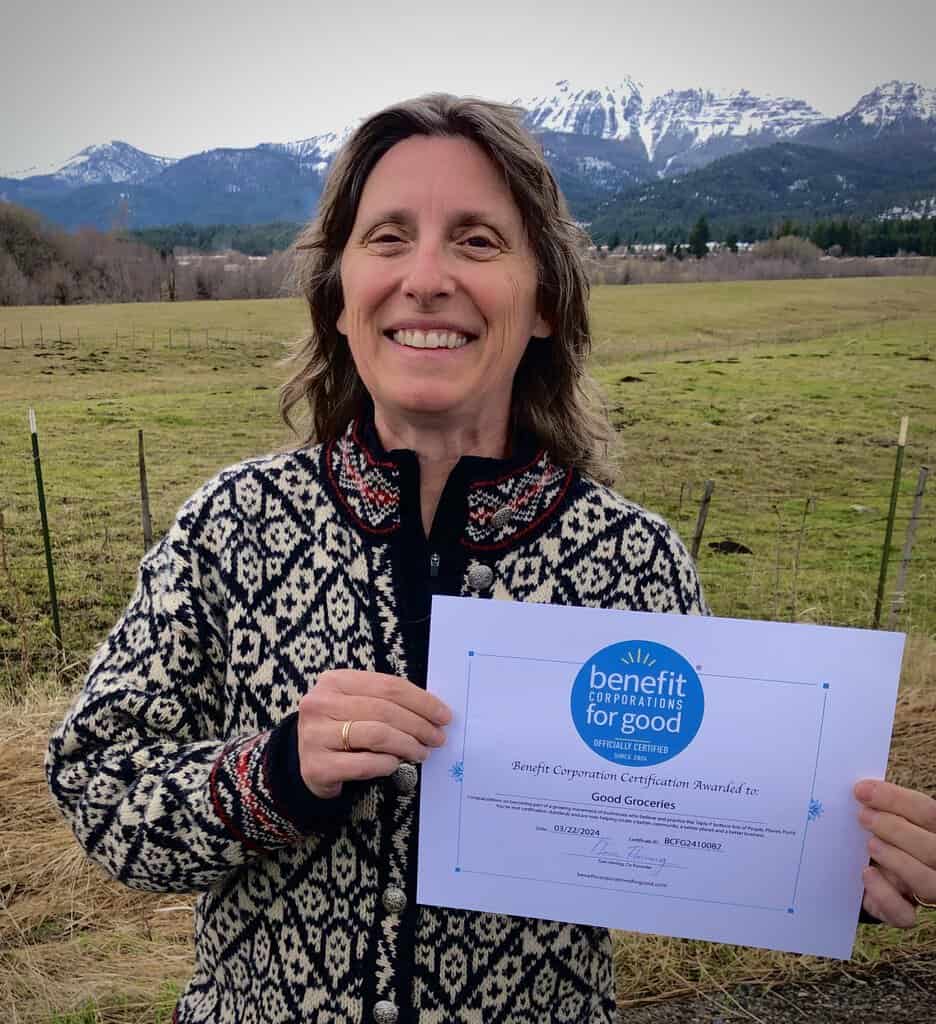
    Kristy Athens of Good Groceries in Wallowa County, Eastern Oregon, joins Kim Allchurch Flick.

    Athens recounts her path from generalist writer to food-systems specialist, including moving to rural White Salmon, writing “Get Your Pitchfork On,” earning an MS in Food Systems and Society, and launching a local gift-box business that evolved into Good Groceries, rebranded in 2024.

    She describes Eastern Oregon’s short growing season and dominance of large-scale commodity agriculture, and how most residents rely on low-priced corporate groceries.

    Good Groceries has grown yearly since 2020, prioritizing paying small farmers while acknowledging higher prices by donating $1 per sale to food pantries and accepting SNAP with Double Up Food Bucks.

    Athens also supports local procurement as a liaison for the Oregon Farm to School Network, discusses pragmatic views on organic and soil care, notes logistical challenges of rural delivery, and urges listeners to buy from local food hubs, CSAs, farm stands, and farmers markets first—“Buy local is not a drill.”

    Listen Now

    Time Stamps

    00:00 Welcome and Guest Intro

    01:15 Kristy’s Rural Journey

    03:18 Food Systems Wake Up Call

    04:07 Launching Good Groceries

    05:55 Eastern Oregon Growing Reality

    08:01 Cheap Food Culture

    09:10 Food Hub Model and Mission

    13:10 SNAP and Access Efforts

    14:10 Farm to School Connections

    15:41 Organic vs Local Nuance

    18:22 Land Stewardship and Awareness

    20:14 Logistics and Scaling Challenges

    23:08 What Keeps Her Hopeful

    24:01 Buy Local Is Not a Drill

    27:49 Dinner Guests and Wrap Up

    Kim Allchurch Flick: Hello everyone. Welcome to the podcast. This is Kim Allchurch Flick. And I’m so happy to be here with Kristy Athens of good groceries. Kristy has an MS in Food Systems and Society from Marylhurst University and is the author of Get Your Pitchfork on The Real Dirt On Country Living.

    She has worked in rural minority economic development for decades, currently connecting Eastern Oregon farmers and school districts as the procurement liaison for the Oregon Farm to School Network and serving for a number of years on the Wallowa County Farmers. Market board. Kristy moved to Wallowa County in 2013 and before that lived in western Oregon, Washington, and the upper Midwest in her spare time, ha ha ha.

    She manages Pitchfork Garden with her spouse, makes collage art, and plays songs on fiddle and electric base. Today we’re gonna talk about how Bilocal is not a drill. Kristy, I’m so excited to have you here. thank you Kim, so much for having me. Thank you. And the Wallowas are beautiful. You live in an amazing place in eastern Oregon.

    And curious, what has been your life journey and inspirations that brought you to the current moment? I. 

    Kristy Athens: I would love to say that it is a linear path, but I don’t think that’s the case. I started out as a writer and as a generalist. I wrote about lots of different industries and, after doing that for oh gosh, probably 15 years. I wanted, I decided I wanted to specialize and around that time my spouse, Mike and I moved from City Life. We had grown up in the Midwest, in Minneapolis, and then we moved to Portland in 1995 and we were looking for something a little more rural. We would go out and hike in the gorge and, fell in love with that area and thought, geez.

    Seeing all these houses on the sides of the road, it’s like, how do these people live here? What are they doing? And so we moved out to white Salmon Washington in 2003 and, that’s how the book Get Your Pitchfork on came about. I learned a lot of lessons not having lived in a rural community.

    There are lots of cultural lessons I learned as well as, how to work the land and that kind of thing. And so I thought other urban people might like a guide to moving to a real place. And when I started doing the research, it was a lot based on my experience, but when I was doing research for that, I was learning more about agriculture and learning nuances like scale and farming methods and different markets and different philosophies about agriculture.

    And that sort of piqued my interest in. In agriculture writ large, but also specifically about small farms because I talked to a few small farmers and one of my friends had also started a farm, moved to the area around the same time as I, and just learning how. Not profitable. That was really surprised me.

    And so I started to get interested in that. And around that time I learned of a brand new master’s program that was at Meryl Hurst University. It was called Food Systems in Society. And I had not yet done a master’s program. And. Finally, I was interested in doing one, and so I joined the first cohort of that in 2013.

    And so it’s a social science degree, so I learned about what are called in quotes, externalities, which means all of the sort of very serious side effects of industrial scale agriculture. Including land grabs and environmental degradation and human rights abuses. And by then I had moved to an even more rural area.

    So in Wallowa County, Oregon where we are now. And I was, so now not only am I learning about in how agriculture works, but I’m learning about rural economies and I originally started a gift box business using the different things that people out here make carb wooden and spoons and different value added food products and things like that.

    And I also, as you mentioned, join the farmer’s market board. And after a couple years of doing the gift boxes, some of the farmers came to me and asked if I would do something like what I was doing for the artist, for the. For the farmers. And I said yeah, that’s what I should be doing anyway so I launched I had a couple of them help me, be on an advisory board and start what is now called good groceries.

    Originally the original gift box business was called Genuine Wallowa County, and then the food delivery was called Genuine Wallowa County Provisions. And then I sold off the gift box piece to another local person and then so I could focus on the food. And so I rebranded the food delivery to good groceries in 2024.

    So that’s my direct line to this position. 

    Kim Allchurch Flick: Wow. You’ve learned so much along the way, and I’m really intrigued in what have been your impressions through time about learning about agriculture and the factory farming side. And also what you’re deeply in now is more the rural local soil carrying side and what are you seeing around you and how are people responding to those differences? 

    Kristy Athens: This area. So first of all Eastern Oregon is a very different growing climate from Western Oregon. I felt like when I lived in St. John’s in Portland, I could throw a candy wrap around the ground and something would grow out of it.

    But out here we have real winter, although we aren’t really having it this year, but that’s another story. We have a very limited growing season for things like tomatoes and basil, and we can have a frost any night of the year. In the middle of summer it can happen. Growing what are called specialty crops, which means everything that’s interesting, all the fruits and vegetables.

    Things that as opposed to commodity crops, which are your wheat and liquid milk and things are sold on a grand scale. So specialty crops are hard to grow out here. The soil is actually good. Unlike a lot of Eastern Oregon we have. Because of the way the mountains are shaped.

    We have more bunch grass than sagebrush and so we have a little bit more moisture. So we have really good soil, but it’s just we’re enterprise is at about 4,200 feet and elevation. And it’s just, it’s harder to grow things here. And just the, climate in agriculture the work that was done over the 20th century to have everything consolidated and and industrialized yeah. Everything out here has been industrial level. So people grow, hundreds of acres of wheat, hundreds of acres of grass hay and raise a lot of cattle out here. Because the land even though the soil could support.

    Different crops, the climate and the season can’t really support them very well. Yeah, so it’s, it’s just like everywhere in the United States, most of the agriculture up here is a large scale

    Kim Allchurch Flick: and what has been the need in the community and some of the solutions with with that climate. 

    Kristy Athens: Most people get their food from a large corporate source. We have one corporate grocery store in our county. And then people travel to others in different areas. I know people will try, will travel two hours to go to Costco in Lewiston.

    They’ll drive to La Grande to go to one of the big box stores there. People in Northeast Oregon, or I different from people anywhere else, most of them are by necessity looking for the lowest price of their food. And, you’ve seen it in news headlines. And I remember even in junior high school there being week or so that we spent in social studies class talking about food system. But every, the whole focus of it was, calculating the cost per ounce of something. And, getting the best deal was definitely the focus. And I think it’s been, we’ve been hardwired for a long time that the cheapest food is the goal.

    And so I’ve got my work cut out for me 

    Kim Allchurch Flick: Indeed. So how is Good groceries doing and how does it fit into these systems? 

    Kristy Athens: It’s going well. As far as growth, it’s the year over year growth. So again, it started in 20. 20. And so I’m closing in on my sixth year. And the year over year growth has been there every year.

    It’s grown every year. But it’s a tiny drop in the bucket of actually feeding people. As I did with the gift boxes, the goal was to create another revenue stream for local people. Here, it’s hard to live out here. People think that things are cheaper in rural places, and that’s not true.

    I think if anything it’s more expensive because of scarcity and, and the, and especially the traveling, that one must due in order to get things or, ordering things that are shipped to you. There’s just a lot of extra and having to drive everywhere. I live four miles from town.

    That’s a long walk. So there’s there are more expenses I think for rural living, but I I have a lot of, colleagues who are doing similar work around the state and around the country. And they, it’s really interesting. Food hubs are approached in from many different directions and they serve many different purposes with different organizations.

    And so what I mean by that is a lot of organizations are. For-profits, a lot of them are nonprofits. And so the food hub in a lot of cases, is a one component of many programs within a nonprofit. Some of them are farmer co-ops. Most of those developed during COVID when they were trying to figure out another way to sell their food when farmer’s markets and other things were closed.

    And so a lot. And then there’s that piece of it, and then. People also come at it from different mission bases. And what I mean by that is a lot of people are looking at food justice on the part of the eater. And which is incredibly important and feeds into that larger conversation of of income inequities that have developed over the last 50 years as well as the industrial agriculture trends that we were talking about earlier.

    But my my focus has been on the farmers because there are so few. Farmers generally. It’s a few, it’s a handful of farmers that run a lot of land out here, and then there are just a very small number of small farms, on 10 or five acres or less. A lot of them are just backyard garden kind of farms.

    We don’t have the big market farms that you have in the Willamette Valley. But I don’t wanna lose those. And my focus has been pay the farmers what they need to make this worthwhile. And in our current capitalists model, it’s really hard to make those two things. Work at the same time.

    Food justice for eaters and income equity for farmers without there being some grant support in the middle. And because I don’t function as a nonprofit, even though I do function as a benefit company which we can talk about as well, but that, that basically is a commitment to focus on the environment and and social justice as well as profit.

    So even though my business is a for-profit, profit is not the main focus. So yeah, so I’ve been focused on paying my farmers and I, in order to. I’m very aware of the fact that in some cases, not all cases, but in some cases, that results in my prices being higher than in a grocery store.

    And to try to compensate for that, I donate a dollar of every sale to the local food pantries. As well as other community giving things, but that in particular. Is it an intention to acknowledge the fact that the pricing, because I’m supporting the farmers, the pricing might be out of reach for some people.

    I also went to the trouble to be able to take snap payments, which if you’ve ever worked with USDA is a huge hassle, but it was also important to me to be able to do that as well. And on now I just just starting in January farmer’s Market Fund in Oregon is supporting my snap payments with double up food bucks.

    So the people who do use Oregon EBT card to buy their groceries at groceries can get half off of their Oregon grown produce. 

    Kim Allchurch Flick: That’s so incredible. I’m curious also about your connection to the schools where a lot of food flows through public schools.

    And what can you tell us about that?

    Kristy Athens: So I do some work on a contract basis with Oregon Farm to School Network. And so I am working with the schools to, to make sure that they take advantage of state funds that are allocated through the Department of Education to school districts to purchase local food for their for their cafeterias.

    And good groceries does not do any wholesale sales. For that same reason that because I’m paying most of the money up to 80% of the retail price goes to the farmer. So there’s no room for me to do any wholesale. With the current model that I have I might, you know, try and work out a different situation in the future, but at this present time, I just sell directly to consumers.

    But I do work as a liaison and so the school districts and the farmers are still making their own contracts with each other, but I’m there to help them find each other. If they have questions about how the program works, I can answer those things like that. But it’s a great opportunity for local schools to support their neighbors, and, in a lot of cases, the kids of the farmers are in the school makes a lot of sense.

    Kim Allchurch Flick: And for the kids’ health and variety of things. And can you share with us your thoughts about the environmental piece of local farming and what you’ve learned about the differences between large factory. Farming and more local. 

    Kristy Athens: It’s an interesting topic. It’s pro, it probably could be its own topic.

    I know we have we don’t have all day to talk, but it is a rich topic and I do think that I do think that it. Is, yeah, it’s something that, it’s something that people should look into from various angles, I guess I would say. And the reason I say that is there are a lot of farmers out here who use organic practices who are not interested in certifying.

    And so for good groceries, I do not require organic certification. And I, I’m, I guess I’m a pragmatist. I think that I understand why chemicals are used sometimes and I also also understand that the word organic has become a bit of a it has. There are realities to organic that a lot of people are not aware of or don’t want to know about.

    ‘Cause there are lots of chemicals that are used in organic farming, especially in industrial organic farming. Personally I would rather eat food from a small non-certified farm then. Industrial organic that you get at a corporate grocery store. That’s my personal my personal preference.

    I, I think that all organic is good. But I do think it’s become a bit of a panacea for some folks. And and I’ll leave it there ’cause it is its own topic for sure. 

    Kim Allchurch Flick: I think there’s another podcast coming up at some point, but we can definitely, I have to get more than 

    Kristy Athens: me on it.

    Kim Allchurch Flick: Indeed. And it’s important. And thank you for that. And I also know that in your area there’s a a ranch that is Regener certified and concerned about soil health. So it seems like in the region there are some people who are really looking at the environmental piece. Yeah, from soil upward and it doesn’t always have to be small.

    Kristy Athens: I would say that all farmers care about soil. It’s just some farmers have a different view of the impact of of traditional agricultural practices. I don’t think that there are farmers that don’t care about soil. I just think that they yeah, they just have a different approach. But yeah.

    I don’t think it was because of a lack of care. I think it’s just a different approach. 

    Kim Allchurch Flick: Yeah. And that makes a lot of sense. And I sense. While it still feels small scale because of things like films like Kiss the Ground, biggest Little Farm, common Ground, those types of films that are talking about agriculture, reaching people that.

    Many of whom never considered where food comes from. And that learning can help move needles of awareness. And I’m wondering what you’re seeing in terms of that awareness of the consumers and awarenesses of the farmers as time goes by. 

    Kristy Athens: As far, if I look at my customer base it’s definitely a lot of people who have moved here from somewhere else who maybe brought their value system with them and also brought a job with them that enables them to be a good groceries customer.

    Yeah. Definitely people everyone who lives in Wallowa County is very, very proud of living here and want to protect it. For example, we’ve had a lot, we have a, Wallowa Land Trust has done a lot of work to preserve. Some lands near the wall Lake. There’s also been some land that’s been returned to the Nez Perce tribe, or oo as the original inhabitants of this area.

    There’s been a great, also the Land Trust has done some great work to work with local ranchers to invite the Nimiipuu. Back here to dig canvas route and do other gatherings that they used to, that they’ve traditionally done in this area. Yeah, again, I don’t think, I don’t think that the love of the land has changed.

    I think maybe some of the processes, people are re reexamining some of the processes. 

    Kim Allchurch Flick: And that’s good. What are some of the obstacles and challenges for you? 

    Kristy Athens: Oh gosh. Where should I start? I mean on the really pinpoint on the ground I have a. Two wheel drive cargo van that has a refrigeration unit in the back and which is great for summertime, but it is impossible.

    Not impossible, but very, very difficult and somewhat dangerous to take. If I because as I mentioned, it’s hard to grow food in Wallowa County, so a lot of the food that I sell is not grown in Wallowa County. That was one of the reasons that I changed the name. So I get a lot of food from the neighboring county, which is Union County.

    That’s where La Grande is located. And then I also get a lot of produce and other food and some really great value added products from two food hubs in Washington. One is in Walla Walla, which is two hours away and one is Puget Sound Food Hub. And they deliver. Orders to Walla if food hub and then I go to Walla Walla and pick up the whole thing and bring it back.

    So I have access to some amazing cheese some kelp snack chips and just all kinds of cool things that I would not be able to carry if I were just relying on our region. And also to get to Walla Walla, I have to go through the Blue Mountains. And in the wintertime, taking a two-wheel drive van over a mountain pass is terrifying, even with studded tires.

    So I have practical limitations like that. I just got a grant slash loan to purchase a four wheel drive van, and I’m very excited about that. And so there’s, yeah, so there’s lots of logistical challenges in that regard. There’s also the challenge of this being a very sparsely populated county.

    There’s 3,500 square miles and 7,500 people. That necessitate has necessitated me moving into, and I am just going to do this next week launch into a weekly delivery to Union County. And so that’s terrific. But that requires an hour plus drive also. So there’s just, there’s a lot of driving.

    The the people who run benefit corporations for good, which is my B company. Certifier, are always pressing me to get an electric van, which I would love to do, but it either needs to be refrigerated or have four wheel drive. So there are those kind of realities at this moment.

    Hopefully that technology will catch up with the need. But yeah, so there’s just lots of challenges, logistical challenges I would say. And then obviously the situation with it just being a short season and hard to grow a variety of crops here. 

    Kim Allchurch Flick: Oh indeed. And what makes you optimistic?

    Kristy Athens: Lots of things. A lot of my existing customers are people who are new to the area. They tend to be in their thirties and they are unwilling to throw their ethics under the bus just for convenience or other considerate air price or anything else.

    They make me optimistic. They are great supporters. They’re super excited about this. And they, they’re telling their friends. They’re making a point of it. So that’s been really great. 

    Kim Allchurch Flick: I really like that thought. Unwilling to throw their ethics under the bus and hopefully all of us how can people reach you?

    That’s easy. Just go to good groceries.shop.

    And is there anything else you’d like to share? Also, thinking about the people that aren’t in the county, but in terms of overall thoughts about how to select food and some of the considerations going to a store. What are some key differences of making a selection that can help us all not throw our ethics under the bus?

    Kristy Athens: For a lot of people, we need in income equality for people to be able to to use that old phrase, vote with your fork. Not a lot of people don’t have as many votes as others, and I definitely don’t want to suggest that if people are buying from large grocery stores that they don’t have ethics.

    It’s, there, there’s a lot to fix. I used to do just as an aside, I used to do a community con, lead a community conversation with Oregon humanities called good food, bad food. And I don’t know if you’re familiar with the conversation project, but it’s it’s not a lecture.

    It’s a conversation. And so we would all be talking, I would, seed the conversation with various aspects of the food system and then we would talk about them. But one of them was that, during the Reagan administration the Emergency Food Assistance Program was developed TFA and it’s still called TFAP or no, it was originally, I just gave away the punchline.

    Originally it was temporary Emergency Food Assistance program, and eventually they just changed the name to the. Emergency Food assistance program because wage inequality has been going on for decades. And eventually it became clear that people are never not in an emergency situation anymore, a lot of people.

    I don’t wanna judge anybody who doesn’t shop at good groceries or any other local farm stand. And there are, I wanna point. Farm stand or food hubs all over the state. So wherever you live in Oregon you can probably find a food hub where you live. But yeah, I think the thing I want to people to take away, despite what I just said, is that, and this is the title of our little program here.

    Buy Local Is Not a Drill. If you can. Find a food hub. Find a CSA, find a farmer’s market. Find a farm stand and go there first. You can always fill in the rest of your list somewhere else, but first buy from your neighbors. Because once if we lose all of our farms. They’re not, if we put buildings and data centers on all of our farmland it’s not gonna come back for a really, really, really long time.

    I don’t think, I think looking at the, our current global situation, I don’t, I think everyone can agree that importing food is not such a great idea or needing, more importantly needing to import it. It’s one thing to import. French wine because you want to, but needing to import our basic staples, I think is everyone can agree is a bad idea.

    And the only way that’s not gonna happen is if people actively seek out local sources of food first. 

    Kim Allchurch Flick: Actively seek out local sources. Yes. And that can vary across regions, counties, and states. But as you said, they are there and they will, they want to sell. They want to continue doing what they’re doing and share food with people.

    And it’s one of my greatest joys is going to a farmer’s market. It’s, they’re fun, they’re. It’s interesting to see what people bring in. It’s fun to talk with people, get to know who the farmer is. 

    Kristy Athens: Yep. 

    Kim Allchurch Flick: Exactly. Indeed. Thank you so much. Thank you for those tips and giving us all food for thought.

    And speaking of food if you could, this is the final question. If you could have dinner with anyone, up to three people living or deceased, who would they be and why? 

    Kristy Athens: Can I have two answers? 

    Kim Allchurch Flick: Absolutely. 

    Kristy Athens: Okay. So my first answer would be my Life group. And that would be my two grandmas and my mother-in-law ’cause I missed them.

    And then my career group would be, also family, my father-in-law because he had a food broker business. When I started dating my spouse in 1990 when we were tiny babies and he had this food broker business. And at the time, like I said, I was a writer and I did not care one bit about his business.

    He died in 2005 and I started doing this food stuff in 2013 with grad school, and boy do I wish I could ask him some questions now. But Jim Menlow and then and then my other two choices were Dolores Huerta. ‘Cause she was so inspirational. So good at motivating people and so food justice oriented a lot of people.

    Might not know who she is, but she was right up there with Cesar Chavez doing the same work. And Cesar gets most of the credit and the streets named after him. But Dolores Huerta is somebody to look up. And then James Beard, another civic, Northwest Hero. The first television chef before Julia Child.

    Although there’s no, no tape of it left anymore. But he is a he is wrote an a million cookbooks and he was probably the first besides native,

    their whole, for millennia. James Beard I think was born. Like early, very early, 19th or 20th century. And he lived in Portland and he and his nanny house person helper would go down to the markets down on the waterfront in Portland. And so he learned to eat oysters as a young boy and learned the importance of.

    Seasonal, eating seasonally and eating from the place you’re in. And so he’s a bastion of regional and seasonal cooking. So I would love to also, he was also if he, especially if he was making dinner, ’cause he was a great chef and and a good he had a good taste in wine from what I understand. Those would be my dinner tables.

    Kim Allchurch Flick: Oh, that’s lovely. And a nod to James Beard is the, Portland is building a new James Beard market in exactly. Downtown, so

    anyone visiting Portland probably into 20 27, 28. I might wanna look that up. Kristy, thank you so much. I love the work you’re doing. The heart and soul you put into the hard work of driving in all four seasons with so much variability and continuing that congratulations on being benefit corporations for good.

    And we’ll put everything in the show notes. Everyone. Thanks for listening. This is Kim Allchurch flick, signing off. 

    This Episode’s Guest: Kristy Athens

    Kristy Athens smiling and holding the Benefit Corporation for Good certificate.

    Kristy has an M.S. in Food Systems and Society from Marylhurst University and is the author of Get Your Pitchfork On!: The Real Dirt on Country Living. She has worked in rural/”minority” economic development for decades, currently connecting Eastern Oregon farmers and school districts as the procurement liaison for the Oregon Farm to School Network, and serving for a number of years on the Wallowa County Farmers Market board. Kristy moved to Wallowa County in 2013, and before that lived in western Oregon/Washington and the upper Midwest. In her spare time (ha ha!) she manages Pitchfork Garden with her spouse, makes collage art, and plays songs on fiddle and electric bass.

  • Low-Waste Living and Climate Action with Alex Gamboa Grand of Way of Being

    Low-Waste Living and Climate Action with Alex Gamboa Grand of Way of Being

    Alex Gamboa Grand joins Kim Allchurch Flick to discuss her journey into climate action and founding Way of Being, a Portland low-waste retail shop and e-commerce business launched in 2019 to make sustainable habits more approachable through education and product alternatives.

    Alex discusses conscious consumerism, the limits and misinformation of recycling, and the need to reduce consumption, plastic, and waste while staying nonjudgmental and recognizing different entry points such as health and wellness.

    They cover examples like toothpaste tabs, refillable or solid personal-care and cleaning products, safety razors, packaging-first purchasing, bidets reducing toilet paper, and innovations from brands like Dirty Labs, Under Luna, Kha, and Axiology.

    Alex shares optimism about cultural shifts toward less convenience, local resilience, and Project Drawdown’s high-impact household actions including reducing food waste, eating more plants, efficient homes, cleaner transport, and better composting and recycling.

    Listen Now

    Time Stamps

    00:00 Welcome And Introductions

    00:57 Alex Origin Story

    02:47 Climate Awakening

    04:29 What Is Way Of Being

    07:36 Small Habit Swaps

    08:59 Business Obstacles

    12:21 Recycling Reality Check

    16:33 Plastic Free Innovations

    19:29 Packaging First Mindset

    23:41 Toilet Paper Rethink

    28:53 Reasons For Optimism

    32:06 Hollowed Out Towns

    33:20 Supporting Local Business

    33:54 New Sustainable Innovations

    34:59 Tariffs And Supply Chains

    37:23 Seven Climate Actions

    42:09 Zero Waste Social Influence

    44:55 Costa Rica Lessons

    46:54 Where To Find Way Of Being

    48:10 Beauty Without Toxins

    55:21 Small Makers Big Impact

    56:21 Dinner With The Obamas

    58:30 Final Thanks And Wrap

    Kim Allchurch Flick: Hello everyone, and welcome. This is Kim Allchurch Flick, and today we’re talking about the undeniable power of individual actions to mitigate the climate crisis and make the world a better place for more of us. This is what Alex Gamboa Grand. Alex is the co-founder and showrunner of way of being a low waste shop.

    She’s a teacher and a friend offering supplies, education, and encouragement to support a sustainable, intentional, and delightful lifestyle where small everyday actions create a better world. She’s also an instructor and speaker, and she’s passionate about social entrepreneurship, conscious consumerism, and the power of individual actions.

    Thank you for being here and welcoming Alex.

    Alex Grand: Thank you so much for having me.

    Kim Allchurch Flick: Thank you. So what has been your journey and what inspired you along the way to be in this current time? 

    Alex Grand: Yeah, it’s such an interesting question. I think it’s interesting for everybody to reflect on that. What are the things that got us to where we are? And what I think about is, even when I was really little I remember, I grew up in a very like Christian environment and one of the things that I think really set in with that for me is the idea that we all have a purpose and this idea that we all have these different strengths and qualities and interests and passions and, the belief that we’re supposed to use those things to contribute in some way to the world.

    I always have felt that always really resonated with me. Okay, yes, I’m here for a purpose and like it’s, to contribute, to serve. The world in a way. And as I’ve gotten older, I really, I also have this belief that everything is interconnected. And everything we do does affect the whole.

    And that I think sometimes when I say that to people it sounds like overwhelming, that’s like too much pressure to put on yourself. But I think it’s actually an exciting opportunity, to live your life intentionally. And for me that’s always been really big.

    I’ve just been someone that, we see so many examples throughout history. I’m also a big I dunno if movie buff is the right way to say it, I’m a movie lover and I studied screenwriting in college. One of the things that was really interesting to me about that is I love looking at humans just like different characters and seeing how everybody has all these really unique things to them.

    Everybody has a unique story, but we all have something to bring to the table. And I’m really fascinated by that, like by the, by how the individual and like our unique individuality contributes to the whole in this way. And for me now I’m working in this like climate action space through my business way of being.

    And it’s just been one of those things like climate is. When I was a teenager, and I remember my dad first took me to sa Inconvenient Truth. It just kinda lit something in my brain of everything I’m saying about contributing to the whole what is more holistic, what is more important to everyone on this planet, every living thing on this planet than taking good care of our planet.

    Back in the day it used to be like I was a really avid recycler. That was what we knew that we could do on an individual level. So I was like, going through the, my, the trash bins at my high school and sorting out the recycling and stuff. And then as I got older I learned, there’s things, how we eat, the things that we purchase make a big difference and all of that kind of.

    Coincided and around the time that me and my business partner decided to start our business all those things started coming together. Like I felt okay, I need to do something. I also wanna remind people of their individual power, their individual agency and how they can contribute.

    And also just like the knowledge of recycling hasn’t, is not enough or it’s not really the solution. And I get it. I’ve just been getting more and more excited about all the other things that we can do. And so yeah, that’s what I feel like my mission is to use my voice and platform and, whatever levers I have at my disposal, which, and right now is my business to help encourage people to, use their daily lifestyles intentionally.

    Kim Allchurch Flick: That’s amazing. Tell us a little more about way of being. 

    Alex Grand: Yeah. So Way of Being is a low waste retail shop. We have a e-commerce shop way of being doco and we have a brick and mortar shop on Hawthorne in Portland. And me and my really good friend Lindsay, we started way of being back in we launched our online store in 2019, but back in 2018 was when we started first envisioning what it could be and starting to share content and things around it.

    But really it was, we were motivated by, okay we can’t wait for the government to make, do all these climate actions that we know it could be making. We can’t wait for all these big corporations. But Lindsay and I had actually also just gotten MBAs around that same time, and so it was really clear to us the power that business has.

    To, to shape the world we’re living in and how much businesses are shaped and influenced by consumers. Absolutely, that’s whatever we’re spending our money on is what we’re telling companies to keep making or to keep doing. We were really passionate about conscious consumerism and like in the, on the climate note, we also, we’re starting to get really excited about this zero waste movement.

    That was all about, reducing as much of your packaging waste, food waste as possible, like avoiding plastic as much as possible, switching from disposable goods to reusable goods and that kind of thing. So we were both adopting these lifestyle habits and we just saw, that is an amazing movement and people that are really trying to like, commit to a zero waste lifestyle, it’s very impressive and like noble.

    But we also saw that there’s like a kind of a gap. There’s all these other people we knew that really care about the environment and just don’t really know what else they could be doing. And there are so many other things. It’s, we really felt we don’t need everybody doing ev doing everything perfectly there, but there everyone can do something.

    For us it’s like you can change the way you brush your teeth. You can just use a different toothpaste or a different toothbrush and that makes it a huge difference. And just the amount of waste that builds up, you can change, the shampoo you’re using, you can take it to the dish soap, laundry detergent.

    All these things have all these myriad benefits beyond just avoiding waste. They have benefits because you’re reducing toxins like in your body and in the environment. They. They can be more cost effective over time. There’s like all these benefits to them and we just saw, ooh, we’re getting really excited about these things.

    We loved finding all the solutions and we wanted to make it easier, more approachable and more exciting in a way, to, for people to learn about these really small everyday habits that they could change that would really add up and make a difference, especially if more and more of us are doing it.

    So yeah, we actually started out just sharing a lot of educational content. We wrote blog posts every week and did like informational social media posts. And then we launched our online store in 2019 and, we’re still going. It’s really actually amazing to see all the people who have been with us all this time and, just who have been open to changing a habit or two over time.

    That’s been really exciting 

    Kim Allchurch Flick: and changing habits can be. It’s not like a switch that goes off sometimes. It takes some practice, doesn’t it? 

    Alex Grand: Totally. I, all the time I hear in fact, toothpaste tabs is one thing, like toothpaste tabs are basically a solid version of toothpaste. They look like little MITs, basically, you pop ’em in your mouth, chew it for a couple seconds, and then it turns into toothpaste in your mouth.

    And I’ve heard multiple people that have purchased them, but it’s just been sitting on their counter because it’s just a little bit, there’s like a little extra mental effort to just do a new, do something new. But we have plenty toothpaste tabs are also like one of our, some of our bestselling products too.

    So there’s plenty of people that have tried them and love them, but it’s, there is like a mental thing to it where it’s a little extra friction. We get in our comfort zones with certain things and I think that’s a big part of. What is challenging in this moment, as I think a lot of us are very like overwhelmed and adding like one more, one more thing to the list can be, can feel overwhelming.

    Even more overwhelming 

    Kim Allchurch Flick: in Indeed. And I think part of it in my life is thinking about making change in all sorts of different areas of life all at once. That can be overwhelming, but doing it one step at a time 

    Can start to create new habits. And along the way, what have been some of the challenges and obstacles for a way of being and for your lifestyle and encouraging others?

    Alex Grand: In terms of obstacles, there’s, a few different types of obstacles. There’s just, running a business and keeping it going for, this long, we’ve been in business for six years now. There’s, the obstacles around, our customers.

    And like I said on the customer end, I think it’s really that thing. It’s like there’s a lot, it can be frustrating sometimes to feel like, oh, we have so many different, solutions to things that like people could switch to. There is sometimes it, and for me it’s I was excited about it.

    So it’s different. I have a different point of view than somebody who, like we’re trying to convince. And so I think for us it’s one of the obstacles that I’ve made peace with is, people have to come to things in their own time. There’s no pressuring, there’s no, and certainly for us, like a big part of what we wanted our brand to be about is not, is nonjudgmental because we felt like there’s a lot in the environmental space, there’s a lot of like finger pointing and shaming over people not doing things the way you think they should be doing them.

    And we really didn’t wanna be about that ’cause we don’t feel like that’s welcoming. We don’t feel like that’s persuasive, in our, political climate in the last, decade too, it’s something I’ve noticed is like the more you judge people and shame them, like the less that you’re gonna convince them to, be on your side.

    For us it’s just been about, it takes time. Sometimes people, everybody has their different entry points. And now what we’re seeing is like a lot of people who weren’t really motivated from a sustainability point of view are motivated from a health and wellness point of view. And that there’s no wrong way.

    Like everyone can have different entry points, everyone can have different motivations. Sometimes it’s just the right time in your life. Something that I’ve been, that I’ve been seeing actually this year, just among my peers is and even actually in culture, like there’s this whole analog movement that like a lot of, even a lot of younger people are trying to switch to more analog versions of things.

    They’re canceling their streaming services and trying to like, read more and get vinyl and, CDs instead and that kind of thing. But to me, I’m really encouraged by, right now in this moment, it feels like there’s a cultural shift where people are trying to, they’re doing things that are less convenient.

    But they believe are either better for them or better for society or better for the environment. And that is really powerful. I think if once we take a step back and we can take a breath and see okay, the things I do actually do matter and what has been normal hasn’t really been working that well, maybe there’s something that I can do differently that’s small, that would make me feel better, would, have a positive impact on my life and have a positive, the kind of impact that I wanted to have on our culture.

    So I think that’s really exciting actually. That’s, there’s like a tension a little bit by we inherently just by existing, are challenging, like norms in the status quo. And I’m not trying to create tension there, but what’s really exciting is when people organically for their own reasons or become ready to try something new.

    Kim Allchurch Flick: I love that. And I think also the other thing is information and misinformation along the way. And we’ve been told for years that recycling is a good thing. But I think you and I met as way of being, was being created. But another connection we both have is Portland State. And when I was at Portland State, I did a with a team, did a project on what was called the China Green Fence.

    And this is back in 20 13, 20 12. And the green fence was them putting up a wall not a physical one, but a wall that said, we’re not taking your recycling anymore. And I hadn’t realized until I did that research that a lot of recycling goes out on cargo ships and it’s supposed to go to China when they say no and send it back.

    It makes what was supposed to be a panacea. A good thing for all of us to recycle and feel good about ourselves to something that was way, way worse. And some of these ships would be out at sea, wondering where are they gonna dock? Because they often didn’t know what was gonna come back.

    And then, so that continued, but it at least was be starting to become a little more public. And then last year, New York Times did an article about February 14th, 2025, about what a really broken system recycling is and how giant piles of clothing land up in other countries, but also waste that is even more toxic.

    And clothing as it breaks down is mostly microplastic ’cause people are throwing away fast fashion. But other things, e-waste becomes toxic to someone else’s pe, the other people in other countries. And it was really eye-opening that maybe the panacea isn’t. Recycle, but it’s the low waste part and now there are innovations coming up, like talking about mushroom enzymes and other things that eat up plastics that are already there.

    But I think the cautionary tale is that doesn’t give us a license to throw away more plastic. It means there’s already so much there. It’ll take decades, maybe centuries to clean up. So why don’t we pull back. And go to more toward the zero waste. 

    Alex Grand: Yeah, absolutely. This is exactly, what we were, Lindsay and I were like learning about, and our minds were being blown around the time we decided to start this business because we realized, okay, yeah, recycling’s not the solution.

    And talk about interconnected by the way, like literally the stuff that you throw in your trash can, or even your recycling bin is going to the other side of the planet. And and there’s, cases of there being just like garbage piles or even from the ocean little pieces of plastic washing on the shore and like Malaysia and things.

    But it’s stuff that we’re throwing away in the US it just does matter. I think we have this outta sight outta mind thing that once we throw it away, that it’s gone, it’s properly dealt with, but really it’s not. So I exactly. That we really felt like, okay, the real solution is.

    Is just throwing less away period, one way or another. It’s consuming less, it’s being more intentional with, the packaging of the products that you’re buying. Like I said, reusable alternatives to disposables. What materials are you consuming? Are they actually recyclable?

    Just going back to the toothpaste example, a plastic toothpaste tube is not recyclable curbside and like most, most, most places. So what are all those toothpaste tubes? Doing all the toothpaste tubes we’ve ever used. What are they doing? They’re, sitting on this planet somewhere. It gives me chills thinking about it because it’s so many toothpaste tubes.

    So I’m like, I don’t wanna use a toothpaste tube. I just don’t, I’m over it. I can be done with that. And it’s, that’s at least one less thing. And I love that you’ve spoke to. The harm that, you know, even if it’s sitting in a landfill and it feels okay, that’s dealt with, it’s still, it’s just breaking down into microplastics.

    It’s leaching toxins into our groundwater. There’s no part of especially plastic, there’s no part of the life cycle that isn’t bad for us. Yeah, I get excited about, okay, let’s figure out ways to minimize our use of plastic and things that can’t be recycled or can’t be composted.

    Let’s figure out ways to avoid them. And that’s actually been a really fun part of our business is there are so many amazing innovations that have come out. There are so many creative people that have come up with. With products that allow us to reduce that waste. And some of them are innovative, some of them are like I don’t even, what’s the opposite of innovative?

    Like they’re reverting back to a simpler way of doing things. One example that’s innovative is there’s this one brand called Do Mighty that they make a skincare products that are all solid. Like their, the first product that came out was called a Jelly Serum bar, but it’s like a facial serum, but it looks like a little, it almost looks like a Jolly Rancher and you just wipe it on your skin and it comes in a recycled paper box and you keep it in like an aluminum tin that you can reuse over and over.

    But a skincare product where you literally don’t need any plastic packaging, it’s all either compostable or reusable. That’s like an incredible innovation. And it’s a product that actually works really well, which is a really important part of our business too, is it’s important for us to carry products that are really efficacious because I think.

    There was, especially in the early days of eco-friendly products, I think people really got, the perce got the perception that if you were gonna choose an eco-friendly product, it was gonna be a compromise in terms of efficacy. And that’s just not true anymore. And in fact, a lot of the more sustainable products are actually better than the conventional op.

    They work better. So that’s been really exciting to be at the forefront of that and to see all those things. But then we also have some other products that are really they’re timeless. They’re classic, like a reusable safety razor that you know. My, my great-grandfather in the house that I grew up in, there’s like in the wall, in the bathroom.

    He like used to slide all his little razor blades, which is also not the right way to dispose of your razor blades, but he would tuck them in a hole in the wall. But he was using a reusable safety razor, like a stainless steel one. And it can last a lifetime if not be something that you can pass on.

    That’s something that we carry too, which is, it’s not innovative, it’s just going back to a simpler way that worked just fine. So yeah, I think I’m excited about the ways that we’re both simplifying and innovating and I love finding those brands and those people that are doing really cool things.

    Kim Allchurch Flick: And I love going into the store, which is in Portland, Oregon, but for those who can’t also online. There is so much because you have al almost every category of life there from cooking, cleaning body care, toothpaste. There’s so much there and the innovators are there. And another thing I’ve discovered is, particularly in the category of cleaning, I really decided I, I’ve gotta make a choice.

    And packaging is an interesting thing when we actually start to consider it because it’s easy to pick up a cleaner in a plastic bottle and say, but this cleaner is better. It’s plant-based and somebody who’s innovative. But there’s still that problem. And when I start to think packaging first, it completely changes the trajectory of the thought process to the purchase.

    And then what’s in these non package related or non-plastic related packages has usually. Plant-based cleaners and I did a little experiment at home in laundry and bought three different brands and started rotating them out without telling anybody. ’cause they were all incented. So there are no, clues and while trying to empty this giant Costco sized plastic bottle of laundry soap that was supposed to be eco-friendly.

    And so it took a while. But the thing is, the clothes all looked great. Nobody noticed as, ’cause I didn’t tell anybody, but one of the bonuses was once I got rid of the plastic bottles and didn’t buy anymore, the space I got back in the cabinet was enormous because mostly what I was dealing with powders and tablets that either come in.

    Tins or I’ve just ended up buying glass jars. 

    Alex Grand: Yeah, 

    Kim Allchurch Flick: and that’s a great bonus to have as well. More space for something else. And it’s interesting how we think about purchases our consumer behavior is what it is. And I started looking at my own and thinking, okay, going to the store if I want salad dressing, if I lead with what salad dressing I want, I come out with a salad dressing.

    If I lead with, I’m only buying salad dressings in glass, I will refuse to buy plastic. It becomes a fast decision because it becomes all about the packaging first, and then I can still find a really good product and maybe tell others about it. And then that leads to, okay, plastic and cell dressing, where else, what other things am I going to avoid that particular type of packaging?

    And it doesn’t mean it’s a hundred percent, it’s really difficult in food to go to zero plastic waste, but there are ways to whittle it down a lot and it takes a while. It’s a mindset change. 

    Alex Grand: It is a mindset change. And that’s, I think a really beautiful way to do it is just every time you’re buying, you’re like looking for a new product.

    Look for, okay, how can, what’s a version of this product that I can get to minimize waste? And yeah, I think that’s one of the easier things is like when you’re grocery shopping, look for glass or paper or aluminum packaging instead of plastic. But a lot of the times, yeah, like condiments and things like they’ll come in glass instead of plastic and glass is easily and infinitely recyclable.

    So that’s why it’s a better alternative and less, it’s not based on fossil fuels. But it, yeah, it is relatively easy to make that switch. And then the more we do it, the more they make those alternatives. That’s really where the power is, whatever we buy, that’s what companies realize they’re gonna make money on.

    So they shift to that. And we’ve seen all these different movements. I think I talked about, I think the most obvious one for us is like organic food, because I feel like, 20 years ago you could hardly find organic food, or there’d be a really small little section in the grocery store and now you can find everything.

    Or you can find an organic corn dog. You can find organic crackers cheese, whatever. Whatever you’re looking for, you can find an organic version of, and that’s because consumers purchase those products and companies followed suit. And now, and obviously we see it with all these different food movements, yeah. Plant-based gluten-free high protein now is big but whatever people are buying, the companies really wanna follow that. So if we’re buying less plastic, they’re gonna give us less plastic. It’s a missed opportunity really not to use that, that lever that we have every day.

    Kim Allchurch Flick: Indeed consumer behavior can push change when it’s collective. 

    There, there’s another topic that hadn’t thought about that much ’cause it’s an everyday thing, but I noticed a video about the evils of toilet paper and actually listened to it and this woman was coming up with how it’s processed, how there’s toxins in toilet paper that are bad for us and bad downstream, and yet it’s prolific.

    It’s another one of those things that’s prolific. And then so started thinking about that at the same time that there’s been a increase in very inexpensive, easy to install bidets. And so we actually did that ’cause it’s kind of nice. And with that living in a place that has a septic tank for different reasons, we decided to use bide and buy the Marley’s cotton.

    They’re like toilet cotton instead reusable. And how those, the combination of a bidet and that, and I just have a pail of water with bioclean or something and put them in there and wash ’em, reuse them and how we’re almost zero toilet paper household. And then we went to Costa Rica where they’re not zero toilet paper, but the country almost everywhere has signs telling people not to flush it.

    They have wastebaskets beside, and for the most part they incinerated it, but they do not go want it going into their water stream at all. And that made me think more what did they know that we haven’t talked about and what would it look like if more and more people went to self-install, installed bidet and started changing?

    And what is it about toilet paper that we haven’t known? And I think that’s part of it, is we can make good consumer behavior decisions with knowledge when knowledge isn’t there. Or worse when the plastic companies are still saying, oh, we’ll take a hundred percent back in recycling. And that was about two years ago on a 60 minutes interview with one of the plastic CEOs.

    And we can tell just driving down the street with how much plastic is at the side of the road that. You can never get to recycling at a hundred percent. So finding that that’s a fallacy and it’s really frustrating when, because there, there are, people have motives, everybody has a motive. And what is the motive to say that recycling is still good and you could do more and more of it when that’s not the real story.

    Alex Grand: Just think about a lot of the big toilet paper companies, especially those like soft plushy ones, they’re literally chopping down rain, the rainforest to make paper for us to wipe our butts with. It’s really like sad when you think of and yeah, then the chemicals and things that are not good for us.

    The thing that’s really interesting about that example too to me is it’s very cultural. Like I think in the US we are just used to our toilet paper, we’re used to our Charmin or whatever, and we have a hard time not being attached to it. But in many other countries around the world, it’s not the norm.

    Actually I first got this awakening when I traveled to India, actually when I was at PSU through a study abroad program. And they don’t use mo. Most places that I went to didn’t have toilet paper and they had a bidet or a version of it, like a hose or something, or even like a bucket with water.

    And I was really confused. I was like, wait, what are people doing? And I asked our host, our guide who was from India, I was like, so what are you guys doing? Are you just walking around wet all the time? And I feel terrible about this ’cause I just think my tone was way too judgy. And rude what I think about it.

    But, and she kinda looked at me and she was like, well, we think you guys are gross. Like, why would you not use any type of water to wipe yourself or to clean yourself? If a bird pooped on your arm, would you not, would you just use a paper towel to wipe it? And I just thought, this is such a good example of how this is totally cultural.

    And when we don’t realize that we get really attached to something that doesn’t necessarily make the most sense. It’s just what we are used to. So I do think the more we learn about all the different sides of it and all the different alternatives and we have the opportunity to make a choice that actually does really make sense for us and others too.

    But it’s just one of those things that we’re, you get so used to doing it your whole life that it’s hard to break the habit or can be, but I think that’s where we are right now. I think actually in our culture, it’s an interesting time because we’ve seen. Especially since COVID, but we’ve just seen so many things about our status quo that have become very clear.

    Like it’s not really working that well for a lot of people in a lot of different reasons, in a lot of different ways. But I think it does push us and challenge us more to think twice. Okay. What is a better way to do everything? So I think that’s just one, that’s one example. Literally doesn’t make sense for us to chop down the rainforest, to wipe our butts.

    And then, the whole plumbing and septic system, all of that too. There’s so many elements of it, but I think it’s a good time for us to start thinking 

    Kim Allchurch Flick: twice. I agree. I, and with that, what makes you optimistic? 

    Alex Grand: All the people that I know that are trying new things, even if it’s inconvenient, like I have, I noticed within a few months this year, my friends New Year’s resolutions, they were all things that were.

    That were like going against the green. I had one friend that said she was gonna try to buy 80% of her produce at the farmer’s market, I had decided that I was gonna try to like, take public transit more. I had another friend that said they were gonna try to stop using food delivery services as much and start cooking at home more.

    And there’s all these kind of like small ways that I see that people are becoming more and more willing to do something that you could argue, creates more friction in their lives, but they just they feel that it’s better for themselves, it’s better for their communities. And I also, something that is making me optimistic is people really being, becoming more and more aware of their, the power of their dollars.

    We’ve been seeing more boycotts and there was like a general strike. In January there’s all these moments where people are using wielding their consumer power and it really has a big impact. On whatever companies that are being targeted. And so I think what the real opportunity here is to make sure we’re funneling our dollars into business, local and small businesses into mission aligned businesses that, that share our values into our own communities and causes and those things.

    To me it’s like we’re waking up to, okay, we don’t wanna give our money to businesses or causes or things that we don’t align with. But then the opportunity, I think is to really refocus on our local communities. And I’ve been thinking about this like agriculture, I think about like regenerative agriculture, this kind as opposed to mono agriculture where.

    For, actually, this is part of our status quo in the US too, is that we’ve had all these mono crops that, one farmer will have miles and miles of land that’s all dedicated to one crop, and then there could be one drought. I like a, or not even a drought, just a year of relatively low rain, or there could be a pest that comes through or flooding or something that happens and the whole, their whole crop is wiped out.

    To me, that’s like in our culture when we have. These huge businesses that we’re all giving so much of our money to, and they’re trying to like monopolize every industry basically. It’s like a monocrop it can be more efficient, it can be more convenient in the short term, it could generate more profit in the short term, but in the long term it makes us less resilient as an economy.

    And I think like refunding our energy and our resources back into small local businesses makes our communities more resilient. In general. It’s like diversifying our farm with different crops and they all nourish each other. And I think, when you look across the country, my husband and I love to go to visit national parks and we drive through it.

    One of the cool things about that is it takes you to really random little pockets of the country that you know, are not necessarily a big city or anything. And so you drive through, you see everything. And one of the things that you know has become so clear is that there’s all these communities in this country that have just been hollowed out because one, because there was one major employer in the area that left, and because that one employer left, there were not enough jobs to sustain the rest of the community.

    And there used to be these thriving downtowns with all these small businesses. But now it’s all hollowed out. So to me, I think it’s a really good time for us to really nourish our communities and to make sure that like we do have that resilience to keep going. We’re not all, we’re not putting all of our eggs into one basket, basically.

    Kim Allchurch Flick: What a good way to think about it. And small communities used to be vibrant because there was collective people traveling through and big industry creates a lot of employment. But what does it do when it leaves? 

    Alex Grand: Yeah, and 

    Kim Allchurch Flick: we’ve seen cycles like that 

    Alex Grand: and then we, yeah, we do. And like unfortunately, sometimes it just, based on their profit motives, it makes sense for them to leave.

    But yeah, there, the whole community is basically a casualty of that. There’s plenty of places right now in the country where Walmart is like the number one employer and like the only source of groceries in a certain area. And so if Walmart leaves because there’s not enough people, shopping there, basically, then there goes the whole community.

    Yeah, so I just think there should be more smaller grocery stores that we’re supporting all the small restaurants and businesses. It’s one of the things that makes Portland really special is we do have all of these amazing small businesses, but it really they require our support.

    Kim Allchurch Flick: Absolutely. And what are you seeing in terms of, since way of being started the innovations you and Lindsay discovered, but what is, what has crept up since then as well? Are there new innovations that weren’t even there in 2016, 2018? 

    Alex Grand: I think one of the things is that things just keep getting better.

    Like for example, cleaning products I think is a great example. There are just new in, there are new innovations coming out. Like one brand that I really love, that actually is based in Portland, it’s called Dirty Labs. And I know I’m not a chemist, so I couldn’t explain to you like how it works, but they use this like BioZyme technology for their laundry detergent and dishwasher detergent and things like that.

    And it’s some of the best cleaning products I’ve ever used. It’s like the, my favorite dishwasher detergent ever. But, they’re just, it’s. Once you’ve had enough time to focus on adapting and figuring out these are like plant-based technologies, non-toxic ingredients.

    It’s pretty cool to see, how good it can get. And another thing that’s been interesting, this moment we just because of tariffs and things we’re seeing some inflation happening for sure, but we’ve also seen costs come down for products. And that is, that’s just because of.

    A number of things, but one thing is just more and more people buying them. Like the companies are able to benefit from economies of scale. So it does happen over time with sustainable products that when more people buy it, the they’re able to make the product more efficiently and at a lower price point.

    We’ve seen several things come down in price over the years, which has been really cool. And then, there’s this flopping, the flip flopping that’s happening now with inflation and the tariffs, which are definitely causing prices to increase. Without that having happened, we would’ve been seeing prices actually coming down for a lot of things.

    Kim Allchurch Flick: Okay. And so it sounds like a lot of your products are also luckily made us made and some are imported, 

    Alex Grand: some are. So actually probably like 90% of our products, or I would say 90% of our vendors are based in the US and we’re very intentional about that as much as possible. There are some products that they aren’t made in the US so, we get them overseas. But even for all the products that are made locally, packaging is often still comes from overseas. There’s some component packaging ingredients. We just don’t make everything here. So almost every product has been affected by tariffs.

    So it really just shows you how how global everything has become. Even soap, a bar of soap that there’s like some ingredients that you’re getting overseas that they, we just don’t grow, we don’t grow that ingredient here or we don’t make it here, or, yeah, most the packaging, I know, especially glass packaging aluminum is off, often comes from China, yeah. Many, many things have been affected beyond even just vendors that are based overseas. 

    Kim Allchurch Flick: Yeah. That’s so true. And I’ve noticed that as well with talking with people who are consumer goods providers. But you’re doing wonderful things and really appreciate having you here. What other things would you like to mention?

    Alex Grand: I talked about, that there’s a lot of power in individual action, but one of the things I think is really cool is I would love to share some of, some specific actions that people can take. Yes. That make it a difference. We actually are in this really incredible moment in time where, the.

    Climate is changing, like the, the international panel on climate, inter governmental panel on climate change. As said basically over the next 30 years, the climate is going to be changing, but over the next 10 years, we have the power to take enough action that we can actually reverse the direction of global warming.

    And that’s a huge opportunity that we can’t pass up. And actually according to Project Drawdown, which is a great nonprofit that, basically measures the impact of climate solutions. They’ve said that 20 to 30% of the total emissions reductions we need to avoid the most catastrophic climate change can be done at the individual and household level.

    So not only yes, does it matter like what we do individually, but it’s way too big of an opportunity to pass up. This is really an all hands on deck thing. So I’d love to share some of what Project Drawdown has identified is like seven of the most impactful individual and household actions we can take.

    So the first one is, please 

    Kim Allchurch Flick: do, yeah. 

    Alex Grand: Yeah. The first one is reducing food waste. And there are many. Ways to go about doing that. But that’s a huge one that not only has a huge impact because food waste creates methane, which is much more potent than carbon at warming the planet. But it also can save you money if you’re, better about not letting things go bad, when you bring them home, not, overspending on product that you don’t get around to eating before it goes bad, that kind of thing.

    So that’s the one. The second one is eating more plants and less meat and animal products. And then I don’t remember the order of the rest, there’s not commuting via public transit or not commuting via fossil fuel vehicle. So either using public transit, riding your bike, carpooling, walking, that kind of thing.

    That’s one of the things that I’ve been trying to focus on this year. There’s in making your household more efficient through your appliances, through your heating, there’s a variety of things you can do. Everything from LED light bulbs to making your, toilet more efficient, your heating all the things in your household.

    So that’s huge. Solar panels is another one. Then there’s reducing plastic and virgin paper consumption. So those are some of the things that we talked about, right? And that’s really where our business is focusing. We also have some food waste. Things that help you reduce food waste. And then opting for virtual meetings and work instead of commuting is a big one.

    If you’re an employer, letting people opt for virtual when it’s possible. And then, how many was that? Is that six? 

    Kim Allchurch Flick: 1, 2, 3, 4, 5, 6? Yes. 

    Alex Grand: What’s my last one? Let me look at my list really quick. Maybe we can. 

    Kim Allchurch Flick: Absolutely. And while you’re doing that I find myself looking at the list and listening to you and saying, yeah, I’m doing some of that.

    I can do more. Doing a little bit of an examination. 

    Alex Grand: Yeah. Okay, the last one is is focusing on your waste is recycling or composting as much of your waste as possible. So whatever you are still having to throw away, making sure you’re intentional about not putting stuff in landfill trash that could be recycled or could be composted.

    You know what I love about that list is that. Everyone can do something. The most, I think, costly one would be whatever you’re able to do to your own household. Not everyone owns their home or whatever is in a position to do that, but everyone can focus on reducing waste, food waste or reducing their plastic or paper consumption or or trying to be better about recycling or composting.

    There’s something, we all have something within our reach. So I think it’s really exciting actually that we can really all do something and make an impact. So I get really excited about that, that within my lifetime I can have seen, what the status quo has been and then see a shift and help us repair.

    Maybe within my lifetime I can actually see. Climate change start to reverse. That’s pretty exciting. And it’s way too big of an opportunity to pass up. So that’s a big part of why I get so excited about this topic and love sharing about it. ’cause I think there’s a lot we can do that we have a lot more control than we often feel like we do.

    Kim Allchurch Flick: I think that is one of the most important messages. You saying 20 to 30% of the changes can be at the household level. That’s all of us. And it isn’t that difficult. And I’m also noticing that it’s creating new trends that are kind of cool. Like having parties that are zero waste. Yeah. And how does one do that?

    Part of it’s selecting products by packaging and people can still get some great snacks, things of that nature with zero plastic. It just takes a little more to think about, but it also almost becomes. A competition or a badge of honor, and people are talking about zero waste parties and even yeah.

    Alex Grand: There’s something really powerful about just the influence we each have as individuals too. One person does something or you have somebody over at your house and they see that you’re using a solid dish washing block instead of, a liquid dish soap or something. And it opens people’s minds to things.

    And we’re always, whether we’re conscious of it or not, we’re always, we’re very aware of what our peers are doing. We just inherently biologically, evolutionarily we want to be accepted. We want, we, we also want to learn what’s working for someone else. Like something I’ve realized as the older I get is that we, adults talk in commercials a lot. Like we’re, we love telling each other, oh, I just tried this new yogurt. Like you have to. Or, oh, I got a new vacuum cleaner. I love this vacuum cleaner. We’ll tell each other about it, but we influence each other just living our lives.

    So I think it’s really cool to take that on as okay, this is gonna be something that I do. I don’t need to make it necessarily a big show of it, but if people see I’m bringing my own reusable Tumblr when I go to get coffee, like on a coffee date, it might remind them, oh, I could be doing that too.

    There’s little things that we’re planting seeds in just the way that we live our lives. I love it, we’re leaders whether we in intend to be or not, but I think it’s a great opportunity to, be intentional about that 

    Kim Allchurch Flick: and it can be fun. And someone else that we both know who’s been on the podcast, Avi, of detox who has single use items that are all compostable and there’s no resins in them, no it’s leaf plates even making straws now and.

    She had a sister’s wedding be a zero waste wedding, including the clothing. It wasn’t brand new. It was, they really put a lot of thought into it. And the pictures are absolutely gorgeous and everyone had fun and thinking about things in that way from little things we do throughout the day to events.

    That, that’s really something to think about. How to make an event zero waste. And then that feeds back to how many people are there, what do they learn from it, what do they take home and what can they do on a small scale throughout a day that could get to that 20 to 30% if we all think about it.

    And I’m inspired by countries like Costa Rica that are, have a lot of people really thinking along those lines. And what it boils down to is they’re also realizing that I. They were not great to their country in terms of deforestation. Over time, they deforested down to 20%, 25%, and now it’s backed up to 50% re forested because of intentionality and because small farmers are using biodiversity, but also doing the kind of things that we’re talking about here.

    How do they live their lives on that farm as well? Down to the toilet paper, down to the cleaning products, down to all of that. And there’s some of the happiest people I’m been around because they see what they’re living around and they see what they’re doing and they see the possibility and they share it with others.

    And I, I find that really inspirational. 

    Alex Grand: It’s actually really cool to me that you’re bringing up Costa Rica. My family, my dad’s side of the family is actually from Costa Rica. And I think in a way probably that has been a major influence, but it’s a great example of it’s a culture that, has made it their priority to take care of their environment their like local ecosystems.

    And you can see that it’s front and center and how good that is for the whole like a lot of Americans love going and retiring there because it just is, it’s a place that feels good. Like it from a standpoint of like the air feels clean and it feels lush and verdant, but also the culture is very, yeah, they’re like happy, they feel like they figured out some kind of balance, which I think we could learn a lot from really. So I think, and just our conversation is reminding me of like how much power there is in travel and just exposing yourself to different ways of doing things because we get so stuck in our ways and we forget that there are other ways to do things.

    So I think that’s can be really powerful too. 

    Kim Allchurch Flick: Yeah. I concur. It’s been such a delight to have you here. How can people reach you? 

    Alex Grand: They can always visit our storefront in Portland on Hawthorne and they can also visit us online, WayOfBeing.co. We’re also on social media WayOfBeing.co as well.

    Instagram and Facebook and all the things. But yeah, I would love to see them. I’m actually, I actually work in our storefront a lot of the time, so I’d love to chat with everybody. I love helping people figure out kinda where to start. What to focus on. I highly always recommend people starting with just one thing.

    Like when you run out of something, when you run outta your laundry detergent or you run out of your, moisturizer or whatever it is. Try to look for an alternative once you’re doing that and just start one thing at a time. And also, don’t feel like you have to start with the thing that you’re the most attached to.

    Like for me, I have curly hair. The last thing that I switched was my haircare routine because I was so worried that I was gonna have to have bad hair the rest of my life if I opted for a plastic free. And I will say that that is a hundred percent not true. But it was still like I didn’t start with the thing that I was the most precious about, so that’s another piece of advice that I would give you. But I, we can always reach out to us also. Hello, at way of being.co. We’re always happy to answer questions and help you out. 

    Kim Allchurch Flick: That’s wonderful. Can I ask about hair care products? And it reverts back to me ’cause I had a corporate life and used to color my hair all the time.

    And, but also side effect was my scalp didn’t feel great sometimes and I had to really work with my hair to get it to be this, corporate style that everybody wanted us to be. And then I just stopped, I got laid off and then COVID happened and during COVID I stopped coloring my hair and grew it out because I, my nephew inspired me because he grew his out and his hair was gorgeous and he donated it.

    I thought, well, I can do that. And now I’m on round two to donate it and to donate it. You can’t layer it and you can’t color it. And, but I’ve never had my hair feel so great. And the only products I use on it are oils and plant-based shampoos and things like that. And I was wondering what you’re seeing and if you’ve seen anything in hair and makeup that where people found it hard to let go of a norm for style be when they tried something else, that the benefit has been actually literally feeling better.

    Yeah. And the other thing I thought of was, we don’t talk about this enough, but hair color nails, all those things that are things of beauty when they go downstream, they’re carrying something and it doesn’t just go away. A lot of it’s very chemically based. So in, in that, what are you seeing in, through your store and through the innovations and.

    Alex Grand: Yeah, get how, 

    Kim Allchurch Flick: how people feel about that. ’cause it’s really hard to let go of fashion style and I’ve gotta give grace for that too, because there’s a lot of pressure for people. 

    Alex Grand: Yeah, I think it’s a really good point actually. It’s one of the things that we’re most cautious, we can be more, most cautious of because, I think we can say probably, especially women, we’re often judged by our appearance and so we really don’t wanna compromise.

    So one of the things that we carry is shampoo bars. We actually do carry liquid shampoo and conditioner two by this brand called Under Luna. That’s another lo local woman-owned brand. And we also carry a couple, few different versions of shampoo bars. And I think the biggest thing is that people.

    This is almost generally I think people can almost be harder on sustainable alternatives than they are in conventional options. If they’re gonna try something new, it needs to almost be better than what they tried before. And so I think people come into it assuming it’s not gonna be good, or maybe they tried one other shampoo bar somewhere else and it didn’t work well, and so they’re like, okay, it doesn’t work for me.

    I can’t do it. But really it’s just like anything else. It’s like, you have to do some trial and error sometimes. Not everything works for everybody’s hair type. But I will say, Lindsay, my business partner and I we’re very picky about these things too. I’m the type of person that I just love trying new products and things like, I don’t like to just stick to the same product for a long time.

    So we like to have a variety of options and like I said, for different hair types and scalp types. And one of the things that I’ve seen for haircare in particular is not only do we have packaging that’s different, but the brands that we carry have an more of an emphasis on the ingredients that are really good for you from.

    From a more holistic perspective. And what I’ve seen is actually more emphasis on the, on scalp care as like an important form of hair care that we really have been undervaluing. And so actually Kha, which is one of the it’s another local woman owned brand, and they carry, they make these shampoo and conditioner stones that are really like a high quality.

    And they have really complex botanical ingredients, but she’s really emphasized scalp care. And there’s all these oils too that are really good at scalp treatments and or you can use them on your hair. But it’s really just like a more holistic way of thinking about it. It’s thinking about solving health issues through like diet and, these more like inter like fixing a problem from the inside out instead of just trying to, put a bandaid on the situation. So that’s what I’m seeing in a lot of the products we’re carrying, is that they’re getting to like the root of issues. And, for example, one product that has, it’s actually a really, it’s a new product, but it’s been a really popular, it’s from the brand under Luna.

    It’s this hop and fused growth serum. But it’s like a scalp serum, but it helps basically to make your hair like healthy, actually come out healthier. It helped something that I had never heard of before is that it helps actually. Reduce like gray hair from growing because gray hair comes from like nutrient deficiencies, like at the scalp level, which I didn’t realize.

    And I’m not an expert on it, it’s just getting to the root of problems, which I really appreciate. And I’ve had a lot of people that have told me they’ve gotten like the best hair of their life from some of the products that we carry. That’s a really good example.

    But it’s, yeah, and the same thing for makeup. It’s axiology is this other great local organ woman, Latina woman owned brand. And like they’re making a foundation that is infused with rechy and snow mushrooms, and it actually improves your skin. It’s like skincare. And people actually say the more that they use it, the less that they have to use it.

    The less they need foundation basically. It’s just the way of thinking is different. For these makers that are not only trying to remove plastic and do things that are better for the earth, but it’s like they’re trying to do things that are actually better for us too.

    Even if it makes their product, obsolete or less necessary. I said that is something that I think is really special. 

    Kim Allchurch Flick: Oh, I love that. And it sounds like some of these, the wisdom of these companies is coming from like long ago indigenous knowledge as well, that these mushrooms have probably been used for centuries and for some reason we in the US and other places stepped away from some of that ingredient thinking by grad chemicals and going beyond.

    But I particularly noticed with hair that it makes a huge difference to stop using the bad products because not only for the environment, but. Literally our scalps do not like having a lot of chemical onslaught. 

    Alex Grand: Yeah. 

    Kim Allchurch Flick: And it makes a huge difference. So everything you’re talking about is so important.

    Thanks for all of this. And I can’t wait to look at some of these and I, I’m finding that there, as there are more innovations, it gives us more choices, which makes the choice to change 

    A little bit easier because it might be a better fit for us as individuals. And even in dog products too. There’s a dog shampoo that comes in a bar that is so much better than anything I bought for them before.

    It works really well. It’s very small, it doesn’t take out much space. The packaging is just a brown paper wrap on it, and I know what it’s made of and it actually works really well. Yeah, 

    Alex Grand: That’s just another great example of all of these individual people who are starting these businesses, creating these products.

    That’s really what we need more of in the world. And I’m, it’s really an, I think another case for supporting small bus, these small businesses and makers who are doing these things, because that’s just like one person that decided to do things a little differently. So many of them do it too, because, they had a kid and like their kid had eczema or they were solving their own issue, but from a really holistic place and now they’re creating a solution that can help a lot more people.

    But that’s who we really wanna be supporting. It’s, not these huge companies that are trying to make a product as cost efficiently as possible, and, not thinking about the end results. We need more of that. That’s exactly what we need more of. So support them. 

    Kim Allchurch Flick: Way of being is a shop with a lot of products in it across a broad range of needs.

    So I highly suggest everybody check it out. And our last question is, if you could have dinner with up to three people living or deceased, who would they be and why? 

    Alex Grand: The first thing that comes to mind really is like Michelle and Barack Obama. They, and actually I would like to invite my husband to come too, because he is very he is always said that Barack is like his role model, but I just think, especially in this moment in time, a, I would love to know all their thoughts on what’s going on.

    But B, I think they have also a really good perspective of how, individuals, can really make a difference with their actions. And they’re really trying to rise up this next generation of leaders. And so I, I would just love to kinda get that inspiration and insight on like where we really need people to show up.

    And, they just seem fun, like good timing. So I think that’d be lovely 

    Kim Allchurch Flick: indeed. I brought I think it dates back to maybe the first campaigns or after the inauguration, but Michelle Obama was wearing this beautiful dress and I saw it. I said, I have that dress and it is a Talbot’s dress off the rack.

    And turned out she loved that dress too. And she probably still has it. I still have it. And in 20, gosh, it’s down almost 18 years later, same dress. And it’s really nice to think of fashion that way too, as something that, that affordable, reusable, timeless. And, 

    Alex Grand: and it’s a good point actually. They’re both really intentional.

    I know Michelle she just came out with a book that talks about how intentional she was about all of her fashion choices over the years. ’cause she knew as a first lady, that’s what people are gonna be paying attention to. So she used it to highlight, American designers bipoc designers, women owned brands.

    I really appreciate that point of view and their intentionality. That’s a big value of mine. And, I just get comforted every, they’re just opt. There are people that are op, realistic but also optimistic, and we really need that energy

    I really appreciate that. I always feel hopeful and comforted after hearing them speak.

    Kim Allchurch Flick: Alex, it’s been a delight. Having you hear all these points touched on, really resonate every time. I am in a room with you or you’re talking about something, you’re, the TED Talk that you did a couple years ago really inspired me to rethink things and there’s always something new and every single thought and every change is progress.

    Alex Grand: Yeah, 

    Kim Allchurch Flick: absolutely. I appreciate that. You’re so inspiring. Everyone, thank you for being here at the Mighty Measure Podcast. And we hope you have a great day. 

    This Episode’s Guest: Alex Gamboa Grand

    Headshot of Alex Gabo Grand, of Way of Being.

    Alex is Co-Founder & Showrunner of Way of Being — a low waste shop, a teacher, and a friend offering supplies, education, and encouragement to support a sustainable, intentional, and delightful lifestyle where small, everyday actions create a better world. She is also an Instructor and Speaker, passionate about social entrepreneurship, conscious consumerism, and the power of individual actions.

    10% off with the code GOODMEASURE

  • Championing Sustainability and Empowerment with Pallavi Pande

    Championing Sustainability and Empowerment with Pallavi Pande

    Pallavi Pande, the CEO and Chief Dishwashing Officer of DTOCS, a company known for its classy, compostable tableware, joins Kim Allchurch Flick. They discuss Pallavi’s journey from noticing waste at social events to creating a successful business that promotes environmental sustainability and social empowerment. Pallavi shares her insights on overcoming business challenges, the importance of people in driving success, and her company’s commitment to ethical manufacturing and social impact in India. The conversation highlights how DTOCS tackles issues like FDA compliance and tariffs while championing eco-conscious products and supporting women workers and children’s education. 

    Listen Now

    Time Stamps

    00:00 Introduction and Guest Welcome

    01:44 Pallavi’s Journey to DTOCS

    05:13 Creating Sustainable Tableware

    07:45 Challenges and Successes

    08:46 Manufacturing and Social Impact

    17:25 Navigating Business Obstacles

    23:18 Transition to Bamboo Products

    24:21 FDA Compliance Challenges

    26:01 Partnerships and In-Kind Donations

    27:33 Consumer Education and Advocacy

    29:46 Bamboo Product Innovations

    32:25 Compostability and Manufacturing Processes

    35:08 Entrepreneurial Insights and Optimism

    37:12 DTOCS Brand Story and Social Media

    40:34 Dream Dinner Guests

    42:55 Conclusion and Gratitude

    Kim Allchurch Flick: Welcome everyone. I’m Kim Allchurch Flick, and today I am very excited to welcome a dear friend of many years, Pallavi Pande, who is the Chief Dishwashing officer and CEO of DTOCS, a company that I discovered through a marketplace that built Oregon a few years ago and just absolutely fell in love with.

    Pallavi is a Bipoc, mompreneur and founder of DTOCS, a brand creating classy, compostable tableware for events and DTOCS consulting, helping brands grow on Amazon. Recognized as one of America’s top 100 businesses. A Tori Birch Foundation fellow. Honoree. She also leads 2000 plus members South Asian Moms Group in Oregon and serves on the board of naturally Seattle.

    When not building businesses or mentoring founders, she’s likely dancing Zumba or sipping wine, always championing people, planet, and parties, and also her family. It’s so nice to have you here. Welcome. 

    Pallavi Pande: Thank you for having me. It’s a pleasure. 

    Kim Allchurch Flick: It is a pleasure to see you. I was enthralled with your product, the leaf plates, when I first saw you at that marketplace and have been using, sharing, encouraging others ever since, because I, right off the bat, I saw you as someone with a good heart for people.

    And the planet in true form. So tell us a little bit about your journey. I love 

    Pallavi Pande: that. Thank you for first giving me this warm welcome, this invitation, and then I’m so happy and want to thank Built Oregon again for initiating this opportunity where you and met when you, where you and I met in person and from there our rendezvous started and from a.

    A buyer, our relationship went into a mentor, to a supporter, to an advocate. So I want to thank you in this journey and beyond our journeys. I wanna go back to my journey to motivate me to where I am today. So let’s go back Six years ago when I started my Brandy talk, and it came into picture because I am a person, like you said, who loves to party, who loves to entertain, and when I was. Entertaining in my own home. There’s something I realized near Trash truck when I was having a trash talk near my trash can with my guests at homes, which was how much of single use do we use at our home parties? And if we do use them, what are those reasons? Is it we tired or washing our dishes?

    Is it because we are looking for convenience? Is it because we just want to make the cleanup easy breezy when we are hosting and not worry about it? What are those reasons and why do we use single use and. At that time, I noticed that everybody who was my guest wished for one thing, which was they wished that they had better single use disposables than the cheap paper, the toxic plastics and the expensive chinaware that we eventually have to handle properly, wash it, dry them, and then.

    Stack them. So that was a light bulb moment for me because I had 10 years of experience in supply chain. I was doing bare housing inventory for a private company for their products, and I knew how things would ship between across countries, across continents. What does supply chain mean? What is logistics?

    What is warehousing? How to get inventory, how to manufacture product. What does retail look like? What does wholesale look like? So I had all this hands-on knowledge. I just had to figure out how would I use this in my personal life and after my own parties. The fact that was that I had a nostalgia of the moments from when I was a child.

    And I grew up eating on banana leaves and I was like, why don’t I do this today in my home here in the us Though I am a first gen woman of color immigrant in this country, I don’t go back to India that often, that I would like to, and I don’t get to experience that. Eating off food on leaves.

    So how can I do that in my own home with being intentional and still create a meaning behind it? And that was the day when I realized I’m gonna use my hands-on experience and create a brand that empowers me to represent my Indian culture of eating on leaves, and at the same time create this into a business model with a purpose, of course, with an income plus an.

    Impact because now I have this power of going back to India, figuring out the raw materials, going back to my farmers, and start manufacturing this meaningful product that will add value to our lives and make it convenient for us to host without being guilty. 

    Kim Allchurch Flick: Oh, that’s such a beautiful story. And how did that progress?

    What? What were the beginnings like going into India and looking at the leaves and saying, how do we make this so whatever we learned, learn, do we turn a leaf into something that you can actually put in a shipping container? 

    Pallavi Pande: Right? So 

    Kim Allchurch Flick: sell to people. 

    Pallavi Pande: So I think when I launched DTOCS, I was more sound and I had that clarity on what I was doing.

    And the reason being before that, I had two prior e-commerce businesses and they were an enter failure. And they were an experience, and those are the experiences that taught me on why is it that I wanna start a business? Why is that I wanna create a brand and how I wanna create it? How do I want to go to India, launch my go to market strategy, figure out my raw material, get it on shipping containers, get it to us, store it in warehouse, and then create marketing with those products and get a customer to pay for it.

    So this. Was my third business DTOCS, which is my successful business. And it is because of those learnings that I had from my prior failure failed experiences because I had not done my market research, I didn’t know what supply chain would look like, which is finding the raw material, finding supply chain and.

    Working on the operations behind the logistics of how to get a product from country A to country B, and even after getting it, how do I market it to sell it? What are those values that I’m marketing? Or even just having that clarity on, instead of going behind 10 values, let’s focus on two. Or maybe three, because those are my challenges.

    And how many people are there like myself? Maybe a hundred, maybe thousands, maybe millions. So how do I amplify my storytelling to make it resonating with the people who are having the same struggles as me, which is, I want the convenience, I hate the dish washing, I hate the clean part. And I don’t wanna be guilty of using and throwing.

    So all of that learning really got me that clarity into going back to India, finding my raw material, working with ethical farmers getting the products manufactured in a ethical way, getting those products into containers, getting them shipped to the United States, storing them, hiring people, giving people jobs at their warehouse.

    And from there. Having a marketing strategy to give it to consumers who are eco-conscious and who give a damn about what they’re using in their kitchens and events. 

    Kim Allchurch Flick: Oh that’s such a wonderful story and I know you have a heart for environmental good impact and also social. And I also wanna tell listeners that in the show notes is the website so you can actually see the product.

    But what I love about. The way these leaves are is because they’re heat pressed. They have a gold and sheen to them, and they’re very sturdy st sturdier than any kind of disposable I’ve ever used. They’re beautiful. Yes, and they are a hundred percent made with palm leaves, people, palm leaves and heat, and that Some of the other alternatives that are green go through more processing.

    That can be environmentally mentally detrimental. The only thing that’s in this is heat, and I was wondering if you could tell us more about the harvest, that process and the giving back to the land, but also the impacts. Sure on the social side in India. 

    Pallavi Pande: Yeah. So I think to say a DTOCS I led with purpose, my heart was full of purpose and that really came into action with ethics because. What that meant was like you rightly said, figuring out a raw material that is not greenwashing, that is not just saying we are compostable, but still ends in landfill. We wanted to make sure this is a hundred percent compostable and palm leaves, and I’ll give you the variety of palm leaves.

    This is an areca of palm leaf, A-R-E-C-A areca. The purpose of the areca tree is to produce ar nuts. Areca nuts are something we consume in the South Asian countries, the Middle Eastern countries and the Areca nuts are generally coated with mint and it is used as a mouth freshener. That people just like to chew on.

    So that is the purpose of these areca trees and the farming. So the tree, it takes three years all the way from a seed to get into a full grown tree. Where it starts shedding its leaves, once it starts shedding its sleeves, it’s a renewable material which is on the ground. And that goes to waste if nobody takes care of them, which is fine because Mother Nature created it.

    The mother nature takes it back and it’s a fertilizer. But here is something where we did was with our cottage farming of the areca trees. We go and we collect these leaves that are actually on the ground, and it is a harvesting season because if you don’t collect these leaves within the certain time period the leaves will start decomposing at its own natural rate in the environment because of the oxygen and the air and the water. So it goes back to nature anyway, because nobody’s picking up those leaves. But here is something golden. This becomes our golden raw material, and we start gathering it, collecting it, and storing it.

    And after that it goes through an elaborate process of cleansing sanitization, because every leaf has dirt, it has bugs, it has different kinds of things attached to it. So we have to go through a quality. Protocol, which is figuring out which leaf to use and which leaf to discard. And this is done in three steps by humans.

    And also we use some of the machineries to figure out which leaves are something we can use and some leaves, which we have to discard because of X, Y, Z reasons. So after they are picked up, they’re, like you said, they’re heat compress, just like you iron your clothes with an iron. We take a huge ironing machine.

    We put the leaf under it, and the leaves could be as tall as four feet. So we take the whole leaf and we just heat compress it and give it the shape that we’d like. So we have an aluminum fo mold that gives the shape to the leaf, whether it’s a circular plate or a rectangle bowl, or an oval tray, or a spoon.

    And after it’s heat compressed again, it follows the protocols for quality and check. Of the thickness of the leaf or how the designs on the leaves are, because some of the leaves are very, very dark. It’ll have its own textures, and it’s like how every human being is beautiful. We are all different with our own skins and textures and colors and gradients, and it’s the same thing with the leaves.

    So again, it goes through quality analysis, it goes through sanitation, and then it’s wrapped and packed. And some of our SKUs are packed in a hundred percent compostable wraps. So again, we had to be intentional in packaging as well. So again, here is under, the challenge that I go through is we have to still sometimes wrap our products into recyclable packaging wraps because sometimes the compostable wraps do not.

    Work. They do not perform. They break, they melt. Yes. They tear. So at the end it is very challenging to not just come up with a zero waste product, but also the packaging around. And so we’ve been intentional and we have made the slow transition in the last six years to move into a hundred percent compostable wraps on just few of our products because of the shape, the way they are packed.

    Because with the half has and big trays and shapes. The compostable wrap packaging just isn’t, is not worth a try. It just tears and breaks. So we haven’t yet found the a hundred percent correct solution for the packaging. But in a g then we the products come in, the shipping containers go to our customers, and at the end, our customers have options if they would don’t have composting.

    Compost the pick up at home, curbside or, yeah, or curbside. They can literally put this in the trash. And the point is, because these are leaves, they will naturally decompose at their rate. They will not add any extra carbon emissions in the environment, so it’s completely safe to put it in trash.

    But if you have composting bins at home, you compost them in your bins or. We do it in the backyard. So because these are leaves, I have a big garden box and we use the plates as the brown component and we put it in a garden and within 90 days they compost as fertilizers. And what my kids would use is use our plates and bolts.

    Either for dog sitting. So when we have dogs around, we just give them water in those bowls. Or my kids put plants like seed starters in those bowls, and we take the whole bowl and put it in the ground. And within 90 days it disappears. And love that. And the third idea is because we love to camp, we just burn them in our camping fire pits, so there’s no trash bags.

    Kim Allchurch Flick: What great idea, and my understanding also is that the scraps of those cutouts from the leaves go back to nature. So they’re doing what the leaves do in the first place, which is part of nature’s cycle is decomposition because it enriches the soil and that’s where the nutrients come from to make new life.

    Yes. That’s such a genius cycle. And what about the social part? 

    Pallavi Pande: Yeah, so we take extra we go extra lens in making sure we hire women workers in the manufacturing unit. And when we do hire them, we make sure to measure how are we impacting their livelihoods. Because in India, even today, it is a male dominant, it’s society and most of the men.

    Would take the wages from the women and just spend it on alcohol or domestic abuse. So we wanna make sure that we are empowering these women to go back to home and see the other bread earners they are taking back a paycheck. And beyond that paycheck, we make sure we give them rations, whether. It’s basic food like rice and lentils so that it’s not taken away so that we know there’s hot food in their plates while they come to our facility to work hard.

    And in supplement to this, we make sure their kids go to school. So we do a lot of education scholarships for these children so that they’re enrolled annually in the schooling system and in India, it’s not free schooling system. All the way from kindergarten to college. You have to pay an annual tuition.

    So we make sure that we pay for this scholarship for the kids to stay enrolled in schools while we can with our profits. 

    Kim Allchurch Flick: Oh my. Thank you for that. Also, what region of India is your manufacturing primarily? So 

    Pallavi Pande: our manufacturing happens only in the southern part of India because the AR farming is in the tropical areas, which is the South India.

    So it’s only, the manufacturing is in South India, but our social impact is actually done for children who are in North India, in the state where I am from, which is near the foothills of the Himalayas and the beauties, some of those kids don’t even have the money for purchasing their school dress, like school uniform or their backpack, or paying for this dance class that they’re really passionate about after school.

    So we make sure it goes beyond just the annual tuition. This fund also goes towards buying them a backpack or paying for their bus that takes them to school, the bus ride or their dance school clothing. So we make sure that we are effective in the livelihoods of these women, these children, and we go beyond borders.

    We also do a lot of sponsorship to children here in Oregon. In a nonprofit called Greater Than Portland, where this fund or our annual donations goes to us making sure that these underrepresented children from Hispanic communities are going to school, whether they need money for iPad in school, whether they need money for a therapist or they need family counseling, or they need a mentor to guide them into college applications.

    We make sure that they are supported in every way here in Oregon. 

    Kim Allchurch Flick: That too is amazing. And your heart is one of inclusion. Diversity, the social, the people part, the environmental part, the planet part, and also profit and supporting a DTOCS has been growing and I’ve been so happy to see that. And along the way for any entrepreneur, there are obstacles and we know the reality that one of those obstacles for anybody importing.

    Or exporting is tariffs and other things. So what has it been like for you at DTOCS and what are some of the obstacles that you’ve had to weather? 

    Pallavi Pande: So last six years, 2019, since we’ve launched, we sold out within three months of launching. In 2019, we won our first retail award and we thought life is gonna be fun.

    Establishing business is gonna get viral and it’s gonna be easy. But none of that happened. Fast forward six years, every year we’ve had to hit a hurdle, a milestone. But the difference was instead of focusing, instead of believing in, oh, we can’t. Figure this out. We, when I say we, I mean my me, my team members and my mentor, we are always in a solution oriented mindset, which is how do we keep moving forward despite these challenges?

    What is that one little thing we can tweak? What is that one pivot we can do? What is this one thing we can figure out to get to next point? And that is has been our motivation and our strategy to keep conquering these challenges and to. Lay out the challenges. Let me start with 2020. COVID happened.

    Yes. 20. 20. I was doing zero sales. Until June because my inventory was stuck in containers in Jamaica and other ports, and I had to con cancel all my confirmed pos up to $300,000 just in my first year. And that I, that felt like a big loss to the business, and it was, but guess what? We quickly pivoted into Amazon.

    And that was our strategy during COVID because Amazon was still trying to figure out how to deliver boxes, two doors with minimal cross-contamination with safety. So they were doing the job for us. We just had to figure out how do we get on it fast? How do we quickly, how. Leveraged this resource. So we got onto Amazon, we started our listings.

    We put in whatever pictures we had from our dang phone at that time, ’cause I don’t even remember if I had an iPhone at that time. So whatever phone I had, I quickly took pictures, uploaded it. And guess what? It worked. We closed at a 10 x sales in 2020. Okay, so one challenge completed, which is, okay, let’s focus on Amazon because that is giving us the most revenue because we tried to get on walmart.com, we tried to get on our website, we tried all the social medias because that was the year because we had zero social media presence.

    We. Didn’t have a website, so 2020 was a year two launching all of these strategies. We deployed everything. After 2020, we saw our result at the end, which was like, which performed the best and why? Let’s dive into that data. So then 2021, we focused purely on Amazon, and that year we launched into vendor central.

    In Amazon, which is an invite only platform by Amazon, because Amazon saw we grew from zero to 10 X sales in one year. So that means, okay, there’s demand for products. People want to shop on Amazon. People do not want to step out of their homes, go to a grocery store, rather have the package delivered to their door.

    So now the data confirmed our, and validated our presence and our strategy. So 2021, we expanded through Amazon Vendor Center where Amazon became my vendor and they started buying from us, which was a confirmed purchase order every week and every week getting a check was. Very, very boost morale boosting it gave us the confidence.

    It gave us the stability. Then 2022 happened, of course, and there were supply chain issues, and I remember, at that time, the container prices were 10 x. So for example, the container that I bring from India, because they manufacture in India and it. If it generally cost me $5,000 per container in 2022, I remember paying $50,000 for that container.

    So that was another challenge because I was not ready to pay $50,000 for a container that costs five 5,000. So what that meant was, was it full? I sorry to interrupt, but was it a full container or a partial? It was a full container. It was a full container. Okay. Yes. And then what, again, quickly, I had to pivot and shift, and that was a mindset change was that instead of getting tin containers, I will survive this, I will thrive this into containers to had to, I had to cut back, I had to slow down.

    But again, guess what? We were sold out of those two containers. But I didn’t have the cash flow to order more containers. So again, I fell into that challenge of how do I navigate this cash flow? Because even if you get purchase orders, the net payment terms are net 90 days, net 15 days.

    So that gave me another perspective to work on how do I work on better net paying terms with our new vendors, our wholesale customers? So, every hurdle taught me something on how to crisp. How to clear my offering and how do I get to better terms, whether it’s paying my vendors my suppliers, whether it’s getting payment net terms with my vendors.

    So all of those were. Actionable items that I had to learn through my p and l and balance statements going through these challenges while I was navigating it, did I make them stop me? Absolutely not. But yes, I, those challenges made me slow, but at the same time, I was learning and I was iterating my processes and systems and I was getting better at it.

    And in 2023 happened, I fell into a very, very unfortunate lawsuit, which had a reminiscence of the repercu repercussions for two long tailgating years. And I was in a loss and a lot of debt until 2024. 2025. Started with a good start, but then we ran into, again, two big challenges. The first one was tariffs because there was a 50% tariffs for products made in India.

    So we quickly had to transition into bamboo products. That was the whole. Point of diversifying our product offerings from palm leaves to bamboo products because we did the SWOT analysis, which is an internal analysis of your brand, of your products, and how do you di diversify it. So then we started manufacturing bamboo fiber products from China at a lower terror, which was 35%, which was still better.

    So it’s still high, but that’s a lower comparatively, right? That’s why that context is important. So that felt like a good pivot at that time. And again, that was a good decision because we are seeing 30% growth compared to our Palm Leaf products on our bamboo products just in six months. So that validates again, there is a demand from customers and they want this product for X, Y, z purposes.

    So the use cases have, again. Empowered us to increase our offerings like now beyond homes, beyond events. We can talk about food service, we can talk about to go carry out clamshells airplanes. So we’ve been able to diversify in that. And then the second challenge was FDA compliance, which we are still struggling with.

    We are still trying to work with FDA because FDA now wants us to have an FD compliance on our Palm Leaf product. So we are under that process in 2026. So, like I said, every year. Something fun, something Challeng has happened. 

    Kim Allchurch Flick: Yeah, there’s that saying. There’s always something. There’s always and for the listeners, if you’re in food production or food accessories, production, this is a reality to many of you and to us as consumers.

    It’s also a reminder that when we’re purchasing something, the energy, the effort, the obstacles, the analysis, the striving that is behind that. Is real and often across the board. And food in particular has, FDA has USDA often, osha, there are so many hoops to jump through and they’re ne necessary. There are, there’s a reason for it.

    And hearing the story, just know that, we’re talking with Pallavi Pande, who I know is heart of gold, always concerned about people in the planet. Striving as an uphill battle and getting some rewards from it. And sometimes in the uphill battle there’s a storm, and sometimes in the uphill battle there’s a beautiful sunset or a sunrise at the top of the cliff.

    And this seems to be part of the journey of entrepreneurship and building and growing. So thank you for outlining some of that and. But there’s also bright spots and your certifications. And one of the things that we like to do, because I’m also in a social enterprise company as B Corps certified and more is I’m a service provider.

    How can I help someone in consumer goods? And one of the things that we’ve done a few times. Is partner for in kind donations where the DTOCS products are getting some use and some wonderful visibility. A nonprofit that we’re donating to gets product. We’ve done this for B Lab taste for Equity.

    Some other organizations I think there was some others and. You get the benefit of exposure, I get the benefit of giving because I, I purchased the products. And we both get to, to share that we wanna do something special. And it’s an education for those events, especially where there’s food being served is trying to make it as waste free as possible.

    So everybody gets that learning curve as well as, oh wow, we get to eat off this. Beautiful, sturdy thing, and it isn’t gonna hurt the planet and it isn’t overly processed and it, there’s so much good about that. So I’m delighted to be able to do that. And this is also what’s the reciprocal nature of.

    A partnership. I don’t make things, but I can support those who do. And you 

    Pallavi Pande: bring a great point here, Kim, because I was just listening to this yesterday, that people just don’t buy anything. There are more chances of consumers buying when they are made aware. So that education piece that you totally mentioned in this cross pollination, cross collaboration partnership, that is what really converts.

    That people care more than ever now, especially for the food like you were mentioning, and that was a gist that we took into our brand, which was not just what is important is on your plate, but what is in your plate is equally important because you’re using that to put your amazing food on and you go and spend all those money on those org.

    Organic groceries from Whole Foods or wherever you buying it from your produce. So not just the food is important, but where you put it on is also important. And if we supplement that with educating our customers about the product, about the challenges when it comes to when they’re using other sustainable alternatives that are so-called alternatives or so-called sustainable that still in landfill.

    That’s how we know we are doing the right thing. And that becomes an easy path for people to believe, test it out, and then become an ad advocate for it. And that is exactly what you did for me. As a supporter or mentor. You’ve been an advocate because you’ve tried it and you believe in it and you’ve seen how it works.

    Kim Allchurch Flick: Yes. Oh, and we did try it in 2022, didn’t we? Yes, because we, my husband and I had a celebration at our home, and it was outdoors in the summer. And it was with food, and we decided to make it zero waste, that everything would be either recyclable or compostable and there would be no trash. And I, we’re about 90 plus percent.

    And the plates made the difference. And like you do in your backyard we have a very large backyard that those plates are from 2022 to now have become soil a long time ago. Beautiful. And that’s what’s made me so dedicated. I am curious to learn about your, the newer Bamboo products. Can you tell people about that and how they might be similar or different in.

    Processing and what to expect. But there’s also different products that can be made from bamboo that can’t be made from leaves. Like clamshells didn’t work as well. With the leaves.

    Pallavi Pande: Yeah. Thank you for bringing that up. Because the whole purpose of introducing the Bamboo products was not just the pivot piece or the challenge piece that made us deploy.

    The products, but it was also a pressing challenge that we were having with our wholesale food service and hospitality vendors, which was like people were looking for clamshell boxes. They were looking for to go boxes that did not have a plastic lid, like those black and plastic containers or those plastic clear lids.

    They were looking for something that’s a hundred percent compostable, not just in terms of the box, but also the lid. That is why we were motivated to do this with bamboo, because we tried lids with palm leaves was not quite successful because the leaves, when you put a little bit of pressure on it, they break, they crack, and they are not as sturdy as the lids should be On a bowl that is full of hot.

    Soup. So we had to find an alternative where we could design a product like that, which had the perfect lid and bamboo made the most sense because bamboo is, again, a renewable material just like palm leaves. Bamboo’s also something that grows in nature within 12 months, and it goes back to nature. Not as fast as palm leaves, but secondary to that later.

    So that was our intentionality behind picking up another raw material and coming up with products that would now suffice a larger use case scenario. And coming back to the point of compostability again, they are compostable in home as well as commercial compostable surroundings and. It’s one thing to say and then another thing to claim it with third party certification, and that is why we’ve been intentional about using Compostability certifications through CMA.

    That stands for Composting Manufacturing Alliance. That verifies that products are compostable and on top of that. People plus Planet First verified certification that full, that tells consumers about our claims of community plus environmental impact. 

    Kim Allchurch Flick: Indeed. And can you tell us a little bit more about Bamboo?

    Because my understanding is there are different ways to process it and some are not so gentle. Yours, yours is, and how to make people aware when they’re looking at a bamboo product. What the variations might be and why yours is safe. Yeah. And compostable. 

    Pallavi Pande: Yeah. So I’ll say if you think about corn-based products or sugar cane based, or some bamboo products, they what is important to ask is from the companies that are offering it when they say compostable, the question as a consumer I think is what is important is asking compostable.

    Is it a hundred percent compostable or 75% compostable, or what’s the percentage of compostability? Because that is where the basic difference of greenwashing, the main compostability versus biodegradable comes into play, which is. N palm leaves is the only material which is 99.9% compostable in the nature within X amount of time.

    After that comes bamboo, and then after that, everything else is called compostable, but it’s not a hundred percent compostable. So that was a study done by Google in 2024 where they did. This Compostability challenge for 10 materials, and I think there should be a review or report on it on Google, somewhere where they clearly showed where Palm leaves was the only.

    Material that compost a hundred percent. And then the second best option is bamboo, which still doesn’t compost a hundred percent, but maybe up to 90% or 95. And then our so other products which are up to 75% compostable. So that is the basic difference why our intentionality was not quant star sugar cane, but gas, but it was bamboo.

    Kim Allchurch Flick: And that makes sense. And I do know in, and this is previous, a few years ago, that. In bamboo clothing and bamboo textiles, sometimes it’s the, is either resins or chemicals that help with the breakdown of the fibers, right? Which makes them, which has a toxic byproduct. So it’s just a cautionary tale to all of us that knowing the manufacturing process can be very informative to make a choice.

    To know is this like a leaf? Is this a hundred percent? Natural. The only manufacturing change is heat. And then the other is what is the breakdown process? And I’ve been surprised over time to learn about things like paper products that are recycled. Sometimes in that process there’s so much toxin added, right?

    That kind of scratch our head sometimes and think what is the balance? What is the. The payment to the planet. What is the negativity that harms us or the planet. And knowledge is power. So I appreciate you bringing up more of that. And what makes you optimistic? 

    Pallavi Pande: I will say it’s people.

    It’s always been people. I could be wanting to offer the world X, Y, Z, but do the people want it? That’s the real question. And that’s what entrepreneurship has really taught me. It’s not about what I want to offer the customers, the people. It’s what people want. And when I changed that messaging, or when I started listening more of what does this customer want?

    What does this person want? Does he wanna play? Does he want a bowl? Does he want a fork? Does he want a bowl with. Bento box kind of a thing. Does he want a lid? That really helped me move forward as an entrepreneur to scale, to grow. It’s always been people. And that came very late to me because it was first me, I wanna be a brand or I wanna offer this, I want, it was me, me, me.

    But then that shift to what can I do to make it better for this person? Tell me your challenges. And I think that’s. The day I went back to the trash talk that was happening right next to my trash can. When people were throwing away dishes and going back to that memory of they was, what were they saying?

    That, oh, I wish I could find a sustainable alternative and I’ll pay more for it. Or I wish there were plates that. Did this or did that, or it could go mic in the microwave or it could hold my drink for more than 10 hours. So going back to that memory really helped me change that mindset and become more optimistic that it’s people.

    People drive the business, people drive products. Consumerism is high. But one thing that I can do to enhance fire amplify is that. Add an impact with that consumerism. Because just with consumerism, you’re a commodity. But now how do I change that narrative and make noise and say, I’m not a commodity, just a product, but I’m more than that.

    I wanna do so much more. So I will drive my passion to create an impact, not just with the product, but in the c. 

    Kim Allchurch Flick: Indeed, and this is also why you are such a good business consultant as well. So everyone stay tuned for a second podcast with Pallavi about her business consulting because this is a very wise individual.

    Is there anything else you’d like to add and how can people reach you? 

    Pallavi Pande: People are always welcome to find me on LinkedIn. I love two-way communications. I love open-ended questions, and even after this podcast, if people have any questions, I highly encourage them to reach out to me. So find me on LinkedIn with the first name, Pallavi, last name Pande.

    And a fun fact here is the meaning of my name, pal V. It actually means leaf. This is something I learned four years ago that my Indian cultural language, Hindi means leaf. And I was like, okay. I was just time to do that. I’m very content and at peace doing what I’m doing. I’m happy I’m successful. So just a fun fact that my name means leave, and other ways to keep in touch would be our Instagram or TikTok under the handle DTOCS plates.

    And a funny story goes behind the handle name. Why I called it DTOCS plates and not just DTOCS. It’s because in 2020 when I was starting our social media, we actually launched our brand with four products, and all those four products were plates, and I didn’t have that vision of going beyond plates. I was like, I give this a try and see how, if I can sell these plates. So since then, our handle became DTOCS plates, but since then we’ve evolved into plates and bowls and SCU trays and cutlery and Togo boxes and CoLab shells and whatnot. But the handle stays the same. DTOCS plates. 

    Kim Allchurch Flick: I love that. And it’s DTOCS, TOCS? Yes. Com. The one 

    Pallavi Pande: factor here is if I ask you what do you think DTOCS would mean, Kim, what is your answer?

    Kim Allchurch Flick: I always think DTOCSify, but spelled differently, but I think it’s an acronym as well. 

    Pallavi Pande: I didn’t put it out as an acronym. You might always get that asked because I wanted to keep it short and sweet. So DTOCS came from that thought of we always think about cleansing or the cleansing process inside our bodies. Like we’re always conscious about what are we putting inside our bodies? And I was like, why not the outside as well. So inside and outside cleansing. Where DTOCS and the, it is a nonstandard right? Spelling, it’s a play on the word. So it became d-T-O-C-S because I was like, think more, think beyond.

    And I wanted people to have this as an icebreaker. What is this? D-T-O-C-S is a DTOCS. Am I saying it right? I’m like, yes, absolutely. It is a cleansing journey of the nasty single use disposables, because that is what I have notoriously become famous for, and I’m good at it, 

    Kim Allchurch Flick: and I love that. Also, I wanna add for the listening audience that.

    Personally and privately because these are single use products. But PAVE has taught me that if you use the plates and hand wash them, they can last for a long time, which isn’t great for resales, but it’s very, very good for knowing that they’re super sturdy and they work and that I have received some of your prototypes and the.

    The clamshell with the lid was one of them, and everything was super sturdy, but it’s leaves just don’t fit very well. And so you’ve, you have your pivot there where you have gone into a natural, another natural product that has better flexibility and fit so. Everything else is great. Do go to DTOCS.com and look at the pictures and the vast array of offerings from small to large.

    So it’s so much fun. The last question is, if you could have dinner with anyone living or deceased up to a table of four, including you, who would that person or people be and why? 

    Pallavi Pande: Very, very interesting question, and I love everything that’s around the table, like from the tableware to the conversations.

    So if I have to fill those three seats apart from myself, I think I would pick the first one would be Oprah Winfrey. And the reason being, she’s a movement and she’s one of the greatest storytellers, community builders that I have been following for years. And she has in this unmatched ability to amplify stories and those stories I’ve seen creating cultures, changing cultures.

    So I would love to talk to her and just learn maybe 1% from her of how she does it. I know why she does it. I’ve seen a passion. It’s just how she does it. And I would want to learn some of that. So that would be my first candidate. The second one I think I would choose is Melinda Gates because of her journey of how she empowers women and how she’s such a thought leader when it comes to supporting other women and doing so much in her foundation.

    So I’m like, that’s another, a reason in my heart to support other women because we have to lift each other up. And culturally we are not taught that. I haven’t seen much support from my own community in the past. Now. I have but I’m just saying that there’s more room to amplify that support for women within our community, outside of community, just women to women kind of thing.

    So that’s something I would learn from Melinda Gates. And then the third one, I think I would choose the. To keep it fun. Jackie Chan, I like his self defense defense and I’m like, I wanna learn that. I’m fascinated by the humor he brings in the movies. So that would be my third choice. 

    Kim Allchurch Flick: And I know from.

    Socializing with you at times as well, that you have a great sense of humor as well and your wonderful husband and your kids are always smiling, the girls. So it’s a joy to know you. I appreciate it. I appreciate your journey. You are so knowledgeable in so many things, business, including that supply chain aspect, the logistics.

    There’s so much to that and I. I really appreciate consumer goods and what you bring to the table. Literally more because of that knowledge of everything that goes into it. There’s so many moving parts, so thank you. Look forward to hosting you a again on another topic. And everyone thank you for listening.

    This is Kim Allchurch Flick and we wish you well and appreciate you being here. 

    Pallavi Pande: Thank you for having me. This was a pleasure. 

    This Episode’s Guest: Pallavi Pande

    Pallavi Pande is smiling while holding two Dtocs plates in the aisle of a grocery store.

    Pallavi Pande is a BIPOC mompreneur and founder of DTOCS, a brand creating classy, compostable tableware for events, and DTOCS Consulting, helping brands grow on Amazon. Recognized as one of America’s Top 100 Businesses, a Tory Burch Foundation Fellow, and Inc. honoree, she also leads a 2,000+ member South Asian moms group in Oregon and serves on the board of Naturally Seattle. When not building businesses or mentoring founders, she’s likely dancing Zumba or sipping wine—always championing People, Planet, and Parties.

  • Transforming Investment Strategies: A Scientific Approach with Corey Kaster of Inbundance Wealth Management

    Transforming Investment Strategies: A Scientific Approach with Corey Kaster of Inbundance Wealth Management

    Corey Kaster, founder of Inbundance Wealth Management, joins Kim Allchurch Flick to share his journey from being an insurance broker with Farmers Insurance to becoming an independent investor coach. He discusses the pitfalls of traditional investment strategies, often rooted in speculation and prediction, and presents a scientifically-backed alternative focused on long-term growth based on 50-70 years of research. Corey also emphasizes the importance of aligning investments with personal values and educating investors on the hidden fees and misinformation rampant in the industry. He highlights the role of B Corps, such as his own, in promoting ethical business practices and contributing to the community. The conversation touches on various aspects of financial literacy, including the significance of teaching investing principles to younger generations.

    Listen Now

    Time Stamps

    00:00 Introduction to The Mighty Measure Podcast

    01:03 Corey’s Journey into Investment Coaching

    02:15 The Birth of Inbundance Wealth Management

    03:47 Understanding Money and Investment

    06:05 Challenges in the Investment Industry

    09:53 The Importance of Values in Business

    22:50 Educating the Next Generation on Finance

    24:39 Volunteering and Financial Education

    24:52 Investing for Entrepreneurs vs. Employees

    26:14 Transforming the 401k Industry

    28:39 Understanding Investment Strategies

    30:33 Ethical and Impact Investing

    34:47 Donor-Advised Funds and Charitable Giving

    36:31 Core Values and Client Alignment

    38:14 Optimism and Positive Mindset

    39:42 Final Thoughts and Contact Information

    43:49 Building Large Companies with Strong Values

    Kim Allchurch Flick: Hello everyone. i’m Kim Allchurch Flick. I welcome here a wonderful person that is so interesting about money, and I’m gonna let him introduce himself, but Corey Kaster is here and basically.

    Corey brings 20 years of experience to his role as an investor coach, helping people eliminate speculation and gambling from their investment portfolio. As a certified B Corp benefit corporation for good and 1% for the planet member business and Inbundance wealth management is committed to business as a force for good.

    Corey, welcome. Yeah, thank you. Please. Thank 

    Corey Kaster: you. Kim, 

    Kim Allchurch Flick: please tell us a bit about yourself and what has your journey in this sector, in this life and money and B Corps been like. 

    Corey Kaster: Yeah, so well, 20 years is a fair journey. Where I, how I first got into this industry is I was recruited by Farmer’s insurance.

    So I actually started mostly on the insurance side of things, auto, home life, all that kind of stuff. And they encouraged me to get my investment license and, which I did, but I didn’t really do much with which I’ll loop back to later, but it was mostly because. Anytime I started to do some digging into the investment side of things.

    Nothing really added up. So I kept my license. Fast forward to 2019, I left Farmers to go independent, so I became an insurance broker with access to multiple companies instead of just farmers, not only for my own business, but as much for my clients. And then in 2022 advisor invited me to a two day event that she had.

    And she said, come to this two day event at the Sheraton Portland Airport. And I thought, that sounds very boring, but okay. And that two days rocked my world and changed my whole career direction. So the first day, we talked a lot about money and scarcity versus abundance and how money exists in language and our money beliefs from childhood.

    And all that kind of stuff. And then day two, they started to pull the curtain back on the investing industry and really put some data behind all these suspicions that I had about the investing industry, and also revealed that there’s an alternative way to invest. That’s all based on scientific research that’s back tested for 50 to 70 years.

    So that’s where Inbundance Wealth Management was born, was out of that two days. Knowing that if I had had that information 20 years prior, I probably would’ve been able to help a lot more people. So we still do all the insurance stuff, but we focus on educating people that there is a scientific way to invest.

    Kim Allchurch Flick: Wow. And what a clever name. 

    Corey Kaster: Yeah, it’s one of the things I love mashing words together just ’cause it’s fun and it’s unique. So that’s how Inbundance came together. Insurance investments, inspiration and abundance. 

    Kim Allchurch Flick: Indeed. In the entrepreneur world and company startups, we hear about investing all the time and it seems like there’s always some potential good.

    Some dark side. And what are your, what’s your take on the importance of money as a B Corps and a benefit corporation for good? 

    Corey Kaster: Yeah. Well, money is one of those things where, as much as we try, or some people may try to ignore it or put it in a silo in their lives. It’s the thread that weaves through everything in our lives, whether we like it or not.

    Having that conversation around how we view money, I feel is one of the most powerful conversations we can have. So the investing side doesn’t just become, I want more which can be really prone to fomo and chasing returns and getting on the next fad or crypto or scheme, that sort of thing.

    But. One of the things we focus on is helping people develop a purpose that’s greater than just having more money. What do they actually want to do with that as a tool? And then as a business owner, the, I became a B Corp, oh, I don’t even know how many years ago, but it was one of those things where one of my clients was a B Corps and just said, wait a minute, why aren’t you a B Corps?

    And I said. I don’t even know what that is. So, because this was many years ago, and then he’s like, well, you should go get certified because you’re already living the values. And so it was somewhat easy to get certified just because I just had to basically prove what I was already living and then also join 1% for the planet just because.

    Like one sort of hierarchy of needs. Saving the planet, I think is the base level. Sure. And our biggest charity that we contribute to is Charity Water. So getting sustainable drinking water systems to communities that don’t have access to it. And so I think like having a, an empowering context around how money works and then having a purpose for money.

    Can profoundly impact not only how you invest, but how you look at life in general and how you make your investing decisions, how you make your purchasing decisions, what charities you support, all of them. 

    Kim Allchurch Flick: That’s so fascinating. What what are some of the obstacles that you see for your clients and for you?

    Corey Kaster: Yeah, so the obstacles for clients are. There’s a lot of misinformation in the investing industry. I say misinformation generously. There’s also just a lot of lies out there. The core class that we teach is called dismantling the myths of investing, and we actually go over the four key lies that we argue this investing industry is built on, and then the data behind why we believe their lies.

    And a lot of it just comes down to a core message from the traditional investing industry that. The success of your investment portfolio has to be based on some sort of prediction of the future, and so there’s a lot of movement of money moving from fund to fund buying the next hot thing. There’s this constant churn and no real plan.

    And then often when we audit portfolios, what we see is what we call a Frankenstein portfolio. It’s just been basically pieced together year after year. And the result is when we actually look at. Actual investors’, actual results, like their actual returns over long periods of time. They’re dramatically below just basic market returns.

    So it’s very destructive to their long-term wealth creation to be in this model based on constantly moving things around and trying to predict the future. So we basically say, if you’re. Portfolio success is based on a prediction of the future. It’s already broken, and so there’s, that’s why we teach that there is a scientific way to do it where you don’t have to fall into that and it’s.

    The founder of the company that I work with, when he started this company in 91, he thought, oh, there’s a scientific way to do this. When people see this, it’s just gonna become how everyone invests and people won’t be trying to gamble and pick stocks and beat the market and all that. And it’s now easier than ever to basically treat it like a video game.

    I mean like you can open an app on your phone and trade it and they even gamify it to make it look like a video game when it’s real people’s real money that they’ve worked for. And I think the biggest challenge for me as a business owner is I sort of fell into that as well. When I came across as technology, I thought, oh, I’ll just teach classes.

    Everybody will get this. People understand and appreciate science. But because of how. This industry sort of gate keeps information around investing and makes it seem way more complicated than it needs to be. Most investors are outsourcing their investment portfolio design, so they’re blindly trusting an advisor just like, Hey, they’re the expert, but with no sort of audit or feedback loop.

    They’re like, oh, my person’s great. They’ve been doing it forever. And it’s like, well. Awesome. I’m sure they’re an amazing human, but what kind of returns are you getting? What are your actual results? And people have no idea. And that has let this industry get away with, basically be what we call Wall Street bullies.

    Like they can essentially do whatever they want with people’s money because people don’t have a way to see what’s going on and actually even audit returns and see what their money’s actually doing. 

    Kim Allchurch Flick: Wow I’ve heard of that. And also, sometimes people don’t know the fees that they’re paying or even where to find them.

    Corey Kaster: Yeah. And 

    Kim Allchurch Flick: I’ve heard that is an issue. For people and company founders as well. 

    Corey Kaster: Yeah, and there’s the problem too, and we teach this in the class, is there are fees that can’t be seen anywhere. So there’s some fees they do have to disclose like how much you’re paying your advisor and how much the expense ratio of a fund is.

    But there’s hidden costs behind the scenes. Based on the biggest one is the amount of churn or turnover happening in the funds in your portfolio. So a lot of people put all their money into X, y, Z fund thinking, oh well that’s a set it and forget it strategy. And then what we often discover is that’s active management.

    And so what’s happening is there’s fund managers buying and selling. Stocks and bonds within that portfolio. And the more turnover there is, the more loss there is to what’s called the bid ask spread. So a lot of people don’t know there’s two different prices for a stock and there’s a little juice in the middle, as I call it.

    And so the more turnover that’s occurring, the more that juice in the middle is coming directly out of people’s returns. And how much is lost to that turnover doesn’t have to be disclosed. But most people don’t even know when I ask. They’re like, oh, well I love my person. I’m like, oh, awesome. Do you wanna have a conversation?

    Maybe have a third party audit this and see let’s look at some data versus just trusting this person’s personality. 

    Sure. And 

    then I ask them like, do you know how much you’re paying your advisor? They have no idea. And it’s fascinating to me from the psychological perspective that people notice when a gallon of milk goes up a dollar, but yet where all their money is with an advisor or even a, even if they’re doing it themselves, they often have no idea what they’re actually paying.

    Kim Allchurch Flick: It’s just fascinating and yet I think it’s somewhat rampant, isn’t it? 

    Corey Kaster: Oh yeah. I can’t remember the last person that I talked to that actually knew how much they were paying their advisor, 

    which 

    is just boggles my mind. But it’s very much how this industry is built. That’s, and it’s so common, I think it’s hard to unravel sometimes for people, and that’s one of the biggest challenges for me is.

    Because I’ve seen both sides, like I’ve been on the dark side where it’s, oh, just put people in funds and if the funds don’t do well, move ’em to another fund. It’s very sort of that the cup game where you just move things around and hope people stay happy and have seen the scientific way to do it. And I think the hardest and most frustrating thing for me is when people won’t even have the conversation.

    Like they’re so blinded to it and. I guess maybe they think like I’m coming for their money or they’re, oh, I just, I’m just like their advisor and I just want to be managing their money and getting their fee different than their advisor. And that I think is the hardest part, is having people realize that I’m not just another advisor.

    That we have a to, like a fundamentally different strategy for how we invest money. 

    Kim Allchurch Flick: And can you talk more about that and also. Your values were noticed even before your company was certified or verified as a benefit corporation. Yeah. And how has that guided you and how has it guided those conversations when you say I’m different, what I have is different for you.

    Please listen. How do the values that you started with guide you through that with this industry that might in many people’s minds have somewhat of a black cloud effect for them? 

    Corey Kaster: Yeah. My. Commitment that everyone has access to under at least understanding that there’s a different way to invest is what drives me.

    And one of my personal main purposes in life is meaningful contribution. And so I think that’s what keeps me going. Even though I’ll have maybe numerous conversations where people just shut down or I don’t want to talk about it. It’s one of those things they don’t even wanna look at it. And it’s interesting ’cause I had I’ll never forget, I had this conversation a couple years ago with a woman. We were going over all the data and science and here’s 50 years of historical information and stuff. And then she was going to my website to do a final double check of. Who am I and what am I about and everything.

    And she’s like, wait a minute, you’re a B Corp. Why didn’t you lead with that? She’s like, yeah, here, invest my portfolio. And I was like, well, I appreciate that, that you want to invest a company that is values aligned, but it always does come back to. I wanna encourage people to trust data when it comes to investing versus blindly trusting me because I think that’s what’s led this industry so far astray is it’s not data driven, it is just relationship driven.

    And I’ll even tell people, I was like, trust the data, don’t trust me. But. The values aligned, I think definitely helped. And I know when I first got certified and put out a press release and shared it with clients and stuff, it was, I think a lot of my clients already knew that, but they acknowledged me for taking that extra step to actually go through the certification process and continues to stay certified.

    Kim Allchurch Flick: Wow, that’s fantastic. And I think. In my world where I’m working with companies, particularly as they have their impacts, but they’re not expressing them very well, is to help with that expression, that marketing piece as well. And I base that on, Nielsen’s done several amazing studies about the social enterprise space and some highlights of a couple of them are that two thirds of consumers are willing to pay more for products and services when they know a company has good values.

    Yeah. So my question, yeah. Right at the beginning it was okay, so how do they know how we make that connection? How do they know a company has good values? And verifications and certifications can help, but it’s not the end all be all to it. It also has to be the expression, the marketing of true values, but also measuring and documenting and not making claims without a proof source.

    Yeah. And Nielsen did another study very similar and said of that if it was millennials, that 70, 73%. But what makes me optimistic is that globally, a whole lot of people are looking to support companies with good values. And where we’ve missed the mark is the connection. So lead with B Corps is, that’s a great quote that you heard.

    So how do you feel about that now? And are you a re-certified B Corps or it’s still in, in the first term? 

    Corey Kaster: I’ve re-certified at least once. 

    Kim Allchurch Flick: Okay. 

    Corey Kaster: It all starts to blur together. ’cause it has been a while.

    Kim Allchurch Flick: It does. Yes.

    Corey Kaster: And it’s definitely, congratulations. It’s, thank you. I mean, we feature the B Corp logo along with the 1% for the planet member business logo in all of our emails and it’s front and center on our website.

    I don’t know, to be honest, I don’t know how much I bring it up. I think it’s even on our voicemail when people call in, but I don’t know how much I bring it up during meetings because I guess because it is so prevalent. But yeah, I guess something to consider bringing up more often. But I think for me it’s one of those, I’m living the values and running the company that way and feature it prominently, so I guess it doesn’t come up in conversations as much, if that makes sense.

    Kim Allchurch Flick: It does. And sometimes we admit in the B Corps world that some companies want that logo and Yeah. So they’ll do what they can to get it. And then there’s others that are living the values and would do that anyway. And adding the B Corps logo helps them be found. But it’s not the end all, be all.

    It’s the certification isn’t the end all be all. It’s the growth and the moving forward and the learning. To do better and better over time and still be a very viable company. And I’m just wondering, what does B Corp benefit corporations for Good and 1% for the planet mean to you personally and how does it affect how you look at your forecasts, your goals, your visions for the future?

    Corey Kaster: Yeah. What it means to me personally is. Anytime I see that logo, I know that the business has. It’s an inherent values alignment. Like I don’t have to do a lot of digging through their website and mission and values and that sort of thing. I know that they’re aligned with my values, and so that was the big reason that I wanted to get certified is, not only from some strong encouragement, but Sure.

    Just so when people see that associated with my business, that they inherently know that I align with their values and. How it impacts my future, I think. It always keeps me committed to. My core principles of delivering value, because in the advisor world, there’s very much a pressure to constantly grow.

    With any business. Sure.

    Yeah. 

    And anytime that I start to see myself drifting towards, oh, like how much is my assets under management, for instance, and how much has that grown? I translate it back into how many people have I saved from. Speculation and gambling with their portfolio because that way, even if, because like our onboarding process is pretty thorough and time intensive.

    Like we’ll do a quick 20 minute discovery call just to see what they’re looking for. But then there’s a 90 minute what we call an investor inventory basically. What’s worked, what hasn’t? What got you to where you are today? And then if it does make sense to move forward from there. We do a 90 minute class, and then after that we do a two hour follow up meeting.

    And so it’s fairly time intensive and for me it has no correlation to their level of assets. Like people can come to us and literally have nothing to invest and maybe want to just consider starting a Roth IRA with $25 a month or something. 

    And. 

    A lot of advisors would think, why in the world would you spend that many hours with someone that doesn’t have a huge portfolio for you to manage?

    I’m like how is anyone supposed to grow wealth if we don’t help them at every level? Oh, I love 

    Kim Allchurch Flick: that. Yeah. 

    Corey Kaster: And a lot of advisors won’t even talk to investors if they have less than 500,000 or, I actually heard, and this was appalling from a, I think it was a fellow B Corp, they wouldn’t talk to people that had less than a million dollars to invest.

    And it just boggled my mind how one could be a B Corp and be committed to. People and yet not want to work with anyone if they didn’t have a certain level of assets. So that’s what drives the future as I don’t get disheartened if maybe they choose a different strategy or they don’t want to invest, so they want to loop back later.

    It doesn’t bother me because at least I’ve shown them that there’s a different way to do this, and so it can give them some access to a different way to do it if they ever choose that. 

    Kim Allchurch Flick: That story touches me so much. I think that’s so key and so important because when people are left to feel small or you’re not there yet, and I hear this with business investing a lot that companies that are.

    Really building something, doing well, but revenue isn’t great yet and they wanna go to the next step. And they’re looking for investors. And the investors say, you’re not there yet. So there’s this gap where they can’t get there yet until they get some in investment or some capital from somewhere.

    Yeah, that can help get them over. And usually it’s either research or marketing expenses or somewhere. And I think you’ve seen that with companies quite a bit and people as well, individual investors, that there’s a point where without somebody who’s understanding and sending, sharing a lifeline of sorts, there’s a place where people get stuck because the people that could help have a bar.

    Or limit and they’re not there yet. And I’ve heard that so many times. And what do you think about education, about money and investing for children or lack thereof? And this is a postulate, but what would it look like if children that are really young were taught some investing saving basics?

    Corey Kaster: Yeah. It’s funny that you bring that up because I had the idea over the last year to start bringing this information to kids. So while it’s not a really accessible for young children, I did recently volunteer to teach a junior class at a local high school. They have a personal finance class.

    So they were just learning like what is a stock and what is a bond and what is a mutual fund, and that sort of thing. And then I came in and taught our core class, dismantling the miss of investing, just like we teach to adults. And it was incredible. I didn’t, to be honest, I didn’t really know what to expect going into a high school if they were gonna sort of tune out or. But I thought alternatively, they’re close to being able to make money and invest, so they have a vested interest in learning about how this stuff works. And they were super engaged, asking really good questions, and how do we pick an advisor and how do we understand the fee structure of one advisor versus another?

    And. It was incredible. So they definitely want to continue to bring me back every quarter to teach because it’s like they can learn these core concepts of what things are, but if they don’t understand how to apply them in an actual portfolio and what to do when they actually start investing it leaves a gap there.

    I think the next step would also be maybe going back at the university level so they understand it. Again ’cause that 90 minute class is distilling over 50 years of academic research into 90 minutes. So it’s a little bit of drinking from a fire hose. Definitely for junior high schooler.

    But it was really fun to go in and 

    Volunteer to school and provide that information. 

    Kim Allchurch Flick: That is so awesome. How do you see helping people invest if they’re entrepreneurs or self-employed and helping people invest who are already in a company that is giving them a 401k or giving them access to investing?

    And where do you see differences in how you speak with people and where are some similarities? 

    Corey Kaster: Yeah. The nice thing is, so entrepreneurs or people that run their own business they might even have their own 401k for their employees, or they’ve got a simpler, a set plan that they can control and.

    Those are fun because they can implement, if they do choose this scientific strategy, they can implement it with all their portfolio, they can share it with their employees. So we’ll come in and teach the class to their employees. And so the employees have access to the scientific option through these plans.

    And it is distinctly different though when people work for a large employer because. As most people know, they give you a very short menu of options of where you can put your money. Yes. Which is a real disservice. It’s very nice of course, when employers are doing a matching, which of course is basically free money.

    But by giving them a limit option to choose from and not really often, much guidance, we. Really see that there’s an opportunity there for a couple different things. One, to provide the individual investors more education. 

    But also to start to move up into bigger and bigger employers and help them realize, and I think there could be a good avenue to do this through B Corps.

    How much. Their 401k plan impacts their employees because a lot of people think, oh, we’re doing a matching, like we’re being competitive. Oh, wow. But it’s like, well, wait a minute. Let’s dig into this and see how much do your employees understand these plans and the options? What is your engagement like?

    How many people are actually taking advantage of those? Because nationwide, I think the numbers are about 50% of people use their employer plan and actually contribute, which is incredible because most plans are probably doing some sort of a matching. And so the fact that half the employees in the country aren’t taking advantage of that is a horrible disservice.

    And where we can come in is. Not only helping the employees understand how this stuff works, but for instance, if they want to come to the two day event that we have, like they can have a profound shift from scarcity to abundance, which impacts the employer directly because we all know if people are more comfortable back to that hierarchy of needs, if their financial needs are met and they’re living in a world of abundance versus scarcity, they’re gonna be.

    More happy, more productive at work, it’s gonna create a greater workplace environment. So yes, we really see that there’s a way to transform the 401k industry, because currently it is typically the employers are looking at it from who’s got the lowest fee. ‘Cause that’s the only thing they really know to compare.

    And they’re not, I think looking at it from the side of, well, what’s the cost on the employee side and how much turnover do I have as a business? Because employees aren’t participating in the plan or they don’t understand how it works. And so they don’t, they’re not feeling that commitment to their success from their employer.

    And as we know, unsupported employees are most ripe for going somewhere else 

    Kim Allchurch Flick: and Oh, absolutely. What do you think are some of the reasons for the people not to engage with their 401k? 

    Corey Kaster: I think a lot of it, I haven’t really dug into research about it, but I think one of the biggest things is their, the way they look at money, because typically when they first get employed, they get the big packet of, okay, here’s matching and here’s how you log in.

    Set it up. So I think it’s two different things. One, it can be overwhelm, but I think more commonly it’s. They’re feeling like they’re paycheck to paycheck. And so they’re very much living in a world of scarcity. And so even contributing 3% or 5% of their paycheck seems like an insurmountable hurdle.

    And it’s very, of course, destructive to long-term wealth creation because their 3% could be an immediate 6% if it matched by the employer. And so I think it’s the combination of those two and. With plans that I work with. Those are the people that I would be the most committed to is figure out what’s going on in their lives that Yeah.

    Is having them look at this way and how can we help support them? 

    Kim Allchurch Flick: Oh I love that. And it’s so important because the future people don’t always look at the potential for the future until they get there and when there’s no savings. In that future that’s now present it can be a scary place and for a lot of people and often not their fault.

    And I myself have someone who’s been laid off a few times in good company with like 50% of the employee base, so surrounded by people who are in the same thing, but knowing that there was still something there. So I love your passion for what you do and for helping people. And you uttered the word gambling.

    Yeah, and I was wondering if you could talk about that in terms of investing. And then another question I have for you is how can people decipher from like those 401k funds, and I know what some of them look like to the words impact investing, green investing, and if they want to invest with ethics or their own morals and values.

    Where would you steer someone but first to just those people you’re talking to. 

    Corey Kaster: Yeah. I think the gambling part, I’m trying to think the easiest way to distill it down. The data shows that if you’re trying to pick individual stocks, either yourself, which some people do, or like they’ll have Robinhood on their phone and they’ll buy individual stocks.

    But the most commonplace we see it is within mutual funds in their portfolio, whether it’s with their employer or outside of their employer. And that’s where I think people don’t realize that there’s gambling happening in their portfolio because. Basically to simplify it, that fund manager that’s managing X, Y, Z fund is trying to predict where the market is going, or even segments of the market, green energy tech, et cetera, and then trying to make trades, trying to beat the market.

    But most of those underperform the market, meaning that you’re basically paying them to lose your money, so you’re paying them to. Yeah, you’re paying them to perform below the market. And so that’s where I think a lot of people don’t even realize that that’s happening and it’s very destructive. So usually once we show people what’s really happening there, then they obviously want an alternative, but, and I think that’s where it can even go into like ESG and sustainable investing.

    In that, well, one, I think there’s a lot of greenwashing, which is I think dangerous in and of itself. Indeed. And we have a deeper conversation with people around basically what their values are and what they want that to look like in their portfolio and where that shows up in their life. Oftentimes due to the overhead for being in that ESG category, those funds often perform, I think the numbers are around 3% below comparable funds. So they’re taking a, basically a 3% calculated loss in their. Expected return by that commitment and unfortunately not knowing well, are those companies actually committed to that or did they just pay to get this certification like that?

    That’s where it gets into a very gray area, and we think that people can have a lot more of an impact with their purchasing decisions versus, even you think about oh yeah, I’ve got half a million dollars in a portfolio and I’m putting it all into ESG funds. It’s like, well, yeah, but if that’s spread across 500 different companies, 

    right.

    Is 

    that having a measurable impact on that company versus. Or on those individual companies versus, oh, I’m going to buy a different type of vehicle, or I’m going to boycott this company, or I’m going to get the word out that they have nefarious practices. Alternatively from the positive side I’m gonna support B Corps and spend my money there and.

    By the way, we do things and just letting the market do the work and getting market returns, then you also have more flexibility to donate to charities and to support the causes that you care about versus basically trying to strong arm companies based on the money that you have in a small percentage of their stock in your portfolio.

    Kim Allchurch Flick: I just learned a new term in the last couple years that hadn’t occurred to me Uhhuh, but it’s donor-advised funds and for people who want to have. Either trust or have donations, in into their future and beyond to have something to be able to give. 

    Corey Kaster: I 

    Kim Allchurch Flick: heard that about donor advised funds.

    What do you think about those for people who wanna give back to the world somehow to have some charitable donations? What are your thoughts? 

    Corey Kaster: Yeah, and I think, are you just factoring, like for passing on their estate or? What do you mean specifically?

    Kim Allchurch Flick: The way it was described is a little bit of both.

    It’s helpful for people who are retired and have to do the mandatory withdrawals. A place to put that, and also for those who feel philanthropic, philanthropic to do it in the near term, but also for longevity as a trust, like after death or something as well. 

    Corey Kaster: Yeah. One, I think it’s a great opportunity to do and this sort of dabbles, which we aren’t providing tax advice, but it, there’s also can be some very nice tax advantages to structuring things that way.

    I don’t specifically have as much experience with donor-advised funds, but I know it’s one of the things that I. Could bring our same methodology to of yeah, how exactly do you want this portfolio to be managed? And then what sort of impact do you want it to have in the world, both while you’re living and after you pass.

    Kim Allchurch Flick: Exactly. 

    Corey Kaster: Yeah. That 

    Kim Allchurch Flick: is amazing. And how, what are your values in this space and in life, and how do you find as you’re talking to someone that they resonate with how you are and your values? 

    Corey Kaster: Yeah, my core purpose is meaningful contribution, epic adventure, and deep connection, and when it is pretty easy to recognize out in the world, people that align with that, and I used to refer to it a long time ago before I refined it into that current iteration, is having a growth mindset.

    People that want to grow, experience life, develop themselves, contribute to the world and live life to the fullest. And so those are the people that I resonate with the most, and I think that’s. As I mentioned before, when we go through our process and have that quick 20 minute discovery call, I’m very strategic in that is this, yes, I wanna help as many people as I can, but also is this going to be somebody who I.

    Align with and things like me, because I’ve definitely had those conversations where they’re like, Hey, what fun do I go into? I was like, wait, wait, wait. Let’s back up a little bit. And I remember one of those specifically, he’s like, I don’t really want to hear anything or learn anything. Just tell me what fun to buy.

    And I was like we’re not a fit. Not a problem. Best of luck. But yeah, so that’s what. I find resonates the most is finding people that align with my same core values, and that’s pretty easy to find out right up front. 

    Kim Allchurch Flick: Oh, that’s so awesome. And what makes you optimistic? 

    Corey Kaster: I think I’ve always had sort of that sunshine and rainbow look of the world.

    Even in the current state of things, I’m like, oh, well maybe everything will crumble and then we’ll really rebuild it new and amazing. So, I think it’s just, it comes back probably the same sort of framework of scarcity versus abundance. 

    I am a big believer in. How you look at the world creates the world.

    Another way to say it is a term called terministic screens. And it’s interesting, it just popped into my head of talking about people that I resonate with versus don’t. I definitely try to stay around people with a similar mindset that. If you look at the world through a positive lens, you’ll see things that align with that.

    ’cause that’s just how the brain works. But if you look at the world through a very negative lens, then that’s all you’re gonna see and the, the brain will find the things that align with that. And not to say I have not fallen into some negativity for sure, but absolutely. Yeah. I keep that as a focus of like, wait a minute.

    The world is just happening as the world is happening, and I choose to interact with it and see it as I wish. And so having that optimistic mindset, if I can choose my belief, why not choose the one that supports me and works versus the one that’s gonna be sad and depressing. 

    Kim Allchurch Flick: Makes so much sense.

    And for those listening, would you share again, your website and contact information? How can they reach you? 

    Corey Kaster: So my website is Inbundance.com. And the best way to get in touch is there’s a schedule button all over. The website is to book a quick 20 minute discovery call and we can just chat a bit, see if we’re a fit and if there’s anything that we can help with.

    Kim Allchurch Flick: And this is all, this is in the show notes as well. Is there anything else you’d like to add before I ask the final question? 

    Corey Kaster: I think the biggest thing that I would encourage people to do is to do the looking and be open to learn how investing works. I definitely understand outsourcing and trusting a professional in a lot of areas, like I have a CPA and attorneys.

    And that sort of thing. Sure. But this is definitely an area of the trust, but verify.

    Kim Allchurch Flick: That’s a really good thing to think of. And I’ll add too I’m a visual learner, a little bit left-brained, and when it comes to things like columns and numbers, I need a lot of repetition. 

    Or I need visuals and I think some people are like that as well. And this isn’t the final question yet, but how do you adapt to how people look at.

    Money and figures and text. And if they can’t get it, like I’m one of these people that sometimes it just doesn’t literally compute. And it’s a pun. Yes. But it’s also just the way my brain works and, but when somebody can show me pictures or graphs, 

    Corey Kaster: yeah. So it, it’s a 

    Kim Allchurch Flick: big difference. And do you see that with people and how do you adapt to.

    How someone can actually take the information. 

    Corey Kaster: Oh yeah, yeah. ’cause it definitely different people and absorb information in different ways. Our class is very visual, so we often, well, most of our classes we teach over Zoom, so they can do it right from home and see, we’ll go over graphs and charts and often those classes are in a small setting and so I can take the time.

    One, I’ll know the people that are in the class. So as I’m going through the class, I can speak specifically to like explaining what a mutual fund is and what goes into a mutual fund, meet them where they are and we try to make all of our content. Accessible for everyone. And I was amazed that even when I had that, took that same slide deck to a high school, that they pretty much understood the bulk of it.

    Even they were brand new to knowing what a stock was. And I’ve taught that same class to somebody 65 years old. 

    Definitely as accessible as possible. And then when we do the follow-up meeting, we do a thing called a portfolio, MRI. It’s a tool that we built that basically, once people understand how investing works and where returns come from the class, then we can actually do an analysis of their portfolio and then we show them in multiple different ways, both numbers, side by side, percentages, et cetera.

    But then even on a graph of how efficient or inefficient their portfolio is, how much risk they’re taking for how much return it’s engineered to get. And we definitely walk through everything until they get it. Like I always ask on every page, like any other questions, is this making sense? And giving them that space to feel comfortable to ask what they might think is a stupid question.

    Because one of the biggest complaints I hear is when people go to ask any question of their advisor that they feel either talked down to or talked over. 

    And I am out to change that ’cause I don’t want to feel, have anyone feel shame about asking a question about how their money is managed.

    That’s just gross. 

    Kim Allchurch Flick: Yeah. Well, and this is their livelihood and their future. So thank you for that. And everyone that do look@inbundance.com. So for the last question, if you’re in community with some of your favorite people living or dead who would it be?

    Corey Kaster: Yeah, I think actually the first. People that come to mind are people that have built very large companies. It’s really fun to spend time with. So the company that I work with that does all the engineering of these portfolios and provides the education is a company called Matson Money, and I’m down in Scottsdale with Mark Matson, who founded the company every couple months for training.

    So the nice thing is I get. Not a sit down meal with him, but I get a lot of interaction and anybody that’s built a big empire, like he started this company back in 91 when he came across this technology. And like him and I think of even founders of. Large companies like Apple, that sort of thing.

    Not that I want to emulate or become that large but just to see how they look at things such that they can build a company so large. Because it’s fascinating to me how, again, I don’t want to necessarily build something that large, even though I do see that the larger my company is, the more people that I can help and the more education I can provide.

    It seems like just such a different lens through which they see the world. Talking about those terministic screens of like, oh, I can build a company from my garage to. Apple or Amazon or something. And again, not that I want to emulate all their characteristics, but it’d be interesting to see how they see the world such that they can build something that large.

    Kim Allchurch Flick: This also makes me think because we’re both so much in the B Corps world, it’s also, and I’m pondering with you, how could somebody build something that large. With strong values. 

    Corey Kaster: Yeah. 

    Kim Allchurch Flick: As a potential B Corps. ’cause the ones you’re the ones you’re listing. Well, they’re publicly traded first of all, but also probably not in the B Corps realm as much.

    What? Yeah. That’s why I say I don’t, do you even think it’s possible and yes. They employ a lot of people. There’s a lot of things about those companies. Do you think there’s a way to do it with a really strong. True north values like you have. 

    Corey Kaster: I think there is, because especially now with, as you mentioned before, the stats about how many people are willing to pay more for those products and services that are produced by B Corp.

    It might not be as explosive as a growth trajectory as maybe some of these companies have seen. But I definitely think it’s possible and I’m. Back to the optimism. I hope that’s our future. Yes. Is that as we continue to vote with our dollars, that it supports the companies growing that large. I’d love to see like a B Corp, Amazon, something that isn’t doesn’t have as many destructive practices, but can provide value and services to people and. Support small businesses and be green and support the planet. 

    Kim Allchurch Flick: Indeed. And we are seeing them crop up, aren’t we? There’s different little pockets or different sectors, but this just popped into my brain as you said that there is one. And I’m very happy about this company, bookshop.org.

    Is a B Corps and they are dedicated to bringing books to sale in several countries and supporting independent bookstores in the process. And they’ve, to date given something like almost $43 million to independent bookstore owners. And every time you buy a book that a, it’s not from Amazon, it’s from bookshop do org and every purchase.

    Gives a little bit of money to this fund that goes back to independent bookstores. And independent bookstores can create their own shop on bookshop.org. So if people can’t go to their store, they can go to curated online shop. And that way, in a way, I’ve answered the question I asked you with one example.

    Corey Kaster: Yeah. Yeah. There are companies that are doing that and I think we’ll see bigger, 

    Kim Allchurch Flick: bigger, more. If you’re big enough to give away 42 million it, it doings. Doing some big number business. Yeah. And I find that very exciting. And then they partnered with Libro fm, which is also a B Corp, which is the audio book portion of Oh yeah.

    Corey Kaster: As well. Yeah, I’ve heard of them. 

    Kim Allchurch Flick: So how do we, the questions for us both that don’t have to be answered now, but how do we keep looking? How do we, there’s, there are. My optimism is the innovators, the people that want to bring the similar products and services to us in a better fashion, in a way that is better for the planet.

    And they’re innovating new ways. 

    Corey Kaster: Yeah, and I think it’s just our role as consumers to constantly be looking for that. So just like when you go to the store and you see two different shampoos and one’s a B Corp, but one isn’t. Like I love it because it makes it a very easy choice for me. I don’t really pay attention as much to the price, but I know that it’s a sustainable business, and I think the more we focus on that, whether it’s services or products, it’ll continue that movement.

    Kim Allchurch Flick: Oh that’s fascinating. I think we could talk for a very long time. Yeah, 

    Corey Kaster: for sure. Look 

    Kim Allchurch Flick: forward to seeing you and networking out and about in the new year. Yeah. But I wanna thank you and everyone, this is Cory Kaster with Inbundance Wealth Management, which is a great title for our company. Thank you.

    Thank you. Look at the show notes and we appreciate you.

    Corey Kaster: Yeah. Thanks Kim. 

    Kim Allchurch Flick: Take care. 

    This Episode’s Guest: Corey Kaster

    Headshot of Corey Kaster, smiling at the camera, with trees in the background.

    Corey brings 20 years of experience to his role as an investor coach – helping people eliminate speculation and gambling from their investment portfolio. As a Certified B Corporation, Benefit Corporation for Good, and 1% for the Planet Member business Inbundance Wealth Management is committed to business as a force for good.

  • Embracing Values-Driven Entrepreneurship with Kathryn Latham of Rogue Women’s Fund

    Embracing Values-Driven Entrepreneurship with Kathryn Latham of Rogue Women’s Fund

    Kathryn Latham joins Kim Allchurch Flick to discuss her journey from a structural engineer and corporate professional to a successful entrepreneur and business consultant. Kathryn shares insights into her career transitions, the values that drive her business decisions, and the importance of optimism and community support for small business owners. She also reflects on the impact of advocating for sustainability and offers advice for budding entrepreneurs on navigating corporate burnout and embracing entrepreneurship. Their engaging conversation underscores the significance of small businesses using their values as levers for positive change.

    Listen Now

    Time Stamps

    00:00 Introduction and Guest Welcome

    00:49 Kathryn’s Career Journey

    03:39 Transition to Entrepreneurship

    06:22 Values in Business

    09:57 Challenges and Optimism in Entrepreneurship

    13:24 Advocacy and Community Support

    18:23 Marketing and Values Communication

    23:05 Referrals and Trust in Business

    28:03 Operational Levers for Positive Climate Outcomes

    28:46 Making Sustainable Choices in Daily Operations

    30:02 The Power of Small Businesses in Climate Action

    31:27 Innovations in Eco-Friendly Products

    32:44 Community Impact and Collective Action

    34:52 Future Visions and Entrepreneurial Values

    43:49 Dinner with Influential Figures

    48:48 Encouragement for Entrepreneurs

    Kim Allchurch Flick: Welcome everyone. It’s December, 2025, and I’m Kim Alrich Flick. I am very excited to be here today with Catherine Latham, someone who I met online through meetings and at breakout rooms, and our conversations seemed to just continue. In wonderful ways. So I’m happy to have Kathryn Latham here on the podcast.

    Kathryn, welcome. Thank you so much, Kim. Absolutely delighted to be here. I’m happy you’re here as well. So how are you today and what would you like to share about your journey and your work here on the podcast? 

    Kathryn Latham: I’m great today. I am on the East coast at the moment in New England with my family.

    It’s snowing. The view from my office here looks out on our horse farm and that’s just, so much joy outside my windows. A bit about my journey that brought me here to this moment, both. And thinking through how I work I’ve had a career that’s been all over the place. I started off as a structural engineer led bridge projects with a structural engineering nonprofit on three continents, which is some of the most, remains, some of the most rewarding and exciting work of my career so far.

    Then from there, I came back to the us. Was really struggling to find the same level of excitement that I felt in working with scrappy teams, under really challenging conditions to build bridges in communities that truly needed them with those communities. For us engineering firms like designing a new highway bridge just wasn’t doing it for me in the same way.

    So I found myself seeking, well, what feels exciting? And I ended up at a very different type of company, a early stage software social media marketing startup in the early days of building software for that type of marketing. What surprised me is I loved helping businesses grow and I loved the kinda the chaos that comes in that entrepreneurial environment.

    All hands on deck, opportunities to try new roles, build new roles for yourself. That I stayed there for about three years and frankly from a place of, it’s hard to turn down a much bigger paycheck. Ended up at companies like Yahoo and Verizon doing, platform optimization. And that means helping those companies clients get the most out of their ad tech platforms and make more money.

    That was really soul sucking work. I went in. I joined Yahoo at the tail end of it, kind of being a really big startup. Even though it was public at that time, it still had that startup atmosphere. Anything’s possible. You have a crazy idea about how to make the planet better and how Yahoo can help will at least tear you out.

    Quickly became very jaded, realizing that in particularly in publicly traded settings, the only thing that matters, and the only thing is does this drive revenue this quarter? And I quickly realized there are very few opportunities to attach that to my values in a way that, would move the needle forward for the company compared to like a big sales conversation.

    And I say that because I was always the person like, well, can we do this? Can we do this? Ask? But when the CEO would visit our little office in Portland, I’d ask challenging questions, and then just felt, again jaded. Like there was no path forward for me there that felt good. And so I took some time off at the beginning of 2021.

    I just looked forward at my life and thought, this can’t be it. This cannot be, it was a very dominating role. Was very fortunate to have support of family. From an emotional standpoint, my dad left a corporate law career to teach at Vermont Law School, which might be the most like hippie values focused law school on the planet.

    And, made a big lifestyle change for our whole family to accommodate that. And

    wow. 

    He was really encouraging. I wish I’d done it sooner and all of my colleagues. Were envious that they weren’t able to make a similar jump because of the lifestyles they’d built. So I went for it and at the time I really thought, I’ll find the dream job.

    That’s what I’m gonna do. I’ll take some time off and I’ll go back and find another corporate job that’s values aligned. But during that time, I started freelancing and. I, once you go down that self-employment path, it’s like a forbidden fruit. Once I tasted it and started applying to jobs about a year later, even values aligned jobs with organizations whose outputs were aligned with my vision for a Better World for all that, that, but you’d have to worry about PTO.

    You’d have to commute, you wouldn’t have ownership of how you work. Sure. It just ate away at me and so I, it felt terrible at first, honestly, because, the, my first engagement was very small, but I decided I have to work for myself. I wanted to launch a professional services firm because the low startup costs were highly attractive.

    And so I started a consultancy and my. Core value from the beg. My two core values from the beginning of that journey that remain true today are one, there must be a better way to work, and I think I have to build it. Two, the world is a better place for all when anybody who feels called to start a business.

    Entrepreneurship is not for everyone, but when everyone who feels called to take that journey has the tools to do so. I’ve gone as far as even imagining a world where even in working for a large corporation, we are all independent contractors, and I know that is often used in an extractive manner, but what if we were empowered to set our wages to set how much PTO we get at set to set how we work to say, no, I don’t wanna do that task.

    That’s outside of the scope of work we agreed upon. So I’m a big believer in. Entrepreneurship as a means to empower oneself to have ownership of how we work. And that also includes the values we bring forth in our work. If something is important to us, there’s no reason that can, can’t be reflected in our work, no matter what it is we do.

    My business is not inherently values based. I’m a business consultant. However when I choose. Holiday cards to send to clients. I can find a small business that prints on sustainable paper here in the us and, embody sustainable practices. Yes, I can prioritize clients who are doing work that I really admire in the world.

    I. I can buy used equipment like monitors or what have you, because that has a 90% lower carbon footprint. And so I, I firmly believe no matter what kind of business we run, we also have the opportunity as entrepreneurs to run those businesses as tools to advance our values, whatever they may be. And I think that that’s part of what jazzes me when I’m getting up in the morning and deciding every day to come do this crazy thing of building businesses 

    Kim Allchurch Flick: and your story is so important and it speaks to what I see in several people who have had corporate life and I, myself had corporate life and there’s a lot of carrots dangling, and yet did you feel as, I think many of us have going to work meant putting on a mask to do the work, to make the quarterly numbers, and then going home and being yourself, where being an entrepreneur means sometimes we can be ourself the whole time.

    Kathryn Latham: Yes, but I’d say it was even deeper than that. It wasn’t a mask I put on and put off. It was, I am changing my entire identity to be what work demands of me and work. There was no, not work. I was always anxious after work. I adopted some pretty what felt revolutionary practices. Like I refuse to put Gmail notifications on my phone.

    It’s like my manager has my number. If there’s a true deal disaster and there are very few, but if there’s a true deal disaster, she’ll call me. But the guilt of knowing the rest of my team was up sending email. It was a badge of honor to send emails until 10 11 at night. There were times where I needed to get on calls at 6:00 PM at 10:00 PM at whatever.

    So it wasn’t a mask. It was my life is my work. There is no outside of work. And yet that was at odds with who I knew myself to be and absolutely entrepreneurship. I do feel like I’m able to show up, especially in this season. I’ve been at it for about almost four years now. I have the confidence to say I don’t wanna take that call because I just don’t feel good about it.

    So yeah, really being in the driver’s sheet seat and being empowered to bring my authentic self into how I work is an absolutely a huge benefit and reward of working this way. 

    Kim Allchurch Flick: Oh, absolutely. As you know, I have been working a little bit with the small business development center. And a lot of the new entrepreneurs coming in are people from corporate worlds.

    Who have incredible skills and they’ve been laid off, or they’re burnt and they wanna create something on their own. 

    Kathryn Latham: And 

    Kim Allchurch Flick: I found in my experience, the gift I took from having been in corporate life was. Business knowledge and acumen to carry that forward. But the burnout part was amazing.

    And what would you say to listeners who are currently in that state about what it feels like to separate from that corporate stress and give yourself grace to, to be optimistic about a new path? Ugh. 

    Kathryn Latham: I loved two things you said there. One optimism and two business acumen. So yes be optimistic. I would say something I’ve learned is really critical in entrepreneurship is that optimism, because if you don’t, if you aren’t able to embody that, it’s a really depressing way to work.

    There’s so much more uncertainty in entrepreneurship. Or, around the metrics like financial stability particularly in the early stages that here in the US many of us see as a marker of success of our identity. So there’s so much uncertainty and without optimism and faith in something that it is going to be okay.

    It is a miserable way to work. So whatever you have to do to nurture that spiritual practices running. Having a friend who will I through an organ entrepreneurship network, someone said the most valuable people on your journey will be those you can cry to, like cry, bawling your eyes out to your friend.

    And ha Or an example I love to give is, I’m fortunate to have an aunt who just every I could, every little thing I do, you’re wonderful. You should run for congress. You’re amazing. You’re so smart, you’re beautiful. Tapping into those people, whatever it is, nurture that optimism. And also know every entrepreneur from Phil Knight, founder of Nike to the smaller businesses like us have moments of doubt all the time.

    And so don’t take those moments of doubt as a sign that you’re not enough or not a good fit. Everyone has those. How do you develop the skillset of holding onto optimism and. Back that up with strong business practices, for example, optimism that your product will make it and you should draw down your 401k to invest in building out that product or manufacturing it and getting it to market when you haven’t demonstrated that there’s willingness to pay behind your customer pace.

    That might not be the best type of optimism. So yes, hold on to general optimism, but you have to bring a business know-how to that, to protect yourself, to make sure you’ve built a strong business foundation so that you can have long-term success versus, and I’ve sadly heard these stories. I talked to a woman a few years ago who had drawn down her entire 401k.

    And she was fairly close to retirement to launch a product, and I asked, talk to me about your, customer discovery process, your customer research, and she said, oh, I didn’t do any because this type of product is so new. No one had anything to say on it, and my heart broke. Because if she had had those conversations, if she had done that due diligence, she would’ve seen, there’s just not a market for this product.

    So yes, be optimistic, but also take care of yourself so that the op, the choices that optimism drives are also rooted in good business practices. 

    Kim Allchurch Flick: Thank you for saying that and reminding us all that it does matter. Having a foundation is important and having a vision is important. You’ve also mentioned the word values and on, on your journey of transition to your business. What have been your values along the way and how have you had support?

    Kathryn Latham: So that, oh goodness, there’s so many. Accessibility to entrepreneurship is a big one. Again, I truly believe the world is a better place when anyone who feels called to starting a business feels that they can.

    It’s expensive. I had savings to cushion my journey. I have a. Partner who shares health insurance, or who I can get health insurance through. I had a family who was like my big, were my biggest cheerleaders. Not everyone has that s both financial and emotional support network.

    Places like Portland, Oregon, and I will love on Portland so much as a place to start a business. Our. And early stage capital, that’s just hard for everybody all around, everywhere right now, especially, but especially in terms of that emotional support and entrepreneurs who are developing interesting ways to make healthcare access and benefits easier for self-employed people.

    Portland does such a strong, loving, supportive community. Other values I really seek to bring the changes I wanna see in the world. Into my business. I would like a future in which I wake up not wondering about the future state of the environment. For example, will my nieces and nephews have drinking water?

    Yes. Will, what will happen to I’m in Vermont right now, a highly agricultural state. What will happen to our beloved agricultural entrepreneurs if we have more years of drought like we had last year, which was terribly challenging. So absolutely sustainability values. Another is social.

    I do not want my business to be extractive, an extractive presence in others’ lives. For example, when, we do sometimes we work with teams abroad, I. I’m, I often offer them more than they come to me with, because they come to me with kind of the standard market rate. But my research around a living wage suggests that is not a living wage in those locations.

    Okay. So even though it’s more expensive, to me, I’d rather go to sleep at night knowing, yeah I paid more for, this contract abroad, but. I know I was paying that individual a living wage where they live. Choosing to pay. This is something I recently have been doing was working on some website updates.

    Realize their Pixa Bay is a great website to directly pay artists for stock photos. Even though their value prop is free stock photos, they also connect you directly to the, make a donation to those artists via PayPal or buy me a coffee if you want. Again. I could have those photos for free, but that values thing enlightens within me that says it’ll feel a lot better if you pay this person directly for their work.

    So I do. And all of that takes time, right? There’s a lot of research that goes into that. The internet is highly supportive of that. Thank goodness for having all this wonderful information at our fingertips, and also finding communities of entrepreneurs who share that same. Ideology that, we’d rather do it in a way that feels right to us than in the most capitalist.

    I’m gonna enrich myself way possible. Not every entrepreneur values the same things I do. I have entrepreneurial friends who are very focused on how do I make my business as profitable as possible because I want to fly private all the time. And those are their business values and frankly, good on them for.

    Building businesses that do that, but that’s not what feels aligned to me. Again, Portland has been a no surprise, a wonderful place to cultivate those types of communities of values minded entrepreneurs who don’t look at you like you’re wild for suggesting oh yeah, I paid someone twice what they asked, because that felt better to me.

    So yeah, I would say getting out there and find particularly group settings and also individuals. When we, I feel acceptance and understanding when we talk about these things, Kim. Yeah. So it doesn’t need to be finding a big group. It’s kinda like, who are your, who are the people who are on this journey with you?

    ’cause no one will understand it. Like them who share your values. That I think is really important to bring into your entrepreneurial life. Call it business development. I also, frankly, think those people are some of the folks who make the best referral partners, because when we have deep conversations about what matters to us, it helps build trust.

    So it’s this virtuous cycle of getting support and advancing your own values. And then you might be surprised with, oh, hey, so and so just referred me a client or sent my product page to someone they know because they tr they like how I do business. 

    Kim Allchurch Flick: Absolutely. How do you express your values so that your clients can find you and remember that and embody it.

    Kathryn Latham: I find myself shrinking away a little. I know that this is such a key part of your work, Kim, and frankly, I am realizing I haven’t done a great job of that. There have been a few opportunities, like public speaking opportunities. I was fortunate to participate in a TEDx talk a few years ago that was rooted in climate.

    And so to get on stage and share about my idea that any small business can be a climate. Focus business and share my story was deeply rewarding. So that, I suppose, was one avenue. Other than that, I would say in just one, one-off conversations. Interestingly, I was working yesterday on kind of some long-term visioning around both my current business and future business activities.

    And I thought of your work and the, yeah. Thinking about, I’m not measuring any of this. I have my values listed here and I’m not measuring any of that, and I do recognize that as a gap both for growth purposes, there’s so much data out there that consumers today are more likely to purchase products from businesses aligned from their value or aligned with their values, but also from on my own.

    Psychological compensation standpoint. I am someone who loves checking the box, and I have no way to check the box since I’m not really measuring those impacts. It’s more of do I feel good in the body about. These decisions like do I feel full body peace or is there something gnawing at me and saying I’m not sure that was values aligned, Catherine.

    Which is hard to market. 

    Kim Allchurch Flick: I think it’s authentic though, and I’ve also noticed so many values driven companies that do not. Check boxes and mark things down, and yet they’ve created something as a solution to their lived experience. And that is the entire goal. The thing I wonder though, is humans are, we, as people are, get so much information 

    And it is hard for people to remember something. It’s been said that people have to see something at least seven times before they’ll remember it. 

    Kathryn Latham: Yeah. 

    Kim Allchurch Flick: And we also know from Nielsen studies, one of the quotes I love from several studies, but A around 2014, Nielsen said that globally two thirds of consumers B2B and B2C are willing to pay more for products and services when they know a company has good values.

    So there’s two things there. One, one I think is, okay, they’re willing to pay more. It doesn’t mean we have to charge more. 

    But knowing that they’re are willing. And the other thing is when they know a company has good values and then a second study was done and millennials only in that percentage was 73%.

    And what I see is the big gap between the people who are looking and the companies that. Express the values that are searchable. Yeah. And find, yes. So in between, that’s where some of this articulation comes from. Yeah. And granted, there are verifications and certifications that have directories and things that make it easier.

    But once, I have also noticed that once a person’s in a company’s values are seated in their community’s mind and in a person’s mind. People start to think about it like reflex. 

    Kathryn Latham: Yeah. 

    Kim Allchurch Flick: So it’s the getting there. And I know because we’ve had several conversations that I am drawn to your work and your values and know how to express it.

    But for someone who is to meet you for the first time there, there would be a natural gap. And yet 66%. Of people globally are looking. So all of us have customers, partners, and clients in that pool of people. Yeah. And I was just wondering what you see with that. And I also look at that as a, that’s a big number.

    So it’s a place of optimism and if we can make those connections more, we can drive change. 

    Kathryn Latham: Yeah. I am not surprised to hear those statistics again. And I recognize. Like my, my and my husband and I are grocery shopping. He’ll see me with the phone out and the two products in hand and he is like, okay, you’re gonna need some time in this aisle.

    I can tell. So I recognize my research hat, like I’m someone who’s going to go deep in put maybe a little too much time into Product A, product B. They both say they’re X, y, Z value, but what, which one is better? Indeed, yes. I also, I’m thinking of, I love what you said about, well, how do you.

    How are consumers finding those businesses, whether they’re B2B or B2C businesses? I think of things that I personally use in my life. There’s for skincare products, there’s a database called by Environmental Working Group called Skin Deep. I, that’s a bookmarked I, every time I’m thinking about a new, oh, here I need sunscreen, does this meet their criteria for like clean.

    A clean skincare product both for human health and environmental health. So again, like those statistics don’t surprise me. Something else I think is very true, and this is more in the my world, right? Like more high value business growth consulting services, referrals and word of mouth are such an important part of how businesses like mine grow and gain customers.

    And when somebody, when you share a commu, a values-based community with somebody, even if you are not like a hanging out necessarily in the same spaces, but if somebody sees you as, oh, I know that Kathryn is working to advance this in her personal life, I’m gonna refer her, those are alive. And what those like behind the scenes.

    Referral engines are alive and well. And so I would say that’s somewhere I do, I have seen it show up for me is many of my referrals have come from people who it. At some point acknowledged, the reason I sent them your way, even if I personally haven’t worked with you, is that I trust you and I trust that your work is working in the same direction that my work seeks to.

    So I would say that’s one place it does show up for me. But as a business owner, again, I think that is an opportunity for me is to. Create those connection points so that those looking for services like those I provide have a better way to find me rather than, oh, I heard from a friend that Latham Business Solutions might share these values.

    There must be, I was talking with somebody yesterday about how do we like, have better control over our marketing versus this just trust-based, oh, customers will find me. And that seems like an opportunity. For me and my business. 

    Kim Allchurch Flick: Absolutely. I see and hear in what you’re saying as well, that referrals and the word getting out between people is also.

    A sense of trust that might be really hard to market and express. Yeah. Except to get to know people. And the other thing I’ve seen what you’re saying and I see it in myself and my clients, is there’s another level as well, and that’s even after the work is done and the invoices are paid, that there’s a constant level of.

    Communication and advocacy. 

    And that’s what I think I see in the world of social enterprise, which is a very broad term for the audience listening. Yeah. And there are many things that may or may not call themselves social enterprise, but in values driven companies, I think one of the things that is a common thread is that we advocate for things.

    We advocate for clients. People advocate for us. We also advocate for issues in community and we advocate for change. And that’s beyond the paywall. 

    Kathryn Latham: Yeah. And that 

    Kim Allchurch Flick: is just part of being a person in our work, but also being a person in our lives. Yeah. And you mentioned doing a TED Talk on the environment, and that seems like one of those things, an advocacy for something beyond the work, beyond the revenue stream.

    And yet something that you value. And I was wondering if you could share a little bit more about that. 

    Kathryn Latham: Yeah. Interesting you said beyond the revenue stream, because that was one of the most in terms again, of that psychological compensation, this feels good. That was one of the most rewarding things I’ve done so far.

    Yeah. Through as part of this business and yeah, it’s funny, I ended up, it was almost an accident that I ended up doing it. I jumped at the opportunity before realizing it was climate focused and the was talking with the person hosting, and they were like, we just gotta make it climate focused.

    And that’s when I decided to, originally my idea was focused on advocating for. Founders to design a business around them and their needs because they’re their business’s most important asset. When I started thinking about it through the climate lens, I had this aha that was, I can advocate for that and for using one’s business as a tool to advance environmental values and really rally behind the rally small business owners behind this idea.

    It doesn’t matter what your product is. Well, there are some, if you’re. User, you can use your imaginations. There are some, if you wanna start a new refinery, like maybe you’re hopeless. But for most small businesses or businesses in general, there are so many operational levers we pull every day.

    And any one of those levers can be pulled in the direction of positive climate outcomes. And so that’s what I really spoke to and I believe so deeply in this idea that. It’s risky and taxing to start a business. We have to reward ourselves as much as we can so that we have the fuel to keep going.

    And one of the ways we can do that is think about the operational levers. By that I mean every little decision you make every day. What email provider am I going to go with? Like I mentioned earlier, where am I gonna source the cards I send my clients this year? How am I like when I am in places like Portland with great public transit networks?

    I take the bus because I can and because it feels good occasionally. I also love the lime scooters. I will not lie, but I like I, unless it’s way, unless it’s impossible to get to by bus or just a really arduous journey using transit, I take, I make the choice. Okay. Now I, I might need to double my transit time, but I get to make that decision because nobody is telling me what to do.

    I don’t have a board of directors. It’s just me up, up at the top. And so yeah, it’s and, this is reflective not just of climate, but of any value. Yes. And that was what really filled me up about that experience is looking into the crowd and seeing the aha looks on everyone’s faces at, lots of entrepreneurs in the crowd thinking about, oh wait, I own my own business.

    I’m thinking through the decisions I made last month and how I could have made different decisions that brought whatever my values are. Into them. Like I could see those, that mental math and those aha moments. And the big beauty of it the part that really jazzes me up right, is when you look at one small business, it’s easy to feel hopeless again, whatever your value might be.

    But thinking about the climate lens, my little business barely has an impact on the climate, no matter what I do. But when you think of all the small businesses in the us, I forget the exact metrics, but if every small business took very reasonable climate friendly actions in the US together, the impact on CO2 emissions could be greater than what Chevron emits in a single year.

    And that’s one of the top polluters globally. So when you think about, okay, as one. It, not, it just, our opportunity for impact is small and I think it’s important to be realistic about that. However, when we combine all of those small impacts, we really do, as small business owners have the opportunity to change the world for the better, and that is so exciting.

    Kim Allchurch Flick: I love that you said that. And sometimes I also feel small working from home, doing little things, and yet I had a home experiment that I did because I was tired of seeing the really giant. Tubs of laundry soap. 

    Kathryn Latham: And, 

    Kim Allchurch Flick: and throwing those into recycling, which is a broken system. And knowing that they probably weren’t being recycled at all.

    And I think part of what helps us in these decisions is over time there are more and more and more innovations. 

    Kathryn Latham: So people 

    Kim Allchurch Flick: are giving us more tools. So I didn’t experiment. And looked up eco-friendly laundry. No plastic, 

    Kathryn Latham: yeah. 

    Kim Allchurch Flick: Keywords. No plastic and or plastic free. And found three companies. So I bought from all three of them.

    Yeah. Non-scented and. I did laundry on a rotating basis with different products and didn’t tell anybody. Oh. And no. And nobody noticed. Yeah. And the people that I do laundry for. Yeah. Nobody noticed. Yeah. And so after three or four months I announced it and I said, okay, we’re switching. Last bottle of plastic is going out now.

    Don’t buy anymore. Yeah. I’ve got, I have these options and. But the thing is the quality part had already been tested. Yeah. Nobody noticed that things are coming back. Yeah. Smelling different or coming back dirtier. And because of that, because of innovation. Yeah. We have more and more options in these innovators.

    I have been able to remove plastic from laundry and cleaning. 

    Kathryn Latham: Yeah. 

    Kim Allchurch Flick: Next step food. More difficult. Yeah. But reduction. But the thing I notice is it’s the little things that, like you said, a cumulative effect. If we can gather people together and talk about it, say if you do this, if our block does this, if our neighborhood does this, if our city does this, if our families do this.

    Yeah. The cumulative effect, when you just got me with that saying, it could offset. Chevron. Yeah. Is, I think that’s where we really need to think about how do we state our values and community as a collective voice. 

    Kathryn Latham: Yeah. And start 

    Kim Allchurch Flick: to get that moving. And this is one of those things that also might be, it’s an advocacy, it’s part of our values, part of business, part of life.

    Kathryn Latham: Not 

    Kim Allchurch Flick: part of revenue. 

    And yet sometimes. It can take a lot of time and effort. 

    Kathryn Latham: Yeah. 

    Kim Allchurch Flick: And yet I never think it’s not worth it. 

    Kathryn Latham: Yeah. Because it’s 

    Kim Allchurch Flick: worth it. And I love that you said that for the environment. The other thing is Portland started a through formerly Audubon Society in Alberta Alliance.

    Started the certified backyard habitat quite a while ago, but it was only in parts of Multnomah County and. I did get through, a friend I got on a list was on a list for two years before they were able to expand to other counties and now they have more volunteers and that’s another thing we can do is small to medium changes to the outdoors that provide natural plants and pollination, leave the leaves.

    Some practices like that. It’s cumulative and, but even in my little backyard there are birds and I see butterflies and release mason bees. That’s one small space for those creatures that might be great habitat and then spread the word. But the other benefit that came of it is where there used to be other plants.

    I water a lot less. 

    Kathryn Latham: Yeah. 

    Kim Allchurch Flick: So that’s another thing that, that comes about and spreading these ideas. So you being able to do a Ted Talk reaches a lot of people, and I was wondering like future forward on these kind of topics. What do you envision and what drives you? 

    Kathryn Latham: Yeah. 

    Be, so before I answer that, can I just reflect two things based you just said?

    Yes, absolutely. The first is when you. We’re talking about seeing more birds and bees in your backyard. You, your face lit up and Yeah, we talked about, yeah, that might not be a, these value-based activities, they feel non-revenue generating. But if you think about how much money we pay to feel good, like, oh I, join, I have a monthly membership at a yoga studio.

    I pay that so I can feel good. But you, this activity made you feel good. So if you think about it through a financial lens like that you, feeling good is that there’s such a high value on, and if we look at our spending habits, we can back it into a monetary value, or at least that we’re willing to pay for those feel good feelings.

    So how cool that you have been able to achieve that by advancing your values, not in a way that benefits not just you, but your community. And I also absolutely love what you said about the innovation because there are more innovations, we have more opportunities to advance our values and in new ways.

    What, what lit up within me when you said that is. Most of those innovators, they’re not the gigantic corporations. Yes, a Clorox might acquire a seventh generation once there’s, a proven large slice of the market that wants to buy that type of product. But it takes brave little upstarts, whether they’re going a small business or startup route.

    To bring those innovations to market because these, again, these large corporations are so focused on, for the most part, driving revenue this quarter, this year that, yes. Why change? Why change the status quo if it’s working for them so well? And so yes, to nurturing entrepreneurship, particularly in values-based communities because it is those brave entrepreneurs who create those new possibilities for us.

    So yeah, I wanted to, just wanted to. Felt called to go back there. 

    Kim Allchurch Flick: Oh, I appreciate that. So how are you looking at the future? It’s a big, big concept, but it’s you are very future forward and have terrific values. So what do you see? Oh, thank you.

    Kathryn Latham: For me personally, I’m looking at how I can.

    What is the future of my entrepreneurial journey? I’m looking at starting to bring the practices that I’ve honed and continue to hone through consulting work, to acquiring small businesses, other small services businesses, bringing those operational and strategy practices into them. But doing it in a way that feels, not like nasty private equity, but good for me.

    And I’ve started just now thinking through what are, what do those values and how do I do this in a way that is aligned with them, particularly when there’s so many opportunities to be extractive, entering that type of deal. So that, yeah, just thinking about broadening impact, that’s something I’m thinking about also more I love to write, and this was, one of these.

    I’ve had a lot of moments in the past few months. It’s like, just do it Catherine. If you wanna do the thing, there’s never gonna be that perfect moment. Just do it. So I’m starting to think about how I can tap into my joy of writing and share these ideas more broadly. Mainly through articles article opportunities.

    I actually am a I’m one of the freakish people who enjoys public speaking. So also, always delighted to share these ideas via that type of avenue as well. And globally or beyond me. I think something that really surprised me earlier this year, right? It was a time of economic chaos, particularly around mid-January here in the US as a lot of uncertainty.

    I, I was a prepared for a slow year of business thinking, I. Like most of my client base are small businesses. 

    And nonprofits and their budgets are, it’s a very uncertain e economy, particularly for that type of business. This is probably the year they say, we’re gonna put off that engagement.

    We’re not gonna pursue this growth opportunity. We’re not gonna pursue this strategic improvement. But what I’ve seen is the opposite because I think a lot are, a lot of entrepreneurs are saying as a. I almost a, an act of defiance. I can’t change the overall state of the whole world by myself, but what I can do is build a thriving small business or a nonprofit that does an even better job delivering what we set out to do.

    And I can do that in a way that. Protects its wellbeing into the long run so that I, as its owner and my team, as our employees, don’t have to worry or at least feel like we have some level of control over this economic uncertainty. And so I have seen, despite the uncertainty this year, nonprofits and small businesses hitting the ground, running, hustling, really almost fighting harder, particularly when there are values related, if, even if the product isn’t value related, if the, it’s a company with, strong values. And this gives me a lot of hope because I think that as the world, looking at all kinds of predictions that, their indicators, that uncertainty is going to continue to increase. I think entrepreneurs in particular will rise to that occasion, use their businesses as levers to protect themselves, to protect their families, their teams, their communities, and to advance what matters to them because they’re not seeing that happen globally.

    We’re seeing pullback from policy that supports and values like sustainability, immigration, et cetera. And so I’ve, I think it’s a seize the moment kind of opportunity looking at the next five plus years for many small business owners. And we’re a. We’re a brave bunch.

    We’re catalysts for something, even if it was starting a business. And so I think it’s a community that’s particularly well positioned to be the owners of that change because most of us did that in some way to start a business. Why not deepen that and then, and go to sleep, maybe a lit breathing a little bit easier at night, feeling like I as a business owner have.

    A little bit of control over these outcomes I’m seeing around me versus just laying down and pulling the covers over my head and crying about it, which is also very reasonable and the more, the direction I thought the world might go. So I think, yeah, I feel hopeful about the spreading of values and particularly entrepreneurs using their ventures as a lever to advance them.

    Kim Allchurch Flick: I am so moved by that and I think it is so important for us to remember that the words power and control have a good side as well. 

    And to have a powerful business to have control of a business because small businesses. Are so important for communities. And collectively. Yeah. Like in Oregon is an example of where small businesses collectively are the economic engine of the state.

    And yes, there are large businesses, we know who they are and those are important as well. They employ people, small businesses, so important. And that support there. So I am going to that quote. Building a small business is like an act of defiance. In a very positive way. 

    That is a beautiful statement.

    So another reason for advocacy, if we can help small businesses 

    Kathryn Latham: Yes. Be 

    Kim Allchurch Flick: strong. Yeah. That also is a collective act of defiance. Yeah. And gratitude for what they’re doing and why. And the values based part of it is ever present because there’s. It’s the whole thing about people and planet and profit and environment and all of those things.

    It’s hard to separate, even though you and I both come from corporations that, 

    Kathryn Latham: yeah, 

    Kim Allchurch Flick: that put the profit first and try to separate everything else, but they are in interconnected whether we think about it daily or not. So an active defiance. In support of and in support of community. Yeah. And the environment and all those things can be true at once.

    Yeah. That’s what a lovely thing. Yeah. So if you could have dinner with anyone living or not, maybe up to a table of four, who would it be and why? 

    Kathryn Latham: When I look at the names I wrote down, this is gonna have to be three consecutive dinner dates. I don’t think this could all exist in one without catastrophe.

    The first is some of my ancestors who were very small business owners 

    And really leaned on those small businesses to build a better life from farmers and agriculture to I have a, my great aunt Lydia owned an antique shop in the Chicago area. And was, it just continues to be almost worshiped in our family for her business prowess.

    They all passed away before I went down this journey, and I would love to sit down with them with what, where I am today, what I know today, and ask like we never talked about greet, my aunt lady shop. I never got to ask my, farmer ancestors who ran farms of small businesses what that was like, and lessons learned.

    So I, I would love to sit down with them. The next, and this is where it’s like we really need consecutive dinner dates. I would love to sit down with Michelle and Barack Obama. That was such, the Obama years in the White House were such a moment of hope. I worked on both campaigns. I 

    The first time I could vote in a federal, a presidential election was for Obama.

    And I remember just the night he won, just sobbing because it was like such a moment of hope. He also, he was also of course an imperfect leader, although one I deeply admire and. Has reflected so deeply and openly on, on his leadership experience. I would love to, yeah. Just that’s a brain I would love to pick.

    We also have the Chicago connection. I was born in Chicago. We got to see him rise through the state government to, when he ran at the federal level for the first time and they literally could not find an opponent. That’s when our, really, we really started getting excited. My dad saw him, went to one of his events and came home and said, this Obama man, like he’s one to watch.

    And so I just so much there. And also I love Michelle’s. Just books. Her advice becoming was a book I read right when I was making the decision right before I made the decision to jump into entrepreneurship. And it was for anybody who’s contemplating a big life change or maybe feel stuck at the intersection, her the advice she shares on that book in particular was so.

    Helpful to me. So just the two of them, what a power couple. Just the dream and then the last one. I would like to have dinner with Donald Trump. I,

    I don’t think I’d trust much that came out of it, but I just, I would, some, I would if given the opportunity to, in a setting of where I was not alone with that person, sit across from them and get to energetically feel them out and try and wrap my mind around why are you doing these things?

    I don’t even know how to go about having that conversation, but I was surprised when you asked that prompt originally that that was a name that came up for me. So I would. Really, I think it would be very interesting to have a conversation with that person. Try to challenge in a and just probe in a way that doesn’t get flat out rejected with a very tough skin.

    I’ve seen how he treats female journalists and women in general. But some, I don’t know. My I crave some understanding of why is it. I, is this all to get back at your dad? Is there a deep trauma there? Are you an evil person? Are, is there a pathological, disorder at play here? Not that I am equipped to suss that out, but yeah I would value that conversation.

    I think I would probably leave, not super happy, but I would have it. 

    Kim Allchurch Flick: That is so fascinating and. I love that you just jumped right into it, because a lot would be very dismissive of getting near someone they don’t like. But yet I’ve always carried a quote with me and that is that everybody has a motive.

    And so when, think about it, wouldn’t it be interesting to find out what are the motives and what is cared about if, 

    Kathryn Latham: yeah. That’s the what, ma, what really what matters. What, what matters. And how is that driving? I don’t know why that feels like it’s important to understand, but it does, 

    Kim Allchurch Flick: and like you say, it doesn’t mean we have to like the answer, but there’s something about under earth understanding motive.

    It can at least help reason out some whys. Yeah. That’s a fascinating answer. I love how you talked about that. We’re about to wrap up. Is there anything else you’d like to add? 

    Kathryn Latham: One thing that just ri is rising up within me is to the entrepreneurs listening. One of the most important things I’ve heard often from total strangers is keep going.

    Like I shared at the beginning, yes, please keep going with solid business practices, however, keep going. It’s, it can feel like such an uphill battle. There are days that, yes, the highs are higher than they were in previous work settings, but the lows are so much lower and those lows can drive.

    I heard some advice recently that was, if you’re going to quit, do it on a good day. And so I might just invite that type of thinking. Keep going. And if it really feels like you can’t do yourself the favor of making sure that decision is coming from a place of one of those not low days that we all experience.

    Because on those days, for every one of us, again, whether you’re Phil Knight or someone like us, it feels like. The only path forward to protect you is to quit. And as we’ve talked about here, small businesses give me so much hope for the future. So for yourself and for all of us, keep going. 

    Kim Allchurch Flick: Oh, thank you so much.

    And also know that there’s help. And I didn’t come into this podcast to promote anything, but I do wanna remind people that there is help in almost every city and every state. Yeah. And the one that is consistent and there are a lot of incubators and there are a lot of places to go. So do look in your local areas.

    And the small business development centers are designed to have. Advising for startups that’s at no cost in classes that are inexpensive. And the reason that is good is it’s available almost everywhere. Yeah. So as a reminder for everybody of that, Catherine, I wanna thank you so much for your time.

    Conversations with you are always fascinating. Your heart resonates with tremendous values. You’ve been through a journey that many people resonate with, I’m sure. Myself as well. People who have come from corporate life and been laid off or left, and it takes some healing time to transition into something else and create something new and to have optimism about that.

    So I’m glad to have a future with you in it. And everyone there are show notes you’ll see how to communicate with and reach out to Catherine and. We will all have future podcasts that are meant for businesses, social enterprise, and basically doing good in general in the world and optimism. So thank you all.

    Kathryn Latham: Thank you, Kim. 

    This Episode’s Guest: Kathryn Latham

    Kathryn Latham headshot.

    Kathryn Latham has seen firsthand that the world is a better place when more people are empowered to own how they work and the value they create through entrepreneurship.

    She knows because she’s lived it. After starting her career as a nonprofit structural engineer, Kathryn spent a decade in media, marketing, and high-stakes corporate growth at companies like Yahoo and Verizon.

    In 2021 she walked away to build a better way to work, starting Latham Business Solutions – a consulting firm that helps clients fix what’s breaking, scale, and stay sane while doing it.

  • Innovating for Sustainability with Michael Klepacz of Natural Materials Unlimited

    Innovating for Sustainability with Michael Klepacz of Natural Materials Unlimited

    Michael Klepacz of Natural Materials Unlimited joins Kim Allchurch Flick for a discussion into Michael’s journey from being an aircraft mechanic to becoming a sustainability advocate and business owner in Poland. Topics covered include the benefits of sustainable materials like hemp, the challenges and misconceptions around sustainability, and the importance of making conscious consumer choices. Michael also shares insights on his company’s innovative products and his future aspirations for shifting consumer mindsets toward more eco-friendly alternatives.

    Listen Now

    Time Stamps

    00:00 Introduction and Guest Introduction

    01:06 Michael’s Journey to Sustainability

    02:26 Defining Non-Climate Change Sustainability

    04:07 Challenges in Recycling and Sustainability

    05:54 Starting a Sustainable Business

    09:45 Innovations and Products

    12:59 The Battle Against Polyester

    17:03 Consumer Behavior and Market Challenges

    27:38 Exploring the Cost of Eco-Friendly Products

    28:54 Mindset Shifts Towards Sustainability

    29:43 The Hypocrisy in Cannabis Merchandise

    30:47 The Economics of Hemp Production

    33:52 Defining Sustainability

    41:55 Personal Choices for a Sustainable Lifestyle

    49:52 The Future of Sustainable Living

    56:30 Final Thoughts and Farewell

    Kim Allchurch Flick: Welcome everyone. I’m Kim Allchurch Flick. I am the founder of Mighty Measure, formerly Mighty Epiphyte Consulting, and my company is a B Corp, A People Plus Planet first verified and benefit corporations for good certified company. And I love to talk with founders and people who are interested in making the world a better place through their business and the way they live life.

    Today we have Michael Klepacz of Natural Materials Unlimited and he, on the website, he also has a book you can download called Hemp, the Future of Sustainable Industry. And it’s such a wonderful time to be here with Michael, who I’ve known for a couple of years, never met in person because Michael is speaking to us from Poland.

    So Michael, I would love to. Bring you in and say what interests do you have in, in speaking to people about what you do and your journey and your values to create your company? 

    Michael Klepacz: It started a really long time ago. I used to be an aircraft mechanic. And what actually got me shifted into sustainability was my own health, so I blew out my back when I was 20 in the Air Force working on airplanes.

    And I gained a bunch of weight because I wasn’t as active as I was when I was an aircraft mechanic. But I, but then I started eating really well. ’cause you get paid pretty decent in the Air Force and you don’t have to buy food when you’re young, the young one, you get food for free there.

    And so I just changed my food choices and I got back into good shape and I ended up moving back home. I gained a bunch of weight and. I moved to Poland for a while, which is where I am now. And I lost a bunch of weight. Wow. I’m eating pretty much the same. What’s the deal? I’d never really traveled abroad before, and when I moved back home, I gained a bunch of weight.

    Like this doesn’t make any sense. So I started looking into it and I have a background in project management from the Toyota Corporation. And so I started looking into why is my food making me fat? And then I fell down the rabbit hole of pesticides and herbicides and chemicals that are messing with our bodies and messing with the planet.

    And then it just became like a longevity mission. But in order to do that, then things needed to be sustainable, right? So I’m one of these like non climate change sustainability people, to get that Pandora’s box open right away. 

    Kim Allchurch Flick: Oh goodness. 

    Michael Klepacz: Yeah. Yeah, I know. Yeah. 

    Kim Allchurch Flick: Non climate change sustainability people.

    Michael Klepacz: Yeah.

    Kim Allchurch Flick: Can you define that for us a little bit more? 

    Michael Klepacz: I think in general, people like to latch onto things that they mildly understand, which I refuse to do. Like I’m not a climate scientist. I almost became a geophysicist at one point, but that more had more to do with whether than whether or not a certain molecule does or does not belong in mass in our atmosphere.

    And like I said earlier, I got into sustainability because of longevity. And climate change in general has become politicized and debatable. There are so many people saying it’s true. So many people saying it’s untrue. And I like to focus on things that I can measure and things that are very factual.

    And I could just rattle off a billion of them. Acidification of the oceans, dead zones and Gulfs of Rivers, microplastics, 90 million tons of polyester clothing being not recycled and just put in dumps every year. Cancer clusters, there are just, I could talk for hours about all of these things that are not climate change, that if fixed would fix climate change, including increasing our longevity. So that’s, those are the things that I like to to focus on the real concrete stuff, not the politicized boogeyman. 

    Kim Allchurch Flick: That’s interesting you bring that up too. And there was a, I think it was February 14th, ’cause Valentine’s Day referenced a New York Times article about how recycling is really broken.

    And one of the things they brought up in that is. Fast fashion ending up in landfills all around the world to the point where those countries are saying, no, we’re not your dumping ground anymore. Yeah. So it’s interesting you bring that up because recycling in this country is still a bit of a panacea in the minds of some.

    But this article, it’s really complicated. This before it, it’s been like 20 years of not working well. And this article really brought that up where the holes are in recycling, but also where the hope might be and where the optimism can be as an industry really recognizes itself and changes.

    But how we define things really matters. 

    Michael Klepacz: When I first moved to Poland, they didn’t, well, Warsaw in general the Warsaw metro area, they did, they weren’t even, they didn’t even have a composting program. So actually their laws were made in such a way that technically you could get.

    Food scraps from everybody in all of their condos. ’cause there’s no apartments here. Everyone has a condo, but there’s also hardly any houses here. Anyways. However, because of the way the law was written, if you were collecting the food scraps of a business person, they would have to issue a receipt for their food scraps.

    And so finally some common sense things have changed and we have just like Spain and just like other developed European countries, we have a metal bin, a paper bin, a glass bin, a food bin. So 

    Kim Allchurch Flick: it’s fascinating. I think another thing, a rabbit hole we could go down at some point in time is differences between countries and how countries respond to things.

    So how with this journey you had through the Air Force and that background of everything, how did you journey into creating your company? And what have been the steps along the way? 

    Michael Klepacz: That one is also like a bit of a strange story. So during this whole like eco-friendly rabbit hole that I went down, I ended up buying the website, StopMonsanto.org and like all this stuff.

    And I was too chicken shit. Too scared to publish the website, but at least I owned the domain for a while. And I had quit smoking cigarettes and I’m sure that you know many people who’ve quit smoking after about month 11, they become pretty evangelical about everyone not smoking. So I was freshly into the evangelical stage and I was trying to get my dad to quit smoking.

    And my buddy worked at a local head shop that family friend owned, and, I said, Joe, I said, my dad’s never gonna quit smoking if he’s not gonna. And because it is like before American cigarettes and like all this stuff how can we even make my dad like a healthier smoker, right? Because, like at the time it was all about longevity for me, quality of life.

    So he gives me like the best cigarette tubes, organic tobacco, this, that, and the other thing. And this wax string called hemp wick. And I’m like, what are we gonna do with this hemp wick? He’s you just, you’re supposed to light it and then you can light your cigarette or whatever with the hemp wick.

    And I’m like, that’s dumb. My dad’s never gonna go for that. Anyway, that night I ended up inventing like a hemp dispenser to make it more convenient for my dad to use and. That’s the stepping stone that took me from sustainable agriculture and project management into inventing stuff and kind of becoming actually a business owner.

    And so I had finished a program at UCLA for entrepreneurship. And that invention is what got me accepted to the program. A year later I got accepted to a business school in Poland and I started renting a farm here to do like organic agriculture while I was in business school here doing my bachelor’s and my master’s.

    And then it became clear to me that I needed more money to get the farm off the ground and we had so many extra buildings. So I thought why not start a side hustle basically in one of the buildings and then the side hustle be, became the primary business.

    Kim Allchurch Flick: Wow, that’s fascinating. And along the way what values were you creating this from and what did you learn and if anything changed, how have your values changed in this process?

    Michael Klepacz: I would say my values haven’t changed at all. I said to myself so there’s this design philosophy called permaculture. So permaculture, the design philosophy, permanent culture or permanent agriculture, nobody can agree to what’s what? And Bill Molson’s dead. So he can’t say what it is. But anyhow so I was like, what if like the principles of permaculture and the principles of Burning Man had a baby. And it became a business. And so it turns out that all other people have these ideas and they usually become a B Corp.

    And so that’s how, that’s honestly that was my thinking. Like Burning Man is very leave no trace, radical self inclusion and all this other stuff. And Permaculture is use everything, waste, nothing. I’m very much boiling down the two of them. So that’s how this country, that’s how this company was.

    That was, those were the seeds if Permaculture and Burning Man had a baby that started a business. 

    Kim Allchurch Flick: Oh, that’s fantastic. Yeah. And what is, 

    what have those seeds grown into? 

    Michael Klepacz: So much random stuff. Literally random things. We we started off making hemp wick because I knew companies in America who wanted wax string and at the time, we had no idea when the US would legalize hemp again. Like we knew that everyone felt like it was inevitable, but no one knew where the tipping point was gonna be. Sure, who would’ve thought it’d be 2018? But in the meantime, there were lot, there’s lots of hemp in Europe. And so we grew the hemp, hemp grows all over Europe.

    There’s spinning meals here still that survived that, that make great yarn and lots of beeswax. And so we started doing that. I landed a pretty good client and I just said to them I’ve been working in the hemp industry for a year, deeply within Europe. What else? What else would you want?

    And I’m like, well, can you do a vegan friendly guitar strap? And I’m like, why not? I played guitar. I know what I loved and hated about a guitar strap. And that was basically what we did. I just went to the store and looked at other guitar straps to see what guitar straps looks like now.

    Because I was 16 when I played guitar straps. I was, you know, 20, this was 10 years later maybe guitar straps had evolved. And then, so we did that project. And then it’s like, well, what else do you want? We ended up making, hemp silk robes for some ultimate fighter gig kind of thing.

    Wow. Like one of those, like boxer robes. We’ve done like a lot of dog stuff, like obviously like rope chew toys and things like that. Because the yarns that we use for making the wax yarn for the hemp wick is very specific. And if it falls out of like calibration, you could say so.

    The yarn is supposed to be 1.2 grams per meter, and if it’s 1.1 or 1.3, then we can’t really use it, especially if it’s less than that because then it’s like too thin or it’s too thick, it just doesn’t give the result that we want. So we just set it aside and then when we have enough of it, we spin it into rope and we use that rope to make rope leashes or chew toys.

    Kim Allchurch Flick: Oh, fantastic. So are those parameters for the hemp, is that for clothing or for ropes to hold weight? What are the parameters you spoke of? 

    Michael Klepacz: The per the parameters have to do with the thickness. So like most people say oh yeah, give me a one millimeter yarn, or a two millimeter yarn, or something like that.

    But this number that I mentioned is called Tex, TEX and it’s 1200 grams per kilometer. Yeah. So ours is 200 x sixt, which means. Six, 200 gram yarns, well threads spun together into a yarn. So little yarn lesson for kilometer. 

    Kim Allchurch Flick: I’m just imagining someone outside on a very straight road, which is rare in European countries and measuring a kilometer of rope.

    But it’s fascinating. And in your search for the guitar strap and other things, what have you been replacing? What materials?

    Michael Klepacz: Mostly polyester. Polyester. 

    Kim Allchurch Flick: That’s what I thought. 

    Michael Klepacz: Yeah. Polyester. Polyester is our that’s our thing. I’m just like with the climate change thing, I’m not completely anti polyester.

    I’m practical, my seatbelt’s made from polyester. And I hope that it continues to be for the foreseeable future until we can find something that’s better. Because I wouldn’t wanna wear a hemp seatbelt. I’ve had many vintage cars with original seat belts and they were made of polyester, and there’s a reason why.

    But that being said, something like, handles for bags or exercising straps or leashes for dogs or dog collars or just, you can you name it. It doesn’t need to be made out of polyester. Like polyester is 5 cents a meter, and hemp is a dollar a meter, $2, a dollar 50 a meter, depending on width, like plastic.

    It’s cheap, petroleum’s cheap, and the scale’s huge. If you looked at like the pie chart of global production of textiles, you would see polyester. That’s the big one. It’s like 75%. It’s probably less, but, and then you have cotton, so you have like polyester and other synthetics, and then you have cotton, and then you have a really, really super teeny tiny bit, which is ba fibers, which is hemp.

    Which linen nettle, Romy, Cecil jute, Canna. Those are the big ones. Yeah. And but that used to be the whole pie, like before the 1920s everything was ba fibers or cotton or wool or leather. 

    Kim Allchurch Flick: Yes. 

    Michael Klepacz: That’s it. 

    Kim Allchurch Flick: And that’s only a hundred years, so that, yeah. So that’s a big shift over a period of time.

    Huge. And so how do you see the role you play in future shift?

    Michael Klepacz: For a long time I really wanted to get, like into fashion, but I’m not a billionaire, right? And the, by fashion, I mean textile mail, like the Chinese in general, hemp started their millennia ago. They’ve never had it be illegal. They have billions of dollars invested in the textile space, and they’re not slowing down, for me it’s like all of these microplastics, like most of the microplastics are from clothing in our world, right? And like, all these microplastics are, because, it’s not being replaced by natural materials, and I want to be part of that movement.

    We’re a small team of people, I don’t have major investors. We’re all self-funded, I had to take out a bank loan after COVID, I’m fighting the good fight as fast as I can, but I, yeah, I’ve always wanted to become basically like the vision was always like, I wanna be the apple of eco, like I wanna make and develop mm-hmm. And sell eco-friendly products that just, that just don’t make the world worse. Like it’s impossible to make something like completely plastic free, nobody would buy a dog collar. You would have to get people to just stop using dog leashes and dog collars and actually train your animals before you’re gonna make it completely sustainable. Like it’s impossible to make it completely nonsynthetic. Like you can have it 95% natural, but you’re still gonna have a plastic buckle people oil.

    Why wouldn’t you wanna use a metal buckle then? Like instead of plastic, well pick your poison. They’re both in theory, not great, like metal’s, infinitely recyclable. But what about when you take your dog swimming in the ocean and the springs rust? You know what I mean? That doesn’t happen with plastic.

    What about the fact that it weighs five times more than plastic? What about the fact that the plastic that you use is highly recyclable? So you just have to pick your battles. That’s where I’m at. I’m always just like, which battle do I wanna fight? Right now the battle is microplastics.

    Kim Allchurch Flick: Thank you. And it sounds like there are a few caveats, but there are ways we as consumers can think. So what, for the audience listening, what are some tidbits or ideas or just a thought process where they could start to think about a future purchase and say, these are the considerations for me to switch to, like something that you’re creating or one of those materials you’re talking about.

    How do we even remember to prompt ourselves to say, I could buy this item. 

    How do I consider buying it made of something from your company or another company that’s doing the same thing? How do we start remembering to do that and then start to make it more of a new habit to consider replacing what we can with the materials?

    Michael Klepacz: If you seek out the alternatives, they’re there. The difficulty is getting people to wanna fork it out. One of my most favorite, least favorite stories is what I call like the dollar difference. And I’ll just quickly explain the story.

    ‘Cause this could be maybe a mind shift person, it could shift someone who knows. So I often have brands come to me ’cause I’m a factory. I make stuff like I don’t do brands. I supply brands. Brands are branding and marketing and sales and all the things that I’m just, they’re not my superpower, inventing and problem solving, that’s my superpower. And so one of my clients brought me a job that said, Hey, we want to redo this pillow. So it’s like a meditation pillow full of buckwheat shells.

    So it’s, 35 centimeters around about 15 centimeters tall. I apologize for the metrics everybody, but that’s how my brain works now.

    And he shows it to me. I get one in person ’cause I refuse to work on anything until I physically see what they’re working with right now. I look them up on Amazon, I see their ratings. It’s not great. It’s like three and a half stars and I don’t wanna make something that’s gonna be less than four stars.

    Like I want the goal’s of a five star product, if it’s not a five star, it’s not gonna sell. You know what I mean? And a four star is usually a four star. ’cause they’re mad about something that wasn’t my fault, and so it’s still a five star product, it’s just a four star experience, anyhow, so I said to him like, Hey, how much are you buying this for? And he said I’m buying it from China for $5 a piece. I said, okay, well here’s, it’s got a weak zipper. It’s got really thin outer liner and it, and the shells aren’t the best. What problems have you had? Well, I had one time we had returns because bugs were crawling out of the inside of the pillows.

    Like they weren’t sanitized properly. 

    Oh, okay. Sure. So you’re paying $5 a piece for like non-certified, non cleaned internal shells. And by the time, so your landing price the price that you actually paid by the time it’s in your warehouse is about $11. Am I right? And he’s like, yeah, 10 and a half.

    Okay, fine. Because by the time you pay for import and tax and shipping and this and that, that’s just how it is. It’s the landing price. So I said, look, I said I can make this for you with a heavier zipper. Heavier fabric, linen on the outside, organic cotton on the inside, certified shell and will definitely be paying, playing, paying people like 10, $12 an hour to make it, which is good money in Poland.

    And you know, what happened? He never called back? 

    Kim Allchurch Flick: Why? 

    Michael Klepacz: It was a dollar difference? I don’t know. 

    Never called back. But that kind of stuff happens all the time. So the consumer, the young ones, right? So the young consumers, right? I’m 40, you have someone who’s 20, I have t-shirts and jeans and boots that are 20.

    I’ll have this same leather jacket probably my entire life, you know what I mean? Like you just condition the leather every year. You take care of it, you have it forever, and so younger people, and I was in that boat too, like I’m the captain, planet generation.

    You know what I mean? And just to bash climate change one more time. Imagine if every episode of Cabinet Planet was about the same thing. It wasn’t. It was. Every episode was about a different problem, so I’m trying to captain Planet this problem and so a broad variety of solutions need to come in.

    But either way, so they’re mad about it, but it’s like they don’t wanna spend a dollar more for the organic cotton version or the linen version, or the whatever version. Everybody just wants to buy from Temu or Ali Express or whatever. It’s just for the people who have tight wallets, what you gotta do sometimes, like prices are going up, people are price sensitive.

    So that’s a rough one. 

    Kim Allchurch Flick: Indeed. And we’re speaking in the end of 2025, so that has become increasingly variable in, in some countries as well. 

    Michael Klepacz: Sure. 

    Kim Allchurch Flick: That, it’s fascinating to think about it because every, everybody has a pain point in terms of price and there is a statistic that I quote a lot when I’m speaking with people.

    It comes from Nielsen and they’ve done a lot of studies, but the main one was, I think it was 2014, it said that two thirds of consumers globally, and I’m paraphrasing, are willing to pay more for products and services when they know a company has good values or a company is sustainable. And that’s more the word they used.

    And then in a more recent study, they studied just millennials, and that percentage for the same characteristics is 73%. So that’s where my optimism lies. Yeah. That’s my, where my optimism lies, is that people are looking, they’re seeking and they’re willing to pay more. So something can be at the same price that might even increase the percentage of people, but that are willing to pay more.

    And the big difficulty is how do we make the connection for the consumer to the supplier that the values are there. And 

    Michael Klepacz: yeah. 

    Kim Allchurch Flick: And that’s one of the important things as well. And then you touch on something where it’s the dollar difference. So for some of those people, they might maybe be willing to pay more, but there’s always an upward limit to pay more.

    They may be willing to pay 25 cents more, but would they pay $2 more? And because every, everyone has their parameters for personal reasons and their life experience, right? So it’s super interesting to think about that. And yet, how do you let B2B, B2C, business to business, business to consumer people a, know that your company is out there, your products are out there.

    And find out what are they willing, what are they willing to pay? 

    Michael Klepacz: I mean for me, I do a lot of market in general. So let’s just say a company comes to me and they say, we want you to make this. What I’ll usually do first is I will go online ’cause I have to, I’m in Poland, and Poland is its own special little bubble.

    So you gotta go online and you gotta use VPNs and you gotta use private browsers and all this other stuff so that you get like fresh data, not biased location data. And. You say, okay, let’s see the high, mid and low tier products within this niche, right? Let’s see who the best manufacturers are.

    Let’s see who the worst manufacturers are. Maybe I’ll buy two or three of the worst stuff. Maybe I’ll buy one or two of the best stuff. We’ll bring it in. We will pick it apart. We’ll look at it and we’ll imagine to ourselves, okay, if, let’s just say our goal is we think the consumer based on what’s available would be willing to pay $50 for this due dad.

    And if we can produce this gizmo for $10 or less, it’s fine. So that’s usually like a it’s a times five. Like physical goods, usually like electronics and other things are different margins and I’m not familiar with those markets. But yeah, for the most part, if you are buying something for 50 bucks, it probably costs around $10 worth of materials and labor to produce for the most part.

    Kim Allchurch Flick: Okay. 

    Michael Klepacz: Unless of course it’s super inflated, like a Louis Vuitton bag or whatever,

    Kim Allchurch Flick: yeah. And before you mentioned that something made of polyester might be 25 cents or something you make of hemp is a yeah. So material costs come into play here too. And what are you finding with those other materials from the cotton and some of those other ones?

    Where can you find reasonable materials? 

    Michael Klepacz: Go to, you can go to, for example, you can go to Joanne Fabrics, not like I’m plugging Joanne Fabrics, but just to get an idea, right? And you can, if you ever buy a Hobby lobby or Joanne fabrics, like even if you don’t eat it, just go in one day just to poke around and you can see the price differences.

    So there, they’re talking about the price per yard, right? In general, when I’m buying, it’s linear meters, not square meters, right? Or square yards or whatever. So I’m gonna assume that that’s also true in America. I don’t actually know if they’re doing linear yards or not. So basically what that means is the loom, the weaving machine that made that fabric is only so wide, right?

    It’s not infinitely wide and it’s not super narrow. And so at a narrow point you have webbing and that, and then the wider you get it somewhere becomes, it turns from webbing into fabric. And so if you look and you say, okay, well per linear yard, this is a dollar, this is $2, this is $5, this is $10, this is $20.

    And it’s the same thing with natural materials, right? So you might have, and I’m just going to say a number, some polyester fabric is a as a dollar, but then you also have some crazy like high-end sports fabrics that are super technological or whatever, and they’re as expensive as linen or more.

    And then you have, your price for wool, right? So like, when you’re talking about wool for knitting, you’re talking about kilos. So you’re not really talking about yards. You’re talking about weight. So weight, yeah. Like a beanie might be 110 grams and you know that you’re gonna be spending, 30 euros for Marino wool, or 25 euros, or 20 euros for regular wool, or 15 euros for, 

    I don’t know, 

    22 euros for hemp, or cotton is 10, or some polyester is five.

    I’m just throwing out numbers. Some of them are real, some of them are not. I’m not sure what the synthetic numbers are ’cause I don’t pay attention. But yeah it’s, it’s all over the place, right? And you go to someone, I just. Shameless plugged hemp beanie naturally died.

    With acorns. It’s what makes black like something like this, like I said, 110 grams I did not mean, this is just you’re at my home desk, so I have prototypes everywhere. But like a polyester hat, like you can go on to you can go on to Alibaba and look up a polyester beanie.

    They might be 50 cents or a dollar, and of course by the time you get it, it’s $2, $3, whatever. And yeah, you might have to buy 3000 of ’em to get it at a dollar, sure. But something like this, which is 10 times the price, and it’s like, well, I really wanted to buy something for a dollar and sell it for 20, and then you make $19, or you could buy something for 10 and sell it for 40, and then you’re making $30.

    But then someone’s less apt or less whatever. There’s less people who are willing to buy like a $40 linen beanie or a wool beanie than they are to buy some unbreathable, super sweaty, gross polyester hat. Yeah.

    Kim Allchurch Flick: Oh I understand. What are you seeing in terms of shifts in people’s mindsets though? And I’m, I think I heard a couple of things about I think it was Billie Eilish in her tours and selling swag, and how she and her mother were very much considering what’s eco-friendly, what’s sustainable, and not going down the road of selling polyester based cheap swag t-shirts.

    And so that seems like a mindset shift that one person can shift a whole lot of other people’s thinking. Through fandom and through following. What does it take to have some of those mind shifts and have somebody else thinking, I really want that hemp beanie. I’m willing to pay $10 for it versus the,

    I think 

    the one for a dollar.

    Michael Klepacz: I think that’s a good example. Like we we, I often like the hemp beanies are a great thing for, let’s just say stoner bands, so if you’re like a stoner jam band or whatever, and you have a merch table, I often work in the cannabis space, and so you can go into any dispensary in any state, anywhere in the world and in general, they’re probably gonna have some swag.

    They’re gonna have a beanie, they’re gonna have a hat, they’re gonna have a t-shirt and a hundred percent chance. Not a hundred percent chance ’cause people like me exist, but a ve a small chance that there actually something there that’s made of hemp. Like they’re selling pro cannabis t-shirts made of cotton.

    They’re selling pro cannabis t-shirts made of polyester, and it’s really hypocritical. 

    Kim Allchurch Flick: Oh, that’s so interesting. Yeah. Yeah. That’s so interesting. It also sounds like the, your consumer base B2B or B2C, it could be really broad too, and if people really thought about it, they could have the products you’re talking about as an option.

    Michael Klepacz: Yeah, and the thing is too is that like this huge price difference is totally all about scale. You know what I mean? Sure. Like at one point in history, like there were something like 2 million acres of hemp being grown, and if there were still 2 million acres of hemp. The yarns and the fabrics made of hemp would not be $20 a yard, $25 a kilo because there’d be scale.

    So it’s just like you just have to vote with your wallet and once you can get it there, it’s like there, there are investors who are like, we want to invest into hemp. But, and like it’s an emerging market, I should say. It’s a re-emerging market, right? Yes. It’s a market that’s regrowing, the hemp industry here used was almost dead.

    Like at one point when I moved here, there was like 2000 acres of hemp left in Poland and now it’s bounced. It started to bounce back up. But like we are nowhere near our global maximum of hemp production again. And when you look at things like , the Horizon grants from the European Union, like any of these grant systems that are really about sustainability and stuff, or I have just tons of books.

    Like I, I bought this book about sustainable fashion and I saw it online. I just wanted it, I needed to have it. And I was so excited to see what this person was gonna talk about. And like hemp was mentioned once, like bass fibers in general I’m more of a bass fiber person these days than a hemp person.

    Like it really depends on where you are. Like the closer to the equator you are, the less you should be growing hemp. There’s a sweet spot for hemp. And there’s other bass fibers that are available for different climates. But either way, like this is cellulose, at the end of the day, as boring as it is, paper cellulose clothing is cellulose.

    All of our microplastics were synthetic replacements for cellulose. And so we need to be able to produce as much good cellulose, real cellulose as possible, and there’s a lot of interest in keeping things the way they are. Like that’s how cannabis became illegal in the first place was paper barons who owned forests and newspapers.

    Imagine being the guy who owned the forest and the newspapers and the paper mill. So you own the forest, the paper mill, and the company that needed the paper all at the same time. And then hemp is threatening you, therefore cannabis is bad. And that’s not even a conspiracy.

    That’s historical fact. 

    Kim Allchurch Flick: Yes. 

    Michael Klepacz: Read about it in my book that you can download for free. 

    I don’t really talk about it in there, 

    Kim Allchurch Flick: But it’s true. And we’ve seen that with other things like. When cars started emerging and being affordable for families.

    The tire industry and the vehicle industry fought the railroads because there could have been more mass transportation via rail and they said no and Right. That’s some historical fact as well. It’s really interesting to think about, but you also queued up a word which I want to quiz you about a little bit in terms of definition and that word is sustainable and sustainability.

    And we talked about one of my experiences where there were some volunteers at at a place where I went to, and they were talking about sustainable palm oil, and they b and Sweeten had been given the information to, to talk with people. And as I talked about it, I said, well, what does that mean? To you.

    And they said, well, Palm is something that grows. So you cut it, it’s like grass, it grows back so you don’t have to cut it down and replant it. And I said, yep. And where is it from? And usually from like Malaysian, Borneo, other areas like this. And he said, so what was cut down for the palm to be planted?

    And it turns out they, they didn’t know. But when we think about it, many, many, many hectares of forest habitat. So when that happens, what does the world word sustainability mean? And 

    Michael Klepacz: Right. 

    Kim Allchurch Flick: That’s something if we can hit on some kind of a common narrative and definition, because sustainability, especially in the B Corps world, is a word that has.

    Been bantered so much that the actual definition is somewhat dubious and sometimes we don’t know what other people are saying. So if palm oil is sustainable Yeah. But still has a negative impact on the planet how do we talk about what might have a positive impact on the planet, still be a product and Right.

    What does sustainability mean there? And so what are your thoughts on sustainability and sustainable? 

    Michael Klepacz: I’m pretty black and white about it. So I rattled some feathers. So last year I gave a speech for the Project Management Institute and I rattled a bunch of feathers talking about this exact topic.

    So sustainability has a lot of different definitions to a lot of different people. But for me I believe in this idea that we’re on a finite planet. And that this biosphere has this ability to regenerate. And that is because of the seasons and the water cycles and the nitrogen cycles and all this other stuff.

    But if we are extracting soil and trees and plants and oil and whatever faster, then it can regenerate, then we are unsustainable. And so if you look at I don’t remember the name of the project, but there’s basically, there’s a project that talks about it. It ranks every country in planets.

    And how many planets we would need if everybody lived like that country. And like the bottom on the rung is like Yemen. And the top of the rung is like the Saudi Arabia or UAE or something like that. And somewhere in the middle is the United States where if everybody in the whole world, ’cause because that’s the goal right now, right?

    Like the goal of quote unquote developing countries and all this and that is to not be developing or to not be a third world or whatever. And to have all the stuff and to consume all the things. And that’s the point. If everybody lived like Americans, we would need six planets. You know what I mean?

    And so like when I read Michael Pollan’s article talking about 10 calories of energy goes into producing one calorie of food that’s not sustainable. You know what I mean? And people think that we’re just gonna invent our way through some scientific miracle into using. Into being able to still use 600% of our planet’s resources, basically.

    And so I’m always just asking myself very plainly, does this lead to 0.99999 and it’s worth of resources, which is less than a hundred percent or not black and white. That’s it. That’s sustainability. 

    Kim Allchurch Flick: That’s fascinating. 

    Michael Klepacz: Super simple. 

    Kim Allchurch Flick: That’s fascinating. 

    Michael Klepacz: It’s that easy. It’s really freaking hard.

    It makes people very angry. But that’s it. It either uses more than one plant’s worth of resources a year and contributes to it, or it doesn’t, or, there are so many I’m gonna get on a high horse now. There are so much low hanging fruit that we can do as a society. So we are smart, we know how to do nature better than nature.

    You know what I mean? Compost teas and natural fertilizers and just all this other stuff. You know what I mean? I think one of the most radical things you can do is have a garden.

    Kim Allchurch Flick: I love that. 

    Michael Klepacz: There’s, it’s, it are things that we could be doing tomorrow just if I were king of the world, and I could just wave a magic wand and snap my fingers and a couple of things were changed, it would be a different place because it doesn’t have to be worse.

    Everyone’s oh, you just want us to go live in mud huts and loincloths or whatever. It’s by the way, cob houses, sand, clay and grass are awesome houses. There are people who pay a ton of money for artisans to come and build them a cob house.

    So, yeah, that’s a mud hut. It’s just a fancy mansion, and it’s like in Poland, we still have thatched roofs. I have a buddy with thatched roofs and it’s pretty crazy to look at,

    Kim Allchurch Flick: they’re very thick. It’s, it is incredible. Oh yeah. 

    Michael Klepacz: They’re wild. They’re wild. But it’s like the house, the houses that are made of natural stuff are so cozy when they’re made.

    Right, and so that’s, to get back to my point, is that we can do nature better than nature. And I don’t know if it’s a real phrase or not, but don’t they say that you can’t fight nature. Isn’t that a thing? You can’t fight nature. So then why the hell do we still try? Like why can’t we just finally start trying to enhance nature?

    If you think about it, like there’s no such thing as perpetual energy, but gravity and sunshine and nature is as damn close as we can get to it. 

    Kim Allchurch Flick: Indeed. And it reminds me of a book. Robin Wall Kimer, who is a, she’s our First Nations author, has written several things, but her premise comes down to don’t extract, be reciprocal.

    And we can live as one planet in parity because if what we take, we also give back. So we don’t need 1.2 to 2.5 to six planets. 

    Per person lifestyle

    and that wisdom, that goes back, it, it’s current in her books that goes back hundreds of years to how people lived. And so I thought it started thinking because it hadn’t occurred to me.

    What about the laws of. Don’t extract, just don’t do it. And and in a conversation about, we’re remodeling a kitchen and I was trying to find the most eco-friendly countertop, and this has taken like weeks worth of research to do. And somebody said why don’t you just go with the most equal friendly thing there is granite?

    And I said, no, because it’s extractive. Because I had learned from Robin ER’s book, what is the price you pay to extract something? And often when we extract, we don’t put things back. When somebody’s mining, sure. They don’t go back and fill the holes necessarily. So it’s interesting how it, it’s a thought process at a time.

    And sometimes it’s just a word like extraction that can, it sent me down a new thought process to think how do I consider, and if something’s extractive, would I do it or not? And it. It’s intriguing that we also have minds that can start to think along those ways as well. If we train ourselves.

    The other thing we’re trying to do in our household is reduce plastic. I would love to get it to zero with food, unless you grow yourself or go to a farmer’s markets, it’s almost impossible to get to zero. But there are ways to make decisions. So that is, packaging is a big part of a decision and instead of wanting a thing, I look at a category and say, I’m only gonna buy a thing if it’s not wrapped in plastic.

    Or if the packaging is not good. And it’s a process of elimination that now it’s more like a treasure hunt. It’s not that I want the thing so much, it’s that I want something that will suffice, that is also considerate in terms of. I have been able to reduce, and this is me also being optimistic because of people like you who are innovators, finding ways to do something differently that works.

    Laundry and cleaning that’s plant-based and the packaging is zero. Plastic has taken that category of life, laundry and cleaning to zero plastic so we can do it. And the parody of price was actually pretty interesting. It did. It has not cost a lot more to do that. So I think what that word sustainable is.

    The next question is how do you view the materials in general, but what is your, what gives you optimism for adoption To reach more people and have them go through the thought process to say, I’m gonna support Michael’s company. I’m gonna try and shift things one at a time. Whether it’s cleaning supplies, food, apparel, house housewares.

    What are some things that I don’t know, slowly encourage people to shift to what you’re doing. 

    Michael Klepacz: People usually, so there’s a lot of co cognitive dissonance, like people just wanna stay focused on what they know, what they love, people wanna be comfortable or whatever.

    This is a silly example and it doesn’t really answer your question, but it’s just like, do you know how crazy everyone’s going to think even with your crowd, that I make my own deodorant. I’ve been making my own deodorant for like 15 years, and everybody could make their own deodorant and it works better.

    I was on a vacation and I ran out of deodorant. I planned poorly and I ran out and I had to buy the commercial stuff. And my wife said to me, you smell terrible today. And I was like, yeah, it’s this store-bought deodorant , it’s garbage. And and so she was like I always thought you were weird ’cause you made your own deodorant.

    It just works better, you know what I mean? Smelling bad is just bacteria, and deodorant generally prevents the bacteria from growing. And it’s like, there’s little silly things like that. We, people don’t even make their own soap anymore. You know what I mean? And I don’t know, I just I just wanna see people do something small to do anything.

    Go to a farmer’s market, make some soap, do something, right? It’s I often think if there were some EMP or some massive solar flare or whatever, there’s no more YouTube, just everyone’s , everyone born after my, not everybody of course, but people born after the 1980s or just.

    Gonna be in a tough spot, like all the only digitals, the digital generation’s gonna be really screwed. You have to at some point take responsibility for your existence and want to somehow relieve the pressure that you’re putting on the planet. I know a ton of people who are super smart, who are like, well, I’m just not gonna have kids because I don’t want to add to the problem.

    And I’m like, but you’re the kind of person who needs to be having kids. Like people who think like you should be having kids, not people who think the opposite, having six, no offense to people who have six 

    Kim Allchurch Flick: And the future of good brains and innovators and people who are learning and thinking along those ways.

    I, I love that. And I think that is part of it, and I love. Seeing people that have kids and bringing them up to play in dirt and to have wonder about birds and to look at a tree. Yeah. And see how magnificent it is. Things of that nature. 

    Michael Klepacz: Yeah. I was teaching my daughter how to identify buckeye trees.

    So Buckeye trees and horse chestnuts are nearly identical except for the little bud the terminal leaf bud on the end of their branch during, once the leaves fall off, unless, you know, oh, I have to look for a smooth light gray bark. And these leaf buds you’re not gonna know that it’s a horse chestnut, but I talked, but she wanted to find the little Buckeyes, and she’s like, daddy, where can I find the Buckeyes? I’m like, just look for the trees that are this color. There are many trees that are that color, but that narrows it down. And then when you walk up to it, look at the branch and then look down and you’ll find them.

    And speaking of not being extractive. Like you try, I’m such a girl dad now, but you try telling a five-year-old girl not to pick every flower. I try. I’m like, you’re not allowed to pick the last flower. Those flowers have worked really hard to grow and they still need to, have food for the bees.

    So they still need to make seeds. So there’s flowers next year, like you can take one flower of each color. That’s it. And if there’s only two left, you’re not allowed to have it. 

    Kim Allchurch Flick: That’s so sweet. That’s so sweet. I know. And what kind of clothing is she wearing? What are the materials that her clothes are made of?

    Michael Klepacz: She wears a lot of, we’re like you for seasons. So she wears a lot of wool. A lot of wool.

    She also wears, cotton and linen, but she does not wear synthetics. 

    Kim Allchurch Flick: Yeah.

    Michael Klepacz: The only synthetics she has because I can’t say, do not, ’cause I would be lying, would be like pajamas that the grandparents in America bought her or whatever.

    Because wearing polyester pajamas to bed is normal in America, and then you like sweat in it. And there’s studies that talk about what happens when you wear synthetics and it just leeches chemicals back into your skin and all that stuff. And we wonder people are saying things like, well, our testosterone’s down and our sperm con’s down and this is down.

    And like the generation that was just born has a life’s expectancy less than ours. Why is that? How is it with all of these magical medicines and everything? Well, we’re just making our own more and more toxic. Because we want stuff. So our desire for stuff outweighs our desire to have a good, long life.

    Like the thing that should make people really angry that can makes me angry is like our meat suits hashtag Supernatural. That’s where I got the word supernaturals TV show. I love that show. They called it meat suits. Anyway so these meat suits could, in theory, live to be 120 and could you imagine like walking around like a 70-year-old or an 80-year-old does at 110?

    Do you know what I mean? Look at Dick Van Dyke. Dick Van Dyke is like 99, a hundred and i’m happy he’s still around, but I wouldn’t wanna be stuck at that meat suit, and but just imagine that, imagine being how Dick Van Dyke is now at 119, that’s 20 years later.

    You know what I mean? And we can’t because we’ve created this world that’s killing us slowly. It’s a soft kill. We have all of these chemicals, mostly, it’s mostly chemicals, and it’s all chemicals that, I mean, prior to the 1930s, we had mercury and other crazy things that we would do that would poison us, that we didn’t know about.

    But we’re still poisoning ourselves, thanks a lot indeed. Dow Chemicals and Bayer, indeed, Monsanto and everybody for the Forever Chemicals. 

    Kim Allchurch Flick: I love this conversation. I wanna end it up on optimism and a little story. 

    Michael Klepacz: And I’m so angry, Kim. 

    Kim Allchurch Flick: I know I went to Costa Rica for the first time in, gosh, about 30 years.

    And I didn’t realize the last time I was there that it had been deforested mostly for agriculture and industry. Down to about 25% of rainforest in a country that, except for the beach, it’s usually close to 99% of rainforest. If no humans were there and was just there staying in ecological only, and more than one person who didn’t know each other said that in the areas where we were staying, there’s such a move to regenerate agriculture and we stayed an ecolog that was growing their own food, with small exception for some organic, or emphasis on organic that they bought from a neighboring farm.

    The cows were there and both places where we stayed had been pasture.

    Now forest on several hectares growing their own food and to a person, they said that Costa Rica is now at 50%. So in that short period of time, like three decades before, they have regenerated from 20, less than 25% forest to 50.

    They also said there is still one of their biggest crops to export is pineapple. The people that fed us and grew their own pineapple and they also had small batch coffee and cocoa, but they grew everything else, they said they would never eat the commercial pineapple because of the pesticides. But they would eat the organic and how much differently it tastes. And the optimism part is a how quickly things rebound from less than 25% forest, which is 75 plus percent deforestation to. 50 in just a few short years. It’s like one early adult lifetime to make that difference, to have people be cognizant about it, to see what regenerative ag is one of the other things I’m really optimistic about.

    And that means biodiversity. It means understanding soil. There’s a ranch, Carmen Ranch in the Willows, Oregon, who a woman is trying to really restore tall grass prairie, and she understands what hoofed animals do and earn the first regenerative ranching certificate all on a hundred percent grass fed beef.

    And the thing is, we can choose to eat the beef or not. She sells beef, but yet knowing what she’s doing is really doing some climate change. So these are the things that make me optimistic are the innovators like you and the people who understand how things work. And that’s a pivotal point, I think is.

    We’ve gotta understand the how and why, and if we don’t know, at least learning along the way, and going back to the Robin Wal Kimer discussion about how to not extract and how to give back and how to be reciprocal so we can eat, but we can also feed the planet . So what are your thoughts about that?

    And then tell me if you could have anyone living or dead to dinner to have a continuing discussion, who would it be? 

    Michael Klepacz: Okay. Yeah, I would love to see, I would love to see us reciprocal more. I imagine one of these days I’m going to be involved in a real estate project where I get to do some consulting.

    I’d like to put my consulting hat and we’re going to design a whole condo. That doesn’t use drinking water to flush the toilet. ’cause that’s pretty insane. Like I on my LinkedIn, anyone can follow me on LinkedIn. I have crazy Wednesdays where I always rant about just a sentence or two of crazy things.

    And so yeah, using our drinking water to flush our own shit is pretty crazy, especially when we all have roofs and the surface area of those roofs is definitely big enough to handle the amount of toilet water volume that we need. It just makes sense. Or like what if every apartment had a chute for their food, instead of being ground up and putting back under the water or whatever.

    Like what if all of our cooking gas came from the biogas created from our building? You know what I mean? We generate so much weight, do you know the phrase, too poor to have a pot to piss in or piss pour? You would say, you know what they, you know where that comes from? Yes. Okay. Since most people don’t, back in the day before we invented the system to produce ammonia that we have now, which is nitrogen for agriculture. You used to sell your piss, so everyone had a pot to piss in, and you would sell it for agriculture. And so if you were too poor to have a pot to piss in, you didn’t even have enough money to buy the bucket to piss in it to sell your own urine.

    True story. Anyway. George Washington, 

    Kim Allchurch Flick: your dinner companion, what would the conversation be? 

    Michael Klepacz: Yeah I wanna talk to George Washington about hemp because there’s a lot of people who talk about the founding fathers and their love of hemp. I wanna know how true it is. There’s just, there’s so many like anecdotal things like, oh, it was they made it mandatory to grow hemp and all the founding fathers had there’s like a story there’s a book called The Emperor Wears No Clothes by Jack Hare.

    It’s all about hemp and cannabis. And he says in the book that apparently back in the day when Thomas Jefferson, was the ambassador to France, he hired mercenaries from Turkey to invade China to steal hemp seeds. And that, because it used to be punishable by death to export hemp seeds from China because that was their military industrial complex thing.

    Like you grew the hemp fiber for the sails and the rope and the clothing, and then the woody bits you burned for gunpowder, and so the hemp was really important for them. And so apparently there was some. Spy stuff, espionage stuff going on with America and China to steal their genetics to start the hemp industry here.

    And I just wanna know how true it’s, I wanna, I would love to have that conversation. 

    Kim Allchurch Flick: Yeah. That’s fascinating considering that companies like Monsanto have strict rules and patent processes on their seeds and they control 

    Michael Klepacz: it’s genetic pollution and it should be labeled as terrorism. 

    Kim Allchurch Flick: Yes.

    On that note , first of all, I love our conversations and I see how I would actually love to have you back to continue it because we’re talking about a large topic and details about it. Thank you in summary for some of the steps that you’ve helped provide to how we can rethink things, a purchase at a time or a thought process at a time and to make things better.

    And everyone listening, thank you so much. And what we’ll put in the show notes is the website, which is Natural Materials Unlimited is the company, NaturalMaterials.eu, is the website and you can download Hemp The Future of Sustainable Industry.

    And that is fascinating. I’ve read that and we appreciate it very much. This is Kim Allchurch Flick of Mighty Measure saying Goodbye, and we appreciate you. 

    Michael Klepacz: Thank you very much. Buy it nice or buy it twice. 

    This Episode’s Guest: Michael Klepacz

    Headshot of Michael Klepacz, smiling at the camera with trees in the background.

    Michael Klepacz is known for growing Natural Materials Unlimited into a lean, high-output producer of hemp wick and other natural-fiber goods while keeping the focus on honesty, usefulness, and craft.

  • Reforestation and Permaculture: Reconnecting People with Nature with Jason Yhost of Planet A-mor

    Reforestation and Permaculture: Reconnecting People with Nature with Jason Yhost of Planet A-mor

    Jason Yhost is a Miami-based permaculture designer working with Planet A-mor, a reforestation and improved forest-management project on 1,000 hectares of previously deforested land in Peru.

    Yhost shares his path from farming and professional volleyball to permaculture work in schools and communities, then joining Planet A-mor after reconnecting with its Danish CEO and learning the project’s origin story involving a Peruvian landowner.

    Jason and Kim discuss the need for transparency tools, monitoring, and funding to scale infrastructure, greenhouses, lodging, and technology, plus the challenge of engaging local communities through practical benefits like food and clean water.

    The conversation covers regenerative agriculture, native plants, trees’ role in urban resilience, examples of ecosystem recovery, and individual actions, partnerships, and investment opportunities to support Planet Amor.

    Listen Now

    Time Stamps

    00:00 Welcome and Guest Intro

    00:40 B Corp BeeHive Connection

    01:33 Jason’s Path to Permaculture

    03:26 Planet A-mor Origin Story

    05:46 Building Transparency Tech

    06:58 Reconnecting People and Forests

    09:06 Costa Rica Reforestation Lessons

    10:21 Miami Challenges and Tree Solutions

    15:05 Small Actions Create Big Change

    18:20 Scaling Planet Amor Obstacles

    19:57 Community Buy In and Food Culture

    27:09 Perception Shifts and Rewilding

    31:31 Optimism and the Soybean Example

    32:14 Let Farmers Farm

    33:31 Regenerative Proof Stories

    34:27 Seed Banks and Forest Recovery

    35:40 Common Sense Over Culture Wars

    37:07 Staying Positive by Solving

    38:07 Trash Pickup and Accountability

    39:28 Propaganda and Nature Perspective

    41:49 Local Wins and Dam Removals

    46:17 Rethinking Lawns and Beauty

    48:57 Kids Gardening and Real Food

    51:57 Meat Debate and Local Farms

    55:26 Convenience Culture and Waste

    57:24 Support Planet A-mor

    59:18 Banana Flour and Closing

    Kim Allchurch Flick: Hello everyone. This is Kim Allchurch Flick with a really, really interesting guest today. This is Jason Yost of who was a permaculture designer in Miami, Florida. Born in San Diego and working with Planet Amor for about four years. He’s passionate about prosperity, joy, neighborliness, and celebrating cultural differences as gifts that we give to each other.

    The topic of this is reforestation, improved forest management. Welcome. I’m so happy to have you here. 

    Jason Yhost: Thank you very much, Kim. It’s a pleasure to finally connect after a little back and forth.

    Kim Allchurch Flick: Absolutely. And we met because of B Lab. B Corps companies have what’s called the beehive, which is a place where people share information, and that’s where I found you and planet more.

    And I thought, oh. We have to have a conversation, so I’m so glad you’re here. 

    Jason Yhost: Absolutely. And it feels like, the beehive might be the first really functional application of social media. Kind of feels like a social media platform when I’m on there and it’s just people trying to do good work. So it’s a nice one.

    We’re B Corp certified actually, so that was just pending for a while and then now

    the last few months. So I just got on there. 

    Kim Allchurch Flick: Congratulations. Yeah. And as, as listeners know from my company, I help companies certify and my company just re-certified in November. I understand your pain and also the excitement of going, getting it done, so congratulations.

    So talk to us a little bit about your, the journey that brought you here to this place in time and what values led you to Planet a more. 

    Jason Yhost: So I’ve always been a nature lover and a bit of a green thumb. After college I did some farming, just for fun and while I had some other things going on.

    And then you fast forward I was involved in some things. I had played professional volleyball for a while in Europe. And then I came home and I wasn’t really sure what to do. I got involved in some tourism stuff and had started a business which the pandemic destroyed thoroughly. And I was talking to a friend of mine and he was a permaculture designer and he was doing installations and all that, and I just started volunteering for him and I loved it, it was nice to be back connecting, digging holes, planting trees, all that good stuff.

    And. Over a few years. I, he, right away he offered to start paying me just ’cause he liked working with me and things were going well ’cause I was doing it for free for a while, for fun. And so then I got into it for a few years, worked from for some different people and really getting to learn a lot.

    I got certified myself. Did some really interesting like school and apartment projects, really working a lot with kids and trying to replace the food in people’s grocery carts, with things that were growing at their school. And it was pretty cool. A lot of fun. Then I reconnected a few years ago with, at the same time I was doing this with our CEO, who was a friend of mine from beach volleyball.

    And we just started chatting. We hadn’t chatted for a while and then he said, Hey, what are you doing now? He’s from Denmark, he’s from Copenhagen. And I said, oh, I’m working in permaculture, this and that. And he said, no way. That’s crazy. I just started a permaculture company. We’re in Peru let’s meet, I’ll tell you all about it.

    We’ll talk and come to find out it was this planet of More, and it was one, it is 1000 hectares that was deforested a long time ago I believe by a European agriculture endeavor. And and then sold and left bear. Wow. So it was bought originally by our Peruvian owner. Then my friend Michael, I’ll try and it’s a really beautiful story.

    I’ll try and tell a very short version. He was on a motorcycle tour of South America. He’s like a sustainability guy, entrepreneur, et cetera.

    At this point, he was in his fifties and in the very remote part in the mountains of Peru. He got in a motorcycle wreck in the middle of the night and serendipitously.

    The Peruvian man who owns this land, rescued him, helped him, found them there. They were remote, no hospital, no hotel, no nothing. Helped him get back to Lima, get the bike there, took care of ’em, helped him get to a hospital. Thankfully he could speak a little English. My friend could speak a little Spanish.

    So they got all sorted out. Some months, maybe a year go by and he says, I’d like to thank you for helping me. How can I do that? My friend, the my friend the Peruvian guy said, well, I’ve got this land and I know I want to fix it. I bought it to do something with it and I don’t know what to do. And my Danish friend said, I’ll write you a plan.

    How we do that? Did it, studied permaculture, studied all these things, carbon markets, all this. Wrote ’em the business plan. And he loved it so much. He said, let’s do this together. Then there came in a third guy as well, a friend, another Danish guy who the two Danish guys had done business and worked together throughout their lives and other things.

    And he said, this is the third guy we need to make it happen. And then it was formed and they started planting trees very slowly. As anyone who has any experience in the snows, it goes very, very slow. So I got involved first. Helping to write some grants some uplink grants, and just getting to know the project, started studying carbon markets a little bit to help ’em out.

    Giving them some ideas. And then it just blossomed into this relationship where all of a sudden I was in, and we were working together and doing things, and it’s a startup and everyone’s been working for free for most of the entire project. And and here we are now and I’m responsible for a lot of our technology stuff.

    A lot of the things that we’re doing, we found there’s, a lack of the things we need to provide transparency. So we’re building a lot of things ourselves. Okay. In order to do things with, transparency, data verification, monitoring, all these kinds of things. We have to piece together a lot that will be, known to the world here pretty soon.

    And I do that, I do a lot of, 

    Trying to connect investors with our land. And 

    yeah, I do a lot of the white collar kind of stuff you could say. I’ve got my own business here doing permaculture designs, vegetable gardens, that stuff here in south Florida, my blue collar where I go and sweat and get my hands dirty.

    And then and then I’ve got this beautiful, beautiful thing. I’ve been to the land in Peru. I’ve seen it. It’s. The most inspiring thing I’ve ever done. When we first met, you said you didn’t want to do anything else, and that was the very same feeling that I got when I was there. I would like to finish this land that we have.

    I would like to expand and buy more land. I’d like to move into other countries ’cause it’s really all about, and I think we’re touching on some of the things you wanted to chat about today. It’s really about reconnecting people with nature. We get all these terms, these buzzwords, all these hot things, oh this is, climate finance and this and that.

    And really what it is a remembering of how people live with nature. There’s nothing new about what we’re doing. It’s actually, in my opinion, quite old. And we’ve labeled it new and we’ve tried to put science into it, which can help and that’s great. However. It’s just what we’ve always done before we had the capacity to do things at such large scale with technology the way it is, you, you just didn’t have the means to cut down a whole forest in a meaningful amount of time to sell the whole forest.

    You had to work with your part and you worked with nature and you found value in having the animals around. So for me, permaculture is just reconnecting people with what’s around them. Reimagining how we deal with forests, improve forest management is one of the real topics now.

    It’s like how do we get forest products and have more forest? People will never stop needing what comes from the forest. So how do we do that? And it’s easy. It’s not easy, if everyone gets on board, it’ll be easy. Yeah, 

    getting 

    easier more support.

    Kim Allchurch Flick: And I think, yeah, what we’re both chatting about as well is people don’t know what they don’t know.

    Sometimes we don’t look deep enough into where does our food come from and what are the alternatives if where it’s being sourced from is a burden on the planet, there are some alternative ways to get food that makes the planet healthier. And as you were speaking, I was thinking about the native wisdom.

    That there are people even alive now that were children when their land was taken, but they tell stories in the local tribes here about how being out in the forests and in the prairies was like being in a grocery store. Yeah. They knew where everything was. They know the reciprocity of everything.

    And then. It was taken away and now it’s a Superfund site. So there’s all this, but I’m also very optimistic. I was mentioning to you a short trip to Costa Rica for almost three weeks, only in eco lodges, but I’d been there before and thought it was beautiful. What I didn’t know when I was there before was it was deforested down to 25% remaining forest in the country.

    And when we went back last year, just a few months ago, every naturalist guide to a person said that the country has invested, and it is now re forested to slightly above 50%. And a lot of it is small plots, small farmers who are doing everything in a biodiverse way, which means native plants are growing with crop plants.

    The crop plants are native and they, every single one of them won’t buy a pineapple if it’s mass produced. They will if it’s off of their farm, but it’s changing a country. And so what we’re going to talk about during this time is also how can we think as individuals, even if we don’t have land, but if you have something or know somebody who does, how can it shape our perceptions about a, how we buy, what we think about, where our food comes from, and helping others who are the heavy hitters, like Planet Amor, who are doing some really big things.

    Jason Yhost: Yeah, I I’ve been able to have some really interesting conversations actually with people because in South Florida, I live down here in Miami and most of my time has actually been spent living in Fort Lauderdale. Just for those who are detail oriented and really care, it’s just normally easier to say Miami.

    And we have some really interesting issues, obstacles, heat flooding. Income inequality, all of these things, right? Like I, I personally am not on a crusade against wealthy people. I just think there’s a bare minimum that everyone can be afforded and we can probably find that, scraping the barrel a little bit.

    I think, such a place like the United States could really provide a quality of life for others. And, wealthy people, that’s cool. Most of them work very, very hard. I think, not to go on this crazy tangent, but I think wealthy people often don’t get enough credit for how hard they work and a lot of the, where their mind goes.

    And we have some really interesting dynamics here and I’m constantly preaching to everyone about how we need more trees. Trees will solve all of it. We have flooding problems, let’s. Plant trees, let’s we don’t see animals anymore. Let’s plant trees. We are hungry. Let’s plant trees.

    It’s too hot. Let’s plant some trees. We can do all of these things and solve so many of our problems. And, I’m constantly on this work to get people to replace their ornamentals with natives. 

    Kim Allchurch Flick: Natives, yes.

    Jason Yhost: We, it’s like I recently met a park ranger who gave me A-A-P-D-F that somebody in Florida had produced where it’s like, if you wanna produce or if you wanna plant this, consider planting this instead.

    And it’s all this beautiful, like substitutes with flowers and butterflies and birds and it’s really magical. And I think that those are some of the, when we say we don’t know what we don’t know, it’s sharing with people the value in that. I think that this is such an interesting place because it’s, it’s hard to talk about certain things because it automatically comes, with the climate of our culture at the moment. If you have an opinion, it comes in a basket of all the opinions. And so I tow the line here a lot with the conversations that I have. And it’s also unique because even the most diehard of people that you would think normally are not gonna care about the environment here, they love it.

    They’re water people. They love the Everglades, they love the ocean. 

    They love their stone crab and all of these things, and they see the value right away their houses on the intercoastal, on a waterway. And so we can bridge a lot of gaps. I always talk about let’s think about it simply, let’s talk about water.

    Do you feel comfortable drinking the water that comes from your faucet? Do you feel comfortable diving into the nearest waterway? Could we maybe reimagine how we’re treating that? There’s muscle repopulation programs in the intercoastal to start cleaning up the waterway, right? Like, I think so much common sense has been removed from our system, and I think that’s where we start.

    We start by sharing with people and connecting and meeting ’em where they’re at and finding what they care about and saying, Hey, this is how it’s deteriorating and this is a really simple way that we can bring it back. I don’t want to take things away from people. I want to have healthier systems so that we can all have more and have easier lives and enjoy our lives.

    And I think generally speaking, that if people feel like their baselines are taken care of, they have the capacity to care about others more. This watching out for themselves, and the selfish mentality comes from feeling not safe. And so if you could feel a little safer, if you could feel like the people around you were your allies instead of trying to come to get something from you, I think in your intro I had forgotten that I wrote that neighborliness is something that I really pray for a lot in my life.

    And it’s it’s like a fundamental thing that to me is what it is to be from the United States to be an American, you could say. And I think that comes with a level of caring about the people around you. And I think that’s missing from us a bit. And so that’s, being willing to talk about a group of people the way that you might talk about one person.

    We all, 

    you 

    could point to any group of people that has a stereotype, however, everyone knows someone who isn’t that. And it’s like, we’ll begin to talk about that group of people the same way that you would talk about that one person that you actually know. And I think there’s so many of these simple common sense things where we be kind to each other and we start to just pay a little more attention.

    And that’s where I think all the change comes from, whether you’re a big fish or a little fish, I shared with you earlier the universal arises from the specific, it’s something that, that really touched me in my life when I heard it, the idea that nothing was something that everyone did until someone did it, and

    until someone did it, and it catches on. And so these little changes that feel like it’s too much for one person to do that’s just not how it works. If you want something to be a trend, someone has to do it first. Someone has to be a thing. And let that be inspiring to others. Let them see you. We all probably have stories where we’ve been touched by something that someone did and they didn’t know we were watching, or they didn’t know that we knew that they did that.

    And we carry that with us in our lives. And so lives 

    Kim Allchurch Flick: Indeed. And sometimes just a little pearl of information. Like this happened to a friend of mine who started a restaurant based on the information that a hundred percent grass fed beef is much better for the planet and the individual than factory farmed and veganism is important too, but this is just to, to share some information.

    And his doctor told him that if he was going to eat beef at all, to eat a hundred percent grassfed, so he’s the kind of PhD scientist who did a deep dive on it, came out with Joel s you know, regenerative ag and. Books and data that showed why. And the why is stressed animals are like us. If we’re stressed, we’re not healthy.

    There’s high. Cortisols affects our lipid levels, blood pressure, everything that passes on down the food chain, grazing animals. It’s known that grazing is important for grass, for prairie, for a lot of things. And every animal contributes in terms of manure, which is healthy. Walking through it and cutting the grass makes everything healthier.

    And they’re healthier because of it. They’re eating things, their bodies were planting seeds, seed, stomping those seeds into the dirt, making the soil healthier. So the seed bank is so much better. And there’s a couple of films that talk about this. Kiss the Ground common Ground, which is the sequel biggest little farm.

    And there’s another one called the Serengeti Rules. And it’s more of a global film, but it’s a beautiful film about what is an apex predator and sometimes apex species are grazing animals. Why It makes the world so much better. And anytime I drive by a field that someone’s plowing and dust is rising up, I know the soil’s not healthy just because of watching one of those films saying, okay who’s planting their crops with cover crops?

    Who’s doing it? So the soil is getting healthy and everything you’re talking about are things that we can think about doing on a small scale too, even in a backyard. And so I was wondering what, you’ve talked about the problems that that were first noticed when the, your company was started.

    What are the problems are rising up that you see in the company sees as problems to be solved and what’s happening around you, where people are catching on?

    Jason Yhost: Wow. So I think there are, for anyone who’s involved already in the things that we’re doing who might be listening, they know all of the bureaucracy that it takes to do this. Yes, how expensive it is. That’s been actually one of the most mind blowing parts to me, is for all the good intentions, it is not easy.

    Our biggest problem is, yes, funding to scale, to pay more workers to be able to commit to a salary for people there. Like we’re creating a bunch of jobs and we can only create what we can guarantee. We need better greenhouses, more greenhouses. We can, we’re really interested in scaling up.

    Workers. So we need more places for them to stay. It costs money to to get the materials there, to build and to assemble all that, all of these things you would do to scale up. Eventually we’re gonna be planting with a thousand hectares, we’re gonna be planting far away, so that’s gonna take investment to be able to make that possible.

    Iot devices, all of these things that come with not just a forest, but also what you might need for carbon credits or for B Corp certifications. Sure. Like liquidity must be everyone’s number one issue when it comes to on the ground. I would say from my time there, speaking for myself, I think if you were talking to one of our owners, you would get different answers and they would also probably be very interesting.

    For me, the biggest hurdle. Is is helping the, because we do a lot of support for the local people we work with the, we work with, local communities as much as we can. We do a lot of support, some interesting things. And I’m 90%, maybe 99% sure that basically all of them, except for maybe our engineer and some of our workers, don’t grasp exactly what we’re doing.

    So Ashika is like a huge, there’s millions of people with different, I don’t know a ton about it. I just know that it’s, it’s a, people from the Amazon before these borders of countries were here. Okay. And so they’re extremely buried from A to Z. What type of practices remain?

    What new ones they have? It’s a huge community and so I, I certainly don’t speak for all of them in our area. I can only describe it as disconnected. They grow yuca and plantains and like sweet potatoes. We get all these interesting local things, Peruvian things. And the main staple for many people is rice with a small side of yuca and potato and plantain, right?

    Like they’re buying an imported starch that has basically the same digestive function as most of it. And having smaller portions of these foods that they grow around them. It’s almost like someone played a trick on them and convinced them something. The last time I was there we picked vegetables, peppers, and turmeric, different things 

    From the garden right outside the kitchen on the land there that they the lady that we pay when we go and visit, we hire a lady to cook meals. We bring like investors and different things down to see it. It’s the most touching special. I absolutely love it. It was my Thanksgiving last year.

    Thanksgiving’s my favorite holiday and I went down there instead and I had two pieces of white bread. ’cause we got there late and, it was like a little late night snack. I had two pieces of white bread with a fried egg as my Thanksgiving dinner and it was like, it was so touching.

    Normally I go crazy. But, they, it took us going out there to pick the things and in showing her how to incorporate them into the food, she didn’t realize that there was food and things out there. They were buying like broccoli and rice to feed us. And it’s like, I don’t want this rice, I want twice as much yuca, plantain and sweet potato.

    And it’s, and you don’t go demanding things. You don’t want to go and tell people how to live. It’s like showing them and reconnecting and inspiring. Like we, this is my favorite story. 

    Absolutely. 

    They under, they have chickens, right? They know chickens give you eggs, you can eat the chickens, whatever, the ducks.

    No. So we gave them ducks on the land to start breeding the ducks. Then they can get eggs and eventually we can be eating ducks. Just trying to provide food sources. Biodiversity, the whole thing, right? It’s a fantastic thing to have more animals. And it’s like a working farm and people live there.

    They go, you have to get there by boat. So they spend a few days there at a time, and then they go home and back and forth. So there has to be lodging, food, a kitchen, et cetera. Right away they just ate the ducks. No more ducks. And when you scale that out, when you extrapolate that to all the changes we would like to make and all the things we would like to do to improve the quality of water, right?

    I don’t want to tell anyone how to live. I wanna make sure they have clean water. I wanna make sure their food is good. I wanna make sure that they can meet the opportunities that they want for themselves. Live the life you want. Not really a too much concern to me. As long as it’s a good, healthy one your children have options.

    You feel safe, you feel well fed, right? And so there’s a minimum need, kind of what I touched on earlier, where we have to touch their lives and inspire their lives, the local people and let them see a benefit to their own lives personally, in a small way in their stomach, in their kids’ opportunities, in their wallet.

    Somehow that, oh, I’m interested in what they’re doing. Nobody’s listening. We can’t show up with a thousand ducks and say, now you have ducks. Your problems are solved. That’s like a month of good eaten, and the ducks are gone. What it is two ducks, four ducks per family, three families over and over again until they really are like ducks.

    I love this. Thank you. And they tell somebody else. And those people want ducks. And in a year, then there’s a thousand ducks because we started one at a time. And if somebody eats the ducks, we give ’em four more ducks. And we say, try it again. You see those guys, they got eggs, there is there is this level of disconnection where they’re buying food, buying medicine and buying water, we can clean the water instead, they can have clean water themselves.

    These kinds of improvements and. I before I went, I thought it would be easy to do that. And it’s not. People have to really it’s like the old saying, I used to do a lot of coaching. And especially with young kids, they say, and maybe teachers know this, they don’t care what you know until they know that you care.

    And so if you are less hungry and we sit down and we have some beers, then maybe you’re listening to me about the ducks. You’re not listening to me about the ducks when I show up and you speak a dialect that I don’t understand and you’re not listening to me and I get that.

    I wouldn’t wanna listen to you either. And so working like, can we produce things at a higher quality on our land in a really good regenerative agriculture way? That cost slightly less. Like organic people are not gonna pay extra for organic. They don’t care. Nobody cares. And so they just see that a kilo of limes is 5% cheaper, 10% cheaper, the quality is as good or better.

    And then they’re interested and they notice that maybe our presence is helping. And they’re curious. They see that we helped send a kid who wanted to study something to a university because she was really interested in music or art or agroforestry or engineering or whatever, and it wasn’t gonna happen.

    And we were able to help with that. Then they’re gonna listen. And so there’s the way, one of the biggest obstacles is, the World Economic Forum has nothing to do with the Han Inca. They don’t care at all about the un And these goals, they don’t care at all. Zero. Explain a carbon market to them.

    They don’t, they, it’s, they could understand if they had some idea of the reality that we are living over here and they don’t care about any of that. And so finding ways to connect with them to improve the life of the people around there, to make a ripple in a way that is inspiring, that we can have clean water, clean food, less import, right?

    I would love for them to import less rice from Asia or wherever that rice is coming from and stick to local products that are more delicious, healthier, cheaper, just all, it’s just all around better. Of course you can still have rice if you want it, but that’s not the biggest part of your plate.

    So that’s where I find, hopefully I answered your question. I, I find a lot of words very easily

    Kim Allchurch Flick: I think you’re touching on something too. And a lot of it has to do with perception and. And it makes me think about what people see now, what is their perception?

    A golf course can look beautiful to someone who doesn’t know what was there before or didn’t think about it. I grew up in England where when I was a kid I thought pastures and mall and hedgerows were absolutely beautiful and rolling hills and all of that. And then I grew up and start learning more and more about what was there first.

    And those are overgrazed and England is in trouble. And there are people like a man named Jake Fis, who wrote Land Healer just recently about, I was trying to turn that around, but I hadn’t seen a forest in England except maybe a couple small spots and what it would mean to reforest. There’s a farm in England called the nep, K and EPP that was dying.

    And Elizabeth Tree and her husband decided to do something differently. They were almost going bankrupt. And she wrote a book called Wilding about the 20 years of them bringing a variety of grazing animals in not to eat, but to actually wander to plant some more native plants to save an oak tree that was living by itself.

    And oak trees like to be closer together and to really learn about healing the soil. And now they have a place where you can go and stay in a tent and eat from the land and tour and learn. And it’s our perception. And I brought up golf courses because there are a couple places now that are actually reforesting golf courses and turning them into public spaces for everyone.

    And the amount of water it takes goes way down. The amount of heat generated way down, the amount of joy for the people that are visiting way up, more birds, more all sorts of things. And in Costa Rica, that had been down to 25% deforestation. We stayed in two eco lodges, one in the Caribbean side, one on the Pacific.

    And on the Pacific, a man from France came in and bought it cow pastures. And now it’s 10 years in. And he said, with planting, he said, the first ones to show up were the birds. Took five years for the monkeys to come back. And when they did, he said, now I know I’ve made it. Now I know that this is a habitat.

    This is a biodiverse habitat where everybody gets to play and be in like a, it’s a community and how important it is to support all the layers from soil to pollinators to bigger creatures. And I think that’s what you’re talking about. And, but you talked about the obstacles. Some people are against that.

    Some people see land is developable for a lot of money. How can we balance that as a species? And I was wondering what makes you optimistic and what can we tell people to look for, even if it’s small, to think about ways that we can support what people like you are doing or the biggest little farm or people that are truly doing regenerative ag.

    Where I live, Carmen Ranch is the first, I believe it’s the first regenerate certified ranch in the country. Because she’s actively restoring tall grass prairie with a hundred percent grass fed beef. And even if people don’t eat the beef, know that that land is becoming healthier. So it’s sometimes it’s not about what is the cow part of it, except they’re the ones making the land better.

    And how do we reframe things? So I was wondering if you could speak to that a little bit about what people can start to notice, how they can contribute, how they can contribute to planet and more so you, your work grows bigger and affects more land, more people. How can we make progress together as a community when we don’t always see that there’s a problem?

    Because what we’re looking at, like a golf course or a beautiful pasture look beautiful. And yet can, our framing is all what we know. 

    Jason Yhost: That’s true. My, my favorite example actually, i’ll touch on one and share maybe a little more in detail. My opinion on the other. One that most people will probably know is most recently we had this soybean debate, this big debacle about what are we gonna do with all of our soybeans?

    If I’m not mistaken, the government subsidizes the farmers to grow those soybeans. Someone is in the comments or knows better than me please help. I believe we make that viable for the farmers through subsidies and the fact that when there was not a buyer for our soybeans, right?

    We just had this big thing with China and they buy the majority of our soybeans, but they also don’t eat, they give it to animals. And that’s a separate thing. So we spend all of our resources to feed animals in other countries, which is absolutely insane to me. But never once in the entire conversation did I ever hear anyone, no matter what their opinion was.

    I’m shouting from the rooftops, but nobody’s listening is, how about we just let the farmers farm? How about we stop subsidizing the food that isn’t food, that’s, that we can use as like a leverage tactic and other countries are using as a manipulation tool. How about we just let farmers farm? I bet they don’t want to grow only soybeans.

    I bet they’d like to plant trees and have animals and have healthy biodiverse systems where they feel comfortable walking outside and eating their own food. I feel like we have enough land in the United States that we could start to localize a lot of people’s products. So much of it, imagine all these subsidies go to helping farmers convert to biodiverse stable systems to improving the logistics and supply chains of connecting local people to their farms of sharing all the data.

    Like, all you have to do is listen to the testimonials of farmers of ranchers who have switched to letting their animals graze. Like there, there isn’t a single, I’ve never heard of anything. Maybe they’re out there of somebody saying, you know what? This made things worse. I have to go back. I haven’t heard it.

    I haven’t heard it. 

    Kim Allchurch Flick: I agree with you. And that brings me to those two films. The first was Kiss the Ground Second, the sequel Common Ground. About that very thing. And there’s a farmer in both movies who was losing so much money because the industry had said, you need all these chemicals to support your soil, to give the plants more nutrients, all purchased.

    And his boundary is with another farmer. He decided, no, I’m going to do this differently. I’m not gonna plow anymore. I’m gonna have cover crop. I’m not, I’m gonna regenerate. I’m going to throw compost back into the soil. We’re gonna churn everything back into the soil. And there is a line where the neighbor is doing it.

    The well, the current more factory ways. Conventional way. Yeah. Would say conventional. And that land looks almost barren next door to the southern man that it bounced back. And I’ve noticed. Even in a small forest that I live on that is being regenerated with the help of a grant from Clark Conservation District the person who owned this before us used to mow down in the forest.

    We started letting everything own except for noxious weeds and just have pathways. And in six years, more and more comes up each year. And one of the experts that was down here was saying, it’s the beauty of a seed bank. And when you, when a tree falls, leave it there or wood chip it, put it back on, let things start to rot back into the ’cause.

    It’s not wrought in a bad way. It is, it’s a beautiful cycle of nature to have things be able to go back into the soil. And I started taking pictures year over year to see the change because you can’t always remember it. There’s a place where the first picture I ever took it was just trees and nothing but moss.

    Now it’s several species of ground cover and medium sized shrubs. That all came from a seed bank that was just waiting to be left alone. 

    Jason Yhost: Waiting to be left alone. Exactly. Yep. Exactly. Yeah. I think of all these kinds of things, and I think I tend to be kind of a one trick pony.

    I have a lot of opinions about a lot of things, and really it just comes down to like common sense and paying attention is like my number one thing. The other example that I, that we don’t have to dive into, ’cause it isn’t exactly nature related, it’s similar in thought process to me, to the soybean thing, which is when we maybe a couple years ago we had the big baby formula thing, and everyone was losing their mind, we don’t have enough baby formula.

    What are we gonna do? And. Never once. Never once did I hear a conversation about breastfeeding. I get it, that maybe there are not, maybe there are women who can’t breastfeed and they need formula. However, if we were having actual conversations about women’s health and about nutrition, then there wouldn’t be, there would be plenty of formula for the women who actually naturally couldn’t breastfeed.

    That must be such a small percentage compared to the norm, right? And not wanting to is not the same, right? That’s a stigma thing. That’s a cultural thing. Never once did we have a conversation about women’s health, about breastfeeding, about why do we actually need all of this baby formula.

    And we don’t have to dive into that. However, there’s all these things, right? When the conversation starts about formula, about soybeans, I’m like, why are we talking about this? It’s all dumb. Why are we arguing about the best way to preserve a system that doesn’t help anybody? It’s like, it just doesn’t compute to me.

    And so that’s naturally where I go. You asked me about staying positive. I’m just like that. It’s never had to be any work for me, to be honest with you. I just am happy to be alive. I think the world’s wonderful. And, for every problem there’s a solution, and it’s like, where does your mind go?

    If you were to tell me that you were thirsty, I don’t sit around thinking how sad. And imagine a dry mouth. I think of water, maybe a beer. If you’re old enough, maybe you’d like some juice or some lemonade. Like, where’s a water fountain? Do you have a bottle? Like, when you tell me you’re thirsty, that’s where my mind goes.

    I’m just like that. It’s easy for me. I love being alive. I love connecting with people. I love. All kinds of things. And for me it’s easy to make that connection to, I don’t dwell on things, I’m pretty sensitive to negativity. So when people start saying, a lot it’s you’re gonna get whatever you focus on.

    You’re part of shaping all of this, just like the rest of us. And so our attitudes mean a lot. The effort that we give, it’s, it’s kind of that universal to the specific thing is do you want to complain or do you just want to be able to live with yourself? Like I pick up trash everywhere I go.

    I have this big project that I’m working on for the city of Fort Lauderdale. There’s a venue, a big festival where they leave a lot of trash on the beach. And I’m kind of on this crusade to, to get some accountability so that when it’s over, they clean it up. And I pick up trash everywhere I go, boom, boom, boom.

    I just put it in my pocket, I throw it away, whatever. I don’t pick up gross stuff, but and it’s easy to be like, how can people don’t throw away their trash? And then, and it’s easy to feel overwhelmed and it’s also easy to look at that and say, if I don’t pick it up, it’s gonna sit there and at least that one won’t be there anymore.

    Kim Allchurch Flick: I call this karma pickups that it’s not my trash, it’s somebody else’s, but I still picked it up. So the world’s a better place in that little, 

    Jason Yhost: yeah. Yeah. That’s nice. I frame it a little different. I just say there has to be balance in the world, and there’s some people not picking up enough trash, so some of us have to pick up a little extra.

    And then soon everyone will just be responsible for their own. And so there will be balance and nobody has to pick up more trash than their own. That’s where my mind goes with that. But it’s the same as the karma thing. It’s just I don’t get defeated because things are a certain way, I always imagine that.

    Things are a pendulum and we’re swinging back the other way. For everything that’s happening, there’s a bunch of people who are sick of it, and no matter what you really believe in our society, I believe most people are very level-headed, very reasonable, ready to be neighborly.

    And really we live in, now get a little, bigger picture. We live in a giant propaganda machine, and what that machine feeds you is the really extreme ends of everything. And the majority of us live in the middle. However, many people are not stopping to think, wait, this person actually doesn’t represent no matter what they believe.

    This person doesn’t really represent what most of us think. And if I talk to anyone that I know, they’re far more reasonable and level headed and somewhere falling in this just want everyone to be happy kind of area. And so it’s easy to feel overwhelmed if you have that sort of personality where you think that the person screaming way over there and the person screaming way over there somehow represent most of us.

    They don’t, and it’s, there’s no money in, there’s no revenue, there’s no profit in letting a bunch of reasonable people be the voice for the majority, and so in knowing all of that, I just, I don’t get too down, I just like, I don’t think that we can really pollute water. I don’t think that we can ruin nature.

    I think we ruin water for ourselves. I think we ruin nature for ourselves and the other animals that are around. And if we make it bad enough, we are toast. And then nature will be fine. I don’t grieve for the earth, it’s not the earth. It’s not nature that suffers, right? Like it’s a very.

    Arrogant human thing to think that we can contaminate water and somehow the water is ruined. The water is the water, and the stuff in it is bad for us. The water will be fine and eventually the water will figure out how to clean itself. The landfills are cleaning themselves. All that will sort itself out.

    It’s just us. We’re cutting ourselves out of the equation. And that is something I would like for us to also keep enjoying life and live it in a balanced way, so I don’t think that I think it’s a human thing to think that humans are in control of everything and we’re not. And I find also a lot of peace in that, we’re gonna swing the pendulum and it’s gonna swing.

    And I think, hopefully it lands in the middle. I don’t know if that’s ever a thing. However I’m full of optimism. I’m full of belief in the power of nature and the power of inspiring people. And, that’s just where I’m at. It’s easy for me to be that way. 

    Kim Allchurch Flick: Can I share a couple of observations that were sparked in me while you were talking and it’s observations about where I live, but I think we can all ask questions wherever we live or wherever we go.

    But in the Portland, Oregon area of what I’ve noticed is there’s, over the last 20 years ago or so, and I didn’t even know this until recently because of the expert who does the planting, but there’s been an increase of what’s called bioswales where instead of putting water down a storm drain from the road, ’cause we get heavy rain here, it goes into a bioswale and they’ve been able to test it and they know how much pollutants and matter are captured that are not going all the way down the sewer system.

    So that’s one on small scale. There are so many nonprofits that are doing really niche and wonderful things. Like we have growing gardens, which deals with. Underprivileged and underserved communities to help them with gardens, even if it’s as small as containers on a patio or a deck. But they work in larger scales for community gardens as well, and they’re teaching people how to grow food, how to create nutrition out of it.

    And it’s such a bonding experience. There’s another one, a friend of mine has created a nonprofit to make medicinal gardens so physicians can actually write a prescription for these people to be able to go and cool and get the produce as a prescription. Friends of Trees is planted well over a million trees now, and we have a problem in Oregon where I’d say probably 30 years ago, plus no one built buildings with air conditioning, but heat in the summer that.

    Demands it. And most people who are underserved can’t afford it. So trees are a big part of that shade really, really helps. And underserved communities often don’t have the trees that richer communities. Do you know these organizations are doing that? And on scale from local, the things that you’re doing internationally as well?

    I think what we can all think about is what’s, what small things can we do on our own? If we don’t work in an organization that’s doing really, really big things, what can we do on our own? And then also, who can we support? Who are the heavy hitters, like Planet A more that we can support? So we’re all making a con contribution for regeneration.

    And it, and I know a lot of the references I had like Reading Healer, it’s quite scientific. It’s a wonderful book, but lighter reading is anything by Robin Wall, Kimmler about. Reciprocity and regeneration. She makes short books that speak to the heart of exactly what we’re talking about, and it brings in community as well.

    And another thing that just recently happened, and this involves the local tribes as well, is there are dams all over the place in Oregon and four were taken down, I think four four at the Oregon California border. It’s the Klamath area. And Senator Merkley was involved in that as well. Those dams came down after 60 years of no salmon.

    And wow. There were plantings like hun, tens of thousands of new plantings along the stream bed, making the stream better for young salmon. The native people reported that they saw salmon coming back within four to six weeks. 

    Jason Yhost: Wow.

    Kim Allchurch Flick: If you give nature a break. It’s amazing what can happen. And the same thing in Washugal Washington, a smaller dam that was built for Girl Scouts primarily 60 years ago so they could play and have camping and getting canoes.

    The water level got so hot, well too high and too hot. Salmon couldn’t live. And on the Wild Boy, boy Creek that comes out of that, they decided with the tribes to take the dam down. It’s a process. You don’t just knock it down, gotta prepare all the downstream. The stream had been denuded to bedrock and salmon can’t live on bedrock.

    They need organic matter. They planted, the dam came down within six weeks they had salmon, DNA. Wow. Amazing. So that makes me so optimistic. If we give things a chance to breathe the way they were supposed to. I’m a big com proponent, and I know I get pushed back on this ’cause people love lawns and they’re a place to play.

    Think of something else you can put there. Lawns take a lot. They release a lot of carbon. They take a lot of water. Yes, people like to play on lawns, but as I have literally killed a lot of my lawn through, shading it out and put in bark chips and pathways and ground covers that the dogs can run through by water.

    Less the number of birds and butterflies and all sorts of breeders that are, and it’s a small little backyard. 

    Jason Yhost: And your trees, 

    if there’s trees there, they’re probably doing better. 

    Kim Allchurch Flick: They’re every, everything’s healthier. And it’s such a remarkable thing to think about, but there was a time when I thought lawns were beautiful.

    I don’t anymore, but it’s, so we gotta give ourselves a little grace for having grown up with, ’cause most of us were born after a lot of deforestation. After a lot of sub developments with lawns. So we didn’t see what was before. So I want to really say that giving us all grace, that we only, we have a baseline and that baseline may be devoid of the knowledge of what the possibility of what had been.

    And to see something regenerate and come back can help us reset. And that’s where we can see beauty again. And to me, a forest with trees that are half down and all sorts of variety of plants coming up to somebody it looked, might look messy and chaotic. Nothing’s in rows, but to me it’s abs absolutely beautiful.

    And I think that’s what you’re talking about as well, is there’s a new beauty to be observed. And that’s in the movie, the Serengeti rules too. That’s about nature being regenerated. There’s, it’s amazing what we, what I didn’t know. Was possible when we leave nature alone. 

    Jason Yhost: Absolutely. It’s really amazing.

    Really, really amazing. We got it took almost no time at all, and we got leaf cutter ants back on our land. 

    there, there are, we have two kinds of monkeys. They don’t come into what’s been reforest yet. They stay, we have some places in our plot that were never cut down.

    And so those stay preserved. And so they, they tend to live in there. I think they know that they could be dinner, to be honest with you, if they come around the people there will, if it looks like it has meat on it, it could end up on a grill. So I think the monkeys are smarter than that, than to come around.

    Eventually they will, but yeah, I mean it’s really amazing how nature works. In terms of making an impact. I guess I would start with like an individual level. We talked a little bit in the beginning, I like to take my own to-go cup, whether that’s like my metal steel thing to get my coffee or my little ceramic espresso mug.

    If I don’t have the other one, I’ll take that and I’ll ask them to put my to-go coffee in there. Typically your small businesses are the ones that will do it and the big places are the ones that won’t anyway. So you’re doing yourself also a favor avoiding that moldy giant brand coffee.

    It’s got mycotoxins in it, so watch out. Those little things. For me, like every time you’ve mentioned the balcony gardening, I think of the value of connecting kids with food and with plants. Like adults are gonna be adults in some care and some don’t, and there’s not really much changing that in any significant way.

    However children are the action. I, I remember when I first started doing this, my first project I ever worked on, we built. A food forest, a farm, like row beds, this giant thing in a school. And there was this particular tree that was always fruiting. These little red berries, we call it like bubble gum tree or Jamaican chariot has all these cute names and the fruit are delicious.

    They’re highly perishable. You never see ’em in the store. It’s a beautiful tree. And I would eat a bunch while I was working. I’d be working, I’d eat some, and the kids would walk by and they would look at me like I was crazy. The idea that somebody would be eating something from a plant was entirely foreign to them.

    If it doesn’t come wrapped in a bag from Publix, from the grocery store, they do not recognize it as food. And over a few years, slowly, we had a garden club. We had kids taking things of produce home. The, when the kids were walking by the tree instead of looking crazy, they would 

    Show their friends how they were edible. And they’d all be picking ’em and eating ’em. And those are the ones who grow up to care about having their herbs on their patio. Those are the ones. If a parent is out there and really wants to affect the world in a meaningful way, grow some cilantro on your balcony.

    Like if nothing else, it’s cheaper, it’s more delicious. They’ll have fun planting the seeds. The, you can send them down ai, rabbit holes. You’re not gonna stop them from the technology, the computer stuff. So give them something interesting and meaningful to study. Tell them to tell you all about it.

    Find out about soil. There’s interesting videos and books. If you can connect kids with food and disconnect them from the idea that everything has to come from the grocery store. We’ve solved so many problems at once. We’ve solved people, getting outside, getting fresh air. We’ve solved a nutrition problem.

    We’ve solved a sustainability problem. We’ve solved like a circular finance kind of thing. We’ve taken at least a little bit of the revenue from these giant places that don’t give a crap about you and probably put it somehow in some, unless you’re getting, everything from Home Depot.

    Find a nursery around you. Be really mindful. You were talking about grass fed beef to tell a personal story, I tried for a while to stop eating meat. And it was terribly unhealthy. My, and I was with a woman at the time who was like vegan while she was a power lifter, and we were doing all the beans and doing all the, doing all the food, right?

    I’m not a processed food kind of guy. Like I was eating a ton. I was doing my best with all the, mushrooms and chickpeas and black beans and all these ways you can get all your protein and all that. And my hair was brittle, my nails. I looked unhealthy, I had no energy, and I couldn’t eat enough by the end.

    And I started eating meat again and I instantly felt better. Like right away. There are just those people who are not gonna be vegetarians. We’re never gonna force veganism or vegetarianism on the world. As an American, I highly resent the idea that people would produce these like fake patties and try to convince us that it’s somehow healthier than, this processed fake meat is somehow a healthier and more environmentally sustainable alternative to animals.

    This idea to me, and I’m probably ruffling a lot of feathers when I say this good thing I did it at the end is I don’t think that burping or farting cows are an issue at all. I think that people who want to change what we feed these animals so that they’re less gassy, I think that is stupid. Sorry to be offensive.

    However, if we put these cows in pastures where there’s biodiversity, nobody’s talking about the methane, are there more grazing animals and cows now in the world? Or are there less trees, bigger cities, more people, entirely different cultures, right? And so I don’t think that, I don’t think that old things are the problem to our new or to our new or the cause of our new problems.

    I think the way we treat animals, the way that we farm, the way that we do all that is an issue. And so I’m less about these high tech solutions, the stuff you can spray on grass. I had a long conversation with a guy who said, it’s made from seaweed, and it’s so good and it’s so interesting. Like maybe that just doesn’t seem, that doesn’t seem like there’s a lot of common sense, and so I’m all for natural common sense solutions that make people healthier. I think where we spend our money matters. It really matters that you support that farm that’s trying to produce beef in a different way. Unless you want Bill Gates who owns all of your farmland to tell you, you know what nutrition is, you have to support the small farms.

    You have to support local. You have to care about what you’re putting in your body. You have to reconnect children and your family with plants, with this idea, even if it’s something simple, growing a flower watching a butterfly turn or caterpillar turn into a butterfly. All these little things they really, really add up.

    And that, so if you wanna do things in your life, care about where your money’s spent, care about the trash that you’re making. And I think in just a way, I’ve probably by now saved thousands of to-go cups by just bringing my own assuming a little personal responsibility, making the commitment to remember it.

    To clean it, you’re gonna forget whatever, right? And you need your coffee. You forgot that day. Ha. Like you said, have the grace with yourself to just take the to-go cup. That’s fine, right? As long as it’s not millions of people every day after day, billions of cups every day. I think if you’re a, an entrepreneur, a small business, consider, especially if you have a lot of regulars, consider rethinking how you do business.

    If you’re a young person and you wanna start a business, consider that. You don’t have to subscribe to the same rules that were laid out to you. Some of it makes sense and other things don’t. My favorite example is I bartended for a long time and people always wanted to go cup for their water, and I always dreamed of just being able to say no.

    If you want a glass of water, I will give you a glass of water. You can sit here, I’ll give you 10 glasses of water. You can drink all the water you want. If you have a bottle, I’m happy to fill your bottle up with water. I’m not giving you trash that we paid for, that you expect for free, that I’m gonna pick up in the parking lot later, half full anyway.

    Because you think right now that you’re thirsty, wherever you’re going is between five 20 minutes away, there’s water there, you’re gonna survive. That’s my dream for businesses is to say, no, that’s dumb. You expect something that is unreasonable, and this is actually how we play it here. Thank you for your understanding.

    Thank you for caring. I think there’s an overhead in business that comes simply from cultural expectations that can make it easier. You don’t want your food to get more expensive. Stop demanding garbage just comes to you automatically, like you deserve it. I can I got a lot of strong opinions about things and I sometimes I could use a prettier bow on the language.

    However, I like to just be really straight and that’s really what I think, is we can readdress, we can address our relationship with convenience, with what we expect from people. With what we see as disposable. We can reconnect children these kinds of things. And that’s in the small day-to-day life, we can control where our money goes.

    And they trick us with packaging and it’s okay to make mistakes, right? And we all have a computer connected to the world in our pocket that we can check on a brand if it’s really important, those are the ways I think you gotta always check the back. The front they say is advertising and the back is information.

    So always look at the back, your, that’s good of your products. And then when it comes to the big picture stuff, there’s a lot of big projects out there. A lot of really great ones. I personally wouldn’t plug any of them. Now I would take this moment to plug us at Planet a more like every single project, we always, the number one thing you can do for us or any project is if you have it, is always investment. Some sort of liquidity. Invest in infrastructure, invest in some way, find out, if you want to talk to us, I’m sure we can get all my info, my contact info to people. There’s tons of ways that people need always financial support to scale to make, to invest in technologies that they need in order to do this work in a good, transparent way.

    All the bad actors have forced those of us doing the right thing to really have to go through hoops to prove that we aren’t monsters that we aren’t taking advantage of anyone. Your data is a huge asset that all of us have. Your infor your attention and your data, sharing our social medias, all the social medias of projects, searching things train your algorithm to send you things that are more enriching, that are like our stuff.

    Share our stuff. We always need help with. If you’re an influencer out there and you wanna help share our stuff if you’re involved in a university and you want to team up with us and send some students out there and start doing some really interesting, 

    there you 

    go. Research, like, we are very open to public partnerships, private partnerships.

    We work, we plant trees with tourism companies, with hotels, with private investors. We do all kinds of things. Your attention sharing, educational research opportunities. If you have experience in this work already and you want to go and check it out and work with us, somehow there’s no.

    Partnership collaboration that I’m not willing to explore. I can’t say yes until we talk, but there’s any way that you’ve ever dreamed of to get involved in this kind of work. Fantastic. We export banana flour if one of our forest commodities is green plantain flour. And we’re looking for somebody who is interested to start importing that from us.

    Organic regenerative agriculture, it’s a resistant starch, so it doesn’t spike your blood sugar. It’s gluten-free. Super, super good stuff, really high quality. So we’re looking for a bakery, a restaurant, a retail shop, anything who’s interested in our banana flour, so 

    Kim Allchurch Flick: I love that. Well, Jason, thank you so much and they can find you@planetamor.org.

    Jason Yhost: Correct. And I am jason@planet-a-mor.org. It’s, so, it’s planet hyphen a hyphen MO r.org. So planet hyphen a planet more.org. So it’s kind of a little play on words there, more planet and planet love. 

    Kim Allchurch Flick: I love that. Well, this is a very rich topic and I think this set the record for one of the longest podcasts.

    And the reason being, it’s a very rich topic. There’s so much to it, but we can all do something. We can definitely find ways to support your work. And is there anything else you’d like to say in closing before we say Adios? 

    Jason Yhost: Thank you very much, Kim. It’s been really a joy. And happy to work together, Chad, anytime.

    And thanks to your listeners, for checking us out and we’re here and happy to work together, thank you. 

    Kim Allchurch Flick: Thanks for all the tips and everyone, thank you for listening, the planet’s really worth taking a look at, and even on small scales, seeing where we can make change because it can all be good when the right changes are made and the planet gets a chance to breathe.

    So much, Jason. 

    Jason Yhost: Thank you, Kim.

    Kim Allchurch Flick: Take care everyone. 

    This Episode’s Guest: Jason Yhost

    Planet A-more logo. Reforestation for nature and people. Certified B-Corp logo. A smiling child.

    Permaculture Designer in Miami, FL.  Born in San Diego.  Working with Planet-A-mor about 4 years.  Passionate about prosperity, joy, neighborliness, and celebrating cultural differences as gifts we give each other.

  • Inspiring Social Change through Video Production with Erik Croswell of Bridge City Media

    Inspiring Social Change through Video Production with Erik Croswell of Bridge City Media

    Erik Croswell, a video producer and content strategist from Bridge City Media, joins Kim Allchurch Flick on the ‘Mighty Measure’ podcast.

    This episode dives into Erik’s journey of founding Bridge City Media, his passion for working with social enterprises, and the significant shift towards value-driven work.

    Erik shares insights about the importance of balancing business acumen with social impact, emphasizing community, and the role of AI in the industry.

    The discussion also touches on memorable projects and the unique qualities of Portland’s business culture.

    Listen Now

    Time Stamps

    00:00 Introduction and Guest Welcome

    00:45 Erik’s Journey with Bridge City Media

    02:46 Focus on Social Enterprises

    04:43 Impact of Certifications and Values

    09:01 Balancing Profit and Purpose

    14:30 Consumer Behavior and Marketing Strategies

    23:53 Challenges and Opportunities in Different Markets

    25:33 Comparing Portland to Other Cities

    26:38 B2B vs B2C in Video Production

    27:44 The Role of AI in Business

    33:04 Challenges in Video Production

    37:54 Optimism and Community Support

    40:11 Dream Projects and Final Thoughts

    Kim Allchurch Flick: Hello everyone. Happy January and happy 2026. This is Kim Allchurch flick. And here with me today is Erik Croswell of Bridge City Media. Erik is a video producer and content strategist that runs Bridge City Media. A decade into his small business. His company has worked with hundreds of companies on creating promotional and informative videos with a specialized focus on social enterprises.

    As a B Corps, he wishes to use the company to inspire positive change in the world. Erik, welcome. How are you? 

    Erik Croswell: Doing well. Glad to be here, Kim. 

    Kim Allchurch Flick: Fantastic. It’s great to have you here. So what is, what has led you. So this place in time and Bridge City Media, what’s your story? 

    Erik Croswell: Yeah. I started Bridge City Media in 2016 with a friend of mine.

    At the time we just didn’t quite know what we were doing. It was just a side hustle. We were both working at the same company and we’ve realized that we had complimenting, skill sets for video as well as marketing. And so we’re like, Hey, let’s start a little business on the side. And in that process we did a lot of wedding videos and music videos and web design and like all, all over the place, just anything that we would come our way, we’d just say yes to.

    But over time we found that it was great to have more of a niche in working with businesses. For producing video content and when he chose not to move forward with coming into the business full time. And I did that’s what I continued to focus on. Since then we’ve produced hundreds of. Projects with different businesses.

    Probably a few thousand videos at this point. And it’s ranged from explainer content, social media, videos, commercials documentaries a pretty wide array of things. And it’s been a really rewarding experience. It’s been amazing to connect with the city of Portland in this way as well as be able to travel around the US to other places to create video content as well.

    And it’s been a nice blend of some of my own upbringing in working in marketing and that was my central focus in school as well as combining it with just being a passionate filmmaker. And growing up making short films with friends. So it feels like a good professional blend of flexing those creative muscles.

    Kim Allchurch Flick: That sounds fantastic. And what is it about the social enterprise piece? 

    Erik Croswell: How is that 

    Kim Allchurch Flick: expressed? 

    Erik Croswell: Yeah, actually I think that you introduced me to that world a very long time ago. We were looking for opportunities for some case studies and we wanted to help some businesses out with, like running an ad campaign.

    And so that’s how you and I originally met through a Facebook group. I would say maybe around seven or eight years ago at this point, 

    Kim Allchurch Flick: yes. 

    Erik Croswell: And. Yeah, we got connected with Benefit Corporations for Good. I had already been a bit a part of Conscious Capitalism. I just happened to read that book by John Mackey from whole Foods and got connected with a local chapter of that here.

    And then meeting you, you connected me with Benefit Corporations for Good and then got introduced to the B Corp movement. I think it was just. Those values were already there, and it was awesome to get linked up to a few different groups that were trying to practice that. I didn’t really want to run a business just to make a lot of money.

    I wanted to run a business to do what I wanted to try and live. And support myself by being an artist. And so money was never necessarily the draw for me, and I’ve always had a deep care for the planet, environmentalism social justice for other people, and plants and animals as well. And it’s been really cool to know that there’s a really thriving community of businesses in the Portland area that try to focus their central point of enacting certain types of social change as opposed to just pursuing consistent profit.

    Kim Allchurch Flick: Yeah it’s interesting and I remember first meeting you and being so impressed and you are have a company that is also certified in both Benefit Corporations for Good and B Corp. And maybe can tell us a little bit more about, but I’m also interested in, as you’ve been in B Corp, benefit Corporations Benefit Company community.

    How do you see clients and what they do in the world and has your lens about the general community at large shifted at all? 

    Erik Croswell: Yeah. I think that it goes both ways in the sense of like, when I meet companies that have been certified and when they meet us, there’s this. There’s this extra recognition of, oh, you’re taking your company seriously.

    If we work together, maybe you’ll take my company seriously. And so I think that that’s nice from just generally a marketing lens for people who are considering going through these types of certification processes. But I know for myself, when I meet a company that has taken those steps to be certified, it tells me that, they’re more connected with what they’re doing and why they’re doing it. They’re having. Consistent challenging conversations. They’re trying to continue to get better. And I think because of all of those steps, they’re just naturally also just gonna be more function like high functioning, effective companies in the business that they do because they’re not necessarily running on autopilot.

    They’re really paying attention to the work that they’re doing and the impact that they’re making. 

    Kim Allchurch Flick: And do you find that they’re, as they’re themselves getting deeper into a B Corps community, or even if not B Corps, social enterprise values, thinking, does their storytelling change 

    Erik Croswell: and what they 

    Kim Allchurch Flick: ask you to do for them?

    ’cause they have product or service, they’re B2B or B2C, but in telling the story. Do they want to resonate their values as well? 

    Erik Croswell: Yeah, I definitely find that companies that are in the nonprofit space or B Corp social enterprise type space they, we more frequently get asks for producing content that showcases their company culture.

    They really like to show that off and they’ll typically use that as a means for recruiting. And that’s something that I pretty rarely ever see outside of those spaces. I we work with all types of companies. We have a little bit more of a focus in working with social enterprise, but but yeah, we pretty much never get asked to say Hey can you highlight our team culture if they’re not within that realm?

    So they really want to use that to push. Like recruitment efforts. But on top of that, you can tell they’re just really proud of it and they know that it helps them stand out from their competition and they really want to flaunt it and show it off because it’s something they worked really hard on.

    Kim Allchurch Flick: And as a creative, how does that make you feel when you’re asked to create content with them and for them that expresses that? 

    Erik Croswell: Oh, great. I love working with, I love working with any company that genuinely enjoys what they’re doing and they care about what they’re doing and they believe that the impact that their company has is a good one.

    And I especially love working with companies where you can tell that everyone works there genuinely likes their jobs. There’s a lot of really large companies that we’ve worked for. That I’ve been surprised that meet people all across like different levels within the company and like everyone is just super happy.

    And then really small companies of course, so you’ll find that as well. So I think there’s something really cool about culture that isn’t inherently something that is diminished as a company grows. I think that. Companies of any size can take appropriate steps to ensure that everyone on their team feels connected and valued, and that people are able to live good lives by spending their time working at a company.

    Kim Allchurch Flick: That sounds so awesome. And your company’s growing. 

    How is it working in your recruiting to, to be Yeah. B Corps and Vision, vision and mission driven? 

    Erik Croswell: Yeah, definitely. I think it, helps build a lot of trust. I think that when you run a small company, you have to essentially ask people to compromise and say, Hey we’re small.

    But if we all wear like a few different hats. For a while, then we’re going to be able to achieve this. And when we achieve this, we’re all gonna be able to get paid more. And then we will add these benefits. And, and you have to ask people to be a little bit patient as you build that process along.

    And it requires a lot of transparency. And I think that being. Certified showcases that were a little bit more serious in that level of transparency. And the promise that we’re making isn’t just to this small group of people that are internal employees, but also to the greater community to say Hey, like everyone, pay attention to us.

    We’re we’re trying to do. The right thing here, and we welcome you to audit us and showing that you’re taking those steps to your employees means that like they’re gonna be so much more likely to trust that you actually do have their best intentions in mind. 

    Kim Allchurch Flick: And the other thing I know about you and full disclosures to the listeners Erik is on my company’s advisory board, and that you have this very strong north about good business acumen as well for business health.

    Like running a business so it is profitable knowing where the expenses are going. Yeah. Knowing how to read the p and l knowing. When to make a pivot or not. And you shared a lot of words of wisdom about that. And social enterprise and business fundamentals kinda need to go hand in hand because there’s people, planet, and purpose.

    But profit being healthy is a good thing to do for society and also for companies that do have employees. They wanna keep those employees and keep them happy. That’s fundamental. Yeah. And you’re a good voice for that. I was wondering as you look at the community, you’re working in, the community in general and the community of clients, how are you seeing that balance, like how can companies be fiscally healthy and also live those values, express them, and and be able to still grow and move forward?

    Erik Croswell: Yeah, I think that it’s so vital that those two things go hand in hand. I think I see a lot in the, especially the small business communities like very small business, they go into social enterprise spaces with a lot of big ideas of wanting to create great change in the world, but they lead a little too forward with that, and they don’t actually consider profit in a thoughtful way, and then they end up burning out.

    And not really being able to survive past a year or two, and then they don’t actually are able to achieve the change that they wanted to see. So the profit aspect of it is vital in the sense of it gives you the consistent energy to continue to show up for your community and continue to create the change that you want.

    Because without that it’s pretty much just wishful and it’s branding that doesn’t actually lead to impact. So I think it’s very important that people continue to tie those two things together. And then on the flip side, if you’re just pursuing profit it’s really difficult to even pull off, frankly, because unless you’re really skilled liar and you are the boss of a company, like people are going to catch wind that you don’t actually have any care.

    For their wellbeing or the community’s wellbeing and they’re not really gonna want to get behind you and support you unless it’s built up as a nefarious type of company that is designed to make a lot of money over a couple of years and then end, which there are pretty plenty of those. But yeah, I think any business that wants to stick around for a while, you really need to find that balance between.

    Consistent profit consistent growth, as well as continuing to ask yourself like, why are you doing any of this? And who are you helping? And like, why do you feel good about this? And how can you feel better about this? How can you help more? How can you make more money? How can you help more?

    How can you make more money? And then just going on that back and forth is. The businesses that we work with that I see are really successful are just constantly auditing that and constantly asking those questions. Yeah. And changing them year to year. 

    Kim Allchurch Flick: Indeed. And that’s where some of the rigor comes with the certifications, right?

    That they’re they’re rigorous on a either annual or every three year basis, but writing a benefit report once a year, all those things that can be, yeah. Difficult for some, just to have the time to be able to monitor all of that, to encapsulate it in a report, but also gratifying and that it’s a look back, it’s a look forward and it’s a proof point and it’s documenting progress with the receipts.

    Yeah. That can be pretty amazing. And I think one of the things that pops into my mind talking to you is a statistic that. I loosely quote frequently, but it comes from Nielsen, and I think it was around 2014 when they published that two thirds of consumers globally are willing to pay more for products and services when they know a company has good values.

    And then they studied millennials only and it was 73%. So my question has always been they’re looking, how are they finding, and that’s where a company like yours comes in. Helping a company really express their values as well as their product and service the marketing to feed into a plan that either helps their SEO or helps their expression somehow.

    And that’s one of the things I think is the big tension, frustration between truly values driven companies and their people are in those two thirds and that 73%. How, where’s the connection? How do you get that line between two points? 

    Erik Croswell: Yeah. 

    Kim Allchurch Flick: And have you seen that and have you seen, what, when you do the videos and the marketing with a company that wants to express that years since, have you seen that it’s made a difference?

    Erik Croswell: Yeah, it’s it depends on where a video like that lands in the decision making process of the consumer. Sure. So sure. I think there’s rosy thinking that people are going to make a big change in how they’re going to buy something based purely on some sort of value, but the likelihood is not, most of the time they’re usually looking for a specific service that can meet a specific demand and within a specific price point.

    Those are the primary reasons that people are gonna make a decision on something. But depending on, especially for like larger purchase decisions and. Whether it’s like a larger type of product or especially in the B2B service world you’re gonna take a lot more steps for considering how you want to move forward with something.

    And so I think that the type of content when you’re really pushing showcasing like what you’re doing as a company for the planet or your community or like how you’re treating your workers, I think those are the types of pieces of content that really tip the scale, but it’s gonna be a little bit later into the consumer’s decision making process.

    Like people aren’t gonna go out and buy a car because a local car dealership one a, how like I, an award on how they treat their employees. They’re gonna go buy a car ’cause they need a car and they want to make sure that they can buy something within their budget range. But then if they’re looking at like four different companies and everyone looks like they’re gonna meet their demand, it’s gonna be within their budget, then they’re probably gonna make decisions.

    Additionally, on top of that. On some values that they might see themselves in and they might align with. And everyone loves people and they want to make sure that they’re supporting something that treats people well. And yeah. And then some people have like different like niches of how they.

    End up promoting some of that. You’ll have like companies, they’ll say that oh, we have some sort of specialized employment work with veterans or some sort of like specialized employment work of making sure we have equitable opportunities for bipoc employees within our company.

    And I think that those are the types of things that tip the scale of someone moving forward with one versus another. And it’s really important to be careful about where you place that content. Because I think that if you place it a little too on in the process as like a first introduction to a company, it feels disingenuous and it can actually sometimes have the opposite effect of what people think it will.

    It’ll make people. A little turned off in the sense of, okay, this company is like using this as some sort of like cheap marketing ploy as opposed to maybe it’s on a secondary page in a website, or maybe it is something that was shared in an email follow up after, like an initial meeting with someone.

    We try to be really careful with the strategy with companies in that way. As well. 

    Kim Allchurch Flick: And I think that’s a very valuable statement, and I’m glad you brought it up. And for listeners knowing that as well as businesses, we also have to be true to our product and service. And it’s not about us, it’s about who the client is, who the stakeholders are, who the potential partners are, and trying to reach that balance.

    And every once in a while a customer, Marie, like I said, just. Feels disingenuous and they have choices. And on the flip side, sometimes a company has a choice to fire a client or not hire a client in the first place. So in between all of that is do a good job, present well, do a good job, have a good product or service that they need, meet all that along the way.

    And isn’t it wonderful that the company treats their employees well? Donates. Some here and there and how to express that. I always find that there’s no hard and set rules about that because every sector is different. Like consumer goods are way different than service providers in a lot of ways how the journey of the customer is very different, but somewhere along the way it helps to know, because Nielsen says two thirds of consumers, and I don’t even know if they’re willing to pay more, is the most important thing, but they’re looking.

    For the good values. And maybe to your point, it’s not first all the time, it’s they’re looking for a product and if they have two choices and one of those companies has good values, that’s the way they’ll lean. And that hopefully creates a ripple effect so that more and more the companies that are getting their supplies are also looking at values-based companies.

    And the companies that are using logistics are doing that. And we’re in this whole purchasing with purpose movement now, which is. Making me really optimistic that people are starting to recognize that as a decision point among all the others that can help frame how they make decisions. How and how do you see that?

    Have you heard of the purchasing with Purpose and people in Planet First? 

    Erik Croswell: Oh, yeah. Yeah. Oh, 

    Are the, are those, are you talking about like organizations? Or just the people And Planet First is a verification and Purchasing 

    Kim Allchurch Flick: with purpose is the organization. So Purchasing with Purpose was created.

    It’s it, this is all fairly recent. If you consider that B Corps is 20 years old, BCFG benefit Corporations for Good is seven going on. Eight people in Planet First and purchasing with Purpose are in the like two to three 

    Years. So these are new things. And Purchasing with Purpose is a nonprofit that wants to gather members to see how literally purchasing is more than one step.

    Looking all the way to who’s the supplier, who’s the packager, who’s the, what’s the logistics? And if it’s service providing, there’s still, it’s a network and creating a network of purpose driven. Communities and those along the way verify with the people in planet first. That creates more recognition.

    And also make sure that there is that third party standard that says, yes, we’re trying to make sure that nobody’s greenwashing, that their claims are true, that they’ve proven that they’re documenting. 

    Erik Croswell: Yeah. 

    Kim Allchurch Flick: Which helps people make decisions. So it’s encouraging. 

    Erik Croswell: Yeah. Yeah, definitely.

    I think, I think that, I think there’s a lot of consumer fatigue in the sense of not trusting what certain certifications might mean. I know that like when I talk to people who are in the small and the medium business space that live in Portland, Oregon, and you ask them what a B Corp is, they’re gonna be like, oh yeah.

    Like maybe they can give you a destination, or at the very least, they’re gonna. Say they’ve heard of it. Most people who are outside of that just don’t seem to know still even after 20 years. And I think that like it’s. When you go to the store and you see the organic and the free range and the cage free and the, like all these like different stamps. I think that now people have gotten this idea that a lot of those stamps are just marketing and not necessarily some sort of genuine showcase of what something, like if it’s going to match the values that they’re hoping that it’s aligned with.

    So I think that there’s an important aspect of education that’s still needed from the community to make sure people like, understand what a B Corp stand means, what what A-B-C-F-G certification is along with consumers taking the steps to make those decisions 

    Kim Allchurch Flick: indeed. 

    Erik Croswell: Make 

    Kim Allchurch Flick: and indeed.

    And you are here in Portland, but you also mentioned you travel for work elsewhere. And I do think Portland is in somewhat of a bubble when it comes to social enterprise and discussions, and yet there’s still a lot of people that I meet run into who say, what’s a B Corps and it’s an opportunity it’s a chance to have a chat with them about that.

    But when you’re working outside of Portland what differences do you see and. Yeah. What kind of companies are you working with? 

    Erik Croswell: Oh, yeah, no significant difference. I really think that the Portland market is so different than other parts of the us. We really value small business in such a cool way and we really value people working locally.

    You’ll see that in a lot of like big cities here, but like the energy is so. Defined in Portland in a pretty significant way. I think a great example is that we kicked out our target and our Walmart. Like it’s very rare that like businesses like that have such a hard time existing in a larger metropolitan area.

    But when we’ve worked outside of Portland, if we mentioned B Corp, people have not heard of it. You can tell that they really don’t care about avoiding making purchases from a larger chain. That they don’t really take as much of a time to consider aspects of their supply chain other than efficiency and cost.

    I think that’s something that is really, really cool about Portland is like our culture here promotes. So much more of wanting to be consistently acting within these values and exploring that. And yeah, I mean you can say that for a few cities in like California and Seattle too. I don’t see Portland’s like severely different than those.

    But when we work outside of the area, it would. Typically be for some sort of con company that’s connected to Oregon in some way, but they have some sort of factory that’s like out in Texas or out in like Idaho or Wyoming, something like that. And so like we might travel to a space to get some, like additional B roll or do interviews with certain executives that are spread out.

    As we work on a larger project. But yeah I think that there’s this idea that all cities are the same. Everyone has their craft beer and their nice coffee and like some cool skyscraper that you can go to the top of and look at the city. But Portland really is culturally quite different and I think that.

    You, I’ve noticed a significant difference in the B2B space. 

    Kim Allchurch Flick: Interesting. And do you work more with B2B or do you work with B2C as well? 

    Erik Croswell: Typically B2B. It’s pretty rare. Usually B2C is gonna be a little bit. Staggered in the sense that we might be working with a larger agency that is hiring us as a video production solution for a larger product.

    Kim Allchurch Flick: Okay. 

    Erik Croswell: So we’re not typically like just producing content that is. Is like directly gonna be shown to consumers. It’s more so like video that is part of some greater ad campaign. That is like working with a much larger full service digital marketing agency. But for B2B, it’s like a law firm or a, like a local healthcare system they’re gonna be great to just reach out to us directly and say, oh, we, we want to create a series of videos to talk about, like the services that we offer or our team culture or like a simple ad that we’re gonna be putting on a few different mediums, things like that.

    Kim Allchurch Flick: I, I hesitated to mention those two letters that go together a lot. Ai. But I think I’ll ask, because we are in, things change constantly. Things are evolving constantly. Yeah. And how do you see the inclusion of ai if a company wishes to go there? 

    Erik Croswell: Yeah, totally. I think that there’s I am. I feel kind of neutral in AI in the same way that I feel about social media.

    I think that like social media has opened up so many opportunities for so many folks and has brought things together and also created just this massive slew of problems that no one knows how to do, what to do with it. And AI is very much rapidly doing the same thing. I don’t think it’s, I wouldn’t advise companies to take a strong moral stance of never touching ai.

    Because I think that’s kind of impossible because if they’re not directly coordinating with it, then they’re working with someone who’s directly coordinating with it. And the tools are integrated into every major software now. So Google is ai, all social medias use ai Adobe slack, like everything uses some sort of AI component at this point, just because it is made.

    Like tools of certain software are just so much more powerful. And so I think that when you trust AI to make larger strategic decisions. You can definitely get into danger in a variety of ways. In the sense of it’s going to potentially give you a strategy that a lot of your competition is gonna be doing simultaneously.

    And so it’s not necessarily gonna help you stand out. But then you’re also going to take away the morale from your. Company kind of actually for yourself as a decision maker, you can you’ll get soft in the sense of not really even thinking about what you’re doing anymore. And you’re just entrusting this system to make decisions for you. And then that, I think that really. Destroys your energy as a business owner or a decision maker in a company, and then also that can have that same effect within your team. People don’t feel like their decision is, or their work is really even valuable if everything’s being outsourced.

    But I think AI is a phenomenal tool for rote tasks, for repetitive things that don’t necessarily take a lot of creative input or thinking and you’re like, I’m gonna use this to. Do this process. Like we, we use an AI systems, for instance, to take footage from three different camera angles and two different audio sources, and then just sync them all up immediately.

    Okay. So like when we started the business 10 years ago, like that’s a process. That were, sync clips on a timeline. There is nothing creative about that at all. Like it is a tedious process and you’re just dragging things onto a timeline and you’re making sure that you’re not getting an echo and stuff.

    And having the capability of using a tool to do a process that would sometimes take 30 minutes to an hour in a matter of seconds is. Like, awesome. And it opens up an opportunity for us to do things faster, which means that sometimes that means we can have a higher profit margin, but then a certain project and we can pay our employees more and or it allows us to just sell things for a lower cost, which helps us.

    Build more opportunities for developing deeper relationships with our clients and being able to just give them more with the same investment. 

    Kim Allchurch Flick: Wow. 

    Erik Croswell: Yeah, I think that, yeah I think the world is gonna continue to change so, so fast and it’s important to pay attention to that. And, continue to use tools as they develop that, don’t take away your greater strategic thinking.

    Kim Allchurch Flick: Indeed. And what I was also hearing is you got an hour back and that could be for your own creative process that’s an hour. For something for you or your employees, your teammates, 

    Erik Croswell: yeah. To 

    Kim Allchurch Flick: get back versus the, yeah. Really tedious, non-creative things. I can see where that would be of great value.

    And yet it’s not making the video. Yeah, it’s not creating the content for the video and I think that therein lies a huge difference because we’re now starting to see things that are a hundred percent AI generated or partially, and it’s nice to see you really thinking about a balance of what’s still authentic and human and creative.

    And yet in the process of creating it, the AI can make things so much better in the actual process of the creation of it. Yeah. But not the content. And that’s good to know. I think people wanna hang on to that and know where things are coming from and know who is the maker and what was the thought process behind it.

    Yeah. It helps us. And what out. In your world and in community, do you see currently as like the downsides of things or obstacles that are in the way? 

    Erik Croswell: I think just the constants of change. I know that there’s a lot of people in the video production space that feel sad about shifting the culture away from.

    Doing a full day shoot with a team of eight people and like a big cinema camera and like really defined roles and multiple takes and things like that. I think there’s this, there’s a lot of this culture around that process and there’s a lot of like specialized roles that people who spent decades really refining and becoming experts in.

    And I think that because of this. Because the barrier to entry to create content is so low now. Like you can get a really nice camera for very cheap, or you can use your phone, you can know, you can use audio tools online to get really amazing audio. Like mostly because of AI innovations. There’s so much less obstacles to enter that the demand for that type of content has just gone way, way down because.

    Essentially you’re having to ask businesses to say do you want something that looks like amazing for like this much, or do you want something that looks like. Super amazing for 10 times that much, you know? And a lot of the time it just, it’s just the natural progression of people can’t justify going from amazing to ultra amazing.

    They’re gonna settle for amazing because they need to make decisions that is best for the health of their companies as well. And so I try to be empathetic to that. While also honoring that there’s the right way to do things, there’s the right way to produce content. Of course you can always like take more and more shortcuts, but finding that balance of process efficiency combined with just genuinely creating an empathetic, thoughtful story that.

    Understands business and tells a narrative that is connecting. I think it’s really important to find that middle ground. And I think that a lot of the hurt that I see within our industry is it’s both a combination of this rapid change in demand because of disruptive technology, but.

    Also it is a big culture of people who are very defiant of it changing as well. Yeah, I think in any industry, like things are going to continue to change and it’s always worthwhile to stay critical of things while also not being, not being blind to a reality that, things are gonna continue to shift much and there’s, that’s gonna be outside of our control.

    But just because things shift doesn’t mean that we have to forego our values. We can stay too true to our values and then just adapt the tools with how we use them. 

    Kim Allchurch Flick: Well, that’s beautifully said. And it’s also, the word content reminds me of a couple of other words that are, have become so ubiquitous that what does that mean?

    Because there’s content everywhere. Any time of day we could get thousands of either reels or any type of content, whether we want them or not. 

    Erik Croswell: Yeah, 

    Kim Allchurch Flick: and it sounds like you certainly see the value of really rising above noise. And still being able to. Cut out a portion of time for people to see a genuine, true, good story that is good for both sides.

    It’s good for the company that is hiring you to create that and for those consumers to really understand and make that connection. 

    Erik Croswell: Yeah. 

    Kim Allchurch Flick: And that takes time, that that’s not done on a TikTok video very, very often. And, but it’s, it still, I think, brings it down to people in the end. I think do appreciate content that is meaningful when they’re looking for something or when they’re in that space in their head, when they need to find out more, am I gonna do business with, am gonna work with, am I going to support, am I gonna advocate am I gonna go this direction?

    To have something that, that really makes them feel confident. 

    Erik Croswell: Yeah. 

    Kim Allchurch Flick: So content is one of those words. And what makes you optimistic? 

    Erik Croswell: I actually, I feel really optimistic about, I’ve noticed a shift in,

    I feel like I’m seeing less fatalism in the community. And I think that’s something that’s very important is I think we’ve been through a lot of, like the last yeah, the last, almost 10 years now has been this mass, like just this insane influx of doom and surprise and dismay and, like this, almost like anti progression.

    And I think that there was such, this like influx of, okay, well we’re all screwed anyways, so what’s the point? And I think that enough time has passed now that people have seen even through and through there’s a lot of cool things happening. There’s a lot of like great progress that’s happening.

    There’s a lot of people showing up for each other and caring and innovating. In really meaningful ways, and that effort is so worthwhile and it shows that with. Enough time and with enough intention for helping others that like that impact versus this ideology that like, eh, whatever. I’m not gonna try anyway.

    Like, we’re all screwed anyway. Like I think people at this point have had enough experience within their own lives of seeing the difference between one versus the other. That they feel more of a sense of being critical of the bad things that are happening in the world, while also saying. And let’s keep doing something about it.

    I don’t know if that just happens to be something that I’ve noticed because I’ve just gotten older, and maybe that’s more so the community that I’m around versus when I was younger. But I really have noticed a shift in that narrative especially within the city of Portland. 

    Kim Allchurch Flick: And that encourages me too.

    That makes me optimistic because.

    It really is encouraging that we have longevity and that things will change and can change. And if we’re activist about it or at least optimistic about it and helpful about it, it can make a big difference. So that’s encouraging. What you don’t have to name a company, but if there was a. A company you’d really like to work with or a sector that you’d really like to work with, what would it be?

    Erik Croswell: Yeah. I’d really 

    like to work with, I like anything that I really like working with any type of company that is innovative with energy. So I think it’s really cool, like wind energy, solar energy just like geothermal energy any type of company like that. I think there’s so much progress that’s happened over the past like decade.

    And it’s just been so cool to see how technology has shifted things in that realm. I strangely get really excited to work on like agricultural projects as well. Like tractors that can like, have high powered cameras and computing systems in there to understand exactly what type of care to.

    Like a specific crop, I think there’s so much like innovation that we just don’t even think about or see. And so it’s really cool to go out to spaces like that with a camera and showcase that. 

    Kim Allchurch Flick: Oh I hope you do because I’ll watch. Yeah. Just for the fun of it. So is there anything else you’d like to say before we have you drop your website verbally and it is in the show notes.

    Erik Croswell: Yeah. Yeah, I 

    think that I’m always just like such a proponent for, I love small business. I love like the culture of believing that you can do something and you have a skillset that you want to bring to your community. I think that the Portland like benefit corporations for good.

    Group is just so amazing. And B Corp’s very amazing as well. I think it’s such, it’s been such like a welcoming community and you can learn so much from people and I think if you just genuinely if you’re a small business and you’re just like curious about what to do next, like just asking people for some advice.

    Like people will just want to give you advice. I don’t think you necessarily have to do all these really specific steps and hire a marketing agency and hire a coach and hire all of these things. I think that as a first step, just reach out and talk to people and say that you admire the business that they’re running and you’d love to just.

    Ask them some questions about what they’ve learned and like what advice that they might have. You’re gonna get a lot of people that well, like that’s not an annoying thing to ask. You’re gonna get a lot of people who genuinely want to share those types of insights. So yeah and I’m, I always think it’s just, it’s so important to do things in a specific order.

    You don’t necessarily need we like to say no to people a lot when it comes to video. They’ll come to us for a video project and we’ll say, oh, you need to like, think about your consumer a little bit more. And in the sense of if you created this video, how do you think this would actually like, connect with them?

    Do you have your distribution channels like set up for this? Are, if you’re planning on. Editing your website six months from now, wait until after you do that to do a video. There’s all those types of steps, which I think are really important and I’m thankful to have a lot of that insight, but also there’s so many amazingly intelligent people in this community.

    And they’ll be happy to share those insights with you as well. 

    Kim Allchurch Flick: I think you’re right. And that’s going back to the first thing I said about your business acumen is so strongly about how pragmatic you are about things like that. And. The worst marketing is the expensive stuff that nobody cares about or sees or doesn’t connect with.

    And yeah, so that ability to do all that groundwork and figure out who is the customer, what do they resonate with, where are they? And it’s not about us, it’s about them. And it’s not about what I think or the companies you work with think as much as it’s about how is that connection? And it goes back to those two thirds of.

    Consumers are out there. And they’re out there for you and me and all the companies. So how do you connect that dot or, what’s the straight line between two points? How do you get to ’em? I think your videos are a big part of that, because you’re doing a good thing by suggesting the timeline, the sequence, and the acumen to do it.

    Erik Croswell: Yeah. 

    Kim Allchurch Flick: Otherwise. People waste a lot of money on marketing because marketing is intended to do one thing, and that is draw people in and if it doesn’t, it just is very expensive. Yeah. 

    Erik Croswell: Yeah, I warn people against marketing all the time as a marketing company. Yeah. I think there’s a lot of bad actors in this field, unfortunately that are after just quick bucks, but but the good ones stick around and I think that working with folks that are part of the communities that you’re part of I think that’s, at the very least, it’s a good place to be in the sense of you should have trust in the people that are in the community that you’re a part of because they want to have a good long-term relationship with you there. And, they’re, hopefully people aren’t trying to screw each other regardless, but I think they’re especially not going to, if, they’re like actually part of the same group.

    Kim Allchurch Flick: And I concur with you. I think we both see and give and receive that kind of community support through BCFG. Be local and more, and sometimes just out there in the community and small business is super important that in Oregon small business collectively is the driver of the economy.

    That’s, it’s a really big deal. I don’t 

    Erik Croswell: believe that. 

    Yeah. 

    Kim Allchurch Flick: So what’s your website? 

    Erik Croswell: Website is bridge city media.com. 

    Kim Allchurch Flick: Bridge city media.com. And I love the logo. It’s one of Portland’s iconic bridges. And the last question is. If you could have dinner with anyone living or dead up to a table or of four or individually, who would they be or who would that person be?

    Erik Croswell: Yeah I would talk to four, including myself. 

    Kim Allchurch Flick: Yes. 

    Erik Croswell: Cool. I would choose Jane Goodall, Steve Irwin. And Barack Obama, 

    I think I’d love to be at the table with all of them. And yeah, I think I’d love to just have a conversation about ecology and pursuing what you believe in and living boldly while also being able to have the insight and lens of.

    A leader who is in a was in a really tough position and has to make like sometimes really awful macro decisions on behalf of the world. And like, how do you balance like all of that knowledge and that insight while trying to do the right thing. So I think that would be a really cool.

    Blend of perspectives. 

    Kim Allchurch Flick: Oh, wow. Oh those people are amazing. And thank you. I think I feel really blessed that one of Jane Goodall’s last talks was in Salem in 2025. And we heard that, and what a profoundly resonant human being. 

    Erik Croswell: Yeah. 

    Kim Allchurch Flick: She started a lot, but another thing that really stood out to me.

    She was talking about how the only way she felt she could really break through sometimes, especially in destructive destruction of the rainforest by large corporations, was to work with them. And she said she had a lot of detractors who’d say, why would you even talk to those people? And she said, because somewhere in there.

    They have someone in there has a heart too. And if I can cross a bridge and get some understanding that they can still do things, run their company, and yet what would be the value of a stronger ecosystem, stronger villages, stronger humanity, where they’re working. And that really resonated because she had the wherewithal to see that sometimes.

    You have to sit across the table from someone you don’t like. Yeah. Or someone with values you don’t like, or someone with methods that you don’t like and try to actually have a conversation. 

    Erik Croswell: Yeah. 

    Kim Allchurch Flick: Yeah. I love that you brought up those three people. That’s pretty amazing. 

    Erik Croswell: Yeah. 

    Kim Allchurch Flick: Well, Erik Croswell, you have an amazing heart of gold and also super talented and thank you.

    I love that we’re in the same community. 

    Erik Croswell: Yeah, likewise make 

    Kim Allchurch Flick: you make people smile. I think you make things better. Thanks for being, thank you, Kim. 

    Erik Croswell: Yeah, 

    Kim Allchurch Flick: thank you everyone. 

    Erik Croswell: Thanks much. 

    This Episode’s Guest: Erik Croswell

    Eric Croswell of Bridge City Media is smiling and looking at the camera. There is photography equipment and a directors chair in the background.

    Erik is a video producer and content strategist that runs Bridge City Media. A decade into his small business, his company has worked with hundreds of companies on creating promotional and informative videos with a specialized focus in social enterprises. As a B Corp, he wishes to use the company to inspire positive change in the world.