Tag: Values-Based Marketing

Approaches to marketing that communicate a company’s real values and impact honestly, without greenwashing or empty claims.

  • Sustainability in Practice and the Evolution of Triple Bottom Line Businesses with Lisa Geason-Bauer of Evolution Marketing

    Sustainability in Practice and the Evolution of Triple Bottom Line Businesses with Lisa Geason-Bauer of Evolution Marketing

    Lisa Geason-Bauer, founder and president of Evolution Marketing, joins Kim Allchurch Flick to discuss sustainability/ESG consulting, impact storytelling, ethical marketing, and environmentally responsive design. 

    Lisa describes founding the firm on Sept. 15, 2007 to prove a professional services company can succeed using a triple bottom line lens – people, planet, and profit – while navigating Wisconsin’s long recessionary period after 2008. 

    She recounts building the state’s B Corp ecosystem through Be Local Wisconsin and helping companies certify, noting growth from a handful of B Corps to 26+ statewide and preparing members for B Lab’s new standards. 

    The conversation covers challenges like politicization of environmental and social sustainability, the need to find common ground, and Lisa’s optimism tied to launching Evolution Marketing’s 2025 Carbon Footprint and Operational Impact Report, climate education, and practical actions such as home efficiency, reduced plastics, local food systems, and Malarkey roofing innovations.

    NOTE: Lisa made an error, saying B Local Wisconsin started in 2007 when it was actually 2017.

    Listen Now

    Time Stamps

    00:00 Welcome and Guest Intro

    02:30 Evolution Marketing Origins

    02:40 Triple Bottom Line Explained

    04:43 Recession Era Lessons

    06:51 Wisconsin B Corp Growth

    11:26 New Standards and Recert

    12:53 Polarization and Language

    18:59 Finding Common Ground

    23:55 Climate Report and Hope

    27:52 Beyond Tech Fixes

    28:42 Clean Tech Optimism

    29:14 Off Grid Reality

    30:24 Low Cost Home Swaps

    31:27 Question Behind Green

    34:08 Responsible Consumption

    35:14 Local Food Mindset

    38:14 Farmers Markets Shift

    39:56 Beeswax And Preserving

    42:53 Eco Roofing Case Study

    46:07 Research And Community

    47:31 Dinner With Ancestors

    48:52 Land Stewardship Lessons

    51:16 Closing Reflections

    Kim Allchurch Flick: Hello everyone. I am Kim Allchurch Flick with the Mighty Measure Podcast. Delighted to be here today with Lisa Geason-Bauer of Evolution Marketing. She’s the president and founder, and our topic today is the 19 year journey of impact, sustainability and practice, and the evolution of triple bottom line businesses.

    Lisa Geason-Bauer is the founder and president of Evolution Marketing, a Wisconsin based woman owned, certified B Corporation, specialing in specializing in the area of sustainability consulting, impact storytelling, environmentally responsive, creative design, and ethical market. Lisa is a sustainability ESG practitioner and has been helping companies tell their impact stories for almost two decades.

    As a consultant, she has worked on projects in supply chain sustainability. For example, product transparency, social sustainability, for example, workplace or workforce engagement, culture and DEI, renewable energy, energy efficiency. The green building space. Lisa is a co-founder of Be Local Wisconsin and current co-president.

    Be local Wisconsin’s nonprofit. Mission is to connect, support and educate Wisconsin businesses on how to drive positive community impact. Through adoption of sustainable and inclusive practices since 2016, Lisa has helped companies become certified B Corps, and she is Wisconsin’s only consultant to have completed multiple to 2023 and 2026 blab US and Canada.

    Trained consultants program. So Lisa, it’s so awesome to have you here and reading this. I’m delighted because we got to meet in person at the Champions Retreat in Milwaukee, Wisconsin earlier this year, and I took one of the side programs, which was the Green Home Tour at your house, and I was. Jazz, I was awestruck.

    I was so happy. So welcome and thank you so much. 

    Lisa Geason-Bauer: Oh, thank you, Kim. I’m so excited to be here and I’m so glad we got to meet in person at the Champions Retreat and at my home. It was. It was. It was very nice. It was nice to see B Corps people and get to show the things that we’ve done over the last almost 10 years at my homes.

    Kim Allchurch Flick: Absolutely. So 19 years in business too. What has been your journey and inspirations to this point? 

    Lisa Geason-Bauer: Okay, so literally September 15th, 20 2007. Evolution Marketing was founded in Wisconsin, and when I started the business, my entire mission was literally to demonstrate that a pul, professional service company could operate in a triple bottom line manner, meaning that we could run all of our decisions through the lens of impact on community.

    So that would be the social side. So that’s people. We could run our decisions through the lens of environmental stewardship. So making sure that all the decisions we make actually we’re best for the environment. And then lastly, that we could be economically viable. Over long term. And again, it’s worked because we’re not, here we are 19 years later still in business.

    And that we’ve been able to actually make a profit, but also besides making a profit, have an impact on our local community. So that’s why I started Evolution Marketing and on our services, as you’d read. Our sustainability consulting and then marketing communications for sustainability consulting. So we’re, we work in this really intersectional space of public policy, operations, sustainability, and communication.

    And so when I started, nobody was doing this in Wisconsin and there were very few firms, I think honestly in the United States that were doing this really. I’ve looked to companies in the EU that were doing things similar. Again, maybe not exactly like evolution marketing. So when I started, I’m like, let’s just prove that we can do this.

    ’cause again. This is 2007. This is before the great Recession. This is, I’m in Wisconsin, so a truly purple state in the Midwest. Maybe a little bit more fiscally conservative, maybe a little bit more socially conservative, but big time environmentalists. So I really entered the market space doing a lot of environmental communication environmental communication tied to compliance like sustainability, storytelling about environmental actions a business was doing.

    And we’ve evolved over time. Of course, there was always the environmental consulting piece. Sustainability consulting piece or ESG consulting piece, pick a phrase in my mind is holistically I think of systems, but that’s how I entered the world. And at our 10 year anniversary we realized, hey, we’ve been doing this.

    We spent the first 10 years of our business literally beta testing my mission, and we were able to do it, which is gives us where we are now. But I think people forget that in 2007 the world was so different. We had a horrible, and then when the great recession happened in 2008 businesses in Wisconsin, really from 2008, actually, the recession, Wisconsin was under recessionary terms from 2008 to 2018.

    We did not come outta the Great Recession until quarter two. Our end of quarter one, early quarter 2, 20 18. So for 10 years we were under recessionary economic terms in the state. And so think about trying to implement really innovative sustainability stuff where there was a price tag associated with it would, it was very challenging.

    So we’ve come a long way since then, but I think people forget a lot of this stuff was new and triple bottom line from a concept. It, it only came out in the late eighties, early nineties. So that concept has only been around about, mid, like 30, 30 plus years. So we’re still perfecting what does that look like in practice?

    And so that’s what I strive to do with Evolution Marketing is to actually beta test it and demonstrate that it is doable to operate in a triple bottom line manner and also be successful and create impact and help my community, 

    Kim Allchurch Flick: and you’re doing such a good job of it. And as you’re speaking, I’m thinking I’ve been in the social enterprise world through corporate life quite a bit, but then with my own company fewer years, but over 10 and just how many landmarks you’re mentioning the great recession of 2008, and then there was COVID and how, I think part of it is companies that create resilience do so because they still have belief.

    In the triple bottom line and managed to work their way through it, but also how many things are changing and we’re both B Corps consultants and know that this new standards has been a topic of the last three years that is coming to fruition and actually being activated now, and how it’s like a great leap forward.

    There are a lot of these things happening, but I love how you’re hearkening back to. To the past and using some words that still have meaning. So with that what is your worldview of your community and what are you seeing happen with, how are people in your community rising up? How are people waking up to this and how have you been changing along the way?

    Lisa Geason-Bauer: Okay. So I think when you say community, I have a lot of communities that I’m part of. So there’s the, our B Corp community, which, as I said, this is my 10th year of helping companies become B Corps. So I was doing that before I was even a B Corp myself. And way before there was ever the B Corp consultant training program.

    Again, because I’m a sustainability person, right? So it’s really exciting to see in 10 years. We’ve went from when we started Be Local Wisconsin. We started rumblings of it in 2007. We officially launched January 1st, 2008. But throughout 2007 we were building the foundation for Be Local Wisconsin.

    And at that point we had. Five, certified B, either there five or six certified B Corp of the state, and it might’ve been five. And then that note, like November, December of 2007, the sixth one came in. My company was the seventh. And so I was like, well, we started this thing called Be Local Wisconsin. I’m helping folks in the B Corp community.

    My company really needs to be a B Corp. And I honestly, I just didn’t have time to do my own application because I was busy helping my clients. In 2018, my, we did, one of my interns, my intern that year she was like, I wanna do that. I’m like, fantastic. So she did our B Corp application the first time.

    And so July, I don’t remember the date, but I wanna say it’s July 23rd. Sometime in mid July 2018, we became the seventh certified B Corp in Wisconsin. And then. That fall, we had done a half day workshop for, with the, the handful of us that were B Corps in Wisconsin, half day workshop, and we had 20 plus people in attendance.

    Almost every one of those co people represented a company. Those companies have all, now, I shouldn’t say all, the vast majority, I wanna say it’s like 90% of them have now become B Corps in Wisconsin. So we went from this, this small scatter, like a handful, right? Or a. Whatever, six or seven B Corps, six B Corps mine mc became a seventh handful, to now we have over 26 in Wisconsin and that’s, to me, I know we think 2018 is a long time ago, but it’s really not that long ago. And I think we, we saw a big in influx of B Corps second half of 20 18, 20 19, 20 20. So we’ve seen a bunch of growth in that space, which is amazing. And these are folks from all across the state.

    And so we’ve really built up our community. And what I love about our little be local Wisconsin, I say little because we’re a mighty small, mighty nonprofit. Half of my board are folks that used to be at B Corps in other states, and they lived in Wisconsin, but they work for B Corps remotely and now over, career changes, job changes.

    They’re no longer at B Corps, but they’re still involved with B local Wisconsin which is really nice because that shows their commitment and maybe some of them are working in government or in other really social impact or social justice aligned positions. So I think. When you think about it that way, because there’s only 26 of us, we’ve really helped to grow the movement in our state by having folks associated with the B Corp community move into other roles and other jobs, which has, I think, been super helpful because in a state like Wisconsin we truly are a purple state.

    I mean our ballots are split ticket. One person votes, they vote for a for president, and you vote B for secretary sorry, Senator. So two diff from two different parties. But that’s how a lot of wisconsinites think. So with that I think it was really important for us to grow our community.

    And then in Wisconsin, we happened to have, it was originally called the Wisconsin Sustainable Business Council. They’ve rebranded to be the Sustainable Business Council a couple years ago. But I was on their board for a really long time and actually. Be local, Wisconsin came out of that board and out of that organization because it was the people in Wisconsin doing sustainability and said, Hey, we’ve got enough folks now in the B Corps space to let’s form a B local.

    So for me, when I think of community, I’ve got my sustainable business community, that’s B Corp. It’s folks that used to be a B Corps, but now in government and other jobs that maybe they’re not at B Corp, but they’re like B Corp allies or B Corp supporters. And then we have our sustainable business community, which is huge and continue to grow.

    And so that’s. That community in my mind is not stopping. It’s moving forward. We have a conference every year for the Sustainable Business Council and we bring together every year we have folks from the B Corps community who speak. It’s just a really nice, like holistic space where anybody who is.

    In, in that bigger holistic sustainability bubble, they all come together, right? And we meet, we talk, we learn from one another. And it’s not that, it’s like we’re learning about things that aren’t related to B Corps. Everything is related to B Corps at the end of the day. And I think in all sincerity, everything B Corps is doing helps the sustainability community, right?

    So I just think sometimes we need a little translator. And so I end up being that translator a lot of the time. Hey, we’re doing this in the B Corps community. What can the regular sustainable business community use? So that community it’s like it’s my family, right? I’m surrounded by them, they’re wonderful.

    But I think everyone right now is having just a challenging time from a community perspective, right? And so I think we doing programming where we can really help and educate the folks within the B Corp space especially about all the changes under the new V two version tube, I think is really important.

    And so that’s actually the theme for Be Local Wisconsin for the next year and a half, is what can we do to help folks in our community? Educate them to help them be prepared so that they can have a successful experience going through the recertification. And I say this as I was the first company in the US and Canada to submit for recertification earlier this year, and I’m still working through Evolution Marketing’s application.

    So it’s a process. The new standards are a big pivot, but it’s not a bad pivot. It’s just different. And I’m really excited about the new pivot. It’s just, it takes time to be prepared. With everything you need, meaning the documentation. 

    Kim Allchurch Flick: Indeed and with anything change can for some be a struggle.

    It’s always different and yet it’s still moving forward. And because it’s somewhat unknown. Maybe that’s part of it. And I was wondering if you could speak to obstacles and challenges you’re seeing some of which you already brought up. And you also mentioned that some B Corps have perhaps chosen this change in the standard as a window to, not recertify, but what are you seeing as obstacles and challenges for some of the people you work with, including those allies and everyone else in the community?

    Lisa Geason-Bauer: I think, at least in Wisconsin. So this is probably maybe a more Wisconsin or maybe a more Purple State issue, but many companies right now are afraid to talk about the things that they’re doing that might be pro Jedi, which is justice, equity, diversity, inclusion. Pro de and I, or I like to say social sustainability because they’re worried about what an elected official might say.

    There’s been proposed legislation in Wisconsin that has not gotten traction, but that. Doesn’t help the things that I’m doing say to say it kindly, right? And so I think there is a sociopolitical shift happening in some places where things have become partisan that actually are not. So to me, environmental sustainability is not partisan.

    I believe everyone. Republican, Democrat, libertarian, green Party wants clean air, clean water, right? They want to make sure that we have natural habitats for fish. When you go fishing, you want to make sure the fish you’re eating are healthy, you want to have the ability to go hunting. All of these things are all connected together.

    You. And I think in some cases there’s this partisan divide that’s occurred that’s made environmental sustainability a partisan topic, which it should not be. To me, environmental stewardship is not partisan, and the work that I’m doing is at these intersectional spaces. So I work with folks from all different sociopolitical and ideological differences on a daily basis.

    And I think ’cause of that, I’m very consciously aware that words have meaning. And especially right now, certain words may have been co-opted or influencers or media organizations may have attached meetings or co-created a new meaning for words. And so what you say to somebody really matters. And I am in one of, one of the, the Reds counties in, in the United States in the, I’m in the, the three, three most conservative counties in the state of Wisconsin.

    And every day I interface with folks who are different than me. And so it’s really important for me at least, to meet people where they’re at. And I think this goes to the challenges, but yet also the opportunity because I have young people that come to me all the time who are getting degrees or finishing school or in their first job and they’re like, oh my gosh, I had this problem.

    I got into a fight with my uncle at Thanksgiving. You know, about carbon reporting or about some, some nuanced thing, and. I said what happened? The young people are like I yelled at them and I was like, okay, hold up. Yelling at your family members is probably not a good idea, instead, I’m like, you need to take a step back. You have to be more neutral. And so this ends up being a conversation I, I have. A lot, probably more so than I actually wanna admit, but I, this also ties into how do we as sustainability practitioners advance sustainability? How do we as B Corps consultants encourage businesses to become B Corp and to advance the programming and the strategies and actually implement and op the, operationalize the B Corp standard.

    So I think we all really need to. Maybe take a step back Sometimes from the emotional response we may have to words and specific words or phrases that people put out because at the end of the day, I truly believe there’s more that unites us. Then separates us. And I think it’s hard to think about that sometimes because of the, the partisan nature of everything.

    It’s like everything’s been coopted by partisanship, which is a real problem. So I think that’s a real challenge. But we also have an opportunity because many of the people I work with, come across from very different perspectives, and I’m not saying one is bad or one is good.

    I have no I work in the nonpartisan space, because of the work that I’m doing. Because at the end of the day, it’s really about how can I help your company to advance sustainability? Whether that’s addressing your workforce issue and challenges or helping you to address environmental stuff so that you’re ready for your next audit.

    It’s, to me, that’s holistic sustainability. So does that answer your question? I hope 

    Kim Allchurch Flick: it does, and it makes me reflect a lot as well. There’s I have a, a couple of clients that have also, they are also in more conservative states, and when they share their values upfront with a client, sometimes they’ll get pushback, like what one said.

    She was, she would say, well, you’re just trying to turn me into a Democrat by a potential climate client. And we talked about okay, what can you bring to the table that makes the connection? Maybe it isn’t sharing the value so hard or leading with it, but what’s the work you can do together? And find a way to build that bond.

    But it also makes me laugh in a way, because when I was in Wisconsin with you and you’re very well run Champions Retreat, there was someone from Georgia who was talking about being a B Corps and going into a space which was clearly, clearly very conservative. Red hats and shirts everywhere. But she said she was going through this massive store.

    And seeing B Corps products on the shelf as well. So at the same time, two things can be together at once, and it doesn’t have to be opposing and polarizing. But I love what you said about being the interpreter. And I think that’s where it matters is because polarization helps people make assumptions and stereotypes, and that is no good at all.

    But when it comes down to it, yes, we all want clean water. We want clean air, we want to f. Feed ourselves and others. We want to live a basically good life and support our families, and you’re so good at interpreting across those lines and hopefully making the lines dissipate a little bit over time. So I love what you said about that.

    And we see it as well. I do wanna give some grace to also the people that are afraid. To speak up or present what they feel because potential backlash, which could come out of nowhere. And I live in a small rural town where that has actually been happening and happen yet with it. I, I think, that still things can still move forward and do well that serves everyone in a nonpartisan fashion.

    So with that, what makes you optimistic and what new things are you working on? 

    Lisa Geason-Bauer: Okay. I will address that in a minute, but I wanna say what you’re experiencing in your rural town. I think that’s very real right now and I just wanna voice over that. That it’s real. And I do, I, I had, I strive to give myself and my clients grace each and every day because these are really challenging times that we’re living in.

    And one of the things I’m a sociologist by training, so one of the things that we do here or that I do, that my team at Evolution Marketing does, when those situations arise. And I literally, I advise people on this all the time. Find something, find a common ground about something. Like for example, I was on our regional workforce development board for 15 years.

    I stepped off of it last year, and usually in the room I was, for a long time I was the youngest person in the room. I was one of the few women in the room. So I represented a lot of different diversity buckets, for lack of a better way of saying it. And of course, with my business being a B Corp.

    Very different than this room filled full of manufacturers that were owned by men. And so we would go to the board meetings and it don’t get me wrong, like I was on the board for 15 years, so it evolved over time. But when I first joined the board, I would find things that I could talk to elected officials about that we all agreed on.

    So innovation was something that everyone agreed on, saving money. Taking your operations, so finding efficiencies in your business operations, especially in manufacturing. So it’s finding whatever the, whatever those little pieces are. The other thing, at least in Wisconsin, and I think this is probably pretty universal across the US and Canada, a living wage.

    I was on the workforce of all award for so many years, and living wage was not a conversation point. And I’d say the last four to five years, living wage has become very important across the board. Vast majority of people, everyone I know says we should have a living wage. I don’t know, many people who are disagreeing that folks should be paid a living wage.

    And so I think finding those little nuggets or those little items that there’s agreement on, and then working from there, because I, that’s the only way I, and that’s, to me, that’s sociology 101 find our commonality and then work from that commonality towards a solution. But you have to also be willing to give and take, and I think that’s the part that’s hard. We’re told right now it’s like my way or the highway. And it’s like in actuality everything’s a negotiation, right? And you know what? There may be things that somebody else knows that I don’t know. So being open to hearing these ideas, and I truly believe the more diverse people you have at a table, the better the solutions are going to be.

    I know that’s a little off, off topic, but I just think it’s important to talk about. 

    Kim Allchurch Flick: Absolutely off topic, but on and here we are in 2026, more than halfway through the year. It also reminds me of some of something the British did. They took people from very different walks of life, but they knew they were, would be polarized, and they put two people in the same room and they said, you can talk about anything you want, but politics.

    And they started talking about. They’re church, they’re grandkids, they’re do I love dogs? Do, what kind of flowers do you grow? What type of work do you like to do? What makes you laugh? What’s your favorite music? And it started really breaking down some barriers. And there’s a little bit of magic that happens when we give ourselves a chance to be able to do that.

    And one of the things I’ve been doing in our small little town is no matter where I go. I smile and say hi to everybody in the grocery store, in the gas station line, whatever it might be. I’m just gonna approach everything in that fashion. And who knows maybe I’ll get a smile back, maybe I won’t but at least just not try to enter into anything as it might be a conflict, but enter into everything as it might just be a moment of grace in passing.

    Lisa Geason-Bauer: That is lovely and I 110% agree. My response in any situation is to smile. And I know not everyone does that. Sometimes people will frown or you can read facial expressions, but I’ve been in enough meetings over the last 30 years of my career where. Things are being said, and like my face, if I did not smile, my face would portray how I really felt, right?

    And so that, and that’s not gonna be helpful if I’m trying to negotiate and or come up with a solution that works for everybody. And so I think responding in a positive manner, smiling is really important because at the end of the day, we’re all humans, right? We are all people, and I think sometimes we forget that because we get into the emotions of everything.

    It’s like we take your step back, we’re all human. We all, at the end of the day, wanna take care of our families. We wanna support those that we love. We all should have access. I believe we should all have access to, to clean air, clean water be the ability to support ourselves and be paid a living wage.

    So 

    Kim Allchurch Flick: Concurs. And so what does make you optimistic and what cool things are you working on? 

    Lisa Geason-Bauer: Yeah, so what I’m optimistic about is we are just, we’re launching today the Evolution Marketing 2025 Carbon Footprint and Operational Impact Report. And Kim will be sharing out a copy of it with with the podcast, which I’m very excited about.

    And this year, because again, we’re working through the new standards and we’re going through our, verification part of that. Right now with Two cert, we have a whole section dedicated to our climate action plan. Again, my business was started in 2007. My first climate action plan was done in 2008.

    So I took, and we’ve been working on it for years, and I think what gives me hope is that there’s always something to do. I think a lot of times folks are like, here’s a goal. Let’s meet the goal and then we’re done. And it’s like, no, that’s not the case. We’re 19 years in. I have new goals for this year.

    We’re taking actions every year. Now, are the goals different today than, than they were actually, I should say were the yearly goals different? Yes, but the overall, the arching goals in our climate action plan have been the same. Our climate action goals were high enough level that we could implement yearly, and part of that is understanding holistic sustainability, which I don’t know if everyone does.

    I was in grad school in the late nineties. I’ve been working in carbon space since the late nineties, so I’ve been doing this a really long time. So when I started Evolution Marketing, I really wanted to make sure that we, in b in everything we’re doing. Operating in a climate responsible, climate friendly, environmentally responsible, pick a word manner.

    And to me that was decarbonization. And so we’ve been taking decarbonization actions for years. However, we’re at the point where we’ve decarbonized to the point where we can’t do anything else. Let get a sip of my water.

    But instead, now we do education. So once you’ve done the actions, then you need to educate about those. And so what gives me hope is that I truly believe and we joined this program, it’s called the Department of Natural Resources, so Wisconsin’s, department of Natural Resources, green Tier Charter for Climate Action.

    We joined it last year. It was a new charter last new charter. I think they came out in 20 23, 20 20, 23 or 24. So they’re pretty new. We were the, I think, the sixth business to join Wisconsin, either fifth or sixth. So there, there aren’t that many of us, but. When we did that we go we agreed to go to quarterly meetings with folks that are part of this program throughout the state of Wisconsin.

    And at our last meeting, our state of Wisconsin climatologist released a new state of Wisconsin Climate Impact report saying basically, this is what, what’s going on with climate in Wisconsin. And I’m borrowing his phrase, that’s why I’m talking about this. He said, we’re at a point in time where it’s all hands on deck moment, everybody.

    Doesn’t matter the size of your business, doesn’t matter the size of your home, right? Like everybody needs to start taking actions. And so in one way, it’s horrible that we’re in a climate emergency, but in another way, we have so many more tools now that we could use to address it. We have businesses like mine who are doing climate education on a regular basis.

    There’s so many more resources now. So my hope for the future is that every single person listening to this podcast can take action. And if you like something that we’ve done in our Impact report, copy it. That’s why we put this out there. We really want to help elevate the conversation and let business people know that small businesses could take action too.

    ’cause I also think sometimes we expect big businesses to make, Microsoft, we’re gonna decarbonize back to 1975. That’s amazing that Microsoft is doing that. However, they’re a huge multinational company. We can’t expect Microsoft to solve all the problems. Or the fact that, I love Google and I’m using the Google office suites and that’s running on renewable energy.

    That’s awesome. But that’s just one choice. There’s so many other little things we can do each and every day. And I know you were at my home, so we went through, like we compost. It’s just an example. We removed the buckthorn, which is a invasive species in Wisconsin, you know, so we do a whole variety of.

    Things that all tie into decarbonization every year. And that’s how we operate. But then we also educate and share what we’re doing with others so that other people ’cause you don’t know what you don’t know. And the older I get the more I’m really convinced that there’s a lot of things that, that I don’t know either.

    So being open and being curious to hearing about what things we can do to help address this challenge, I think is important. And just knowing that we all can have an impact. We can’t, we don’t, it’s not. We don’t want to put all of our hopes and dreams on technology. We can’t tech our way out of the climate crisis, right?

    So what can we do? We can all be empowered to take action.

    Kim Allchurch Flick: We can’t tech our way out of the climate crisis. That what a beautiful quote. And it’s so important and there’s small things we can all do as individuals. The other thing, as you were speaking, I was reminding myself how I’ve been so excited about innovations some things that weren’t there 3, 5, 10 years ago 

    Lisa Geason-Bauer: Yeah.

    Kim Allchurch Flick: That we can now embrace and future innovations are coming. And there are incubators for tech innovators, like clean tech incubators like Virtue Lab, which is based in Seattle and Portland. So there’s things there that even if we don’t see them every day, just knowing they’re there can help us with a little bit of optimism.

    And you’ve done so much with your house almost completely taken it off the grid in many ways. 

    Lisa Geason-Bauer: I wish we 

    Kim Allchurch Flick: could 

    Lisa Geason-Bauer: it, it’s illegal to go off the grid. Yes. We, so even if we wanted to, we could not leave the grid because it is currently illegal in the state of Wisconsin. 

    Kim Allchurch Flick: Oh, okay. That pardon my misstep then, but it does make sense.

    But your energy usage is so low and giving somewhat back to the grid. And I live in a house with solar panels as well, where every power bill is in the negative because it’s also giving back somewhat.

    There’s things we can do. 

    Lisa Geason-Bauer: Yeah. I wish we, this is a point of contention that I have with the state of Wisconsin.

    I wish we could go off the grid. But yeah, the way we have invest, we have five investor owned utilities, and currently that is not, if you build a new home, you could potentially build it not, and not connected to the grid, but it has to be a new home. And it has to be, there’s a bunch of criterion that have to, it can’t be like in a subdivision.

    It has to be, in a rural farm field surrounded by nothing for miles, but there’s a system in place that’s, that controls me in Wisconsin. 

    Kim Allchurch Flick: Yeah, indeed. And the other thing is it means we, we can continue talking about this and make a step at a time.

    Sometimes we can’t do everything at once. Some adjustments, particularly in environment cost money, like buying solar panels is not inexpensive and yet there’s an upside to it. But there are other things. That we can do that leave us pretty even. Some examples in my house are I decided I’m anti plastic as much as I can possibly be, even though food is almost impossible to wholly do away with it.

    But cleaning supplies, I now am down to zero plastic packaging and zero plastic content in any cleaning supplies in the house, and I start spreading the word the cost of that has. It’s been pretty much parody. It hasn’t cost that much more. And another bonus I hadn’t thought of in the beginning was because some of these things are.

    Dry capsules that you mix with water. I got so much space back inside of my cabinets that it’s just remarkable. So there are things and I think the other thing that you’re really wise about, you and your husband and I think about more is. Sometimes we tend to stop at the first question, and I’m gonna give an example.

    I was at the Oregon Zoo one time, which has a lot of conservation and whatever people might think about zoos, and I’m one of them. But this particular one has a lot of conservation science and is doing things behind the public view that are very strong for the environment. But there were some volunteers out of probably high school age who were standing by an exhibit that said There’s renewable palm oil.

    And I said, oh, what do you mean by that? And I said Palm oil grows, so once it’s planted, it grows and you never have to plant it anymore. And I said, but I’m gonna tell you a story about someone I know who’s a friend who happened to, at one point in time, be the US Ambassador to Malaysia. And in Borneo, there has been so much deforestation for palm oil that is yes, now sustainable.

    It is still growing in producing fruit every year. But all those orangutans lost a tremendous amount of habitat and. When the helicopter took off outta the forest and flew over the palm oil, the heat inside the helicopter increased. So what’s the question behind the question? Is this palm oil sustainable?

    Yes. If a plant keeps growing, keeps producing, all it needs is maybe some water, sun. But what’s the downside? What was before that? What was taken away? And I think that’s one of the mindsets that it’s hard for us to grasp. We tend to stop, like recycling is really good because we’ve been trained that, 

    Lisa Geason-Bauer: yep.

    Kim Allchurch Flick: Recycling has some huge downsides per the New York Times article of February 14th, 2025 and others before that, the green fence that I studied at Portland State University. Gosh, that was 2013. We knew then that recycling was bad, that China was sending full containers back of our recycling back to us because they wouldn’t take it anymore.

    Yes, exactly. So how do we reshape our questions and try to unpeel the onion a little more and ask the question behind that, that first point? Because. A lot of people would stop and say, oh yeah, recyclable palm oil. I feel better about that. I know that are renewable. So I think we’re. Framing that a lot has been done.

    We’re excited about where we are. We’re excited about innovations, but we can still challenge ourselves to keep thinking more and asking questions and saying, okay, this is good where we are at this point. What more can we do and what can we press against a little bit to challenge and say, yeah, but is it as good as we’re being told?

    What do you think about issues like that? 

    Lisa Geason-Bauer: I think you’re right and I wanna take it a step further and say. Again, I’m a sustainability person through and through, right? I’m a sociologist who worked in I’m a rural and environmental sociologist, so like that’s my classical training.

    So for, so me, for me, I’ve always watched people and watched companies and watched how things happen. And to your point, okay, what does responsible palm oil mean? How is it different than sustainable palm oil? And what third party certifications exist now? And I think. We’ve come so far from the late nineties when I was in grad school till now about factoring out or digging into, I call it, doing a deep dive right into these topics.

    And people are learning so much more. And I think taking, bringing the regenerative mindset is also really important. But also I think at the end of the day, we have to move away from this take, make, and consume model to. Do we do? First of all, do we even really need this? And if we really do need this, how can we do that?

    And I’m gonna use the word responsible because people define things differently, but for me, responsible is gonna be both socially and environmentally responsible. Okay? So should we be buying in the middle of summer tomatoes grown in a different state? Not state, a different country. In the United States.

    If we can grow our own tomatoes here, should we not be buying our tomatoes locally? And I remember being at a, a food ag conference, literally, I think it was like 2000, it was either 1999 or 2000 and Michigan State University. And the keynote speaker talked about apples and he said, I went to the, this was in the fall time, and he is like, I went, I think it was 2000 this happened.

    He went to, I went to the, the local co-op and he’s like, I looked at all the apples. There was only one, one set of apples that were local to Michigan. So fall and Michigan, there’s lots of apples, but they weren’t at the co-op. The apples were from Oregon, they were from Washington, they were from the West coast.

    So those, the food miles for all those apples. And so like that. Got me thinking about, okay. And I grew, and now I grew up on a dairy farm. So a lot of our food was local. Like we raised our food, we ate our food, we ate our animals, we drank our cow’s milk, we had our butter. All of that was from our cows.

    But I think a lot of people just go to the grocery store and they just, they want something, they get it. I remember being a kid. Avocados, were not at the grocery store in the wintertime, avocados and, I don’t know, I actually don’t know when avocados started showing up at the grocery store. But I was, I, from what I can remember, it was the nineties, like probably late nineties.

    I remember seeing avocados at the grocery store, unless you were in Hawaii or, ’cause trust me, like I’ve gotten lots of avocados awesome. In Hawaii or California or places where avocados go. But I think we’ve moved away from this seasonal diet, just as an example. And I think now, as we look towards the future, if.

    If we are, ’cause all the prices are going up. And my mother-in-law was really concerned about prices this fall for food because so much of the food that she buys at the grocery store is trucked in.

    An organic farmland surrounds us. It’s lovely. So I said to my mother-in-law, , well, you could go shopping at the Farmer’s market stores.

    And she’s like, yeah, but they’re only open Lisa from whatever, nine to five. And she started kinda giving me, like, pushing back and they don’t always have what I want. And I’m like. Yes. They won’t always have what you want, and you’re going to have to make the effort to go when they’re open.

    I get that you could go to the grocery store at any time of the day or night. Grocery stores are open 24 hours now. But I’m like, at the end of the day you’re also like, you don’t always need to have tomatoes. Don’t get me wrong. I love tomatoes. I love avocados, but I also realize I don’t buy tomatoes in the middle of winter unless I’m getting them at a farmer’s market where I know they were grown hydroponically by a farmer.

    Now I understand there’s a level of I have that privilege, right? And I know that there are people that don’t have that privilege, but I just think the more local we can eat as an example, that helps all of us. So then I can manage my pricing because I know, but I also need to realize that maybe in fall I’m eating different things and I ate in spring.

    And I think sometimes we want what we want, what we want it, and we don’t realize that there’s a cost to that. Not just a physical cost, but like a, like an environmental cost. And so to your point I mean I’m trying to use this as a good example, but I think people have started to really rethink food and food systems.

    I’m not saying it’s perfect. I’m not saying we’re done, but like I’ve been part of the farmer’s market food scene for over. 30 years now. A really long time and I know that we, during the great recession, more and more people across the United States went to farmer’s markets. More and more farmer’s markets opened in Wisconsin.

    Like I literally started a winter farmer’s market and then all these winter farmer’s markets started showing up all winter long during the Great Recession because people wanted to support farmers, but also help. Buy produce into the middle of winter. So you could buy 20 onions for, I don’t know, five bucks.

    I’m making up a number right now. But you could buy a lot of things at the farmer’s market that were gonna be cheaper, but you just had to know how to process it. I remember buying like bags of carrots and we made carrot cake, carrot muffins, we did all these different carrot things you know what I’m saying?

    So it’s like you have to understand how to process it and have the ability to do that, but. When we have less things and we, when we, when the price of things goes up, that I think encourages people to start to think about it. To do your point, ask these questions. What things can we do? That can change that, and I think growing up on a farm like I was taught, never waste anything. You only buy something if you’re, if you actually need it. Not because you want it, though. I do enjoy jewelry. That’s one of those things that it’s just. It’s an individual thing. My husband’s like, you don’t need any of that.

    He’s like, you just want that. I was like we can debate that. The point at the end of the day is, I’m not saying don’t treat yourself, but I think if we all start to look at our daily habits and the things we’re doing, there’s probably many things that each of us could do to live more sustainably or responsibly.

    And then the last thing I’m gonna say is, have you heard of bees wax paper? Oh my God. I love. I’m obsessed. I all of the presents, I do a lot of baking, so I gave vegan baking to all of our friends and clients. Last year for Christmas or for the holiday season, they all got it. It’d be bees wax, wax paper, and they all got their own set of bees wax paper with it so that they could start taking plastic out of their homes.

    Kim Allchurch Flick: I love that. There’s so much we could talk about. I think there’s a webinar in our future, you and I, about all the, the things that can add up by what seemed like small but mighty changes that we can make getting rid of plastic is a big one. And you’re also making me think of historically what did people do?

    They took their fresh produce and they preserved it. 

    Lisa Geason-Bauer: Yep. 

    Kim Allchurch Flick: Canned, and that’s where canning and freezing and in all, in some countries they pack things in salt, like fish and Yep, yep. There, there are ways to do it and, but also supporting local because I do think that a lot of us forget about what transportation costs are, and they’re not just monetary costs, they’re climate costs as well, 

    Lisa Geason-Bauer: discussion.

    Kim Allchurch Flick: So I do appreciate all these points you brought up. 

    Lisa Geason-Bauer: One, just with the transportation right now, the costs are going up because the fuel is went up. Right? 

    Kim Allchurch Flick: Fuel. Yeah. 

    Lisa Geason-Bauer: So my mother-in-law, she was really upset and concerned. She’s like, I don’t know how people, and she’s on a fixed income, she lives in a retirement home.

    She’s like, I don’t know how people are gonna be able to afford their groceries. And I was very nice when I said, there are winter farmer’s markets. There are things you can do. It may be inconvenient, but I think sometimes that inconvenience is probably gonna also be better for your health in the long run too.

    But people just, they don’t know what they don’t know. And so my mother-in-law’s awesome. And she means, well, she just, it’s from a generation that ha was, it had so many things like I can’t imagine. Growing up in the sixties and, and then looking at what we have in the two thousands, right?

    The fact that you could get any type of food you want any time of the day, it just it’s amazing, right? We have food from around the world in our grocery stores. And my mother-in-law loves to cook, so she loves exotic things, and I’m just like maybe tone that back a little bit, 

    Kim Allchurch Flick: yeah, indeed. Or get some exotic seeds and grow some under a, a light in the basement or something. There’s fun things we can do. 

    Lisa Geason-Bauer: Yes, exactly. She does not grow. She I literally, I’m growing organic lettuce for her and she’s like, oh my God, I want lettuce, Lisa. Because she’s, she does not grow. But that’s, we all, we each have our own thing.

    But the point, I just think we have to have these conversations though.

    Kim Allchurch Flick: Yes. And I loved what you said is responsible, what, thinking about what are things we can do responsibly that is a, and around a couple of layers of it. But there, there’s a future discussion here and I think it’s super important and ongoing.

    And also for everyone, everything will be in the show notes as well. There’s a lot of links that Lisa’s providing. Is there anything else you’d like to add before the final question? 

    Lisa Geason-Bauer: I think you should talk about the Malarkey River real quick because I think people need to know that. We have an Eco Home page on the Evolution Marketing website that’s in English and Spanish, and we showcased that page when we had our tour, the Eco Home Tour.

    But tell everybody your story, Kim, about what you learned and then what you did with the Malarkey RevX. I think this is just amazing. 

    Kim Allchurch Flick: Here we go. Because I was at your home tour standing outside as you were discussing with that group of people, all the energy efficiencies you’d added to your beautiful home.

    And one of them was these roof tiles, and you talked in detail about the roof tiles and how they actually reflect instead of pull heat in. And I know in older homes, if you’ve ever been in an attic in the summer, it’s in uninhabitable. And how that. This particular roof tile actually helped reflect that back out, but also that you said that, and these roof tiles were made in Oregon and two of us were standing there in Wisconsin saying, that’s an Oregon company.

    This is fantastic. And while my primary work is being a consultant in the same space in Oregon and Washington. I’m also a licensed real estate agent and we were selling, getting our house ready to sell in Beaverton, Oregon. It needed a new roof, so guess where I went for the new roof. Went over very well with the buyers and also two houses that I’m representing now have malarkey roofs on them as well.

    And it’s a very good company that. It has a lot of values driven I things baked into their charter and also my, our solar panels are from Oregon and they’re also from a benefit corporations for good benefit company. So that there are ways to do things that are really super, so it’s sometimes it’s asking the question, I need a new roof.

    What are some options? That are really good for the environment as well, and the good part is the price point was really no different than standard options, so I thank you for that, Lisa, because I didn’t know about a company in my backyard until I went to Wisconsin and saw it on your house. 

    Lisa Geason-Bauer: But you know what, that’s okay because what I did my research, and I think I drove my husband a little crazy before we put our new roof on, and I did all of this research and this was back in 2021, and I came down to it and I was like, okay, I want the malarkey roof.

    And so our roofer company was like, oh, okay, Lisa, they’re out of Oregon, so you’re gonna have to pay. A fee to get it shipped here. And I was like what’s the fee? And he’s like it’s $5,000. And I looked at him and he said, but you know what? Let’s, we’ll do Hals these, if you pay 2,500 for shipping, we’ll pick up the other 2,500.

    And I said, done. So like at the end of the day, yes, I paid a little bit more, but again, this is 2021. So I think the prices have probably come down since then, but. Well worth it because not only does it reflect the sun, it also pulls water out of the air and pulls well, actually pulls smog outta the air and makes, turns it into water, and it’s made with recycled materials.

    So O-M-G-I-I should just go work for malarkey because I’m so obsessed with our roof. But the reality is. There really are some cool companies, to your point about innovation and sometimes we just don’t know because these are newer companies, they have newer product lines, right? So it’s incumbent upon us to do our due diligence.

    But I think it’s hard because there’s so much going on in the world right now that we don’t maybe have the time. So I, that’s the other thing is I would just encourage people, if you have a big decision to make, take some time. Do some research, look into it, talk to people. ’cause that’s how my dad did it, 30 years ago or whatever, a long time ago.

    That’s how my dad and my grandpa did things, is they would talk to people. They were always asking, oh, we have to do this on the farm. Well, what have you done on your farm? And I didn’t ever fully understand that at, but now we, at, on our fingertips, we can ask Google and we, there’s so much more that we can find today where back in the day we didn’t have to, but I think.

    Reaching out to folks in our community is so priceless because let’s learn from each other. I don’t need to reinvent the wheel. So I think that’s a, something that maybe like a, a drawback or throwback to the way things used to be. 

    Kim Allchurch Flick: Indeed, a little bit of research can go a long way and some good keywords, and we have for some that are certified.

    B Labs directory. Or other places, other ways to search too. But keywords like eco-friendly. There’s so many ways to run a search and try and hone it down just a, a little bit and also and. Certainly try and keep it local, but this is an example of where the options weren’t available. So maybe more and more will happen.

    But I think you and I are both so encouraged by innovations and taking advantage of them as well. So for the last question, this is, if you could have dinner with one to three additional people living or deceased, who would they be and why? 

    Lisa Geason-Bauer: So I was just talking about my dad. So my father, my grandmother, and my grandfather are all deceased.

    My grandpa and grandma died on my dad’s side of the family over 30 years ago. My dad passed away 11 years ago. So I would have dinner with all of them and I would actually talk about what we what my company does, and how the world has changed. Because I keep thinking back to, I grew up on a dairy farm.

    My grandfather was born on the family farm. He died on the family farm. My dad was born on the family farm. He died on a piece of land next to the family farm, which was his home. That’s not gonna be my future. I am. I the, where I was, the home I lived in my whole life as a kid, that’s not the home I’m gonna pass away in.

    And just these shifts that have happened in familial like agricultural families where you have a piece of land. ’cause our family farm is 110 years old, and so like I would love to talk with my grandparents and my father about just. My father, not as much as my grandparents, just ’cause my grandparents had been gone so much longer, but how the world has changed and.

    Most people today aren’t born in the same home that they’re gonna pass away in. And most people don’t have that relationship with the land. And so I think land stewardship is so important to me. So I would love to talk with them about that and just see their take on the things one that I’d also love to like.

    Okay. We’ve done these things in my house. We’ve done these things in my yard. What other things could we do? Because growing up on a dairy farm, we did a lot of things that one might say. How do I say it the right way? Were environmentally responsible farming practices, but they also were things that just made sense and it was the way farming used to be done.

    50, 70, 80 years ago, you planted cover crops. You wanted to make sure that in the middle of winter there was something growing so the soil didn’t road. Because we live in Wisconsin and we have snow, and snow comes down and then snow melts, right? So erosion’s always been an issue here, however. More mainstream farms or bigger production, ag farms change their farm management practices to do things that maybe weren’t as environmentally responsible, that then the short term produced results.

    But at the end of the day, there were long-term ecological repercussions, right? And how does what I learned as a kid and what our farm did, and all of us kids working on the farm, how does that then translate to what I’m doing today? I’m striving to use that same mindset, of like a addressing, not per se I don’t have cover crops because I don’t have that big of a spot of land to have cover crops.

    But I have trees and I’m taking care of my trees and I’m planting things with the trees and and just trying to. Make good decisions. And so I would love, I think, to talk to my grandparents about that because they lived through the recession and as a child, like we had a cellar, and then the, the cellar were jars of, everything was tanned, or it was pickled.

    And then we started freezing things. I remember we got the chest freezer, I don’t know, maybe I was seven, five or six. They got this chest freezer and it was this big deal because then the meat went to the chest freezer, and so just all of these things that. To me we’re like huge technological changes, but have actually revolutionized how we eat, how we feed ourselves, how we take care of ourselves, right?

    And to see, and then the sustainability space. ’cause my grandpa would always be like do you really need that? I said this earlier, do you actually need that? No, I want that. You don’t need it, Lisa. That’s fine. Don’t worry about that. You don’t, you only worry about what your needs are.

    And I think if all of us as a society, maybe we’re less consumer driven, consumer product driven, I, I think that would make the world a better place and maybe help to address some of the plastic problem and. Other overproduction problem that we have. 

    Kim Allchurch Flick: Oh, indeed. What a beautiful table. I am so appreciative.

    I think there’s future conversations and let’s talk about that. Everyone, thank you so much for being here, listening. This is really special. This conversation is going to continue and we hope that you’ve all picked up something. Show notes are there for you. And this is Kim Allchurch Flick signing off with the Mighty Measure Podcast.

    Wishing you a wonderful day. Thank you all very much. Bye-bye. 

    This Episode’s Guest: Lisa Geason-Bauer

    Lisa Geason-Bauer's headshot. She's smiling and looking at the camera with glasses on, standing outside with trees in the background

    Lisa is a sustainability, ESG practitioner and has been helping companies tell their impact stories for almost two decades.  As a consultant she has worked on projects in supply chain sustainability (i.e. product transparency), social sustainability (i.e. workforce engagement, culture and DEI), renewable energy, energy efficiency and the green building space.  Lisa is a co-founder of  B Local Wisconsin  and current co-President.  B Local Wisconsin’s nonprofit mission is to connect, support, and educate Wisconsin businesses on how to drive positive community impact through adoption of sustainable and inclusive practices.  Since 2016, Lisa has helped companies become Certified B Corps and she is Wisconsin’s only consultant to have completed multiple (2023 and 2026) B Lab US & Canada Trained B Consultants Programs.
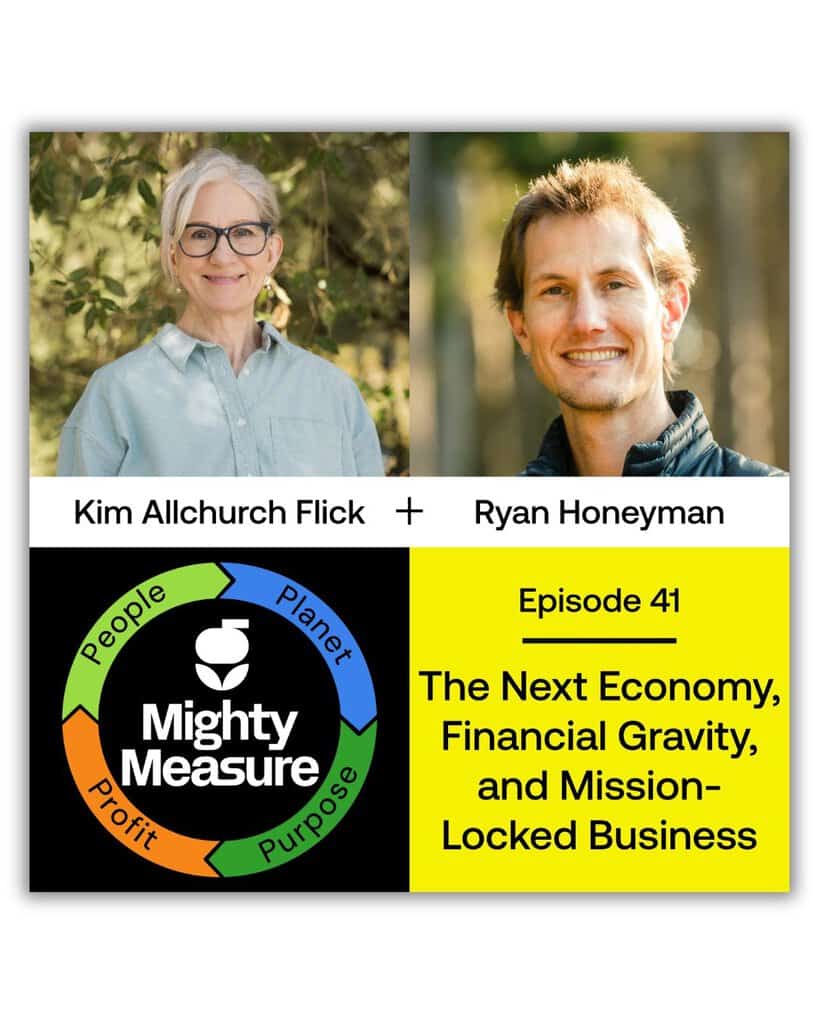
  • Embodying B Corp Certification: The Next Economy, Financial Gravity, and Mission-Locked Business with Ryan Honeyman of Lift Economy

    Embodying B Corp Certification: The Next Economy, Financial Gravity, and Mission-Locked Business with Ryan Honeyman of Lift Economy

    Ryan Honeyman of Lift Economy, co-author of the B Corp Handbook, about “embodying” B Corp certification and aligning stated values with lived leadership and culture – joins Kim Allchurch Flick. 

    Ryan shares his path from criminal-justice-focused psychology work to sustainability consulting and early B Corp advising beginning around 2010, helping over 100 companies certify and recertify. 

    They discuss takeaways from the B Corp Champions Retreat, including shifting from anxiety about new standards to implementation and the value of in-person community. 

    Ryan explains Lift Economy’s broader “next economy” work (worker ownership, racial equity, regenerative agriculture) and the Next Economy MBA, which has reached 800 participants across 16 cohorts. He identifies “financial gravity” as a key barrier and references Eric Ries’ forthcoming book Incorruptible on mission-locking structures. 

    Listen Now

    Time Stamps

    00:00 Welcome and Guest Intro

    01:13 Champions Retreat Takeaways

    02:38 Ryan’s Origin Story

    04:43 Discovering B Corp Early

    07:36 Why Lift Economy

    09:34 Next Economy MBA Explained

    10:53 Community Shifts and Principles

    13:37 Barriers and Financial Gravity

    17:32 Optimism and AI Ownership

    21:56 Equity Focus and New Standards

    24:16 Meeting Companies Where They Are

    25:10 Consumer Demand for Values

    26:17 Real World Barriers and Hope

    27:28 Champions Retreat Strategy

    30:17 Where to Find the Work

    31:32 B Corp Paradox and Standards

    34:54 Defining Social Enterprise

    38:17 Marketing Claims and Verification

    39:29 Future of the Movement

    42:24 Dinner Table Dream Guests

    44:41 Closing Thanks and Sign Off

    Kim Allchurch Flick: Hello everyone. Welcome to the Mighty Measure Podcast. This is Kim Allchurch Flick and I am so excited today to be with Ryan Honeyman. Ryan Honeyman is a partner and worker owner at Lift Economy and co-author of the B Corp Handbook. The next economy, MBA, both published by Barra Kohler. For more than 15 years, Ryan has helped over a hundred companies, including Patagonia, Allbirds, Ben and Jerry’s, and Thrive Market become B, certified B Corporations, and Recertify under evolving standards and use certification as a catalyst for deeper organizational change.

    In recent years, his work has expanded beyond standards and strategy into leadership, embodiment, and culture. Ryan works in long-term advisory and coaching relationships with founders, CEOs and leadership teams to address the gap between stated values and lived behavior, helping leaders build organizations where governance, decision making and culture actually reflect their social and environmental commitments.

    Today we’re gonna talk about embodying B Corps certification. Rain. Welcome. It is a joy to have you here in the room. 

    Ryan Honeyman: Thanks so much for having me. 

    Kim Allchurch Flick: Yes. So we’ve known each other through B Corp for a few years, but never met until last week at the Champions Retreat in Wisconsin. That was a delight. It was amazing.

    And I learned more than I’ve ever known before, and I feel like I’m pretty up to date with some things. But what did you feel about that event? 

    Ryan Honeyman: Yeah and thanks, thanks for having me on. I think the. The things that stood out about the Champions Retreat were, a lot of the B Court movement.

    I think in the, over the past few years we’ve been feeling a little bit stressed or anxious about the new standards and this, the content of this, champions Retreat was a lot on the new standards and luckily I do feel like people are moving from fear and an anxiety and. Feeling stuck to, okay we’re actually doing this and now let’s move into implementation.

    So it was nice to feel a little bit more of the sort of movement towards. Getting the work done and a little less of the stalling out around the new standards, so that, that stood out to me. And similar to you your opening comments I really found a lot of value. I’m reminded of how valuable it is to be in person with folks.

    I, I often forget that that is so amazing. And so that was also replenishing for me to be around other humans.

    Kim Allchurch Flick: Thank you so much for that. What, before this, what was your life journey and inspirations to this point? 

    Ryan Honeyman: Yeah, so I started out wanting to reform the criminal justice system.

    So I was into psychology and the psychological effects of incarceration. My, one of the professors I had in college was leading the Stanford Prison Experiment for folks who randomly know about that. But anyways I was doing this. Sort of, reforming criminal justice approach. And one of the things I did was work at a, in San Francisco at San Francisco General Hospital, had a mental health unit for emotionally troubled kids.

    Folks who were systems impacted. And that was both very. Difficult, very fulfilling. It was like, wow, this is really in the trenches. This isn’t just writing papers, in college or academia is like what? Writing papers on things. This was like one-on-one interventions and when working with the kids, but it was also so incredibly hard that I was like, wow I’m burning out.

    This is, it had been I think two years of doing that work and it was really not, it was just so hard. And also I felt like the. Where I was intervening with, kids that were already 13 to 18 had already been through so much trauma that it was feeling like I was catching folks, later in the path.

    And so what happened is that my. Brother had studied environmental studies in college and he had some of these early sustainability books. I think things like natural Capitalism, I dunno if you know, readers May, listeners may have heard some of these. Cradle to Cradle, which was a funny book, but it was like made outta plastic and it was all about remaking things and and then, some other books around about Paul Hawkin and I read these books. This is around 2010, and I said, wow, this is pretty cool. I could be, I would much rather do this green thing than what I was doing, before. And so I convinced the. The executive director of this nonprofit I was working at to allow me to be a sustainability person, sustainability manager for a year.

    So I was at the nonprofit working, but I was more looking at, lighting and, energy efficiency and water and waste and how to, make sure the kids were getting healthy food, et cetera. And then at the end of that, he the executive director was like, we can’t really keep you as a sustainability person, so what do you wanna do?

    And I was like I think I’m gonna just start a solo consulting business to work, with a number of companies around sustainability. And this is pretty early in the B Corp movement. And so as I was starting this solo consulting business by fall of 2010, I had found out about B Corps and was like, oh, this is cool because this is, all this social and environmental things.

    In one wrapped up in one thing, was the legal structure, but also the certification. And so I said, instead of sustainability more broadly, what if I just talk to companies about B Corp as a way to, to become more, socially and environmentally conscious and, so I started doing that.

    IB lab had just opened an office in San Francisco around I think 2010 or 2011. And I met folks know Andy Fife from B Lab. He’s one of the. He’s back and he was an intern. It was funny we met pretty early and yeah, I started helping companies with B Corp certification and that was the good old days when the Bay Area, we had I think there was 200 B Corp and it was like 20%, I think there was a thousand in the world and there was 20% of all the B Corps were in the Bay Area.

    But now that’s those are, those days are over. The other, I think Portland’s probably ahead of us and, and definitely places like the UK are head of the United States now. So yeah, that was the history and how I got into B Corp work. 

    Kim Allchurch Flick: That’s fabulous. And I was listening to the dates ’cause B Corp, as we know, Dar B Lab just turned 20 years old.

    So you’ve been doing this for 16 years, so you were really on the cutting edge. And I got into it through Portland State University kind of sideways because I’d been laid off and had to find something to do. But my values came with me and that was around 2013 and it felt like there weren’t that many people out there doing what we do.

    And now there’s a lot. Yeah. But progress is really amazing. But you’re definitely one of the headliners for the B Corps movement and have always been there. I think to your question, Portland is above a hundred B cores, the state of Oregon. Just slightly above. We’re like getting toward 1 30, 1 40.

    I don’t know the exact number, but it is growing and it’s so fun to, to watch and be a sideliner of, as well as doing the work with, so how has the lift economy created and what are the solutions that you’ve been bringing about? 

    Ryan Honeyman: Yeah, so you know, one of the things that led me to lift economy, so I was a solo practitioner.

    From 2010 to 2014 actually till 2016 technically, but I met Kevin Bayou and Sean Berry, my current business partners in 2014 or so. And what I was intrigued by, so they had started Lyft. As a company to redefine success, basically to create an economy that works for the benefit of all life.

    And it felt like they were talking about things that the B Court movement wasn’t quite talking about yet. Things like, worker ownership or. Racial equity and, also regenerative agriculture, really getting into like carbon sequestering and how do you manage land in ways that yeah.

    Is beneficial for the climate. And so I was like, wow, this is what they’re talking about is are some things that. Pretty far past what my, at the time in 2014, I was, I thought B Corps were like the highest you could go. I was like, wow, this is the top of impact. And there are some B Corps that really live into that.

    But also, there’s, the movement has some large, larger companies and large businesses that are not necessarily looking at, permaculture and regenerative ag and worker ownership. And so I was intrigued and I started to work with Kevin. On a few projects where I would do the B Corp side, and then he would help with the vision and culture and strategy around like, how do you change your business to actually be more regenerative or more aligned with all life.

    And I said maybe I should just stop being a solo consultant and work with Lyft Economy to be, a team member there so that I can handle the B Corp component of the business and still participate in some of the other pieces. And so one of the things that. Yeah, so Lyft economy more broadly so we do B Corp certification.

    We do some of the nuts and bolts consulting for vision, culture, strategy, operations, but we also have some other things that are pretty cool, like the next economy MBA, which is a, an online MBA course that we started in 2018. And we just put it out there as this. Idea of what if people wanna learn business, but they don’t wanna do a traditional MBA and they wanna learn business a different way.

    And so we had worked with 300 social enterprises more customized to help them with their business. And so we took some of the learnings from that and some of those permaculture principles and other ideas and put it into this curriculum. And we had 50 people sign up in the first year.

    Of this online course, and that was the first cohort. And now we’re actually, we’re just launched cohort 16. And so we’ve had 800 people take the next economy MBA over the last, eight or nine years. And the. Cohort 17 is gonna be launching in the fall. I think that’s September. And yeah, those are some of the different things we do as well as our other podcast, next Economy Now and The Beyond The Be Podcast.

    Kim Allchurch Flick: So I’m going to switch my question in order a little bit because it leads me to, you’re getting to know so many people who are going through this program and also working with companies. What are the communities doing in response and what is, what do you see in your community as a growing worldview about these topics that you’re teaching?

    Ryan Honeyman: Yeah. I think the cool thing about the MBA is we go into some of the first six sessions are really like, let. Define the problem set and some of the, and some of the solutions. So it’s like really getting clear with folks about why we’re in the situation. We are, like, one of the things we talk about is just we call it the business as usual economy versus the next economy.

    So business as usual, we don’t really use capitalism or those things. ’cause there’s, people often have strong views like capitalism is this, or socialism is that. So we just say business as usual versus the next economy. And the business as usual is constant pressure to grow, constant, make money extraction at all costs.

    It’s the sort of standard operating model for business that we all know about in the B Corp world, in this impact world. And what we do is take folks through, like here’s some of the basic principles of what’s happening and then what are some next economy principles that could help you change your company.

    So things like defaulting to open source, something that we don’t really do in the B Corp world, which is kind of cool. Like I feel like it could be more open source. Components of things we do. Definitely shared ownership democratizing governance not just ownership, but also how do you run the company and how do you create organizations that are, vibrant and can operate more on a flat model.

    And, talk about regenerative operations. Talk about deliberately developmental. So it’s like how are you developing people? And we go through all these components and then set people up for then. Okay, let’s now go through specifically how do you do marketing from a next economy lens?

    How do you do sales? How do you do culture? How do you do, all of these things? And it’s been great ’cause there’s been a lot of B Corps who’ve come through. A lot of B Lab staff actually have taken the course and I think the way that people are responding in their communities is to say.

    Hey I’m either starting a new business and I want to integrate some of these principles or ideas from the start, or I’m within an existing company. There’s also folks who work at B Corps, maybe even large B Corps, who are like, I’m not gonna start something, but how do I bring some of these principles within my organization?

    And, yeah, people are doing different things. It’s just depends on what their role is, but it’s it’s been a vibrant community and people are building towards something that goes beyond even what B Corp can offer. 

    Kim Allchurch Flick: Yes. Thank you. This is so inspiring. And what, along the way and currently are some obstacles and challenges?

    Ryan Honeyman: Yes. Some of the obstacles and challenges and know I can go in a little bit too. One of the things that I have learned recently is there’s a author named Eric Rees who wrote the book, the Lean Startup many years ago in 2011, and he became very famous for that because he was all, the basic theory was like, how do you create the minimum at MVP, which is a minimum viable product, which is basically tried something, test it, and then iterate instead of doing a lot of work to create these fully fleshed out things.

    He’s been. He started something called the Long-Term Stock Exchange, which is also a, for publicly traded companies who want to go public but associate their their going public with long-term investors. And so they’ve got a couple companies, I think thread up is one and Asana, and there’s another one.

    So it’s in the earlier stages. But the reason I mention Eric is one of the main barriers. For a lot of us in the mission-driven world is what he calls Financial Gravity, which is like the business as usual idea that we talk about, but financial Gravity is just that. Ultimately everything comes down to how are you going to, how.

    Make money and protect against the pressures of, what it means to run a business which is usually to maximize shareholder value. And so he talks about benefit corporations in there, but he also talks about some of the things that benefit corporations are one aspect of this.

    Sort of, he calls it like creating armor for your company. Like benefit corporations are one thing, but you can also do things with the board of directors where you have your board take an oath to like always uphold the mission, which is pretty important. You can also create. He calls it spiritual holding companies, which is like a nonprofit, which owns a a for-profit entity.

    There’s also purpose trust, like Patagonia with their purpose trust. I think Tony Choon also has a trust ownership structure. So the, I think some of the barriers to this expansion of the B Court movement or the next economy has been just, the financial gravity of always feeling pressure to do more with money.

    And so what he’s been able to do is to create this, his book is called Incorruptible that’s coming out and it’s basically how do you structure your company not just as a benefit corporation, but other unique models that will really mission lock your company for the long time and help us better prevent.

    Things like what happened to, to Allbirds or others who were, Allbirds was a benefit corporation and a certified B Corp, but they still felt that pressure to expand and grow and they weren’t even, they were never actually profitable and it led partially to their unraveling of their company and like an AI company now, which is crazy.

    Yeah, there’s a lot of, there’s a lot of barriers and I think the Eric’s book, incorruptible is a great resource for folks 

    Kim Allchurch Flick: and in a timely fashion. As we’re recording this in spring of 2026, I just saw your newsletter come out this morning with that book mentioned, so we’ll put that in the show notes too.

    It’s great that people are thinking along those lines in a pragmatic fashion. The what? Businesses, but not the old ways where it used to be the corporate world that I came from, where you live and die by your quarterly numbers and. The stress level is just beyond, but it’s all for the stakeholders and it’s like, what have you done for me lately?

    Ryan Honeyman: Yeah. 

    Kim Allchurch Flick: And so I’d love the way you’re talking about that. I’m gonna get the book Incorruptible and I’ve read your books as well. Also wanna mention to the audience that the B Corps handbook is going into version three, so keep our eyes out for that. Really, really interesting topics. All of this what makes you optimistic?

    Ryan Honeyman: I think going to something like the Champions Retreat and just. Getting that sort of feel like the live contact with other people and the sort of inspiration from being around other B Corps. That’s, that makes me optimistic. I’ve got a, an 11-year-old and an eight 11-year-old daughter and an 8-year-old son who are like very cute and.

    Joyful, but also pushing my daughter’s pushing into tween zone, she’s still, she’s very sweet and so I just, I’m optimistic because I see it’s just so fun to be with them and to parent them and things like that. And this is kind of a weird way to go, but I will say that maybe 12 to 24 months ago I was.

    Much more pessimistic about all the AI stuff. With I, I still know that it’s like using a ton of energy and it’s, potentially changing a lot of things for the worse. And at the same time, like I just am. I feel like I’m more, it’s more like it’s here. And I think maybe a year or two ago it was like, wait, we should stop it.

    And slow down and things like that. But now it’s just it’s here. And then, so how are we working with it and using it in ways that are actually beneficial to folks? And creating, creating an economy that works for all. My, my business owner, my business partner Kevin, talks about, with ai you need to pair it with inclusive ownership. The example he uses was in the seventies when, Ford Motor Company would come in with robots and say, we’re gonna lay off, 5,000 employees because we’re gonna have robots build the cars.

    If you are just an employee of Ford Motor Company, you’re like, this is terrible. You’re gonna fight it as hard as you can. You’re gonna push back. If you’re a co-owner of Ford Motor Company, like if there was broad based ownership of Ford or something and you’re, the robots came in, you’re like. I’m an owner of Ford, and so the profits and benefits of these robots coming in is actually gonna make my work easier.

    Like I don’t have to, it’s not as unsafe as maybe it was and blah, blah, blah. And so that changes the dynamic of technology advancing because you’re participating in the upside. And so Kevin’s thing with AI is like, how do we make sure that the. The, there’s more broad based ownership of AI models and the sort of profits that come because then the sort of wealth creation and benefits go to the people.

    All people as opposed to it being a, just more financial gravity and shareholder primacy and going to these super rich billionaires. So that, that makes me optimistic too, about that possibility. 

    Kim Allchurch Flick: It’s interesting you brought that up because a AI is still something I find hard to define.

    Because of so many things. I use it a little bit to help correct my grammar. That’s way different than flying airplanes and a lot of other things that it does. But I love how you phrased that. And also anytime there’s change and people worry about losing jobs, you mentioned the robots. I said, yeah, but somebody’s gotta build the robots.

    So that’s creating jobs. So there, there also seems to be that along the way and we. Now we have more and more B Corps. So also looking for who are those innovators that are doing some really amazing things with good values. And I think that’s why I find optimism is in the innovators. And there’s one I’d love to support.

    It’s called Virtue Lab. That’s mostly Cleantech. Not every company’s gonna make it from the get go, particularly when they’re. Inventing something that has to have prototypes. It takes a lot of money and research. Often it cannot prove out, so some companies never get off the ground. But the ones that do can do some amazing things, and maybe AI is helping them go faster.

    I think AI can help medical research be clearer and go faster. So there’s so many possibilities, but I’ve gotta admit, I can’t understand. That the two little letters that are bigger than me. Yeah. And then there’s the energy concerns as well that come up with that. But I’m glad you brought it up because this is real conversation in real time.

    It’s talking with you is the other thing that comes to mind is we work in a world where we’re working with businesses and each one of those businesses has a silo or a niche. Or something that they’re very, very focused on. And we get to see a global view of all that. But I love that you brought up really specifics that people are focusing on, like permaculture, regenerative, ag regenerative business, how to do things better for people, employees doing it with equity and not backing away from that.

    And I think one of the things I really appreciated right from the get go at Champions retreat was they put equity and current affairs on the table and said, we are here. To talk about it, to do the right things, not shy away from it and stand for our values. And that made me feel really optimistic because it’s the not shying away from it part, nobody tread lightly.

    But it wasn’t combative. It wasn’t anything that was anything. But like Michael said, this is about all people. What else would you like to share? What else is on your mind about the world you work in and what you’d like to do?

    Ryan Honeyman: I would be curious, maybe we could talk a little more about. What you’re sensing from your, we could talk about the conversations around B Corp, did you find folks, in your conversations, did you find people still feeling overwhelmed by the new standards or were you finding people get grasping it a little more?

    What? What did you see from your conversations at the Champion retreat? 

    Kim Allchurch Flick: I think it’s twofold. One is people who haven’t looked at them yet still have trepidation. And the other discussions I’ve had with the organization that I’m in, in Oregon, the on purpose Oregon, which used to be local PDX.

    Also talking about how it almost seems like the companies that have recently recertified or certified and still have some time are postponing. So there’s that gap too. I, what I did is, as you did, worked with B Lab along the way. So the last two years have been aware enough. My company just recertified in November and I just jumped right into the new standards.

    But I’m plotting along and taking a bit at a time as I do other things in life as well. I’m a visual learner. I really, really like it. I think another thing that I’m seeing that. For me, and this is my world of view about it, is I wanna meet people where they are. And I love B Corps. I’ll always say that.

    Not every company wants to become a B Corps, so how can I help other innovations have come along? B Corps is definitely the, the stake in the ground 20 years plus. And yet there’s benefit Corporations for Good, which was created seven years ago, almost eight now, and it’s a lighter version. It’s also more accessible to companies at a lower price point.

    And then there’s the purchasing with purpose movement and people in planet first, and somewhere in there there’s something for almost everybody who’s mission driven. The other thing I never forget is Nielsen’s data from, one is from 2014. One’s from 2017, I think, and I’m always paraphrasing, but it’s that globally, 66%.

    Of consumers are willing to pay more for products and services when they know a company is sustainable and has good values. So there’s a lot of interpretation in there. The world sustainability can mean a hundred different things to a hundred different people. It’s kind of overused term, but knowing that people are looking.

    That gives me optimism. So how can they find us? And all these B cores, that’s to me is the missing link. And it comes with the marketing, the expression, all of that. And then the other study was about millennials. Same kind of questions, but they were in the 73%. And I also believe that as we’re growing and innovating and becoming more prolific as B Corps and mission driven companies, that the price point doesn’t always have to be higher.

    That maybe even if they’re willing to pay more. They can also know that they’re gonna pay the same to transition and find a company that has good values. So that’s what I’ve been operating with. And, but also being really realistic. For instance, there’s a couple of companies that really wanted to strive for B Corps.

    They’re also consumer products. They also import, and guess what happened? The tariffs went from 15% to 50, and the last thing this business owner can do is become a B Corps. And she’s just struggling to survive right now. So that’s the worldview. I really hope that through this year that more opportunities arise for people instead of fewer and that they find their way.

    But I do think the possibilities are endless, and I love seeing that there are people in agriculture. That are getting certifications, like regenerate certifications, and they really know what they’re doing in that realm. And that really gives me optimism too. And there’s people in different sectors who really know what they’re doing in these realms, whether it’s energy environment, but also with equity, with hiring, with treating people well things that they’re doing in community.

    So it’s out there. 

    Ryan Honeyman: Yeah. 

    Kim Allchurch Flick: Yeah. But how do you see it? 

    Ryan Honeyman: Yeah. Yeah. I think other takeaways for me from the retreat were, it’s funny, one of my strategies. For B Corps retreats is I actually don’t go to that many formal sessions. I just more hang out in the hallways because I I tend to see a lot of people that I wanna talk to.

    And, usually at retreats it’s they’re quite heavily scheduled of you have 10 minute break and then you go into this 90 minute session, then there’s an eight minute break, and then you’re, but most of the. People, there are the people I wanna see. And yeah, I just tend to go to the hallways and also pace myself ’cause, it’s also hard to, and I’ll mention it to Karen for the feedback on the retreat, but a lot of the events also had really loud music. They’re like, and it was like hard to have communic to like communicate with folks. But yeah I think that that was a piece that, that stood out was just the sort of, the whole retreat strategy and like how do you get, go and meet the right folks and get the most out of it? For me, my retreat strategy is mostly to go to a couple sessions, but mostly hang out in the hallways just to communicate with folks.

    Kim Allchurch Flick: That’s so smart. This is my first Champions retreat and I was all in, and I did find it exhausting at the end. I also noticed the noise level like you did. I met so many new people, but it was also great to see people that I’d been on Zoom with for years and never met in person. So things of that nature I thought were, it was so interesting.

    I also made an error. I, because I needed to come home, so I had to leave before the end sessions. I also missed all the. Banter and everything at the end that was coming up in LinkedIn. I’ve seen photos of, and I said, oh, I should have not done that. So lesson learned, but I also go to really specific conferences sometimes, like one was Go Green that I haven’t heard of anymore, but Clean Tech ones that are more focused on a specific type of industry, but still doing it with values and optimism and what I see as the.

    Connectivity and how much of that champions retreat like touched on, things like that they touched on. I went to one about water. It was really interesting. Even though it may not affect me directly, the indirect knowledge is still important. So it’s, the thing about general business is we can’t always be too general.

    It’s nice to know some really deep specifics and I think Champions Retreat did touch on that as well. Yeah, absolutely. The vendor marketplace was great. It was fun. Yeah, I came home with stuff. Yeah. 

    Ryan Honeyman: Awesome. 

    Kim Allchurch Flick: Is there anything else that you’d like to add? 

    Ryan Honeyman: I. Maybe we could I’m happy to jump on the, like the dinner with the three people or like the dinner one question or something.

    Or I dunno if you had other questions as well. 

    Kim Allchurch Flick: One is, how can people reach you? And I do wanna make sure that people know that in the show notes is your books, that newsletter. Everything. So how would you refer people to reach you? Yeah, 

    Ryan Honeyman: yeah. Folks wanna reach out? I definitely would suggest folks check out the Next Economy mba.

    That’s at lyft economy.com/mba. The Lyft economy.com site has all of our. Sort of content. I’m probably, I’m most active if folks are on social, on LinkedIn. I’ve removed myself from Twitter whatever the platform is now. And I never made it to the other transition platforms like Mastodon or anything.

    And I also never really signed up for Instagram. So LinkedIn is is where folks can go if they want to connect. And. Yeah the other podcasts I mentioned, so Next Economy Now is it’s more of a broad podcast that we’ve been doing now for 10 years at Lyft. And we’ve had. I think 300 people on now.

    But it’s things like, climate activists racial and racial justice activists. Also like business leaders. Like we had the, a number of people from Patagonia on there’s one gonna be coming out. With Eric Rees on the, his new book that’s coming out soon. And so it, it ranges the gamut.

    And then our Beyond the Be podcast is more B Corp specific. We also like to get into the, so we talk about the new standards and things and developments, but there’s also the bigger juicy questions of one of the recent episodes we did was on the paradox at the heart of the B Court movement with todd Ling and Ante Kim, and if, have you heard of that? The h the Harvard Business Review article that they did? 

    Kim Allchurch Flick: No, I haven’t. I’d love to. 

    Ryan Honeyman: Yeah, so they did a an article called The Paradox of Growing as a Values LED Company and it was a Harvard Business Review article from 2024, and it was about the B Court movement and how the B Court movement has.

    Grown but not collapsed like a lot of other social movements. Famously, like there’s been a lot like Social Venture Network, which started and then is like not really as, as strong anymore. I think it’s trying to be revived, it’s a little unclear. There’s like the American Sustainable Business Network, which I think is still going, but also had merge with Social Venture Circle and the Investors Circle and so there’s been a lot of.

    Communities that have been shifting. And so their research was on B Corp and they’re trying to say, why has it lasted? And so their paradox was that B Lab has both relaxed the standards or relaxed the sort of. The requirements at times, like for example, to allow in Ben and Jerry’s in 2012, but at the same time it’s tightened the standards.

    So for example, if Ben and Jerry’s could get in 2012, but then they also required Ben and Jerry’s and other companies to have, fully transparent, like a hundred percent of their. Their B impact assessment answers are transparent and it, and you have to have a full audit of all of your answers on a much more strict frequency as opposed to the frequency for other B Corps.

    You have to have the governance, they have to examine the governance of the sort of subsidiary to make sure it’s truly independent and has their own sustainability management system, et cetera. And so there’s they’ve both relaxed and strengthened, and they called it the paradox.

    Another word they use is consistently inconsistent about some of the changes. But it I think it’s a really helpful article and like framework to think about why B Corps have grown and been successful, and at the same time why there’s. Tensions in the movements because, like they, they list organic as something that had a lot of early momentum and then they had a lot of, or some of the fair trade controversy, but then a lot of multinationals came in and took over and it felt like that got co some of those things got co-opted, whereas opposed to the.

    The true purity side. They mentioned like the craft beer movement where it’s like you literally cannot be a large brewery in it. So it’s, it only stays small. And they would, were saying that maybe limits the effectiveness of the B Corp movement, if it was like never allow any multinational, like we would probably never.

    Reach effectiveness threshold or like a public awareness of how we are. So it’s a really fascinating article and it’s we did an interview that’s coming out on that just came out on beyond the b but I also recommend folks check out the Harvard Business Review article as well.

    ’cause it. Nerds out on B Corp stuff. 

    Kim Allchurch Flick: I’ll do that. And it also makes me think about some of the large B Corps that have chosen not to recertify and what is the definition of social enterprise. Can a B Corp be a P corp and not a social enterprise? And there’s another podcast out there and I was listening to one about an alcohol company.

    Tequila is tequila social enterprise. Probably not. Is alcohol’s been around since the dawn of humans almost. And yet how they run the company is another example is a company that I love locally. That is, they do oil changes in auto mechanics. They don’t sell fossil fuel, but they work with cars that use fossil fuel.

    Oil is a fossil fuel, and yet they’re a B Corps. And. And he says I can’t stop people from driving, so I might as well help people take care of their car and do it in a way that the other oil change companies don’t. So what are you seeing in as far as that goes? What is a social enterprise?

    Can you be a B Corps and not be a social enterprise? And what about these ones that have been B Corp for a while and are choosing not to? Yeah. 

    Ryan Honeyman: It’s funny, I. That oil, that car mechanics company, do you know if it’s run by someone named Farhad? Farhad 

    Kim Allchurch Flick: Kadi, yes. 

    Ryan Honeyman: Okay. So I went to college with him.

    Oh, at uc, Santa Cruz. 

    Kim Allchurch Flick: Yeah. That’s 

    Portland. 

    Ryan Honeyman: Yeah. Yeah. And now I know, I knew that he had opened up at B Corp auto mechanic. It’s so That’s great. Yeah, tell him hi, if you say, if you talk to him. But yeah I actually, the whole social enterprise thing is interesting to me because. It wasn’t until Aaron Sahan from Donate Economic, formerly of Donate Economics had made some, critical statements of B Corps allowing espresso in that I ever thought that the B Corp movement were not comprised of or composed of social enterprises. Like I thought everyone was just a social enterprise and I, and it was helpful to have some conversations on beyond the b and otherwise with a, to, to have him clarify well look, social enterprise is you’re doing this for the benefit.

    Of society and your, probably donating or you’re probably putting a majority of profits back to the mission as opposed to taking them out for shareholders. And so he is like not, not every B Corp you could say is doing it. For the for the benefit of society and the environment, you could argue that something like, I don’t know, maybe Allbirds or others was like more of a profit driven company that had some sustainability components.

    But is it a social enterprise? I think they would, Erin would’ve quibbled with it. So it was interesting conversation and I do, that’s one reason I like the people in Planet Firth first certification and Rebecca Dray’s work and Erin’s work as well because as but just for listeners who don’t.

    It’s only five requirements and one of them is you have to donate or you have to give a majority of profits or reinvest or give a majority of profits to your purpose. Like you can’t just say you’re a social enterprise and then take like 98% of the money out for shareholders, to enrich shareholders or something.

    And that I think is a really great, like litmus test for a lot of companies is what are they doing with the majority of profits that they make. 

    Kim Allchurch Flick: Yeah, I agree with that. Thanks so much for that. I think it is important to talk about definitions and where definitions can be lacking, so they can mean different things to different people, and yet it can still all be good.

    You have words like sustainability, words like impact. They all mean different things to different people. So in conversation I think it helps to discuss it in some ways and say what does it really mean to us or to a person or to a company? And have that be defined? And for me, I find the frustration when I know a company is doing really good things.

    The frustration is the lack of expression not strong marketing, not. Making a claim and not having a way to back it up. All of these things. So that’s where I see a lot of work can be done is, and if companies aren’t, they don’t say so. That’s, I think that the verifications are really terrific for helping weed out what might be potential greenwashing and.

    Which we’ve been through before in, in recent and long histories. There’s long history of making false claims. So I do think there’s tremendous value in making claims and being able to prove it and have a third party verification. Yes, absolutely. Yeah. I’d love to talk to you about the future a little bit.

    What Sure. That comes with the optimism. And then let’s go to dinner with your four people. What is there anything in the future. That you wish for or think about might happen? 

    Ryan Honeyman: One thing that’s, that is weighing on me a little is you mentioned I’m writing the third edition of the B Corp handbook.

    And so that’s probably gonna come out in September, 2027. A little bit TBD, but I think. The, so the, you know what I’m hoping for the future is to write something that’s both, takes into account the things that have happened because I feel like in 2019 when the last edition was written, it’s like a whole new, it’s actually all the racial justice uprising, all COVID, all the anti woke.

    Everything has happened since then. So it’s actually interesting to write a new edition, but I think what I’m hopeful for is doing some writing something and. That can be a tool for expanding and growing the movement in a way that takes into account everything that’s happened, but also, helps I think, position the B Corp movement for the next 20 years.

    That like some of the founders of B Lab have said. ‘Cause I’ve spoken to a few for this book and they’re like, don’t look backwards in the last 20 years. Let’s look forwards the next, the next 20 years. And I’m like, yeah, that’s true.

    There’s a lot of exciting stuff. So I think it’s like balancing those things while staying sort of authentic. And I’m optimistic that B Corps can maybe adopt some more some of these potential like mission lock structures that Eric Rees talks about that we can create more systems change with the new the new B Corps standards being focused on systems change a little more than individual company performance and that.

    Fingers crossed, we don’t have any more big negative scandals in the B Corp community. Seems like we’ve gotten out of that pattern a little bit, but, honestly, with with 10,000 companies, Bart Houlahan at the Champions Retreat was saying this is the largest business for good movement in the world now.

    And I did ask AI to verify that it’s the UN like global compact for business is larger, but those aren’t verified third party. So I was like, okay, it’s the largest, maybe it’s the largest third party verified of business for good movement. And so yeah, I’m optimistic about what’s possible in the future.

    Kim Allchurch Flick: Great. And I think the global B Corps is also growing. Yes, B Corps is around the world that’s faster than 

    Ryan Honeyman: us, 

    Kim Allchurch Flick: and the purchasing with purpose movement is actually growing more quickly. The US is the slowest growth. It’s growing more quickly and in Africa, Latin America, Asia, Europe. So yes. Thank, thanks so much.

    I think we could geek out for a long time, but let’s wrap it up with the dinner question. If you could have dinner with up to three people living or deceased. For a table of four, who would they be and why? 

    Ryan Honeyman: Oh, wow. The one person that popped into my mind just, so alive is Yon Scho from Patagonia because he’s such a, he’s such a, a I would, I will say like weird or like eccentric or he’s just so out there that it’s like, who is this guy? And what, what really makes him tick? And I’ve only, I’ve seen some of his talks. I did many years ago in, I think 2014 or something, I did see him speak live and got to meet him at a 1% for the planet event.

    He’s not very, he’s not like a gregarious, he doesn’t like open up and just let loose. But I feel like in a dinner table context, he might just say more about, about himself. So that’s definitely one person that, that comes to mind immediately. Another person would probably be.

    I think Barack Obama would’ve a lot of interesting things to say about what he sees in the world and what it’s like being president and all the balances, all the things that he’s had to go through. And so that’s someone I’d probably want at the table. And then, yeah, maybe some. I think I’m like searching for more of a historical.

    Figure that’s been through some stuff that could maybe put all the, like global unrest, in context. ’cause that, someone who’d been through the civil rights movement, like the easy answer would be like Martin Luther King or something. But maybe it’s maybe or may not, it’s that, but just someone to be like, how are we doing?

    And is this, are we like way outside the norm of what we’ve been through in America or the world? Or is this like just. It’s a cycle and, these are the moves that like, keep doing this, keep pushing forward because things will change rapidly and then, suddenly what you’re doing could really break through.

    So I think I would be yearning for someone to have that like historical perspective, a little bit of like systems change. 

    Kim Allchurch Flick: Oh, that’s so intriguing. Oh, I think having you at that table too would be pretty awesome because you have done a lot of systems change for a lot of people, and it’s been terrific. I really appreciate you being here.

    Ryan Honeyman: Thanks so much for having me, Kim.

    Kim Allchurch Flick: Thank you. Everyone, thank you for listening. This is Kim Allchurch Flick with the Mighty Measure Podcast. Signing off and wishing you a good day. 

    This Episode’s Guest: Ryan Honeyman

    Ryan Honeyman is smiling in an outdoor setting.

    Ryan Honeyman is a Partner and Worker-Owner at LIFT Economy and co-author of The B Corp Handbook and The Next Economy MBA, both published by Berrett-Koehler. For more than 15 years, Ryan has helped over 100 companies—including Patagonia, Allbirds, Ben & Jerry’s, and Thrive Market—become Certified B Corporations, recertify under evolving standards, and use certification as a catalyst for deeper organizational change.

    Ryan is the co-host of Beyond the B, a podcast exploring what is working and not working in the B Corp movement, and a co-host of Next Economy Now, a LIFT podcast highlighting leaders advancing regenerative and whole-systems approaches to business.

  • Accountability, Certification, and the Triple Bottom Line with Tom Hering of Benefit Corporations for Good (BCFG)

    Accountability, Certification, and the Triple Bottom Line with Tom Hering of Benefit Corporations for Good (BCFG)

    Tom Hering, co-founder and managing partner of Benefit Corporations for Good (BCFG), joins Kim Allchurch Flick for a discussion about whether small businesses truly reflect their values and how to communicate them with accountability.

    Hering shares his three-act career journey from advertising to purpose-driven business through the Benefit Corporation structure, and describes BCFG’s work since 2018 certifying businesses across 13 states and one Canadian province around people, planet, and profit.

    They discuss challenges including a trust deficit from purpose-washing, accessibility for small businesses, funding and scale, purpose fatigue, and an awareness gap about Benefit Corporations.

    Hering outlines BCFG’s process (values quiz, legal benefit status, 60-question assessment across eight standards, annual public benefit reports) and highlights community-building events, student support from University of Oregon’s Allen Hall PR teams, optimistic market data and generational expectations, ways listeners can help, and how to connect via BCFG’s website, newsletter, and YouTube.

    Listen Now

    Time Stamps

    00:00 Welcome and Guest Intro

    02:00 Tom Journey to Purpose

    04:38 Trust Deficit and Community

    09:44 Key Challenges Today

    14:34 Why Optimism Is Rising

    18:04 Expansion Beyond Oregon

    21:39 How Certification Works

    27:05 Student Outreach and Mentorship

    33:53 Recertification and Value Proof

    39:33 How to Support and Connect

    43:22 Dream Dinner Guests

    47:00 Closing Thanks and Wrap

    Kim Allchurch Flick: Hello everyone. This is Kim Allchurch Flick of the Mighty Measure Podcast, and I’m thrilled to be here today with a friend. Tom Hering is co-founder and managing partner of Benefit Corporations for Good, also known as BCFG, an organization he launched in 2018 along with Mary Anne Harmer to grow the benefit company movement across Oregon and North America.

    Under his leadership, BCFG has certified businesses in 13 states and one Canadian province championing a triple bottom line of people, planet, and profit. He is the co-founder of two books. Putting soul into business, how the BI Benefit Corporation is transforming American business and 25 building blocks to create a conscientious organization and currently serves as a member of the advocacy action team for the Interfaith Alliance on Poverty.

    Tom holds a degree from the University of Oregon School of Journalism and Communication. Today we’re gonna talk about. Does your small business truly reflect its values? And there’ll be some key takeaways why a responsible small business communicates its values to all stakeholders. What lies at the heart of small businesses practicing the triple bottom line, and how a small business builds in accountability to its mission, vision, and values.

    Tom, welcome. It’s so great to have you here. 

    Tom Hering: It is awesome to be with you, Kim. I am honored and look forward to chatting with you here over the next few minutes and see if I can, help bring some interesting viewpoint or enlighten a few people or just reaffirm some things to some of the great leaders that might be listening to your podcast, 

    Kim Allchurch Flick: all of the above.

    And a nod to Mary Anne Harmer. I met her first and she led me to BCFG in 2018, and we’ve all been friends ever since. So I am truly blessed by that. So let’s start with what has been your life journey and the inspirations that brought you to this point? 

    Tom Hering: This is just a very interesting question. I know that, you sent these ahead to me, Kim, to look at ’em, and really, my journey is simply defined by three x.

    All right. And honestly, I didn’t really figure out how they were connected until I was deep into this one, the third one. And little bit about the first two acts they were spent in advertising. I was copyrighted creative director. Are two decades of learning how to shape stories communicate what a company stands for.

    And I really did love it at that time, but somewhere along the line I started asking a harder question, particularly in my second act, that what do I actually wanna stand for? And, the question started to become impossible to ignore. And that is I wanted my third act to mean something beyond the campaign, beyond the ads, beyond the beyond beyond the radio spots.

    And so I started exploring the intersection of business and purpose, along with my co-founder and now retired partner Mary Anne Harmer. And that’s when we discovered the Benefit Corporation structure. The idea that a company could embed its commitment to people and plan it into its legal DNA, not just in its marketing materials or pr brochures.

    But something that was genuinely electrifying. And my inspirations have always been, the entrepreneur, the entrepreneurs who refuse to accept the false choice between profit and purpose, that they were not, opposites but actually work together. And those business owners who you know, who look at their team, their community, their environment, and say, these are not trade-offs, these are responsibilities.

    Every one of our certified members in the BCFG community inspires me, including you, Kim, and you are our very first certified BCFG. I want listeners to know about that. And we’re very humbled still to this day by that and you all in, in that community and our community are really proof that there’s another way of doing business.

    You know that it’s not only possible, but it is actually happening.

    Kim Allchurch Flick: What a lovely way to put it. And thank you for the nod. It’s the so much fun. I was so delighted to hear about BCFG. And learn what you and Maryanne were putting together. And I thought, I’m, I’ve gotta be on board and haven’t looked back. I’m so delighted. What are you seeing and hearing in the community and what do you see about you in terms of what you’re doing and how the community’s responding?

    Tom Hering: Yeah the way I see it as the communities we serve are small business owners and they are simultaneously really the most underestimated. And as I see the most powerful force in the American economy the issue I see most clearly with them, it’s a trust a deficit. Consumers are, increasingly skeptical of corporate purpose claims and rightfully so. purpose washing is everywhere. I remember hearing about greenwashing so much the very first time I heard about Oregon Benefit Company in 2017. From a good friend of ours in the Oregon Secretary of State’s office, and, there’s this thing about companies plastering sustainability language across their websites without a shred of accountability behind it.

    And I think the cynicism, it damages everyone, including the businesses that are general, generally trying to do things right. Another issue that bubbles up for me is accessibility. The infrastructure for purpose-driven business has historically been built for larger companies with ESG departments or legal teams that have the monies to engage with those those specialists, those subject matter experts and small businesses, which represent the vast majority of employers in our country have been largely locked out.

    And so that’s why we came up with Benefit Corporations for Good a, a solution that has a certification but is aimed at the small business person. And this is from solopreneurs to, we have a few businesses that are in the thousands, a 1500 thousand employees are teams. But for the most part, they’re for smaller businesses.

    And our standard really was developed alongside, respected bodies like B Lab and what is the other one I’m thinking about? Green America, GRI, those are similar organizations that are recognized by the Oregon Secretary of State. And designed to be really accessible to small businesses, and we are humbled to be on the, on that page with those three other great business organizations.

    And then we also offer something just as valuable as the certification itself. And I call that community, when our purpose-driven business owners find each other. They’re able to accelerate and encourage and inspire each other, and they share practices, they refer customers, and the cool thing is that they really raise the bar collectively.

    And so the solution really to a trust deficit is verifiable accountability. And I think that’s what we provide to these purpose-driven leaders that become part of our community. 

    Kim Allchurch Flick: I concur from my vantage point as well being in Portland, but also you’re building this across several states and your gatherings are mostly in person, but there are some virtual ones as well, and they aren’t typical networking events.

    I think the magic that you do is bring people together where everyone gets to announce who they are, what they do. And it’s a chance to see who’s in the room. And it brings people much closer together. And I know that I personally have done business with a lot of BCFG businesses because of that, because we’ve had a chance to shake each other’s hand and say hi.

    But not in a sense of networking. It’s more in a sense of the commonality of we’re all here too. Work our butts off, earn money and do it for a higher purpose. And everyone has their own individual view of that. 

    Tom Hering: Yeah. Yeah, absolutely. To use an old cliche, you are all singing out of the same hymn book, and it delights me to no end.

    When we have those happy hour for good events or get togethers that bring not only just to our community, but others that are interested or are also purpose-driven leaders, nonprofit leaders come, that it is something that inspires me. That’s what really keeps me going. It is it’s great energy and I’m grateful for every one of those really inspiring professionals that are in the same room on those events in particular, to see that energy and that connect connection.

    Kim Allchurch Flick: And I think you also do something magical, which is bring a focal point. There’s always someone who’s talking about something specific for 15 to 20 minutes, not too long, not too short, and yet it, it encapsulates the meaning for a particular event. So you’re very, very good at that. We’re gonna switch gears just a little bit and say, what are some of the obstacles and challenges that you’re seeing these days?

    Tom Hering: Yeah, so I, yeah, I came up with three. And these are the ones that, it definitely enters my mind and my heart, pretty regularly every week. And, the very first one is really about scale and advocacy and certification for good. Don’t necessarily attract traditional interested investors.

    We’re not a product, with a hockey stick kind of growth curve. We’re really building infrastructure for a moment and a movement, I should say, and that requires a different kind of patient mission aligned support. Finding that support at the scale needed to grow our impact remains our most persistent challenge.

    And so that’s cer certainly one of the three obstacles challenges I think that are on that weigh on me pretty regularly. And the second one is what I call purpose fatigue. There’s so much noise around ESG and sustainability and social impact. That I feel business owners and consumers are becoming somewhat numb.

    When everyone claims to be purposeful, nothing feels meaningful. And our job is really to cut through that noise with something concrete and certification and accountability and annual reporting all add up to, to proof not promises. And I think that’s a good direction.

    And then the last one, and this has been one, since Maryanne and I founded this in this organization in 2018 it’s the awareness gap. And it’s surprising how few people still know about the Oregon Benefit Company or the Benefit Corporation across the United States at this time and date, even though that ability for a business to incorporate as one has been on the books since 2008.

    We’re talking almost 20 years. A remarkable number of small business owners have never heard of it, and a lot of them are living the triple bottom line in practice how they run their businesses. They just don’t know that there’s a legal framework and a certification that formalizes and then validates exactly what they’re doing.

    Every conversation we have is partly in education, and education at scale takes time and resources. That’s something I finally have accepted. So none of these, it’s funny, Kim. None of these challenges really discourage me, but they certainly help clarify the work that I need to do as the leader of this community.

    Kim Allchurch Flick: And you’re doing it well and you bring up something really important it that it is true. There is still greenwashing and purpose washing, looking good, but not really doing it. And then there’s the other thing that you and I have talked about is in our community, finding these small companies bumping into some, someone in retail may be walking through a door and it’s obvious that they’re doing things with heart, with soul, with purpose, doing some really great things.

    And to see the depth at which they are thinking about their employees, their sourcing. This happens a lot in food. And so ask a couple more questions what is your purpose? What are your values? What do you do? And. They tell me and then I say, oh, and how do you track that?

    Oh, we don’t. Or, it’s, or there’s some vry to it. So there’s the also this I’m not gonna call it a trend, that’s not what I see, but people that really are doing great things and they haven’t thought about really bringing that to light and the value of measuring and documenting and keeping track of that and.

    I find that because of our work my work as well, because I live in the certifications and verifications world and want to showcase what companies are doing, and part of that is measuring and reporting it so that consumers can find the companies that are doing well and know exactly what it means to these ones that are doing great things and don’t showcase it at all.

    And. And that seems to be a gap. And I was wondering what you’re seeing in that regard too. Not the over promising ones, but the ones who are doing great things and can’t even find it on their website or 

    Tom Hering: I think that’s, getting that message out and clarifying that there is some third party that’s helping, to validate claims that have been made by businesses that are doing good is a helpful thing. And you’re right, there are many that are doing that, and I think that’s the one thing that Maryanne and I saw. Back in 2018 is that there were so many good small solopreneurs, small businesses doing amazingly good work but didn’t either have the time or the resource to go through a formal certification.

    I think until we, I think we came along at least and offered an alternative there, things that are really making me optimistic because I was talking about my challenges, but I think there’s some things that are really making me optimistic. Data Next Generation and the businesses I meet every day are totally fueling that for me.

    So a couple interesting recent stats here. For your audience and this is really some data that is pretty much unambiguous. So PricewaterhouseCoopers in 2024 in their voice of consumer survey, found that consumers are willing to pay nearly 10% more. For sustainability produced goods, and this is even in an inflationary environment.

    So this was just two years ago, not even two years ago, Deloitte found that purpose-driven companies retain employees at a 40% higher rate. And a 2024 study from them showed that 94%, 94% of Gen Z consumers expect companies to address social and environmental issues. These aren’t fringe numbers, they’re mainstream market signals.

    The way I see it. This next generation does give me enormous hope particularly millennials and Gen Z. They aren’t asking whether businesses that you know, business asking the question whether a business should be purposeful, but rather they’ve already decided it should be. They’re the dominant consumer and work workforce for the next three decades.

    And they’re businesses that the businesses that understand this now are gonna have a structural advantage for sure. We always say to businesses that are considering coming to our community or whatever certification standard they might be seeking, is that if you really wanna attract the best and the brightest in terms of employees, make sure that you’re paying attention to the needs of those two generations.

    And that is. Basically they wanna work for a business that does more than just make a profit. And, and then I guess the last thing really is that there are the inspiration I find are from, as I mentioned earlier, the business owners themselves. Every company that we’ve certified, from solar providers to law firms, to artisan food producers.

    It’s proof that profit and purpose are not opposites. And these opportunities aren’t sacrificing performance for values. They’re discovering that values, their values are a competitive advantage. And so when I look at all of this together I just don’t feel optimistic. I feel like we’re on the, the right side of history.

    We’re really at an inflection point, I think, and I think that history is moving faster than a lot of people realize. 

    Kim Allchurch Flick: I think you’re so right and it’s why I think I have the best seat in the house with this podcast series as well, is hearing the stories of those people and collectively how much optimism I have as well.

    Because there are innovators and creators and supporters that are doing something for good and collectively, this is a pretty large force of just values and purpose-driven people. In concentric circles all over the place. 

    Yes, and 

    and you’re right. And it’s really encouraging to hear those statistics as well.

    Very encouraging. Yeah. And tell me about the expansion. Other states you’re in 13 states now. Not all states have the, legal entity of Benefit Corporation, but a lot do. And what are you seeing beyond the local area? 

    Tom Hering: I think they’re very similar. right now, I think it’s 40 states that offer Benefit Corporation legislation.

    And I gotta believe that almost every state’s gonna have that at one time or another. Before this whole chapter I guess is written, but what I see a really no different than what I’ve seen in the businesses that we’ve certified in in Oregon. They they’re very purpose driven.

    It’s all built Kim, on values. Their values are aligned. All 13 states have values that are aligned. And I think this is something that I always say, even in our happy hours for Good, which is in person here in Portland, and that is, people should be talking with one another.

    It’s always one of, you’ve heard my pitch, dozens of times now. But I always say to everybody in the room, and we have plenty of people that are new that come each time that are not necessarily certified, but I say. You should be talking to your neighbor who, even if you don’t know them at this point, because your values are aligned, and why would you not wanna do business with somebody who, believes and acts the same way that you do in terms of how you run your business?

    So I see that in these, 13 o other states. I just certify one of our businesses in New Mexico two weeks ago. And it always comes through loud and clear that, they are built on. The belief that the triple bottom line that people, planet and profit that idea is the only way to do business.

    And they’re doing it, they’re doing that. They’re reflecting that in their certification process with BCFG. 

    Kim Allchurch Flick: Well, congratulations. That’s another state. And I think the other thing I see happening with the magic that you create between companies, and I wanna say not everyone’s like-minded, but certainly like valued.

    And I think the beauty of it all is also diversity of thought that comes into it. Diversity of businesses, diversity of the types of people running those business and working with those businesses, but doing the work together and discovering. Supply chain. Discovering potential partnerships, discovering supporters, discovering contractors discovering.

    Helpers and the assistants and all within that community and beyond. And I know that because of it, I’ve found great companies to work with that I didn’t know of if I wouldn’t, may not have known of if it wasn’t for your group. And because of the group, we’re all getting to know each other more. And that differentiator is values driven because we all have competition too, and some values driven, some not.

    But having that differentiator and being able to find it is really, really something. 

    Tom Hering: It really is. And you’re right. And that’s a, another real benefit of being certified is it is a clearly a differentiator in how you market your business. And it’s something to be, as I said earlier, something that younger generations are particularly looking for.

    And they will do their due diligence and they will look to see what does this business, whether they’re a customer or a prospective customer or a prospective employee. Or just a prospective supportive community member, see what this particular business stands for and stands up for, is what I say. So 

    Kim Allchurch Flick: abs, absolutely.

    And would you mind talking a little bit about the evolution of BCFG since 2018 and what the assessment’s and any changes you’ve made to it? 

    Tom Hering: Yeah, I think ours, is a, it’s a simple process. Really there are just we say there are really three things to move forward into our community. And that first thing is obviously to see if you’re a good fit. And we have a free values alignment quiz that is on our homepage. There are 12 questions. It takes you less than two minutes. You get a good idea of whether you’re a good fit now, whether you’re working toward it.

    And then we’re able to offer some follow up information to help them get on that path if they need more help. Secondly we always suggest that they incorporate their business or amend their business if they’re already incorporated to include that benefit company or benefit corporation box and that structure in their legal documents on their Secretary of States website.

    And then the questionnaire is 60 questions. Somebody goes through it, and our pricing is all based on the number of FTEs in a particular company. And as you could imagine, we, the majority are in our smallest fee range. And that’s five FTEs or less. And those questions are based on eight standards.

    And the eight standards are understanding the values of Benefit Corporation, what we call conscientious leadership diversity, equity, inclusion. Green practices, community engagement, customer service, strategic business practices, and work life, or what we call life balance. 60 questions based around those and it’s self-evaluating.

    And then once somebody’s done, we ask if they’re supporting documentation on why you gave yourself a particular score. To include that. And then we go through the process of not only scoring, but evaluating what are some quality steps that you might be able to take to improve your scores and here’s where you’re doing great work.

    And recently we’ve added a new written report then that follows that we hadn’t been doing that. Because of our, what we felt was a very low price point. But now we’ve added this not only in documentation, but in scoring and an infographic that shows a company leader what’s being done well and where can we improve and something they can refer to each year.

    And we do, speaking of each year, we do require our founding 20. Businesses. Our first 20 businesses ask that we bake in some real accountability, and that is the annual benefit report must be produced. That is pretty much a legal requirement in all 40 states. How did you improve people and planet, or that’s the simple word.

    There’s some more policy statement that talks about positive impact, positive material impact on people and planet. But and nobody gets re-certified in our committee until that report has been, not only created and, but it has to be published on that particular businesses website.

    Kim Allchurch Flick: That’s super important. And you’re saying something that is so. Critical to remember is the state is requiring it, it’s, it is written in there and that means make it public. It can be on a website. And there are other organizations we know other verifications and certifications that are also saying Benefit report annually must be public.

    I find re-certifying annually to be. Something where you gotta brew a good pot of tea or something and sit down and just do it. You’ve made it so it can be saved and can go back to it. But I also find that I love having a sense to look back and look forward and retrench. Certification is usually the hardest because sometimes we don’t know what documents to prepare, and that’s where consultants and people like I come in.

    But also, once you’ve done it. The documentation doesn’t have to change. It needs to be updated, but the platforms created can be similar and it doesn’t have to feel like a second job. It can be part of the operations to keep documenting in those eight standards, and then you’re ready to prepare and in some ways, preparing for taxes annually.

    Feeds into this type of documentation because if you’re a company that’s tracking philanthropy volunteer hours, things of that nature, then you’ve got some of the documentation there anyway. And I think that’s where some people get scared and put off is they think that the tracking is gonna feel like a heavy load, but when it becomes.

    When it becomes I’m trying to find the right word for it, but when you have a system 

    And can create a system that works really well, it can be plugged into so many different things and you feel really good about it. But for companies that do have employees or to be able to share with partners, like to attract part partners in a supply.

    That’s also something that becomes really great to share and people start to find each other. 

    Yeah, so 

    I think what you’re doing has so many layers to it, that the assessment itself is one thing, but what it does for companies is many things. And that’s great to know and it has been updated. And tell us a little bit about your outreach too and how you’re being supported by and are supportive of the U of O students and others.

    Yeah that’s a bright spot too. That’s a really cool thing. 

    Tom Hering: It is a very bright spot. So I’ve been fortunate. So this is almost the end next week I think is the end of my fourth year of engaging with Allen Hall pr, which is a student run. PR organization with the University of Oregon, my alma mater, and I’ve had the privilege of working with a different student team the last four years who’ve helped me and BCFG with its social media and some great creative thinking to help me problem solve particularly when it comes to communication.

    About our community about our businesses, and it’s, I’m gonna do it again. I’m gonna be, I’m gonna be signing up for year five because it’s something that I get their creativity and their energy and their smarts, and they get a little bit of mentoring from me. But I’ve had some students on those teams that have gone on and are doing great things at very young ages at least in my perception.

    And it’s been a total delight and joy. They’re just really I think students today, the majority that work on these teams, they’re passionate and yet they’re really maxed on time on the time that they have because the majority of them are all working as well. They’re working part-time to get themselves through school.

    And, I was privileged to go to a time where I could work on a summer and make enough money to put myself through school. And that’s just not a realistic thing. So I even have I place even a higher value of what they bring because of that and because. They have been doing such good work for our community.

    Kim Allchurch Flick: Yes. And I see the products of that on your LinkedIn post. I know they’ve been creating some of those graphics. Yes. And that beautiful infographic that you create for the people that have certified, that becomes a beautiful marketing tool and something to put in a benefit report. But the highlighting that you’re doing of members and when the teams show up at the BCFG happy hours and when they do a survey.

    All these things are a huge part of the community that’s built through BCFG, and I’m very appreciative and I know a lot of other people are as well. So what makes you optimistic? 

    Tom Hering: Optimistic I think is pretty much, what I think I mentioned a little bit ago about just having meeting with the company leaders, these business owners.

    They’re the ones that truly make me the most optimistic. I see them firsthand. I’ve met them. Some screen to screen, but mostly face-to-face and what they’re doing and their commitment as leaders to do something that is very mission-driven. Even though they’re not necessarily nonprofits, but they are very mission-driven in how they approach their business.

    I recently certified a business in the last two weeks. That is doing some amazing work for teenage financial literacy, and I am just absolutely blown away by these two co-founders who. Found this deep need through one of the founder’s nephews as a matter of fact. And it’s being around people that wanna do good and not only wanna do good, but are doing good, Kim, that really give me this good, healthy dose of optimism and a world, at least from my viewpoint, that needs a whole lot of it right now.

    And that’s where I can find it for me for sure. 

    Kim Allchurch Flick: I thank you for that. Yeah, it’s, it, this is 2026 and people are having some challenges and, we find this network that we have in our community, but also see in other communities of mission-driven, values driven entrepreneurship. That there’s a lot, and that’s where I find my optimism is small, but collective is mighty and I think there’s a lot of good people.

    People are doing some really great things and you also help bring people together so that they can see it. And because of that, I mean I’ve been able to hire people and get jobs done with because I’ve met people through your organization and your networking, and I have an opportunity to really find out how they feel and how.

    They care about their employees. One was solar panels and it was a really rough time because of tariffs. And they were talking about the, the employees were talking about how they loved working for this company, power Northwest, that, and they’d been with other companies that probably would’ve laid them off, but.

    They, they kept their jobs, but the other thing I saw is they were empowered to be creative problem solvers and they really worked together and issues came up and they solved together. And I was able to observe it and they were great to be around and they did a phenomenal job. So I think that’s part of it too.

    It ripples down and it ripples up and it ripples through everything that companies do because when employees recognize it and feel happy and they say, yeah, we could go to a similar company anywhere, but we wouldn’t be treated like this. That’s just one example. And we have others. And you know who they are too.

    But some produce, food, some produce, services, some produce a variety of things. And collectively it really makes a difference in how we do our work, but also how we live our lives. 

    Tom Hering: Absolutely. Yes. Yeah, it makes a real difference. I think that whole stakeholder’s approach versus a shareholder’s approach works wonders for everybody in a business across the board.

    And I think the one thing that, again, we see that is a very consistent marker of the leaders that are in our community is this idea. Not necessarily a new idea, but still a great one is servant leadership. They walk alongside their employees, not in front of them, and their team members and they’re all treated equally.

    And it is really refreshing and that’s why. Employees, team members stay together. They recognize that. And this whole, this example you just shared Kim about Power Northwest is, I didn’t, I wasn’t aware of that. It’s very impressive. And I believe that’s happened to a couple other companies recently that I’ve, recertified.

    So I’ve been hearing the same kind of story. It’s just how these leaders are built. It’s what’s in, their DNA. 

    Kim Allchurch Flick: Absolutely.

    Every once in a while somebody’ll say, oh, we’re not gonna recertify anymore for a variety of reasons, but we’re doing the work. What do you see and what are your thoughts about that?

    Tom Hering: Yeah. I think that’s a, it’s a, it’s an interesting question and certainly we’ve had, a good number of businesses that have chosen not to recertify with us. I think, my feeling is that. The mission of that particular business might have changed the profitability of that organization might have changed.

    And that has been probably the most, those are the two most common reasons why people haven’t recertified with BCFG. Now, I recently heard from a. Business that had been certified then did not recertify for two years, and now wanna be back and recertify. And I said absolutely. They said that they believe in our mission.

    We were helpful as a community. They’re still struggling a little bit, but they’re working out, their revenue scenario. And I always say particularly to to historically challenge communities, we do offer scholarships too. That means, there is no cost to go through our certification if there indeed is a financial challenge with that particular business. As long of course as they’re aligned and with the triple bottom line movement. So we try to do that as well. But overall, I think that the majority, we have businesses like you, Kim, that have been with us, eight, nine years now I think, and several as a matter of fact.

    I think what it help, what helps with businesses that continue to recertify is it, I was gonna mention as we were talking earlier. That a leader gets each year at the recertification while it at 60 questions seems pretty onerous to some people. I understand it, particularly if you’re a solopreneur, but the information that you glean from just going through that process, even if I’m not involved, that leader is able to recognize almost right off the bat, here are some things I need to be doing better.

    Let’s see what BCF GC is doing this. It’s this self-awareness of, wow, here’s a way I can improve my business with my team members. Here’s something that I’m missing. Or I haven’t thought about this particular grain practice. Why haven’t I looked into that? It is an ama It’s very enlightening.

    You’ve been through it and I know that you’ve discovered that yourself. And I think that’s the one thing that I keep telling people that even though I heard from one of our leaders and I, a solopreneur and rightfully so, just a week ago on, on how, she saw this questionnaire and thought, oh my gosh, 60 questions.

    Do I have time? And that’s the question. It’s not that they, that she didn’t believe in it, but did she have the time? And I said, here’s how to do it. Chunked this out. However, whatever guidance I could give her. But in the end I know that she will find some new things that will help her be a better purpose-driven leader and as a result, better purpose driven business, which I think is gonna be more attractive too.

    The, types of customers and prospective customers that she wants as part of her business. 

    Kim Allchurch Flick: I concur. And I think it also goes back to those statistics, and I’ve always done the older Nielsen 20, I think 20 14, 20 17, that said two thirds of consumers globally were willing to pay more for products and services when they know a company has good values.

    I’m paraphrasing. And around 2017, they said that 73% were millennials, and now you have the 2024 PricewaterhouseCoopers. Are justifying paying up to 10% more in the Deloitte, up to 24% more, and 94% of Gen Zs expect values driven. So having a verification helps all those percentages of people find you if you’re a company owner and also helps us find each other.

    When we wanna do business, ’cause we as business people are also consumers 

    Yes. Of 

    something either whether B2B or B2C. So having the proof points and that beautiful infographic, it can be enlightening for somebody who’s looking to do business with someone who’s has great values. So that’s one of the reasons why I personally am driven to recertify, is to keep current, to keep up to date.

    Also, because I like to know how things work and I help others do their certification. So I have a different motive. But I also have a motive for myself, and that is striving and being recognized. For that and what you have as an infographic and a badge that is becoming increasingly recognizable.

    And so all of this helps because consumerism is full of, we know this, millions of messages daily and how do we sort through it? So this is, gives people a way to, to cut through. And those percentages I think are very important. And, but I also don’t wanna dismiss that there are people who’ve been consumers longers.

    Baby boomers onwards, and a lot of those people have good values too, whether it’s originally or evolved over time. And people are also getting more data. And the more we know, the more we might seek to do something good or work with companies that are doing good and there are new innovations that didn’t exist back, didn’t give us choices.

    So having new choices also means we can shift and our values can be pointed in that direction to make choices. 

    Tom Hering: Absolutely. Absolutely. Yeah. 

    Kim Allchurch Flick: So what else would you like to share? 

    Tom Hering: I just, I think what I would share maybe is a couple things, how people might be able to help me better listening help me move the needle a little bit more on this expanding this community.

    And I would say, the first and probably obvious one is maybe to tell someone about it. And particularly if you’re a small business owner listening who cares about the world they’re operating in, thinks about their team, their community, their carbon footprint, tell ’em a little bit about BCFG.

    I, being in the, my first two acts in the advertising world, word of mouth from Trusted Voices is still our most powerful growth engine, and I don’t think that’s ever gonna change. The second is maybe if you’re interested to champion certification as a standard.

    As you were saying earlier, we live in a world where consumers and partners increasingly and those stats from Pricewater House Coopers you know, and Deloitte increasingly, underscore that people wanna support businesses that mean what they say. And if you’re in a position to, to recommend vendors or choose choose certified benefit corporations or certified B Corps you know that they’ve been verified if you’re a journalist or an investor or a community leader, talk about certification, the way you talk about other quality standards and normalize this expectation of accountability.

    And then I guess again, maybe just as a little part A part B of the last, second point I just made there about championing certification is think about maybe being a certified member. And again, whether it’s through our community or through one of the other three communities in Oregon, or many of them are available throughout the United States.

    Do that. I just put a pitch for us is that we’re a Lean Oregon. Organization. We have an outsized mission. Every dollar, every relationship we bring in, goes directly into building the infrastructure for a more accountable econ economy. We don’t need everyone to do all three.

    We just need more people maybe to do one of those things. 

    Kim Allchurch Flick: Well said. How can people reach you? 

    Tom Hering: The best front door is obviously our website benefit corporations for good.com. I know it’s a mouthful. Everything lives there. You know how certification works who’s already part of our community.

    You can see the annual benefit reports of those that have been recertified. You know how to start a conversation about becoming a certified member. If you wanna stay connected with our movement, the. Best practices, member stories, policy updates tips and tricks.

    Sign up for our newsletter. It’s also available on the website. We make it worth your inbox. And, if you’re a small business owner who’s asking the right questions about what your business stands for I’d love to hear from you directly. You can reach out through the website.

    Our work really grows through conversation more than anything. I’m generally energized by every, small business leader, entrepreneur who’s ready to take the next step towards accountability. And then I’ll just say the one thing that we’ve just been building out is if you wanna even just learn more quickly.

    Our YouTube channel now is getting several shorts that have been posted. They’re usually one minute, and that’s at ben Kors for good.com. You can find us on the YouTube channel. So those are some ways that you certainly can reach us. 

    Kim Allchurch Flick: Very clever and I highly recommend the newsletter as well.

    You always have great tips and all sorts of things happening, and it’s for beyond Oregon. It’s a really solid, good monthly newsletter. Yes. 

    Tom Hering: Yeah. Yes. Appreciate 

    Kim Allchurch Flick: it. So thank you so much. And now for the final question, if you could have dinner with up to three other people living or deceased for a beautiful table of four, who would they be and why?

    Tom Hering: So this is, I’m smiling as I’m saying this because I, I thought about this more than I probably should admit, but I kept coming back to the same three people. And not because they’d agree with each other, because the tension would make for the most honest, important conversation I could imagine.

    And because I recently read what, I could probably say is the most important and memorable book I’ve ever read. It was the biography on Martin Luther King, Jr. And it’s a book called King by Jonathan eig. It was written in 2025, I believe, and it got the Pulitzer Prize. Dr.

    King understood something that most business leaders still haven’t absorbed, and that is that economic justice and moral justice are inseparable. His vision, the of the beloved community wasn’t just about civil rights, it was about building an economy where every individual, every person has dignity.

    That’s the North star of what we’re trying to do at BCFG. I’d want him, to push us on whether we’re being bold enough. Probably he’d say no. But the second seat would go to Yvonne Sheard the founder of Patag. And, most people who are aware of the B Corps community or of that particular organization, or both, know that he recently gave his entire company to a trusted, dedicated trust dedicated to fighting climate change.

    He’s the most radical practitioner, I think of exactly what benefit corporations certification is meant to protect. He’s also as people that are, familiar with him know he’s a reluctant entrepreneur who stumbled into purpose. The same way many of our members do. Not by following a framework work, but by following his conscious or conscience or values, I would say.

    So I’d wanna learn from him what he got right and what he’d do differently. And then the third seat’s gonna be probably a clank here. But this is the one people might raise an eyebrow as I said here. It goes to Milton Friedman. And so for those that are unfamiliar with him, he was the Nobel Prize winning economist who wrote the, the famous 1970 essay arguing that a corporation’s only social responsibility is to increase its profits.

    And that essay became the intellectual foundation for shareholder primacy, the ideology that we at BCFG is, essentially built to challenge. We were built to challenge that. So I’d invite him not to argue, but to listen because I think if Friedman were sitting at the table with Dr.

    King, with Yvonne Chouinard and with the evidence of what purpose-driven business actually produces for employees, for communities. For long-term value, he might be the most interesting person in the room to watch, change his mind. I think that dinner would be worth every minute. 

    Kim Allchurch Flick: I think that would be amazing.

    You’ve really got me thinking there. Yeah. And the snarky side of me wants to say, and I’d love to video the whole thing, encapsulate it and put it on 60 minutes.

    Tom Hering: Maybe we could Yeah. Have Scott maybe get Scott Palley to introduce it too. Yeah. 

    Kim Allchurch Flick: Indeed. Oh, well it is 2026. What are we gonna say? Yeah, Tom Hering you are a treasure. I also wanna thank you for. Just this the beauty and friendship you bring to everything. And a nod again to our friend Mary Anne Harmer, who co-founded with you and continues to be a friend to both of us and all things there.

    Thank you for everything. Thank you audience for listening. This is Kim Allchurch Flick. I appreciate you listening to the Mighty Measure. Please share it with friends and listen to other episodes because there’s a common thread running through this and I’m noticing it sometimes purely by accident, but there’s a lot of good out there and a lot of people doing great things to give us a lot of optimism.

    Thank you.

    This Episode’s Guest: Tom Hering

    Tom Hering headshot, smiling, in an office setting.

    Tom Hering is Co-Founder and Managing Partner of Benefit Corporations for Good (BCFG), an organization he launched in 2018 alongside Mary Anne Harmer to grow the Benefit Company movement across Oregon and North America. Under his leadership, BCFG has certified businesses in 13 states and one Canadian province, championing a triple bottom line of People, Planet, and Profit. He is the co-author of two books, Putting Soul Into Business: How the Benefit Corporation is Transforming American Business and 25 Building Blocks to Create a Conscientious Organization, and currently serves as a member of the advocacy action team for the Interfaith Alliance on Poverty. Tom holds a degree from the University of Oregon’s School of Journalism and Communication.

  • Clarity and Resilience with Hussein Al-Baiaty of Rising Authors

    Clarity and Resilience with Hussein Al-Baiaty of Rising Authors

    Hussein Al-Baiaty, founder of Rising Authors, joins Kim Allchurch Flick for a discussion about clarity and resilience.

    Hussein shares his journey from Iraq and a refugee camp to building multiple businesses, including a t-shirt printing company with a refugee-focused mission, and later pivoting into author marketing after working at Scribe Media and being laid off in 2023, which accelerated the launch of Rising Authors.

    He discusses learning through adversity, staying present, and how parenting his eight-month-old son teaches him to be in awe of the world.

    Hussein emphasizes niching down by deciding “I am the most sought-after X,” aligning daily actions with that identity, and defining marketing as sharing a clear message. He describes optimism, happiness, and kindness as intentional practices.

    Listen Now

    Time Stamps

    00:00 Welcome and Guest Intro

    00:48 Clarity and Resilience Theme

    02:30 Journey and Inner Growth

    07:00 Parenthood as Teacher

    09:50 Multipotentialite Career Path

    11:44 From Architecture to Rising Authors

    14:31 Resilience Through Setbacks

    15:35 Building Rising Authors Vision

    18:35 Van Podcast and Authentic Marketing

    21:16 Trademark Lessons and Due Diligence

    23:47 Choosing a Niche to Be Known For

    25:54 Define Your Expertise

    26:45 Live the Identity

    28:12 Bold Claims and Proof

    30:55 Relief Through Focus

    32:06 Niching Down Wins

    35:07 Forge Interests Into One

    38:46 Be Sought After

    40:31 Optimism as Practice

    43:54 Connect and Closing

    Kim Allchurch Flick: Hello everyone. This is Kim Allchurch Flick. I’m delighted to have you all listening to the podcast and today I have a dear friend, Hussein Al Baiaty, whose business is rising authors. Hussein Al Baiaty is a speaker, author, and marketing strategist who founded Rising Authors to help nonfiction writers turn their books into platforms that actually grow their impact.

    His podcast runs out of a 1985 Vanagon built for rising author voices and stories. His book, the Art of Resilience, which I have read and highly recommend, shares his journey from a war torn childhood and refugee camp to building businesses, writing books, and teaching others how to amplify their message and clarify with purpose.

    Today’s topic is clarity and resilience. Welcome, it’s so nice to see you. 

    Hussein Al Baiaty: Kim, thank you so much for having me. I really appreciate this and thanks for the time that you spent with my book. I’m so grateful to just pop in today and just hang out with you. 

    Kim Allchurch Flick: Indeed. And we were talking before about how we had met in the Portland, Oregon area long before COVID through the benefit corporations world and.

    Good community of people and now you are not in Portland anymore. And Yeah. How life is expanding 

    Hussein Al Baiaty: Yeah. 

    Kim Allchurch Flick: For both of us in different ways. And it’s so good to be in the same room together

    Hussein Al Baiaty: thing. Yeah. Yeah. Thanks for making this happen. This is so good. Yeah. And it was our work before all of this and pre COVID and all this stuff, you were such a great connector and communicator. I remember you invited me to like your LinkedIn community thing and you just have this beautiful spirit about how you can further connect people and listen to their voices, and listen to their, and pain points and solutions. So I always just wanted to say, I always appreciated that about how you go out in the community and do your work.

    So thank you. 

    Kim Allchurch Flick: Oh, thank you. I think I appreciate that. I find that stories resonate and remind me that I’m not the only worldview around. And yeah it broadens so much to hear people have been through different things and bring so much kindness and value to the world. And I definitely see that in you, a beautiful, kind heart.

    So thank you. What has been your journey to this point and how has it shaped some of your values to where you are today? 

    Hussein Al Baiaty: Yeah, we, I guess we’re all on a journey to discover things in our world, and I think for me what my journey has taught me coming from Iraq, then refugee camp and getting the blessing of growing up in America is.

    I realize there’s a lot of self-discovery through good times and bad times. Times just teach us a lot about ourself and if we can just raise our awareness just enough to where you can anticipate that you’re going to learn something from what’s in front of you and to pay attention to that.

    I think my journey has helped me. Yeah, just really cultivate like an awareness of how I can learn from the past and present and apply it to the future as best I can and know confidently that it’s in a lot of ways it wants to work out for me and, not to plan too much, but plan enough not to try to control everything but control what you can.

    Not to. Overanalyze, but just lean into your own philosophy and develop that philosophy and like you said, learn from others. Whether it’s reading, whether it’s meeting people, whether it’s having conversations and just remembering like how, I think for me specifically, just remembering how lucky I get to.

    The how lucky I am to one be alive, two, experience, what it means to experience being a human. Three, connect my values and spiritual understanding to that experience. 

    And then lastly, it’s just like in enjoy what is in front of you. Because if you’re overthinking the past, and if you’re overthinking, like I’m talking about me, right?

    I’m overthinking the past or overthinking the future. I’m not really living right now. I’m living in those other worlds that don’t necessarily exist right now. So I try to remind myself of that. And there’s been many teachers and many amazing people. And whether they’re here now or in the past, or hopefully come in the future, that in a lot of ways, if you’re paying attention, they’ll remind you of that.

    And it’s cool. It’s beautiful. So I think the thing about my journey personally. That I’ve come to realize is that it’s teaching me something about myself and I, it’s all about the interior, in my opinion. And ’cause your exterior begins to reflect what’s on the inside. I’m just looking for ways to learn and relearn what my journey is trying to teach me and.

    Through my actions, I hope to teach, right? I hope to teach again, reteach myself, teach now my son, who’s eight months old, which is crazy. And teach the people I get to work with by being, I think the best teachers are themselves, right? It’s like they’re not even really teaching they are or advising you.

    They’re just being, and you’re like, oh man, I want that. I want that habit. I want that demeanor. I want that calm, but they just embody it. They’re not telling you how to do it. You gotta come to it yourself. I think that’s beautiful. I think that’s something my, ’cause when you’re young, you want to learn and do and reenact and want to be taught to where I think at some point I learned.

    I can just be myself and, and pay attention. And by just by being attentive, my behavior will change. And from behavior, that’s what we seek in leaders, in people around us and whatever. It’s like we seek an attribute that they may be carrying, but in order to practice that attribute, you gotta see where it can apply in your life. Where do you go practice that? So I don’t know. I think that’s what my personally, I think that’s what my journey has taught me and how it shaped me. And yeah, I don’t know if that’s a good answer or not. That’s just where I’m at. 

    Kim Allchurch Flick: Oh, when you were saying that, it also strikes me that as a teacher and a young parent, that also becomes a two-way street.

    It’s gonna be a new, 

    Hussein Al Baiaty: very much, 

    Kim Allchurch Flick: a new part of the journey. Beautiful. Making impressions on someone that’s young, but How much they can teach us too. 

    Hussein Al Baiaty: Exactly. I look at it like, oh my God, I’m relearning. What it, because it’s a part of, obviously when they’re, when you’re babies, when they’re babies, it’s a part of you that you didn’t know ex almost existed.

    You don’t remember being a two month old. And, but it’s like, oh, this is interesting, this how, this is how I must have been. Or they’re, like it’s things that like, oh, this is how my father must have felt, or my mother must have felt, or whatever. And it’s closes the loop on things you didn’t realize.

    And I and that is such a beautiful learning journey, but what, guess what, he’s not teaching me anything. He’s just being, and that is, is teaching. It’s just the being the innocence of, they’re not trying to do anything. They’re just trying to exist and learn and look around and they’re paying attention, obviously, like him just.

    Looking at the room and like looking at the little thing and falling over to it and I realized oh wow, like that is the most powerful way to teach. It’s just to, you yourself has have to be in awe of the world that you’re in. And that’s so inspiring to other people because everyone I’ve ever looked up to or wanted to be, they’re just.

    They’re beautifully in awe of the world that they’re in, and they’re trying to investigate, figure out, solve and I don’t think there’s a better teacher right now than my little one. So yeah. 

    Kim Allchurch Flick: Be beautifully in awe of the world you’re in. That 

    Hussein Al Baiaty: makes, yeah. Obviously there’s a naive, hey, right?

    There’s a Yes, absolutely. There’s a pause and disbelief 

    Of the things that are completely and utterly out of our control. But there is a beautiful thing when you’re just in your environment and everything is interesting and beautiful, like the pen that you hold the fact that you get to do, just like remembering how beautiful our built in natural world is and just being in it and we just forget because we.

    Are consumed by so many other things that are completely and utterly out of our control. And I, yeah, I think that is what I’m insanely grateful for these days, is how my son is reminding me to just be in this moment. Yeah. 

    Kim Allchurch Flick: I am so happy for you. I’m excited. 

    Hussein Al Baiaty: Thank you. 

    Kim Allchurch Flick: So we have a friend who uses a word that I love, multipotentialite.

    And I think you can guess who that is. As a multipotentialite, how has it been to create new ideas? Because I’ve known you through four or five different companies. You still live here now you’re in the desert, and what has that been like? 

    Hussein Al Baiaty: Yeah, so I guess we could walk through them, right? So I went to school for architecture.

    I, I was in the graphic, so at first. I was a, I’ve always been an artist a creative, a drawing and painting, big part of my life. And then I wove that and got into architecture school, got an architecture degree, but also got a business mine. I’ve always been interested in how I can utilize my skills to earn some income because, I didn’t.

    Become very affluent, co, family or anything like we were on welfare and Medicaid and all that stuff. So I always wanted to figure out how I can, not only grow my business or grow a business, but I was also surrounded by some business owners. So I used to work at the Saturday market, flipping euros and, whatever it was to just earn some extra income to help myself and my family.

    But I learned at a very young age. That you can take if you’re good at something or if you can get good at something, you can offer it to someone else. So that started for me. I was like hand painting t-shirts for my friends and selling ’em on eBay. That was my first spark. Actually, even before that, I offered to paint the wall of the bowling alley.

    I was working at like the two big walls that run across the the sides of the bowling alley. That was my first taste of oh, I can use my skill to earn extra income. And that was really powerful. And so anyway, I went to school for architecture. I came out of that. I could not get a job like my life, like I just could not get something going.

    I had an a brief internship, but it didn’t go anywhere. I started t-shirt printing again just to make extra income because I was like maybe this is like intermediary so that I can eventually get a job in the architecture world. And the t-shirt business started growing and growing some more, and then I started doing like, marketing stuff and like websites and just learning how to market my own business.

    And I started taking it really serious. Eventually you and I met and then I started saying, okay, how can this turn into a mission so I could be a little bit different than all these other print shops, which led to refugees giving back to refugee communities. And then, at some point I just was like, I didn’t really set out in life to be a t-shirt printing business owner.

    There’s, there was something else bigger for me but I was really good at consulting and coaching other people and like doing and telling stories and speaking. I was getting hired to speak, which was so fun and I loved every minute I spoke for 10 years to like high schools and colleges and so I was like, oh, maybe there’s something there for me where I can do like more consulting, more speaking.

    I really wanted to write a book and I, and there was a moment. That made the flip for everything, which was unfortunately when my father passed away, which was in 2016, and I knew, like at the end of 2016. So I knew I, I wanted to do something more fulfilling and change the trajectory, and so I went on this path for the next like few.

    It took a while, it took all the way to 2020 to sell my shop and sell that business and then start something new. I wasn’t new to starting something new but I also moved and I completely just shed I don’t wanna say older version of myself, but like a, an exterior version of myself that felt like I needed to hustle and bustle and just go outta my way to over please people.

    And there was a lot of layered things. I needed to break out of, to enter this new version of myself, which was this kind of getting back to being a creative and, but what does that mean? For me, it was, I wanted to write, I wanted to paint, and I wanted to build something around helping pe other people understand how they can clarify and spread their message.

    And that was my like resilience thing. The resilience thing came from how many times I like tripped up and started over. Tripped up and started over. Or built something after something not so good happened. Which was again, my father passing, or like before that it was like the NBA suing me.

    Before that it was, I didn’t get into architecture school. It was, like there was so many sort of dips in. Before it became somewhat successful, there was like a huge, this is not gonna work, I gotta make it work. And so I learned a lot from those times and I think that’s what helped me build the courage.

    When my wife and I decided to move down to Tucson and start over. And not really start over, right? It’s just starting a new chapter. And I think that’s the realization I, I’m like, I’m not starting over. I have all of this amazing life experience and I know what not to do. I know how my financials better.

    I know all of these things, and now I can apply them to a new trajectory, which is gonna make it that much better and more potent. Rising authors didn’t just come outta nowhere. I went and worked for the company that published my book, scribe Media for almost three and a half years, or a little bit more.

    And I worked with some of the best, writers and editors, and I worked with Tucker Max and this woman, Emily Gidel Barger and Chaz Hoppy and Charlie Hoen. Someone like I worked with some. Amazing people to, and I learned so much about the publishing world. That and then there was like a missing element that I felt like I could eventually fulfill, which was the sort of marketing and brand element that I was good at from all these previous things that I’ve done.

    But now I could bring them to this sort of specific niche and I can deploy all my creativity, all my. Ideologies, my learnings and everything to this niche. And so unfortunately I got laid off along with a hundred other people in 2023, like May of 2023, and that stung. But immediately, literally within two weeks, I had rising authors up and going, I had a website, I had people signing up for my coaching programs and my, brand programs.

    And I just knew I like. I was, at the time too, I built this other little community of everyone that got laid off and all the authors that were impacted because I rec, I know a refugee when I see them, right? And so we developed this whole thing where they can still connect and like work with each other.

    So that was really cool. And so it was just a moment of like, I know what to do when chaos happens. In that moment, I never felt more calm. I never felt more oh, and again, it was just all of the, my previous experiences had led to, okay, this isn’t here anymore. What am I gonna do now? And it’s, and honestly even months before I was prepping that I was eventually going to leave this job and go do my own thing, this just sped it up.

    So that’s part of my journey that I feel like. Was important to me. And again, level of awareness and paying attention to what’s going on and the paying attention. I saw the problem and then I started investigating a solution. And in that solution there was skills, skills that I can apply.

    And so when I started rising authors it just, it felt almost natural. It felt like a. Duh, next step. And yeah. And then, there’s a component of rising authors that we’re still developing and working on, which is going to be like the Garden of Wisdom Publishing. I have two more books in me that I wanna publish.

    There’s where we, the idea is where we can, grab onto and help. People of color stories resonate and publish as well and help build their brands. And I dipped my toes in podcasting in my van before the rising author stuff, and. Today it’s oh, this is a no-brainer to use the van and travel around.

    Obviously I put it on a back burner ’cause I had a son this last year and a half, right? But when we bring it back and do the travel tour to interview authors and things like that’s something I’m very passionate about. And like I love meeting people and there’s something about the immigrant, this idea of movement.

    And then like settling for a moment and then moving again, and then investigating and learning. I think for me, the van is a metaphor to that. And now we can utilize it to highlight other people’s stories, but also to bring awareness and attention to my work as a marketer. And it’s like you can do all kinds of different things.

    That can align with who you are and how they help your business. So I’m not a, I’m not a fool. Like I want to grow my business and grow what I’m good at, but I need clients for that. And it’s like, well, how can I use the van, the, this, the, that, my marketing abilities do something for that person and in return, get some kind of work out of it.

    But do it in a very authentic and clean way. So I’m not like. One, I’m not like begging for work or whatever, but I’m actually giving more than I’m receiving. So yeah, that’s the journey of, I think being multi, you can use your multi-pass, multi-dimensions and apply it to a I don’t wanna say narrow field, but apply it to something you are really passionate and trying to obsess over.

    And for me, I learned that. All of these things. I just, I love the idea of marketing, and marketing is sharing a clear message so that other people can resonate with it. And I didn’t realize that for a long time that all of these things fit under that umbrella, but that’s where I ended up going.

    It was like, you know what? I’m gonna try to become a really good marketing expert for authors so that they can learn from me and then I can meet them and help them. 

    Kim Allchurch Flick: I love that and marketing is sharing a clear message and emphasis on that. ’cause marketing can be clear a lot of things. But I, I know from that history that you’ve been a benefit corporations for good company owner and the clarity of message fits into vision and values, which resonate through you so much.

    And I also wanna tell you unintentionally. You gave me a gift more than one. But there’s one that stands out and it triggered my memory when you said about being sued by the MBA because I am a business generalist and coach and was also in the small business development center for five years.

    As a business advisor and working with companies that come up with names or wanna have taglines or do things. And in the back of my mind, there’s always been a few stories about. Danger. Danger. You don’t wanna cross a trademark, you don’t wanna do copyright infringement. And people’s gut response, even if they think about checking something, is to go straight to Google.

    And I’m like, Nope. That is not a way to, 

    It’s okay for a little bit, but do the due diligence to check copyrights. And part of it was when you were. I’ve been to several, few lectures, but one of them, you told that story and it really helped me bring home to other people’s people cautionary tales of don’t go the way you wanna go without some due diligence.

    Because it’s very painful to get expensive to, to get caught. And we have ways to search and look and that story taught me so much about helping people anticipate. And helping people forecast a little bit what could be down the road. And to be cautious and because it’s great to have a, it’s feels, you know how it is, it feels so good to have a good name for a product or a service.

    It’s, it feels great to think you’ve nailed it and then find out, oh, that might get a cease and desist letter down the road. How to anticipate that and shift beforehand and have some disappointment beforehand because I have seen, unfortunately, several really sweet, wonderful entrepreneurs almost go bankrupt because of things that they didn’t anticipate.

    And it’s it, 

    Hussein Al Baiaty: right? It’s, 

    Kim Allchurch Flick: it is brutal. A cruel world out there. But knowledge is power and being able to anticipate and learn how to do due diligence can be part of that. And your stories resonate with me. Constantly about, these other parts of business ownership as well and, I don’t wanna overuse the word pivot, so I’m not going to here, but sometimes to sidestep or move in a different direction or be observant and see that there’s something even more important to others out there. Yeah. If you just take an off ramp and a slightly different journey, it can lead to beautiful things.

    Hussein Al Baiaty: Yeah, I think a lot of people get, this has happened to me and it happens to a lot of people, is that we get stuck, especially if you’re like, oh man, that name is taken, or whatever, and then they like don’t move past it and they just like get frustrated or irritable and it’s like, no, try a hundred different names, try it.

    I think as, as much as I’ve been able to narrow and concentrate my energies on what I’m doing now, I think. There’s one thing that really helped me with that and it might help you and other people, and that is to realize, like for me it was what do I want to be known for?

    I think this is like a the black smith back in the day can make knives and swords and make your shoes or whatever. And then it became shoe making is like a completely different thing. And then. Even in shoemaking, there’s like the leather and there’s different types, right?

    There’s subcategories to almost every category, right? And so I’m not a marketer for, I can do marketing for plumbers and electricians, but that’s not what I want to do. That’s not what excites me. Nothing wrong with them or what they do. I think it’s a very necessary thing in our world, clearly. Can I do that?

    Yes, of course I can apply what I know to that world. However, for me, I just, I love the world of books. I just attribute so much of who I’ve become from learning from books that I was like and working with authors who have wild stories and experiences and all these things, and I feel like it’s another way to experience the world.

    So wait, why don’t I take what I know and say, and this is, I know this is really corny, but it’s a really good practice. You say something like, I am the most sought after X, Y, Z, right? So for me it was, I am the most sought after author marketing expert in the world. So if you can take that sentence and say, I am the most sought after X, but that X needs to be specific.

    So for me, it’s author marketing expert, right? Everything else lines up right behind that. So what does that mean? I, so the three definitive things that I have is I help an author with clarity. I help an author build an online presence, like their website and all this stuff, and then I help an author with how to get their message out into the world using their online presence.

    So once you define what is. Author, marketing expert, like what do they do? What is the daily thing? It’s like a shoemaker takes leather and turns it into a, a pair of really cool shoes. So it’s like that is the thing. And I think people need to visually see that for themself and visually recognize what it is that they’re actually providing.

    So for me, once I like wrote that sentence. Slowly, like really leaned into believing it. So I’m like, okay, if I am the most sought after X, what does the most sought after X do? What does this person do to be that the most sought after? So then you have to live up to this identity and it creates a little bit of pressure and it creates a little bit of uncomfort and it creates a little bit of excitement.

    And for me. Duh. I’m not the most, like from the world perspective, I’m not the most sought after author, marketing person, whatever. But for me, I am that and that’s all that matters. And I need to live up to that for myself. I need to not fool myself. ’cause if I am that person, then I need to wake up in the morning.

    I need to show up like this. I need to read the right books or the books that will help inform this knowledge so that when I teach or work with people that I’m delivering things that matter. Practicing it myself. So speaking and going out there and getting work and marketing myself and marketing my brand.

    And that is, there’s so many people who will tell you like, oh, I know how to help market you, but they don’t market themself. That doesn’t make any sense to me. I’m gonna give you the best shoes on earth to wear for basketball. But we actually make soccer shoes. What? You know what I mean?

    It’s the. Do you live up to that thing? Does do your action. Are your actions the byproduct of what you’re doing? Is it visual? Is it, is there proof? That’s the biggest thing. Is there proof? So as a business owner, but more so as a person this, when I decided that I am the world’s most sought after X, then.

    Everything lined up behind that to make that as powerful as it can be and as true as it can be for me and hopefully for other people, when they get to experience working together with me. So I’m not here to try to promote my thing. I’m just saying that was a one-liner that really like is very uncomfortable, because a lot of people will just say I don’t wanna be the most sought after thing. It’s okay, now you’re playing it safe, right? Because saying I’m the world’s most whatever, is very bold. It’s very big, right? It’s scary. But also if you just want to say, I just need a few clients and I just want to be a marketing, whatever.

    That’s okay. That’s you and the rest of everyone else because. And they’re not gonna stand out. They’re not. So when you say, I’m the world’s most sought after whatever, that must mean everything you do, all the bold statements, it means you own a contrarian way of doing something. It means you are going to, like, when a basketball player decides that they’re gonna be the best basketball player in the world, it means they’re gonna show up to the gym differently.

    They’re gonna wear their shoes, they’re gonna put their socks on a specific way. They’re going to all of these, they’re gonna drink the right things. Their diet is gonna be a specific way, right? So that, that’s literally going from amateur to being a pro. When you make a decision that you’re going to be the best at the thing that you’re gonna do.

    Right now, again, that’s a leap and that’s the leap I help people make, is that when you build a personal brand as an author, as a person who wants to share a message of any kind, even a small business owner of any kind, if you have a salon, if you have a radio station, if you have whatever, an app, just decide you’re the best at it in the world because it’s not the business that’s gonna be the best at it in the world.

    It’s you have to rise up to that occasion. And that’s the rising up, which is literally why rising authors exists. It’s the rising up to that occasion that differentiates what you can offer and put on the table. You’re gonna do things differently. It’s gonna force you to yeah, think differently, think in a ways that really empower you and others.

    Sorry I went off on a tangent there, but I think that’s really important. 

    Kim Allchurch Flick: You gave me a lot of quotes though. You have to rise to that occasion. And it, what I also means to me is particularly for people who are trying to do too much and wearing several different hats and things of that nature, is we can’t be the best at one thing if we’re doing a lot of different things and 

    Hussein Al Baiaty: oh my God, 

    Kim Allchurch Flick: to be able to, I have so much 

    Hussein Al Baiaty: to say about 

    Kim Allchurch Flick: this, focus it in oh and guilty trying to do too many things, and yet what?

    As you were saying those words, I felt relief. Oh, if I can just say that, I can shed 

    Hussein Al Baiaty: a lot. Tell me about that relief. Why? Why did you feel a relief? 

    Kim Allchurch Flick: Because trying to do too many things and be too broad is a lot of extraneous work that doesn’t feel very fulfilling. And to be able to tell ourselves, this is a very specific niche that I someone else.

    Can, the specific part speaks to niche, which speaks to, okay, if it doesn’t fit in the niche, you don’t have to worry about it to really create something that resonates. And if it resonates inside, it resonates with others. And as this through the SBDC, there’s this story I’m, I may have told you before, but just take a couple of seconds about niche and what you’re speaking to.

    One of my friends was teaching a class at a new entrepreneur. Was very good at repairing windows, and the niche was repairing windows. That could be Home Depot to anybody. It’s like the homework was be more specific, create a niche, and after some time this person came back and said, the niche is to repair windows with sash windows that were created.

    Before, I think it was 1887 and the teacher who’s my friend was saying, I’ve never met a niche. That may be too specific, but there’s something about that. That was the end of hand tools and hand repair and hand creation of windows. And there, after that we got into, machine age. And the reason this person is so successful is in fixing windows like Mount Vernon and historic registry buildings is because they’re one of the few people in the world that knows that specific, 

    Hussein Al Baiaty: that’s it.

    Kim Allchurch Flick: Talk about success. It’s not about fixing every window out there. And so when you were talking about I am the most sought after specific in the world. It wasn’t about windows, it was about history. And I think what you’ve, if everyone listening can take this and think, oh wow, this is really something.

    Hussein Al Baiaty: Yeah. 

    Kim Allchurch Flick: And it makes a difference. It resonates. And anyone searching for that or wanting to find something, it really resonates. And then the marketer in you also knows searching for a window repair. It’s gonna be a lot broader in crazy making than I have a historic building who can help me.

    Hussein Al Baiaty: Exactly. 

    Kim Allchurch Flick: And knows it a whole bunch. 

    Hussein Al Baiaty: Yeah. Because let’s say there is a million historic windows that need to be repaired. You probably can’t do them all in your lifetime, and you’re gonna make an amazing living doing that and doing what you love. Because you know those historical, you know the frames, you know the wood and the brick around them, and so much that even if it takes you five minutes, you can still charge $10,000 because you are the only one in the entire state that could probably do that, right? Or you are one of five great. That means someone else can fix all the other windows that I can’t, and even in my niche, right? So people are terrified of niching down.

    In fact, I even saw. A post today that I completely disagreed with, which was you don’t have to, you don’t have to niche down. Don’t take that advice. And I’m like, yeah, cool. Keep being a generalist because that’s fine. You can be a gen, like in, in reality, I’m a generalist. I’m, I love painting, drawing, writing, copywriting, websites, marketing.

    I’m interested in Arabic music I’m in. You know what I’m saying? Yeah. Like I have a ton of interest. Here’s where it gets strong is that it’s all forged, right? It’s all forged into a beautiful sword so that I can cut through the noise and deliver one thing that I’m remarkable at, right? And that is how you build a garden.

    You walk by somebody’s house and their garden is beautiful, front yard, back yard, whatever. You can see it and you pause and you look and you appreciate, and you see the birds and the bees and the person there, gardening and all of these beautiful things, and you appreciate that home, right? That’s what it means to build our thing.

    Literally my next book, it’s called The Garden Warrior, which literally means how do you cultivate and build something so unique, so beautiful, right? And so you, right? If you’re if you just grew roses in front of your house, just grew roses, imagine how many people will come and stop and take pictures of those roses, right?

    Just imagine. So it’s the same thing with your business. I always I love like a good taco truck that serves like not a bunch of different types of tacos, just the biggest and best chicken taco in the world, right? Like it’s just the one thing and they just pour all their energy into that.

    I met, those are the ones that have lines. The best sushi place doesn’t serve burgers. It’s evident all of everywhere, like Michael Jordan to the little kid who decides not to play every sport but just run track and he becomes great at running track, whatever it is. When we decide that I want to, I wanna obsess over this thing, then the world becomes your library.

    This is a quote from Kobe Bryant. The world becomes your library on how you become the greatest thing at that thing, right? So it’s like Kobe Bryant used to take ballet classes to improve his feet and legs, right? So yes, you can be multidisciplinary and learn a bunch, but the key is how do I apply this to the world?

    How does it make me the world expert at that thing? Or my business at that thing. And so people think they need to spread their, so that comes also from fear and insecurity, where we spread ourselves thin. ’cause we’re trying to people please. How do I know? Because I’ve done this, when we are saying like, I’m good at this and I’m good at that and I don’t know where to go and I have so many good things and I don’t wanna decide on what type of business.

    My business does everything. And it’s if you’re everything for everyone, you’re for no one. It’s just the way it is. I’m sorry to say it. Why? Because we love when people put a lot of effort. Look at these Olympians that we were just watching. The, in the, whether they’re skiing or snowboarding or whatever, they spent years just perfecting that one thing, that one, ten second thing that they’re working on like after life.

    But we’re all watching all around the world to see who’s gonna get the microsecond win, something unique about that. So when we think about that and apply it to our work, and I say I am the now, here’s the key part, sought after, which means people are looking for me for this thing as opposed to me going to find people for my thing.

    So the problem with a lot of marketing and marketing advice is that we go out there and do outreach. Which is, so somebody goes and comes back and says, oh, I want a website, but I need it for my plumbing service. And I’m like, yeah, I can do that. And then I need a website for my thing. I can do that.

    Now I’m a generalist website developer and there’s nothing wrong with that. There’s people who make a good living doing that. But I’ll never be the go-to plumbing website builder person on earth because that’s not my world. Because I wouldn’t, I would build a plumbing podcast. I would build a plumbing newsletter.

    I would build like a plumbing community. I would build a plumbing conference. I would build all of these things for the plumbing people to show them that I love them and guess what’s gonna happen. They’re gonna show me that they love me too. ’cause I provide things and services and community and all those things for them, right?

    It goes back and forth. So everyone I feel like I’ve ever admired in business or whatever, and at least their niche, they’re not only good at that thing that they’re really seeing, but their business is a reflection of this whole thing. They lead that conversation and people look to them for what they’re doing or not doing to build their own thing.

    So that’s just really powerful. So the word sought after, before the X is just as important as the X because it’s cool. You don’t have to go out there and look for work. People are referring you. 

    Kim Allchurch Flick: Words of wisdom. And this is so awesome. And I feel so upbeat about it. I’m just wondering what makes you optimistic?

    Hussein Al Baiaty: You can see my energy go through the roof when I talk about this stuff, right? 

    Kim Allchurch Flick: Yes. 

    Hussein Al Baiaty: I think optimism is a practice. It’s like patience. It’s gratitude. It’s health and wellness and taking a break and it’s work. I look at everything that we are trying to be as we gotta work at it.

    You can’t just be optimistic, right? But being optimistic requires paying attention. So that’s a practice that you can do to the, and the byproduct of paying attention. Can be opportunity prospects, solutions, optimism. Kindness, generosity, when you’re paying attention and looking for the thing, right? You gotta look for the thing.

    It starts with intention. So I look for ways to be optimistic. I look for ways to create opportunity for myself and others. I look for ways to grow my business. I look for ways to be happy. Happiness is not a, a state, it’s a, it’s an inten. It starts with an intention. I can look at my baby and be happy as whatever, right?

    Because how can you not? I can look at my wife and feel the same way. I can look at my work and feel the same way. So just as much as you can feel bad or sad or shitty about the world, you can also choose to be happy, excited, optimistic, and prosperous about your world. Happiness, optimism, patience, kindness.

    All of those things are a practice. They are not something you receive because you are privileged. They are not something you receive because you’re white, black, Asian, Jamaican, whatever. They are a privilege that you get to practice and it is a choice and I strongly believe that now do things.

    It’s again, because it’s a byproduct. I believe what makes for Optum optimism is to generate luck. And the way you generate luck is you create it by working hard at the thing that you’re doing and sharing about it and being excited about it. And there’s not gonna be, you’re not gonna be excited about it every day.

    So just put that away. You’re probably not gonna be excited for about it for a month, maybe two, but, all of these things that we expect are a reflection. They are a mirror. So if I’m optimistic, the world is gonna come back with optimism. If I’m happy, the world is gonna come back to me with happy things to see.

    So I want to pay attention, take your attention and direct it towards something in your life that is positive. And you guess what? Literally the byproduct of that attention is optimism, piece, love, happiness, all the things that we want are there, but they’re hidden behind your attention, your intention.

    That’s how I feel about that stuff. So optimism is not something I have, it’s something I work on. It’s something that I practice, something that I go out there and look for. It’s, it requires me just as much as I require it. 

    Kim Allchurch Flick: Wow. I, that’s the most profound answer to that question. I just, I love that. As we wrap up, I’m curious how can people reach you and then we’ll go to our final question.

    Hussein Al Baiaty: Yeah. Just HusseinAlBaiaty.com or rising-authors.com. Or you can find me on LinkedIn. That’s where I love to hang out. LinkedIn community. Reach me there, Hussein Al dash B-A-I-A-T-Y. Yeah, I’d love to connect with you there. You wanna reach out, message me, whatever. 

    Kim Allchurch Flick: I love that. And if you could have dinner with up to three people living or deceased, who would they be and why?

    Hussein Al Baiaty: Yeah, I think that one for me is pretty easy. I would, I just there’s, I don’t have a pedestal anymore. I knocked that down a long time ago. There’s no one on a pedestal. I don’t really care about that world anymore. I just, I would love to have dinner with my father again and I would love to have dinner with my father and my son and all three of us can hang out and have a beautiful dinner together.

    And 

    Kim Allchurch Flick: yes, 

    Hussein Al Baiaty: and most of the conversation would just be.

    Thank you. 

    Yeah, it’ll just be, thank you. 

    Kim Allchurch Flick: You are amazing. I really wish I could give you a hug. 

    Hussein Al Baiaty: Thank you. I 

    Kim Allchurch Flick: appreciate 

    Hussein Al Baiaty: your time. I’ll be back in Portland soon, so we’ll make it happen. 

    Kim Allchurch Flick: Oh, fantastic. This resonates so deeply. Thank you. Thank you everyone for listening. So many messages to take forth and that’s where wisdom lies.

    I think it’s learning, sharing, spreading those things. I’ve learned a lot today and carry it close to heart. Thank you so much, everyone. Have a wonderful day. Take care. 

    Hussein Al Baiaty: Appreciate 

    Kim Allchurch Flick: it. Bye-bye. 

    This Episode’s Guest: Hussein Al-Baiaty

    Hussein Al-Baiaty is a speaker, author, and marketing strategist who founded Rising Authors to help nonfiction writers turn their books into platforms that actually grow their impact. His podcast runs out of a 1985 Vanagon, built for raising author voices and stories. His book, Art of Resilience, shares his journey from a war-torn childhood and refugee camp to building businesses, writing books, and teaching others how to amplify their message with clarity and purpose.

  • Sustainable Marketing, AI Disruption, and Trust with Jen McFarland

    Sustainable Marketing, AI Disruption, and Trust with Jen McFarland

    Jen McFarland, founder of Women Conquer Business, joins Kim Allchurch Flick.

    Women Conquer Business is a mission-driven consultancy helping women solopreneurs build sustainable, scalable marketing using digital strategy, SEO, and AI with a values-based focus on accessibility and clarity.

    McFarland shares her path from early marketing work to Peace Corps service in Kazakhstan, which shaped her perspective on equity and being “in the know,” then to earning an MPA and leading policy and digital transformation projects for the City of Portland, including IRS data tax matching.

    Burned out and disconnected from community impact, she started helping women with technology and later rebranded from Foster Growth to Women Conquer Business.

    She discusses challenges of entrepreneurship, community-based marketing amid economic stress, capacity-aware marketing, mixed feelings about AI’s environmental and privacy costs, the need to reduce doomscrolling, and optimism centered on younger generations and a marketing future focused on trust. 

    Listen Now

    Time Stamps

    00:00 Welcome and Guest Intro

    01:39 Jen’s Origin Story

    02:20 Peace Corps Perspective Shift

    06:57 City Government Lessons

    10:18 Leap to Entrepreneurship

    14:07 Serving Community in Hard Times

    21:21 Capacity Aware Marketing

    22:45 AI Disrupts Marketing

    25:43 Staying Optimistic and Joyful

    28:36 Values and Trust in Marketing

    32:27 Where to Find Jen

    34:06 Dream Dinner Guests

    38:11 Closing Thanks

    Kim Allchurch Flick: Hello everyone. This is Kim Allchurch Flick and today I am delighted to have a dear friend, Jen McFarland. Jen McFarland runs Women Conquer Business and is the founder. Jen is a marketing strategist, former City of Portland digital transformation leader and founder of Women Conquer Business, a mission-driven consultancy helping women solopreneurs build sustainable, scalable marketing.

    After a decade of shaping policy and public facing digital services inside government, she saw firsthand how small businesses are underserved and often preyed upon. She built her business to change that. Jen blends deep expertise in digital strategy SEO, and AI driven marketing with a values-based approach centered on accessibility, clarity, and real world results.

    She now helps women-owned businesses cut through overwhelm, build marketing they can sustain and grow with confidence. Today we’re gonna talk about how small businesses grow lessons from city government to helping women survive the marketing mess. That has to be about the coolest topic ever because I feel it every day.

    Welcome. It’s so good to see you. 

    Jen McFarland: You too. Thank you so much for having me. This is great. 

    Kim Allchurch Flick: Yes. 

    So 

    Jen McFarland: good 

    Kim Allchurch Flick: to see you. It’s, it is, and we have known each other for a while and both of us have been involved instructing at the small business development Center. So you’re a teacher, a coach supporting Accelerate women as well, and I’m so happy to learn more about your journey.

    So what has been your journey and the inspirations that brought you through a city to this point in time? 

    Jen McFarland: I know it’s so funny, like the question because when I, sometimes when I talk to people, they’re like, you did that too. What haven’t you done? Like I, because I am really into having really good experiences.

    So I’ve worked at a paper, I was a DJ for a while. I’ve done, I’ve done a lot of things. I got my first marketing job in at a company on Swan Island here in Portland, Oregon in the nineties, because I knew. What a scanner was like. The person interviewing me amazing. I know pointed at and said, you know what this is, I’m like a scanner.

    And so it’s just been it’s been a journey. I think the most transformational experience I had that probably set me on this trajectory was when I was in college and like right after I got out of college, one of my closest friends was in the Peace Corps. In Guatemala. And then and then I was like I wanna do that, and so then it started this whole thing of but then I got married and, but my husband wanted to go to, and so we had to figure out our finances. So it was this whole big thing about how to go serve. And then when you do have an experience like that, it just like. Sets you on a different mindset, a different place.

    You look at the world differently because you realize contextually what goes on here is so different than somebody else’s context, and it makes you look at things through a different lens. Just because I think it’s because of the length. After the first year, you’re still holding on to all of your.

    Ideas about we do it better America, whatever, but by the end of the second year, you have enough experience that you’re like, we really don’t, we don’t really know what we’re talking about anymore than anybody else does. We just do it differently. And I think for me, the biggest thing for me in terms of like equity and inclusion happened when, it’s really cold in Kazakhstan. That’s where we served. And so getting dressed to go to the school. Is like a big deal, like you’re, ’cause the whole, the apartment is cold. Like we’re not talking about central heating and stuff here, and so you put on all of your clothes and it’s 20 below and and you get to the school and there’s a padlock on the door.

    And nobody told you that there’s no school today. And I remember that. I remember standing outside the school and it was the second year and nobody told me there wasn’t school. And like I started to lose it, and I remember saying to myself that just doesn’t happen at home, and I was like, wait, no, it does. I’m just part of the group that’s in the know. And so those are the kinds of things that happen when you live in a culture long enough. Like you start to see that oh, I’m the other, oh, at my, where I live, I’m not the other. And like you start to have these aha moments, and so after that, when I got back from the Peace Corps, that was when I ran an AmeriCorps program for a year, and then I got my master’s in public administration. And worked at the city and did do a lot of policy work and things like that. And tech projects.

    Like my last project was bringing IRS data to the city of Portland for tax matching. You’re welcome. So for higher tax compliance at the city. And that was a big lesson like working with the federal government. That’s like a whole other thing versus working in local government. And then I just got burned out.

    I really felt like I wasn’t, I was affecting, there’s more, but at the time, 50,000 business owners at any one time. And then when it came to like bigger projects, it was like every portlander, we were affecting with like apps we would stand up or, redoing the website was one of my projects.

    All kinds of things. And then I was like, but I don’t really see. How it’s impacting people, and I got, I felt very disconnected from the community in that work, doing it at that level. And and a bunch of other things happened. Like it wasn’t a good environment for me as a individual.

    It didn’t really work for me. I like to move a little faster and so I started helping people on the side, like just with websites and things like that, because I could see. That there was a lot that needed to happen and a lot of people who particularly with like technology would just pat women on the head and be like, oh, you’re okay.

    And like they wouldn’t really help them or didn’t really have a real sense of. How the, as a provider, their actions were affecting these women business owners. And I was like I can help with this stuff. Like I can do this. And so that’s where at the time, foster growth, that’s, that was my, still my LLC was born, was out of that because I help and the name foster growth was because I help people foster growth and change.

    And that was what was on my resume, like all kinds of stuff. And then I got out in the world and people didn’t understand what foster growth meant. So a couple years later I changed it to Women Conquer Business, which is a pretty cool name. And it does a good job of attracting the right people and repelling the wrong people, which is always a good marketing exercise,

    Kim Allchurch Flick: wow, that’s my 

    Jen McFarland: story of sticking to it. 

    Kim Allchurch Flick: Indeed. You said something that I think is profound because essentially a city and employees of a city or government, county state. All that are supposed to be there for the people. And it really struck me that you said you felt so disconnected from the people in that role and yet we’re learning so many things and what a viewpoint that must be, but also seeing what’s missing that led you to women conquer business.

    Jen McFarland: Yeah. I think that. We tend to see and we talked about it a lot in grad school, we tend to see the street level bureaucrats. So those are like firemen, police officers customer service people, if you go to a public park or things like that. Like they’re there and they’re like the people that you see, that you interact with.

    And then there’s a lot of people like me who are making decisions. Without public meetings, without any sort of discourse. And then you learn later oh my gosh, we like, we didn’t translate something. Or the form is confusing and people don’t do it. Or, people didn’t even know they were supposed to pay this tax.

    There’s all kinds of things that happen and there’s a lot of fallout and it’s because there is a big disconnect. The, a lot of policies, the city happened because somebody got elected and they decided this thing was gonna happen, and whether or not people want it or not.

    And that’s the thing that, that has always been frustrated. Frustrated. My dad, who worked at the Idaho Tax Commission for 42 years was like, politicians make decisions, but it’s the frontline, like workers of a state or county or whatever that get all of the blowback, and it’s.

    It’s politicians who raise your taxes. It’s politicians who make decisions that you don’t like. But then everybody says that they hate government. And there’s things within the system that are not great, not good. I find most government was formed, like how we do things was formed in the 1950s.

    And the world has changed vastly since then, but we don’t fund government to be agile at all. And if you look at some of the things that have happened since Trump 2.0 where they’ve just been slash and burning things like they’re, they have devastating consequences because everything is so interconnected that you can’t just be like.

    Doge and like just cut through everything. It just, it’s too intricate and making those shifts take so long, and it’s good and it’s bad. If you’re like me and you want change to happen quicker, like it’s not the right place for you to work, but. Government taking a time to like shift is actually a good thing because then you have more time to make sure that everybody comes along, and the danger with a lot of the things that are happening is it just skips over all of the like, inconveniences that people think make government slow, but it’s also what makes it work better. For all of its flaws. There are some things that were good about government being slower. Especially at the federal level.

    Kim Allchurch Flick: Yeah, that, that makes sense. And thank you for that insider view. And I think we’ll probably come back to that every once in a while through the conversation. And what been some challenges and obstacles, particularly also going from employment or an organization, which is the government to being an entrepreneur?

    Jen McFarland: I. Every, I always think about it like, I’m so grateful to the infrastructure of like corporate life and like working at the city because I, and that’s why like I’m so grateful for my business operations manager, because there were just a lot of things that I didn’t realize I was getting help with.

    You learn pretty fast as soon as you’re out and you’re doing everything like holy cannoli, there’s like a lot to do. And so that was like the biggest gap was like, here I was somebody who did a lot of work but I wasn’t the face of the city. That was other people. I wasn’t doing all the finance.

    I wasn’t doing all the admin. I didn’t have an admin employee, but there was still a lot of admin that happened without. Me having to do anything. It was like magic, and all the magic’s gone. When you have your own, when you have your own business, all of a sudden you’re like, you’re the magic maker for everything.

    And that was like, that was a big shift. Like it was a, oh, be careful what you ask for, Jen. You just got it,

    Kim Allchurch Flick: yeah, be careful what you wish for it. It is true, isn’t it? I also came from more corporate life, not in a city, but through necessity after being laid off. It’s what’s next?

    Have to build something and having business acumen, but not having been a, not having run a business had been a part of a bigger machine, and steady paychecks are. Very nice. Pretty nice, 

    Jen McFarland: aren’t they? Yeah. Yeah. 

    Kim Allchurch Flick: And work. Working hard for sometimes to build revenue that is not yet arriving is a good boy Cup call is, that is really 

    Jen McFarland: something, isn’t it?

    Or I remember the, and it hasn’t, I’ve been very blessed. It hasn’t happened very many times, but somebody didn’t pay, so I did all this work and then they never paid. And that happened to me like. Within two months of leaving the city. And I was like, are you kidding me? And then having like conversations with this business owner who just it was so vitriolic and adversarial, and I’m sending like proof of work, which she knew, she knew that I’d done the work, and I had to walk away from a few thousand dollars like.

    And I was like, oh man, I didn’t even consider this, as like a possibility. And that was a, that was also a big thing that happened, like pretty, pretty new to business that I was like, oh yeah, I guess that’s why they have small claims court, or whatever. And so yeah, you have those moments, but then.

    Then you learn how to analyze people when they come in to see if they’re really a good fit. And of course you can’t really know if people are not gonna pay. That’s still a thing that could happen I guess. You get better with time at assessing. If somebody’s full of it, 

    Kim Allchurch Flick: absolutely. And knowing you through the years, I also see as being. A very mission-driven, values aligned business owner and caring about people in the community. And sadly, it’s too, sometimes along the way, there are those who don’t always see the same value set. They just want something to be done.

    And unfortunately, I have heard more than once about people who don’t get paid. With that it strikes me that you stuck to your values so much throughout and actually building stronger ones, and I think that’s one of the things I admire about you and women conquer business so much. And what do you see in the community you serve and how do you share your values with your community?

    Jen McFarland: I would say that, there’s a couple of different ways. There’s. There’s the community of say, like Accelerate Women or the work that David Mim and I put together for Prosper, Portland’s Inclusive Business Resource Network, where we built a digital marketing program from the ground up and served.

    I think it ended up being several hundred businesses. In the beginning it was just the two of us. And then at the end we had, I think, six or seven consultants, who were all serving. BIPOC business owners. Through IBRN and Mercatus, which is how I also got hooked into SBDC and some of those other things because David and I were also training the trainers so that we could help people understand how to help businesses.

    And that was really the foundation of getting into the community and really hearing about the problems and the questions that people had. It’s been a struggle lately. I’ve been talking to more businesses who are thinking of closing because of tariffs or the economy just hasn’t been what it once was in this immediate area, and then at the same time it all it’s all tied together. The nonprofit funding has dried up, which means the state funding has dried up. And then the city funding, is tied to how much business income we have. And if I talk to a lot of businesses that are thinking of closing, that means there’s not as much money then to go into places like Prosper Portland to support business development, and so the wheels go round and round. And so a lot of it right now in the immediate is how do we. Keep going. How do we do this in a way that is helpful? And so for a lot of people right now, I’m reminding them that everything isn’t online. You have to build relationships in the community.

    You have to talk to other people. You have to share and collaborate with others. And that’s always been a part of it. But when you’re a digital marketer, that’s maybe not always like the front and center. Piece of it, necessarily. I’ve been really fortunate too that I built my own community and the conversations we have in the online Women Conquer business community have been really great because there are some people who’ve been there for three years now. And so everybody’s really comfortable. It’s a really safe space and very supportive. And the question comes up a lot, like, how are we supposed to do marketing in this environment? Where it seems like the world is on fire like every day, and. And then at the same time, I’m navigating like crazy pants changes to marketing at the same time, and so I just keep reminding people in all of these meetings and stuff like, okay, we do the work because we care about our communities and marketing is energy. And if we can keep showing up for our communities, it benefits yes, our business, but it also benefits the people that we serve.

    And if we stop. Marketing and if we stop talking to people because we’re scared and we have so many things going on in the world that are making us fearful for the future, if we stop talking to other people, then we’re not helping. The people that we have vowed to surf. So it’s a real conundrum because if you feel scared and you feel uncertain, it makes marketing hard.

    ’cause like I said, it’s energy. So people can like, feel that you’re tentative about something. And it may not be like the business, it may just be like you read a headline, you doom scrolled and then you walked into a client meeting or whatever so it’s a really. Hard time to be a business owner.

    If you are mission driven and , if you have feelings about what’s going on right now it’s a hard time. And so really it I was putting together next week’s newsletter yesterday, and there’s actually like a link. In there that talks about like less doom scrolling more books.

    And it’s about just read and don’t read the book online. Read an actual physical book, so that you’re not putting yourself in a place where you could suddenly start scrolling something else, and and I bought myself, they sell like iPod lookalikes for $60 now, and I bought myself one so I can.

    Put my music on an iPod and go for walks without having my phone with me. And we just have to separate ourselves from a lot of the noise. It’s good to be aware, but like, when it comes to running a business in an environment like this, sometimes we have to protect our peace or it’s gonna be too much for us.

    Kim Allchurch Flick: We have to protect our peace and. That resonates so much because we do ’cause it’s constant fire hose out there, so if we don’t pull away from the fire hose, we will get watched downstream. 

    Jen McFarland: Yeah. 

    Kim Allchurch Flick: Thank you for saying that. And this is from you working in like in depth so much about digital strategy and even though I am a marketing major and I’ve.

    Earned a digital strategy certificate. I discovered what I like about marketing, which is more the idea of it and reaching people in authenticity and creativity. And what I don’t like about it is things like ad words and all the machinations that can go into marketing. And what I have noticed about you is you understand all of these things and bring.

    Marketing to light in such a holistic fashion that it’s still important and yet it doesn’t need to be. It is still a game in a way. It’s always a game. It’s a game to get views. It’s a game to be noticed. I understand that part, but you make it really authentic and. That’s one of the things I appreciate and yet deeply digital and your understanding of ai, which to some people sounds new, but I know AI’s been around for 20 years.

    It’s just the incarnations are so rapidly growing and the use of it is, I don’t even know how to express it. The use of it seems to be like. Not just one train it. It’s almost like an airport and every plane flying out is like the AI doing something without us gathering information. Also, creating some things that are good, creating some things that are potentially nefarious and trying to understand it all at once.

    It’s like trying to understand how an airport works. It seems big, there’s a lot going on and in airport working where there’s no people. It’s just imagine that going on every day. Yeah. That’s how AI feels to me. It’s almost, I know it’s out there. I know it can be useful and it’s very large.

    Jen McFarland: Yeah. There’s a few things that you said that I wanted to touch on, if that’s okay. Like 

    Kim Allchurch Flick: Sure. 

    Jen McFarland: Absolutely. Sometimes people say that that what I, that I only help people with marketing basics, and I’m like, no, you don’t understand. I make marketing so approachable that it sounds basic and it’s not that I do basic things, it’s that I give people.

    Like a modular approach so that they can figure it out for themselves. And sometimes it’s really technical and sometimes it’s not. And the big thing that I’m excited about right now is that I’m helping people with something that it doesn’t have a sexy name. I’m sorry but it’s capacity aware marketing.

    So it’s like you only have so much capacity in any given day. To do things, and you have to market your business. So like, how can you fit this in, and so it like changes the conversations with people where, they’re like, I wanna do this, this, this, this, and this. And I’m like, okay, but you have a whole business to run.

    Is this really reasonable? And so I’m trying to really encourage people to ask those types of questions to really think about what they can, what their marketing strategy actually is, so that they can build it for success. Instead of saying that you’re gonna do 150 things and feeling like a failure because you did 20, like you should feel like a success because you did 20.

    And it’s just what you had capacity to do. So if we can build the capacity from the beginning that gives people more opportunities to succeed when it comes to things like ai. And it’s so tricky, because I and AI has become so. It has disrupted marketing more than Elon Musk buying Twitter, which is now X or more than TikTok hitting the scene and now.

    The US splintering off TikTok into its own formation with horrible, even more horrible privacy policies than we’ve ever seen. Like I know, I feel I sound like Trump. It’s the worst that we’ve ever seen, but it literally is the worst we’ve ever seen in terms of a privacy policy. AI has disrupted everything.

    And when it came, I remember it was right after I had hired Alti and I said there’s this thing chat, GPT. I don’t know if it’s gonna be a big deal or not, because I’ve been using AI for five or six years, and then I was actually surprised when that was the thing that like everybody latched onto is a big deal, but it’s terrible for the environment.

    We know this, it’s just as bad as crypto is for the environment. And at the same time I find that I have to use it so that I can compete with everybody else. And so it’s like a real, it like. It can be so cool. And then it also gives me some heartburn to use it and and I think that there’s a real struggle with that right now.

    You’re seeing it right now where a lot of people are saying like they don’t wanna see the junk. They wanna see the potential for what it can do, but then it’s also like a huge privacy risk or, it’s not even a risk, it’s just a threat really, to the privacy. And then, so there’s so many ways that we can look at the AI conversation, like in a silo from a marketing perspective.

    As a professional, I have to use it at least in some ways because I’m gonna get left behind, and also doesn’t mean I have to like it all the time, that I don’t like what it does. And I certainly don’t like the people in charge of it because I don’t think they’re using the right governance.

    I used to say that Claude and Anthropic had the right governance, but right before coming on this call, I read that they have lifted their guardrails, which was what made them so special for military purposes at least. And that is terrifying, because it still makes a lot of mistakes and the guardrails are what protects us from some of this stuff.

    I don’t. So I am very conflicted about ai. I help people navigate it. I do use it and and I’m concerned. 

    Kim Allchurch Flick: Yeah. Thank you for that. And for listeners, this is February, 2026 in a conversation that will span 

    Jen McFarland: a long 

    Kim Allchurch Flick: time, a lot of, a long time. But sometimes it’s good to make a record and make a mark in time.

    And I agree with you. You said it very, very, very well. And with that, what makes you optimistic? 

    Jen McFarland: Oh, like so many things, I’m like, I’m really optimistic about the generations that are coming after. Like I’m definitely not one of those people that’s like, oh, but we used to do it. Right. Except for drinking out of hoses.

    I still think that was okay. But I think that, like aside from that, the new generation they really excite me and it makes me really hopeful. I think that also with, everything I just said about ai and I said all that stuff before, aside from the anthropic comment, like all of this stuff is pretty timeless.

    Like all of those issues existed like three years ago. They’ll exist in three years too. So I’m optimistic because younger people as digital natives, as people who like. Understand the technology and how it works in ways that, like people older than me don’t, you know, because they grew up with it, like in their hand.

    They have a different way that they relate to work. They have a different way that they relate to the world and what they want. I’m seeing some really exciting conversations around the environment that have never happened before. And that makes me really optimistic. And, I’m optimistic about business.

    We survived this before, and and we’ll make it this time too. And it’s just, we just it just means that if you were in business, say during the pandemic, it’s almost like that again, where you have to really like, be agile and think about it. And I do feel like, we came through the pandemic and we were better.

    I think if we come through this we’ll be better. It’s just a matter of what it looks like and I don’t know, but that’s exciting too. I don’t know. I don’t know what’s gonna happen. But I’m always optimistic, my, my tagline that I don’t use nearly enough is fine joy marketing your business.

    And that’s why I like protecting your piece is so important because. If you don’t, you stop being joyful and optimistic and that’s really important for all of us. 

    Kim Allchurch Flick: I love that. Find joy marketing your business and it can be fun. 

    Jen McFarland: Oh, absolutely. 

    Kim Allchurch Flick: To make an expression that people resonate with can be really joyous.

    Jen McFarland: Yeah, and like marketing can be fun as long as you don’t listen to somebody who tells you you have to do. X, y, z like when you don’t want to do the things that you enjoy when it comes to marketing your own business. Yeah. There are people everywhere that, that need what you offer. So it’s about saying I like to do these things, and then doing it.

    Kim Allchurch Flick: Yeah, 

    Jen McFarland: It sounds simple. It’s not you have to do, put some thought into it. But but yeah, everybody can do it and you need to do it your own way. That’s how you stay optimistic and hopeful, I think. 

    Kim Allchurch Flick: Yes. And it gives some agency, may I share some data with you? 

    Yeah.

    Data. So I, I geek out on Nielsen every once in a while and they’ve done several studies on social enterprise and consumers, and I think it was 2014 and then another round 2017 where they said that. Two thirds of consumers globally are willing to pay more for products and services when they know a company has good values.

    And then the later one was about 73% were millennials. And I’ve always thought, and where I come in my work is, okay, great. There’s somebody out there who’s got great values as a business and somebody’s looking, how do they find each other? And that’s where marketing comes in. And that’s where the big gaps have been.

    And as a consumer, sometimes I am delighted when a company is very expressive about their values. And I have a friend that says, market your values like a product. Yeah. And yet I get so frustrated sometimes with the. The companies that I know have great values and I can’t find it anywhere unless I’ve had coffee with the person and they bring it up as an aside and say, oh yeah, by the way, we, we helped a village, or we help a village in some country, and they’ve done amazing things, but it’s nowhere.

    So that’s part of it. And then there’s a couple of other things that I’ve heard along the way that just helped me get through these times. And it’s like running a business, enjoying it, and being part of a community is an act of resistance. Also the other one that is just as important as working hard is rest as an act of resistance.

    Jen McFarland: Yeah. 

    Kim Allchurch Flick: And that’s what I’m working 

    Jen McFarland: on right now. I am not good at rest at all. 

    Kim Allchurch Flick: And in a way it’s interesting though. I find being in conversation with you here restful. It’s like it’s, it brings me. Fun. Yeah, its fun. It brings me joy and we all find our own things. Sometimes it’s not always sleeping, but you’re also talking about handling a book instead of digital.

    It gives the brain a break, and it may be different forms of rest, but business itself and how your values have always resonated to me, that’s, I think, one of the things I enjoyed from the first meeting and how dedicated you are to helping others. 

    Jen McFarland: The one thing that I will say that I, that also makes me optimistic or could be like one other tidbit to share, is that with all of this AI stuff it has made people less trustful of brands that are not forthright about their values, that aren’t talking about what they do.

    And so the underlying thing is that. Moving forward. So starting with this year, it really is about trust. So think about how you can get people, how you can share what you do so that people trust you. And a lot of times that comes back to things like values, impact, being integris in what you are doing, conscientious, like all of those types of things lead to.

    Customer trust, and so it’s do good work, have honest conversations. If you can’t do the work, tell people and help them find somebody else. There’s a lot of things. And so that actually makes me very hopeful too, that people aren’t just believing what the AI overlords are saying.

    They’re wanting to find and be in community with people that they trust. And so marketing is really about trust and I like that better than marketing being about AI and what it can make because it can’t make things that you and I can do. 

    Kim Allchurch Flick: Yeah, I agree. And even metrics. It’s nice to get the analytics, it’s nice to see how to tweak and adjust and, but I love that.

    Moving forward, it’s about trust. What more would you like to add and how can people reach you and how can people get on that newsletter?

    Jen McFarland: Yeah. I don’t know what else to add except, yeah I do think it’s important to get off. I also think that’s how we build better community among people that we don’t agree with, is to get them off of their devices and have real conversations. ’cause people say stuff online that they would, I hope it would never say to an actual person.

    So the more conversations that we can have the better I think we are as a community. I am excited about the fact that trust is just so critical right now. And I think that that’s gonna stick with us for a long time. You can find me all over the internet at Women Conquer Biz and then that’s my website.

    WomenConquerBiz.com. The newsletter is at WomenConquerBiz.com/newsletter and that’d be the easiest way to subscribe. I’ve also been very good about putting it on the bottom of blog posts and on every page to try and make it as easy as possible. The newsletter is super fun and it’s informative and really focused on.

    Small businesses, local businesses and then people who work in professional services to an extent as well. So coaches, consultants, experts which is probably why you like it, Kim, as an expert. And yeah. So yeah, find me. Let’s hang out. Let’s have coffee. Let’s chat. 

    Kim Allchurch Flick: Absolutely. I love getting your newsletters and they’re the kind of newsletters I like to share, so I hope everyone will tap into that.

    And the last question is, if you could have dinner with anyone living or deceased up to three people, one, two, or three people, who would they be and why? 

    Jen McFarland: Okay, so this is hard because there are so many people. But I decided to go with the three that came. Right away, like top of mind. And my guess is it’s possible that one of these people you’ve never heard of, so that could be interesting.

    So first, the first two people that you’ve heard of. One is Amy Poehler because she’s funny and fun and feminist. The next one is Ichiro Suzuki, ’cause he’s my favorite baseball player of all time. And the third person is Effa Manley. Who is the only woman in the Major League Baseball Hall of Fame. She was a civil rights activist and she owned a Negro League team with her husband and helped first of all, helped get African Americans into Major League baseball.

    And then also was really helpful to players so that they had income after. ’cause like back in the early days, baseball players did not make enough money to live and so she helped them with finance. Then, like I said, she was integral into the civil rights era and I just think she would be interesting to talk to.

    When I learned about her, I was like, wow, that’s so cool. Ichiro Suzuki has given the most money of any former player to the Negro League Museum to help keep the history of baseball alive. And and I just think he’s an interesting guy. He played for 20 years in Japan and then played another 20 years here.

    When we lived in Arizona, we would go to spring training games and he just had the most interesting routine before a game, like to get ready. And I just thought, that’s just so cool. 

    Kim Allchurch Flick: That blows me away. First of all, names I’ve never heard Amy, of course, no, but don’t know personally, but it’s what also strikes me about those two people is in their worldview.

    They did something small that was really mighty and not small. Globally, small, but not small to the people that they were serving, that those things were huge and how we don’t all have to spread broad and do big things Sometimes. It’s the deep niche and serving people. 

    Jen McFarland: Yeah. 

    Kim Allchurch Flick: In a narrow sense and locally that can make some of the biggest differences.

    And when you were talking about those two that really struck home that I know nothing about baseball, I don’t know anything, but the fact that they helped people knew how to do it and made a difference that’s lasting. 

    Jen McFarland: Yeah. 

    Kim Allchurch Flick: Is something we can all think about in whatever niche we might wanna operate in.

    That’s amazing. 

    Jen McFarland: I guess that’s something else about me. I am. I love baseball. We have season tickets to the Pickles, which is our little Portland Pickles, wooden bat league. And and so yeah, the more I’ve learned about baseball, like there are these people who have like really helped with the community and then as they’re like butterfly wings, that have an impact beyond the immediate circle and, amy Poller would just be a kick, like Parks and Rec. I could relate to that on so many levels as a former like city employee. And and so yeah. And I just think that she would be fun and interesting to talk to. But yeah, I mean there are a lot of people who’ve done really big things and certainly I had some people in mind like JFK, who started the Peace Corps. But I’ve read some things about him that I find very troubling, so I’m like, I don’t know if I’d really wanna talk to him, as a person. These are people that I’ve read enough about that I think I would actually like, they would probably talk to me and be interesting.

    So yeah that’s why. 

    Kim Allchurch Flick: I appreciate that so much. What a delight. I appreciate you and I can see what people Amy Pohler, ’cause you make me laugh and have her you two in a room together, I think really something 

    Jen McFarland: you should come to be. Yeah. 

    Kim Allchurch Flick: Fly on the wall. I’ll bus the table and.

    Bring you dessert. Thank you so much. This is a delight. Everyone, I appreciate you listening. This is Kim Allchurch Flick signing off and wishing you a good day. 

    This Episode’s Guest: Jen McFarland

    Headshot of Jen McFarland smiling.

    Jen McFarland is a marketing strategist, former City of Portland digital transformation leader, and founder of Women Conquer Business, a mission‑driven consultancy helping women solopreneurs build sustainable, scalable marketing. After a decade of shaping policy and public‑facing digital services inside government, she saw firsthand how small businesses are underserved and often preyed upon. She built her business to change that. Jen blends deep expertise in digital strategy, SEO, and AI‑driven marketing with a values‑based approach centered on accessibility, clarity, and real‑world results. She now helps women‑owned businesses cut through overwhelm, build marketing they can sustain, and grow with confidence.

  • Joy as Counterculture: Building Quiet Climate Influence with Andrea Learned

    Joy as Counterculture: Building Quiet Climate Influence with Andrea Learned

    Andrea Learned, a Climate Influence Catalyst, writer, and podcast host, joins Kim Allchurch Flick for a conversation about using joy and curiosity as a countercultural way to build climate influence.

    Learned traces her “windy” path from public relations and marketing to women (including co-authoring “Don’t Think Pink”) to sustainable business studies and climate leadership, emphasizing authentic personal visibility over PR-driven messaging.

    She advocates small, joyful shifts—“veer” plant-based, try biking or e-cargo bikes, reduce plastic, rethink recycling, and restore native habitats—as subtle one-to-one influence that can spread through networks and policymaking.

    The conversation highlights innovations like compact detergents, balcony solar, and regenerative land efforts, and draws inspiration from figures like Bill McKibben and Jane Goodall. Learned shares where to find her (Blue Sky, Substack, LinkedIn) and previews her upcoming podcast, “Name and Fame.”

    Listen Now

    Time Stamps

    00:00 Welcome and Guest Intro

    01:26 Joyful Career Journey

    04:11 Building Influence Online

    05:55 Authentic Leadership Presence

    08:15 Small Steps Not Extremes

    10:14 Veer Plant Based and Bikes

    15:38 Innovation Sparks Joy

    17:44 Resistance and Counterculture

    21:28 Backyard Habitat Ripple Effect

    23:47 Joyful Discovery Loops

    24:11 Plant Based Parameters

    25:03 Solar Hope With McKibben

    26:23 Joyful Mayors And Leadership

    28:08 Water The Bamboo Patience

    29:11 Regeneration And Soil Health

    32:06 Swing Big Together

    34:19 Where To Find Andrea

    36:51 Optimism Through Joy

    39:58 Bring Values Forward

    42:06 Dinner Guests And Resistance

    44:50 Final Thanks And Sign Off

    Kim Allchurch Flick: Hello everyone. Welcome. I am delighted today to have Andrea Learned join me. Andrea is Climate Influence Catalyst and podcast host. Andrea is an author, speaker, commentator, and podcaster with a mission to catalyze climate influence. Leveraging her established platform on Blue Sky and Substack.

    She identifies and amplifies the people, places, and projects that are quietly changing the world. Andrea co-created and hosted the award-Winning Living Change, a Quest for Climate Leadership Podcast, and is currently incubating her new show. Name and fame with Andrea Learned. She is most known for her Deep Climate Network and her counterintuitive leadership visibility approach, which centers on loving others up with an early career in marketing to women during which she co-authored the book.

    Don’t think pink. What really makes women buy and how to increase your share of this crucial market. Andrea’s background may seem winding, but it all aligns beautifully through the lens of her contagious joy in celebrating big unexpected impact. Today we’re gonna talk about joy, the counterculture way to build climate influence.

    Welcome, 

    Andrea Learned: oh, I’m so happy to be here. Thank you for inviting me. 

    Kim Allchurch Flick: This just speaks to my heart in so many ways. As we were talking before I just love the thought of your journey being windy, and I guess I myself have had a windy journey from being a biology major to an MBA, to being in all sorts of business aspects of the world, and yet the biology major has been screaming to get out.

    And do things about climate, and I love dirt therapy. So welcome, welcome what has inspired you and been your inspiration and a journey to bring you to all of this that you are and doing now? 

    Andrea Learned: I’ve only probably recently really figured it out because I just keep moving forward, but I’m looking for things that bring me joy.

    It turns out. And try to hit the high points. I started really in college. I was a poly sci major. I didn’t know what I was gonna do. I ended up doing public relations sorts of things in a variety of roles, right outta college. And then the marketing to women thing came up and.

    It’s really interesting because what comes out of that is that it’s like a marketing book and it’s like women’s consumer behavior. And for me it was really like, oh, in the back of my head I was thinking like, oh, they’re a powerful force. They’re powerful force influencing things. It’s interesting to figure out how they make decisions broadly.

    In other words, I wasn’t as interested myself in selling more stuff to women because now here I am in climate and sustainability and I would hope that people would maybe consider buying less. And even at the time before my climate world, I was just like, I don’t think women need more help buying stuff.

    But what was interesting to me was how do these women make decisions? And so the fast forward from that is. Then I was like, oh, I’m actually interested in leading thinkers, and so then it became women as leaders. Then it became leadership, then it became sustainability and climate leadership.

    That’s how I got there. Now I did a master’s degree. So later in my life on in sustainable business and communities. And the whole point of my thesis was to look at how men, who are leaders in, because sustainability leaders for corporations, how they think or what they would say the key traits are that help them be the best leader in a sustainability position.

    And I wasn’t able to do, like scientifically do a hundred interviews or whatever, but I talked with a couple of really great guys and they were just like, they were like, listen. It’s psychology, communication skills, all these things that get attributed to women’s ways of leading. And they were just like, it has nothing to do with my MBA, it has to do with communications and kind of psychology and building community engagement. And so that sort of set me on this path. And long story short, I have joy in discovering in this knowledge. And just oh, that’s another puzzle piece, right? So then that’s another puzzle piece. And so then I realized that. I could get my writing out more and be more visible with this thoughts and kind of the cool people I was talking to if I got better at social media.

    So I got better. I’m an early Twitter user. 

    Kim Allchurch Flick: Oh, okay. 

    Andrea Learned: And that led to me getting some significant kind of contracts or opportunities in, climate, NGO social media, like during COP 21. And as I was doing that, I was like, oh, I should just be building my name as well as forwarding this organization.

    And then that’s how I became someone who’s just, and I say this a lot, I’ve never been with an organization per se, for longer than a year contract. I’ve never worked in some big corporate role. I’ve just been quietly building my own influence. And so to your point with the question, I think it’s been joy and curiosity that keeps pushing me forward.

    And all along the way I realized, oh, I’m also building more kind of contacts and networks for myself. Ultimately, I’ll figure out how to. Leverage that for good, and I think that that’s where I am with my career now. Like I’ve built all these pieces, I’ve had all this curiosity. Now I don’t have the world’s biggest network known demand, and I’m on blue sky, not Instagram, i’m on the more written word related social media platform, but I’ve got. High quality people that are following me that are interested what I have to say, because I’ve been building this up for so long and it’s all because I’ve been following a thread of joy and my own curiosity, I would say.

    Kim Allchurch Flick: That’s fascinating. And with those connections, how is that shaping your world view further and how are they listening to you? How is it changing some of these thought leaders? 

    Andrea Learned: What I’m realizing is that I’m bringing more, I feel like I’m bringing more permission for them to be themselves. A lot of times when people, when I’ve advised people in the past, they’ve been like, we gotta up our numbers and how do I get more known on this platform or that platform?

    And I’m just like, listen, back it up. Are you yourself on this platform or is your PR team for your nonprofit doing your feed? And I’m just like, I don’t wanna follow your, the structured kind of way that a PR team would do a feed for a person. I’ll give you an example, and I don’t know for sure, I believe that this person, but Paul Pullman, remember Unilever fame, he was, he’s been big and using social media well for a long time.

    And even way back in those old, COP 21, 20 15, that era. He was really good and you got the sense that he was doing it himself. What he would share what he would do and that’s an example of someone with a lot of visibility, a lot of influence just being himself on there.

    I believe that he’s continued to do that. I haven’t followed him lately, but that’s what I’m looking for. In other words, the leader. Is not an arm of the organization like they are the organization, but the leader needs to be sharing in their way as a human. And so that ended up being what I started to advise people on what my secret sauce was.

    And in a way. What I like to do is not get on people for it, but just go, Hey, did you realize that the fact that you like basketball is something you could throw into here? You have permission to do that. You have permission to be a human being. And so that connects to what I do because I ride my bike for transportation and it just came because it was faster.

    And I really liked it. And so that’s become part of my brand. And so the stuff I’m selling comes from me and is like personal joys that happen to have climate influence. And that’s what I wanna advise people and nudge more people to do. 

    Kim Allchurch Flick: Oh I love that. And along the way, what do you see as problems and the solutions that you can help create that you are creating but help others create, 

    Andrea Learned: Problems with?

    Doing that or with what? 

    Kim Allchurch Flick: It’s a big question and I apologize. I think what I see as problems is sometimes resistance or, like this particular time is 20, early 2026. There’s some inherent problems that are huge but also sometimes money is not available to make progress or lack of understanding of what issues are.

    And I think one example that I see is. As I learned more and more about recycling through time, I did a project on it through Portland State a few years ago, and recycling was broken then, and there’s a lot more that’s bad about it than good, but yet it feels like a panacea because we’re fed that and it’s no one’s fault to think that recycling is something they should do, but understanding the systems means.

    A lot of it’s broken and some people are doing some innovative things, but it’s still very, very wasteful and negative to the planet. So what are some solutions and how do we learn our way out of it to do better? Is one like an example that I came up with? 

    Andrea Learned: I 

    think 

    Kim Allchurch Flick: so what do you see as things like that are issues that are in intransigent?

    Andrea Learned: I think this is what I’ll respond to that with, and you can ask me if this wasn’t clear enough but. Like I, so for example, I’m vegan and so I forward kinda a plant-based diet. Also, I’m someone who rides a bike for local transportation. I currently don’t have a car, but I have in the past. So all that is to say, I’m not saying no one should ever have a car, right?

    I’m saying, wow, consider bikes for local transportation. I’m also not saying. You’re horrible because you eat meat and dairy. I’m not gonna say that. I’m saying you’ll be blown away by how much better you feel healthwise and you will find joy and you don’t even realize. Kind of what a ethical weight it is on your head that you’re eating animals.

    I I don’t even really get into that. So I think it’s this extreme situation that we’re in where you’re either for us or you’re against us. And I’m just saying, I’m aiming for the better world. I was just talking with somebody, you’re listening to a podcast about this and I did have a conversation with one of the people I interviewed for Living Change about.

    The idea of going vegan and people are like, I could never go vegan. I could never, and a lot of the thing is, I can’t give up dairy. And so the person that I was talking to was like, so I tell people, go ahead, eat, plant, place as much as you can and keep eating pizza or whatever. So it, and then the fact is, and this is what I know.

    It’s gonna self perpetuate. You’re gonna realize that eating cheese and pizza maybe doesn’t feel that good. And you’ll but no one’s saying you can’t eat cheese. I guess the point is that I use the term veer, right? Veer plant-based, because I trust in my soul that if you veer plant-based, you’re gonna keep veering and veering and veering because you feel so dang good.

    And I think the other thing with bikes is transportation. Veer towards a bike to take your kid to school. It will change your life because you’ll go, oh my gosh, these two mile trips. Are so much more fun and so I’m not, meanwhile, that person could have three SUVs parked in their driveway, right?

    It is what it is. I trust the universe that ultimately they’ll be like, Hey, I guess I don’t need that third SUV. So the whole thing is happening. It may feel like it isn’t overnight, but the other element of that kind of, from my work and climate influences. If you are out there having joy in riding your child to school on an e cargo bike, you better believe other people waiting in line in their SUVs in the school line are gonna be like that person looks like they’re having a lot of joy.

    You are gonna be influencing people. Same thing with plant-based, like you don’t run around with a t-shirt that says I’m vegan and I’m never gonna go anywhere to a restaurant with people who aren’t vegan. You just go, you just. Invite your friends to come to a great vegan spot and you just don’t hammer on it.

    And so my whole thing is it’s influence. It’s quiet, it’s subtle, it’s one-to-one. And the power of that is that we all have networks where maybe we have 10 quote unquote influential people, right? Whatever in our circles, whatever. If we in some way impact those leaders that we know that are in our circles to maybe eat a little less meat and to maybe ride a bike to take their kids to school.

    That will seep into their policymaking. They will go, oh, it will open up new avenues. And that’s the kind of quiet influence I’m talking about. 

    Kim Allchurch Flick: I love that. Would it be okay if I share a brief story that was inspired by what you just said? 

    Andrea Learned: Yes. 

    Kim Allchurch Flick: I have a mentor since Portland State over the last decade and a half and just met with her again with another friend a couple days ago.

    And this woman has held hands with the Dalai Lama. She led the business of Social Enterprise Certificate program. I went to Cambodia with her on social enterprise. Travels very, very, very inspiring. And we were talking about habits and how to change habits and how when talking or lecturing or teaching, not to try to change the whole world at once, but how maybe take one topic.

    And she was very good about talking about that. And I spoke with her about how. It’s taken a while to create a new brain pathway for me to think about how to use less plastic. I said, but now it’s like, what’s the first decision I make in a grocery store when I’m looking at what to buy? And an example was salad dressing, and there’s a salad dressing I really like and I really wanted, but it’s in a plastic bottle.

    Therefore it is eliminated from the choice what is the packaging. So it becomes the leading part of the choice. It’s not just do I like it, it is. Is this in something more eco-friendly? Is it in glass and is it in something cleaner? So I’m not taking microplastics, but I also don’t have to worry about plastic downstream glass.

    Not a panacea, but better. And when our decision choices, priorities are shifted, that can really help. Another one is vegetables or. Or meat, how to make that decision completely eliminate factory farming. 

    So if the choice is where it comes from, matters first, then the choice becomes, okay, if, ’cause I live with someone who likes to eat meat, is it a hundred percent grassfed?

    Was this local, are the vegetables organic from a local farm, those kind of things, because we can still eat the vegetables and I find it, it takes a while, but reshifting, our priorities then becomes a habit, and now it’s reflexive for some of these things. And the same thing in laundry and cleaning. I managed to, through experimentation, completely eliminate plastic and all my laundry and cleaning supplies because there are innovators.

    10 years ago there, those innovations may not have been there, but now there’s. Plant-based, eco-friendly packaged options out there. I was wondering how do you see that with innovations coming up and spreading that word so people don’t feel overwhelmed, but it sounds like your messaging can really get to someone to take a step at a time and not feel like they have to do it all at once.

    Andrea Learned: Yeah, and the thing that I was hearing when you were telling me your stories and even in the ways that your eyes lit up, there’s one of the things is you put in front of you. Are there other choices? And then because it’s innovations, it’s exciting and your curiosity is peaked, and so then there’s joy in oh my gosh, I didn’t know they had cleaning products that came in, cardboard containers or whatever. I’m working, I’m using a laundry detergent, that normally was in a big plastic jog and now I’m using, just it’s like a paper. The cardboard little, but it’s also that kind of really condensed stuff.

    So it’s this teeny tiny little thing that lasts me for like 50 loads. And I, I’m on this forever and I only just started doing that within the last like couple years and I’m like, this is so cool. So my thing is when you feel that joy bubbling up in innovation adds to the whole thing.

    I’ll give you another example that’s happening right now is all of a sudden, because. Of course we saw it happening in Europe much faster. Those balcony solar panels, everyone’s like, I don’t care what color your state is, you’re interested in balcony solar panels. Hello. Like that’s, and that’s joy.

    That’s a human joy. And you mean I could generate a little electricity and lower my electrical bill. You’re a Democrat, you’re Republican, you’re in on that and there’s a joy in going, this is so cool because there’s also a joy in telling your neighbor how cool it is. And I, that’s something I found with e-bikes and e cargo bikes, if there’s joy in innovation and I think that we aim if innovators can be telling stories that really integrate the joy aspect of that, of did you know that you could do the same thing? But in this approach people are just like, ah, they’re all over it. So I think I saw that in your eyes and in this like awareness. Once you like make an intention I’m not gonna, I’m gonna look at the choice and if I have a choice not to buy plastic, I’m gonna go.

    That just opens up the world to packaging innovations. And same thing with going plant-based or attempting to, I think there’s. Joy in that. And I, so I can’t remember the rest of your question, but I wanted to point that out. Your eyes lit up and you get excited. I do the same thing when I’m talking about these various things that I’m involved in.

    Kim Allchurch Flick: That is so cool. As you speak to people, how do you see people catching on? And if somebody isn’t or is resistant, what are some of the resistances that you come up against still? 

    Andrea Learned: One of the things that I’m trusting more in humanity, I think that there are a lot of people that are pushing their joy or their curiosity down because it isn’t cool.

    It isn’t in our culture. And so what I’m saying more and more is that this is counterculture, it used to be the hippies in Haight Ashbury, smoking pot, whatever, patchouli oil. And now the counterculture is those of us who are like wanting to ride an e-bike and grow our own food and do these things.

    And so it, I think counterculture is the new black. Like we should be cheering that on. And I think that lies just under the surface of a lot more people than we think and that so many of us, particularly probably, that are like ensconced in corporate business. They’re the CEO or they’ve been there for 20 years and they like, they, they’re expected to make decisions this way and it’s expected to be, just these little nudges here and there no big pivots for innovation that comes out of nowhere.

    I think that we have to tap more into our personal values and our personal joy. And then go, oh my gosh, this opens up a whole new, and I think that that’s just under the surface with a lot of people and they’re not giving themselves permission to listen to it and test out, making a little change that way.

    So to your point. It’s more accessible if people are like, oh, I can start checking out an e-bike. Just riding my kid to school a mile away. I don’t have to tell anybody. I can keep driving, and then as it gets more and more fun, they’ll be talking about it. So I think that lies just under the surface with regard to resistance.

    It’s funny because I do people get a little defensive around me ’cause they know I’m vegan and they just go, oh I still eat meat, and they cringe back and I’m like, I. That’s your prerogative. I’m certainly not here to they think they’re used to a culture of extremes and someone’s gonna jump on ’em for that.

    And I make a point not to jump on it. I just, I’m just like, that’s fine. But the thing is that I know that they’re curious about someone who could go vegan. How did that work? And. Once you kind of chime in, anybody who’s gone vegan or who’s not quite gone vegan, it’s always the cheese, they’re always like, I can never live without cheese.

    And so then you have this conversation and then you say, Hey, maybe try and have one meal a week without cheese, or whatever. All that is to say it’s just these, it’s these small steps, and I think that people have not tested themselves or listen to their curiosity or listen to the joy and the values in their gut.

    That they’d really like to express a little bit more, but they don’t know how in our political and kind of corporate climate the way it is. And I think now more than ever, is a really good time to do it. It’s like looking at renewable energy and all of that. People, we’ve got a federal government that’s just everything’s off the list in terms of climate action.

    So now the states and cities have to do stuff well. Everything’s off the table as far as big campaigns to eat less meat or whatever because our current administration isn’t gonna let that happen. So we need more of us individual people. It’s a smaller scale to be like in our communities making a difference.

    We are the cities and states of bigger change in climate and I think that our, one of my things is that we each have a lot more influence than we notice or use. And that’s what I’m here, that’s why the podcast is called, gonna be called name and fame, because I’m looking for people who are doing these little things and just going, wa you know, watch this space, watch this person, watch what this person’s doing.

    Check it out. I think there’s much more to be said for joy and love and like enthusiasm about cool innovations or cool things that are happening than we’ve given kind of attention to. 

    Kim Allchurch Flick: I love that. And it reminds me also that years ago, one of my friends who lives in a different district of Portland than I do, said my yard is a certified backyard habitat, which came through the then Audubon Society, which is now Bird Alliance of Portland.

    And it’s run by volunteers and there’s certification levels and it has to do with how, what percentage of native plants you have in a yard. And it can be a yard, it can even be. Container gardens small and up to an acre. So I got on the list and they didn’t have it in my county for two years, but I was on a waiting list.

    And then we did it. And by removing bad things like Ivy and Finca, replacing it with native plants, putting out some mason bee, and it takes time, but it’s. It’s such a joy to see how things change and it’s not just for me, it’s birds and squirrels and I’m actively still killing a part of my lawn that was too shaded anyway, and putting in native ground covers that are shade tolerant and everybody’s happy around it.

    It’s, and just the amount of creatures and watching spring and the seasons change, it’s really inspiring. I still see in the neighborhood people with leaf blowers where we keep the leaves. I just move ’em around and, but some people are also catching on and every once in a while you see another certified backyard habitat sign pop up and pop up.

    And I, I think people do get encouraged and sometimes people catch on slowly or they they hang on to thinking lawns are beautiful. It’s all a matter of. Slowly learning what the differences are, but I love what you said about individuals slowly starting to create a collective. Can make a difference even if we haven’t met each other.

    Numbers start to really make a difference. 

    Andrea Learned: I think to your point, this kind of longer term thing, again, our culture is I tried that. It didn’t work, overnight. And it’s and to your point with the joys of the I’ve done the same thing, I killed my whole front yard over time and I do this, every time I see another bird in my front tree that I planted in a big thing that just used to be a big pile of grass, I’m just like, oh my gosh, there’s a bird.

    The joy, these little, again, it’s innovation that you’re doing, right? You’re like, I’m gonna kill my yard and I’ll figure out what plants and dah, dah, dah, dah. And then you’re like, oh my gosh, a butterfly appeared and you’re like, your day is made. I think that people don’t remember what that’s like, and I think it’s this longer term game, and we’ve become a culture that if it doesn’t work in a sales quarter.

    It’s not a thing. And I think even when I’ve been involved in conversations or like moderated panels or something on, say a corporation moving in the direction of more plant-based food in their, what used to be, catering services or their food service when corporations still had lunch rooms or whatever that.

    It’s this longer term game and everyone that’s in the process, the chef, the people who come to dine, whatever, they’re in a learning process and all of a sudden they’ve got more plant-based meals to choose from. So they’re gonna try a few more, right? And all of a sudden the chef has more parameters, right?

    Which is don’t use as much meat that chef has to get more creative. You can say at the front end, oh, that sounds like a lot of work. I’m never gonna do that. But the fact is that having these interesting parameters starts to push people’s boundaries and they have more joy in the discovery of these cool things.

    And I think that is not talked about enough. 

    Kim Allchurch Flick: I concur. I concur. It’s, and speaking of joy bill McKibbon McKibben’s pretty famous and. And has often written things that almost seem like in the depths of despair until he wrote, here Comes The Sun, a recent book, and he was talking about innovations and the thing about solar being small and localized on banisters and railings, and he speaks about China and how even though they’ve have been in very bad air quality situations.

    But the fact of how they’re leapfrogging over fossil fuels and going to solar at such an extent that I read an article yesterday that they have had installed more solar over the last year or two than the United States has installed ever, collectively, total, and. It’s encouraging to when he’s upbeat about something with all his scientific knowledge and wrote this book, it’s super, super encouraging.

    Have a, yeah, go ahead. 

    Andrea Learned: Sorry. I have, speaking of Bill McKibbon, ’cause it’s the same thing. A lot of us, read somebody who’s been following this for so long and is so wise on that. Also, I lived in Vermont for seven years, so I and I, he was in some room that I was in once and I’m like, oh, he’s my best friend, but we follow each other on Blue Sky and whatnot.

    But. I’m gonna say the same thing with regard to both these potential things like these solar panels and to leadership. He also is looking for joy. And so there was an article that he wrote on in his substack, I think in like late October about the Mamdani election in New York City, and we in Seattle also had a quote unquote socialist mayoral candidate.

    And what. McKibbon said in the title is something like there’s, basically keep a look on these three mayors be, or, and candidates ’cause there’s something up and they’re having fun doing it. So he pointed to Joy in State City leadership and turns out right Mom, Donny just took it from there and everyone, you cannot deny if you’re watching that at all, that man has a lot of joy.

    He also mentioned Michelle Wu in Boston, who’s been on my list to interview potentially too for a long time because. She was riding ecar her kids to school on e cargo bikes before she became mayor, so just like the awareness and I’m just gonna pause there and say that there’s a thing about being aware and actually walking and riding bikes and taking transit in your own city.

    That changes your perspective. And so then the same thing is Seattle’s mayor Katie Wilson won. And so it was. Wilson, Mamdani and Woo, that McKibbon was highlighting. So he’s also highlighting people who are reflecting joy. So solar panels are joyful. And if people want, in mayors who have joy, more people wanna support ’em because they’re looking for joy, whether they realized it or not.

    Given the choice of a candidate who’s got some joy going and somebody who’s just doing the same old stuff, we’re all going for the joy. And so I, I. I love that Bill McKibbon ’cause he does write about the depths of darkness. Like he’s been watching this for a long time. It can be pretty horrific to look at this.

    And, but the thing is, those bubbles, they’re like little shoots, little bamboo shoots, right? So if it takes years underneath, in the ground for bamboo to start to develop and then they start shooting up in this way, I’m, I hope that I’m doing the same thing with the things that I bring up or help, emerge to the world.

    Kim Allchurch Flick: Yeah, there’s a book called Water the Bamboo, which is about the psychology of that. The importance of Wait for what you don’t see. 

    Andrea Learned: Exactly. It’s clear. 

    Kim Allchurch Flick: Don’t 

    Andrea Learned: give up. Wait for what you won’t see. Would be a great name for this episode of your podcast. 

    Kim Allchurch Flick: Oh, that’s a beautiful, 

    Andrea Learned: because and I think that we could go on and on about that because we haven’t seen it.

    It’s almost like leadership, right? Almost like we haven’t seen a black woman president. We haven’t seen it. It’s developing. It’s there, it’ll come up, but it’s just we lose heart and we think nothing will ever change, and we think that X is the social norm and that this culture that we’re in now, which is hell, is it.

    I call BS on that, other things are brewing. 

    Kim Allchurch Flick: Yes. And Jane Jane Goodall. Who I got to hear before she passed away, but in the same year she was in Oregon last year, said regimes end. And she was talking about a lot of other things as well, and talking about somebody who still had joy, even though with some pain, with all the things that she went through with diseases.

    And yet she has created so much joy in others. And I think I find inspiration too, from. Organizations that can, are heavy hitters, they can swing big. And when I feel small, I look and say, oh, I can help support them. Like Oregon has, Oregon Business for Climate, an organization that rallies businesses and the voices to take to legislation and policy makers things of that nature that really, really help.

    I also think. We’ve gotta give ourselves some grace where I grew up in England as a kid in the countryside where everything was pastures and these walls covered in moss and a occasional tree here and there in little streams, and it looked beautiful. And that’s what I remember until I also have been learning about how forested.

    The whole island of Great Britain used to be and how they’re really hurting in terms of their agriculture and their climate. It’s hurting a lot. And I read a book called Land Healer by Jake Fiennes, and he talks about that. He talks about people see beauty differently and now we’re trying to reverse it.

    And one example is the KNEPP farm, K-N-E-P-P. That was not making any money, I think 20, 25 years ago. And Isabella Tree, who wrote the book, wilding and her husband decided to stop farming and reclaim and regenerate that land. And they did such a beautiful job of it. And that book is my joy. I’ve listened to it, I’ve read it twice and.

    They have created now a place where people can go and stay and eat from the land. 

    That is so beautifully regenerated. The soil health is back, and when you look at a pasture and particularly look at farms, even in Oregon, sometimes at the wrong time of year, you can drive down a back road in the agriculture country and you’re driving through dust because somebody’s telling soil health matters.

    That book Land Healer and the net wilding farm and the film, biggest little farm, things that of that nature are showing how it doesn’t take that much to do some real good. And when we can get back to soil health and the native tribal people know this. Soil health is everything. It’s human health, it’s animal health, it’s wisdom.

    And I love that people are looking at that and trying to turn things around. 

    Andrea Learned: I agree, and I think to your point, you had mentioned this idea of swinging big, supporting the communities, the organizations, the, I think part of the reason that I want more people to be more visible with whatever influence they’ve got is that it’s almost like, oh, I didn’t know you too.

    Were on this bandwagon and we can start to form these mini collectives. I think a lot more of us could swing a lot bigger if we were aware. That there were more people out there that wanted to combine efforts, even if it was just like a massive, like talking about something on some social media channel or something.

    I think this idea of swinging big, bigger than we ever thought we could, and being involved in these organizations like that, Oregon Businesses for Climate that you mentioned and stuff like that. And from the storytelling perspective and from the podcast perspective and from what will get told.

    We don’t wanna hear the same old stories about, how boring are the stories about the corporations that did this or that? Or even the climate tech companies, like they got another funding round. Who cares? It’s these. Stories of the little guy or gal, right? Swinging big or figuring out a way to circulate their community to swing big.

    If you look at Minneapolis and resisting the ice stuff, like it’s these moms and dads and ki like just coming together at a very ad hoc level and doing these amazing things and we all, all over the country are all over the world, are riveted by what’s happening in Minneapolis community right now.

    They’re swinging so big with the amazing community and love that they’re reflecting. And I think that there, that’s there for a lot of things. It could be transportation, it could be food systems, it could be cities, affordable housing, whatever your thing is. And that’s one of the reasons that social media is so great.

    Like you can a monitor, you can just take a look at social media, even if you don’t use it much yourself. Who are the people that are, that you can sense a little bit of a hint of swinging bigger, follow them and support them and amplify them. That starts to, we can get more big swings happening.

    Kim Allchurch Flick: Oh, absolutely. I love being a backstage person that’s helping build the set for somebody else to shine, or at least being in an audience doing the standing ovation. They feel good to continue on. 

    Andrea Learned: Yes, 

    Kim Allchurch Flick: we all have a place in a space, even if we’re not on stage. 

    I love that. How can people reach you and.

    And learn from you and work with you? 

    Andrea Learned: I am very active on Blue Sky, which some people may not really be that familiar with it. It’s basically something that came. It’s the same sort of people that used to be on Twitter. It’s very there’s not, it’s not just about sharing pictures or whatever. It’s very much about links and resources.

    People that just, read too much probably and listen to too many podcasts. We’re sharing resources and things like that, and I’m on there a lot. The other tip I will give to other people who are listening to this, there are a lot of climate media on there, a lot of journalists in the climate space, and it’s really fun to follow them as the human beings that they are.

    So few of them are with. Established publications anymore. So they all have their own newsletters, et cetera, and it’s a really fun place to be. So I’m really on very active on Blue Sky. I’m on LinkedIn and just getting less and less active because I’m not. I’m not feeling the joy there as much.

    I have a newsletter. It’s currently on Substack. I may be migrating it, migrating that, but I’ll keep people posted. But I’m, what I’m trying to do with that newsletter is some audio posts. In the future, there may be some interviews, and as you mentioned way early on, I am just about to try and launch my new podcast name and fame with Andrea Lerned.

    That’s it’s a. It’s a big thing to do and I’m doing it independently, so I’m hoping to get that launched pretty soon. But you really get to know me by following me on Blue Sky. And the other thing is that you, I’ve I think on LinkedIn or anyway, I have a link tree from my, you can find my site, AndreaLearned.com.

    But that need is in need of an update. But I. Get interviewed by people a lot. So I have a link tree and I believe I link to it from my blue sky. I should check that right now. But you can go to the link tree in like recent podcasts that I’ve been on. I’ll put a link in there. So that’s a way, and I will share those on Blue Sky whenever that’s on there.

    So yeah, you can find me on Substack, you can find me on Blue Sky, you can find me on LinkedIn if you have questions, you can just, message me on LinkedIn and I can point you to certain directions. But I’m out there and hoping to refine easier ways to find me in one spot. But I’m out there.

    Kim Allchurch Flick: Yes. And we found each other because you’re out there, which is terrific. And is it at Andrea Lerned on Blue Sky? 

    Andrea Learned: Yeah. If you go to Blue Sky, Andrea Learned, it’ll just come up. I don’t believe I’ve got any competition for that. 

    Kim Allchurch Flick: And for listeners, we’ll put everything in the show notes as well.

    Yeah. 

    Andrea Learned: Great. 

    Kim Allchurch Flick: And what makes you optimistic? 

    Andrea Learned: I’m somebody who is fueled by joy, so what makes me optimistic are these little moments. So a couple of things. One, I am, watching these protests and kind of the horrors that are happening, I just took so much from. The inflatable frogs in Portland, it’s joy, right?

    The I, the joy is influential and fear is irrelevant. And so what Portland showed us, and I lived in Portland for 10 years. I love that place. I will never like it’s in my blood. So when they became famous for the inflatable frogs, it was incredible. And then I will say something like Bad Bunny’s halftime show.

    You right. These, the storytelling that he did, he was not yelling at the other side. He was just telling a story about how great, a real story of humans and how much buzz that did. It’s these. Again, these are these like smaller stories and I guess bad bunny is a big story, but it’s these moments where you are seeing, and I just am gonna keep saying it, joy as the influence and fear as the irrelevance and I think quote unquote other side is starting to see that the irrelevance of fear is not gonna get ’em everything they want.

    And the joy side is on the up and up and there’s a great op-ed in the New York Times today by Will McGrath. And so if you could put that in the show notes, it would be amazing. And he goes into detail on how all these families in Minneapolis are helping so many immigrant families get their kids to school and try and stay safe and all of this and driving these minivans, and whatever.

    It’s just lovely. Op-ed and I often mention this in a podcast. He mentions it too, and I don’t know the guy, but we have, we’re Kindred. He mentions a band called Idles, I-D-L-E-S, that is a post-punk band out of Bristol uk. They had an album called Joy as an Act of Resistance, and that’s the tattoo that I got on my arm.

    This is the first tattoo I’ve ever had. Joy as an act of resistance. And so his whole article is, and he talks about a song on that album, Danny Delco, which is about an immigrant story and. He’s talking about all these moments of joy and how these families in their minivans are rising up and I am just reading it going, oh my, like this is it.

    So these little stories make me optimistic, which is one of the reasons I stay alert and reading publications and staying on blue sky when I could just sign off and say, forget it. These little things bubble up. These are the same things that I wanna help bubble up with my work because it’s there.

    These little things bubble up and that’s how I stay optimistic. ’cause they exist and they’re not going anywhere and the fear won’t. Fear won’t beat us down. 

    Kim Allchurch Flick: I love that. And we’re one day into the year of the fire horse, which this is an evergreen podcast. Everything we’ve said today is relevant into the future, but I do wanna mark that it is February, 2026 as well.

    And what a, what an interesting conversation that we have had. I feel joy because of this, and. I’ll put a lot into the show notes. Great. I’d like to ask you if you have anything more to add, and then I’ll ask you the final question. 

    Andrea Learned: Do I have anything to add? I think if it didn’t become clear in our conversation, I would love for everyone who’s listening to this to really step back and think about what their key joys are, what their key values are, and if they’re, they’ve been in any way.

    Hiding them or not talking about them much, that they choose to bring them forward a little bit in their life. And if that influences one or two people and maybe just your next door neighbor. That’s huge power. And so I, I just want people to reflect back on if they’ve been holding back on their own joys and their own values in any situation.

    And I think ideally, since I work a lot with leaders and influence at a leader level, I really would love for people to like, identify that and figure out ways that they can maybe reflect that or share that or be a little bit more visible with that in their professional space. I think that’s it.

    Kim Allchurch Flick: And I think what we can all do is share your information and sometimes ask open-ended questions of some leaders. Say, Hey, this is on my mind. I heard this podcast with Andrea Learned who. Who mentioned some things, what do you think? Would you engage as well? Yeah. And see if we can make this flow?

    Andrea Learned: The other thing I forgot to mention is that , I’m so become kind of media and commentary and things like that are my thing. But I do, if people are. Called and get the sense that they might wanna have a conversation with me. I do our, hourly advising or just if you want a cheerleading call for an hour, I am available for that, especially for leaders because I want to help you tap this and move it along.

    And that is through this app called intro.co. And I’ll give you a link to that too. So I do all this media stuff. I interview people on podcasts and occasionally I still, if people ask for it and feel like they could get something out of talking with me. And most people do because they get a little dose of energy and kind of a realization that there’s something more they could be doing.

    So that is something I would love to help with. So I am available for that. 

    Kim Allchurch Flick: I love that mine shifts toward the positive and joy can make a big difference. So if you could have dinner with anyone. Up to three people living or deceased, who would they be and why Doesn’t have to be three. It could be one, it could be two.

    Andrea Learned: It’s so funny because it’s like how the three people that I would want at dinner, it would be a strange I’m not sure how they would all connect except if I really thought about it and it would, it was gonna be joy and love I guess they would all connect no matter what.

    But I will say that that band that I mentioned idols I, the lead singer of that band, Joe Talbot. Would be somebody that I would love to be sitting at a dinner with because he just exudes joy and has a real social justice angle to everything he does. Another piece person would probably be who I’m so bad at this because I just, I would like to interview or I would like to have dinner with somebody who.

    First came, came up with the electric bike, I would like to talk with somebody about that. I, and then I also, I will say, one more that I know is the person who was behind the advocacy campaign. I don’t know if you remembered or not, that they really the angle was, let’s stick it to the man by not smoking.

    So the way that smoking, became less cool, if you will. Was, let’s figure out how to get young people involved in saying, I’m not gonna die just ’cause big tobacco. 

    Kim Allchurch Flick: Excuse me, 

    Andrea Learned: I’m not gonna die just because big tobacco wants me to smoke cigarettes. And so I think there’s something I would like to talk with the person who is probably dead by now who activated that or made that happen.

    And again, it could be the leader of it or not, right? But who made that campaign happen? Because I think with regard to all the stuff that I do too, a lot of this is figuring out ways to stick it to the man or stick it to a culture. So we stick it to culture by choosing to eat less meat. We stick it to culture by choosing to drive and buy fewer fuel, fossil fuel vehicles, right?

    We stick it to culture, and so I want to get more educated and find more joy and kind of information sources about how we stick it to the man, which is our culture of awfulness by simplifying and analoging our life. If you will. Whoever can help me put together that dinner table, I would love it.

    So Joe Talbot of idols, whoever came up with the e-bike and whoever was behind the scenes of the stopping smoking, sticks it to the man, I want that at my dinner table.

    Kim Allchurch Flick: I love that. And there are still ways that we can stick it to the man on many levels and build. Build good businesses by changing our purchase habits and our thought processes and our habits. It’s such a great conversation. We could continue talking for a very long time. I have enjoyed this so much.

    Everyone, thank you for being here. This is Kim Allchurch Flick. Delighted, thank you. Delighted to be able to share this with the world. 

    Andrea Learned: Thank you so much, Kim. I really enjoyed the interview and I I hope that this conversation did start some joy for any of your listeners and gonna get them thinking about their own, how they’re gonna be more visible with their values and their leadership.

    So thank you so much for inviting me to do this. 

    Kim Allchurch Flick: Small as mighty little steps can make big journeys. Thanks so much. Signing off. 

    This Episode’s Guest: Andrea Learned

    Headshot of Andrea Learned, wearing headphones and sitting at a microphone.

    Andrea Learned is an author, speaker, commentator and podcaster with a mission to catalyze climate influence. Leveraging her established platform on Bluesky and Substack, she identifies and amplifies the people, places, and projects that are quietly changing the world. Andrea co-created and hosted the award-winning “ Living Change: A Quest for Climate Leadership” podcast, and is currently incubating her next show, Name & Fame, with Andrea Learned. .She is most known for her deep climate network and her counterintuitive leadership visibility approach, which centers on loving *others* up. With an early career in marketing to women, during which she co-authored the book “Don’t Think Pink: What Really Makes Women Buy and How to Increase Your Share of this Crucial Market,” Andrea’s background may seem winding, but it all aligns beautifully through the lens of her contagious joy in celebrating big, unexpected impact.

  • Building a Business with Introverts’ Superpowers with Nedra Rezinas

    Building a Business with Introverts’ Superpowers with Nedra Rezinas

    Nedra Rezinas, a Portland-area business strategist and coach for introverted and empathy-driven solopreneurs, joins Kim Allchurch Flick.

    Nedra shares her journey from self-criticism and comparison to embracing a quieter, values-aligned approach to business, shaped by owning four businesses and noticing that her best clients preferred deeper conversations over small talk.

    They discuss stereotypes and confusion around introversion/extroversion, the idea of a spectrum (including ambiverts), and how energy is recharged differently—often requiring quiet or alone time for introverts.

    The episode covers challenges such as workplace expectations in sales and networking, social media pressure, and Zoom fatigue, along with practical strategies like auditing time and energy, taking small recharge breaks, and using quieter marketing approaches (email marketing, one-on-one conversations, and referral partners).

    Nedra highlights introverts’ strengths in listening and reflective sales, and describes creating a facilitated in-person “Quiet Networking” group for women business owners in a calm venue to reduce overwhelm.

    They also discuss noise levels in public spaces, the post-COVID shift in local business hours, balancing online connections with in-person community, and growing awareness including quiet rooms at conferences and more open discussion of neurodivergence.

    Nedra recommends Susan Cain’s book “Quiet” and mentions the podcast “Awkward Handshake.” She directs listeners to her website to sign up for her newsletter.

    Listen Now

    Time Stamps

    00:00 Welcome and Guest Intro

    01:38 Nedra’s Introvert Journey

    03:40 Introvert Labels and Spectrum

    05:38 Energy and Recharging Basics

    07:46 Workplace Expectations in Sales

    09:53 Recharge Strategies at Work

    12:10 Quiet Marketing and Sales Strengths

    14:27 Zoom Fatigue and Quiet Networking

    19:03 Finding Quiet Spaces Post-COVID

    21:50 Hope, Science, and Inclusive Spaces

    26:35 Resources, Contact, and Wrap-Up

    Kim Allchurch Flick: Hello everyone. This is Kim Allchurch Flick, welcoming you to a podcast with Nedra Rezinas. I’m so happy to be here with Nedra. Nedra is a business strategist and coach for introverted and empathy driven solopreneurs and businesses. She helps people build a clear path to a business they will love, and that reflects the true you while not having to be loud in an extroverted world.

    She lives in the Pacific Northwest and is a mom, dog owner, instructor, facilitator, guide, and love books, tea and Nature. Having owned over four businesses, Nedra brings all of her mistakes and successes into her practice to help guide her clients. She’s been nominated twice as one of the top 15 coaches in Portland.

    Today we’re gonna talk about building a business with introverts superpowers. What a great title. It speaks to me. How are you? 

    Nedra Rezinas: Good. Good to see you, Kim. 

    Kim Allchurch Flick: It’s good to see you. I don’t recall how long ago we met, but we’ve been together working at the SBDC Small Business Development Center in. Just in the world of entrepreneurs in the Portland area you’ve invited me to be a guest lecturer in a couple of your classes at Portland State, and you’re also on my advisory board, which I’m so grateful for.

    So there’s a lot of crossover and I admit to being an introvert, so I am always intrigued when you have something to say. So what has been. Your journey what is it like to come to a place where you’re reaching out to introverts and what have been the Q clues, cues and values along the way as you’ve had four businesses and and come to this point? 

    Nedra Rezinas: I think part of it is my own journey of realizing where I am and who, where I lie. So I think, just, since I’ve known you, Kim I think I’ve become a little bit more confident in my ability to help guide and coach people. And, but yet. I used to compare myself to other people and be like I’m not as outgoing, or I’m not as loud as ’em, or I’m just, is that okay?

    And I, I would just just critique myself and, not be very nice and be hard on myself. And then I realized, no, this is, there’s a path for this. There’s a way, there’s a way. That I can do this and relate with people. And what I started noticing too, is even throughout a couple different businesses, I had a web design business for a while and even a marketing coaching business, I kept seeing that my best clients tended to be more introverted and empathy driven and appreciated.

    The, not the small talk, but the deeper conversations we would have about their business, even who they were, like, be able to see them who they are and help them connect. Their love of what they’re doing and their own superpowers. Like sometimes people I think lose track of that and don’t remember what they’re best at or maybe think, ah, sadly, and I’ve been in this too, where they think their superpower is a detriment.

    They think it’s a hinder. It is hindering them or it’s hurting ’em. And that’s usually the opposite to some extent, depending on how you view it. So I think just through my own clients and my own personal journey, I’ve seen that. There is a, there’s a, there’s quite a few people out there that just want to be seen and heard, but in a way that reflects their values and understand that being more quiet or being more reserved or, not wanting to put your, not wanting to be on video, on YouTube is okay, and just being yourself where you’re at.

    Kim Allchurch Flick: Absolutely. And do you think introverts have been stereotyped through time? Is it a stereotype to say introvert or extrovert? 

    Nedra Rezinas: It depends on the people. I was just even like at a small meeting last week with other business owners and even giving me, saying, I help introverted business owners.

    I get this interesting reaction of like, well, I’m an extrovert. Can you help me? Am I excluded from that? Or just even Ooh, tell me more. What do you, how do you define introvert? I think some people don’t even really know where they look. They are on the spectrum, and that’s okay.

    They don’t have to know. It’s, I think it’s just awareness of there’s a different way, maybe there’s different ways to do things. I think it’s thinking outside the box and being okay with maybe a little bit non-traditional path of how to market or how to do business, or how to sell your business, how to basically run your business in a sense, 

    Kim Allchurch Flick: yeah I agree with that. And how do you view introverts in your community and what has resonated as problems to be solved as you’ve gotten deeper into this work with that word, but the greater meaning of all of it? 

    Nedra Rezinas: I think generally speaking, a lot of my friends are introverted.

    I like, I feel like I’ve been, starting even in, in school, like even in high school I was a friend to many different groups. Almost like I, I’m a translator ’cause I can camouflage myself with extroverts for a bit and then, be really comfortable with the introverts.

    And I think I can see how there, if you don’t have that. Flexibility. It’s really hard to converse and understand each other, and I think we just need more of that ability as we see with the world right now. To be more open-minded and find common ground. And I think people are just really rigid in not wanting to find that common ground as much unless they have someone that can help them see that.

    I think there’s a lot of division that even when it comes to extrovert introvert, where people put people in the buckets, and that’s not what I’m trying to do. I’m trying to, let’s see what we have in common. What can we , let’s start with something simple oh, we all like nature.

    Let’s start with that. 

    Kim Allchurch Flick: Yeah. And I think it’s a little bit of science on it that says a lot of it has to do with how people process their own energy. And recognize like how to fill the tank back up. And for some people it, it’s being out in crowds that helps fill their tank.

    And for some people, and I’m one of ’em, I love being around people for a while. Yeah. But then there’s a point where to fill the tank means. Quiet time or alone time or, 

    Nedra Rezinas: yeah, 

    Kim Allchurch Flick: something. Something like that. And that may be part of the difference. And how are people responding because this, someone working with that word still feels new to me.

    That it just hadn’t been addressed that much scientifically. A little bit. There’s been discussions but. The stereotypes have still existed and you’re breaking through a bit and saying, I do understand it. And what have the re, what have the response has been? 

    Nedra Rezinas: I think there’s been, I think there’s a number of people that.

    When I’ve talked about this in my newsletters or, in my workshops, they’re like, wow, you see me, you understand, you. No one really talks about these things. What This is incredible. Just, and then I think. And then there’s also like a, and then there’s this other group of people I think are like, wait, where do I fit in?

    I don’t even know. And I think there’s a bit of confusion or like ident, you know, self-identification. Like I don’t know where I’m supposed, where I’m supposed to be. And a little bit of a almost like a loss in trying to find their way. So it’s a, it is, I think. The more we can have discussions about it and understand that maybe some of us are not even, maybe just have more tendencies to one or the other.

    Or maybe we’re like even an Amber Vert, maybe we’re a little bit of both, and that’s that’s where I sit sometimes, depending on the day. But I’m also hearing more leaders like Brene Brown talk about it in her podcast. I’m starting to, I feel like we’re starting to see more emergence of people like that, talking about it and making it more.

    For lack of a better word, mainstream, to, to make it, to help us all have some definitions to work with that aren’t feeling like we’re labeling people, we’re actually gonna help ’em. 

    Kim Allchurch Flick: Yeah. And you and I were talking before about what’s expected at work sometimes, particularly in something like sales and.

    I’ll share my experience in corporate sales. It was for medicine, and as I was a territory manager, which was usually a couple of states, I could fly, I could drive, I could be alone quite a bit. I, it was work from home and I loved calling on the clients and that was terrific. And then to go to a sales meeting.

    It was all extrovert all the time, and sometimes our sales meetings would last for a week. There would be, 

    Nedra Rezinas: wow, 

    Kim Allchurch Flick: you expected to show up for breakfast or you expected to go to lunch? I expected to go to dinner and I learned to keep my sanity as I would go for walks at lunch and just completely skip it.

    And until somebody called me out on that. And then I became a manager and they said. First, when I was interviewed for a startup to be a manager, somebody said, you’re a loner in a quiet one. Like it was a bad thing, but I still had the job. And as I was hiring, one of the profiles that they had, they wanted us to hire was, vivacious and outgoing and all these words.

    And that’s a lot of energy. And yet I also realized that on the customer side, there ever some people who really appreciate and vivacious, outgoing, and some are like you and I, where they’d rather talk quietly, maybe have a cup of tea and have a discussion that’s not. Doesn’t include jokes and things and I, it’s to be careful not to stereotype, but when a company creates a profile, and this was a while ago, there’s some science that says that everybody can be good at sales or good at something regardless.

    But it’s when we’re shoved into a box. And what I noticed was long days and exhaustion often came from not having any time to myself. Oh, I bet. And I think people can definitely relate to that too. 

    And so when you’re, we’re talking with people, if they’re in those situations, what do you recommend?

    What do you offer if they’re in a place where they can’t control how much alone time or quiet time they get? 

    Nedra Rezinas: That’s a great question, Kim. I think, it is gotta be a way, possibly for them to audit their time maybe like a week audit or something, or their energy and just seeing if there’s opportunities maybe in different parts of the day where they can recharge themselves.

    If it’s not, like you said, if it’s like full on. Nine to five or even their lunch is demanding. Maybe there’s a way they can sneak away just to get outside for a minute. Like you said, walks are really good just to have some quiet time. Even if you can maybe put on some headphones just to have your own space.

    But I think outside of that, it’s really important in your off time to have that recharge, whether it be. Reading or doing a craft or doing something that can relax you, I think can also be helpful. But yeah, that’s hard. I, it’s, I think it’s just finding the little opportunities where you can and asking for permission to asking your, giving yourself permission to do, to take those breaks.

    I think that’s part of it. Sometimes I think we’re just so. We feel like we have to show up and have to do these things, but when in reality, we’re all adults here, we’re making our own choices, maybe you can find some wiggle room here and there to give yourself some grace and go hide out in your car for a minute if you need to, or go for a little walk.

    And people, it, it’s not gonna break a deal or make, people, I think there’s more understanding than there ever has been in this world.

    Kim Allchurch Flick: I think we’re in a good space. And what are some challenges in your work and that you’re seeing for people? 

    Nedra Rezinas: Can you gimme more, can you elaborate on that?

    I’m not sure if there’s a stick. Yeah. 

    Kim Allchurch Flick: Challenges or obstacles like stereotypes might be one, but how they can navigate. A around a challenge in their work that where they may feel like they, they’d like to have a different way to do things or, okay. I’m not real sure. I think we all have some challenges and obstacles 

    And stereotypes that come up against, and I’m just wondering if people share anything with you that seems to be relevant in community or in their lives, in your life. 

    Nedra Rezinas: I think there’s a couple things. It’s maybe more you’re showing up I think there’s, we’ve talked about this a lot, like social media can be something that a lot of people, I think there’s a, I think there’s a big shift happening just recently where people are like, whoa, this is not where I wanna be hanging out.

    And it’s not depending, it doesn’t even matter if you’re introvert or extrovert at all. I think there’s a lot of awakening in for that, but, so it’s just, I think it’s just even putting where you’re putting your energy. So the challenge is, you need to, let’s say you’re a business and you just need to market yourself maybe, instead of leaning into social media, maybe email marketing or more quieter techniques are gonna help you.

    Leaning into more one-on-one conversations and building referral partners. There’s a lot of things you can do that aren’t demanding that you would put yourself on video and show up in the Instagram reels. I think that. I’ve seen so many business owners like just look at me, sadly, like, is that my only option?

    And it’s just nice to show and give them a path that no, you don’t have to do everyone else is doing. In fact, if you, it’s better if you don’t because that is such a loud. Like channel. It’s such it’s hard to be even seen or heard over that. So maybe do something a little bit different.

    I think the, another challenge that comes up is sales. Like you mentioned people, feel like they have to be like so outgoing and so vivacious and, invigorating. And that’s not what people always want. And the superpower of a introvert is listening and be able to listen to someone and see if you can.

    Their, what their problems are, what they’re facing, and how you can help them and reflect back. And I remember one time I had a one one web design client, and we had a we had a sales call and I took lots of notes and listened to ’em carefully and then refer, summarized back what he was looking for.

    And he’s like, I’ve interviewed different web designers and you’re the only one that actually listened to me. And I heard that a lot. I heard that. So I, and it’s nice to know that. The listening skill can be really helpful and can be a really great asset, especially when it comes to sales and working with clients.

    Kim Allchurch Flick: I, I totally agree. And you brought up social media, which I feel as well, and sometimes the demand that we, in many businesses, we should be focusing on content and frequency and all of that. And that in itself can feel. Exhausting introvert or extrovert and targeted can be so much better.

    But the other thing is, before COVID there were more meetings in person during COVID, more meetings on Zoom and noticing that. And it all depends on the type of meeting. If it’s one-on-one camera, on feels okay. If there’s a group, and this is my. Personal thing. If there’s a group and there’s a lot of talking, sometimes even in standing in my own house alone, it can feel like too much noise and there’s a shift.

    What if I can turn my camera off? It actually feels different than when it’s on and yet I realize that turning it off. I’m also in rooms where when somebody else is off, I think, why are they engaging? And, but yet when I do, sometimes I feel like I’m engaging more. And then there’s some that are at webinars where there’s many, many people.

    And having a camera off is fine because it’s a learning, it’s not an engaging kind of thing. And I’m wondering what are your observations with Zoom and the increasing amount of time on Zoom and how it affects. The people you’re talking with. 

    Nedra Rezinas: Wow. 

    Kim Allchurch Flick: It’s a big topic. 

    Nedra Rezinas: It’s a big topic. I actually was in a meeting with other community builders last week and I think we’re all a bit burned out on Zoom to, and I think Zoom can be great and I think it’s a good tool.

    But I think what we’re gonna see and what we’re starting to see in the next year or two is a return to people in person and we and as introverts or people that you know, wanna be careful with their energy. That can be a delicate thing. So I think it’s it’s really important to find.

    What you’re seeking. And it could be through on, virtual meetings like and being careful with your time on that. But I think it’s also really important to be open to more in-person connections. ’cause I think as we are getting more and more like AI and tech in our worlds, we need more human connections.

    And so I actually created. Quiet networking. This is a in-person networking group for women. People identify as female business owners that tended to be introverted. And I started this up about six months ago and I started it around summertime and I was like, ah, I don’t know. I don’t feel are gonna show up for this.

    This is a risky thing. I had about eight women show up the first meeting, and so I’m like, okay, this is something people want. And I think. For, at least for me, especially when I go to a networking event, I like it to be very facilitated. I want, I don’t wanna have to do the small talk and mingle and hope I run into the right people.

    I have it very structured and any chance for it to have some deep conversations quickly and really connect with people and so I think the answer to Zoom is maybe less zoom more in person. 

    Kim Allchurch Flick: Yeah, it might be. And then I find sometimes the, where is important quiet spaces. Where if there’s networking and a lot of people talking all at once 

    The venue matters because some can really resonate noise and there’s a noise factor as well. And I know some people might thrive off that vibrant energy that comes from it. And then at the same time, there’s also, too much. 

    Nedra Rezinas: Oh yeah. 

    Kim Allchurch Flick: I actually, too much noise. It’s too much reverberation.

    Too much vocal noise. And 

    Nedra Rezinas: you’re right. 

    Kim Allchurch Flick: And it can make even having a conversation kind of stressful if we have to get closer together and talk louder to have a one-on-one conversation or a small group conversation because the networking is

    So big. 

    Nedra Rezinas: Yeah, that’s why it’s really good to have more one-on-ones where you, or maybe smaller groups if you can, maybe having the, the coffee chats or the get to get know you, but maybe even doing it with a small group of people where you can all collaborate and get to know each other.

    I, there’s a new podcast that just got released. Awkward Handshake is what it’s called. Megan and Mary, some colleagues of mine, some friends started it and they’re basically breaking down their hole. Their whole like last year of going to multiple networking events and what they learned and sharing like stats and data it’s fascinating.

    So they, they talk on that kind of stuff too. And I know a lot of people that have these loops like ear protection like earplugs when they go to these things because it is so loud and I mean that that’s so sad. Commentary if people are wearing earplugs at these network events, like something needs to change.

    That’s why I wanted to start. One is very, I purposely chose Taper Space is a very quiet venue. Sometimes there’s kids in the background, but that’s a little different than saying loud voices all, dominating. And it’s a very calm space to hold an event.

    And I was very, I try to make that very purposeful and meaningful so that, when folks come, they are, it’s a grounding experience. It’s not they’re gonna leave uplifted, not, they’re not gonna have to recharge their battery. 

    Kim Allchurch Flick: I love that you brought up technology too, because it’s becoming like, how can we protect ourselves?

    And I’m noticing and giving reviews of when I experience it, even in restaurants when you’re trying to have. Restaurants where you wanna have a table of two or four or so and have conversations and have that intimacy. A restaurant can make that happen or not. And the noise level is huge. And I have noticed that there’s technology where people are wearing more like noise canceling in a way that is not for the table, but noise canceling.

    What’s reverberating around a room. 

    Nedra Rezinas: Exactly. 

    Kim Allchurch Flick: Yeah. What are your thoughts about the technology and still being able to try to go out and find places that quiet?

    Nedra Rezinas: Yeah. I think we’re still like this phase of we’re very, we’re a little awkward and getting together and it’s, COVID did a number on us. It was really. It was, we went, we spent some time at home a lot, and it’s hard to get outta the house. And I think we’re just starting to see like movement in that regard.

    Business or personal, like trying to get together with people and what that looks like and feeling comfortable doing that. Here in Portland, I’m still seeing sadly the hours for a lot of these to try, just go into a coffee shop. It’s really short hours. Like there, it’s hard for places to stay open to be sustainable.

    It’s, I think it’s, it is a challenge just to even find a place that’s open at a certain time of day. You want to go meet someone? I don’t know. I, it’s, I think we’re in, we’re, we have a couple years to go before we figure this out and find some normalcy with it. It’s, I think it’s still like wobbly and how we are trying to figure that piece out, 

    Kim Allchurch Flick: I agree. And that’s about being local. I do also find that. Connections are coming up partly because of COVID and because of Zoom rooms and because of learning, actually meeting people that I’ve never physically been in a room with. And yet building some relationships with those people who are in other states, some, sometimes in other countries.

    And so I find the networks are shifting a bit as well. And I definitely wanna protect those relationships. And yet the local in person. Are very important as well, and it becomes some somewhat of a balance. I. 

    Nedra Rezinas: Yeah. Yeah. I’ve definitely made a lot of great connections to folks in different cities over, the last five years.

    And yeah, it’s, I’ve had a chance to meet some of ’em like you’re saying. And it’s finding that balance of making sure you’re getting the right satisfaction and your needs met locally and online. It, this is new territory. We have never really done this before, so we’re still figuring out, with this all how this all is gonna play out. 

    Kim Allchurch Flick: Yeah, I, what makes you optimistic? 

    Nedra Rezinas: I am optimistic because I see, new way people are coming forward and with businesses that are helping people in ways that never happened before. There’s a lot of creativity and openness and folks saying, yeah, I might have this challenge, but I’m gonna go through and help these people and accomplish this thing.

    And I’m trying to think of a specific example here, but I’m drawing a blank. But I think, I just see people coming together and helping and supporting each other and building more community, and that’s what gives me hope right now. That’s what we need more of. And, none of us can do this in a vacuum or a, we don’t wanna be little silos.

    We gotta, people that have accomplished a lot of great things, done it with a community of other people, it’s never been by themselves. So we gotta remember that. 

    Kim Allchurch Flick: Yeah. I. That is so good. I also personally am optimistic that there’s more science on the topic of what makes an introvert or an extrovert and what stresses both and what’s better for both.

    And I was the kind of kid who would hide in a closet or hide behind my dad’s chair to read a book. And to me, that felt perfectly comfortable and fine and normal and to, 

    Nedra Rezinas: yeah. 

    Kim Allchurch Flick: And some people might say that’s really strange and. Some extrovert kids were always wanting to go out and play sports, and I also noticed my introversion came out in track and field I was great at.

    Team sports felt in intimidated and whether that’s part of 

    Nedra Rezinas: same 

    Kim Allchurch Flick: being an introvert or not, and what the science is starting to say is, and hopefully younger in schools that can give. Everyone a chance to feel okay with who they are. Yeah. And spaces and places. And I’m also noticing in things like conferences where some organizations are building quiet rooms in a conference space.

    Oh yeah. And quiet rooms and exhibit halls and places for people to go to and who are saying words like neurodivergent and finding ways to help people.

    We were discussing technology or technology science and awareness that might help create safer spaces for people when schools. But in conferences, learning spaces, and I was wondering what you’re seeing about that. 

    Nedra Rezinas: Yeah. I’ve definitely seen more trend, more trending in that direction.

    I think you and I went to a conference a few years ago and I noticed they even had some quieter spaces to hang out in, which I really appreciated. Yeah, I’ve seen even just seeing business owners come out and feel more comfortable doing, doing business the way to play their strengths and play to who they are, maybe as introverts or neuro diversion or whatever is going on and I don’t think that was even possible five years ago.

    I don’t think that would’ve been. It wouldn’t have felt safe. I think people can talk about it a little more openly. So I think just even having conversations around it and feeling like you can even vocalize, this is how you. Lean or this is your tendencies, I think is huge. And we’re gonna just hopefully see more and more of that.

    So it’s not so awkward or strange, it’s gonna be more normalized. 

    Kim Allchurch Flick: Yeah. I totally get it. I do find it funny sometimes when I’m talking to people and I admit to being an introvert and they say, wow, I see you everywhere. You can’t be an introvert. And it’s, 

    And it goes back to how do we define it?

    And if we all have a different definition it’s hard to pin it down, but also. It doesn’t mean introverts don’t like people. It’s the, it’s like the dosage. 

    Nedra Rezinas: Exactly. 

    Kim Allchurch Flick: Yeah. Small times. But it’s having the private time, quiet recovery from that. That is important, at least to a lot of us.

    And I love that the, this is being recognized and discussed more and more. 

    Nedra Rezinas: Yeah, like in that book by Susan Cane called Quiet, which came out almost like, I love that. Right? 

    Kim Allchurch Flick: Oh, yes. 

    Nedra Rezinas: There’s that one part I remember I’ll never forget, and it helped me understand folks that, I’m not quite, I don’t, this was not my tendency, but there was this one professor, speaker that would get up and have these amazing talks in front of, hundreds of people and then and then they made me an after party and they were like, no, I need to go recharge. I need to, I can’t do that. I need to go sit by myself for a while. That was, I just drained my battery. And I think just understanding, I think just helping people understand how to recharge ’em, batteries and help them see ways, certain ways to live their lives.

    I think. It’s been for so many years this is the way to do things. This is the only path, this is the way, and I think I wanna help change that. No, there’s lots of ways you can run a business and lead your life and let’s explore those. Let’s talk about those so we can not feel like we’re always drained.

    Kim Allchurch Flick: Oh I so agree. Is there anything else you’d like to add? And also, how can people reach you? 

    Nedra Rezinas: Yeah. My website is a good place because you can sign up for my newsletter. I have my newsletter. I have a lot of great things I share in that around introverted running, being a business owner, running a, running an introverted type of business.

    If you, sorry, scratch that. Running a business right, as a introverted person and what the challenges are and what this. Solutions could be and some insights and building a community around that and yeah. 

    Kim Allchurch Flick: That sounds so wonderful. And the last question is, if you could have dinner with any one to three people living or deceased, who would they be and why?

    Nedra Rezinas: The first person that popped in my head was my husband’s grandmother Rita, who passed away. About almost two years ago, she was such. She was an outgoing person, but yet had a really gentle way about her. I love having my conversations with her. So I’d have her at the TA table for sure.

    And then I would also invite Ann Patchett, one of my favorite authors of all time. 

    And I know between the three of us, we’d have some really good conversations that would just be memorable. 

    Kim Allchurch Flick: Oh, that sounds delightful. And I love that you brought up the book quiet, because I read that when it came out.

    She has a whole online group system now. The Awkward handshake is another reference and resource, so I appreciate that. I think Anne Patchett would be really, really interesting. To have a dinner with as well. Thank you so much. It’s so great to have you here and everyone thank you for listening.

    Hoping you have a great day and a great month and a great year. Talk soon. 

    This Episode’s Guest: Nedra Rezinas

    Nedra Rezinas smiles while leaning against a stone wall outside.

    Nedra Rezinas is a Business Strategist and Coach for introverted and empathy-driven solopreneurs and businesses. She helps businesses build a clear path to a business they will love and that reflects the ” true” you, while not having to be loud in an extroverted world. She lives in the Pacific Northwest and is a mom, dog owner, instructor, facilitator, guide, and lover of books, tea, and nature. Having owned over four businesses, Nedra brings all of her mistakes and successes into her practice to help guide her clients. She’s been nominated twice as one of the “Top 15 Coaches” in Portland.

  • Championing Sustainability and Empowerment with Pallavi Pande

    Championing Sustainability and Empowerment with Pallavi Pande

    Pallavi Pande, the CEO and Chief Dishwashing Officer of DTOCS, a company known for its classy, compostable tableware, joins Kim Allchurch Flick. They discuss Pallavi’s journey from noticing waste at social events to creating a successful business that promotes environmental sustainability and social empowerment. Pallavi shares her insights on overcoming business challenges, the importance of people in driving success, and her company’s commitment to ethical manufacturing and social impact in India. The conversation highlights how DTOCS tackles issues like FDA compliance and tariffs while championing eco-conscious products and supporting women workers and children’s education. 

    Listen Now

    Time Stamps

    00:00 Introduction and Guest Welcome

    01:44 Pallavi’s Journey to DTOCS

    05:13 Creating Sustainable Tableware

    07:45 Challenges and Successes

    08:46 Manufacturing and Social Impact

    17:25 Navigating Business Obstacles

    23:18 Transition to Bamboo Products

    24:21 FDA Compliance Challenges

    26:01 Partnerships and In-Kind Donations

    27:33 Consumer Education and Advocacy

    29:46 Bamboo Product Innovations

    32:25 Compostability and Manufacturing Processes

    35:08 Entrepreneurial Insights and Optimism

    37:12 DTOCS Brand Story and Social Media

    40:34 Dream Dinner Guests

    42:55 Conclusion and Gratitude

    Kim Allchurch Flick: Welcome everyone. I’m Kim Allchurch Flick, and today I am very excited to welcome a dear friend of many years, Pallavi Pande, who is the Chief Dishwashing officer and CEO of DTOCS, a company that I discovered through a marketplace that built Oregon a few years ago and just absolutely fell in love with.

    Pallavi is a Bipoc, mompreneur and founder of DTOCS, a brand creating classy, compostable tableware for events and DTOCS consulting, helping brands grow on Amazon. Recognized as one of America’s top 100 businesses. A Tori Birch Foundation fellow. Honoree. She also leads 2000 plus members South Asian Moms Group in Oregon and serves on the board of naturally Seattle.

    When not building businesses or mentoring founders, she’s likely dancing Zumba or sipping wine, always championing people, planet, and parties, and also her family. It’s so nice to have you here. Welcome. 

    Pallavi Pande: Thank you for having me. It’s a pleasure. 

    Kim Allchurch Flick: It is a pleasure to see you. I was enthralled with your product, the leaf plates, when I first saw you at that marketplace and have been using, sharing, encouraging others ever since, because I, right off the bat, I saw you as someone with a good heart for people.

    And the planet in true form. So tell us a little bit about your journey. I love 

    Pallavi Pande: that. Thank you for first giving me this warm welcome, this invitation, and then I’m so happy and want to thank Built Oregon again for initiating this opportunity where you and met when you, where you and I met in person and from there our rendezvous started and from a.

    A buyer, our relationship went into a mentor, to a supporter, to an advocate. So I want to thank you in this journey and beyond our journeys. I wanna go back to my journey to motivate me to where I am today. So let’s go back Six years ago when I started my Brandy talk, and it came into picture because I am a person, like you said, who loves to party, who loves to entertain, and when I was. Entertaining in my own home. There’s something I realized near Trash truck when I was having a trash talk near my trash can with my guests at homes, which was how much of single use do we use at our home parties? And if we do use them, what are those reasons? Is it we tired or washing our dishes?

    Is it because we are looking for convenience? Is it because we just want to make the cleanup easy breezy when we are hosting and not worry about it? What are those reasons and why do we use single use and. At that time, I noticed that everybody who was my guest wished for one thing, which was they wished that they had better single use disposables than the cheap paper, the toxic plastics and the expensive chinaware that we eventually have to handle properly, wash it, dry them, and then.

    Stack them. So that was a light bulb moment for me because I had 10 years of experience in supply chain. I was doing bare housing inventory for a private company for their products, and I knew how things would ship between across countries, across continents. What does supply chain mean? What is logistics?

    What is warehousing? How to get inventory, how to manufacture product. What does retail look like? What does wholesale look like? So I had all this hands-on knowledge. I just had to figure out how would I use this in my personal life and after my own parties. The fact that was that I had a nostalgia of the moments from when I was a child.

    And I grew up eating on banana leaves and I was like, why don’t I do this today in my home here in the us Though I am a first gen woman of color immigrant in this country, I don’t go back to India that often, that I would like to, and I don’t get to experience that. Eating off food on leaves.

    So how can I do that in my own home with being intentional and still create a meaning behind it? And that was the day when I realized I’m gonna use my hands-on experience and create a brand that empowers me to represent my Indian culture of eating on leaves, and at the same time create this into a business model with a purpose, of course, with an income plus an.

    Impact because now I have this power of going back to India, figuring out the raw materials, going back to my farmers, and start manufacturing this meaningful product that will add value to our lives and make it convenient for us to host without being guilty. 

    Kim Allchurch Flick: Oh, that’s such a beautiful story. And how did that progress?

    What? What were the beginnings like going into India and looking at the leaves and saying, how do we make this so whatever we learned, learn, do we turn a leaf into something that you can actually put in a shipping container? 

    Pallavi Pande: Right? So 

    Kim Allchurch Flick: sell to people. 

    Pallavi Pande: So I think when I launched DTOCS, I was more sound and I had that clarity on what I was doing.

    And the reason being before that, I had two prior e-commerce businesses and they were an enter failure. And they were an experience, and those are the experiences that taught me on why is it that I wanna start a business? Why is that I wanna create a brand and how I wanna create it? How do I want to go to India, launch my go to market strategy, figure out my raw material, get it on shipping containers, get it to us, store it in warehouse, and then create marketing with those products and get a customer to pay for it.

    So this. Was my third business DTOCS, which is my successful business. And it is because of those learnings that I had from my prior failure failed experiences because I had not done my market research, I didn’t know what supply chain would look like, which is finding the raw material, finding supply chain and.

    Working on the operations behind the logistics of how to get a product from country A to country B, and even after getting it, how do I market it to sell it? What are those values that I’m marketing? Or even just having that clarity on, instead of going behind 10 values, let’s focus on two. Or maybe three, because those are my challenges.

    And how many people are there like myself? Maybe a hundred, maybe thousands, maybe millions. So how do I amplify my storytelling to make it resonating with the people who are having the same struggles as me, which is, I want the convenience, I hate the dish washing, I hate the clean part. And I don’t wanna be guilty of using and throwing.

    So all of that learning really got me that clarity into going back to India, finding my raw material, working with ethical farmers getting the products manufactured in a ethical way, getting those products into containers, getting them shipped to the United States, storing them, hiring people, giving people jobs at their warehouse.

    And from there. Having a marketing strategy to give it to consumers who are eco-conscious and who give a damn about what they’re using in their kitchens and events. 

    Kim Allchurch Flick: Oh that’s such a wonderful story and I know you have a heart for environmental good impact and also social. And I also wanna tell listeners that in the show notes is the website so you can actually see the product.

    But what I love about. The way these leaves are is because they’re heat pressed. They have a gold and sheen to them, and they’re very sturdy st sturdier than any kind of disposable I’ve ever used. They’re beautiful. Yes, and they are a hundred percent made with palm leaves, people, palm leaves and heat, and that Some of the other alternatives that are green go through more processing.

    That can be environmentally mentally detrimental. The only thing that’s in this is heat, and I was wondering if you could tell us more about the harvest, that process and the giving back to the land, but also the impacts. Sure on the social side in India. 

    Pallavi Pande: Yeah. So I think to say a DTOCS I led with purpose, my heart was full of purpose and that really came into action with ethics because. What that meant was like you rightly said, figuring out a raw material that is not greenwashing, that is not just saying we are compostable, but still ends in landfill. We wanted to make sure this is a hundred percent compostable and palm leaves, and I’ll give you the variety of palm leaves.

    This is an areca of palm leaf, A-R-E-C-A areca. The purpose of the areca tree is to produce ar nuts. Areca nuts are something we consume in the South Asian countries, the Middle Eastern countries and the Areca nuts are generally coated with mint and it is used as a mouth freshener. That people just like to chew on.

    So that is the purpose of these areca trees and the farming. So the tree, it takes three years all the way from a seed to get into a full grown tree. Where it starts shedding its leaves, once it starts shedding its sleeves, it’s a renewable material which is on the ground. And that goes to waste if nobody takes care of them, which is fine because Mother Nature created it.

    The mother nature takes it back and it’s a fertilizer. But here is something where we did was with our cottage farming of the areca trees. We go and we collect these leaves that are actually on the ground, and it is a harvesting season because if you don’t collect these leaves within the certain time period the leaves will start decomposing at its own natural rate in the environment because of the oxygen and the air and the water. So it goes back to nature anyway, because nobody’s picking up those leaves. But here is something golden. This becomes our golden raw material, and we start gathering it, collecting it, and storing it.

    And after that it goes through an elaborate process of cleansing sanitization, because every leaf has dirt, it has bugs, it has different kinds of things attached to it. So we have to go through a quality. Protocol, which is figuring out which leaf to use and which leaf to discard. And this is done in three steps by humans.

    And also we use some of the machineries to figure out which leaves are something we can use and some leaves, which we have to discard because of X, Y, Z reasons. So after they are picked up, they’re, like you said, they’re heat compress, just like you iron your clothes with an iron. We take a huge ironing machine.

    We put the leaf under it, and the leaves could be as tall as four feet. So we take the whole leaf and we just heat compress it and give it the shape that we’d like. So we have an aluminum fo mold that gives the shape to the leaf, whether it’s a circular plate or a rectangle bowl, or an oval tray, or a spoon.

    And after it’s heat compressed again, it follows the protocols for quality and check. Of the thickness of the leaf or how the designs on the leaves are, because some of the leaves are very, very dark. It’ll have its own textures, and it’s like how every human being is beautiful. We are all different with our own skins and textures and colors and gradients, and it’s the same thing with the leaves.

    So again, it goes through quality analysis, it goes through sanitation, and then it’s wrapped and packed. And some of our SKUs are packed in a hundred percent compostable wraps. So again, we had to be intentional in packaging as well. So again, here is under, the challenge that I go through is we have to still sometimes wrap our products into recyclable packaging wraps because sometimes the compostable wraps do not.

    Work. They do not perform. They break, they melt. Yes. They tear. So at the end it is very challenging to not just come up with a zero waste product, but also the packaging around. And so we’ve been intentional and we have made the slow transition in the last six years to move into a hundred percent compostable wraps on just few of our products because of the shape, the way they are packed.

    Because with the half has and big trays and shapes. The compostable wrap packaging just isn’t, is not worth a try. It just tears and breaks. So we haven’t yet found the a hundred percent correct solution for the packaging. But in a g then we the products come in, the shipping containers go to our customers, and at the end, our customers have options if they would don’t have composting.

    Compost the pick up at home, curbside or, yeah, or curbside. They can literally put this in the trash. And the point is, because these are leaves, they will naturally decompose at their rate. They will not add any extra carbon emissions in the environment, so it’s completely safe to put it in trash.

    But if you have composting bins at home, you compost them in your bins or. We do it in the backyard. So because these are leaves, I have a big garden box and we use the plates as the brown component and we put it in a garden and within 90 days they compost as fertilizers. And what my kids would use is use our plates and bolts.

    Either for dog sitting. So when we have dogs around, we just give them water in those bowls. Or my kids put plants like seed starters in those bowls, and we take the whole bowl and put it in the ground. And within 90 days it disappears. And love that. And the third idea is because we love to camp, we just burn them in our camping fire pits, so there’s no trash bags.

    Kim Allchurch Flick: What great idea, and my understanding also is that the scraps of those cutouts from the leaves go back to nature. So they’re doing what the leaves do in the first place, which is part of nature’s cycle is decomposition because it enriches the soil and that’s where the nutrients come from to make new life.

    Yes. That’s such a genius cycle. And what about the social part? 

    Pallavi Pande: Yeah, so we take extra we go extra lens in making sure we hire women workers in the manufacturing unit. And when we do hire them, we make sure to measure how are we impacting their livelihoods. Because in India, even today, it is a male dominant, it’s society and most of the men.

    Would take the wages from the women and just spend it on alcohol or domestic abuse. So we wanna make sure that we are empowering these women to go back to home and see the other bread earners they are taking back a paycheck. And beyond that paycheck, we make sure we give them rations, whether. It’s basic food like rice and lentils so that it’s not taken away so that we know there’s hot food in their plates while they come to our facility to work hard.

    And in supplement to this, we make sure their kids go to school. So we do a lot of education scholarships for these children so that they’re enrolled annually in the schooling system and in India, it’s not free schooling system. All the way from kindergarten to college. You have to pay an annual tuition.

    So we make sure that we pay for this scholarship for the kids to stay enrolled in schools while we can with our profits. 

    Kim Allchurch Flick: Oh my. Thank you for that. Also, what region of India is your manufacturing primarily? So 

    Pallavi Pande: our manufacturing happens only in the southern part of India because the AR farming is in the tropical areas, which is the South India.

    So it’s only, the manufacturing is in South India, but our social impact is actually done for children who are in North India, in the state where I am from, which is near the foothills of the Himalayas and the beauties, some of those kids don’t even have the money for purchasing their school dress, like school uniform or their backpack, or paying for this dance class that they’re really passionate about after school.

    So we make sure it goes beyond just the annual tuition. This fund also goes towards buying them a backpack or paying for their bus that takes them to school, the bus ride or their dance school clothing. So we make sure that we are effective in the livelihoods of these women, these children, and we go beyond borders.

    We also do a lot of sponsorship to children here in Oregon. In a nonprofit called Greater Than Portland, where this fund or our annual donations goes to us making sure that these underrepresented children from Hispanic communities are going to school, whether they need money for iPad in school, whether they need money for a therapist or they need family counseling, or they need a mentor to guide them into college applications.

    We make sure that they are supported in every way here in Oregon. 

    Kim Allchurch Flick: That too is amazing. And your heart is one of inclusion. Diversity, the social, the people part, the environmental part, the planet part, and also profit and supporting a DTOCS has been growing and I’ve been so happy to see that. And along the way for any entrepreneur, there are obstacles and we know the reality that one of those obstacles for anybody importing.

    Or exporting is tariffs and other things. So what has it been like for you at DTOCS and what are some of the obstacles that you’ve had to weather? 

    Pallavi Pande: So last six years, 2019, since we’ve launched, we sold out within three months of launching. In 2019, we won our first retail award and we thought life is gonna be fun.

    Establishing business is gonna get viral and it’s gonna be easy. But none of that happened. Fast forward six years, every year we’ve had to hit a hurdle, a milestone. But the difference was instead of focusing, instead of believing in, oh, we can’t. Figure this out. We, when I say we, I mean my me, my team members and my mentor, we are always in a solution oriented mindset, which is how do we keep moving forward despite these challenges?

    What is that one little thing we can tweak? What is that one pivot we can do? What is this one thing we can figure out to get to next point? And that is has been our motivation and our strategy to keep conquering these challenges and to. Lay out the challenges. Let me start with 2020. COVID happened.

    Yes. 20. 20. I was doing zero sales. Until June because my inventory was stuck in containers in Jamaica and other ports, and I had to con cancel all my confirmed pos up to $300,000 just in my first year. And that I, that felt like a big loss to the business, and it was, but guess what? We quickly pivoted into Amazon.

    And that was our strategy during COVID because Amazon was still trying to figure out how to deliver boxes, two doors with minimal cross-contamination with safety. So they were doing the job for us. We just had to figure out how do we get on it fast? How do we quickly, how. Leveraged this resource. So we got onto Amazon, we started our listings.

    We put in whatever pictures we had from our dang phone at that time, ’cause I don’t even remember if I had an iPhone at that time. So whatever phone I had, I quickly took pictures, uploaded it. And guess what? It worked. We closed at a 10 x sales in 2020. Okay, so one challenge completed, which is, okay, let’s focus on Amazon because that is giving us the most revenue because we tried to get on walmart.com, we tried to get on our website, we tried all the social medias because that was the year because we had zero social media presence.

    We. Didn’t have a website, so 2020 was a year two launching all of these strategies. We deployed everything. After 2020, we saw our result at the end, which was like, which performed the best and why? Let’s dive into that data. So then 2021, we focused purely on Amazon, and that year we launched into vendor central.

    In Amazon, which is an invite only platform by Amazon, because Amazon saw we grew from zero to 10 X sales in one year. So that means, okay, there’s demand for products. People want to shop on Amazon. People do not want to step out of their homes, go to a grocery store, rather have the package delivered to their door.

    So now the data confirmed our, and validated our presence and our strategy. So 2021, we expanded through Amazon Vendor Center where Amazon became my vendor and they started buying from us, which was a confirmed purchase order every week and every week getting a check was. Very, very boost morale boosting it gave us the confidence.

    It gave us the stability. Then 2022 happened, of course, and there were supply chain issues, and I remember, at that time, the container prices were 10 x. So for example, the container that I bring from India, because they manufacture in India and it. If it generally cost me $5,000 per container in 2022, I remember paying $50,000 for that container.

    So that was another challenge because I was not ready to pay $50,000 for a container that costs five 5,000. So what that meant was, was it full? I sorry to interrupt, but was it a full container or a partial? It was a full container. It was a full container. Okay. Yes. And then what, again, quickly, I had to pivot and shift, and that was a mindset change was that instead of getting tin containers, I will survive this, I will thrive this into containers to had to, I had to cut back, I had to slow down.

    But again, guess what? We were sold out of those two containers. But I didn’t have the cash flow to order more containers. So again, I fell into that challenge of how do I navigate this cash flow? Because even if you get purchase orders, the net payment terms are net 90 days, net 15 days.

    So that gave me another perspective to work on how do I work on better net paying terms with our new vendors, our wholesale customers? So, every hurdle taught me something on how to crisp. How to clear my offering and how do I get to better terms, whether it’s paying my vendors my suppliers, whether it’s getting payment net terms with my vendors.

    So all of those were. Actionable items that I had to learn through my p and l and balance statements going through these challenges while I was navigating it, did I make them stop me? Absolutely not. But yes, I, those challenges made me slow, but at the same time, I was learning and I was iterating my processes and systems and I was getting better at it.

    And in 2023 happened, I fell into a very, very unfortunate lawsuit, which had a reminiscence of the repercu repercussions for two long tailgating years. And I was in a loss and a lot of debt until 2024. 2025. Started with a good start, but then we ran into, again, two big challenges. The first one was tariffs because there was a 50% tariffs for products made in India.

    So we quickly had to transition into bamboo products. That was the whole. Point of diversifying our product offerings from palm leaves to bamboo products because we did the SWOT analysis, which is an internal analysis of your brand, of your products, and how do you di diversify it. So then we started manufacturing bamboo fiber products from China at a lower terror, which was 35%, which was still better.

    So it’s still high, but that’s a lower comparatively, right? That’s why that context is important. So that felt like a good pivot at that time. And again, that was a good decision because we are seeing 30% growth compared to our Palm Leaf products on our bamboo products just in six months. So that validates again, there is a demand from customers and they want this product for X, Y, z purposes.

    So the use cases have, again. Empowered us to increase our offerings like now beyond homes, beyond events. We can talk about food service, we can talk about to go carry out clamshells airplanes. So we’ve been able to diversify in that. And then the second challenge was FDA compliance, which we are still struggling with.

    We are still trying to work with FDA because FDA now wants us to have an FD compliance on our Palm Leaf product. So we are under that process in 2026. So, like I said, every year. Something fun, something Challeng has happened. 

    Kim Allchurch Flick: Yeah, there’s that saying. There’s always something. There’s always and for the listeners, if you’re in food production or food accessories, production, this is a reality to many of you and to us as consumers.

    It’s also a reminder that when we’re purchasing something, the energy, the effort, the obstacles, the analysis, the striving that is behind that. Is real and often across the board. And food in particular has, FDA has USDA often, osha, there are so many hoops to jump through and they’re ne necessary. There are, there’s a reason for it.

    And hearing the story, just know that, we’re talking with Pallavi Pande, who I know is heart of gold, always concerned about people in the planet. Striving as an uphill battle and getting some rewards from it. And sometimes in the uphill battle there’s a storm, and sometimes in the uphill battle there’s a beautiful sunset or a sunrise at the top of the cliff.

    And this seems to be part of the journey of entrepreneurship and building and growing. So thank you for outlining some of that and. But there’s also bright spots and your certifications. And one of the things that we like to do, because I’m also in a social enterprise company as B Corps certified and more is I’m a service provider.

    How can I help someone in consumer goods? And one of the things that we’ve done a few times. Is partner for in kind donations where the DTOCS products are getting some use and some wonderful visibility. A nonprofit that we’re donating to gets product. We’ve done this for B Lab taste for Equity.

    Some other organizations I think there was some others and. You get the benefit of exposure, I get the benefit of giving because I, I purchased the products. And we both get to, to share that we wanna do something special. And it’s an education for those events, especially where there’s food being served is trying to make it as waste free as possible.

    So everybody gets that learning curve as well as, oh wow, we get to eat off this. Beautiful, sturdy thing, and it isn’t gonna hurt the planet and it isn’t overly processed and it, there’s so much good about that. So I’m delighted to be able to do that. And this is also what’s the reciprocal nature of.

    A partnership. I don’t make things, but I can support those who do. And you 

    Pallavi Pande: bring a great point here, Kim, because I was just listening to this yesterday, that people just don’t buy anything. There are more chances of consumers buying when they are made aware. So that education piece that you totally mentioned in this cross pollination, cross collaboration partnership, that is what really converts.

    That people care more than ever now, especially for the food like you were mentioning, and that was a gist that we took into our brand, which was not just what is important is on your plate, but what is in your plate is equally important because you’re using that to put your amazing food on and you go and spend all those money on those org.

    Organic groceries from Whole Foods or wherever you buying it from your produce. So not just the food is important, but where you put it on is also important. And if we supplement that with educating our customers about the product, about the challenges when it comes to when they’re using other sustainable alternatives that are so-called alternatives or so-called sustainable that still in landfill.

    That’s how we know we are doing the right thing. And that becomes an easy path for people to believe, test it out, and then become an ad advocate for it. And that is exactly what you did for me. As a supporter or mentor. You’ve been an advocate because you’ve tried it and you believe in it and you’ve seen how it works.

    Kim Allchurch Flick: Yes. Oh, and we did try it in 2022, didn’t we? Yes, because we, my husband and I had a celebration at our home, and it was outdoors in the summer. And it was with food, and we decided to make it zero waste, that everything would be either recyclable or compostable and there would be no trash. And I, we’re about 90 plus percent.

    And the plates made the difference. And like you do in your backyard we have a very large backyard that those plates are from 2022 to now have become soil a long time ago. Beautiful. And that’s what’s made me so dedicated. I am curious to learn about your, the newer Bamboo products. Can you tell people about that and how they might be similar or different in.

    Processing and what to expect. But there’s also different products that can be made from bamboo that can’t be made from leaves. Like clamshells didn’t work as well. With the leaves.

    Pallavi Pande: Yeah. Thank you for bringing that up. Because the whole purpose of introducing the Bamboo products was not just the pivot piece or the challenge piece that made us deploy.

    The products, but it was also a pressing challenge that we were having with our wholesale food service and hospitality vendors, which was like people were looking for clamshell boxes. They were looking for to go boxes that did not have a plastic lid, like those black and plastic containers or those plastic clear lids.

    They were looking for something that’s a hundred percent compostable, not just in terms of the box, but also the lid. That is why we were motivated to do this with bamboo, because we tried lids with palm leaves was not quite successful because the leaves, when you put a little bit of pressure on it, they break, they crack, and they are not as sturdy as the lids should be On a bowl that is full of hot.

    Soup. So we had to find an alternative where we could design a product like that, which had the perfect lid and bamboo made the most sense because bamboo is, again, a renewable material just like palm leaves. Bamboo’s also something that grows in nature within 12 months, and it goes back to nature. Not as fast as palm leaves, but secondary to that later.

    So that was our intentionality behind picking up another raw material and coming up with products that would now suffice a larger use case scenario. And coming back to the point of compostability again, they are compostable in home as well as commercial compostable surroundings and. It’s one thing to say and then another thing to claim it with third party certification, and that is why we’ve been intentional about using Compostability certifications through CMA.

    That stands for Composting Manufacturing Alliance. That verifies that products are compostable and on top of that. People plus Planet First verified certification that full, that tells consumers about our claims of community plus environmental impact. 

    Kim Allchurch Flick: Indeed. And can you tell us a little bit more about Bamboo?

    Because my understanding is there are different ways to process it and some are not so gentle. Yours, yours is, and how to make people aware when they’re looking at a bamboo product. What the variations might be and why yours is safe. Yeah. And compostable. 

    Pallavi Pande: Yeah. So I’ll say if you think about corn-based products or sugar cane based, or some bamboo products, they what is important to ask is from the companies that are offering it when they say compostable, the question as a consumer I think is what is important is asking compostable.

    Is it a hundred percent compostable or 75% compostable, or what’s the percentage of compostability? Because that is where the basic difference of greenwashing, the main compostability versus biodegradable comes into play, which is. N palm leaves is the only material which is 99.9% compostable in the nature within X amount of time.

    After that comes bamboo, and then after that, everything else is called compostable, but it’s not a hundred percent compostable. So that was a study done by Google in 2024 where they did. This Compostability challenge for 10 materials, and I think there should be a review or report on it on Google, somewhere where they clearly showed where Palm leaves was the only.

    Material that compost a hundred percent. And then the second best option is bamboo, which still doesn’t compost a hundred percent, but maybe up to 90% or 95. And then our so other products which are up to 75% compostable. So that is the basic difference why our intentionality was not quant star sugar cane, but gas, but it was bamboo.

    Kim Allchurch Flick: And that makes sense. And I do know in, and this is previous, a few years ago, that. In bamboo clothing and bamboo textiles, sometimes it’s the, is either resins or chemicals that help with the breakdown of the fibers, right? Which makes them, which has a toxic byproduct. So it’s just a cautionary tale to all of us that knowing the manufacturing process can be very informative to make a choice.

    To know is this like a leaf? Is this a hundred percent? Natural. The only manufacturing change is heat. And then the other is what is the breakdown process? And I’ve been surprised over time to learn about things like paper products that are recycled. Sometimes in that process there’s so much toxin added, right?

    That kind of scratch our head sometimes and think what is the balance? What is the. The payment to the planet. What is the negativity that harms us or the planet. And knowledge is power. So I appreciate you bringing up more of that. And what makes you optimistic? 

    Pallavi Pande: I will say it’s people.

    It’s always been people. I could be wanting to offer the world X, Y, Z, but do the people want it? That’s the real question. And that’s what entrepreneurship has really taught me. It’s not about what I want to offer the customers, the people. It’s what people want. And when I changed that messaging, or when I started listening more of what does this customer want?

    What does this person want? Does he wanna play? Does he want a bowl? Does he want a fork? Does he want a bowl with. Bento box kind of a thing. Does he want a lid? That really helped me move forward as an entrepreneur to scale, to grow. It’s always been people. And that came very late to me because it was first me, I wanna be a brand or I wanna offer this, I want, it was me, me, me.

    But then that shift to what can I do to make it better for this person? Tell me your challenges. And I think that’s. The day I went back to the trash talk that was happening right next to my trash can. When people were throwing away dishes and going back to that memory of they was, what were they saying?

    That, oh, I wish I could find a sustainable alternative and I’ll pay more for it. Or I wish there were plates that. Did this or did that, or it could go mic in the microwave or it could hold my drink for more than 10 hours. So going back to that memory really helped me change that mindset and become more optimistic that it’s people.

    People drive the business, people drive products. Consumerism is high. But one thing that I can do to enhance fire amplify is that. Add an impact with that consumerism. Because just with consumerism, you’re a commodity. But now how do I change that narrative and make noise and say, I’m not a commodity, just a product, but I’m more than that.

    I wanna do so much more. So I will drive my passion to create an impact, not just with the product, but in the c. 

    Kim Allchurch Flick: Indeed, and this is also why you are such a good business consultant as well. So everyone stay tuned for a second podcast with Pallavi about her business consulting because this is a very wise individual.

    Is there anything else you’d like to add and how can people reach you? 

    Pallavi Pande: People are always welcome to find me on LinkedIn. I love two-way communications. I love open-ended questions, and even after this podcast, if people have any questions, I highly encourage them to reach out to me. So find me on LinkedIn with the first name, Pallavi, last name Pande.

    And a fun fact here is the meaning of my name, pal V. It actually means leaf. This is something I learned four years ago that my Indian cultural language, Hindi means leaf. And I was like, okay. I was just time to do that. I’m very content and at peace doing what I’m doing. I’m happy I’m successful. So just a fun fact that my name means leave, and other ways to keep in touch would be our Instagram or TikTok under the handle DTOCS plates.

    And a funny story goes behind the handle name. Why I called it DTOCS plates and not just DTOCS. It’s because in 2020 when I was starting our social media, we actually launched our brand with four products, and all those four products were plates, and I didn’t have that vision of going beyond plates. I was like, I give this a try and see how, if I can sell these plates. So since then, our handle became DTOCS plates, but since then we’ve evolved into plates and bowls and SCU trays and cutlery and Togo boxes and CoLab shells and whatnot. But the handle stays the same. DTOCS plates. 

    Kim Allchurch Flick: I love that. And it’s DTOCS, TOCS? Yes. Com. The one 

    Pallavi Pande: factor here is if I ask you what do you think DTOCS would mean, Kim, what is your answer?

    Kim Allchurch Flick: I always think DTOCSify, but spelled differently, but I think it’s an acronym as well. 

    Pallavi Pande: I didn’t put it out as an acronym. You might always get that asked because I wanted to keep it short and sweet. So DTOCS came from that thought of we always think about cleansing or the cleansing process inside our bodies. Like we’re always conscious about what are we putting inside our bodies? And I was like, why not the outside as well. So inside and outside cleansing. Where DTOCS and the, it is a nonstandard right? Spelling, it’s a play on the word. So it became d-T-O-C-S because I was like, think more, think beyond.

    And I wanted people to have this as an icebreaker. What is this? D-T-O-C-S is a DTOCS. Am I saying it right? I’m like, yes, absolutely. It is a cleansing journey of the nasty single use disposables, because that is what I have notoriously become famous for, and I’m good at it, 

    Kim Allchurch Flick: and I love that. Also, I wanna add for the listening audience that.

    Personally and privately because these are single use products. But PAVE has taught me that if you use the plates and hand wash them, they can last for a long time, which isn’t great for resales, but it’s very, very good for knowing that they’re super sturdy and they work and that I have received some of your prototypes and the.

    The clamshell with the lid was one of them, and everything was super sturdy, but it’s leaves just don’t fit very well. And so you’ve, you have your pivot there where you have gone into a natural, another natural product that has better flexibility and fit so. Everything else is great. Do go to DTOCS.com and look at the pictures and the vast array of offerings from small to large.

    So it’s so much fun. The last question is, if you could have dinner with anyone living or deceased up to a table of four, including you, who would that person or people be and why? 

    Pallavi Pande: Very, very interesting question, and I love everything that’s around the table, like from the tableware to the conversations.

    So if I have to fill those three seats apart from myself, I think I would pick the first one would be Oprah Winfrey. And the reason being, she’s a movement and she’s one of the greatest storytellers, community builders that I have been following for years. And she has in this unmatched ability to amplify stories and those stories I’ve seen creating cultures, changing cultures.

    So I would love to talk to her and just learn maybe 1% from her of how she does it. I know why she does it. I’ve seen a passion. It’s just how she does it. And I would want to learn some of that. So that would be my first candidate. The second one I think I would choose is Melinda Gates because of her journey of how she empowers women and how she’s such a thought leader when it comes to supporting other women and doing so much in her foundation.

    So I’m like, that’s another, a reason in my heart to support other women because we have to lift each other up. And culturally we are not taught that. I haven’t seen much support from my own community in the past. Now. I have but I’m just saying that there’s more room to amplify that support for women within our community, outside of community, just women to women kind of thing.

    So that’s something I would learn from Melinda Gates. And then the third one, I think I would choose the. To keep it fun. Jackie Chan, I like his self defense defense and I’m like, I wanna learn that. I’m fascinated by the humor he brings in the movies. So that would be my third choice. 

    Kim Allchurch Flick: And I know from.

    Socializing with you at times as well, that you have a great sense of humor as well and your wonderful husband and your kids are always smiling, the girls. So it’s a joy to know you. I appreciate it. I appreciate your journey. You are so knowledgeable in so many things, business, including that supply chain aspect, the logistics.

    There’s so much to that and I. I really appreciate consumer goods and what you bring to the table. Literally more because of that knowledge of everything that goes into it. There’s so many moving parts, so thank you. Look forward to hosting you a again on another topic. And everyone thank you for listening.

    This is Kim Allchurch Flick and we wish you well and appreciate you being here. 

    Pallavi Pande: Thank you for having me. This was a pleasure. 

    This Episode’s Guest: Pallavi Pande

    Pallavi Pande is smiling while holding two Dtocs plates in the aisle of a grocery store.

    Pallavi Pande is a BIPOC mompreneur and founder of DTOCS, a brand creating classy, compostable tableware for events, and DTOCS Consulting, helping brands grow on Amazon. Recognized as one of America’s Top 100 Businesses, a Tory Burch Foundation Fellow, and Inc. honoree, she also leads a 2,000+ member South Asian moms group in Oregon and serves on the board of Naturally Seattle. When not building businesses or mentoring founders, she’s likely dancing Zumba or sipping wine—always championing People, Planet, and Parties.

  • Embracing Ethical Email Practices with Yuval Ackerman, founder of Ethical Emails

    Embracing Ethical Email Practices with Yuval Ackerman, founder of Ethical Emails

    Yuval Ackerman, founder of Ethical Emails joins Kim Allchurch Flick, to discuss better email practices that align with company values.

    Yuval shares her journey from journalism in Israel to helping mission-driven B2Bs and e-commerce companies discover hidden revenue in their email lists.

    They explore the importance of human connection, ethical standards in email marketing, the environmental impact of digital communication, and the cautious use of AI.

    The conversation also touches on the growing importance of nature in business, sustainable practices, and the universal quest for community and dignity.

    Yuval’s insights highlight the significance of alignment between personal values and business strategies.

    Listen Now

    Time Stamps

    00:00 Introduction and Guest Welcome

    02:23 Yuval Ackerman’s Background and Journey

    06:31 Global Perspectives on Social Enterprise

    09:44 Nature’s Role in Business and Life

    19:23 Ethical Email Practices

    26:38 The Impact of AI on Email Marketing

    32:14 Challenges and Opportunities in Email Marketing

    43:03 Closing Thoughts and Final Question

    Kim Allchurch Flick: Welcome everyone. I’m Kim Allchurch Flick, and I am so happy to have Yuval Ackerman here from Portugal who is with us for the podcast today. Is the founder of Ethical Emails, a boutique consultancy for mission-driven brands. She helps B two Bs and e-commerce companies find the six and seven figure revenue hidden in their email lists.

    She guides businesses away from generic best practices toward better practices that align with their values and actually deliver results. Her clients have seen outcomes like a 40% increase in event ticket sales with a simple three-part email strategy and over 200,000 generated in just eight weeks. The topic today is better email practices that align with your values and bring in results.

    Yuval Ackerman: Welcome is so good to have you here. Hey Kim. Thank you so much for having me. I’m very excited for this conversation. 

    Kim Allchurch Flick: I am as well, and you are very prominent in my email and also on LinkedIn and it, what really attracted me to invite you to this podcast is your heart, your vision, your values that really show through, but also an international perspective.

    And. Y you and I have been in social enterprise for a while, but there are different definitions for those words, just this, there are different definitions for things like sustainability and purpose and, but one of the things that is interesting in statistics is the Nielsen study that says that. Two thirds of consumers are willing to pay more for products and services when they know a company has good values.

    And with millennials that they tested, it was 73%. And I’ve always thought, okay, how do they find your company? My company, other companies? That doesn’t seem to be a straight, clear line often. How are they gonna find you? And I’m talking to all you mission driven, purpose driven business owners out there, or people who are working or in nonprofits.

    How are people gonna find you? So that’s one of the topics of this discussion. So I welcome you here and what do you, what has been your journey even before ethical emails, but. Where is your heart and your vision and your mission and what led you to this point? 

    Yuval Ackerman: So I come from a very long, extensive experience in writing.

    Writer at heart. I started, I’m a millennial by the way. We’ll get back to, how millennials find good products. I’m among those 73 percents for sure. I, I always wrote, I think I, I wrote before I, I could even read. And I wrote all sorts of different things, which then led me to.

    My first real grownup job as a journalist, right after high school. Oh wow. In a national radio station. I grew up in Israel. That was my army service. It was a civilian job that was very fulfillment fulfilling, but also scarred me for life. It was very, very tough dealing with a lot of.

    Big topics that people who were twice my age had difficulty dealing with and coming to terms with. And I think that’s also the time where I developed my sense of justice and doing what’s right and seeing how different people live, really different realities. And that. Sense of justice and that broader experience only got broader when I started traveling the world.

    And, I met with different kinds of lifestyles and cultures and languages that didn’t know even existed. And writing helped me process everything right. In between the journalism job and me opening my business, ethical emails, I had a seven year hiatus where I tried different things and nothing really stuck, but all equipped me really well to do what I do today.

    So sales, jobs customer facing jobs things that are super, super important, especially when we’re trying translate the real world to the digital world and then vice versa. And I think, my, my upbringing and my experiences in the world are very different from a lot of different people.

    I think in multiple languages as well. I think I can read from left to right and from right to left. So my brain functions in different ways. Right. And when it comes to my journey.

    It’s an ever evolving thing, right? I feel like I’m, we’re talking today. I just started a new chapter in my life just today by moving to Portugal officially today as the day of recording this. That’s remarkable. And yeah. And so yeah, the journey is long. The journey is unexpected. I’m very, very grateful though for every step I took along the way though.

    That 

    Kim Allchurch Flick: is so remarkable. And writing before you were reading, I, my brain paused at that for a moment. That, wow, that’s profound. So you have a journalist, heart and expressiveness and observation. As part of that journey, although, 

    Yuval Ackerman: yeah, in writing that, that feels more safe. I told you before we started recording that I always feel like talking about myself and my journey, it feels way more challenging than to write about it.

    And it doesn’t necessarily gets easier, but it, at the same time, I am talking to people and sharing my story and my observations because I think it’s important for. All of us to, especially these days, to hear from different people with different experiences, even if it’s not in the most perfect English or in the most coherent way.

    Kim Allchurch Flick: Oh, indeed. And what is your view of possibilities and potential across the US and abroad in terms of social enterprise, which is a broad concept, sustainability. Things of that nature. Because reflecting back on what you said about observing what people older than you were seeing and seeing positives and traumatic things.

    What, as you’ve moved forward in life, where do you, what do you find the good 

    Yuval Ackerman: everywhere really? If anything, I think that I. Traveling the world, seeing and living in different cultures showed me that we’re more alike than we are different. And we’re more together than we are apart. And people are really looking for community.

    People are really looking for good solutions. So if anything, and I know it’s a weird thing to say in this point in time I’m really optimistic about the future of social enterprise, both in the US and globally. ’cause I think we as people, regardless of our nationalities, where we’re located where we choose or not choose to live, we all want to earn money live well.

    Enjoy life, enjoy the people around us get older with dignity. And yeah, that, that’s a global, shared wish, I suppose. And I’m very positive about, even if it looks like we’re going through a very, very rough patch globally and perhaps even locally. Yes. We have so many opportunities to come together and change things for the better for ourselves now and for future generations.

    So I’m actually cautiously optimistic. 

    Kim Allchurch Flick: How about you? I am as well, and I, as we say this, we’re recording in January 20, 26, is I feel the same. And in this seat I feel like. It’s one of the luckiest times of my life because I am meeting so many people or inviting people in that I’ve known for a long time, but learning more, and this podcast is just opening doors of new mindset, our new ways of thinking about things, optimism and realities as well.

    I think that’s a big part of the story is what is harsh? What is. How do we work together to get around it and where are the bright spots? Yeah, that’s amazing. So I really appreciate That’s, and do you see, what do you see in, in, I’m gonna use the term social enterprise again because it, it gives us a framework, but yet still is, it means different things to different people, but across countries and a across where you’ve been, what do you see as similar and what do you see as different?

    Yuval Ackerman: So I think aside from. All of us wanting to live a good life and be healthy and be happy. I do see how nature is becoming a really, really good thing. And a really prominent thing for a lot of people. And the combination of finding community and going out to nature together that’s something that I’ve experienced myself in the past couple of years.

    But it is something that I see more and more people being, really magnetized toward. I think there’s a lot that we can learn not only from our communities, but from nature. I specifically work with companies that balance people, planet and profit. And so the role of nature not only in business, but I think in our day-to-day lives is becoming more and more important.

    What are other kinds of observations? Again, I think that we are more, we have more in common than what the internet says that is or trying to tear us apart and that people are way more understanding and perhaps even curious about one another. Then it may seem online and that brings me a lot of hope.

    Kim Allchurch Flick: Oh, I’m so glad to hear that. I’ve observed more recently in terms of nature films, documentaries, books coming out that are really talking to us, and kiss The Ground is One Common Ground is a sequel to that, and the Serengeti rules about when we let go and let Nature heal itself, mostly by us as humans.

    Backing off that. The potential is so profound and nature’s wisdom is so profound, and there’s a common thread through a lot of this. And I just finished a book that’s fairly new called Land Healer by Jake Fines, written in the uk and it’s on The Heels of Wilding, which is a book that I read a few years ago.

    And Jake finds used to work on the Net Farm, which Wilding is about, and some of the commonality is that. We in this art generations like post World War II, have become so used to looking at a manhandled destroyed world, that it starts to look normal and beautiful. And examples are the pastures and walls of Great Britain.

    And I grew up in the uk and I then, when I was a kid, I thought, this is really beautiful. It turns out that the UK was mostly Forest and the Nip Farm, which is about 3,500 acres. Don’t quote me on that. They decided about 20 years ago to start actively Rewilding. And what that has done as a case study of what it means to bring nature back is profound.

    And Jake Fines talks about that in terms of agriculture. That we need to really think in terms of shifts, but people are pushing back in a way because their mindset is the pastures are beautiful, but the pastures aren’t trees. They aren’t biodiverse, they aren’t attracting the animals, the pollinators.

    And so seeing these shifts and reading these books and seeing these documentaries. It gives me optimism that there are people that are seeing it and sharing it in a way that’s awe inspiring and positive. And if we really think about that, we can get a lot of sea change. And there’s a ranch in Oregon.

    I’m currently in the state of Oregon and a ranch that earned the first regenerative certificate as a ranch for. Literally trying to preserve and rejuvenate tall grass, prairie with a hundred percent grass fed beef and wow. Understanding why animals need to roam. The other thing that they’ve pointed out that we see is because we are in an era where we don’t see roaming wildlife, like back in the days of the Plains Indians, when Buffalo bison were everywhere, that there are places in.

    Like Colorado and other places where there’s sanctuaries for bison, but that’s a tiny number compared to what the planes would look like if bison and antelope were roaming free and all the biological dynamics that occur because of grazing animals. So it’s good to see that. It seems like we’re at a point of.

    Aha moments where people are starting to understand that. And I wonder what you see in you’ve been to Germany and you’re in Portugal and other places. What do you observe about these kind of nature changes that also crossover with business? 

    Yuval Ackerman: I think that similarly to what you mentioned before.

    I think there’s a lot of learning from nature and there’s a lot of respect for nature. I’m seeing a lot of businesses and some, some are doing this better than others. I’m not gonna criticize anyone for trying. Some businesses are actually appointing nature as a chair.

    Or, oh. Yeah. Have you heard about this at all? No. Tell us more. Yeah, this is fantastic. So I, I don’t know as much about this for me to elaborate greatly about this, but some companies globally are pointing nature and then a human to represent nature and nature’s. What’s the word that I’m looking for here?

    My goodness. I forgot the word, but representing nature, in a among the chair people. And so it’s a really interesting initiative because you have to think, okay, so nature has a seat at the table, but it is being represented by a human that, has, their own upbringing and thoughts and education, et cetera.

    But I think it’s a really, really interesting experiment and only time will tell whether this experiment has impacted those companies and the impact, impact that they’re trying to create in the world in a positive way or in a net positive way. I would say. Interesting concept. What else do I see?

    I see that a lot of businesses, especially products are getting a lot of wisdom from nature. And you see that from in the way that products are being built. You see a lot more companies thinking about their whole supply chain from the packaging to how they mobilize products to different locations.

    How do they do that in a more earth conscious way? So I see a lot of good movement in that aspect, of course, you know? I see a lot of same old, same old happening that is not so great. Yes. But I do see the appetite for doing things differently, doing things better, being more aligned with nature.

    And keeping our planet, our earth in mind, because this is the only place that we know that we can call home at the moment. And we need to take care of it for ourselves, for our future generations. Yeah. ’cause that’s, we only have one of those. 

    Kim Allchurch Flick: So true. And I’m encouraged by what you’re saying and I am seeing as people make change.

    Agriculture is one where the farmers themselves are saying we can’t do it the old ways, and try regenerative practices and see that they’re spending less and doing better than they used to, and it starts to catch on in their local community. And then as they’re supplying others further afield. It does start to ripple and sometimes I hope the ripples get a little faster and bigger but we are where we are and, but spreading the word is a part of it.

    I’m very encouraged by that. And I think one of the next steps when it comes to nature and things of that nature is also who are the heavy hitters that are speaking to policy makers. And that’s where I find that I feel small. There’s. I’m a solopreneur, but who can I give to or support that can really deliver information to larger crowds, bigger voices, and start to change policy.

    And I think that’s where potential is as well. 

    Yuval Ackerman: Yeah, definitely. It. I don’t know if you share the sentiments but what you just said kind of throws me into my, state of mind of I’m always entering rooms either virtually or in person where I am so glad to be the most stupid person in the room because there are people who are doing things that are so much more important than what I do which humbles me in the best way.

    But I think, what we can do from where we sit and with our skillset and our knowledge and our experiences and expertise is we can only support those people to have broader audience greater impact. So that more people can actually be exposed and benefit from what those people with much more knowledge can actually change in the world.

    So 

    Kim Allchurch Flick: fantastic. And what does purpose and ethical mean for you? Because ethical is also in your company name and Sure. What is, what has that been like? 

    Yuval Ackerman: Don’t get me wrong, I think that ethical, like a lot of those other words are becoming or has already had already become buzzwords. And they do mean different thing to different people.

    I think, especially with regards to my line of work and how I’m consulting other companies to create and send better emails or have better email ecosystems what ethical means to me is not necessarily what’s in line with what’s ethical for my client’s audiences. I’ve been frequently accused, so to speak, of being too ethical and at least in my business I’m crossing I’m not crossing the certain lines that other companies that I’m supporting might choose to use.

    And I’ll give you an example. An example that I would not use for my own business, but given the right company and the right audience that might work. So you must have seen in your inbox all the time, things like, hurry up, the sale is being over in or the sale is wrapping up in 12 hours.

    Right. And then after 12 hours, you’re getting another emails, email saying, you know what? We’ve extended the sale just for you. Which is, I mean, who are we kidding? We are not extending any sales just for you, we’re extending the sale because we want to get more sales. And some people are, that’s how they operate best, with this urgency.

    Now, is that something that I think is ethical myself? Absolutely not. Is this something that. Some audiences might find, okay, and it will work for them without eroding ongoing and long-term trust perhaps. So it’s something that we need to test. It’s something that we need to hypothesize with something that we need to strategically decide on and implement and learn from.

    But yeah. What is ethical? What is sustainable? It is something that I still think is very the answer will vary depending on the person audience. Indeed even people who are listening to us 

    Kim Allchurch Flick: indeed, and people who are reading those emails and choose to respond or unsubscribe right at some point.

    There’s an annoyance factor that’s very individual for sure. And at some point there’s also, I really wanna stay in touch with this company, organization, whatever it might be. And even if their emails are annoying the connection is more important. And then they’re the ones, as you’re describing that do it really well.

    And then the question is, what does well look like? 

    Yuval Ackerman: Exactly, and I find that a lot of companies don’t even know what well looks like for their audience. And that’s the bridge that I’m helping companies gap. 

    Kim Allchurch Flick: And I got a certificate in digital strategies from Portland State University with a marketing major.

    And I found that when it came to things like emails, the instructors well in social, inter social, social media in general, they would say, don’t memorize anything because everything’s gonna change. Just know where to look it up. But when it came to emails, they would say, these are some hard and fast rules to think about.

    And always remember that even though people dismiss email, they really don’t because it has the biggest open rate of all the other platforms. But the, some of those rules were very conscribed in. And what you’re saying is. Are ethical and different ways to do it than the usual machinations of how to get more clicks and more open rates.

    And I was wondering if you could describe some of those differences and how ethical emails in your business can stand out as different and yet the results can be better Sure. Than the usual prescribed way of doing it. And still this is social enterprise ethical. Yeah. Ways of thinking and it’s very psychological as well 

    Yuval Ackerman: for sure.

    I can tell you that the writers in my clients’ teams that are getting my briefs for the emails that they need to write the briefs are so rich with. Psychological data and levers and it’s a lot of fun. But you need to know and going back to your question, you need to know which lever to pull, right?

    Because it something that I don’t do w with my emails or with my client’s emails which is a one of, lines that I’m not crossing at all is shaming people or making people feel bad about either decisions they’ve made in the past or indecision. Or inaction. W something that I remind all of my clients, not that I they need the reminder but I think to put things in better perspective is that we’re all going through things in life and we don’t know, especially clients with lists of 20,000 people, a hundred million, a hundred thousand people, a million people it’s. Hard or borderline impossible to know what our subscribers are going through, feeling, experiencing at any given moment.

    And in the end of the day, we’re sending them emails. We’re just sending them emails. There are bigger fish to fry in life then all of this, right? So all we can do is, especially if I’m tapping into my work with B two Bs is be there, be valuable, nurture relationships, be human.

    Really be human and not just blast people and remind people why they joined your list in the first place. Indeed. When they’re ready they’ll come to you. That’s it. It’s that simple. I’m saying simple. It’s not easy. It is simple. But it’s not easy. And the how is a lot of the times, especially for good doing businesses is very hard to figure out, especially when we’ve been indoctrinated and trained to believe that the best practices.

    That were not developed for were actually developed just for profit, not for people, not for our planet. We’ve been hearing about those best practices, so to speak for decades. So it’s very hard for us to imagine what better practices could look like and how they could work for us. But if we’re going back to people seeking community, people seeking connection, people seeking.

    Good solutions, good companies good products companies and leaders who are not only talking the talk but walking the walk. That’s where better practices play a much, much bigger role than we could even talk about. 

    Kim Allchurch Flick: I love that. And I hadn’t planned on asking this question, but it popped into mind now that, AI is evolving at a rate that is, is.

    I don’t even know what, how to describe big fast in terms of that. And sometimes I think I can spot an AI generated content email. And the word content is so ubiquitous it’s also one of those that is starting to become meaningless. And content for content sake is pretty worthless, but content that is focused in and niche.

    But in terms of ai. The other thing that is in the back of my mind is when I’m receiving something like that, is also what is the environmental cost? 

    That goes 

    into, because we know the servers are being built, being planned to be built, the energy and water consumption is going to go up exponentially.

    And what is our responsibility to consider? That and use of, and yet companies, many companies also know that there are positives to using ai. It can be a time saver. It can, you can do a lot of good, and I say that cautiously and how to be judicious about everything that’s around that. And I was wondering what you think about that.

    And you’re a writer. Which is. A unique perspective as well. I write, but I’m not good at it. And some people are using ai almost a hundred percent. They’ll plant an idea and then take what it gives them. And in that, how do you see AI and ethical emails? How does there any possibility of partnership there?

    Yuval Ackerman: Oh, absolutely. Good. I have so many different answers to this because AI is obviously is becoming a bigger part of our digital lives. And maybe not only our digital lives but in, in digital businesses. So let me try to come up with a clear answer that tackles a DA different, several different aspects.

    I am not anti ai. I think it is a tool. And like any tool, like a sword it’s a matter of what you do with it, right? Yes. How do you use it? How much do you use? I can tell you that I do have a conversation as a part of the onboarding of each one of my new clients or projects where we do dedicate some time to, are we using AI in your upcoming strategy?

    How are we using ai? What are the pros? What are the cons? What is the cost, the environmental cost? What is the cost in terms of, building trust versus eroding trust with your subscribers. So that’s a thing. You did mention AI and it being it’s having a cost, environmental cost. And that’s also a thing now.

    It’s as to us recording this. Yes. It is very difficult to measure the impact of AI and email marketing as in, let’s say that your email service provider, the tool you’re sending your emails through easy using AI to generate a subject line, so to speak. Okay. And this is a very, very small.

    Insignificant example, what’s the environmental cost of that? We, we don’t have transparent reporting about this, right? We also need to keep in mind that each email that you sent out has a carbon footprint. 

    Kim Allchurch Flick: Yes, 

    Yuval Ackerman: and if 300 and can’t remember the exact number at the moment, but it’s something ridiculous, like 356 billion emails are being sent out every single day, and each of those emails has a footprint of a minimum of.

    I think like anything between eight to 14 grams of carbon, depending on how heavy the email is, that’s a lot of carbon emitted. Just with emails. Just with emails that we’re sending out. And more than half of those emails are spam, by the way. So these are the conversations that I’m having with my clients so we can consciously decide what are we using AI for?

    Where do we draw the line? Where do we stay human and stick to human creativity and where do we allow, or where do we want AI to step in and help us with analyzing data, for example? That’s something that, that I think every company needs to talk about with regards to emails, but definitely beyond emails as well.

    Kim Allchurch Flick: I concur. And the more I learn, the more I know there’s more to learn and to balance it. And I love your analogy of the sword. A tool that can do good things, it can do damage. 

    And being judicious about that and trying to stay on the cutting edge. So it’s it’s so interesting. And thank you for giving us an, a reminder of something that’s so ubiquitous.

    Part of life that every email has a cost. And yes, they have benefit, but every, actually every digital interface we have has an environmental cost to it. And what do you see as some of, in your work and beyond with the clients, what kind of obstacles are they facing? Are you facing.

    Yuval Ackerman: Are we talking about clients who’ve been working with me for a while or new clients? ’cause there’s a big difference between the two po 

    Kim Allchurch Flick: Possibly both. Maybe I itemized that, but I’m interested in what the landscape looks like from your viewpoint in terms of what are the hardships that some companies are coming up against.

    Yuval Ackerman: So we’re talking in a very interesting point in time. Yes. Email marketing had quite a few changes in the past five years alone, right? Changes that made open rates not reliable as a statistic whatsoever. Click through rates not becoming less and less stable. Conversions going down, clicks going down.

    Email still being a very, very strong channel for companies who know how to do it right. But email becoming more technical gatekeepers becoming more strict to protect their to protect recipients and email clients. As a marketer my job is becoming increasingly more difficult, however.

    It means that for interesting, for recipients. So people who are receiving our our emails, they have more control and they have more say than ever before to not only be protected from malicious links and malware and whatever, but they have more choice than ever before to curate their inbox the way that they want to do it.

    And I think for. Companies, that’s a great gift if you know how to play your cards. Right, because right now visiting someone in their inbox is a privilege and you cannot take that for granted. And companies. Really need to think of how they communicate with email and through email, and how do they create a brand experience that is not a blast.

    It is a one-to-one to many, so it feels personal and it feels like it’s just for me. But it is being sent to 50,000 or 500,000 other people at the same time. And that’s the challenge. I also think it’s a big opportunity. And it, it really depends on the kind of company. ’cause e-commerce challenges and B2B challenges are pretty much on the same spectrum, but on different ends of the spectrum.

    But yeah, there are lots of challenges. Lots of them have to do with connection, real human connection. 

    And nurturing trust. And how that does that look like in 2026 and beyond? 

    Kim Allchurch Flick: I love how you framed the personalization of an email that could go to 5,000 people, but to the recipient, it feels like they’re the only one.

    And that’s something to think about. I’m also noticing more and more, particularly with something like DuckDuckGo, that there are tracker blockers and ways for people to be the recipient. In control as well. And are you seeing that on the rise, and how does that affect the sender? 

    Yuval Ackerman: Yeah. We’ve seen that for a very long time.

    Okay. And again, in terms of giving more power to the recipient and our audiences, I’m all for it. As marketers who need to report on results and statistics, very difficult. But it only means that we need to find better tools and more accurate ways to. Report on human relationships really.

    And luckily we’re in 2026 right now omnichannel marketing and connecting the dots, let’s say between marketing and sales and customer experience and operations is easier than ever. It is it requires a lot of intentionality and strategic thinking because otherwise just relying on open rates or click-through rates right now, we’re almost flying blind in that sense.

    So how do we report on email assisted revenue and impact rather than email attribution. Like pure email attribution, like we’ve seen maybe 10 and 15 and 20 years ago. 

    Kim Allchurch Flick: Okay. That’s a good way to frame it as well. And it also speaks to the evolution of everything. Digital strategy might be the same, but the use of the platforms is changing and and has been and the rate is quite rapid. So what makes you optimistic? 

    Yuval Ackerman: It is going to sound very weird, but people again we’re very much alike. Even if we speak different languages, even if we are located somewhere, across the world from one another we are simple creatures.

    We all want the same things. And, and another thing with regards to people is how a lot more people are questioning whether what they’ve been taught or raised by, and I’m talking about, mindsets. Concepts are the right concepts for them moving forward individually and collectively.

    So rejecting all kinds of concepts is this are my values aligned with this kind of growth? Is this sustainable both in life and in business? Is this what I really want or was that taught, was I fed by the internet that this is what I want? So I see a lot of people actually questioning 

    What is right for them and what is a good way to live.

    And I think we’re in a very pivotal transitional point in time. That’s how it feels to me. But I feel like we’re going to get out of the other side stronger, smarter and hopefully happier. 

    Kim Allchurch Flick: I love that. And I do hope also that we’re getting away from some of the things I do see, and I’m glad I went through a certificate course about digital marketing strategy and deep into analytics and things of that nature.

    Knowing how things work and knowing from that that there’s some things in marketing I just would never wanna do, like AdWords. And, but what also strikes me is there are people making money telling us that you need to have content, you need to have it frequently, you need to do this, you need to have video embedded, you need to just flood the zone almost.

    And I don’t like that term in the current. Time context, but in terms of just talking about blasting people with constant content and wanting to, to bring on clients. So they’ll pay a lot to have somebody else just blasting things out there and, but how that is a strategy, but it lacks humanity and that sometimes the best marketing can be also what you’re talking about is ethical, but.

    What is the niche? Who are the people we don’t have, can’t be all things to all people, but really reach those humans in a human fashion that will connect, that have the potential to, and content doesn’t have to be a fire hose. 

    That 

    it can be very strategic and I hope a lot more people get to that because I think we’re all recipients of spam.

    That we never asked for, that doesn’t match us at all. And because somebody thought it was a good idea to just have a fire host of words out there. And there’s a cost to that environmentally as well in terms of energy. But there’s also cost to our time. And I find that, I call it swatting digital flies.

    How many can I just click and delete or click and unsubscribe or click and, but that takes my time and I prefer not to have my time. Even if it’s seconds, but if it’s seconds, a few times a week, it adds up. And you’re providing people with a thoughtful approach. And not about fire hoses, but about targeted, ethical and how are people responding?

    How are your clients responding and how are they saying their people are responding? 

    Yuval Ackerman: Yeah. It’s just great to see, especially because I’m helping a lot of clients that I’ve never met in person and are located across the world from me, yes. But I can give you an example of a client that, I have maybe like 10 hour, 10 hour difference time zone wise between us.

    And they’re a B2B and they’re meeting people all the time, and it’s just so great to see how, or to hear from them on our weekly calls that they meet people, they meet clients, they meet prospects all the time who are on their email list and them saying, I remember this email from.

    However long ago, and it was so much fun. And I knew that once I have this contract in my hand and I’ll need your assistance or I’ll need an assistance in what you’re specializing in, I’m going to give you a call because we created a brand experience that is so out there and not in line with what their industry.

    Expectations, so to speak are like that people remember them. And that’s a brand that specifically is very brave in terms of taking risks and standing out and using fun as a part of their marketing strategy. And when I started working with them, they gave me full reign in terms of, this is our list. Do whatever you think is best. And that’s why they have conversations with people in real life that recite back emails to them months after the fact. And that’s why they’re getting more business coming in because people remember them and people re remember them fondly because of an email with a meme of a cat.

    Kim Allchurch Flick: That speaks volumes, doesn’t it? Absolutely. Is there anything else you’d like to add before we share how people can get ahold of you? 

    Yuval Ackerman: Anything else I would like to share? You know what I feel like we’re starting a new year. One thing that I have been very cautious and thoughtful about is.

    Slowing down and easing into this year both personally and professionally. I think one thing that I’m very, very cautious of and aware of these days is how I conduct myself online. Which phrases do I use? Which phrases do I not use? Which kind of psychological levers do I pull with my own audience.

    So the whole new year, new me kind of bs. That’s not my spiel whatsoever. I want to wrap up by saying whatever you hear online, especially online. 

    It’s not necessarily what’s right for you or your business or your audience. Question that challenge that, and I’m sure you’ll get to a much clearer answer.

    That feels right to you, that feels right to your business and your audience. And people can feel that, sticking to someone else’s playbook is not necessarily the answer every time. 

    Kim Allchurch Flick: Oh, beautifully said. And what’s your website? How can people get ahold of you? And this is also in show notes.

    Yuval Ackerman: My website is ethicalemails.co I’m also on LinkedIn with my full name, Yuval Ackerman. I’m sometimes on blue sky when I feel whimsical and that’s where I share a bit more behind the scenes of life and business. And my email list. Of course, just. Go onto my website, you’ll have a non-intrusive popup, very important.

    And you’ll be able to join my email list and come hang out in my monthly round tables where we talk about emails and how to move the needle with things that matter through email. 

    Kim Allchurch Flick: Thank you for that. That is actually one of my goals for this year is to do more of that community. Introspection and sharing.

    So I have one last question and it’s a surprise question that I ask everyone. 

    If you could have dinner with anyone living or deceased, or you could have up to a table of four, including you, who do you think that person or those people would be?

    Yuval Ackerman: That’s a good question. So we obviously want this dinner to be fun. So I’m thinking perhaps someone like Robin Williams would be a really good addition. I would love to have someone to cook with to cook this dinner with, ’cause I love cooking. So perhaps. Some kind of a chef. So I’ve been watching last year, I’ve been watching chef’s Table and there’s this chef, I can’t remember her name at the moment, but she’s incredible.

    She’s the owner of ESE in, in California and she’s incredible. Alice Waters. Yes. Thank, I think yes. Yes. So she’s incredible. I would love to cook with her and learn from her. And maybe someone who would make us cry, but I, in a good way. In a good way. I don’t know. Maybe Maya Angelou or someone like that.

    Yeah. So someone who would make us laugh, laugh would be someone who would feel our bellies and someone who would make us cry. 

    Kim Allchurch Flick: Oh, that is just deliciously delightful and so poignant. Oh, thank you so much. Thank you for gracing this podcast with your presence. We’re signing off.

    Thank you everyone. We’ll see you out there. 

    Bye-bye. 

    This Episode’s Guest: Yuval Ackerman

    Yuval Ackerman is smiling at the camera. The background is purple, her top is teal, and she wears her red curly hair down.

    Yuval Ackerman is the founder of Ethical Emails, a boutique consultancy for mission-driven brands. She helps B2Bs and eCommerce companies find the six- and seven-figure revenue hidden in their email lists. Yuval guides businesses away from generic best practices toward better practices that align with their values and actually deliver results. Her clients have seen outcomes like a 40% increase in event ticket sales with a simple 3-part email strategy, and over $200,000 generated in just eight weeks.